


You're probably here because your car still drives fine, mostly. Maybe it hesitates once in a while when you pull away from a light. Maybe the revs seem odd. Maybe a shop mentioned CVT service and you're trying to work out whether that's real maintenance or just another line item.
That's a smart question.
A CVT gearbox service isn't the same as routine engine oil work, and it isn't something I'd treat casually. CVTs can feel so smooth when they're healthy that owners often assume nothing is happening inside. In reality, the transmission is constantly adjusting under load, heat, and hydraulic pressure. When the fluid is right, it works beautifully. When the fluid is neglected, small drivability issues can turn into expensive mechanical ones.
Ontario drivers have another layer to think about. Stop-and-go commuting, winter cold, summer traffic, and short-trip driving are hard on transmission fluid. That means generic advice from a broad owner's manual often isn't enough on its own.
What a CVT Gearbox Is and Why It Is Different
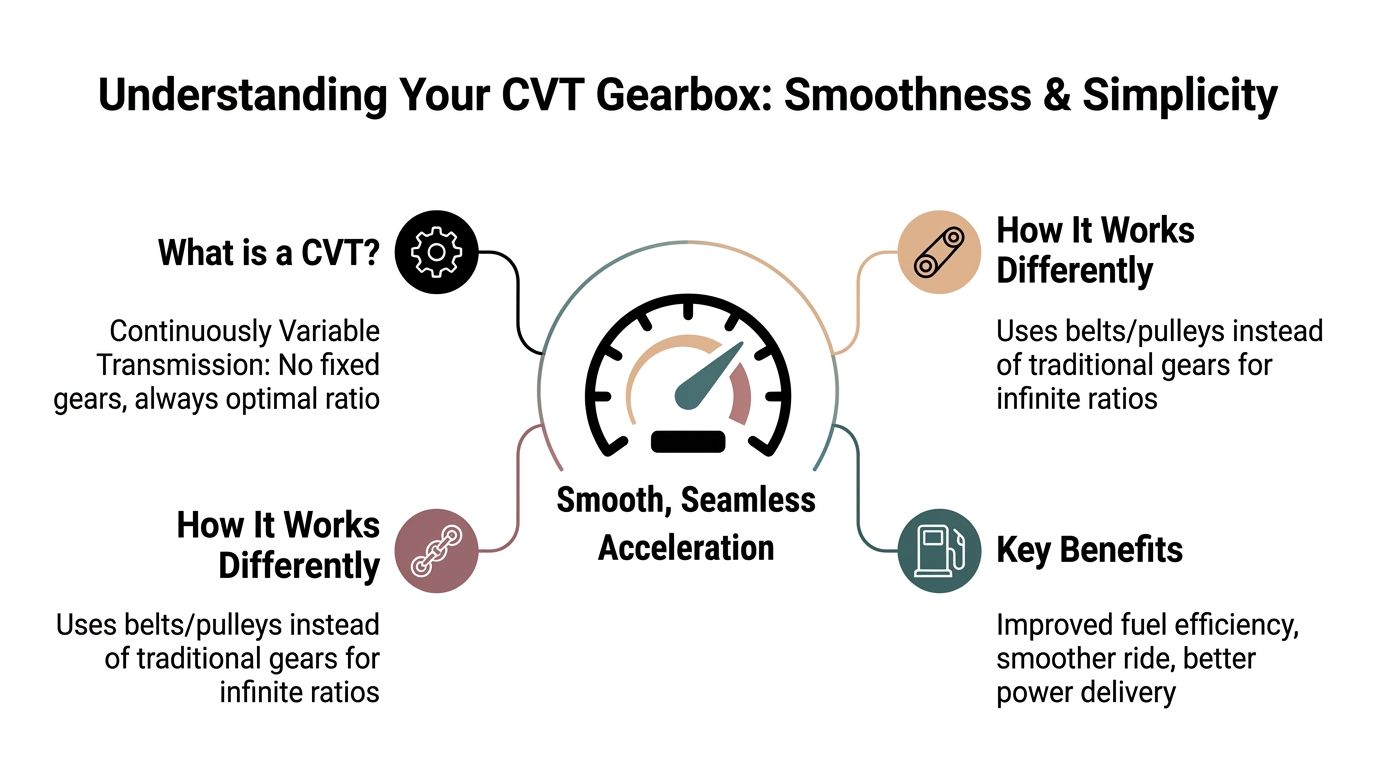
A Continuously Variable Transmission, or CVT, doesn't shift through a fixed set of gears the way a conventional automatic does. The easiest way to understand it is this: a traditional automatic is like a three-way bulb with a few set brightness levels. A CVT is like a dimmer switch. Instead of stepping from one gear to another, it can adjust continuously to the ratio the engine needs at that moment.
That's why a healthy CVT often feels unusually smooth. There's no obvious upshift, no pause, and less of that familiar stepped sensation people associate with older automatics.
How the mechanism actually works
The core layout is different from what most drivers picture when they hear “transmission.” According to Subaru's CVT technical overview, a CVT can achieve gear ratio transitions in as little as 5 milliseconds without reducing engine torque, and it uses a pair of variable-diameter, cone-shaped pulleys connected by a steel chain. That setup creates an effectively infinite range of ratios.
Think of two cones facing each other with a chain riding between them. As the pulleys change width, the chain rides higher or lower, which changes the drive ratio. It's elegant engineering. It's also demanding on fluid quality and internal precision.
If you've ever driven a vehicle where the engine holds a steady rev while the car keeps accelerating, that's the CVT doing its job. It's keeping the engine where it works best instead of chasing fixed shift points.
Why that difference matters for service
Because the CVT relies on precise hydraulic control, the fluid does more than lubricate. It helps manage pressure, heat, and pulley response. The transmission doesn't have much tolerance for the wrong fluid, contaminated fluid, or a poor level check.
Practical rule: Treat a CVT less like an old-school automatic and more like a hydraulic control system that happens to move your vehicle.
That's why a proper transmission repair service starts with understanding the design, not guessing based on habits from older gearboxes. What works on a conventional automatic doesn't always work on a CVT, and that's where many expensive mistakes start.
The Critical Importance of Regular CVT Maintenance
The same design that makes a CVT smooth also makes it unforgiving when maintenance is ignored.
A conventional gearbox can sometimes hide neglect for a while. A CVT usually can't. Its pulleys, chain or belt, valves, and fluid all depend on clean hydraulic control. Once the fluid breaks down, the transmission doesn't just get “a bit dirty.” It starts losing the precise behaviour it was built around.
The sealed-for-life myth
One of the most damaging ideas in modern transmission ownership is the phrase sealed for life. In practice, that wording has convinced many owners to leave the fluid untouched far too long.
A technician-focused video explanation notes that many manufacturers market CVTs as sealed for life, but that this can lead to transmission failure around 100,000 km if fluids aren't changed every 50,000 km (3 to 4 years), as explained in this discussion of sealed-for-life CVT claims.
That lines up with what mechanics see in the bay. The transmission may not leak. It may not trigger a fault right away. But the fluid still ages, carries debris, and loses the characteristics the unit depends on.
What neglect looks like inside a CVT
When old fluid stays in service too long, several things tend to happen:
- Heat builds faster because degraded fluid can't protect internal parts as well.
- Metal particles circulate and can contaminate narrow passages and sensitive control components.
- Pulley response becomes inconsistent, which shows up as hesitation, slipping, or odd engine behaviour.
- Wear accelerates until the vehicle develops a real drivability complaint, not just a maintenance reminder.
In plain terms, the fluid is the working medium. If it's worn out, the system loses accuracy.
Old CVT fluid doesn't retire quietly. It starts taking parts with it.
If you want a useful baseline on the service side of transmission care, this guide on how to check transmission fluid properly helps explain why condition and procedure matter so much. On many CVTs, guessing by sight alone or checking fluid cold can lead you the wrong way.
Why proactive service is cheaper than reactive repair
Drivers often delay service because the vehicle still moves and there's no warning light. That's the trap. A CVT can operate in a degraded state for a while, but every overheated trip and every contaminated cycle pushes the unit closer to a larger repair.
And once a CVT starts slipping because of wear, a fluid change may no longer solve the problem. Maintenance works best before symptoms become chronic. That's not upselling. That's the whole point.
Recommended Service Intervals and Fluid Types
If you ask ten drivers when to service a CVT, you'll hear ten different answers. That confusion comes from one big problem: manufacturer recommendations vary widely, and Ontario driving often falls closer to severe use than is commonly assumed.
The interval range that matters
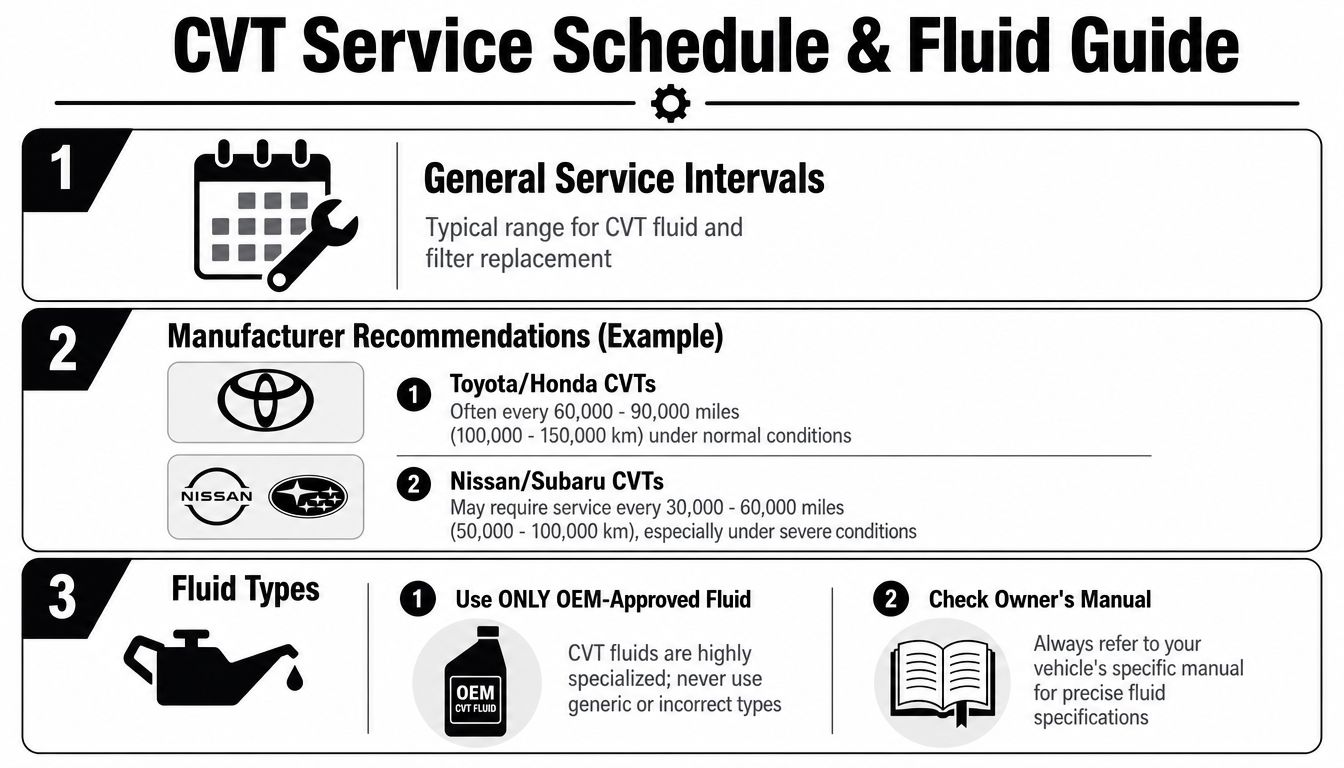
Most manufacturers recommend CVT service somewhere in the normal band of 30,000 to 60,000 miles, while Nissan may call for service as early as 25,000 miles. In Ontario stop-and-go traffic, some experts also advise inspecting the fluid every 15,000 miles, according to this Ontario-focused CVT service article.
That's the key trade-off. The longer interval may look attractive on paper, but urban commuting, short trips, and repeated heat cycling aren't paper conditions. They're real-world conditions.
A practical Ontario view
For a lot of drivers in Whitby, Durham Region, and the GTA, “normal driving” doesn't describe daily use very well. Frequent stops, traffic backups, cold starts in winter, and summer idling all load the transmission in ways that age fluid faster.
Here's a useful way to think about it:
| Driving pattern | Practical takeaway |
|---|---|
| Mostly short city trips | Treat the CVT as severe-service use |
| Heavy commuter traffic | Shorter intervals make more sense |
| Highway-heavy, steady driving | You may be closer to the longer end |
| Towing or repeated hard use | Don't stretch service timing |
If you're comparing service pricing while planning ahead, this breakdown of transmission fluid change cost considerations is a good place to start.
Fluid choice is not a place to improvise
The wrong fluid can create complaints that feel mechanical even when the original mistake was chemical. A CVT needs the exact fluid specification the unit was designed around. “Universal” sounds convenient. It's not a word I'd trust casually with a CVT.
Use these rules:
- Match the specification exactly. Brand and model matter.
- Don't mix fluids casually unless the service procedure specifically allows it.
- Don't rely on colour alone to identify fluid type.
- Don't assume all CVTs are alike. They aren't.
If a shop can't clearly tell you what fluid spec they're using, keep asking questions.
Common CVT Failure Symptoms and Diagnostics
Most CVTs don't fail out of nowhere. They usually start talking first. The problem is that they don't always talk in the old familiar language of hard shifts and obvious gear banging. Their warnings are subtler.
Symptoms drivers notice first
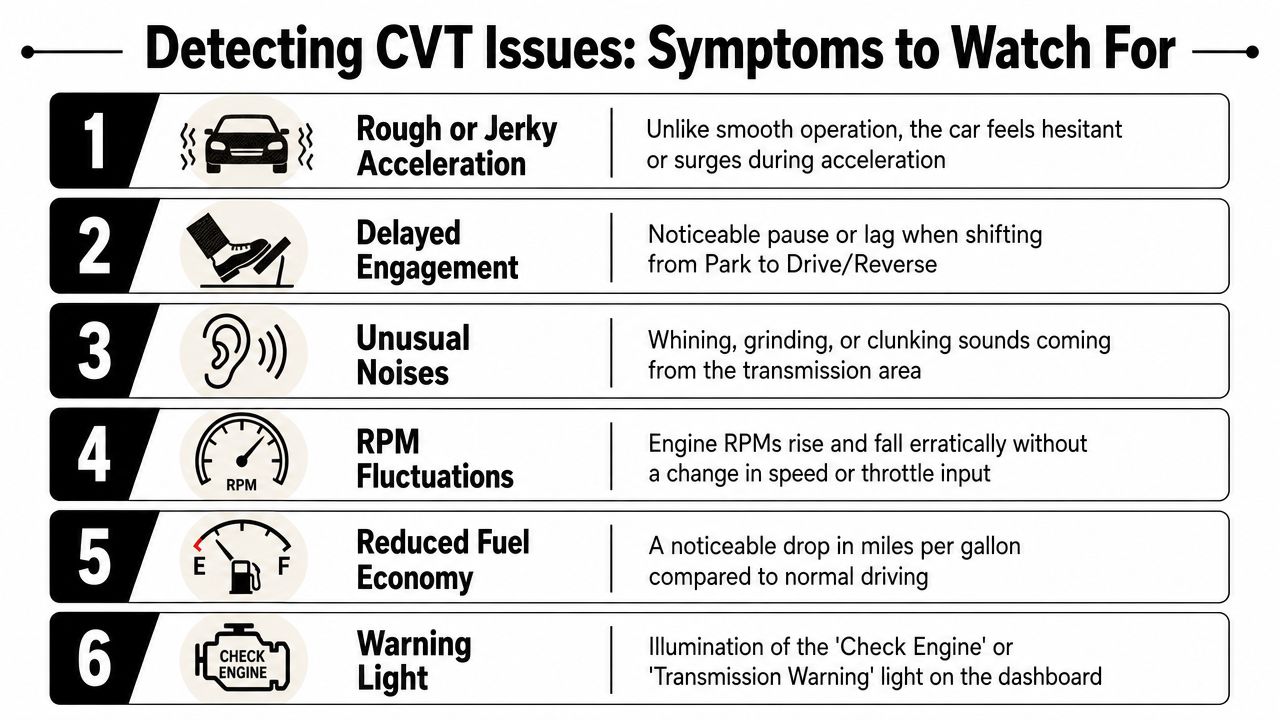
The most common early warning signs of fluid degradation include delayed engagement, unusual acceleration noises, burning smells, and fluid colour shifting from bright red to brown. Modern vehicles may also trigger temperature warnings or limp mode, as noted in this overview of CVT fluid degradation signs.
That shows up in everyday driving as things like:
- A pause selecting Drive or Reverse. You shift, wait, and then feel engagement.
- A rising engine note without clean response. The revs climb but the vehicle feels hesitant.
- A hot or burnt smell after traffic. That often points to overheated fluid.
- Dashboard warnings. If a CVT temperature alert appears, don't ignore it.
What those symptoms often mean
A delayed take-up often points toward fluid condition, pressure control issues, or wear that's affecting hydraulic response. Noise under acceleration can suggest belt or chain slip, pulley wear, or internal bearing trouble. A burning smell tells you heat is in the picture, and heat is never a minor detail on a CVT.
Some drivers describe the problem as “it feels weird, but I can't explain it.” That's fair. Healthy CVTs are so smooth that even a small loss of refinement stands out.
How a proper diagnostic process works
Good diagnosis starts with confirmation, not assumptions. A technician should want to know when the problem appears, whether it happens cold or hot, and whether the vehicle is setting any faults.
A solid workup usually includes:
- A road test to duplicate the complaint under the right conditions.
- A scan for transmission-related codes and live data.
- A fluid condition check for level, colour, and signs of contamination.
- A temperature-aware assessment if overheating is suspected.
If warning lights are involved, professional vehicle computer diagnostics matter because CVT faults can sit in modules and data streams the average DIY scan tool won't interpret well.
Don't keep driving a CVT in limp mode and hope it clears itself. The control system is trying to protect the transmission from further damage.
The CVT Service Process and Estimated Costs
A proper CVT gearbox service is more than opening a plug and pouring in fresh fluid. The exact procedure depends on the vehicle, but the principle is always the same: protect the transmission by servicing it in a controlled, accurate way.
What a typical service includes
For many vehicles, the starting point is a drain-and-fill. That removes a portion of the used fluid and replaces it with the correct specification fluid. On some models, technicians will also inspect or replace accessible filters or strainers if the design allows it.
Level setting matters just as much as the fluid itself. CVT fluid is temperature-sensitive, and some systems need the level checked at operating temperature. If it's filled incorrectly, the transmission may behave badly even with new fluid in it.
A technician may also inspect related items that affect CVT life, such as cooling system condition, leaks, and stored faults. In some cases, the vehicle may need a relearn or software-related procedure after service, depending on the manufacturer's process.
Drain-and-fill versus flush
For CVTs, I'm cautious about high-pressure approaches. A measured, correct-service drain-and-fill is often the safer path than trying to force a lot of movement through a sensitive unit. Owners hear “flush” and assume more is better. Sometimes more force is exactly what you don't want.
Here's the practical comparison:
| Service type | What it means in practice | Main consideration |
|---|---|---|
| Drain-and-fill | Removes part of the old fluid and replaces it carefully | Common and controlled |
| Flush-style service | More aggressive fluid exchange method | Not always the best fit for a CVT |
That doesn't mean every machine-assisted service is wrong. It means the procedure has to suit the transmission, not the other way around.
What it costs in Ontario
Ontario pricing can vary a lot depending on where you go. In this region, corporate dealers like Mississauga Subaru charge approximately $600 for a CVT drain and fill, while independent mechanics estimate a retail cost of $250 to $300 after taxes, according to this Ontario CVT service cost comparison.
That's a significant spread for the same basic category of service.
What you're paying for usually comes down to:
- Brand-specific fluid and procedure
- Shop labour rate
- Dealer overhead versus independent overhead
- Whether diagnostics or additional inspections are included
The cheapest invoice isn't always the best value. But a high dealer price doesn't automatically mean higher quality either. The real question is whether the shop understands CVTs, uses the correct fluid, and follows the correct temperature and level procedure.
Your Trusted CVT Service Partner in Whitby
Once you understand how a CVT works, the maintenance decision gets simpler. You want accurate diagnosis, the right fluid, the right procedure, and straight answers about cost.
That matters because CVT issues are easy to misread. One shop may call a problem normal. Another may jump too quickly to replacement. The best service partner sits in the middle: methodical, informed, and honest about what the transmission is telling them.
What to look for in a local shop
When choosing someone for CVT gearbox service in Whitby, I'd look for a few specific things:
- Clear fluid specification knowledge. They should know exactly what your vehicle requires.
- Temperature-correct level setting. That detail matters on CVTs.
- Diagnostic discipline. They shouldn't guess from a symptom alone.
- Transparent pricing. You should know what's included before work starts.
Why local expertise matters
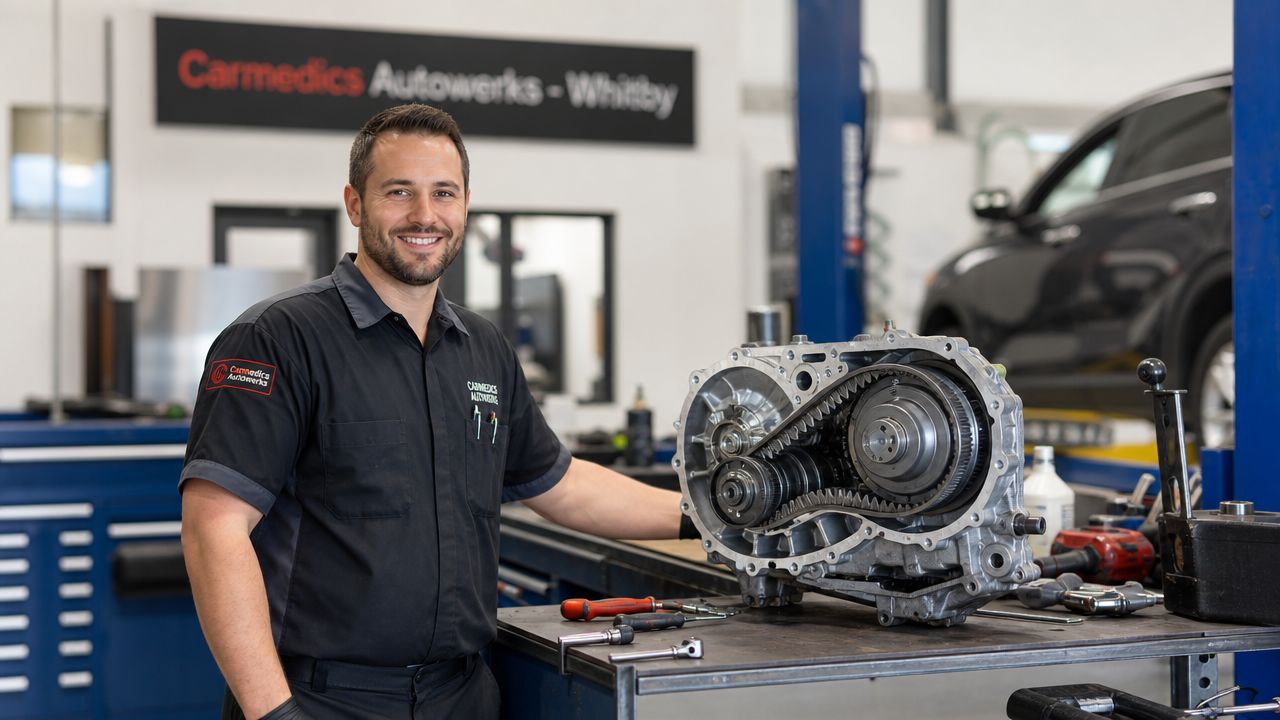
Ontario driving conditions are hard on fluids and cooling systems. A shop that regularly sees Whitby-area commuter vehicles understands what repeated stop-and-go use, winter starts, and mixed seasonal conditions do to transmissions. That local pattern recognition is useful. It helps separate textbook advice from practical maintenance timing.
If you want to learn more about the team and facility, visit Carmedics Autowerks in Whitby.
Good CVT service doesn't feel mysterious. A competent shop should be able to explain what they're doing, why they're doing it, and what they found.
CVT Gearbox Service Frequently Asked Questions
Is CVT service covered under warranty
Sometimes parts of the transmission may fall under extended coverage, but maintenance is still your responsibility. Subaru Canada offers a CVT Warranty Enhancement Program covering vehicles up to 160,000 km, and owners are often confused about what that changes. The same Subaru Canada material also notes that manuals can be unclear, while Honda recommends fluid changes every 80,000 to 160,000 km and Nissan advises about 40,000 km, as outlined in Subaru Canada's CVT warranty information.
The practical takeaway is simple. Warranty coverage doesn't replace maintenance. If the vehicle needs fluid service, skipping it because you assume warranty will handle everything is a poor bet.
Can I do a CVT service myself
Some owners can handle basic maintenance well, but CVT service has more risk than people expect. Fluid level can be temperature-sensitive. The wrong fluid can cause problems. Some models need a specific procedure for level confirmation, and scan tools may be needed when faults or temperature readings are involved.
DIY makes more sense when you already know the exact factory method for your vehicle and have the tools to follow it properly. If you don't, the cost of one mistake can wipe out any savings.
What's the difference between a drain-and-fill and a flush
A drain-and-fill removes some used fluid and replaces it. It's the more conservative service path and is commonly preferred for CVTs. A flush-style service aims to exchange more fluid, but the method matters. On a sensitive transmission, aggressive servicing can create its own problems if it isn't manufacturer-appropriate.
If you're unsure, ask the shop to explain the procedure in plain language. If they can't explain it clearly, I wouldn't hand them the keys.
What warning signs mean I should stop delaying service
Don't wait if you notice delayed engagement, unusual acceleration behaviour, hot smells in traffic, temperature warnings, or limp mode. Those aren't “watch it for a few months” symptoms. They're signs that the transmission needs attention before the problem becomes more expensive.
Is dealer service always better for a CVT
Not automatically. A dealer may have model-specific familiarity, but an experienced independent shop can often provide the same category of service with more personal communication and lower overhead. The important part isn't the sign on the building. It's the procedure, the fluid, and the technician's understanding of the unit.
If your vehicle is due for CVT gearbox service, or it's already showing hesitation, noise, or warning lights, Carmedics Autowerks Inc in Whitby can help you make sense of it. The team handles modern vehicle repair with a practical, no-nonsense approach, whether you need diagnostics, maintenance, or a second opinion before committing to major transmission work.
That small hesitation when your vehicle shifts is usually how this starts. You pull away from a light in Whitby, the revs climb a bit higher than normal, then the next gear lands with a soft thud. Maybe it only happens when the car is cold. Maybe it's a faint shudder backing out of the driveway. Most drivers notice it, then hope it goes away.
Sometimes it does. Often, it doesn't.
A transmission rarely fails out of nowhere. More often, it gives warnings through the way it shifts, sounds, and responds. In the shop, one of the most common patterns I see is simple: the vehicle kept driving, but the fluid service got pushed down the list until the transmission started complaining. By then, what could've been routine maintenance turns into diagnosis, drivability problems, and a much bigger bill.
Transmission fluid service matters because the transmission is one of the most expensive and least forgiving systems in your vehicle. The fluid inside it isn't just there to “top up” a level. It carries heat, creates hydraulic pressure, lubricates moving parts, and helps the unit shift properly. Once that fluid degrades, the whole system has to work harder.
If you like keeping good records on your vehicle, a vehicle maintenance log helps you spot when a service is due before symptoms show up.
Your Transmission Service Guide Introduction
A lot of owners come in with the same description. “It's not terrible, but it doesn't feel as smooth as it used to.” That's usually the right instinct. You don't need smoke, a warning light, or a complete loss of drive to justify looking into transmission fluid service.
Why this service gets misunderstood
Part of the confusion comes from the language around it. One shop says change. Another says flush. A dealer says the fluid is lifetime. A friend says never touch it. None of that helps when your car is the one shifting poorly in traffic.
The practical way to think about it is this. Transmission fluid service is preventative maintenance first, and problem prevention second. If the fluid is still doing its job, servicing it helps protect the transmission. If the fluid has already broken down, the service decision gets more nuanced.
Practical rule: Don't wait for obvious failure symptoms before thinking about transmission fluid. By the time the transmission is making its distress obvious, your options are usually narrower.
What you should expect from a good guide
You should be able to answer a few basic questions without needing a trade background:
- What does the fluid do inside the transmission?
- What warning signs matter and which ones need attention soon?
- What's the difference between a drain and fill and a flush?
- What should it cost in Ontario, and when should it be done?
- How do you judge the advice you're getting from a shop or dealer?
That's the gap this guide is meant to close. Not generic internet advice. Real-world guidance that helps you make a sensible decision before a minor shift quality issue becomes a transmission repair.
What Transmission Fluid Does For Your Vehicle
The term "fluid" often brings lubrication to mind. That's only part of the job. Transmission fluid is the working fluid of the whole unit. If engine oil is there to protect the engine, transmission fluid has to protect, cool, clean, and operate the transmission at the same time.
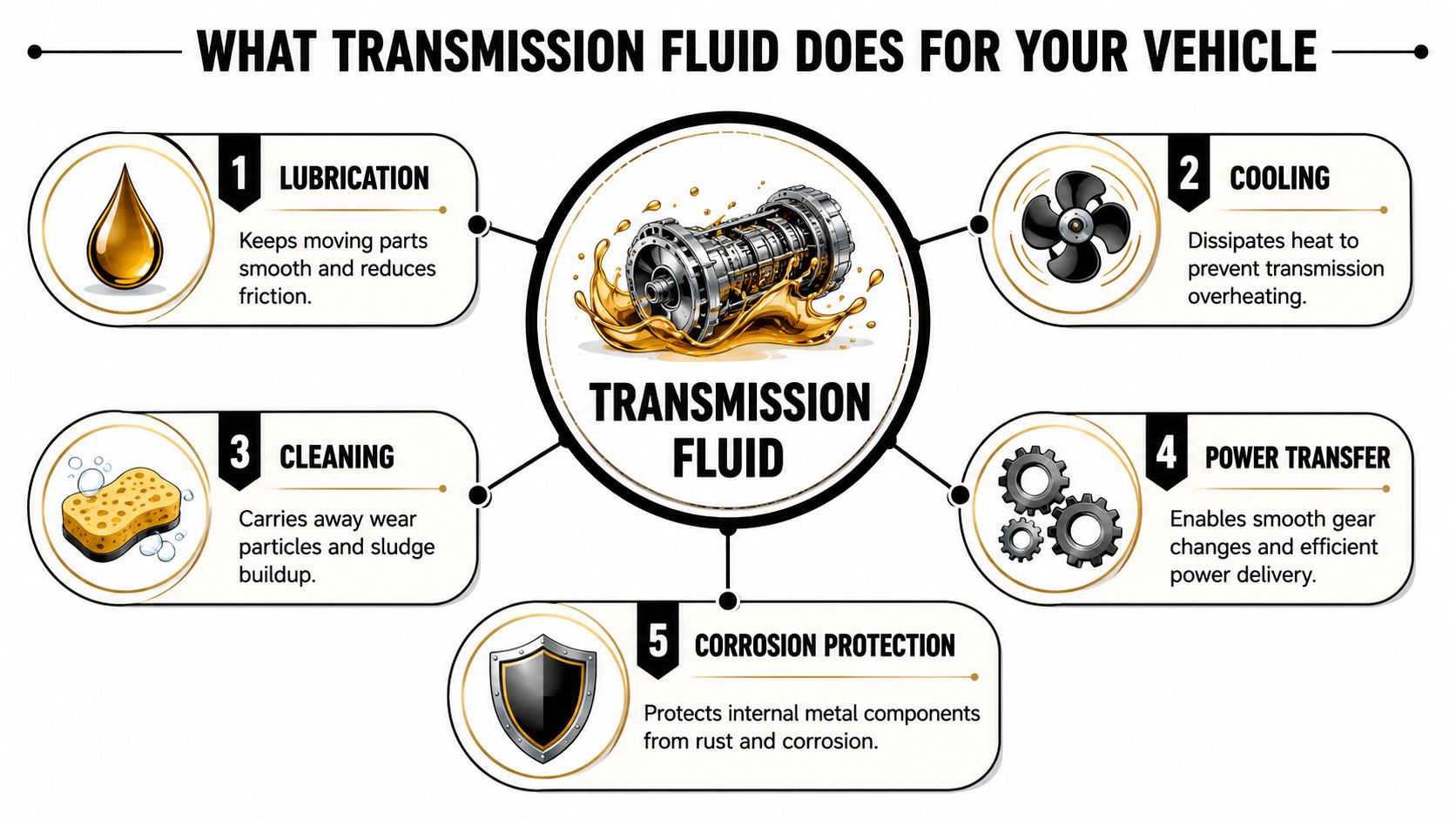
If you want a step-by-step walkthrough, Carmedics has a guide on how to check transmission fluid.
It lubricates moving parts
Inside the transmission, metal components are constantly meshing, rotating, and applying load. The fluid creates a protective film between those parts so they don't grind against each other. When that protection weakens, friction rises and wear starts accelerating.
Consider a skating rink. With a smooth surface, everything glides. Once the surface gets rough, every movement takes more effort and creates more damage.
It carries heat away
Heat is one of the biggest enemies of any automatic transmission. Every shift, every stop-and-go commute, every hill, and every towing load creates thermal stress. The fluid absorbs and moves that heat so the transmission doesn't cook itself from the inside.
When the fluid ages, it doesn't manage heat as well. That's when a vehicle that used to shift cleanly starts feeling lazy, harsh, or inconsistent.
It helps keep the internals clean
Good transmission fluid also suspends fine wear material and contamination so it can be managed during service. It isn't magic. It can't make debris disappear. But it does help prevent that material from immediately settling where it can interfere with valves, passages, and clutch operation.
Old transmission fluid doesn't usually fail all at once. It loses its ability to protect in layers. First the shifts feel different. Then the heat rises. Then the wear shows up faster.
It creates hydraulic force
This is the part many drivers don't realise. In an automatic transmission, the fluid doesn't just sit there. It's used to generate the hydraulic pressure that applies clutches and controls gear changes. If the fluid condition is poor, the shift quality often suffers because the system can't respond as precisely as it should.
Why the correct fluid matters
Not all transmission fluids are interchangeable. Viscosity, additive package, and friction characteristics matter. Using the wrong fluid can create shift problems even if the transmission itself is mechanically sound.
That's why a proper transmission fluid service isn't just “drain whatever's in there and pour in something red.” The spec matters.
Warning Signs Your Transmission Needs Attention
Most transmission complaints start as behaviour changes, not dramatic failures. The vehicle still drives, but it no longer feels consistent. That's the point where paying attention can save you from a much bigger repair.
If your vehicle has developed symptoms and you need deeper diagnosis, this page on transmission repair gives a useful overview of what gets inspected.
What drivers usually notice first
Here are the signs that should move transmission fluid service or diagnosis higher on your list:
- Delayed engagement: You shift into Drive or Reverse and the transmission takes a moment to respond.
- Rough or abrupt shifting: Gear changes feel harder than normal, especially under light throttle.
- Slipping sensation: Engine speed rises, but the vehicle doesn't accelerate the way it should.
- Shuddering during shifts: Instead of a clean gear change, you feel a vibration or chatter.
- Unusual noise: Whining, humming, or grinding that seems tied to shifting or vehicle speed.
- Fluid leaks: Red or reddish-brown fluid under the vehicle deserves attention.
- Warning lights: A check engine light or transmission-related warning shouldn't be ignored.
What those symptoms can mean
A delayed shift doesn't automatically mean a failed transmission. It can point to fluid that has lost some of its hydraulic effectiveness, internal wear, a valve body issue, or low fluid level. The symptom matters, but so does the pattern. Cold only, hot only, uphill only, or all the time. Those details help narrow it down.
Rough shifts can also be deceptive. Some owners assume a hard shift means the transmission is “strong.” It usually means the shift event isn't being controlled the way it should be. That can come from fluid condition, adaptation issues, internal wear, or the wrong fluid having been used previously.
When to stop guessing
Use this quick decision table as a practical guide:
| Symptom | What to do |
|---|---|
| Mild hesitation with no warning light | Book an inspection soon |
| Repeated slipping or shuddering | Stop delaying service |
| Leak under the vehicle | Check it promptly |
| Grinding, severe harshness, or no engagement | Don't keep driving it |
The worst approach is guessing from one symptom and approving the wrong service. A neglected transmission with internal damage won't be “fixed” by fresh fluid alone.
The reason these signs matter is simple. A transmission can tolerate old fluid for a while. It can't tolerate old fluid, rising heat, contamination, and slipping at the same time for very long.
Drain and Fill vs Transmission Flush
This is the question that confuses more owners than almost anything else. Both services involve replacing old fluid with new fluid, but they are not the same process, and they are not right for the same vehicle in every situation.
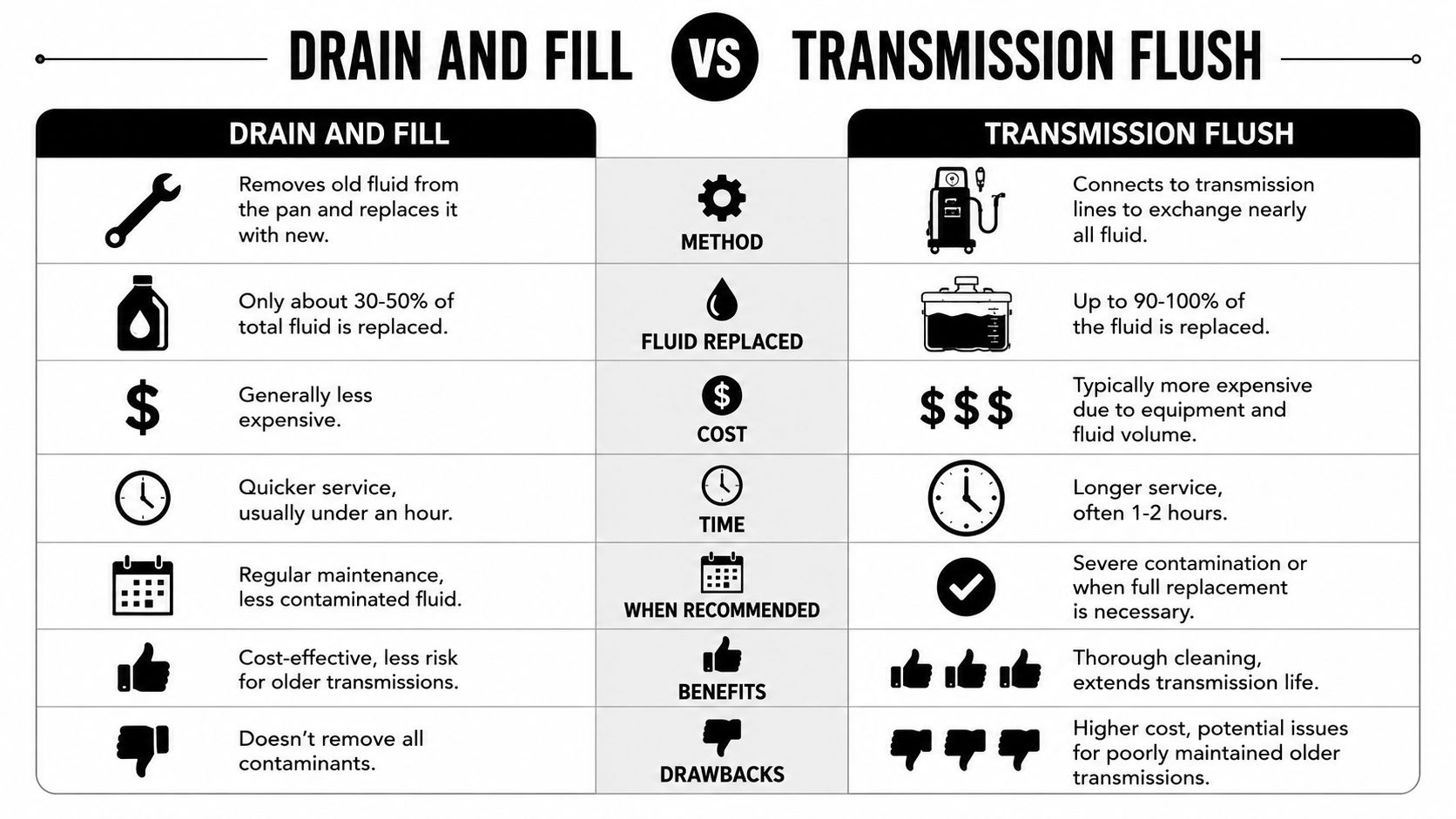
If you want a pricing breakdown before booking, this guide on how much a transmission fluid change costs is a helpful reference.
What a drain and fill does
A drain and fill removes fluid from the pan and replaces that portion with fresh fluid. According to the cited comparison, a change replaces about 50% of the fluid, while a flush replaces 85 to 90% by cleaning the entire system, including areas a simple drain won't reach, as outlined in this change versus flush explanation.
That makes a drain and fill the more conservative service. It refreshes the fluid without forcing a near-complete exchange through the whole system.
A good analogy is replacing part of the water in a bathtub instead of emptying and scrubbing the whole thing. The water gets cleaner, but some old water stays behind.
What a transmission flush does
A transmission flush exchanges far more of the old fluid through the transmission and cooler circuit. That gives you a much more complete fluid replacement, which can be useful when the goal is to remove as much aged fluid as possible.
The benefit is obvious. More old fluid out, more new fluid in. The trade-off is that a neglected transmission with existing wear or debris problems may not respond well just because the service is more aggressive.
Which one makes sense
The right choice depends less on internet opinions and more on the vehicle in front of you.
A drain and fill often makes more sense when:
- Service history is unclear
- The transmission is older and still operating acceptably
- You want routine maintenance without being overly aggressive
A flush can make sense when:
- The service history is known and consistent
- You want a more complete fluid exchange
- The transmission is a good candidate based on inspection and behaviour
Some experts prefer changes over flushes on neglected transmissions because a cautious approach can be safer than trying to force a full exchange on a unit with unknown internal condition.
What doesn't work
What doesn't work is treating every transmission the same. A flush isn't automatically harmful. A drain and fill isn't automatically enough. The wrong service recommendation usually comes from skipping diagnosis and jumping straight to the menu option.
The better question isn't “Which service is best?” It's “Which service fits this transmission's condition, history, and symptoms?”
Service Intervals and Costs in Ontario
A transmission service schedule only makes sense once you factor in how the vehicle is used in Whitby and across Durham Region. A car that spends its life on Highway 401 has a different workload than one that does school runs, winter short trips, and stop-and-go commuting every day. Towing, delivery use, and repeated cold starts also shorten the useful life of the fluid.
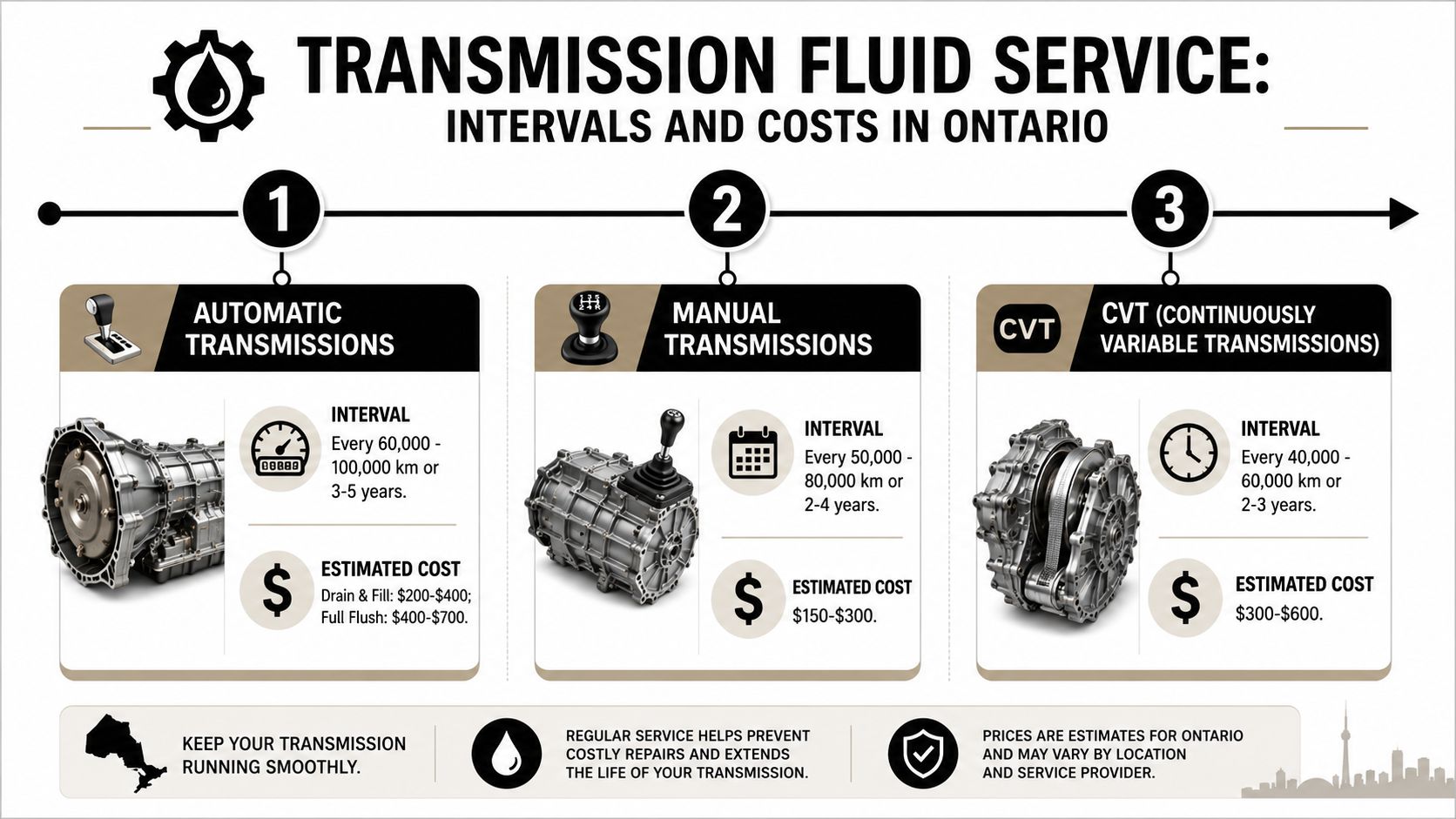
A practical interval Ontario drivers can use
For many vehicles, a reasonable starting point is to check the manufacturer schedule and then adjust for real use. Industry guidance from this Ontario flush versus exchange resource notes that automatic transmission service often falls in the 50,000 to 100,000 km range, depending on the vehicle and service type.
That range lines up with what we see in the shop. Vehicles driven hard, driven in traffic, or kept for the long term usually benefit from earlier service than vehicles with light highway use and a clean maintenance history.
“Lifetime fluid” causes a lot of confusion. In practice, it usually means the manufacturer has stretched the maintenance message around the expected ownership period, not that the fluid stays healthy forever. Heat, clutch material, moisture, and shear still wear the fluid out. Transmission fluid works like the hydraulic lifeblood of the unit. Once it degrades, the transmission has to work harder with less protection.
Drivers planning to keep a vehicle well past warranty should treat fluid service as cheap insurance. That is especially true for late-model automatics and CVTs, where a fluid mistake or a missed interval can turn into a very expensive repair.
A similar maintenance mindset shows up in industrial equipment. Shops often use condition-based hydraulic oil analysis to judge fluid health instead of trusting a label, and the same logic applies to vehicle fluids.
What transmission fluid service costs in Ontario
Cost depends on the transmission design, the amount of fluid required, whether the filter is serviceable, and whether the job is a basic drain and fill or a full exchange. Consumer pricing guidance from Auto Service Costs shows the same pattern drivers see in Ontario. A simple fluid change sits at the lower end, while services involving more fluid, more labour, or a filter replacement cost more.
Here is the practical range most drivers should expect:
| Service type | Typical cost |
|---|---|
| Basic fluid change | $100 to $200 |
| Fluid and filter change | $250 to $400 |
| Transmission flush | $300 to over $500 |
Those numbers are only part of the story.
A quote can rise quickly if the transmission needs a specific OEM-spec fluid, if access is poor, or if the pan, gasket, or filter adds labour and parts cost. CVTs are a common example. The service may look simple on paper, but the fluid spec and fill procedure leave very little room for shortcuts.
That is why the cheapest quote is not always the lowest-cost decision. If the wrong fluid goes in, or if a shop skips the inspection that should come before the service, the savings disappear fast. A careful estimate from a local transmission service shop in Whitby, such as Carmedics Autowerks in Whitby, should explain what service is being recommended, what fluid is being used, and whether related items like leaks or a filter are part of the price.
The Carmedics Autowerks Advantage in Whitby
A transmission service can go wrong before the pan is even opened. A Whitby driver comes in with delayed shifting, asks for a flush because a quick search suggested it, and the issue turns out to be low fluid from a leak or wear that needs diagnosis first. The value of a good shop is judgment.
At Carmedics Autowerks in Whitby, that starts with identifying what the transmission is doing now, how it has been maintained, and whether a fluid service makes sense at all. That matters even more with newer vehicles sold with "lifetime fluid" messaging, because that label often creates false confidence and delays the inspection the unit needs.
A careful shop should evaluate a few things before recommending any service:
- Current symptoms: Routine maintenance and a shifting complaint are two different jobs.
- Service history: Regular maintenance supports a different recommendation than unknown history.
- Transmission type: Conventional automatics, CVTs, and dual-clutch units each have their own fluid requirements and procedures.
- Fluid condition: Burnt smell, discoloration, debris, and incorrect level all change the decision.
- Leak status: Fresh fluid does not solve an active leak.
Experience is highly beneficial. Some transmissions respond well to a standard drain and fill. Others need a filter service, a precise temperature-based level set, or no fluid exchange until the root cause of the complaint is confirmed. If a shop skips that step and sells the same service to every customer, the result can be wasted money and the same drivability problem on the trip home.
Fluid choice matters just as much as the service itself. Modern transmissions are calibrated around specific friction properties, and using a universal fluid where an OEM-spec product is required can create shift flare, harsh engagement, or long-term wear. CVTs are especially unforgiving.
Cost should be explained in plain language. A basic service is one price. A service that includes a filter, pan removal, gasket replacement, extra labour, or model-specific fluid will cost more, as noted earlier in the guide. What Whitby drivers need from a quote is clarity. What fluid is going in, what parts are being replaced, and whether the shop is servicing a healthy transmission or diagnosing a problem first.
If the recommendation is a flush, the shop should explain why. If the recommendation is no fluid service yet, the shop should explain that too.
Frequently Asked Questions About Transmission Care
Is CVT service different from regular automatic transmission service
Yes. A CVT is not just a regular automatic with different branding. It relies heavily on the exact fluid specified for that unit, and it tends to be less tolerant of the wrong product or vague service practices. If your vehicle has a CVT, the fluid choice and procedure matter even more than usual.
My owner's manual says lifetime fluid. Should I leave it alone
Not blindly. The lifetime-fluid claim causes a lot of confusion. Data referenced by Cars.com says fluid still degrades over time, and even vehicles marketed this way benefit from a fluid check and change around 100,000 miles to help prevent premature failure, as noted in this Cars.com article on changing transmission fluid.
Can I change transmission fluid myself
Sometimes, yes. Whether you should depends on the vehicle and your experience. Some vehicles are straightforward enough for a careful DIY drain and fill. Others have no dipstick, require temperature-based level setting, or need a very specific fill procedure. The biggest DIY mistakes are using the wrong fluid, overfilling, underfilling, or assuming the process is as simple as an oil change.
If the transmission is already shifting badly, will new fluid fix it
Maybe, but don't count on fluid as a cure-all. If the issue is mostly degraded fluid and the transmission is otherwise healthy, service can improve shift quality. If the transmission has internal wear, clutch damage, valve body problems, or electronic faults, fluid service may help very little or not at all.
Is a flush dangerous
Not by definition. The risk is applying the wrong service to a neglected transmission with an unknown history. A flush on a well-maintained transmission is a very different decision from a flush on a unit that's already slipping, contaminated, or overdue by a long margin.
What's the smartest approach for most owners
Keep records, service the transmission before symptoms become severe, and don't let marketing terms replace actual maintenance judgement. If the vehicle is shifting differently, get it assessed early while you still have options.
If your vehicle is hesitating, shifting hard, or you want a sensible transmission fluid service plan before problems start, book an inspection with Carmedics Autowerks Inc. A clear diagnosis, the right fluid, and the right service choice can save you from chasing symptoms later.
Rotate your tires every 10,000 km or every six months as a solid starting point. That baseline works for most vehicles in Canada, but the right tire rotation schedule changes with your drivetrain, how you drive, and how quickly your tires are wearing.
A lot of drivers start thinking about rotation only when something feels slightly off. Maybe the steering wheel has picked up a faint vibration. Maybe the car doesn't feel as planted in a fast on-ramp as it did a few months ago. Or maybe you've bought a newer vehicle and you're trying to avoid the expensive habit of replacing tires sooner than necessary.
That's the right instinct.
Tires are one of the few parts on your vehicle that affect handling, braking feel, road noise, ride quality, and replacement cost all at once. Ignore them and the car slowly stops feeling right. Stay ahead of them and the vehicle keeps the balanced, predictable feel you paid for in the first place.
A proper tire rotation schedule isn't just a maintenance box to tick. It's a way to protect the investment sitting in your driveway. It helps spread wear more evenly across all four corners, which gives you more usable life from the set and helps preserve the way the vehicle turns, tracks, and puts power down.
If you're not sure when your last rotation happened, keeping a simple vehicle maintenance log makes this easy. The drivers who stay organised usually catch tire issues before those issues become expensive.
Your Introduction to Smart Tire Maintenance
The basic rule is simple. Most vehicles in Canada should follow a tire rotation schedule of every 10,000 km, and many drivers also use the six-month mark so it doesn't get forgotten.
That sounds straightforward, but real-world driving is never one-size-fits-all. A front-wheel-drive commuter car used for stop-and-go errands in Whitby won't wear tires the same way as an all-wheel-drive SUV that sees highway runs, winter slush, and cottage trips. A performance coupe driven hard out of corners won't treat its tires like a family sedan either.
What tire rotation is actually doing
Rotation means moving the tires to different positions on the vehicle so one pair doesn't carry the same workload all the time. Tires don't wear evenly on their own. Steering, braking, acceleration, road crown, alignment condition, and load all change how each corner of the car uses tread.
If you leave each tire in one position too long, you usually end up with two problems:
- One axle wears out first, which pushes you toward replacing tires sooner than expected.
- The vehicle feels less consistent, especially during cornering, wet braking, and higher-speed lane changes.
Why this matters financially
A lot of owners think of rotation as a small service and tire replacement as a separate problem. They're connected.
When one pair wears much faster than the others, you lose usable tread you've already paid for. In the shop, that usually shows up as a customer saying, “These two are done, but the other two still look fine.” That's exactly the kind of uneven wear pattern a disciplined schedule is meant to prevent.
A good tire rotation schedule protects two things at once. The lifespan of the tire set and the way the car feels from behind the wheel.
There's also the safety side. As tread wears unevenly, traction becomes less predictable. You may not notice it in dry weather at city speeds, but you'll notice it when the pavement is soaked, the road is cold, or you need the car to respond quickly.
Why a Tire Rotation Schedule Is Non-Negotiable
Think about a pair of sneakers. If you always lean harder on one heel, that shoe wears out in a pattern the other one doesn't. Tires do the same thing, just with more weight, more heat, and far higher consequences when wear gets ignored.

Michelin Canada recommends rotating tires every 8,000 to 12,000 kilometres or every other oil change for vehicles in Ontario, which is aimed at even tread wear and longer tire life under normal driving conditions, while still putting the vehicle maker's own schedule first for the final call (Michelin Canada tire rotation guidance).
The money side of uneven wear
Tire wear never stays “just a little uneven” for long. Once a pattern starts, it usually becomes more obvious with every month of driving.
Here's what that costs you in practice:
- Shorter useful life from the set: If one axle does most of the work for too long, that pair can force an early replacement decision.
- Less value from premium tires: Better tires only pay off if you use their tread evenly across the full set.
- More avoidable add-on work: Uneven wear often leads drivers to chase vibrations or noise that could have been caught earlier during routine service.
The performance side drivers feel first
Drivers who pay attention to their cars usually notice performance loss before they notice visible tread problems. The vehicle may still be safe to drive, but it no longer feels balanced.
Common signs include:
- Turn-in feels duller: The car doesn't respond as cleanly when you first steer into a corner.
- Braking feel changes: Grip can feel less even, especially on wet roads.
- Road noise grows: Irregular tread patterns often make themselves heard before they become obvious to the eye.
Practical rule: Tire rotation isn't an upsell. It's basic preventive maintenance, just like fluid service or alignment checks, because it helps stop a small wear pattern from turning into an expensive tire problem.
If you already treat maintenance as investment protection, this fits the same mindset as regular preventive maintenance for vehicles. The work is simple. The value comes from doing it before the tires tell you they've been neglected.
Your Vehicles Ideal Rotation Pattern and Frequency
The right tire rotation schedule depends first on how the vehicle puts power to the ground. Drivetrain matters because each layout asks different tires to handle different jobs. Some tires steer, some carry more drive force, some do both, and those jobs shape the wear pattern.
This is the part many owners skip. They know rotation matters, but they don't realise that how the tires are moved matters too.
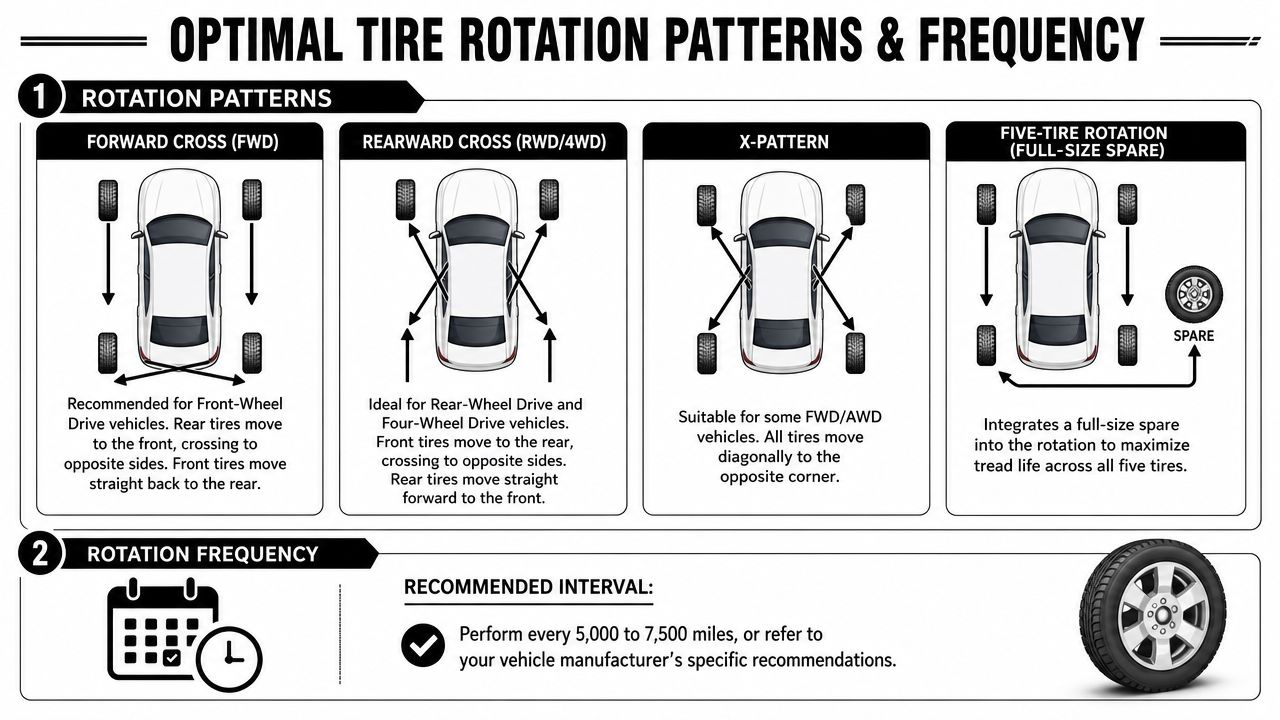
According to Hankook's Canadian tire guide, the standard schedule for most vehicles in Canada is every 10,000 kilometres, and that interval is especially important for front-wheel-drive vehicles because they make up over 60% of passenger cars in Ontario and their front tires wear 30% faster than the rears (Hankook Tire Canada service guide).
Front-wheel drive
On a front-wheel-drive car, the front tires do a heavy share of the work. They steer, they handle much of the braking load, and they put power down. That's why the front pair usually wears faster.
A common pattern is the forward cross:
- Rear tires move to the front, crossing to the opposite sides.
- Front tires move straight back to the rear.
This pattern helps spread the more aggressive front-axle wear across the whole set. If you own a compact sedan, hatchback, or many crossovers, this is often the setup you're dealing with.
Rear-wheel drive and four-wheel drive
Rear-wheel-drive and traditional four-wheel-drive vehicles wear differently because the rear axle handles the drive load more directly. Steering is still up front, but acceleration loads the rear tires harder.
A common pattern here is the rearward cross:
- Front tires move to the rear, crossing to the opposite sides.
- Rear tires move straight forward to the front.
This works well for many trucks, performance cars, and body-on-frame SUVs.
All-wheel drive needs more attention
All-wheel-drive vehicles can be less forgiving about tire maintenance because all four tires are part of a more complex drivetrain relationship. If wear gets uneven corner to corner, you can end up with more than just handling changes.
For owners swapping between winter and summer setups, a scheduled seasonal tire change is a smart time to review tread wear and confirm whether your current pattern still makes sense.
If you don't know your ideal pattern, check the owner's manual before moving anything. Manufacturer guidance beats generic advice every time, especially on newer vehicles with sensitive AWD systems.
Two exceptions that change everything
Not every vehicle can use the common cross-pattern approaches.
| Vehicle setup | What changes |
|---|---|
| Directional tires | These are designed to roll in one direction only, so they're typically moved front to back on the same side. |
| Staggered fitment | If the front and rear tires are different sizes, you usually can't rotate front to rear at all. |
That matters for performance-oriented cars in particular. Owners often assume they're following a proper tire rotation schedule when, in reality, the tire design limits what can be done. In those cases, your best protection is regular inspection, proper inflation, alignment checks, and replacing tires before one end of the vehicle falls too far behind the other.
Factors That Change Your Standard Rotation Schedule
A 10,000 km interval is a strong starting point. It isn't a law of physics.
Real driving changes the schedule. Some vehicles can stay comfortably near the standard interval. Others need attention sooner because of how they're built or how they're driven.
Driving style changes tire wear fast
Bridgestone advises shorter intervals of 3,000 to 5,000 miles (4,800 to 8,000 km) for high-torque vehicles such as electric SUVs and performance coupes because hard acceleration and cornering create uneven wear more quickly (Bridgestone tire rotation guidance).
That lines up with what performance-minded owners already feel in the seat. A car driven aggressively usually starts to lose its clean, even contact patch sooner. The tread blocks get worked harder. The tires heat cycle more. The result isn't just faster wear. The steering can feel less crisp and the chassis less settled.
City driving and rough conditions matter
Short trips, parking-lot steering, stop-and-go traffic, potholes, and winter road surfaces all add stress. A highway commuter may rack up kilometres steadily with relatively smooth wear. A city-driven vehicle can cover fewer kilometres while still punishing the front tires and shoulders.
That's why two vehicles with the same odometer reading can need completely different service timing.
A shorter schedule often makes sense if your driving looks like this:
- Frequent short trips: The car rarely sees long, steady highway runs.
- Urban turning and braking: Tight corners, constant stops, and repeated low-speed steering load the front tires hard.
- Heavy loads or towing: Extra weight changes how the tires carry and distribute force.
- Rough seasonal roads: Potholes and winter damage can worsen wear patterns quickly.
Mechanical condition can override mileage
Sometimes the issue isn't the schedule. It's the car.
If alignment is off, or if wheel balance or suspension condition has changed, a normal interval may not be enough to keep the wear pattern under control. Rotation helps distribute wear, but it can't correct the root cause. A tire that's already feathering or cupping needs diagnosis, not just a new position on the vehicle.
If the steering feels off-centre, the car drifts, or you've picked up a vibration, it makes sense to pair tire service with a check of wheel alignment and balancing.
Mileage is only one trigger. If the car is talking to you through vibration, pull, or visible shoulder wear, listen to that before you listen to the odometer.
Spotting Uneven Wear and When to Call a Professional
You don't need a hoist to catch tire problems early. A careful walk-around tells you a lot if you know what to look for.
Start with the obvious. Turn the steering wheel to expose more tread on the front tires. Look across the full width of the tread, not just the outer edge. Then run your palm gently across the surface. Uneven texture often shows up before it looks dramatic.
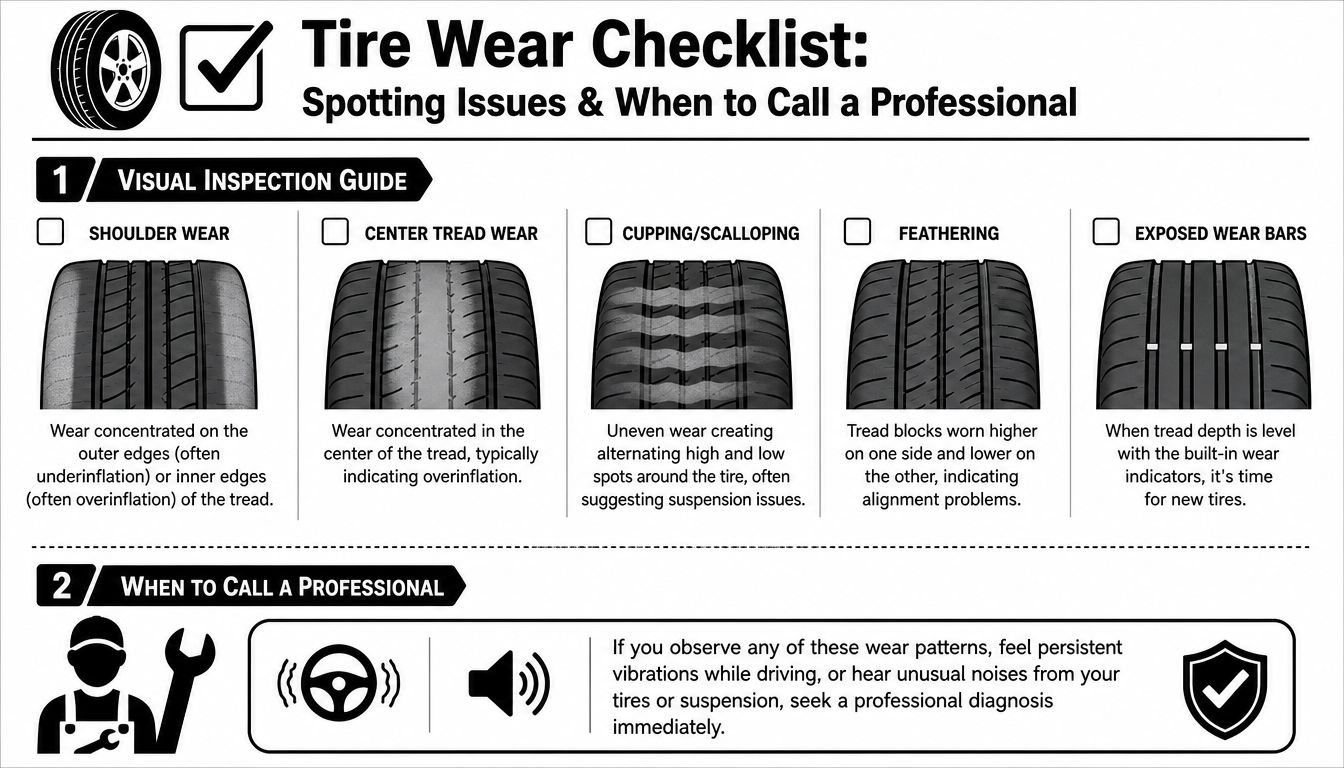
Consumer Reports notes that proper tire rotation helps maintain at least 90% of original tire tread depth for longer, which reduces hydroplaning risk by 35% in wet conditions (Consumer Reports tire maintenance and safety guide).
Wear patterns worth catching early
Here's a quick way to read what your tires may be telling you:
- Shoulder wear: Excess wear on the inner or outer edge can point to inflation or alignment issues.
- Centre wear: The middle of the tread wearing faster often suggests inflation isn't where it should be.
- Cupping or scalloping: A patchy high-low pattern often points toward suspension or balance problems.
- Feathering: Tread blocks feel sharp one way and smoother the other. That usually suggests alignment trouble.
When DIY inspection stops being enough
You can inspect. You can track wear. You can even spot the early signs of trouble. But proper service still matters because tire work is more than swapping corners.
A professional rotation should include:
- Correct torque on the wheel fasteners: That matters for brake rotor health and wheel security.
- Balancing when needed: If the car has a vibration complaint, moving the tires without addressing balance can leave the actual problem in place.
- An experienced eye on the full system: Tires often reveal problems in alignment, suspension, or steering before those faults are obvious elsewhere.
For Whitby drivers, Carmedics Autowerks' tire repair service is one local option for rotation, inspection, and diagnosing the wear patterns that a simple driveway check can't fully confirm.
Uneven tire wear is rarely random. The pattern usually points to a cause, and catching that cause early is what saves the tire.
Common Questions About Tire Rotation and Maintenance
Some tire questions come up in almost every shop conversation. Here are the straight answers.

Should brand new tires be rotated
Yes. New tires start wearing from day one. Rotation isn't something you wait on until the tread looks visibly different. The goal is to prevent a wear imbalance from developing in the first place.
Can tire rotation be done during an oil change
Usually, yes. That's one of the easiest ways to stay consistent with your tire rotation schedule. Many owners remember oil service more easily than stand-alone tire maintenance, so bundling the two helps keep the intervals from slipping.
If the car feels fine, can you skip it
That's where people get into trouble. Tires often wear unevenly long before the vehicle feels dramatically worse. By the time the steering feels odd or the road noise gets obvious, the wear pattern may already be established.
How much should a tire rotation cost
Pricing varies by shop, wheel type, and whether balancing or inspection is included. The better question is whether skipping it makes sense financially. In most cases, a routine rotation is far cheaper than replacing a set early because one axle did all the work.
Do winter and summer tires change the schedule
They can. Seasonal swaps are a natural time to inspect tread, check for odd wear, and decide whether your usage pattern calls for a shorter interval than the standard recommendation.
If your vehicle has picked up a vibration, the handling feels uneven, or you prefer a tire rotation schedule that matches how you drive, Carmedics Autowerks Inc in Whitby handles tire service, inspections, and general vehicle maintenance for cars and SUVs. A proper rotation at the right interval is one of the easiest ways to protect tire life, preserve road feel, and avoid paying for wear you didn't need to create.
You know the moment. You pull away from a light in Whitby, turn the radio down, and there it is. A clunk over bumps. A squeal when you brake. A hum that wasn't there last week. Your first thought usually isn't technical. It's financial.
Most drivers don't panic because of the sound itself. They panic because they don't yet know whether it's a loose heat shield, a worn wheel bearing, or the kind of repair that blows up the month's budget. That's why affordable auto repair matters so much. Not as a slogan, but as a practical way to keep a vehicle safe and reliable without paying for the wrong fix, the wrong parts, or the wrong shop.
In Whitby, where a lot of people rely on their vehicle every day for commuting, family errands, and weekend driving, getting value out of a repair matters just as much as getting the car back on the road. Cheap and affordable are not the same thing. A cheap repair can fail early, cause a second issue, or leave you arguing over the final invoice. Affordable auto repair means you understand what you're approving, why it's needed, and what kind of result you should expect.
That Dreaded Sound and the Search for Affordable Repair
A common pattern plays out in the shop world. A driver hears something new, puts it off for a few days, asks a friend, searches online, and then starts bracing for bad news before anyone has even inspected the car. That reaction makes sense. Repair costs have climbed, and people feel it.
J.D. Power's 2024 Canada Customer Service Index found that the average cost of a visit to an independent shop rose 4.2% to $273, while dealership visits increased 7.6% to $465. That gap is one reason many drivers start with an independent shop when they're trying to control costs without gambling on workmanship.
Still, the first decision shouldn't be, “Where's the cheapest place?” It should be, “What am I hearing, and who's going to diagnose it properly?”
Start with the symptom, not the fear
A brake squeal under light pedal pressure points you in one direction. A knock over potholes points somewhere else. A grinding noise that changes with speed can be very different from a ticking noise that follows engine RPM. Good diagnosis starts with the conditions.
Before you book an appointment, write down:
- When it happens: Cold start, highway speed, turning, braking, idling
- What it sounds like: Squeal, clunk, grind, hum, rattle
- Whether it changed suddenly: Overnight changes often matter
- Any warning lights: A sound plus a dash light changes the priority
That short list helps a technician narrow things down faster. Faster diagnosis often means less wasted labour.
Don't walk into a shop saying, “I think it needs brakes” unless you know it does. Tell them what the car is doing. Let the inspection prove the cause.
Affordable starts with a clear process
If you're trying to find a trustworthy place to begin, this guide on how to find the best car repair shop near me is a useful starting point because it pushes you to look at process and communication, not just price.
The sound in your car might turn out to be minor. It might not. Either way, the smartest move is to replace panic with method. That's how drivers avoid paying for guesses.
The Best Repair Is One You Never Needed
A Whitby driver skips a small coolant leak in February because the car still runs fine. By July, that same car is on a hook after overheating on the 401. That is how affordable repair turns into expensive repair.
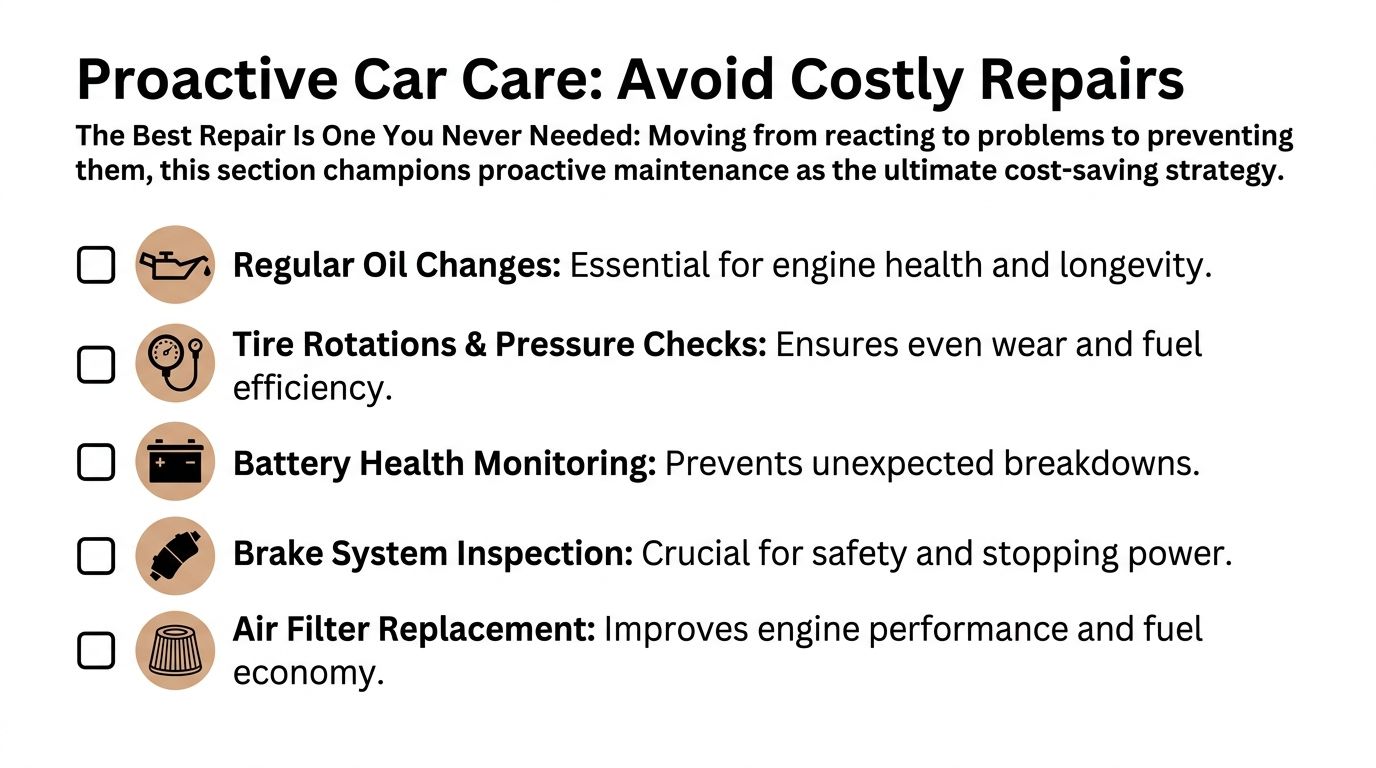
Preventive maintenance is where drivers keep the most money in their pocket. In the shop, I see the same pattern over and over. The painful invoices usually start with something routine that got pushed off too long, especially fluids, tires, and small leaks that seemed harmless at the time.
Coolant is cheap. Engines are not.
A lot of owners stay on top of oil changes and forget the cooling system until the gauge climbs. In Ontario, that is a risky habit. Cold winters, summer traffic, road salt, and stop and go driving all put stress on hoses, clamps, radiators, and the coolant itself.
The basic rule is simple. Use the coolant type the vehicle calls for, keep the system full, and deal with leaks early. The Government of Canada's vehicle safety guidance also tells drivers to check fluid levels regularly, including coolant, as part of routine maintenance: Motor vehicle maintenance and repair safety.
What I tell customers in Whitby is this:
Unknown service history means inspect it now
If you bought the car used and have no record of coolant service, do not assume it is fine.Topping up repeatedly is a warning sign
Coolant does not get “used up” like fuel. If the level keeps dropping, there is a leak or another fault.Contaminated coolant needs attention
Rust colour, sludge, or oily film can point to corrosion or internal engine problems.
One overheating event can do real damage. On many modern engines, the repair bill climbs fast once heat gets involved.
Ignored tires drain money
Tires affect more than tread life. They change fuel use, braking distance, ride quality, and how quickly suspension parts wear. In a place like Whitby, where drivers deal with potholes, curb hits, and big temperature swings, tire maintenance saves money in ways people do not notice until the car starts pulling or vibrating.
Transport Canada recommends checking tire pressure at least once a month and before long trips, and it explains why proper inflation matters for safety and wear: Tires. That advice lines up with what works in the bay every day.
A simple routine catches a lot:
Check pressure with a real gauge
Do it when the tires are cold, especially after big temperature drops.Rotate on schedule
Front wheel drive vehicles chew through front tires faster. Rotation helps you get full value from all four.Watch the wear pattern
Inner edge wear often points to alignment issues. Cupping can suggest weak shocks or struts.Do not ignore new vibration or pulling
After one hard pothole hit, I would rather inspect it early than sell you two tires and suspension work later.
That is not fussy maintenance. It is basic cost control.
Build a maintenance record that protects your wallet
Good habits matter, but paperwork matters too. In Ontario, clear written records make it easier to approve the right work, question the wrong work, and track what was already done. That becomes even more useful later under the province's repair rules if there is a dispute over authorization or billing.
Keep your invoices. Ask what is due next based on time and mileage, not just what is urgent today. If you want a practical starting point, this guide to preventive maintenance for vehicles lays out the basics in a way drivers can follow.
The best value usually comes from boring visits. A coolant service. A tire rotation. A small leak caught early. Those jobs are a lot easier to live with than a major repair you could have avoided.
Choosing Your Repair Partner in Whitby
Where you take your car matters as much as what's wrong with it. A strong shop can save you money with accurate diagnosis, realistic parts advice, and repairs that hold up. A weak one can burn through your budget with guesswork, poor communication, and repeat visits.

Independent shop or dealership
In Ontario, the labour-rate gap is real. Statistics Canada reporting cited for this industry context shows independent repair shops typically charge $140 to $210 per hour, while dealership service centres average $220 to $290+ per hour. That means independent shops can be 30% to 50% cheaper.
That doesn't mean dealerships are wrong. They can make sense for certain warranty work, highly brand-specific diagnostics, or software-related concerns on newer vehicles. But for many common repairs and maintenance jobs, a capable independent shop is often the better value.
What to look for in a Whitby shop
Price matters. Trust matters more. Start with a short list and vet each place the same way.
Clear communication
The shop should explain the complaint, the inspection findings, and the next step in plain language.Written estimates before work
If the front counter gets vague when you ask for a written quote, that's a warning sign.Reasonable parts discussion
A good shop should tell you whether they recommend OEM, aftermarket, or reconditioned parts and why.Consistent reviews
Don't just look at star ratings. Read for patterns. Are people praising diagnosis, honesty, and follow-through?Clean workflow
A spotless floor isn't the point. An organised operation usually reflects organised repair orders and better accountability.
Test the relationship before you need a big repair
One of the best ways to choose a repair partner is to start small. Book routine maintenance, a brake inspection, or a drivability concern that isn't a full breakdown. Watch how they handle approvals, timelines, and explanations.
A reliable shop should be able to tell you three things without dancing around the answer:
- What the issue is
- What needs doing now
- What can wait
That last one matters. Shops that can separate urgent from non-urgent work usually think long-term.
A trustworthy mechanic doesn't try to win every dollar today. They try to become the place you return to next time.
If you're comparing local options, reviewing a Whitby car mechanic page can help you see how a shop presents its capabilities and service approach before you ever book in.
How to Decode Estimates and Choose Your Parts
A repair estimate shouldn't feel like a foreign document. Once you understand the line items, you stop being a passive customer and start making informed decisions.
Read the estimate from top to bottom
Most repair orders include the same core categories, even if the layout changes by shop.
Concern or complaint
This is your description of the issue. It should reflect what you reported.Inspection or diagnostics
This is the time spent identifying the fault, not fixing it. Diagnosis has value. Replacing parts without proving the cause usually costs more in the end.Labour
Labour covers the technician's time for the repair itself. It may be listed as hours, operations, or job-based labour.Parts
This section should identify what's being replaced. Ask whether the parts are OEM, aftermarket, or reconditioned.Shop supplies or related materials
These are the small consumables used during the repair. Ask if anything is unclear.Taxes and totals
Review the final approved amount before work begins.
The line items that deserve questions
Not every estimate needs a debate, but some should trigger a conversation.
Ask questions if:
The diagnosis is thin
“Replace front suspension parts” is too vague. Which parts, and what failed?The parts description is generic
“Brake parts” isn't enough. Pads? Rotors? Hardware? Sensors?The labour seems disconnected from the complaint
If the labour line is broad, ask what operations are included.A recommended add-on appears without context
Maintenance upsells aren't automatically wrong, but they should be explained.
A good shop won't get defensive when you ask for clarity. They'll welcome it.
OEM and aftermarket are not the same decision on every car
The parts conversation is where a lot of drivers either overspend or underspend. There isn't one right answer for every repair.
Here's a straightforward comparison.
| Attribute | OEM Parts | Aftermarket Parts |
|---|---|---|
| Fit and design | Built to the vehicle maker's specification | Varies by brand and supplier |
| Consistency | Usually predictable in fitment and finish | Can range from excellent to poor |
| Price | Often higher | Often more budget-friendly |
| Best use case | Brand-specific systems, newer vehicles, sensitive components | Older daily drivers, routine wear items, cost-conscious repairs when quality is verified |
| Buyer caution | Higher cost doesn't always mean necessary | Cheap versions can create noise, fitment issues, or shorter lifespan |
If you want a plain-language consumer explanation from outside the shop world, the Total Loss Northwest guide on repair parts is worth reading because it frames the OEM versus aftermarket choice in practical terms rather than treating one as universally better.
A simple decision framework
Use the vehicle, the system, and your ownership plan to guide the choice.
For safety and precision-sensitive repairs
Brakes, steering components, and certain suspension parts deserve extra care in part selection. On a newer vehicle, many owners prefer OEM or a top-tier aftermarket brand with a strong track record. The reason is simple. You're protecting drivability, safety, and predictable fit.
For older daily drivers
On an older commuter car, high-quality aftermarket parts often make excellent sense. If the vehicle is out of warranty and you're trying to balance longevity with a sensible budget, reputable aftermarket can be the sweet spot.
For cosmetic or non-critical repairs
Used or reconditioned parts can be reasonable for some non-safety-related items, depending on condition and source. The key is disclosure. You should know exactly what's being installed.
Saving money on parts only works if the part solves the problem once.
If you want a more detailed breakdown of where each option tends to make sense, this guide on OEM vs aftermarket parts is a helpful reference.
The best estimate is not the shortest one or the cheapest one. It's the one you can understand, question, and approve with confidence.
Know Your Rights as an Ontario Driver
You drop your car off for what sounds like a straightforward repair, then the phone rings at 3 p.m. The price has climbed, the explanation is fuzzy, and you are being asked to approve more work on the spot. That is exactly when Ontario's repair rules matter.
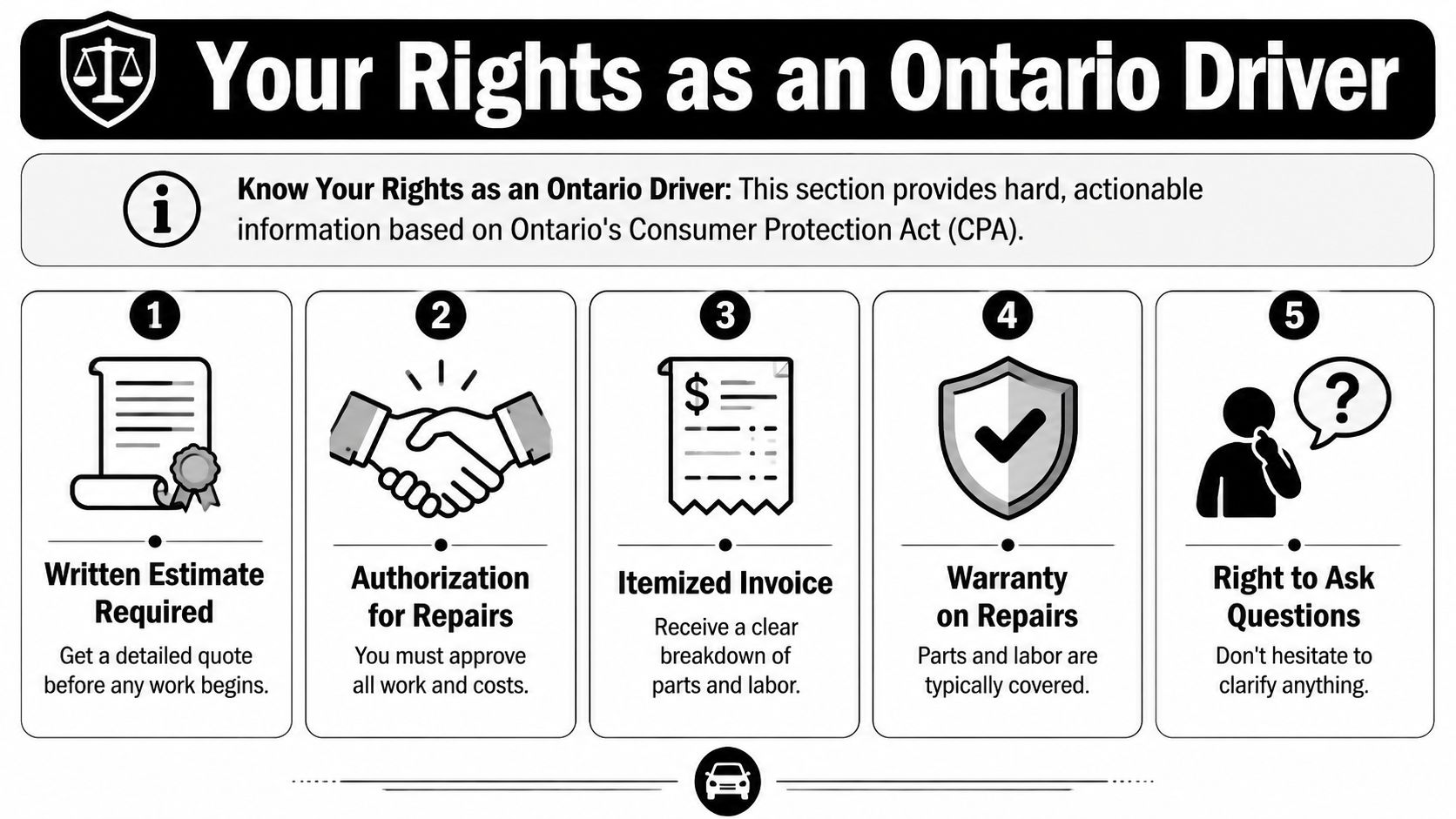
In Whitby, I see the same pattern over and over. Drivers focus hard on the quote, but true protection is in the paper trail and the approval process. Under Ontario consumer law, a shop cannot go past the estimate by more than a limited amount without your consent, and repair contracts are covered by rules set out by the province under the Consumer Protection Act, 2002 and related guidance from Consumer Protection Ontario. Those rules are there to control two common problems. Unexpected charges and disputes over what you authorized.
The practical move is simple. Slow the job down for a minute before the wrenching starts.
What to do before you approve anything
Get a written estimate
A verbal number at the front desk is not much use later. The written estimate should identify the work, the parts, and the expected price.Ask how approvals will be handled
If more problems are found, tell the shop you want a phone call or text before extra work begins. Good shops in Durham Region do this as a normal part of business.Make sure the invoice matches the authorization
If the final bill is higher, there should be a clear record showing when you approved the change.Keep your paperwork
Invoice, estimate, mileage, and dates all matter if the repair fails or a billing dispute starts.
A lot of drivers are surprised to learn that warranty protection also matters here. Ontario requires certain minimum warranties on qualifying repair work, which gives you a basis to return if the same repair does not hold up. That does not mean every new symptom is free. If a ten-year-old Whitby commuter comes in with worn front-end parts and the shop repairs one failed component, a different worn component can still fail later. The key is whether the failed part and the labour tied to that repair fall within the warranty terms shown on your invoice.
If a bill or repair does not look right
Start calmly and get specific. Ask the service advisor to show you where you approved the added cost. Ask which part failed, when it was installed, and what warranty applies to that line item. Vague arguments waste time. Exact questions get answers.
If the explanation still does not add up, put the concern in writing and keep a copy. Ontario drivers can also review complaint options through OMVIC's consumer complaint information, which is useful if the issue involves dealer-related service or repair concerns. Independent shops are common in Whitby, so it also helps to know whether you are dealing with a dealership, a franchise operation, or a local independent, because the complaint path can differ.
One more point that saves people money. If the repair is tied to collision damage, vandalism, or another insured loss, sort out responsibility before authorizing customer-pay work. This guide to car repair insurance coverage and claim situations can help you figure out what may belong on an insurance file and what is likely your bill.
Affordable repair includes legal protection. A fair estimate, clear approval, and proper records usually settle problems before they turn into expensive ones.
The True Meaning of Affordable Auto Repair
Affordable auto repair has nothing to do with chasing the lowest quote in town. Instead, the goal is the lowest total cost of ownership. That means fewer repeat failures, fewer surprise invoices, and fewer cases where a small issue turns into major damage because it sat too long.
The biggest trap is delay. Cost pressure causes people to postpone work they already know the car needs. That choice can be understandable, but it isn't always economical. Research cited for California drivers found that 60% postpone repairs due to cost, and 43% of those delays lead to secondary failures costing 2 to 5 times more. The same source says drivers using independent shops without certified technicians faced 38% higher repeat failure rates within 12 months, according to Auto Repair Transformation.
Whitby isn't California, and local conditions and rules are different. But the core lesson applies anywhere. Deferring a necessary repair or choosing a shop only because it's cheapest can become the most expensive path.
Value comes from stacking smart decisions
Affordable auto repair usually looks like this in practice:
- You maintain the car before wear turns into failure
- You choose a shop that diagnoses before replacing parts
- You understand the estimate and ask about part quality
- You know your legal protections before authorising work
That combination saves money better than bargain hunting ever will.
Cheap repairs often carry hidden costs
A low quote can hide weak parts, incomplete labour, or a rushed diagnosis. If the noise comes back, the light returns, or the new part exposes the old underlying problem, you haven't saved anything. You've just spread one repair over two invoices.
That's why drivers should think beyond the upfront number. If you've ever wondered whether it's worth fixing a charging problem now or stretching it a little longer, reviewing a realistic alternator repair cost breakdown can help frame the risk of waiting versus repairing.
Affordable auto repair means paying for work that makes sense, lasts, and protects the rest of the vehicle. That's the kind of value that keeps a car dependable without draining the budget.
If you want help from a local team that understands how Whitby drivers balance reliability, cost, and long-term vehicle care, Carmedics Autowerks Inc offers professional repair and maintenance services for cars and SUVs. Whether you need a proper diagnosis, routine service, or advice on the most sensible repair path for your budget, their team can help you make a confident decision.
A professional cabin air filter replacement usually lands around $85 to $130 CAD for most Whitby drivers, though the exact bill depends on the vehicle, the filter type, and the service centre. As a baseline, U.S. repair data puts the average replacement at $86 to $114, with labour at $45 to $66 and parts at $41 to $48, before taxes, fees, and regional differences.
That's the answer many seek initially. The reason they keep searching is that the quote on one car can feel perfectly fair, while the quote on another feels inflated for what seems like a simple filter swap.
In the shop, this usually starts with a complaint that sounds minor. The vents smell damp. The fan sounds busy but the airflow feels weak. The windshield takes longer to clear. A lot of drivers assume the air conditioning is failing, when the issue is often much simpler and much cheaper.
That Musty Smell in Your Car and What It Means
A Whitby morning after rain is enough to make this obvious. You start the car, turn the fan on, and get hit with that stale, slightly mouldy smell from the vents. The heater still works. The AC still turns on. But something's off.
In many cases, that smell points straight at a dirty cabin air filter.
The cabin air filter functions much like the furnace filter in your house. Its job is basic but important. It catches dust, pollen, road grime, and other debris before that air reaches the cabin. When it loads up, air doesn't move through the HVAC box the way it should.
What drivers usually notice first
The first sign isn't always smell. Sometimes it's airflow.
- Weak vent output: You turn the fan speed up, but it still feels like the system is struggling.
- Stale or damp odour: This often shows up after wet weather or after the car has sat overnight.
- Foggy windows that take longer to clear: Restricted airflow can make the defrost feel less effective.
- More dust inside the cabin: Not always, but it can be part of the pattern.
A clogged filter won't cause every climate-control problem, but it can make a healthy system feel lazy.
If the blower sounds strong and the air coming out feels weak, I check filter restriction early, before assuming there's a bigger AC fault.
There's also a comfort issue that gets overlooked. If airflow drops enough, the heater and AC have to work harder to do the same job. That doesn't mean every dirty filter leads to a repair, but it does mean the system isn't operating efficiently.
If the odour lingers after the filter is changed, the next step may be cleaning deeper in the HVAC system rather than just replacing the filter. Drivers dealing with that kind of persistent vent smell often end up needing car air conditioning cleaning rather than another filter alone.
Why this small part matters
Cabin filters are easy to dismiss because they're inexpensive compared with brakes, suspension, or AC compressors. But they affect the part of the car you interact with every single day: the air you breathe and the comfort of the cabin.
That's why the cabin air filter change cost matters. It's a small maintenance item, but if you understand the actual pricing, you can avoid overpaying and avoid ignoring it until the car starts feeling unpleasant inside.
The Real Cabin Air Filter Change Cost Breakdown
On most invoices in Whitby, a cabin air filter replacement comes down to two charges. The part, and the labour to get at it.
Earlier, I referenced U.S. market pricing from RepairPal. Use that as rough context only. It does not account for Ontario shop rates, HST, or the fact that some vehicles sold here are fitted with different filter options than what broad American estimators assume.
Parts cost
The filter itself is usually the smaller part of the bill, but there is still a real choice to make.
A basic particulate filter is often enough for a daily driver that sees normal commuting and regular maintenance. A carbon filter costs more, but it can do a better job with odours, exhaust smells, and some of the stale-air complaints drivers notice in heavy Durham Region traffic. The cheaper option saves money upfront. The better filter can make the cabin noticeably more pleasant if you spend a lot of time on the 401.
Fit matters too. A low-priced filter that does not seal properly or collapses early is not a bargain. I would rather install a decent aftermarket filter that fits the housing properly than the cheapest box on the shelf.
Labour cost
Labour is where the spread in quotes usually comes from.
On some vehicles, access is simple. Drop the glove box, remove the cover, swap the filter, and reassemble. On others, the technician has to work around trim panels, a tight lower dash area, or clips that get brittle with age. That extra time is what changes the labour line, not a shop trying to inflate a small job.
This also affects value. If a shop is already inspecting weak airflow, poor cooling, or a lingering vent smell, a proper diagnosis may matter more than the filter itself. If the issue turns out to be larger than a maintenance item, this car air conditioner repair cost guide is the more useful reference.
A fair quote reflects access time, filter quality, and the local labour rate. It should not look identical across every make and model.
Vehicle differences change the total
Make, model, and trim all matter. A straightforward replacement on one sedan can be a fiddly job on an SUV, a pickup, or a European vehicle with tighter packaging.
That is why two Whitby drivers can call around on the same day and hear different prices for what sounds like the same service. One car takes a few minutes and an ordinary filter. Another needs more careful disassembly and a higher-priced part. If you want an accurate number, the shop needs your exact vehicle details, not just the year and a general description.
Key Factors That Influence Your Final Bill
The quote changes for reasons that are usually logical. The problem is that most shops don't explain those reasons clearly, so the customer just sees one price that feels random.
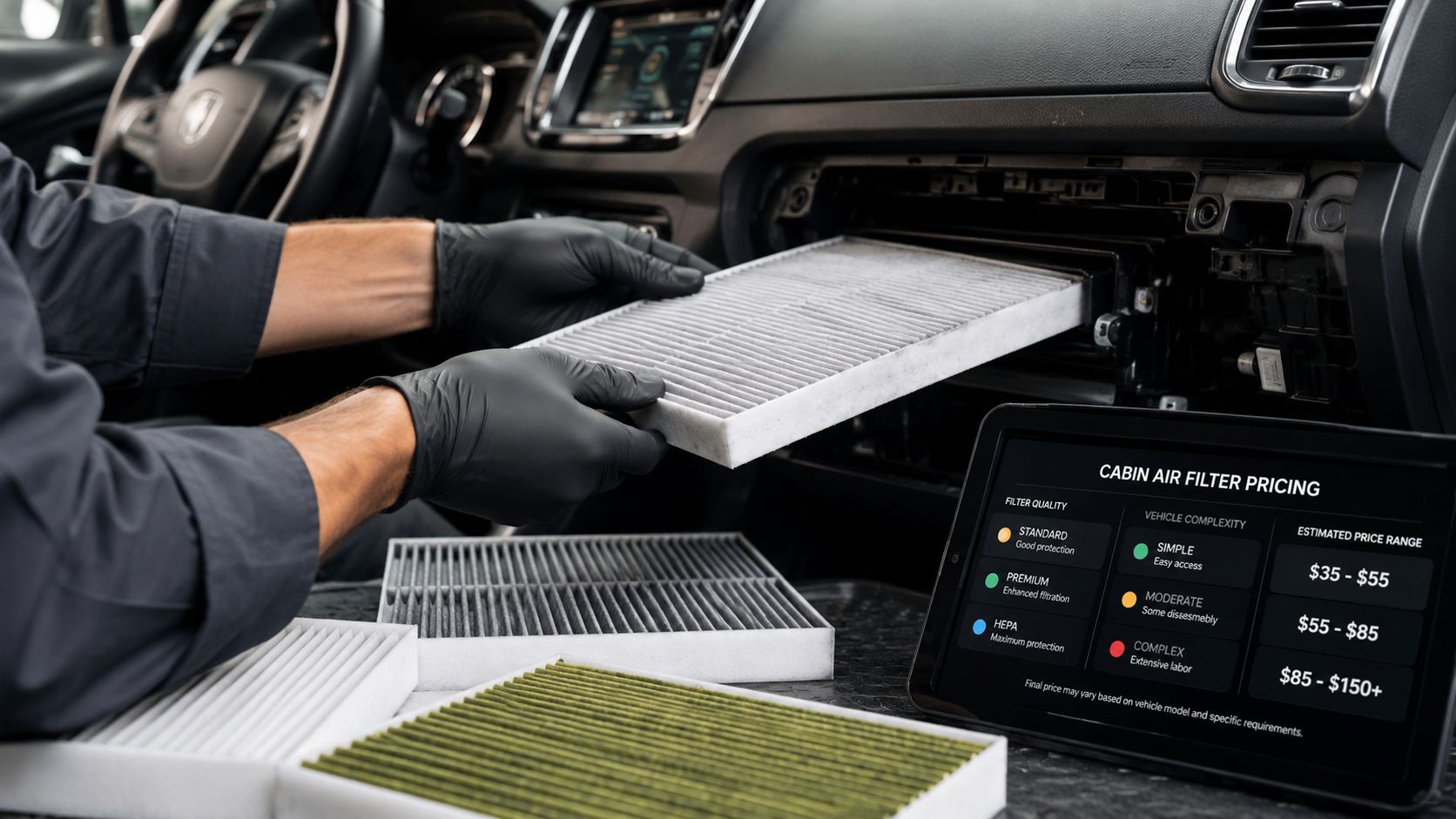
Vehicle design matters
Some vehicles make cabin filter replacement easy. Open the glove box, release the stops, remove the cover, slide the old filter out, slide the new one in. Clean, quick, done.
Others are fussier. The filter may sit behind side panels, under the dash, or in a tight housing where a technician has to work carefully around trim and electrical pieces. That extra access time adds labour, even when the part itself is ordinary.
That's why one owner says, “It took ten minutes,” and another gets a quote that reflects a more involved job.
Filter quality changes the parts bill
Not every aftermarket filter is built to the same standard. Some are plain paper-style filters. Some use carbon media. Some fit beautifully. Some don't seal as well as they should.
That choice affects the bill and the result you get.
- Basic aftermarket filter: Usually the lower-cost option. Fine for many daily drivers.
- Premium carbon filter: Better suited to drivers who care about odour control and a more refined cabin feel.
- OEM filter: Often chosen by owners who want factory-spec fitment and consistency.
If you're sorting through the difference between factory and non-factory parts, this broader look at OEM vs aftermarket parts helps put the filter decision in context.
A cheap filter that doesn't fit the housing properly isn't a bargain. If air slips around it instead of through it, the system loses the benefit you paid for.
Accessibility drives labour more than people expect
This is the factor that surprises most owners. Access dictates time, and time dictates labour.
A filter hidden behind a simple glovebox panel is one thing. A filter that requires delicate trim removal on an older interior with brittle clips is another. On some vehicles, the replacement itself is easy but getting to it without breaking anything requires particular skill.
Here's a simple way to look at it:
| What changes the bill | Why it matters |
|---|---|
| Vehicle make and model | Some housings are quick to reach, others are buried |
| Filter type | Standard, carbon, and OEM options don't cost the same |
| Interior access complexity | More panel removal means more labour time |
| Service centre pricing | Independent shops and dealerships often price differently |
That's why estimates vary. It's not always markup. Often, it's just the vehicle.
DIY vs Professional Service: The Practical Trade-Offs
You pick up a cabin filter at a Whitby parts counter for a modest price, figure it will take ten minutes in the driveway, then find yourself wrestling a glovebox damper or a brittle trim panel in February cold. That is usually the point where the cost question changes. It stops being about the price of the filter and starts being about time, fitment, and the risk of breaking something inside the car.
A cabin air filter is still one of the more approachable maintenance jobs for an owner who does basic work. On the right vehicle, DIY can be straightforward and worth doing. On the wrong vehicle, the labour charge at a shop is often cheaper than replacing clips, trim, or a second filter after the first one was installed incorrectly.
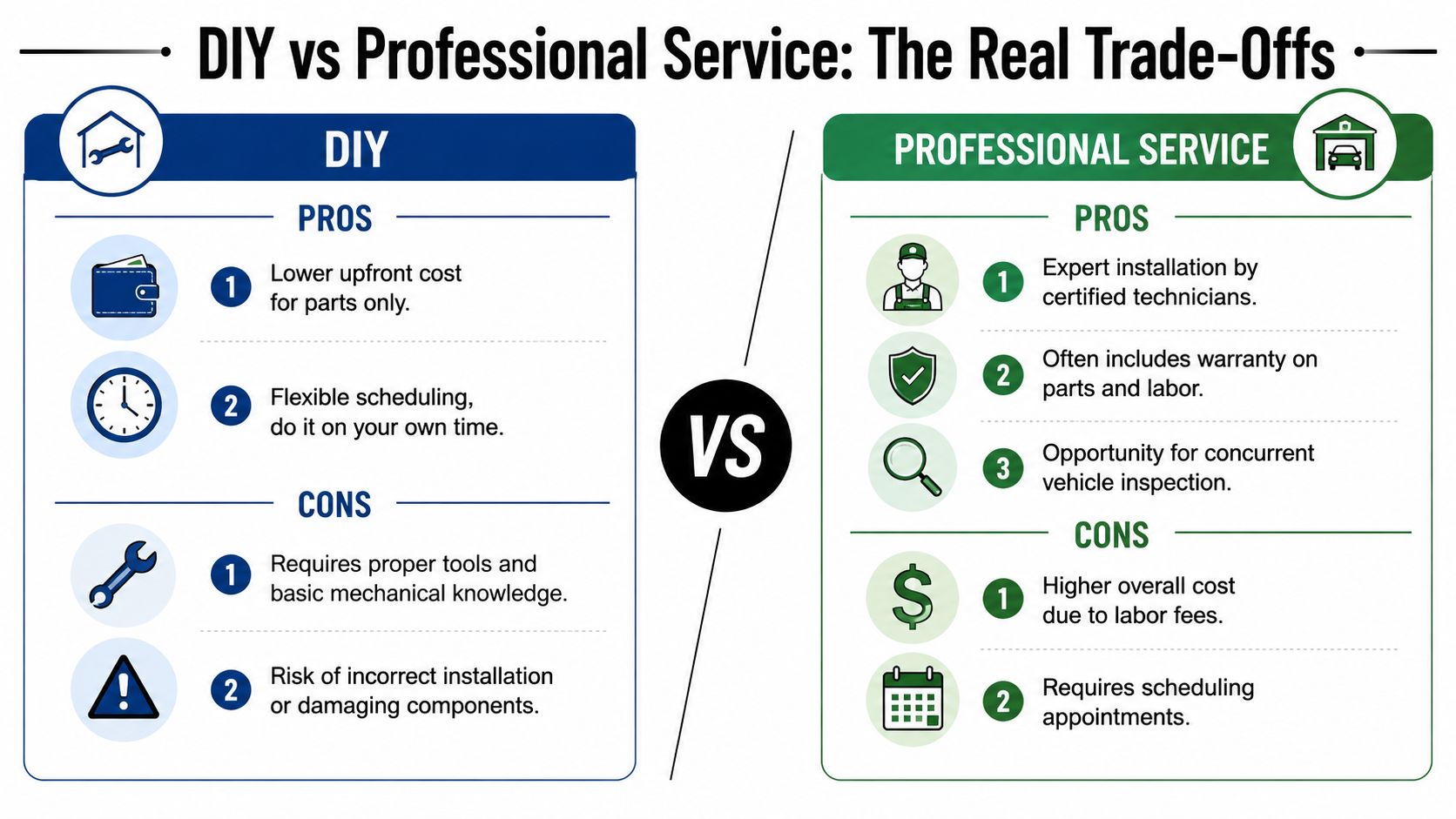
Where DIY saves money, and where it does not
If the housing is easy to reach and the part number is confirmed, DIY usually saves the labour portion of the bill. That is the clear upside.
The catch is access. Some filters slide out behind the glovebox with no drama. Others need trim removed carefully, and that is where owners get into trouble. I see this most often on older vehicles with stiff plastic tabs and on newer interiors where everything fits tightly but does not like being forced.
There is also the quality of the part itself. A low-cost filter that is slightly off in size can bow, leave gaps, or fight you going into the housing. You may still get it in, but airflow and sealing suffer.
A discussion in this Reddit thread about oil change and cabin filter pricing shows how often DIY looks cheaper at first glance. The missing part of that comparison is the value of correct installation and inspection, especially on vehicles with awkward access or existing HVAC complaints.
Side-by-side comparison
| Factor | DIY (Do It Yourself) | Professional Service (e.g., Carmedics) |
|---|---|---|
| Upfront cost | Lower if you only buy the filter | Higher because labour is included |
| Time | Fast on simple vehicles, frustrating on others | Usually predictable once the vehicle is in the bay |
| Part selection | You need to match the correct size and spec yourself | The shop typically confirms fitment before installation |
| Installation risk | Higher if the filter is reversed, bent, or not seated properly | Lower when handled by an experienced technician |
| Interior trim damage | Clips and dampers are easy to damage if rushed | Less likely when access points are already familiar |
| Added inspection | Limited to what you notice | Technician can check for debris, moisture, and airflow issues nearby |
DIY makes sense on simple layouts
DIY is a sensible option when the filter is easy to access, the replacement procedure is clear, and you are comfortable working gently around interior panels.
Details matter here. The airflow arrow has to face the correct direction. The filter has to sit flat in the tray. The access cover has to close properly. Miss any of those and the job is done, but not done well.
Shop service makes sense when access or diagnosis is part of the job
Professional service earns its keep when the filter is buried, the interior plastics are delicate, or the car has symptoms that point to more than a dirty filter. Weak airflow, recurring odours, or signs of moisture in the housing deserve a closer look.
That is where experience pays off for Whitby drivers. A certified auto mechanic is not just swapping a filter. They are checking whether the housing is sealing properly, whether debris is collecting in the cowl area, and whether the complaint matches the filter condition.
DIY saves money on the right car. On the wrong one, one cracked panel or one poorly fitting filter wipes out the savings quickly.
The practical answer is vehicle-specific. If your car has easy access and you are careful with trim, DIY is reasonable. If access is awkward or you want the job documented and checked properly, paying for labour is often the better value in Ontario shop conditions.
How to Save Money on Your Next Filter Change
A cheaper cabin air filter service usually comes down to one thing. Replacing it based on condition and use, not on autopilot.
In Whitby, I see two common ways drivers spend more than they need to. They replace the filter too early because it looks a bit dusty, or they agree to a premium filter without asking whether it suits how the vehicle is driven. Ontario roads, construction dust, winter slush, and heavy commuter traffic can shorten filter life, but that still does not mean every car needs the same schedule.
Replace it at the right time, not just at the convenient time
The best savings come from avoiding unnecessary replacements. If airflow is still strong, there is no musty smell, and the filter is not heavily restricted, it may have more life left.
A quick inspection matters more than a blanket interval.
If your car is already booked in, ask the shop to check the filter first and show you its condition. A good technician should be able to explain whether it is due, or whether you can leave it until the next service. If you want a second opinion from a local car mechanic in Whitby, ask for the reason behind the recommendation, not just the price.
Combine it with work you are already doing
Cabin air filter replacement is often cheaper as part of a planned visit than as a separate trip. If the vehicle is already in for an oil change, seasonal inspection, tire swap, or brake work, the shop may be able to handle it with less added labour time.
That does not mean every bundled quote is a deal. Ask whether the filter price includes inspection, installation, and confirmation that the housing closes properly. If those details are vague, the low number on the estimate may not be the whole story.
Match the filter to the job
The least expensive filter is not always the best buy. The most expensive one is not automatically better value either.
A standard filter is often enough for drivers who mainly want clean airflow and normal replacement intervals. A carbon filter can be worth the extra cost if you spend a lot of time in stop and go traffic, drive near industrial areas, or notice outside odours entering the cabin. For some Whitby commuters, that upgrade is money well spent. For others, it is an easy place to trim the bill without giving up much.
The goal is simple. Pay for the filter your car needs, at the time it needs it.
Finding Trusted Auto Service in Whitby
Whitby drivers don't need another vague estimate copied from an American website. They need a shop that will look at the actual vehicle, explain the access involved, and tell them whether the filter really needs replacing or whether something else is causing the smell or airflow issue.
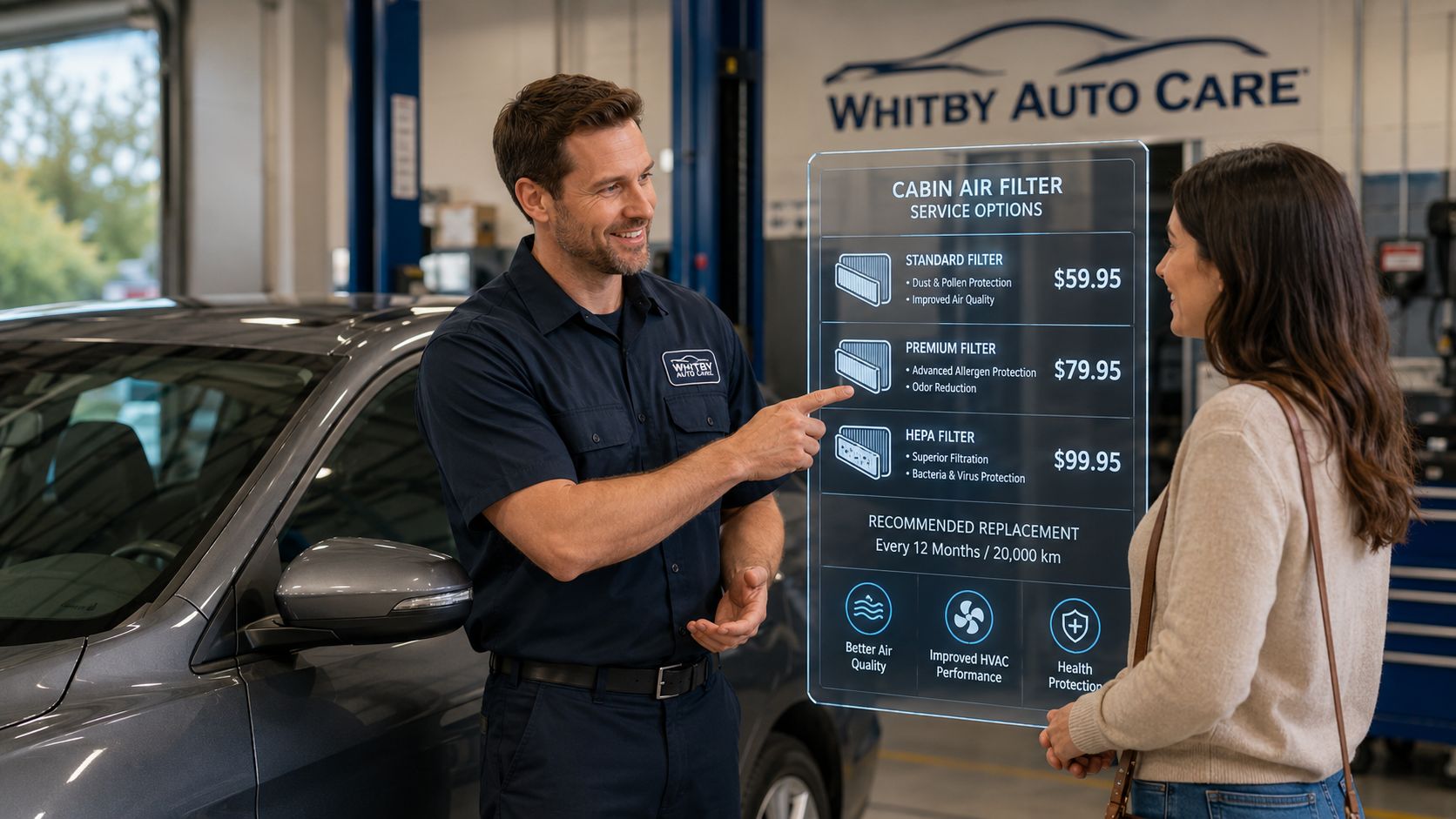
That's where a good independent repair centre usually has the edge. You get more context, more honest advice, and a better chance of speaking with someone who has seen the quirks of your make and model before. Dealerships have their place, and chain stores can be convenient, but for a job like this, clear diagnosis matters more than polished upsell menus.
What a good shop should tell you
A trustworthy mechanic should be able to answer these points without dancing around them:
- Whether the filter is due: Not just whether it's slightly dusty.
- How difficult the access is on your vehicle: Labour should be explained, not hidden.
- What type of filter they're quoting: Standard, carbon, OEM, or aftermarket.
- Whether the filter is the whole problem: A musty smell may need deeper HVAC cleaning.
If you're looking for a local technician who can handle routine maintenance and larger repair work with the same straight answer, start with a Whitby car mechanic who will quote the job based on your specific vehicle, not a generic menu board.
The best result is simple. Clean air, proper airflow, no rattles from broken trim, and a fair invoice that makes sense when you read it.
If you want a precise, no-hassle quote for your specific vehicle, contact Carmedics Autowerks Inc. We help Whitby drivers with everything from routine cabin air filter service to diagnostics, repairs, tint, PPF, and collision work, with practical advice and workmanship you can trust.
You drive the new car home, park it a little farther from everyone else, and catch yourself looking back at it twice. Then the significant thought hits. Not the payment, not the fuel bill. The first stone chip.
If you drive in Whitby long enough, that first mark rarely takes long. Highway grit, winter sand, salt, loose gravel from shoulders, dirty slush kicked up by trucks. A fresh front bumper can start looking tired much faster here than most owners expect. That's why the conversation around paint protection film advantages and disadvantages matters more in Ontario than generic online advice suggests.
For the right owner, PPF isn't a vanity add-on. It's a practical way to keep factory paint from getting hammered by normal use. But it's also not magic. It's expensive, installer-dependent, and it has a useful life. If you're deciding whether to protect a new vehicle, a weekend car, or something you plan to keep for years, you need the honest version.
Protecting Your Pride and Joy in Whitby
A lot of drivers start thinking about PPF the same way. The car is new, the paint looks perfect under the dealership lights, and you want to keep it that way. Then a week later you're on the 401, a transport throws up debris, and you hear that sharp little tick against the front end.
That's the moment most owners realise paint damage isn't a theoretical problem. It's daily wear.
In Whitby, the trouble spots are predictable. Front bumpers get peppered. Hoods take direct hits. Mirror caps, rocker panels, and the lower doors collect grime and abrasion. Winter makes it worse because the roads aren't just wet. They're loaded with salt, grit, and road debris that keeps hitting the same high-impact areas.
Most paint damage doesn't come from one dramatic event. It comes from hundreds of ordinary drives.
That's where PPF makes sense. It gives the paint a sacrificial surface, so the film takes the abuse instead of the clear coat. For owners who care about appearance, resale, or avoiding the frustration of seeing a nearly new vehicle age too fast, that changes the ownership experience.
Still, not every car needs full-body coverage, and not every owner will see the same value in it. Some drivers want maximum preservation. Others just want to protect the areas that get blasted first. The right answer depends on how you drive, where you park, and how long you plan to keep the vehicle.
What Exactly Is Paint Protection Film
Paint protection film, or PPF, is a transparent urethane film installed over painted surfaces. Think of it as a high-tech, nearly invisible suit of armour for your car. It isn't a wax, and it isn't a liquid coating. It's a physical layer that sits on top of the paint and absorbs abuse before the paint does.
That distinction matters. A coating can help with gloss, water behaviour, and cleanup. PPF is built for impact and surface preservation.
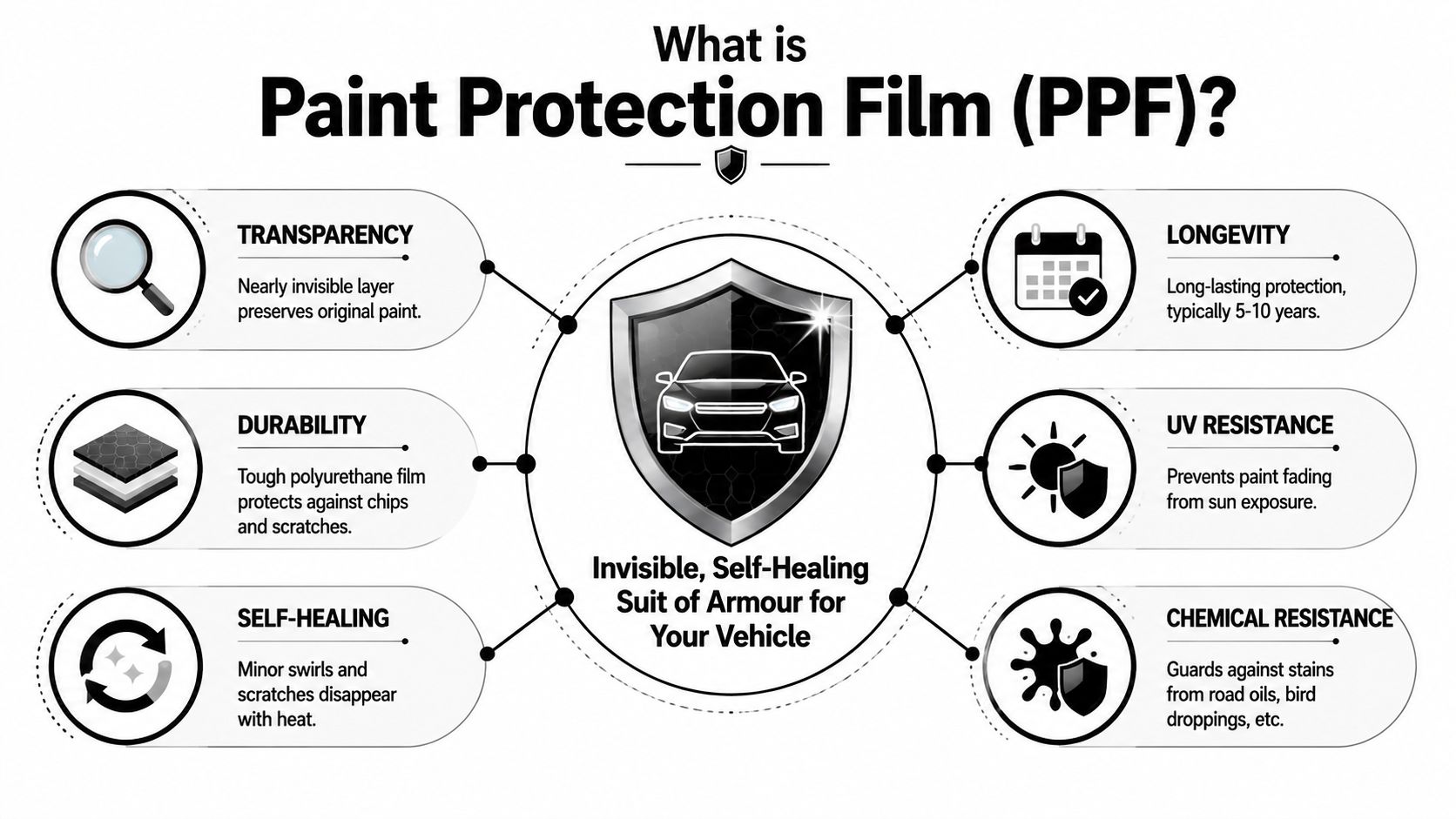
How the film works on the car
A properly installed film is shaped to fit panels like the bumper, hood, fenders, mirrors, rocker panels, and sometimes the full vehicle. Once applied, it acts as the first point of contact for common road abuse.
That includes:
- Stone chips and road grit: The film takes the hit instead of the paint.
- Bug splatter and bird droppings: Contaminants sit on the film, not directly on the clear coat.
- UV exposure: PPF helps reduce fading and oxidation from sun exposure.
- Light surface marring: Minor swirls and shallow marks affect the film first.
If you want to see what that looks like in a real installation context, this guide to professional paint protection film installation gives a useful local reference point.
What self-healing actually means
Self-healing is the feature that people hear about most, and it's also the one most often misunderstood. It doesn't mean the film repairs deep gouges or major damage. It means the upper layer of the film can relax and recover from minor scratches and swirl marks when exposed to heat.
According to Tint Pros Mobile's explanation of PPF technology, elastomeric polymer layers repair minor surface abrasions through thermal activation, which helps maintain the factory paint's integrity and the vehicle's resale value over a standard 10-year warranty period.
In real ownership terms, that means the light wash marring or surface haze that would normally make dark paint look tired can fade away from sun exposure or warmth. The paint underneath stays untouched because the film is doing the work.
Why owners choose it over bare paint
PPF's biggest appeal is simple. You can drive the car without obsessing over every speck of debris. The paint remains original, and the car keeps that cleaner, newer look for longer.
That's the practical heart of it. PPF isn't there to make promises. It's there to take damage so your paint doesn't have to.
The Key Advantages of Installing PPF
The biggest advantage of PPF is simple. It protects the factory finish that gives a vehicle its best long-term appearance and strongest resale story.
Around Whitby, that matters quickly. A few runs on Highway 401, winter sanding on Dundas, and slush thrown up along the lower doors can start marking a new vehicle long before most owners expect it. Once those chips and peppering hit the paint, correction gets harder and touch-ups rarely disappear completely.

It takes the abuse first
PPF works because it sits between the road and the paint. On a properly protected front end, the film absorbs the light impact from grit, salt, bug residue, and road rash that would otherwise mark the clear coat.
For Whitby and Durham Region drivers, the highest-value areas are usually easy to predict:
- Front bumpers, especially on daily highway-driven vehicles
- Leading hood edges and partial or full hoods, where chip lines start
- Fenders, mirror caps, and A-pillars, which catch debris at speed
- Rocker panels and lower doors, where winter slush and sand grind away at the finish
- Rear wheel arch areas, especially on SUVs and wider-body vehicles
This is why partial coverage often makes sense. You protect the sections that get hit instead of paying for film where the risk is low.
Self-healing helps the car stay cleaner-looking
In day-to-day ownership, self-healing is less about technology and more about appearance. Fine wash marks and light surface scuffs that would sit in clear coat often fade out of the film with heat, so the vehicle keeps a sharper finish between polishing cycles.
Dark paint benefits the most. Black, dark blue, and graphite vehicles show every little mark in Ontario sunlight, especially after a salty winter and a few rushed spring washes. PPF makes those colours easier to live with.
It holds up well against Ontario conditions
Ontario is hard on paint. Salt, brine, freeze-thaw cycles, bug acids in summer, and gritty snowbank spray all work against the front end and lower body. PPF does not stop every form of damage, but it does reduce the routine wear that ages a vehicle faster than expected.
That matters more if the car is parked outside, driven on the 401, or used year-round.
Film quality and installation quality also affect how well that protection ages. Owners who want a realistic view of service life should read this guide on how long paint protection film lasts in Ontario conditions.
It helps preserve original paint for resale
Original paint carries weight with careful buyers. A front end that still looks consistent, without heavy chip touch-ups or repaint work, usually presents better at trade-in and in private sale photos.
I see this most often with newer German cars, performance models, and well-optioned trucks. The owners who protect them early usually avoid the patchwork look that shows up after a few winters. The vehicle looks better cared for.
It changes how you use the car
This is the advantage owners mention after the install. They stop worrying about every normal drive.
A protected vehicle still needs proper washing and common sense, but routine trips through Whitby, Oshawa, and Toronto feel less punishing when the high-impact panels are covered. For many owners, that peace of mind is the part they appreciate most after the first winter.
The Real-World Disadvantages and Limitations
A Whitby driver usually feels the limits of PPF after the first real hit, not during the sales pitch. A chunk of gravel on the 401, a hard brush with packed snow, or years of sun on a daily-driven hood can still leave marks, lift edges, or force a section to be replaced. PPF is strong protection. It is not unlimited protection.
The cost can be hard to justify for every vehicle
This is the first point I discuss with owners because it changes the whole recommendation. PPF is expensive, especially if you want more than a partial front package, and full-body coverage only makes sense when the vehicle value, ownership term, and driving habits support it.
For a new luxury car, performance car, or a truck that spends a lot of time on the highway, the math can work. For an older commuter with existing paint damage, it often does not. In those cases, selective coverage on the front bumper, hood edge, fenders, mirrors, rocker panels, and rear arch impact areas usually makes more sense than wrapping everything.
It has a clear performance ceiling
Good film absorbs a lot of routine abuse. It does not stop every kind of damage.
A sharp stone at speed can still puncture film. A heavy impact can dent the panel underneath. Scrapes against concrete, garage walls, or icy debris can tear the film badly enough that the affected section needs to be removed and redone. Owners should go into PPF expecting reduced damage, not total immunity.
Service life depends heavily on use and care
The common warranty language causes confusion. A film may carry a long manufacturer warranty, but that does not mean it will look perfect for that entire period on a vehicle driven through Ontario winters, road salt, slush, UV exposure, and frequent highway mileage.
Real lifespan depends on film brand, panel location, how the car is washed, and how much abuse the vehicle sees. Front-end sections always age harder than protected door panels or roof sections. Owners who want a local, realistic benchmark should read this guide on how long PPF lasts in Ontario conditions.
You can still see it
This surprises people who were expecting an invisible result. Even well-installed film can show edge lines, relief cuts, or slight texture differences depending on the paint colour, body shape, and coverage plan.
White paint, black paint, and very soft Japanese finishes tend to reveal different things. Partial hood and partial fender installs are the most common source of visible transition lines. Full-panel coverage costs more, but it usually looks cleaner and ages better visually.
Film ages, and Ontario makes that more obvious
Over time, the film itself collects the wear that would have hit the paint. That is the point, but it also means the film can haze slightly, stain from bug residue, pick up contamination along edges, or show discoloration as it gets older.
Lower panels and front bumpers usually tell the story first. Cars that are parked outside year-round in Durham Region tend to show that wear sooner than garage-kept weekend cars.
Poor installation creates expensive headaches
This is the risk owners have the most control over. Bad prep or careless trimming can leave trapped dust, silvering, lifted edges, fingers around curves, misaligned patterns, and in the worst cases, cut marks in the paint.
I would judge the installer before I judged the film brand. A skilled shop plans coverage properly, wraps where it makes sense, explains what will remain visible, and stands behind the work if an edge lifts early. Around Whitby, that local accountability matters more than a flashy online warranty.
PPF vs Ceramic Coating vs Vinyl Wrap
Whitby drivers usually ask this after the first few weeks with a new vehicle. The paint still looks perfect, but Highway 401 debris, winter sand, and tight parking lots start to feel real fast. The right product depends on what you are trying to prevent, not what sounds best on a quote sheet.
These three options serve different jobs.
PPF protects against physical impact. Ceramic coating helps with washing, water behaviour, and resistance to grime. Vinyl wrap changes the look of the vehicle and adds only limited protection compared with film.
Paint protection options compared
| Feature | Paint Protection Film (PPF) | Ceramic Coating | Vinyl Wrap |
|---|---|---|---|
| Primary purpose | Physical barrier for painted surfaces | Easier maintenance and chemical resistance | Colour or finish change |
| Stone chip resistance | Best option of the three | Very limited | Limited compared with PPF |
| Self-healing | Available on many premium films | No | Not a core feature |
| Appearance change | Keeps the original paint look | Keeps and can enhance the original finish | Major styling flexibility |
| Best use case | New vehicles, highway commuters, long-term ownership | Owners who want easier cleaning and gloss | Owners who want a different colour or finish |
| Ontario cost position | Highest upfront cost, especially for full-front or full-body coverage | Lower than PPF | Varies widely by material, finish, and coverage |
Which one actually protects the paint
PPF is the strongest choice if the goal is preserving factory paint from chips, sandblasting on lower panels, and the constant abuse Ontario roads deliver through the year. That is why I recommend it first for new daily drivers, performance cars, trucks that see highway miles, and leased vehicles where paint condition matters at turn-in.
Ceramic coating still does useful work. It makes the surface easier to wash, sheds water better, and helps contaminants release more easily during maintenance. What it does not do is stop a rock strike from marking the paint.
Vinyl wrap sits in a different lane. It is mainly a styling product. It can hide a colour you are tired of, create a satin or matte finish, and protect lightly against minor scuffs, but it is not what I would install for someone worried about front-end chip damage on a Whitby commuter. For a closer look at where each fits, this guide on PPF versus vinyl wrap for Ontario drivers breaks it down clearly.
When each option makes sense
Choose PPF if:
- You want to keep factory paint as original as possible
- You drive the 401, 412, or other debris-heavy routes often
- You plan to keep the vehicle for years and want the front end to age better
- You care more about protection than changing the look
Choose ceramic coating if:
- You want easier washes and less grime sticking to the finish
- You value gloss, slickness, and simpler upkeep
- You already accept that it will not stop stone chips
Choose vinyl wrap if:
- You want a colour change or a custom finish
- You like the idea of refreshing the appearance without repainting
- Style is the main goal, with protection as a secondary benefit
The wrong choice usually comes from mixing up appearance products with impact protection. If you want fewer chips, buy film. If you want easier maintenance, buy a coating. If you want a different look, buy a wrap.
Maximizing Your PPF Investment
If you're going to spend serious money on film, the goal is simple. Get the right coverage, maintain it properly, and make sure the install is done at a high level.
Choose coverage based on how you drive
Not every owner needs full-body PPF. For many vehicles in Whitby, the smartest money goes into the highest-impact areas first. That usually means the front bumper, hood, fenders, mirrors, and rocker panels.
A daily highway commuter needs a different strategy than a garage-kept weekend toy. If the vehicle sees winter use, lower-body protection matters more because slush and grit keep hammering those sections.
Maintain the film like it's part of the finish
PPF isn't maintenance-free. It's durable, but neglect still shows up as contamination, edge buildup, and premature cosmetic wear.
A sensible maintenance routine includes:
- Use safe washing methods: Clean mitts, proper wash technique, and regular rinsing matter.
- Remove contaminants early: Bug residue, bird droppings, and road grime shouldn't sit on the film.
- Watch the edges: Dirt tends to collect where film boundaries are exposed.
- Ask before layering products: Some owners add a coating on top of PPF for easier upkeep. This guide on whether you can put ceramic coating over PPF covers that setup.
The installer matters as much as the product
This is the biggest lever you control. A strong installer plans coverage well, aligns film cleanly, manages edges properly, and avoids the kinds of shortcuts that create visible lines or trapped contamination.
A weak installer can make premium film look average. Worse, poor trimming and careless handling can create paint damage that defeats the whole purpose of protection.
When you're evaluating options, look for signs of process discipline. Clean patterns, tidy edges, consistency around curves, and a shop that understands how Ontario conditions affect wear all matter more than a flashy sales pitch.
Your Local PPF Solution in Whitby Carmedics Autowerks
A Whitby driver can pick up stone chips on Highway 401 within the first few weeks of ownership. This is particularly true here, especially through winter and spring when salt, sand, and road grit keep getting thrown at the front of the vehicle.

For local owners, the PPF decision is less about hype and more about how the car will be used. If the vehicle is new, sees regular highway mileage, or is something you plan to keep for years, film usually makes sense. If it is a short-term lease or a daily driver you are less concerned about cosmetically, partial protection or no film at all may be the better financial call.
Ontario also changes the cost conversation. PPF is not cheap, and local pricing reflects both material quality and labour. Good installation takes time, clean prep, careful patterning, and proper edge work. Cheap quotes often cut corners in the places owners notice later, such as visible lines, lifted edges, trapped debris, or poor coverage on high-impact panels.
That is why shop choice matters so much.
For owners comparing local options, Whitby PPF and tint services at Carmedics Autowerks are worth reviewing because regional experience shows up in the final result. A shop that works on Durham Region vehicles every day understands what Ontario roads do to paint, which panels need priority, and how local drivers balance full-front packages against full-body protection.
Carmedics Autowerks fits the kind of local role many owners need. Not a generic sales pitch. A shop that can assess the vehicle, explain where PPF delivers real value, and recommend coverage based on how you drive in Whitby, Oshawa, Ajax, and the surrounding area.
Frequently Asked Questions About Paint Protection Film
Can PPF go on an older car, or does the vehicle need to be new
It can absolutely go on an older car. New vehicles are ideal because the film preserves clean factory paint from day one, but older vehicles can still benefit if the paint is in solid condition. The key is preparation. If the paint already has chips, scratches, or heavy swirling, those defects usually need correction before installation because the film won't hide them.
Will removing PPF damage the original paint
Proper removal shouldn't damage healthy factory paint. Verified data states that removal after the film's useful life is straightforward and doesn't damage the paint, though you may notice uneven coloration between wrapped and unwrapped panels if the film stayed on for a long time. That's another reason professional installation and removal matter.
How long should I wait before washing after installation
Follow the installer's instructions. Cure time can vary based on film, temperature, and how much moisture remains under the material after install. Washing too soon can interfere with edges and adhesion, so it's always better to wait for the shop's specific guidance than rely on a generic timeline.
Can ceramic coating go over paint protection film
Yes, many owners do that to make maintenance easier. The coating doesn't replace the protective role of PPF. It complements it by improving cleanability and helping the surface stay easier to wash. The order matters, though. Film goes on first, then the coating goes over it.
Is full-body PPF always the best choice
Not always. It's the most complete option, but it isn't the only sensible one. For many Whitby drivers, strategic coverage on the front end and lower impact areas delivers the best balance between protection and budget.
If you want straight advice on whether PPF makes sense for your car, your driving habits, and Ontario road conditions, talk to Carmedics Autowerks Inc. Their Whitby team handles auto protection services including PPF installation, window tinting, collision repair, and general vehicle care for owners who want their cars to stay sharp and well protected.