

Most advice about a vehicle maintenance log gets the main point wrong. People treat it like a reminder system for oil changes, tire rotations, and whatever sticker is sitting in the corner of the windscreen.
That's useful, but it's not the primary reason to keep one.
A proper vehicle maintenance log is proof. It proves you maintained the car when a warranty question comes up. It shows an insurer that the vehicle wasn't neglected if a claim turns into an argument about pre-existing issues. It gives a buyer confidence that your car was cared for properly, not just washed before the listing photos. Around Whitby, where people keep vehicles for a long time and often put them through mixed city, highway, and seasonal driving, that paper trail matters more than most owners realise.
At a shop level, the pattern is easy to spot. The owners who keep records usually have fewer headaches when they sell, trade, or dispute a repair history. The owners who rely on memory almost always end up saying the same thing: “I know it was done. I just can't prove when.”
Why Your Log Is More Than a To-Do List
A basic notebook with “oil change done” scribbled beside a date is better than nothing. It still falls short when someone asks for proof.
That's the part most quick guides miss. The hidden value of a maintenance log is not just reminders. It's documented evidence. Guidance from Navy Federal points out that receipts, invoices, photos, and detailed notes can be critical when filing a warranty claim, and that matters in Canada because new vehicles come with a Maintenance and Learning Manual that owners can use as the reference point for documented upkeep. A log that ties service back to that guidance helps protect vehicle value, especially in Ontario's market for used vehicles and long-term ownership (warranty-focused maintenance record guidance from Navy Federal).
A lot of owners assume warranty coverage means the manufacturer will look after them. That's not how disputes usually work. If a manufacturer, adjuster, or buyer asks whether service was done on schedule, “I always take care of it” isn't enough. They want dates, mileage, invoices, and records that connect the work to the actual vehicle.
A maintenance log becomes important the moment someone else asks you to prove what happened.
That's why a proper log protects more than the engine. It protects the financial story of the car. If you've ever looked at two similar used cars and chosen the one with a folder full of invoices, you already understand the point. Buyers trust evidence.
For owners who want to stay ahead of problems, a log also works better when it's tied to a real service plan instead of memory or windscreen stickers. That's the same thinking behind preventive maintenance for vehicles. The schedule matters, but the record proving you followed it matters just as much.
What a weak log gets wrong
A weak log usually has one of three problems:
- It's too vague. “Service done” doesn't say what was serviced.
- It's missing proof. No invoice, no receipt, no photos, no shop details.
- It isn't tied to the vehicle. If the VIN, plate, or asset identity isn't clear, the record loses strength.
What a strong log does instead
A strong log creates a trail that another person can follow without your help. If you handed it to a warranty administrator, fleet supervisor, or buyer, they could see what was done, when it was done, who did it, and what parts or fluids were used.
That's when a log stops being a chore and starts acting like an asset.
Building Your Log The Essential Fields to Track
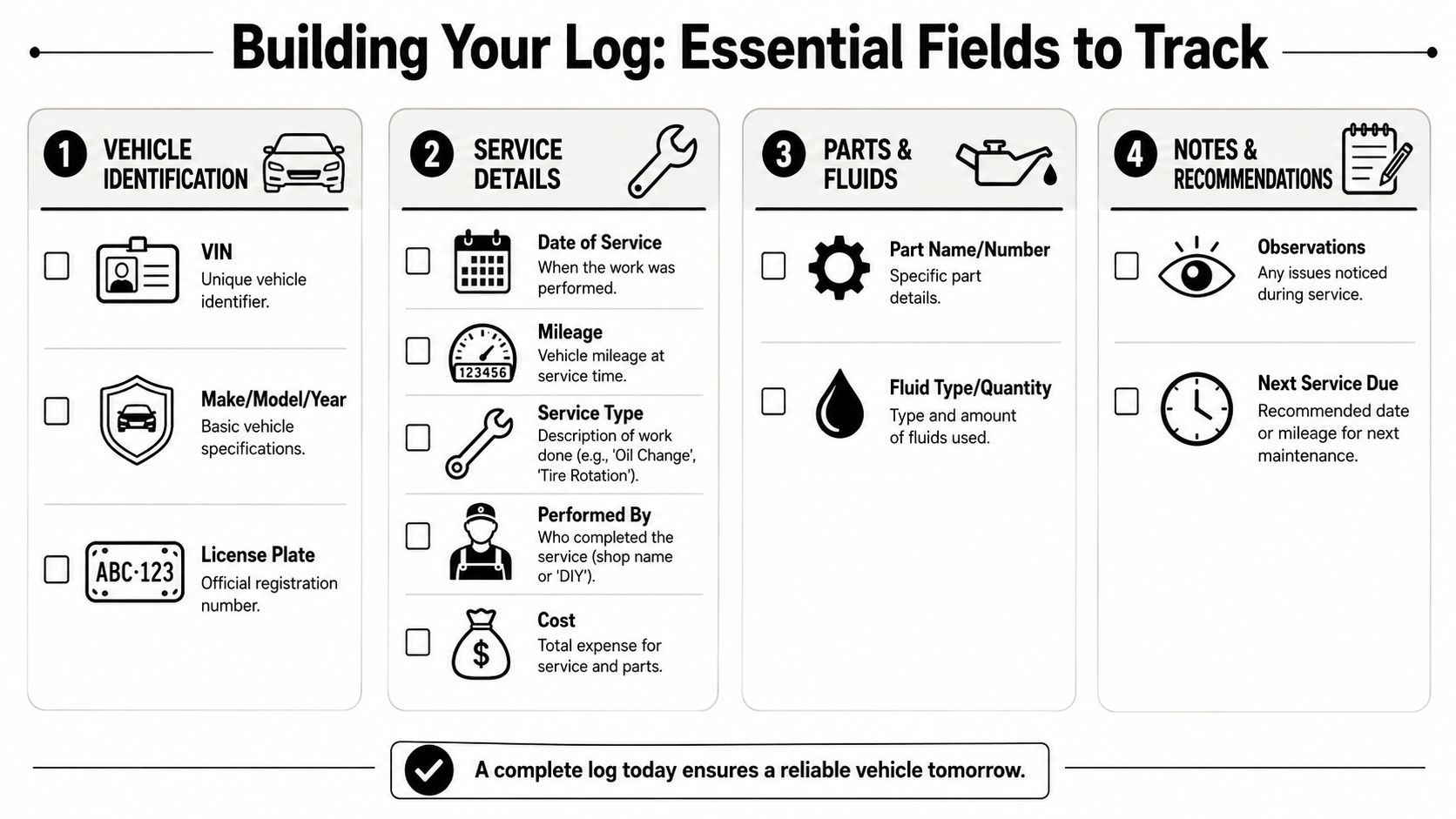
A maintenance log only holds up if another person can follow it without guessing. That person might be a warranty administrator, an insurance adjuster, a buyer, or a fleet manager reviewing downtime and cost. If the record is missing identifiers, dates, mileage, or proof of what was installed, the log turns into a rough memory aid instead of a document you can rely on.
Vehicle identity comes first
Every entry should be tied to one specific vehicle before you record any service work. In the shop, this is where weak paperwork usually falls apart. Owners keep the oil change receipt but forget the VIN, plate, or unit number, then later have to prove which car the invoice belongs to.
Start your log with:
- VIN
- Year, make, and model
- Licence plate
- Asset ID, if it is part of a fleet
- Location or cost centre, if the vehicle is assigned to a business unit or site
That sounds basic, but it protects the record. For enthusiasts with multiple cars and for companies running several similar units, clear identity fields stop one vehicle's history from being mixed into another's.
Service details are what make the record usable
The next group is the service event itself. A good entry shows what happened, when it happened, who did the work, and what was used. If a transmission claim, engine issue, or brake failure comes up later, these are the fields that show whether the vehicle was maintained properly and whether the repair path makes sense.
Best-practice guidance for traceable service records stresses clear dates, mileage, work descriptions, repair follow-through, and verification that the issue was resolved (maintenance logbook best practices for traceable service records).
Each service entry should include:
- Date of service
- Mileage or engine hours
- Work performed, written in plain language
- Reason for service, such as scheduled maintenance, warning light, noise, vibration, or inspection finding
- Who performed the work, whether a repair shop, in-house technician, or owner
- Part names and part numbers
- Fluid specification and quantity
- Defects found
- Corrective action taken
- Confirmation the repair was completed and checked
Short notes cause problems. “Serviced brakes” is weak. “Front pads and rotors replaced, slide pins cleaned and lubricated, brake fluid topped up, road test completed” is a record you can defend.
Cost, proof, and next due fields protect the car financially
A proper log should also show what the work cost and preserve the evidence behind it. This is the part many basic templates miss, and it is the part that often matters most once money is on the line.
Include these fields every time:
- Parts cost
- Labour cost
- Total invoice amount
- Invoice or receipt number
- Warranty coverage or recall notes
- Photos, if damage, wear, or installation details matter
- Supporting files, such as receipts, inspection reports, and invoices
- Next service due, by date or mileage
Those fields do more than help with scheduling. They support warranty claims by showing the vehicle was serviced on time and with the correct materials. They help justify insurance payouts after a loss by documenting condition, prior repairs, and recent parts installed. They also strengthen resale conversations because a buyer can see a complete paper trail instead of taking your word for it.
Service intervals still matter, of course. If you need a practical baseline for what should be logged and how often, compare your owner's manual with a realistic maintenance schedule such as how often you should service your car. The goal is a record that proves care, protects value, and stands up when someone asks for evidence.
Choosing Your Logging Method Printable versus Digital
The best logging method is the one you'll keep using after the first month. That's the true measure.
Some owners do better with a binder in the glovebox and a folder of invoices at home. Others will never keep paper organised, but they'll update a spreadsheet on their phone before they leave the car park. Neither system is automatically better. The right choice depends on how you work, how many vehicles you track, and whether you need fast search, backup, or sharing.
Printable logs work well when you want a physical trail
A binder or notebook gives you something many enthusiasts still value. A visible, tangible service history.
That matters for classic cars, weekend cars, and vehicles that already have a stack of receipts going back years. A paper log is also simple. No app setup, no password reset, no file format issues. If you like paper invoices and handwritten notes, a binder feels natural.
The downside is that paper gets lost, coffee gets spilled, and receipts fade. Search is slow. If someone asks for every brake-related service entry over a period of ownership, you'll spend time flipping pages.
Digital logs win on search and backup
Digital logs are easier to sort, search, and duplicate. A basic spreadsheet can work fine for one or two personal vehicles. An app can be even better if it lets you attach receipts and photos to each entry.
For fleet use, digital usually becomes the practical option much sooner. Once more than one person touches the same vehicle history, you need consistency. A shared system also makes it easier to connect repair history with scheduling, downtime, and vendor records. For businesses managing multiple units, fleet maintenance support fits naturally with a digital-first record because invoices, service details, and follow-up work can all be stored in one place.
Paper is easy to start. Digital is easier to search. The right answer depends on which failure you're more likely to have: forgetting to log, or losing the record.
Printable vs. Digital Vehicle Maintenance Logs
| Criterion | Printable Log (Binder/Notebook) | Digital Log (App/Spreadsheet) |
|---|---|---|
| Ease of setup | Very simple. Start today with paper and a pen. | Simple if you're comfortable with apps or spreadsheets. |
| Physical proof | Strong. Buyers often like a folder they can hold. | Strong if documents are attached and organised clearly. |
| Searchability | Weak. You must read through pages manually. | Strong. You can sort by date, mileage, repair type, or vehicle. |
| Backup | Weak unless you scan everything. | Strong if files are backed up properly. |
| Receipt storage | Good if you use sleeves or folders. | Good if you photograph and upload receipts right away. |
| Multi-vehicle use | Can get messy quickly. | Better for multiple cars or fleet units. |
| Sharing with buyers or staff | Slower. Usually in person only. | Easier to send, print, or review remotely. |
| Risk point | Loss, fading receipts, incomplete handwriting. | Forgotten uploads, duplicate files, inconsistent naming. |
What usually works in practice
A hybrid system is often the most reliable. Keep digital copies of every invoice and photo, then keep a lean paper summary for quick reference if you like physical records.
For a new daily driver under warranty, digital tends to be the cleaner option. For an enthusiast car with a long ownership story, a binder plus scanned backups often works better than either system alone.
Best Practices for Consistent Record-Keeping
Most logs don't fail because the format was wrong. They fail because the habit never stuck.
The owners with solid records usually do a few small things the same way every time. They don't wait until the weekend to update the file. They don't toss receipts onto the passenger seat. They don't trust the memory of “I'll sort that later.”
Build the habit around the service visit
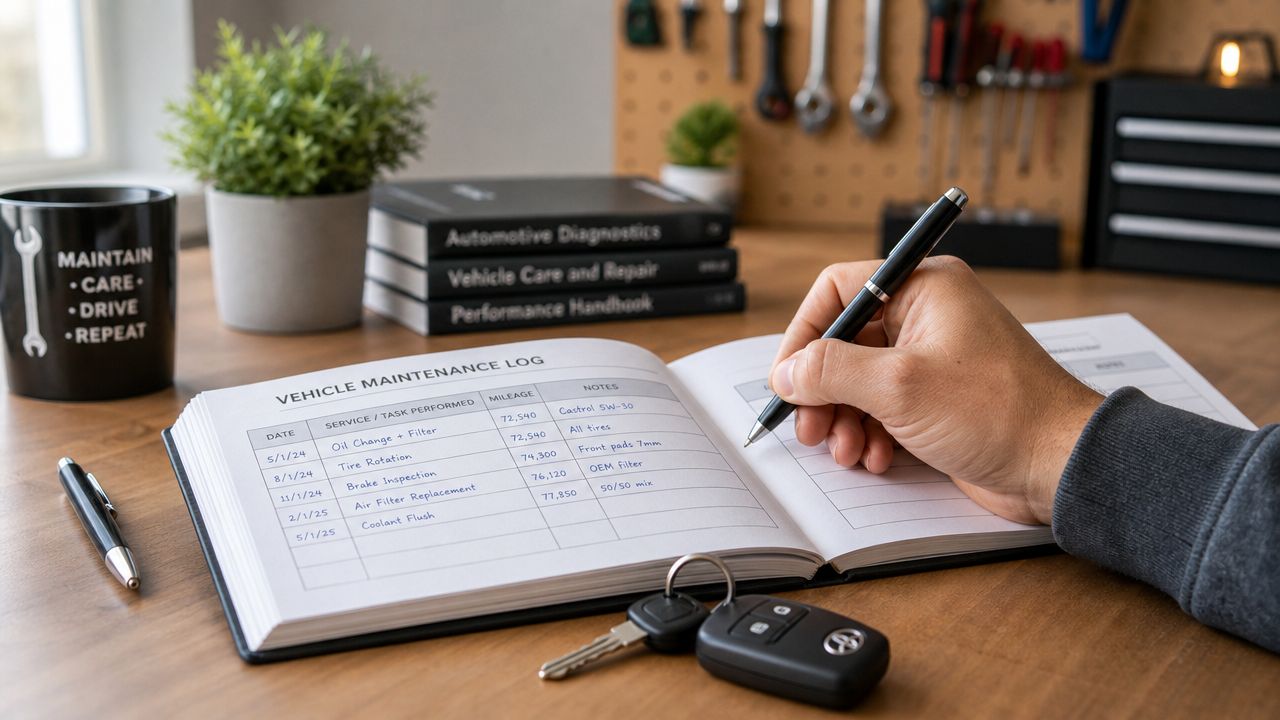
The strongest routine is the simplest one. Update the log immediately after service.
That can mean standing at the counter before you leave the shop, sitting in the car for two minutes, or uploading the invoice to your phone the moment you receive it. If you wait, details get fuzzy. Part names disappear from memory. Recommendations from the technician get forgotten.
A practical routine looks like this:
- Enter the date and mileage while it's fresh.
- Add the invoice or receipt as a photo or scanned file.
- Note what was done in plain language.
- Record what's due next based on the manual or shop recommendation.
- Store photos of any observed issue if the repair was deferred.
Protect the evidence, not just the memory
Thermal receipts fade. Text reminders disappear. Windshield stickers get replaced.
That's why the proof should live in more than one place. A good process is to photograph invoices, save PDFs from emailed bills, and keep notes about anything unusual. If the technician pointed out a seep, a torn boot, or uneven tire wear, write it down. That note can explain a later repair and show that you didn't ignore maintenance.
A complete record beats a perfect memory every time.
Keep the format boring and repeatable
People abandon logs when they make them too complicated. They create custom tabs, colour codes, formulas, tags, and categories they stop using after a month.
What works is a plain repeatable format. Same fields every time. Same file naming. Same storage location. If you sell the vehicle later, that consistency becomes obvious to the buyer. It tells them the car was managed carefully.
Here's where that pays off most. A private buyer looking at two similar cars will usually trust the one with organised service history more. Not because the folder is fancy, but because the record lowers uncertainty. It answers the questions before they have to ask them.
Use reminders, but don't rely on them alone
Calendar reminders are useful. So are service stickers. Neither should be the main record.
Use reminders to prompt action, then make the log the final record after the work is done. That keeps your file tied to real maintenance, not intentions.
Advanced Logging for Fleets and Enthusiasts
A basic log tells you what got done. An advanced log helps you defend decisions that can cost real money.
That matters fast once you manage multiple vehicles or maintain one car to a higher standard than average. For fleet owners, the record supports repair-versus-replace calls, warranty disputes, downtime reviews, and insurance documentation after an incident. For enthusiasts, it proves the car was maintained with intent, not just serviced whenever something failed.
Fleets need records built around each asset
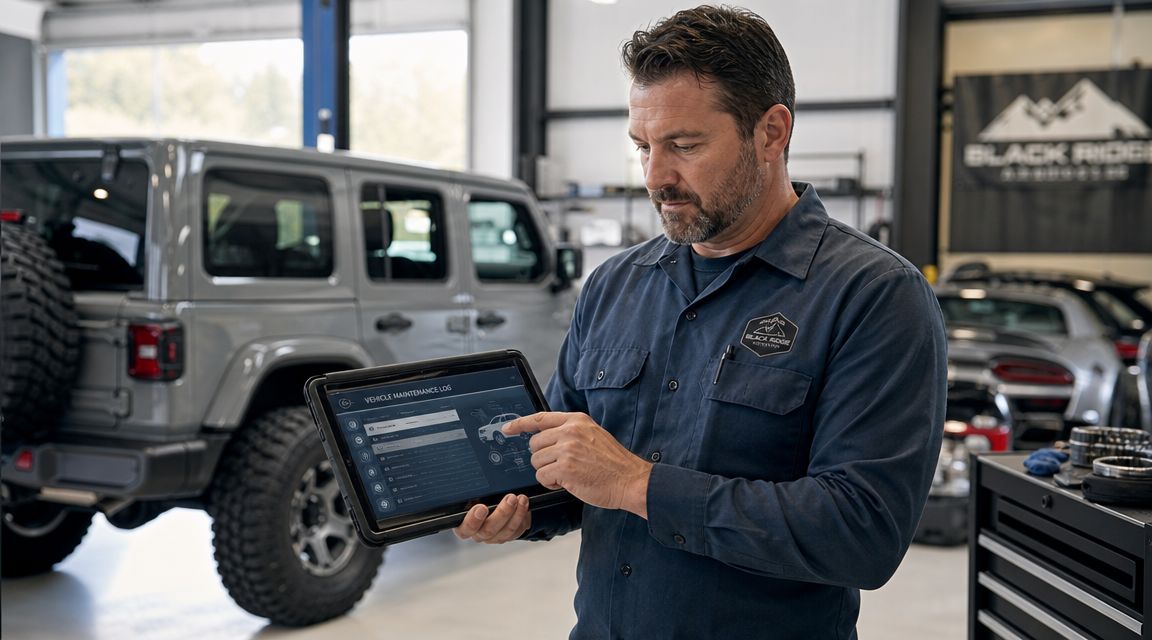
Fleet logs fall apart when service notes live in email threads, glove boxes, and separate vendor portals. Every job needs to tie back to one unit first, then sit in order by date and mileage. That is how a manager proves what happened, who approved it, whether the work was under warranty, and how long that vehicle was off the road.
In the shop, averages hide problem units all the time. Three vans may have normal brake costs, while one keeps burning through pads, calipers, or front-end parts because of route load, driver habits, or a missed root cause. A clean asset record makes that pattern obvious before another invoice lands on the desk.
For fleet use, stronger logs usually track:
- Asset ID, VIN, plate, and assigned driver or department
- Date in, date out, and downtime reason
- Mileage or engine hours at service
- Complaint, diagnosis, repair performed, and who authorized it
- Parts used, supplier, invoice total, and warranty status
- Repeat failures or comebacks on the same system
That level of detail does more than keep operations tidy. It gives you a file you can hand to an insurer, a warranty administrator, or a buyer without filling gaps from memory.
Enthusiasts should record intent
Enthusiast-owned cars usually get decent service. The weak point is the missing why behind the work.
If you changed to a different oil because of track use, note it. If you chose OEM control arms over cheaper aftermarket parts because of ride quality, note that too. If a vibration improved but did not disappear after balancing and an alignment, write it down. Those details matter later when the same symptom returns or when a buyer wants proof that the car was sorted carefully.
A stronger enthusiast log often includes:
- Part brand, part number, and whether it was OEM, OE supplier, or aftermarket
- Fluid type and specification
- Wheel, tire, alignment, and suspension settings
- Storage prep, battery maintenance, and seasonal changes
- Test results, scan codes, and follow-up notes for intermittent faults
- Deferred repairs and the reason they were deferred
For performance cars and collector vehicles, that context protects value. Buyers pay more for a car with a believable paper trail. They are not just buying receipts. They are buying confidence in how the car was cared for.
Intermittent faults deserve special attention. If a warning light appears twice in six months, a one-line note is weak evidence. A dated entry with symptoms, scan results, weather conditions, and the final fix gives the next technician something useful to work from. That is the same logic behind a proper engine diagnostics service in Whitby. Good diagnosis starts with a clear history.
Better logs lead to better calls
The primary advantage is judgment.
A fleet owner can look at one unit and see recurring cooling system repairs, rising downtime, and a pattern of deferred work. An enthusiast can verify whether a noise is new, whether a part was already replaced, or whether a modification introduced the problem. In both cases, the log stops guesswork.
At Carmedics Autowerks, we see the difference immediately. Owners with disciplined records approve repairs faster, challenge denied warranty claims more effectively, and sell cleaner vehicles with less pushback from buyers. A thin log creates doubt. A detailed one gives you something solid to stand on.
Turning Your Records Into Peace of Mind
A proper vehicle maintenance log isn't administrative busywork. It's protection.
It protects you when warranty coverage gets questioned. It protects your negotiating position when you sell. It protects your understanding of the vehicle because you can see what's been done, what keeps coming back, and what should happen next. For fleets, it also protects decision-making because every vehicle gets judged on its own history, not on guesswork.
The biggest shift is mental. Stop thinking of the log as a reminder list. Think of it as a defence file for the vehicle.
What matters most
The owners who get the most value from a log usually keep these priorities straight:
- Proof beats memory. Receipts, invoices, photos, and clear notes carry more weight than recollection.
- A few strong fields beat a messy system. Vehicle identity, date, mileage, work performed, parts, labour, and next due are the core.
- Consistency matters more than detail overload. A simple log updated every time is far stronger than a perfect template abandoned after two entries.
- Good records improve confidence. Buyers, warranty teams, and business owners all respond better to documented history.
That's why the right shop matters too. You want repair records that are clear enough to file, keep, and understand later. If you need a place to start or want service records that are easier to track properly, a qualified car mechanic should be able to give you invoice detail that makes your maintenance file stronger, not harder to manage.
A vehicle that's maintained properly is valuable. A vehicle that's maintained properly and documented properly is worth more, easier to defend, and much less stressful to own.
If you want service work documented in a way that supports your records, Carmedics Autowerks Inc in Whitby handles auto repair and maintenance for cars, SUVs, and fleets, with invoice detail that fits cleanly into a serious vehicle maintenance log.