
A crash changes your day in a second. One moment you're driving through Whitby thinking about work, dinner, or hockey practice. The next, you're standing beside your vehicle, looking at a bumper, fender, headlamp, or wheel that no longer sits the way it should.
That's when most drivers start asking the wrong first question. They ask, “How fast can this be fixed?” The better question is, “Who can restore this vehicle properly?”
A modern collision repair isn't just cosmetic. It can involve structural measurement, sensor checks, camera or radar calibration, paint blending, parts decisions, insurer communication, and final quality control. If you drive a newer car, the repair also affects safety performance and long-term value. A good collision centre puts all of that back in order, not just the visible panel damage.
After the Accident Your First Steps in Whitby
If you're reading this right after a collision, slow the process down.
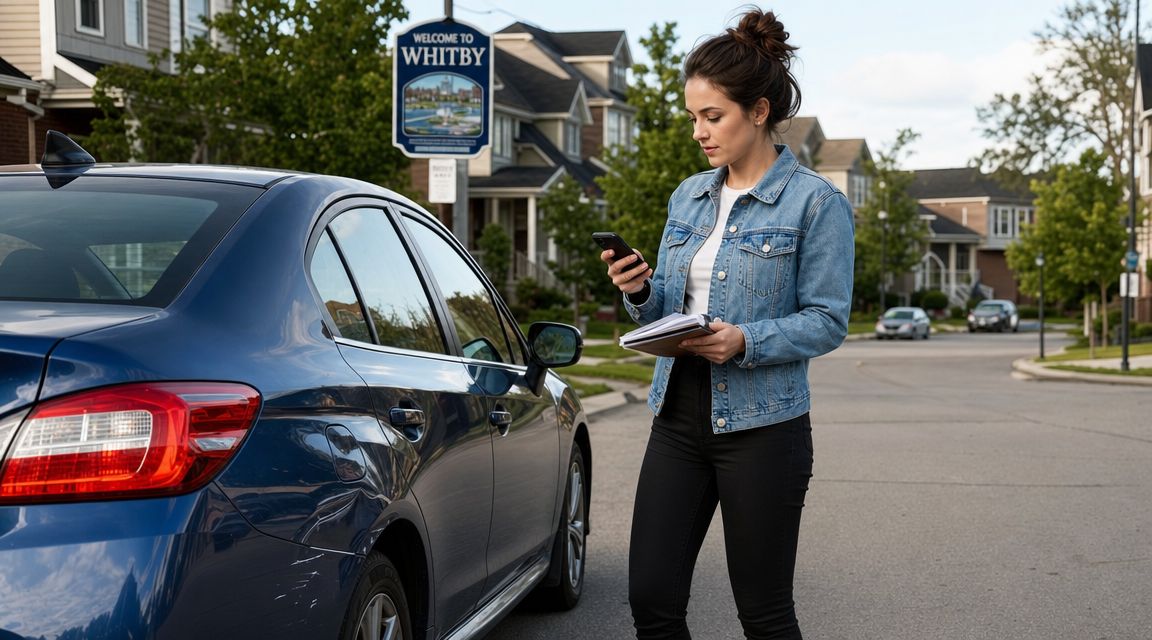
Start with safety. Move the vehicle only if it's safe and legal to do so. Check everyone involved. Gather photos from several angles, including wider shots that show position, road conditions, and nearby signs. Get the other driver's information, and write down anything you notice before details get fuzzy.
If you want a clear Ontario-focused checklist while the situation is still fresh, UL Lawyers' car accident resource is useful because it walks through the immediate steps without legal jargon. After that, contact your insurer, but remember that opening a claim and choosing where the vehicle gets repaired are separate decisions.
What to do before authorising repairs
The first shop you speak to shouldn't automatically become the shop that repairs the car. Ask for a proper assessment. Even a low-speed hit can affect mounting points, hidden brackets, absorbers, wheel alignment, or safety electronics.
Use this short sequence:
- Document the damage carefully. Take photos of the exterior, interior warnings, mileage, and any fluid leaks.
- Ask whether the vehicle is still safe to drive. If there's suspension damage, lighting failure, coolant loss, or warning messages, don't guess.
- Choose a repair facility deliberately. If you need both collision work and follow-up mechanical inspection, it helps to understand what a full-service auto repair process in Whitby can look like after body damage is assessed.
- Keep your paperwork together. Tow bill, claim number, photos, police or reporting-centre information, and rental details should all stay in one place.
Practical rule: Don't judge crash severity by how easy the door still opens or how small the dent looks. Hidden damage often sits behind parts designed to absorb impact.
The bigger reason this matters is that collision repair has become far more technical. The global automotive collision repair service market is estimated at US$195.27 billion in 2024, with the North American segment projected to reach US$72.02 billion by 2034, according to Fact.MR's collision repair market analysis. For a Whitby driver, that scale reflects something you can feel in the shop every day. Repairs now involve more complexity, more procedure, and more room for costly shortcuts if the centre isn't organised.
Your car's value is part of the repair
A sound repair protects more than appearance. It helps preserve resale, lease-return condition, corrosion protection, and the vehicle's pre-loss safety performance. That's why the right collision center in Whitby should treat the estimate as the beginning of a restoration plan, not a quick price to win the job.
How to Spot a Top-Tier Whitby Collision Repair Shop
You can tell a lot in the first ten minutes.
A strong shop feels organised. The front counter can explain the process without rushing you. The production area looks controlled, not chaotic. Staff answer direct questions directly. That doesn't mean the place has to look like a showroom. It means the workflow looks intentional.
Green flags and red flags
Here's a practical side-by-side view.
| What you see | Green flag | Red flag |
|---|---|---|
| Front office | Clear intake process, written next steps, realistic timing | Vague answers, pressure to sign immediately |
| Shop floor | Clean lanes, labelled parts, vehicles staged by repair step | Loose parts everywhere, mixed-up vehicles, clutter around work areas |
| Estimator | Explains repair logic and possible hidden damage | Talks only about price and says “we'll see” to everything |
| Technology discussion | Can explain scanning, calibration, and documentation | Changes the subject when asked about electronics |
| Customer communication | Gives update expectations before the job starts | Says they'll “call if anything comes up” and leaves it there |
One of the most overlooked questions is whether the shop can restore your vehicle's driver-assistance systems after impact. A local content gap in the market is that many collision pages still focus on dents and paint, while newer vehicles may need camera, radar, or other safety-system checks after a crash. This is the key issue addressed in this Whitby-area discussion of ADAS-related repair concerns. If a shop can't explain how it handles post-repair calibration, you should keep looking.
A repair that looks straight but leaves the vehicle's safety systems out of spec isn't finished.
What a good conversation sounds like
Ask simple questions and listen to the confidence of the answer.
A good shop will explain whether it follows manufacturer procedures, whether sublet work is involved, how parts are tracked, and when calibrations happen in the sequence. It won't hide behind generic promises like “we do everything.” It will tell you who does what.
For specialty vehicles, the same principle applies. If you own something outside the usual passenger-car workflow, experience matters. For example, owners of larger recreational vehicles often look for dedicated motorhome collision specialists because body construction, panel materials, and repair access differ from a sedan or SUV.
Signs the shop understands modern vehicles
Before you book in, look for evidence that the team works on current vehicle technology, not just legacy bodywork. One practical place to start is checking whether the facility presents itself as a certified auto repair option in Whitby with clear service scope and process discipline.
Watch for these specifics:
- Calibration awareness: Staff mention scanning, aiming, or recalibration without needing to be prompted twice.
- Parts discipline: Removed parts are tagged, stored, and separated by vehicle.
- Repair planning: They discuss teardown, approvals, and reassembly in sequence.
- No false urgency: They don't try to rush your signature by implying every other option is unsafe or invalid.
The best collision center in Whitby won't just reassure you. It will make the process understandable.
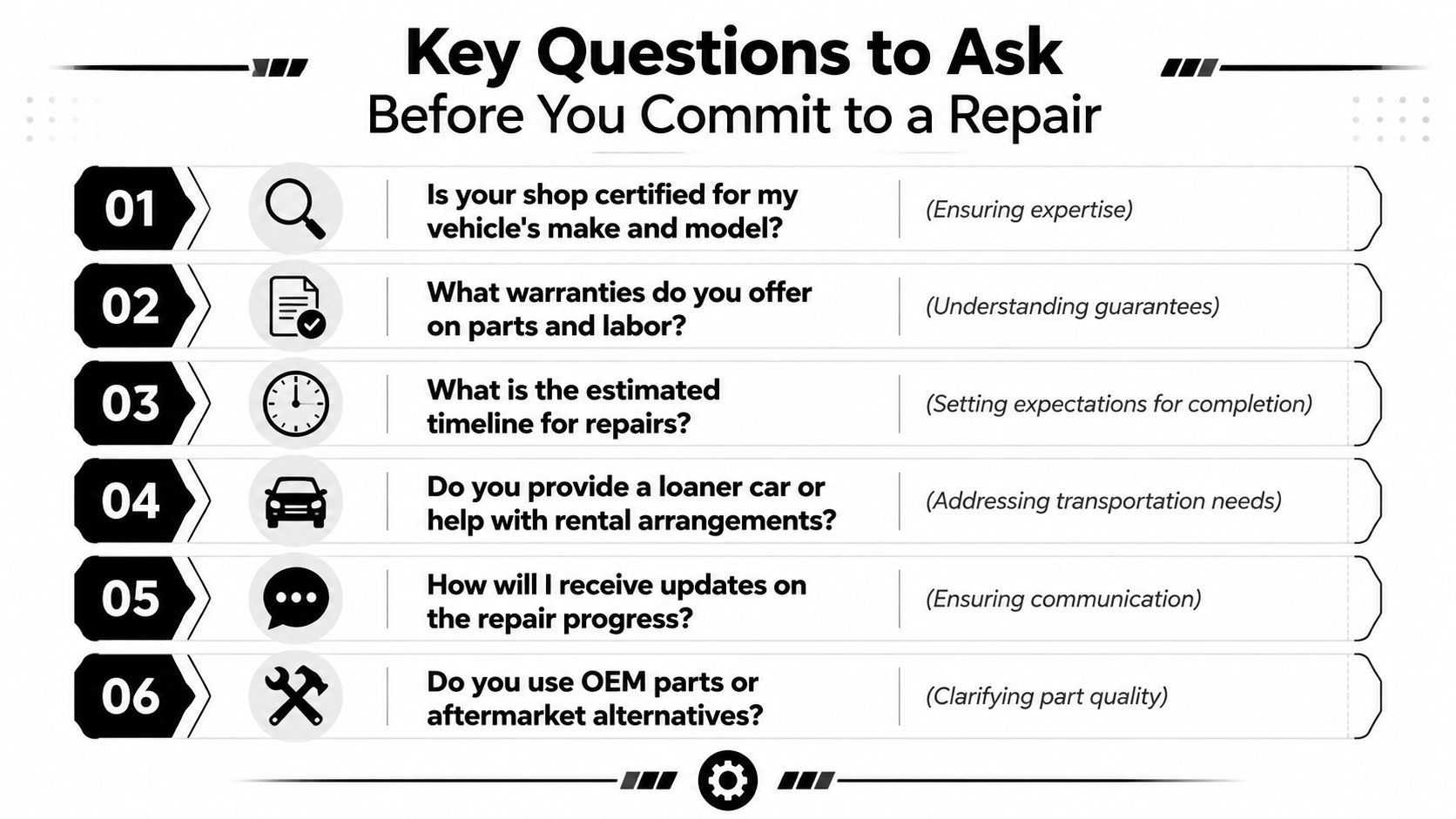
Key Questions to Ask Before You Commit to a Repair
You are standing at the front counter with a damaged late-model SUV, and the estimate sounds fine until you realize nobody has explained how the sensors, cameras, or structural materials will be checked. That is the point to slow down and ask better questions. A proper repair restores how the vehicle protects you, how it drives, and what it is worth later. Paint quality matters, but it is only part of the job.
Modern collision work has more handoffs, more scanning, and more manufacturer rules than it did a decade ago. That is why the estimate meeting matters. It is your chance to find out whether the shop has a repair plan or is merely writing a number.
Ask about certification and repair procedure
Start with a direct question: “Do you have the repair information and equipment needed for my vehicle?”
That wording points to the main issue. Some shops are certified for certain brands. Others are not certified but still have solid experience with a model line, access to repair procedures, and the right sublet partners for specialized work. The answer should cover the vehicle's material type, whether sectioning is allowed, what has to be replaced instead of repaired, and whether pre-scan and post-scan steps are part of the process.
Then ask: “How do you decide whether a part gets repaired or replaced?”
A good answer mentions more than cost. It should include fit, corrosion protection, crash performance, mounting points, and sensor location. On newer vehicles, a bumper cover or bracket can affect radar aim, parking sensors, and camera alignment. Saving a part is not always the smart choice if it creates problems later.
Ask about parts, paint, and warranty
Parts decisions can change repair quality, resale value, and claim cost. Ask: “Which parts are you proposing, and why?” If you want a clearer explanation before approving the job, review this guide on OEM vs aftermarket collision parts.
Then keep going:
- “Will any used, aftermarket, or reconditioned parts be on this repair?”
- “Are there any parts on this vehicle that should stay OEM for fit or safety reasons?”
- “What warranty do you provide on paint and workmanship, and can I see it in writing?”
- “How will you handle colour match, blend panels, and texture on adjacent panels?”
Those answers should be specific. “We warranty our work” is too vague. “We blend the front door because the fender colour transition will show otherwise” is the kind of explanation that shows the estimator understands the finish side of the job.
Ask about electronics and calibrations
Many drivers never get to the most important topic. Ask it plainly: “What electronic systems will be scanned, tested, or calibrated after the repair?”
You want a real process here. The shop should explain pre-repair scanning, post-repair scanning, calibration requirements, and whether those calibrations happen in-house or through a qualified partner. If the answer avoids discussing electronics, treats warning lights as the only sign of a problem, or speaks in generalities, take that seriously.
This matters even after what looks like minor damage. A front-end hit can affect radar brackets. A windshield replacement can require camera calibration. Suspension or steering work can change what the driver assistance systems see. If those steps are skipped, the car may look right and still not perform as designed.
Ask about timing and communication
Delivery dates are often missed for predictable reasons. Parts get delayed. Hidden damage appears after teardown. Insurer approvals take time. Calibration slots are not always available the same day reassembly finishes.
So ask: “What usually changes the schedule on a repair like mine, and how will you keep me updated?”
A useful answer includes update frequency, who contacts you, how supplements are approved, and what happens if the insurer and shop disagree on a repair line. Clear communication reduces surprises and gives you a record of what changed and why.
Ask how the vehicle is cleared for return
Finish with the question that protects you most: “Before you hand me the keys, how do you confirm the vehicle is safe and complete?”
The reply should include final inspection, scan results if applicable, road test where appropriate, warning light checks, fit and finish review, and confirmation that safety features operate as they should. I would also expect clear documentation. If the conversation stays focused on cosmetics alone, the shop is missing the bigger responsibility.
One local option some Whitby drivers compare is Carmedics Autowerks' collision and related vehicle service offering, especially when the repair discussion also includes post-repair protection such as PPF. Whatever shop you choose, listen for process, documentation, and a clear explanation of trade-offs. That is usually the difference between a repair that only looks finished and one that is properly finished.
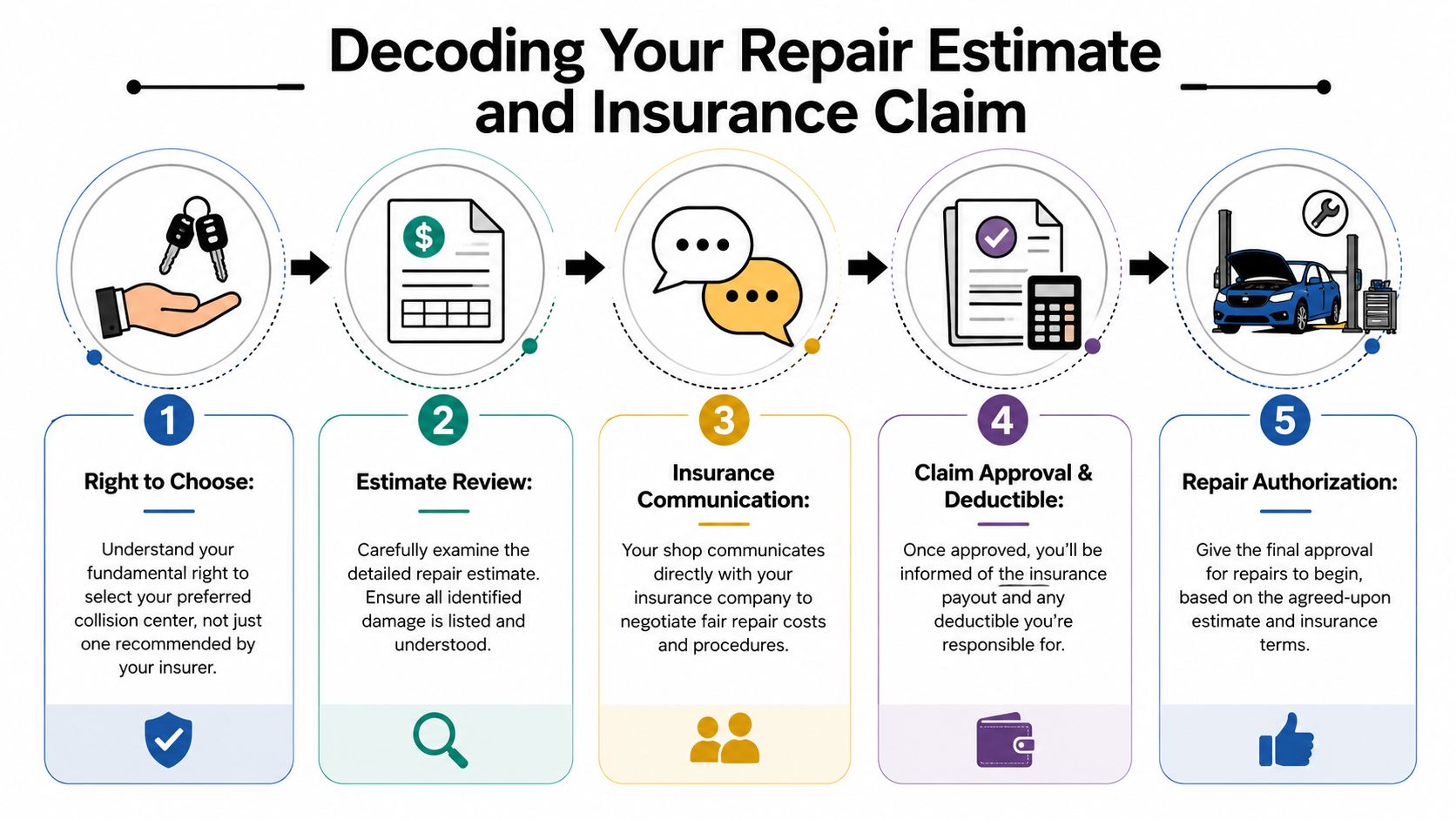
Decoding Your Repair Estimate and Insurance Claim
Most estimates look more complicated than they really are. Think of the document as a repair blueprint. It lists visible damage, expected operations, paint work, parts, and labour categories. It is not the final truth on day one. It's the informed starting point.
That matters because modern jobs often slow down when the administrative side isn't handled tightly. Industry data reported through Audi Durham noted that shops were averaging only about 2.5 labour hours per repair day on drivable vehicles in the second half of 2021, down from more than 3.5 hours in 2016-2017, according to Audi Durham's Whitby Collision and Glass page. For drivers, that shows why estimate handling, approvals, and supplements can affect your timeline as much as the wrench work.
Terms that confuse drivers most
A few estimate terms come up constantly:
- R&I means remove and install. A part may need to come off so technicians can reach damage behind it or refit it properly later.
- Blend means extending paint into an adjacent panel so the colour transition looks correct.
- Paint materials refers to the products used in refinishing, not just the final visible coat.
- Supplement means added repair operations discovered after teardown or after further inspection.
A supplement is not automatically a red flag. In many cases, it's the sign of a shop that kept looking instead of pretending the first glance showed everything.
Your right to choose matters
You do not have to treat your insurer's suggested facility as your only option. Insurers can recommend. You can still decide where the vehicle goes.
That decision matters most when your car has newer electronics, higher trim content, specialty paint, or brand-specific procedures. If you're comparing local options, reviewing a nearby auto body shop in Whitby can help you understand service scope before you authorise the claim work.
Approvals move faster when the estimate is clear, the photos are complete, and the supplement explanation is tied to actual teardown findings.
How to read the estimate without getting lost
Use this sequence when reviewing paperwork with the estimator:
- Confirm the vehicle details. VIN, mileage, and claimed damage area should match.
- Walk panel by panel. Ask which items are repair, replace, refinish, or inspect.
- Clarify non-visible operations. If scanning, alignment checks, or calibration-related work is needed, ask where that appears.
- Ask what could change later. The shop should identify likely supplement areas, not act as if surprises never happen.
An estimate should leave you better informed, not more dependent. If the shop can explain it in plain language, that's usually a good sign the internal process is organised too.
From Drop-Off to Delivery What to Expect
Once you hand over the keys, the repair moves through a chain of stages. Good shops control that flow carefully because one missed step early can create fit, finish, or safety issues at the end.
Current claims data shows average last-estimate-to-vehicle-out time of 32.3 days for combustion vehicles and 37.6 days for EVs, according to CCC Intelligent Solutions' 2024 claims reporting. That gap is one reason I tell drivers not to compare every repair timeline as if all vehicles move through the same pipeline. EVs and newer tech-heavy vehicles often need more coordination.
What happens in the shop
Most repairs follow this order, even if the exact timing changes:
Check-in and pre-wash
The vehicle is documented, inspected, and prepared for teardown.Disassembly and discovery
Hidden damage becomes visible once covers, lamps, liners, and adjacent parts come off.Structural and body repair
This can include measuring, pulling, panel repair, or replacement.Prep and paint
Surface prep, priming, colour work, and curing all need controlled conditions.Reassembly
Trim, lamps, clips, mouldings, seals, and mechanical components go back together in sequence.Final inspection and handover
Fit, finish, functions, warning lights, and cleanliness should all be checked before delivery.
What usually causes delays
Drivers are often patient with repair work and frustrated by silence. The best shops explain where hold-ups happen.
Common causes include:
- Parts backorders
- Supplement approval waiting
- Calibration scheduling
- Unexpected hidden damage
- Model-specific repair procedures
If your vehicle is electric or heavily equipped with driver-assistance features, the process can add coordination points that a basic cosmetic repair doesn't have. That's why choosing a collision center in Whitby with a disciplined workflow matters more than a fast promise made on day one.
Your pickup checklist
Before driving away, take five extra minutes.
Review these items:
- Panel gaps: Check doors, hood, tailgate, and bumper alignment.
- Paint match: Look at colour and texture in daylight if possible.
- Lights and electronics: Confirm lamps, cameras, parking sensors, and warning lights.
- Interior condition: Make sure trim pieces, mats, and settings are in order.
- Paperwork: Ask what was repaired, what was replaced, and what warranty documents apply.
If you want a local point of reference for drop-off expectations and communication style, you can review Carmedics Autowerks in Whitby alongside other facilities you're considering.
Choosing Excellence for Your Vehicle in Whitby
The right repair doesn't just make damage harder to spot. It restores the vehicle in a way that respects how modern cars are built and how owners use them. That means body lines, paint finish, corrosion protection, electronics, and safety systems all need to come back together properly.
That's the standard for a collision center in Whitby. Not the lowest estimate. Not the fastest verbal promise. The standard is whether the shop can explain its process, document its decisions, and return the vehicle with the same seriousness the manufacturer put into building it.
What quality looks like in practice
A quality-focused repair centre usually does a few things consistently:
- It communicates clearly. You know what's happening, what changed, and why.
- It treats safety systems as part of the repair. Cameras, radar, and related checks aren't afterthoughts.
- It protects vehicle value. Fit, finish, parts choices, and documentation all affect that.
- It doesn't rush the final stage. Delivery should include inspection, not just billing.
Whitby drivers who care about their vehicles tend to notice the details. They notice when metallic paint doesn't lay the same from panel to panel. They notice when a hood sits high on one side. They notice when a steering wheel warning appears after pickup. They should.
The best collision repair is the one you don't have to keep thinking about a week later.
One final standard to hold your shop to
Ask yourself one simple question before you authorise the work: Does this shop sound like it's restoring my vehicle, or just processing a claim?
That question cuts through a lot of noise. A good facility will speak in terms of procedure, inspection, parts fit, and safe return to service. That's what protects your investment and your peace of mind.
If you want a repair conversation grounded in process, safety, and finish quality, Carmedics Autowerks Inc offers collision repair in Whitby along with related vehicle services such as PPF, tint, fleet maintenance, and general auto repair. Start with an assessment, ask detailed questions, and make sure the plan for your vehicle covers more than the visible damage.