

You're probably here because something already happened.
A parking lot scrape at the grocery store. A rear-end tap at a light on Dundas. A cracked bumper cover that looked minor until the estimate started climbing. Most drivers don't start researching car repair insurance when life is calm. They start when they're stressed, short on time, and trying to figure out whether their policy will pay for the repair that now matters.
In Whitby, that confusion gets expensive fast. The words people use at the counter, “insurance claim,” “collision,” “repair coverage,” “extended warranty,” “car repair insurance,” often describe very different products. If you mix them up, you can approve the wrong repair, accept the wrong settlement, or assume a breakdown is covered when it isn't.
This guide is the practical version. Not the brochure version. The goal is simple: help you understand what your policy likely covers, what it probably doesn't, how the repair process works on the shop floor, and where drivers get burned when they move too quickly.
The Real Cost of a Fender Bender in Whitby
It usually starts with a hit that doesn't feel catastrophic.
You hear the crunch, get out, and think the damage looks manageable. Maybe the bumper is split, the grille shifted, and one headlamp bracket is broken. The car still drives. That's where a lot of people get lulled into bad decisions. They assume “minor” damage means a minor bill.
In Ontario, that assumption often falls apart. The Insurance Bureau of Canada reports that Ontario drivers pay the highest average premiums in the country, and national claims data show the average auto liability claim for property damage was $5,313 in 2022 (Insurance Information Institute). That figure matters because a typical fender bender doesn't stop at paint and plastic. It can include teardown, hidden brackets, clips, scanning, towing, storage, sublet work, and rental-related costs.
For drivers who want a plain-language outside perspective on how “small” collisions turn into meaningful repair bills, this NY driver's guide to fender bender expenses is useful. It's U.S.-based, but the underlying lesson is the same. Visible damage is often only part of the story.
What catches people off guard
A bumper is no longer just a bumper. On many newer vehicles, it sits in front of sensors, wiring, mounts, absorbers, and trim pieces that all need proper inspection. If one part is distorted, the rest of the repair plan can change.
That's why the first estimate isn't always the final number. A proper shop needs time to inspect the vehicle correctly, document what's obvious, and identify what may only appear after disassembly. If you rush that stage, you risk approving a partial repair instead of a complete one.
Practical rule: Never judge repair cost by what you can see in the parking lot.
If your vehicle needs collision-related work, what matters most at the start is getting it assessed properly by a shop that handles real-world insurance repairs every day, not just quick cosmetic fixes. If you need that kind of inspection, a proper auto repair service in Whitby is the starting point, not a guess based on surface damage.
Decoding Your Car Repair Insurance Coverage
The biggest mistake drivers make is using one label for two completely different kinds of protection.
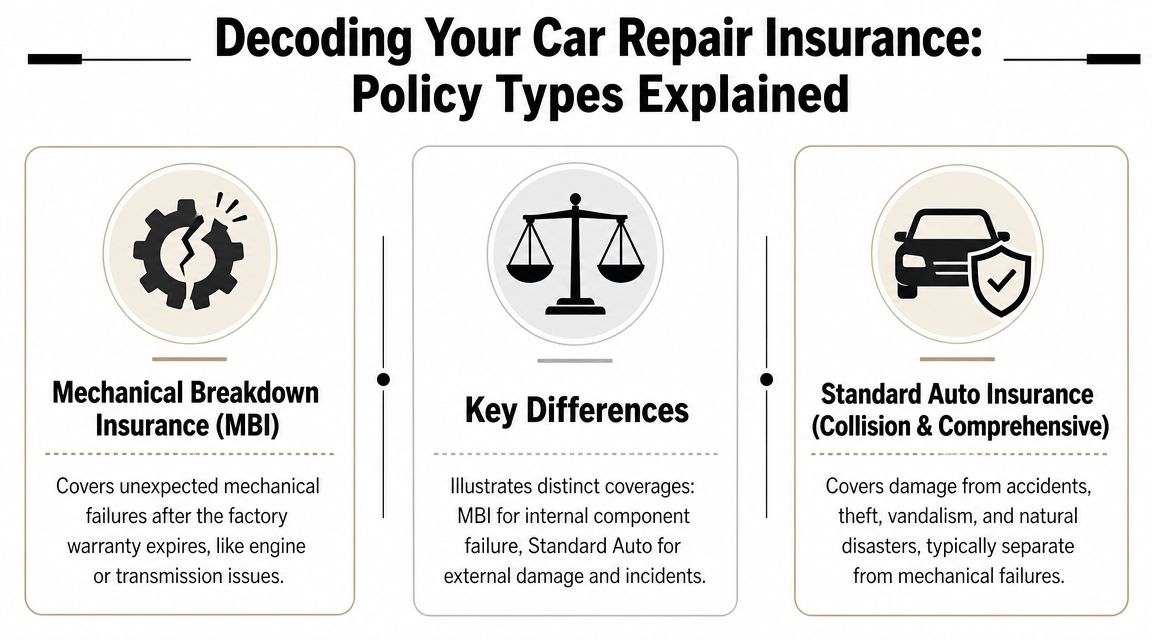
When car repair insurance is mentioned, it may refer to accident coverage. It may also mean a product that pays for mechanical failure after warranty. Those are not the same thing, and if you confuse them, the claim conversation goes sideways immediately.
Accidents versus breakdowns
The simplest way to understand it is this:
Collision and non-collision coverage deal with outside events. A crash. Hail. Theft. Vandalism. Something external happened to the vehicle.
Mechanical breakdown insurance, vehicle protection plans, and many extended-warranty-style products deal with internal failure. The engine develops a covered issue. The transmission fails. An electrical component stops working after the factory warranty period.
That distinction matters because what consumers often call car repair insurance is usually a vehicle protection plan or mechanical breakdown coverage, not standard auto insurance. These products pay for covered mechanical or electrical failures after the typical new-car warranty of 3 years/36,000 miles expires, while collision policies do not cover engine or transmission breakdowns (Cuvrd explainer on automotive repair insurance).
A quick comparison
| Scenario | Covered by Collision/Comprehensive | Covered by MBI/Extended Warranty |
|---|---|---|
| You back into a pole and damage the bumper | Yes, typically under collision | No |
| A tree branch damages the vehicle | Often under comprehensive | No |
| Your engine suffers a covered internal failure after factory warranty | No | Often yes, if the plan includes it |
| Your transmission develops a covered problem after warranty | No | Often yes, if the plan includes it |
| Brake pads, tyres, oil changes, wear items | No | Usually no |
| Rust, cosmetic aging, routine maintenance | No | Usually no |
Where drivers misread the fine print
The confusion often gets worse when people mix repair coverage with legal injury rules. If you want to understand how policy choices can affect claim disputes on the injury side, this overview of the impact of full tort on injury claims is a useful comparison point. It's not Ontario-specific collision advice, but it shows how one insurance term can change the meaning of a claim.
The practical takeaway is straightforward:
- Crash damage needs accident coverage: If another car hit you, you're usually dealing with collision-related policy language, not mechanical breakdown coverage.
- Mechanical failure needs the right contract: If the engine or transmission fails without an accident, your standard collision policy usually won't help.
- Parts matter to the outcome: Your policy and estimate may involve choices about replacement parts. If you're trying to understand that issue before approving work, this guide on OEM vs aftermarket parts is worth reading.
Don't ask, “Do I have car repair insurance?” Ask, “Am I dealing with crash damage or a mechanical failure?” That question gets you to the right answer faster.
Navigating the Auto Claim and Repair Process
Once a claim starts, most drivers want the same thing. Clear steps, no surprises, and no ugly phone call halfway through saying the repair has stalled.
That's realistic, but only if you understand how the process works. Insurance repairs are not one approval and one invoice. They move in stages, and every stage affects what gets paid.
What happens first
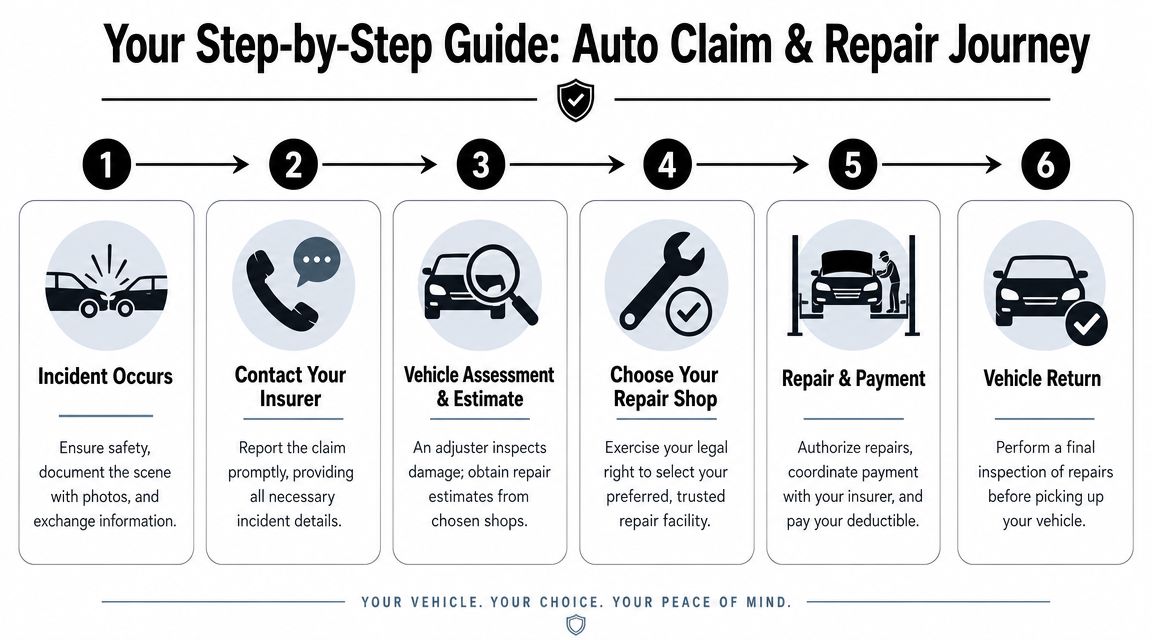
Start with safety, documentation, and reporting. Photograph the scene, the damage, the other vehicle if relevant, and anything that may matter later. Then notify your insurer promptly and get your claim file moving.
From there, the vehicle gets assessed. Sometimes that starts with photos. Sometimes with an in-person inspection. Either way, the quality of the initial diagnosis matters more than drivers realise, because insurers don't pay based on feelings. They pay based on documented damage, policy terms, and approved operations.
How deductibles and approvals work
Most insurance-based repairs use a deductible plus prior authorisation model. Progressive explains that deductibles can range from $100 to $1,000, and the provider pays the shop directly for covered work after diagnosis and approval (Progressive mechanical breakdown coverage). Even though that reference is tied to mechanical breakdown coverage, the working principle is familiar across repair-approval environments: diagnosis first, approval next, payment follows covered work.
That's why good documentation from the shop matters. If the estimate is weak, vague, or incomplete, the claim slows down. If teardown reveals additional covered damage, the shop submits a supplement. That's normal. It isn't a sign anyone is padding the bill. It usually means hidden damage became visible only after parts came off.
A practical claim flow
Report the loss quickly
Give your insurer accurate facts, not guesses about fault or repair cost.Book a proper inspection
The vehicle needs a real assessment, not a parking lot opinion.Review the estimate carefully
Check what parts are listed, what operations are included, and what isn't.Expect supplements if hidden damage appears
Front covers, liners, grilles, lamps, brackets, and supports can conceal additional damage.Pay your deductible when required
The insurer usually pays the covered balance directly to the shop.Inspect the finished vehicle before pickup
Panel fit, warning lights, finish quality, and system function all matter.
Where people lose control of the process
Drivers often think speed is the goal. It isn't. Clarity is the goal. A fast but incomplete estimate causes more delay than a careful first inspection.
If you want a useful contrast from another market, this explainer on carBoost o mini autocasco shows how limited forms of auto damage coverage can create misunderstandings when drivers assume they're broader than they are. The lesson carries over. Always match the policy type to the loss type.
A smooth claim usually comes from three things: accurate reporting, a shop that diagnoses properly, and patience when hidden damage needs supplementary approval.
Your Rights and How to Choose a Quality Repair Shop
A lot of drivers still believe the insurer chooses the shop.
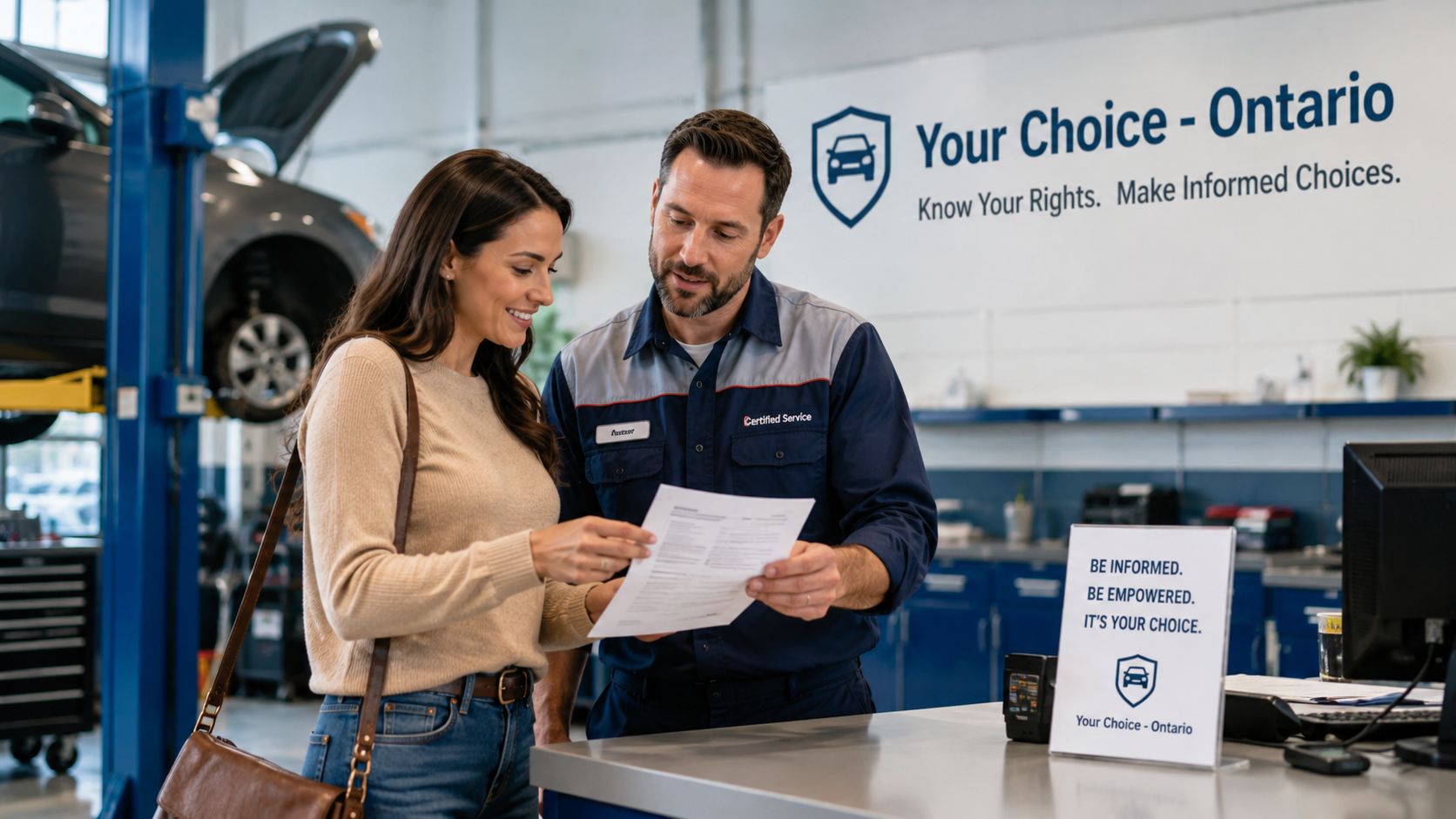
That's one of the most damaging assumptions in the whole process. You need to choose the facility that will repair your vehicle properly, communicate clearly, and stand behind the work. An insurer may suggest a network shop. That suggestion isn't the same as a command.
Why shop choice matters more now
Repairing modern vehicles isn't just bodywork and paint. RSM reports that the consumer price index for motor vehicle maintenance and repair rose by about 10% from 2023 to 2024, and notes that modern vehicles packed with sensors and cameras can turn even minor bumper damage into complex recalibration work (RSM on rising auto repair costs).
That has a practical consequence on the ground. The wrong shop may write an estimate around what's visible and miss the technology side. The better shop asks harder questions. Was an ADAS sensor near the impact zone? Does the repair require scanning? Is calibration needed after parts replacement or alignment-related work? Was the mounting geometry affected?
What to look for in a repair facility
Use a short checklist, not a gut feeling:
- Clear documentation: The shop should explain the estimate, not hide behind jargon.
- Strong diagnostic habits: They should inspect beyond the painted surface.
- Parts transparency: You should know what type of parts are being proposed.
- Communication discipline: Someone should update you when approvals change or supplements are submitted.
- Comfort with modern systems: Sensors, cameras, and recalibration issues shouldn't sound exotic to them.
What doesn't work
A low estimate isn't automatically a good estimate.
Sometimes it means the shop left operations off the sheet, assumed the simplest path, or built the repair around insurer convenience rather than vehicle correctness. That may look efficient on day one. It often creates friction later when parts don't fit right, hidden damage appears, or electronic systems need additional attention.
If you're comparing local options, look for a facility that presents itself as a genuine auto body shop near me in Whitby with the equipment, repair planning discipline, and communication standards needed for current vehicles.
Choose the shop the way you'd choose a surgeon. You're not buying the cheapest estimate. You're buying the quality of the repair and the confidence that the vehicle was put back together properly.
The Carmedics Autowerks Process for Whitby Drivers
When drivers bring an insurance-related repair into a serious shop, they usually want two things handled at once. They want the vehicle repaired correctly, and they want the paperwork headache reduced.
That only happens when the front office and the shop floor are working from the same plan. The estimate can't be written in isolation from the actual repair path, and the customer shouldn't be left acting as the middleman between the adjuster and the technician.
What to bring to the appointment
Bring the information that lets the claim move without unnecessary back-and-forth:
- Your claim number
- Insurer contact details
- Policy information if available
- Accident details and photos
- Any adjuster or appraisal notes you've already received
- Vehicle ownership and contact information
If the vehicle has warning lights, drivability issues, or recent related repairs, mention that at the start. Those details can affect diagnostic direction and communication with the insurer.
How a proper shop interfaces with the insurer
The repair process works best when the shop documents thoroughly, communicates directly, and doesn't treat supplements like a nuisance. Hidden damage is part of collision work. The key is proving it properly.
A disciplined shop will inspect visible damage, identify likely hidden areas, and update the estimate when teardown reveals more. It will also discuss parts, repair-versus-replace logic, and any calibration or sublet operations that belong in the plan. That keeps the file cleaner and reduces the chances of the customer being surprised at pickup.
Why this matters to Whitby drivers
Local drivers don't need more theory. They need a repair partner that can translate insurer language into plain English and explain why an approval is pending, why a supplement was submitted, or why a part choice affects the result.
If you want to understand how that local process is set up, the Carmedics Autowerks Whitby location gives you the practical starting point. Its primary value isn't just wrench time. It's having a shop that can manage the administrative side without losing sight of the vehicle.
Common Insurance Claim Pitfalls You Must Avoid
Most expensive claim mistakes happen early.
Drivers feel rushed, want the problem gone, and agree to things they haven't fully understood. That's how a manageable repair turns into a frustrating one.
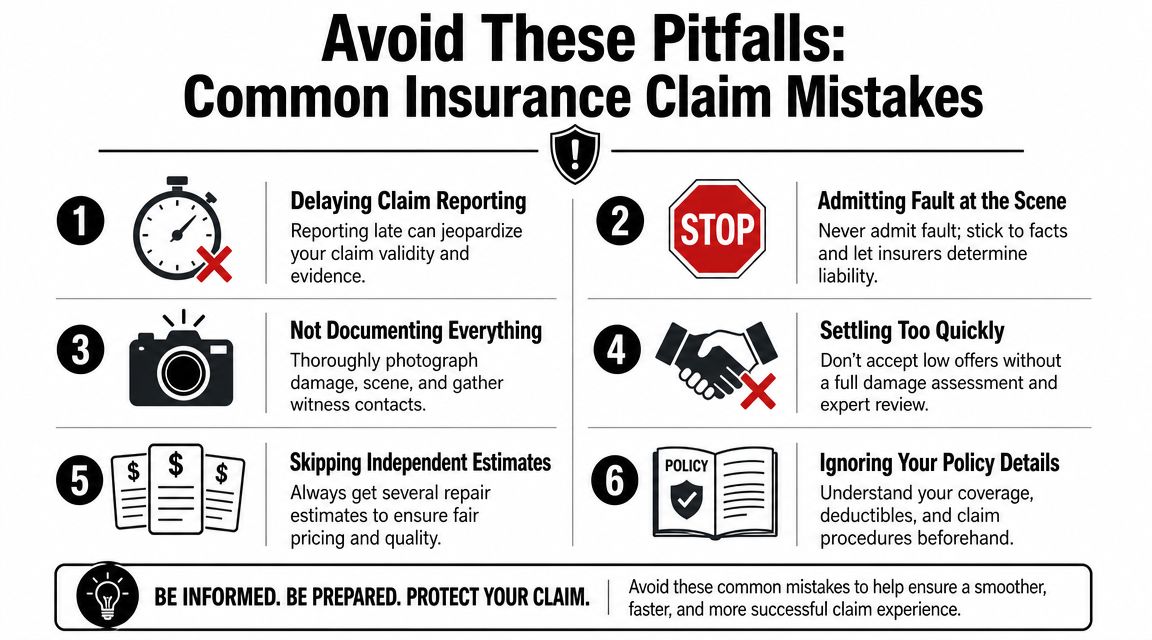
The mistakes that cause the most trouble
- Accepting a quick cash offer too soon: If you settle before a full teardown or proper inspection, you may own the gap when additional damage appears.
- Letting the insurer's suggestion make the decision for you: Recommended shops can be fine, but “recommended” is not the same as “best for your vehicle.”
- Ignoring parts language in the estimate: If you don't ask whether the quote includes OEM, aftermarket, recycled, or reconditioned components, you're approving blind.
- Treating visible damage as the whole claim: Covers, lamps, liners, brackets, mounts, supports, and electronics can all change after disassembly.
- Confusing wear-and-tear with covered damage: Insurance repairs and maintenance repairs are not the same category.
- Failing to keep your own records: Save photos, claim emails, estimate revisions, and approvals.
The better approach
Challenge every assumption that sounds convenient.
If someone says the damage is minor, ask what was removed to confirm that. If someone says a part is equivalent, ask equivalent in what sense. If someone says the claim is straightforward, ask whether scanning, calibration, or supplements are still possible.
For drivers who want a shop held to a higher standard, start with a facility known for certified auto repair in Whitby. Certification alone doesn't solve every problem, but it usually tells you the shop takes process, equipment, and training seriously.
Your Car Repair Insurance Questions Answered
Does car repair insurance cover oil changes, brakes, tyres, and routine maintenance
Usually no.
Routine maintenance and normal wear items are generally separate from both collision claims and mechanical breakdown style coverage. If a part wears out through normal use, don't assume an insurance product will pay for it.
If I take a cash payout, do I still have to repair the car
That depends on your situation, your policy obligations, and whether there's financing or leasing involved.
The bigger issue is practical. Once you accept a payout without a full repair plan, you also accept the risk that the visible estimate didn't capture the full damage. If the repair later costs more, recovering the difference can become difficult.
What happens if the shop finds more damage after starting the repair
That's handled through a supplement.
A proper shop documents the newly exposed damage, submits the additional operations or parts to the insurer, and waits for approval where required. That's standard collision-repair workflow, not a red flag by itself.
Can I choose my own repair shop
Yes. You should choose the shop you trust to repair the vehicle correctly and communicate clearly.
An insurer may offer a network option. You're still the vehicle owner, and the quality of the finished repair affects your safety, resale confidence, and long-term satisfaction.
Is car repair insurance worth it for a newer vehicle
It depends on what product you mean.
If you mean mechanical breakdown coverage, the value question is harder to answer with precision because the available explanations often describe what the product covers but don't provide a clear California-specific break-even analysis for new-car owners (Experian discussion of whether car repair insurance is worth it). The practical decision usually comes down to how long you'll keep the vehicle, what warranty protection remains, and how comfortable you are paying for a major unexpected failure out of pocket.
If you want straight answers about an insurance-related repair, Carmedics Autowerks Inc helps Whitby drivers sort out damage assessments, repair planning, and the practical details that insurers and estimates don't always make obvious. Bring the claim number, the photos, and the paperwork. We'll help you understand what the vehicle needs so you can make a smart call.