


You're driving through Whitby, the car feels mostly normal, and then a dashboard light comes on. Maybe it's the check engine light. Maybe it flashes once, then stays on. Maybe the vehicle starts and drives fine, which almost makes it worse because now you're left guessing.
That uncertainty is what pushes drivers to search for computer diagnostics car information in the first place. You want to know if the problem is minor, urgent, expensive, or even real. You also want to know whether a quick scan at home will give you the answer.
In practice, a warning light is a symptom. It's your vehicle asking for investigation. It is not a repair plan, and it is not proof that one specific part has failed.
That Unsettling Light on Your Dashboard
A dashboard warning light changes the way you drive almost immediately. You start listening for noises that weren't there before. You notice every hesitation, every rough idle, every shift. Even if the vehicle seems fine, the concern is valid because modern cars monitor far more than the average driver can see or feel.
The first thing to understand is simple. A light turns on because the vehicle's control system has detected something outside expected range. That can point to an emissions issue, a sensor problem, an electrical fault, or a condition that only happened once and was stored for later review. If your warning light is on, getting a proper check engine light inspection is the sensible next step.
Why the light feels vague
Most drivers expect a warning light to work like a burned-out bulb at home. Bulb fails, replace bulb, problem solved. Vehicles don't work that way anymore.
A modern vehicle is more like a network of systems that report to one another. The engine computer watches inputs from sensors. Other modules monitor braking, body functions, and communication lines. When one message looks wrong, the system stores a fault code. That stored code helps point a technician in the right direction, but it doesn't automatically identify the failed part.
A warning light tells you where to start looking, not where to stop.
What owners usually want to know
When someone arrives with a warning light on, the same practical questions come up:
- Is it safe to keep driving? Sometimes yes, sometimes no. It depends on the symptom, not just the light.
- Can the code tell me the exact part? Sometimes it points close. Often it only identifies the affected system.
- Can the light be cleared and forgotten? Clearing a code without finding the cause usually brings the problem back.
That's where computer diagnostics earns its value. Done properly, it turns uncertainty into a methodical process.
How Your Car Talks to Technicians
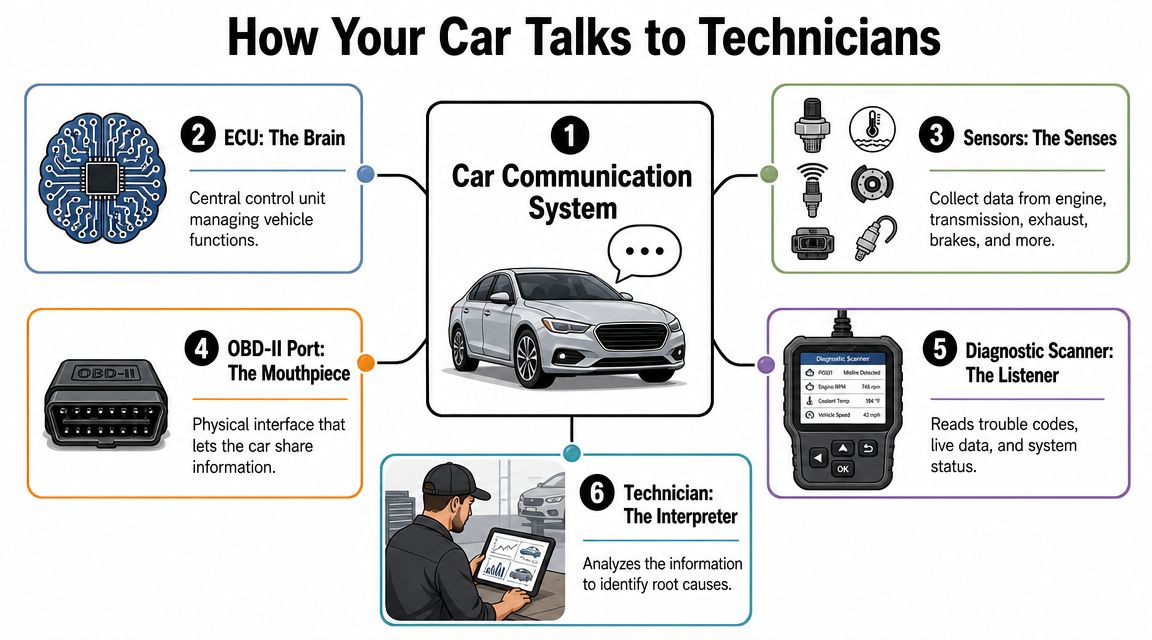
Your vehicle has a central control strategy, and the easiest way to understand it is with a medical analogy. The ECU, ECM, or PCM acts like the brain. Sensors act like the nervous system. They report temperature, airflow, oxygen content, misfire activity, and many other operating conditions. The vehicle then reacts based on those inputs.
Technicians don't guess what the car is “thinking.” They connect to it through the OBD-II system. In North America, OBD became the basis of modern diagnostics during the 1980s, but the major turning point came in 1996, when OBD-II became required on all cars sold in the United States, creating a standard diagnostic port and standard trouble-code framework across makes and models, as outlined in this history of OBD-II and standardised diagnostics.
The OBD-II port is the doorway
The OBD-II port is the physical connector that lets a scan tool communicate with the vehicle. Think of it as the mouthpiece through which the car can “speak” in a common language.
That standardisation matters in practice. A technician in Canada can connect to a North American market vehicle, retrieve diagnostic trouble codes, and read emissions-related information through the same basic interface. If you've looked into a proper engine diagnostics service in Whitby, that's the technical foundation behind it.
What the scanner actually reads
A scan tool can pull several kinds of useful information, including:
- Stored trouble codes that show a fault was detected
- Pending faults that may not have turned on a light yet
- Live sensor data that shows what the engine computer is seeing in real time
- Readiness information that indicates whether certain self-checks have completed
Why this matters to the owner
A lot of drivers think diagnostics is black-box magic. It isn't. It's a structured conversation between the vehicle and the technician.
The skill is not in plugging in the tool. The skill is in deciding whether the data points to a failed sensor, a wiring issue, an operating condition, or a mechanical problem that the computer can only detect indirectly.
Practical rule: A scanner reads the message. A technician decides what the message actually means.
Decoding Common Trouble Codes
A trouble code looks precise. It has a letter and numbers, and that makes it feel definitive. In the shop, it rarely is. Codes are useful because they narrow the field, but they don't finish the job.
The four main code families
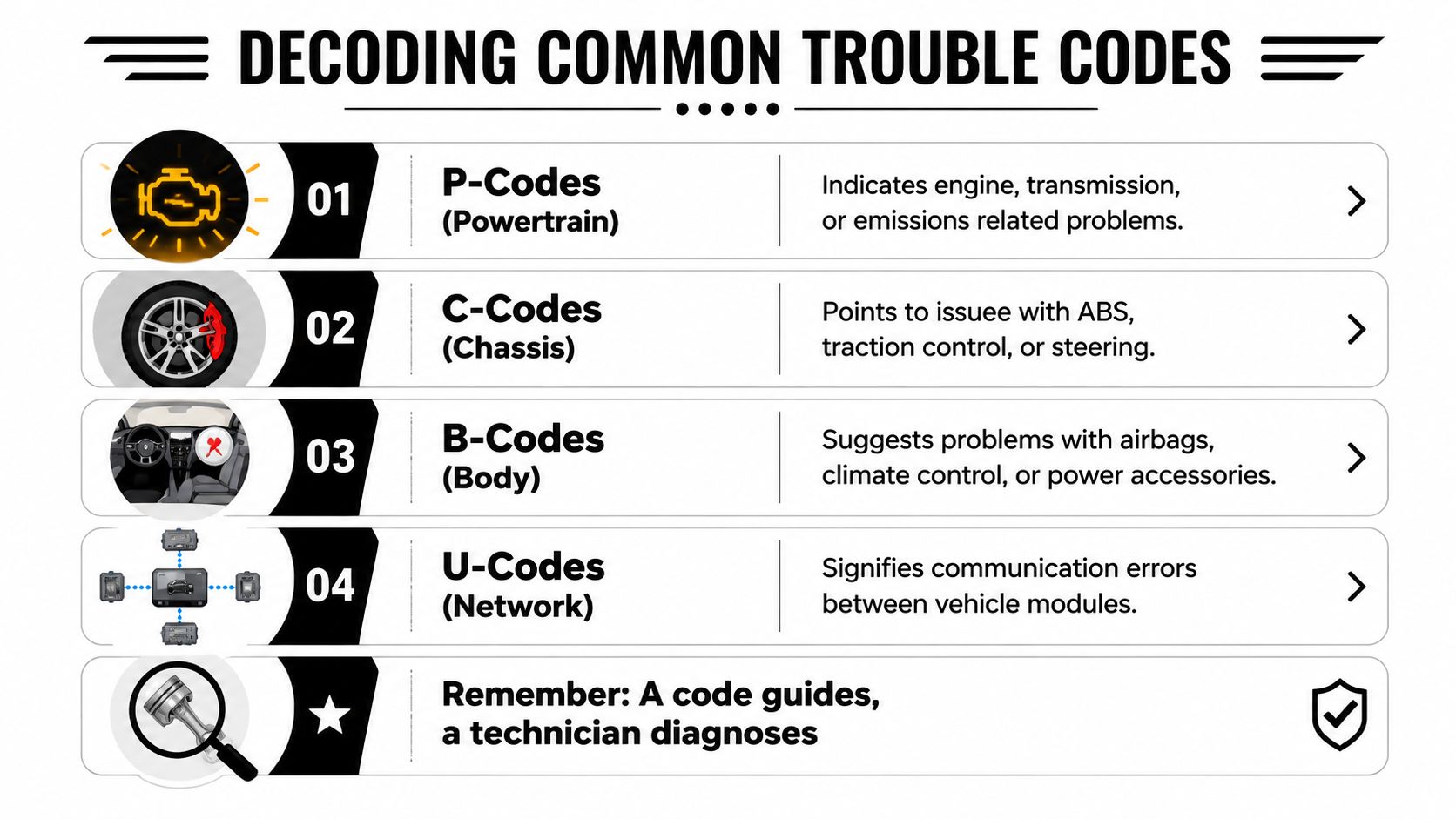
Most drivers run into P-codes first because they're tied to the powertrain. That includes the engine, transmission, and emissions systems.
Other categories matter too:
- P-codes point toward powertrain concerns
- C-codes relate to chassis systems such as ABS or stability control
- B-codes involve body systems such as climate control or airbags
- U-codes usually indicate communication issues between modules
That last group matters more on newer vehicles than most owners realise. A communication fault can make one module look guilty when another module, connector, or power supply issue is the underlying cause.
A misfire code is a good example
A misfire-related code often sounds straightforward. Owners hear “misfire” and assume the spark plug is done.
Sometimes that's true. Sometimes it isn't.
A misfire code can show up because of:
- Ignition problems, such as a weak coil or worn plug
- Fuel delivery issues, including an injector that isn't behaving properly
- Air leaks, where unmetered air disrupts combustion
- Mechanical faults, where the cylinder can't contribute properly
The code points to the event. It doesn't automatically identify the reason behind the event.
Sensor codes can also mislead
Oxygen sensor and catalyst-related codes are another common source of confusion. Owners often replace the part named in the code description, only to find the light returns.
That happens because the vehicle is reporting a reading or behaviour that looks wrong. It may be a bad sensor. It may also be wiring, an exhaust issue, a fuel control problem, or an operating condition upstream that pushes the sensor out of expected range.
“A code guides, a technician diagnoses.”
Why code definitions are only part of the story
The internet is full of code lists. They're fine for orientation, but they can create false confidence. A code definition tells you what system the vehicle is unhappy with. It does not tell you whether the root cause is electrical, mechanical, environmental, or intermittent.
That distinction matters most when the fault comes and goes. Intermittent problems leave clues, not confessions.
DIY Code Readers vs Professional Diagnostics
A DIY scanner can be useful. For some owners, it's a smart tool to keep in the glove box or garage. But it helps to be clear about what it can do, and what it can't.
The biggest gap is interpretation. As noted in this explanation of why a code may only be a symptom, OBD-based diagnostics can identify stored DTCs, yet the code is just a starting point and still requires interpretation against live sensor data, ECU behaviour, and mechanical inspection, especially on newer vehicles with networked systems, as discussed in this overview of symptom-based code reading.
Where a basic scanner helps
A handheld scanner is useful when you want quick direction. If a warning light comes on during a trip, reading the code can help you decide whether the issue appears related to a familiar engine concern or whether you need a shop involved soon.
DIY tools are also handy for owners who like to understand the basics of their vehicle before authorising work.
Where the limits show up
What catches drivers off guard is how often a basic scan creates more questions than answers. You get a code. You search it. You find five possible causes. Then you're standing in the driveway wondering whether to replace a sensor, a coil, or nothing at all.
That problem isn't unique to cars. The same pattern shows up in other electric vehicles and control systems. A useful example is this guide on diagnosing electric golf cart issues, where the essential work is separating surface symptoms from the actual electrical or control fault.
DIY Scanner vs. Carmedics Professional Diagnostic
| Feature | DIY OBD-II Scanner | Carmedics Professional Service |
|---|---|---|
| Primary use | Reads basic fault information | Diagnoses root cause |
| Code access | Often limited to generic engine-related codes | Broader system access depending on vehicle and platform |
| Live data | May be limited or difficult to interpret | Used alongside testing and inspection |
| Module coverage | Often narrow | Can include multiple onboard systems |
| Fault context | Shows stored information | Connects code data with vehicle behaviour |
| Mechanical verification | Not built in | Includes inspection and confirmation steps |
| Best for | Curiosity, first look, basic awareness | Intermittent, electrical, networked, or unclear faults |
When to use which
Use a DIY tool when:
- You want a quick snapshot of why a warning light appeared
- You're tracking a recurring issue and want to note when it returns
- You understand its limits and won't treat the code description as the repair decision
Book professional diagnostics when:
- The same code keeps coming back
- The vehicle has multiple warnings
- Symptoms don't match the code description
- You're dealing with drivability, electrical, or communication issues
A code reader gives information. A proper diagnostic process gives direction.
The Carmedics Autowerks Diagnostic Process
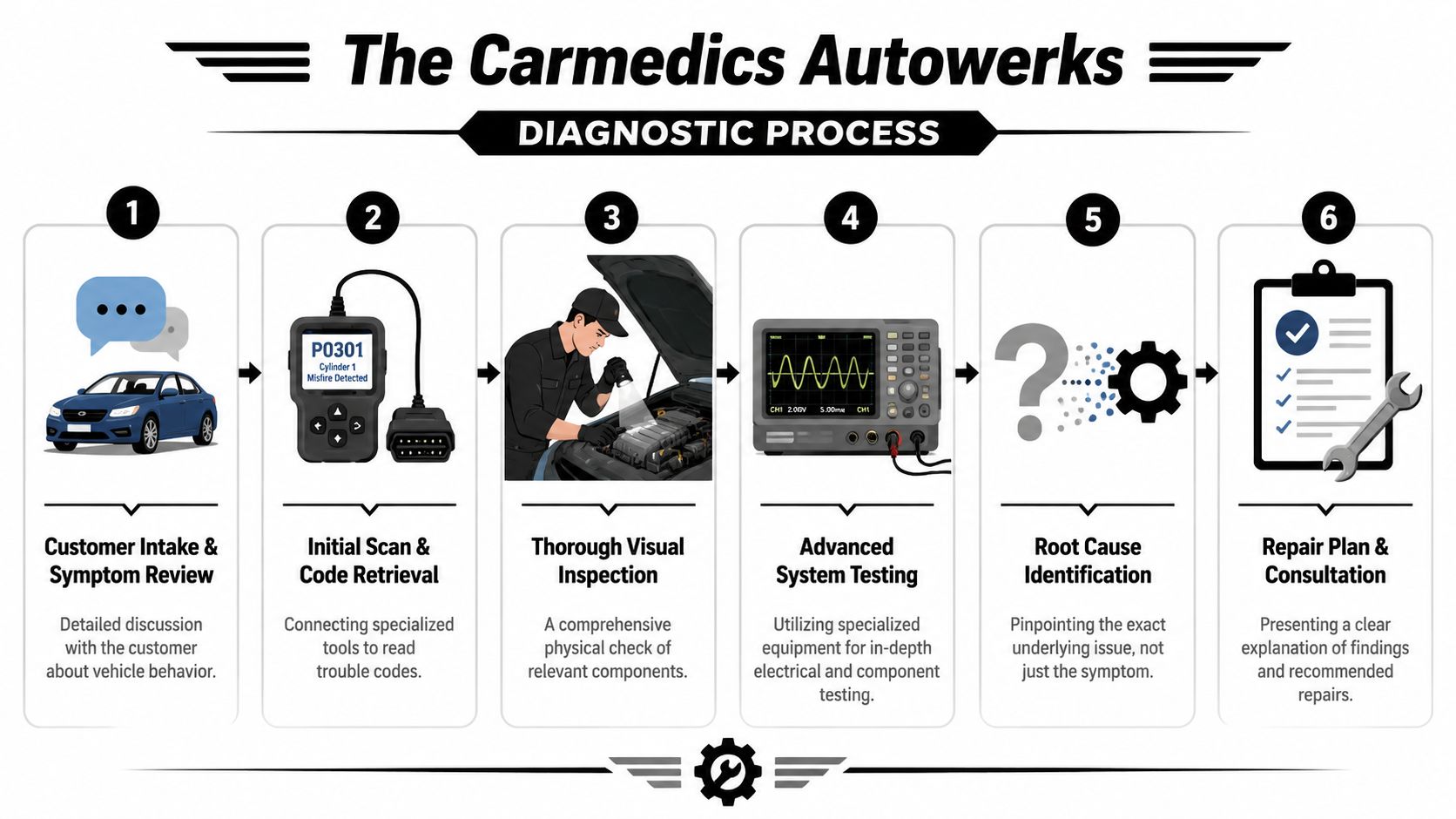
When a vehicle comes in for a warning light, poor running, or an intermittent electronic issue, the work starts before any parts are touched. The process matters because the wrong first assumption can waste time and money.
In Canadian light-duty vehicles, modern computer diagnostics are built around OBD-II communication, standardised trouble codes, and live sensor data. The practical advantage is speed and specificity because technicians can correlate fault codes with parameters such as coolant temperature, fuel trims, misfire counters, and oxygen-sensor behaviour to narrow the root cause instead of replacing parts by guesswork, as described in this technical overview of live-data diagnostics.
Step one starts with the symptom, not the scanner
A proper intake matters. When did the light come on? Does it happen only on cold starts? Under load? At idle? After fueling? On the highway? Those details change the testing path.
A car that stalls once a week needs a different approach than one that runs rough every morning. If you're looking at a local shop such as Carmedics Autowerks in Whitby, this is the kind of symptom review that should happen before anyone talks repairs.
Pre-scan and system review
The first scan captures the vehicle as it arrived. That matters because clearing codes too early can erase clues.
At this stage, technicians look for:
- Stored and pending codes
- Pattern failures across modules
- Freeze-frame or supporting operating data when available
- Signs that one issue may be triggering others
Live data changes the picture
Professional work sets itself apart from mere code reading. A scanner may show a fault related to fuel control, but live data can reveal whether the engine is adding fuel, pulling fuel, missing under load, or reacting to a false input.
Common data points reviewed during testing may include:
- Coolant temperature behaviour
- Fuel trim movement
- Misfire activity
- Oxygen-sensor response
Those values have to be read in context. A number by itself doesn't diagnose the car. The pattern does.
Good diagnostics narrows the fault before parts are ordered.
Inspection and targeted testing
The computer can report an abnormal signal, but it cannot physically inspect a connector, confirm a rubbed-through wire, or tell you if moisture entered a component housing.
That's why a proper diagnostic process usually includes hands-on checks such as connector inspection, wiring review, basic circuit verification, and system-specific testing where needed. If the code is only the surface symptom, the actual cause begins to show itself during these checks.
Repair plan and verification
Once the fault is confirmed, the next step is not “replace everything nearby.” It's to recommend the repair that addresses the proven cause.
After the repair, technicians should confirm the result. That may include a post-scan, road test, or checking whether the original fault condition is gone. Verification is what separates a completed repair from a hopeful one.
Why a Code Is Only the Starting Point
The most expensive mistakes in diagnostics usually happen when someone believes the first code description at face value. That's especially risky in Canadian driving conditions, where temperature swings, moisture, and low voltage can distort the picture.
In Canada, cold-weather starting and low-voltage conditions can trigger misleading warnings, temporary faults, or multiple codes at once, which means technicians have to separate a weak battery or charging-system issue from a true component failure, as explained in this discussion of winter-related electronic faults.

Winter faults can mimic bigger failures
A vehicle with a weak battery can produce strange behaviour on a cold morning. Modules may see unstable voltage. Warning lights can stack up. Communication faults may appear even though the affected module isn't actually bad.
That's why electrical diagnosis matters. Before replacing the part named by the scan report, it often makes sense to assess the health of the supporting system. For owners dealing with recurring warning lights, charging concerns, or unexplained electrical behaviour, an auto electrical repair assessment is often more useful than another quick code clear.
Intermittent faults are the real test
Intermittent problems are where experience shows. The car may behave perfectly during a brief parking-lot scan. Then it fails only after a long drive, only in wet weather, or only when vibration changes a wiring fault.
These are the situations where basic tools disappoint owners most:
- The code points to the wrong suspect
- The problem disappears during a short inspection
- Replacing the obvious part doesn't solve anything
Networked vehicles raise the stakes
Newer cars don't operate as isolated systems. Modules communicate, share signals, and depend on stable power and clean data. One problem in that network can create symptoms somewhere else.
The vehicle may complain about the messenger when the real fault is in the message, the wiring, or the power supply.
That's why a computer diagnostics car service has to be more than “plug in and print codes.” The professional value is in sorting false leads from genuine failures.
Your Next Step for a Healthy Car in Whitby
Modern vehicles are smarter than ever, but they're also less forgiving of shortcuts. Reading a code can be helpful. Treating that code as a diagnosis can send you straight into unnecessary parts replacement.
For repair planning in Canada, one checkpoint that often gets overlooked is the emissions and readiness-monitor status. A vehicle can have no dash light and still fail an emissions-related monitor, and scan data can reveal that before an inspection, as noted in this explanation of readiness-monitor checks. That's one more reason a proper scan should include more than a quick code read.
If your vehicle has a warning light, inconsistent performance, or an issue that nobody has pinned down yet, the smart move is to let a qualified car mechanic in Whitby verify the cause before you approve repairs. Clarity is worth more than guesswork, especially on a newer car or SUV.
If your warning light is on, your vehicle is acting strangely, or you want a proper answer instead of a vague code description, book a diagnostic appointment with Carmedics Autowerks Inc. Their team handles computer diagnostics, electrical concerns, and general auto repair for Whitby drivers who want a clear explanation of what's wrong and what needs to be fixed.