

That small hesitation when your vehicle shifts is usually how this starts. You pull away from a light in Whitby, the revs climb a bit higher than normal, then the next gear lands with a soft thud. Maybe it only happens when the car is cold. Maybe it's a faint shudder backing out of the driveway. Most drivers notice it, then hope it goes away.
Sometimes it does. Often, it doesn't.
A transmission rarely fails out of nowhere. More often, it gives warnings through the way it shifts, sounds, and responds. In the shop, one of the most common patterns I see is simple: the vehicle kept driving, but the fluid service got pushed down the list until the transmission started complaining. By then, what could've been routine maintenance turns into diagnosis, drivability problems, and a much bigger bill.
Transmission fluid service matters because the transmission is one of the most expensive and least forgiving systems in your vehicle. The fluid inside it isn't just there to “top up” a level. It carries heat, creates hydraulic pressure, lubricates moving parts, and helps the unit shift properly. Once that fluid degrades, the whole system has to work harder.
If you like keeping good records on your vehicle, a vehicle maintenance log helps you spot when a service is due before symptoms show up.
Your Transmission Service Guide Introduction
A lot of owners come in with the same description. “It's not terrible, but it doesn't feel as smooth as it used to.” That's usually the right instinct. You don't need smoke, a warning light, or a complete loss of drive to justify looking into transmission fluid service.
Why this service gets misunderstood
Part of the confusion comes from the language around it. One shop says change. Another says flush. A dealer says the fluid is lifetime. A friend says never touch it. None of that helps when your car is the one shifting poorly in traffic.
The practical way to think about it is this. Transmission fluid service is preventative maintenance first, and problem prevention second. If the fluid is still doing its job, servicing it helps protect the transmission. If the fluid has already broken down, the service decision gets more nuanced.
Practical rule: Don't wait for obvious failure symptoms before thinking about transmission fluid. By the time the transmission is making its distress obvious, your options are usually narrower.
What you should expect from a good guide
You should be able to answer a few basic questions without needing a trade background:
- What does the fluid do inside the transmission?
- What warning signs matter and which ones need attention soon?
- What's the difference between a drain and fill and a flush?
- What should it cost in Ontario, and when should it be done?
- How do you judge the advice you're getting from a shop or dealer?
That's the gap this guide is meant to close. Not generic internet advice. Real-world guidance that helps you make a sensible decision before a minor shift quality issue becomes a transmission repair.
What Transmission Fluid Does For Your Vehicle
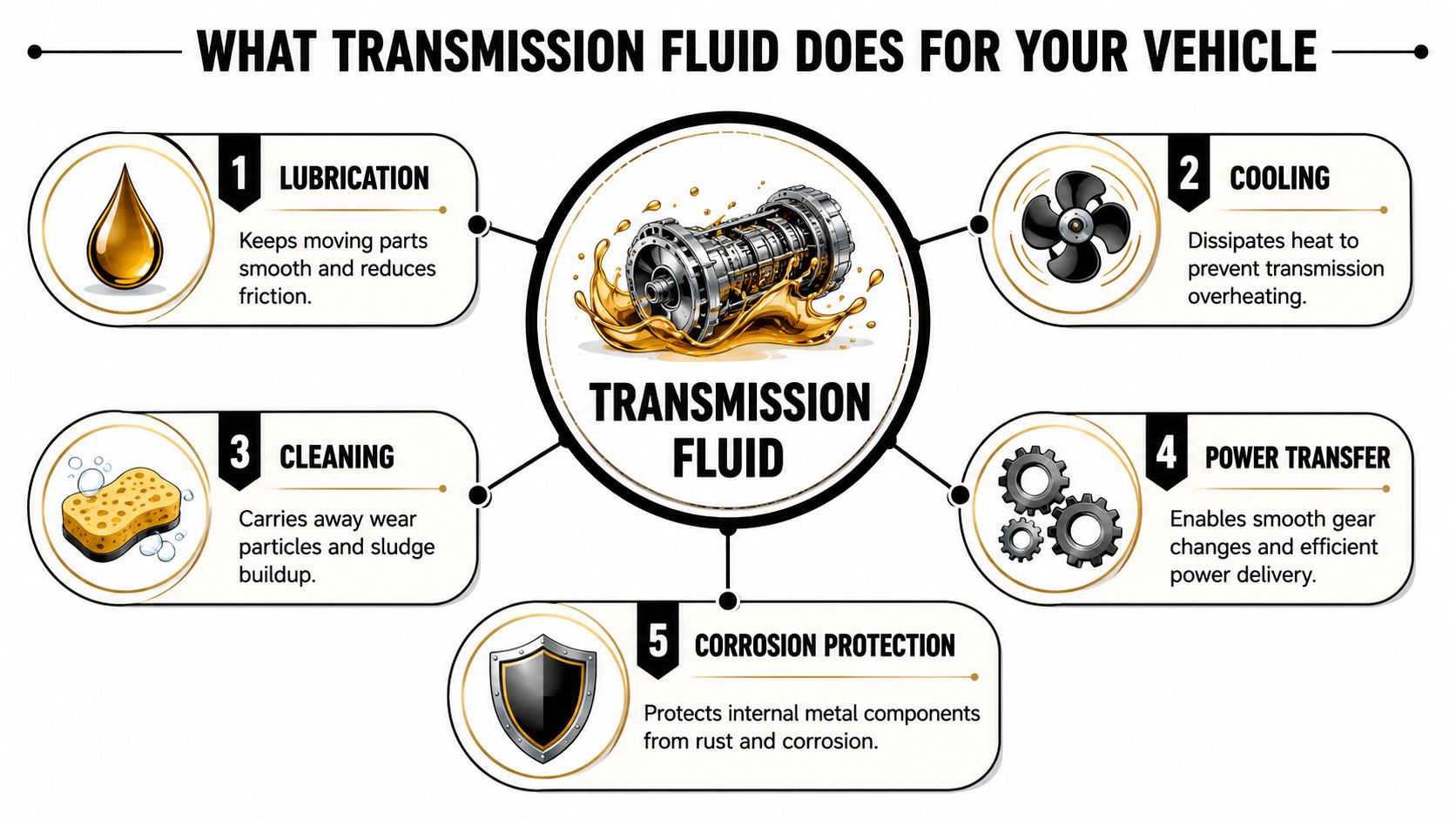
The term "fluid" often brings lubrication to mind. That's only part of the job. Transmission fluid is the working fluid of the whole unit. If engine oil is there to protect the engine, transmission fluid has to protect, cool, clean, and operate the transmission at the same time.
If you want a step-by-step walkthrough, Carmedics has a guide on how to check transmission fluid.
It lubricates moving parts
Inside the transmission, metal components are constantly meshing, rotating, and applying load. The fluid creates a protective film between those parts so they don't grind against each other. When that protection weakens, friction rises and wear starts accelerating.
Consider a skating rink. With a smooth surface, everything glides. Once the surface gets rough, every movement takes more effort and creates more damage.
It carries heat away
Heat is one of the biggest enemies of any automatic transmission. Every shift, every stop-and-go commute, every hill, and every towing load creates thermal stress. The fluid absorbs and moves that heat so the transmission doesn't cook itself from the inside.
When the fluid ages, it doesn't manage heat as well. That's when a vehicle that used to shift cleanly starts feeling lazy, harsh, or inconsistent.
It helps keep the internals clean
Good transmission fluid also suspends fine wear material and contamination so it can be managed during service. It isn't magic. It can't make debris disappear. But it does help prevent that material from immediately settling where it can interfere with valves, passages, and clutch operation.
Old transmission fluid doesn't usually fail all at once. It loses its ability to protect in layers. First the shifts feel different. Then the heat rises. Then the wear shows up faster.
It creates hydraulic force
This is the part many drivers don't realise. In an automatic transmission, the fluid doesn't just sit there. It's used to generate the hydraulic pressure that applies clutches and controls gear changes. If the fluid condition is poor, the shift quality often suffers because the system can't respond as precisely as it should.
Why the correct fluid matters
Not all transmission fluids are interchangeable. Viscosity, additive package, and friction characteristics matter. Using the wrong fluid can create shift problems even if the transmission itself is mechanically sound.
That's why a proper transmission fluid service isn't just “drain whatever's in there and pour in something red.” The spec matters.
Warning Signs Your Transmission Needs Attention
Most transmission complaints start as behaviour changes, not dramatic failures. The vehicle still drives, but it no longer feels consistent. That's the point where paying attention can save you from a much bigger repair.
If your vehicle has developed symptoms and you need deeper diagnosis, this page on transmission repair gives a useful overview of what gets inspected.
What drivers usually notice first
Here are the signs that should move transmission fluid service or diagnosis higher on your list:
- Delayed engagement: You shift into Drive or Reverse and the transmission takes a moment to respond.
- Rough or abrupt shifting: Gear changes feel harder than normal, especially under light throttle.
- Slipping sensation: Engine speed rises, but the vehicle doesn't accelerate the way it should.
- Shuddering during shifts: Instead of a clean gear change, you feel a vibration or chatter.
- Unusual noise: Whining, humming, or grinding that seems tied to shifting or vehicle speed.
- Fluid leaks: Red or reddish-brown fluid under the vehicle deserves attention.
- Warning lights: A check engine light or transmission-related warning shouldn't be ignored.
What those symptoms can mean
A delayed shift doesn't automatically mean a failed transmission. It can point to fluid that has lost some of its hydraulic effectiveness, internal wear, a valve body issue, or low fluid level. The symptom matters, but so does the pattern. Cold only, hot only, uphill only, or all the time. Those details help narrow it down.
Rough shifts can also be deceptive. Some owners assume a hard shift means the transmission is “strong.” It usually means the shift event isn't being controlled the way it should be. That can come from fluid condition, adaptation issues, internal wear, or the wrong fluid having been used previously.
When to stop guessing
Use this quick decision table as a practical guide:
| Symptom | What to do |
|---|---|
| Mild hesitation with no warning light | Book an inspection soon |
| Repeated slipping or shuddering | Stop delaying service |
| Leak under the vehicle | Check it promptly |
| Grinding, severe harshness, or no engagement | Don't keep driving it |
The worst approach is guessing from one symptom and approving the wrong service. A neglected transmission with internal damage won't be “fixed” by fresh fluid alone.
The reason these signs matter is simple. A transmission can tolerate old fluid for a while. It can't tolerate old fluid, rising heat, contamination, and slipping at the same time for very long.
Drain and Fill vs Transmission Flush
This is the question that confuses more owners than almost anything else. Both services involve replacing old fluid with new fluid, but they are not the same process, and they are not right for the same vehicle in every situation.
If you want a pricing breakdown before booking, this guide on how much a transmission fluid change costs is a helpful reference.
What a drain and fill does
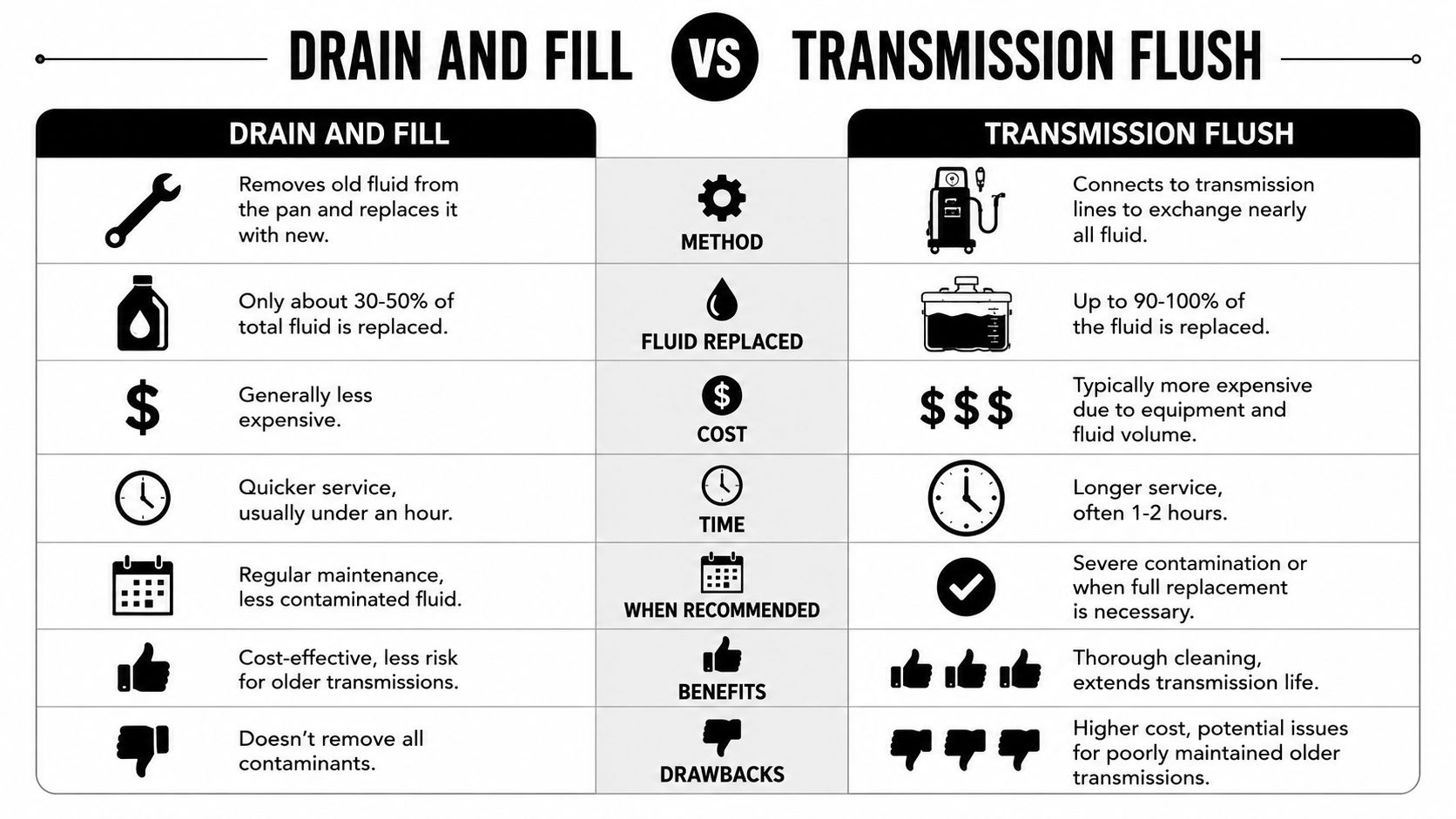
A drain and fill removes fluid from the pan and replaces that portion with fresh fluid. According to the cited comparison, a change replaces about 50% of the fluid, while a flush replaces 85 to 90% by cleaning the entire system, including areas a simple drain won't reach, as outlined in this change versus flush explanation.
That makes a drain and fill the more conservative service. It refreshes the fluid without forcing a near-complete exchange through the whole system.
A good analogy is replacing part of the water in a bathtub instead of emptying and scrubbing the whole thing. The water gets cleaner, but some old water stays behind.
What a transmission flush does
A transmission flush exchanges far more of the old fluid through the transmission and cooler circuit. That gives you a much more complete fluid replacement, which can be useful when the goal is to remove as much aged fluid as possible.
The benefit is obvious. More old fluid out, more new fluid in. The trade-off is that a neglected transmission with existing wear or debris problems may not respond well just because the service is more aggressive.
Which one makes sense
The right choice depends less on internet opinions and more on the vehicle in front of you.
A drain and fill often makes more sense when:
- Service history is unclear
- The transmission is older and still operating acceptably
- You want routine maintenance without being overly aggressive
A flush can make sense when:
- The service history is known and consistent
- You want a more complete fluid exchange
- The transmission is a good candidate based on inspection and behaviour
Some experts prefer changes over flushes on neglected transmissions because a cautious approach can be safer than trying to force a full exchange on a unit with unknown internal condition.
What doesn't work
What doesn't work is treating every transmission the same. A flush isn't automatically harmful. A drain and fill isn't automatically enough. The wrong service recommendation usually comes from skipping diagnosis and jumping straight to the menu option.
The better question isn't “Which service is best?” It's “Which service fits this transmission's condition, history, and symptoms?”
Service Intervals and Costs in Ontario
A transmission service schedule only makes sense once you factor in how the vehicle is used in Whitby and across Durham Region. A car that spends its life on Highway 401 has a different workload than one that does school runs, winter short trips, and stop-and-go commuting every day. Towing, delivery use, and repeated cold starts also shorten the useful life of the fluid.
A practical interval Ontario drivers can use
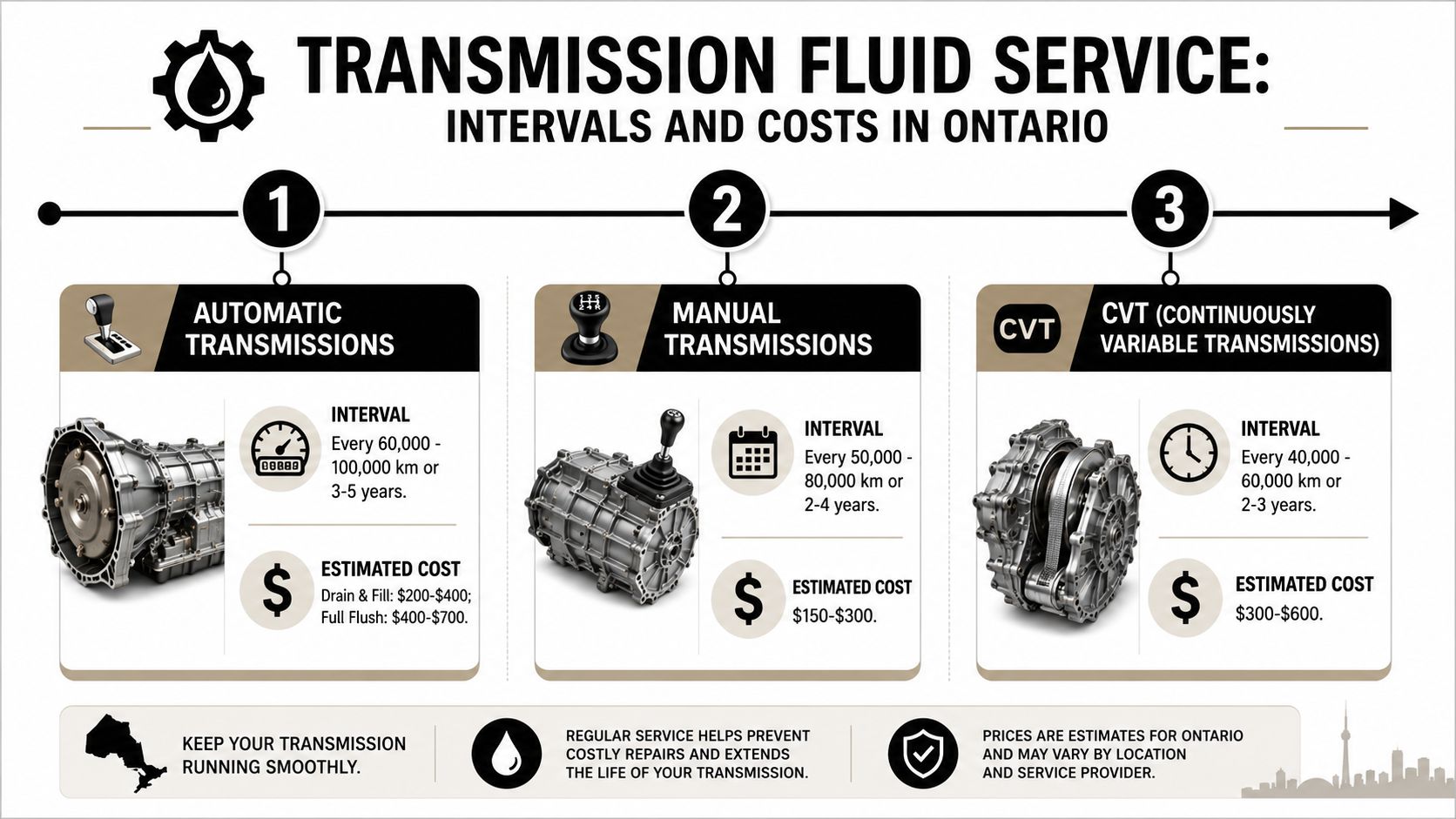
For many vehicles, a reasonable starting point is to check the manufacturer schedule and then adjust for real use. Industry guidance from this Ontario flush versus exchange resource notes that automatic transmission service often falls in the 50,000 to 100,000 km range, depending on the vehicle and service type.
That range lines up with what we see in the shop. Vehicles driven hard, driven in traffic, or kept for the long term usually benefit from earlier service than vehicles with light highway use and a clean maintenance history.
“Lifetime fluid” causes a lot of confusion. In practice, it usually means the manufacturer has stretched the maintenance message around the expected ownership period, not that the fluid stays healthy forever. Heat, clutch material, moisture, and shear still wear the fluid out. Transmission fluid works like the hydraulic lifeblood of the unit. Once it degrades, the transmission has to work harder with less protection.
Drivers planning to keep a vehicle well past warranty should treat fluid service as cheap insurance. That is especially true for late-model automatics and CVTs, where a fluid mistake or a missed interval can turn into a very expensive repair.
A similar maintenance mindset shows up in industrial equipment. Shops often use condition-based hydraulic oil analysis to judge fluid health instead of trusting a label, and the same logic applies to vehicle fluids.
What transmission fluid service costs in Ontario
Cost depends on the transmission design, the amount of fluid required, whether the filter is serviceable, and whether the job is a basic drain and fill or a full exchange. Consumer pricing guidance from Auto Service Costs shows the same pattern drivers see in Ontario. A simple fluid change sits at the lower end, while services involving more fluid, more labour, or a filter replacement cost more.
Here is the practical range most drivers should expect:
| Service type | Typical cost |
|---|---|
| Basic fluid change | $100 to $200 |
| Fluid and filter change | $250 to $400 |
| Transmission flush | $300 to over $500 |
Those numbers are only part of the story.
A quote can rise quickly if the transmission needs a specific OEM-spec fluid, if access is poor, or if the pan, gasket, or filter adds labour and parts cost. CVTs are a common example. The service may look simple on paper, but the fluid spec and fill procedure leave very little room for shortcuts.
That is why the cheapest quote is not always the lowest-cost decision. If the wrong fluid goes in, or if a shop skips the inspection that should come before the service, the savings disappear fast. A careful estimate from a local transmission service shop in Whitby, such as Carmedics Autowerks in Whitby, should explain what service is being recommended, what fluid is being used, and whether related items like leaks or a filter are part of the price.
The Carmedics Autowerks Advantage in Whitby
A transmission service can go wrong before the pan is even opened. A Whitby driver comes in with delayed shifting, asks for a flush because a quick search suggested it, and the issue turns out to be low fluid from a leak or wear that needs diagnosis first. The value of a good shop is judgment.
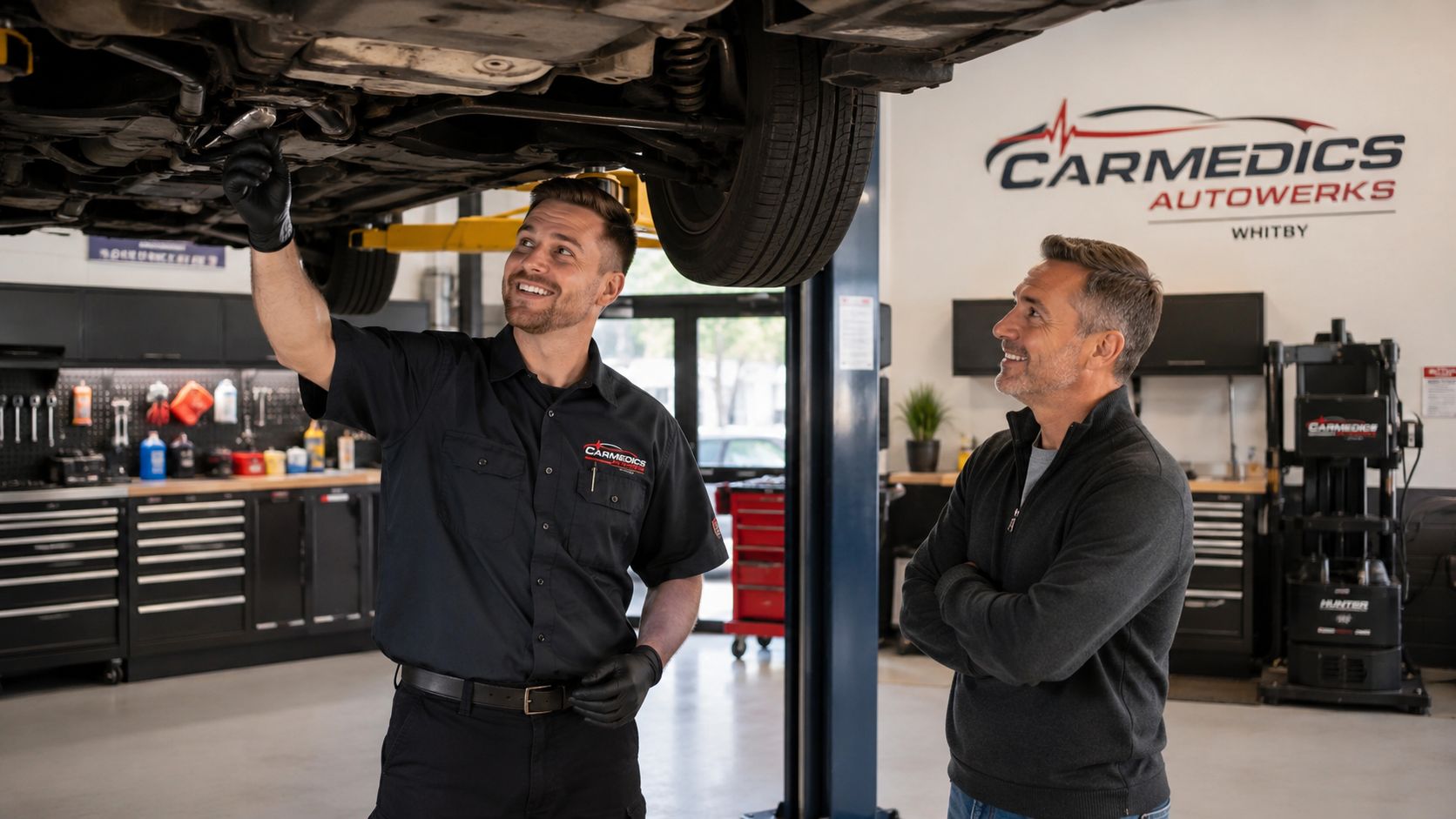
At Carmedics Autowerks in Whitby, that starts with identifying what the transmission is doing now, how it has been maintained, and whether a fluid service makes sense at all. That matters even more with newer vehicles sold with "lifetime fluid" messaging, because that label often creates false confidence and delays the inspection the unit needs.
A careful shop should evaluate a few things before recommending any service:
- Current symptoms: Routine maintenance and a shifting complaint are two different jobs.
- Service history: Regular maintenance supports a different recommendation than unknown history.
- Transmission type: Conventional automatics, CVTs, and dual-clutch units each have their own fluid requirements and procedures.
- Fluid condition: Burnt smell, discoloration, debris, and incorrect level all change the decision.
- Leak status: Fresh fluid does not solve an active leak.
Experience is highly beneficial. Some transmissions respond well to a standard drain and fill. Others need a filter service, a precise temperature-based level set, or no fluid exchange until the root cause of the complaint is confirmed. If a shop skips that step and sells the same service to every customer, the result can be wasted money and the same drivability problem on the trip home.
Fluid choice matters just as much as the service itself. Modern transmissions are calibrated around specific friction properties, and using a universal fluid where an OEM-spec product is required can create shift flare, harsh engagement, or long-term wear. CVTs are especially unforgiving.
Cost should be explained in plain language. A basic service is one price. A service that includes a filter, pan removal, gasket replacement, extra labour, or model-specific fluid will cost more, as noted earlier in the guide. What Whitby drivers need from a quote is clarity. What fluid is going in, what parts are being replaced, and whether the shop is servicing a healthy transmission or diagnosing a problem first.
If the recommendation is a flush, the shop should explain why. If the recommendation is no fluid service yet, the shop should explain that too.
Frequently Asked Questions About Transmission Care
Is CVT service different from regular automatic transmission service
Yes. A CVT is not just a regular automatic with different branding. It relies heavily on the exact fluid specified for that unit, and it tends to be less tolerant of the wrong product or vague service practices. If your vehicle has a CVT, the fluid choice and procedure matter even more than usual.
My owner's manual says lifetime fluid. Should I leave it alone
Not blindly. The lifetime-fluid claim causes a lot of confusion. Data referenced by Cars.com says fluid still degrades over time, and even vehicles marketed this way benefit from a fluid check and change around 100,000 miles to help prevent premature failure, as noted in this Cars.com article on changing transmission fluid.
Can I change transmission fluid myself
Sometimes, yes. Whether you should depends on the vehicle and your experience. Some vehicles are straightforward enough for a careful DIY drain and fill. Others have no dipstick, require temperature-based level setting, or need a very specific fill procedure. The biggest DIY mistakes are using the wrong fluid, overfilling, underfilling, or assuming the process is as simple as an oil change.
If the transmission is already shifting badly, will new fluid fix it
Maybe, but don't count on fluid as a cure-all. If the issue is mostly degraded fluid and the transmission is otherwise healthy, service can improve shift quality. If the transmission has internal wear, clutch damage, valve body problems, or electronic faults, fluid service may help very little or not at all.
Is a flush dangerous
Not by definition. The risk is applying the wrong service to a neglected transmission with an unknown history. A flush on a well-maintained transmission is a very different decision from a flush on a unit that's already slipping, contaminated, or overdue by a long margin.
What's the smartest approach for most owners
Keep records, service the transmission before symptoms become severe, and don't let marketing terms replace actual maintenance judgement. If the vehicle is shifting differently, get it assessed early while you still have options.
If your vehicle is hesitating, shifting hard, or you want a sensible transmission fluid service plan before problems start, book an inspection with Carmedics Autowerks Inc. A clear diagnosis, the right fluid, and the right service choice can save you from chasing symptoms later.