


You're driving home, the roads are wet, traffic compresses ahead, and that amber ABS light suddenly appears on the dash. The brakes may still feel normal in that moment, which is exactly why this warning gets ignored too often. Drivers assume it's an electrical hiccup, a weak battery, or a sensor that will sort itself out after the next restart.
That's a mistake.
An ABS fault means one of your car's key safety systems may not respond properly when you need maximum control. Under hard braking, especially on slick pavement, gravel, slush, or packed winter roads around Whitby, the difference between a functioning anti-lock braking system and a failed one isn't just stopping distance. It's whether you can still steer while braking hard enough to avoid what's in front of you.
ABS system repair also isn't a place for guesswork. The internet is full of shortcut advice, but the shortcuts people try most often are usually the ones that waste time, mask the actual fault, or create a worse intermittent problem later. The proper fix starts with diagnosis, not hope.
That Amber ABS Light Just Came On Now What
When the ABS light comes on, a common set of actions ensues. Drivers restart the car. They drive a bit farther to see if it clears. Then they search online and get buried in advice that ranges from helpful to flat-out risky.
The first thing to know is simple. Your base braking system may still work, but your anti-lock function may not. That means the vehicle can still slow down, but under a panic stop the wheels may lock more easily, and steering control during braking can suffer.
What the light is telling you
The ABS warning light doesn't confirm one specific failed part. It tells you the system has detected a fault and stored information that needs to be read properly. That fault could trace back to a wheel speed sensor, wiring, a hydraulic issue, contamination in the brake fluid, or the control unit itself.
That's why guessing from the dash light alone doesn't work.
First move: If the light has just appeared and braking feels different, don't keep testing it on public roads. Get the vehicle inspected before the next bad-weather commute.
If you're also due for a brake check, a free brake inspection in Whitby is a sensible starting point. ABS faults often show up alongside brake wear concerns, fluid issues, or wheel-end problems that a proper inspection can catch.
What not to do right away
Drivers often jump to the cheapest possible answer first. Disconnect the battery. Clear the light. Wiggle a connector. Spray something on the sensor. That might feel proactive, but it isn't diagnosis.
A better response looks like this:
- Drive cautiously: Avoid hard braking tests, towing, or pushing the car in poor conditions until the fault is identified.
- Pay attention to brake feel: A soft pedal, odd pulsing during ordinary stops, or wheel lock-up changes the urgency.
- Book a diagnostic check: ABS faults need scan data and circuit testing, not trial-and-error parts swapping.
When ABS acts up, the safest path is always the same. Confirm the fault, test the circuit, and repair what failed.
How Your ABS System Keeps You in Control
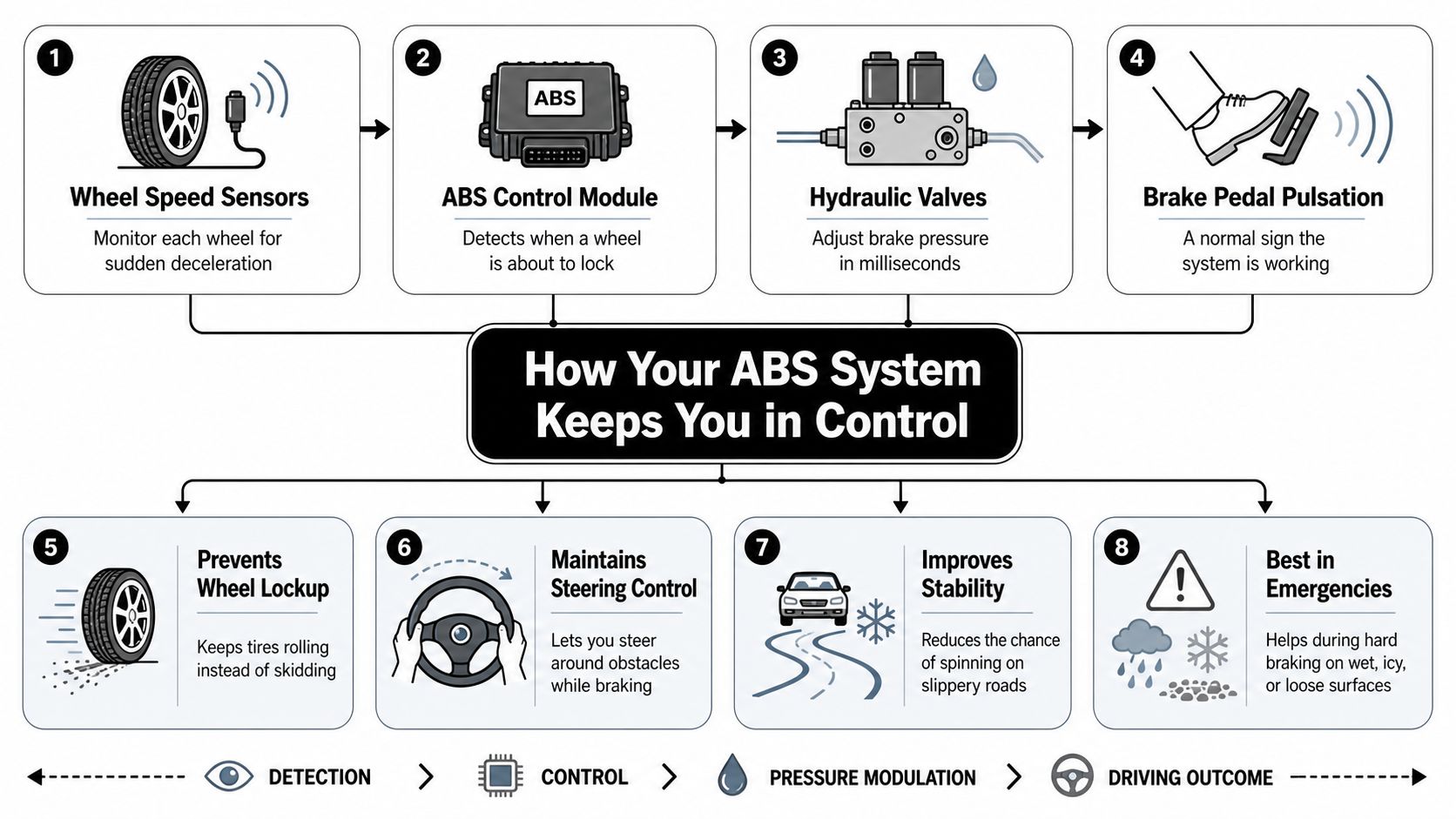
ABS is easiest to understand if you think of it as a brake pressure manager working faster than any human foot ever could. In a hard stop, the system can pulse brake pressure extremely quickly so the wheels don't stay locked. That rapid control helps the tyres keep traction long enough for you to steer.
It's not there to make every stop shorter. Its real job is to help you keep control during emergency braking.
The three parts that matter most
Every modern ABS setup has its own design details, but the working logic comes down to three main players.
Wheel speed sensors
These are the system's eyes. Each sensor monitors how fast a wheel is rotating and sends that information to the ABS control unit. If one wheel starts slowing much faster than the others under braking, the system reads that as impending lock-up.
Sensor faults are common because they live in a harsh place. They deal with moisture, salt, road debris, and constant suspension movement.
The control module or ECU
This is the brain. It takes the wheel speed data, compares what each wheel is doing, and decides when brake pressure needs to change. If the inputs don't make sense, or if a circuit test fails, the ECU triggers the warning light and stores a fault.
The ECU is also where proper diagnosis gets more technical. According to the ABS maintenance guide from FPInnovations, when a fault remains after the initial checks, technicians need to perform systematic resistance or voltage testing at the ECU connector with a digital multimeter. The same guide notes that if the circuit matches the specified values but the fault remains, the likely failure is internal to the ECU. If the readings are out of spec, the issue points back toward the wiring harness or a component in that circuit.
The hydraulic unit and pump
This is the muscle. Once the control module decides a wheel is about to lock, the hydraulic unit adjusts brake pressure at that wheel. That pulsing is what you sometimes feel through the pedal during true ABS activation.
ABS works in the background until grip gets marginal. Then it acts fast enough to stop one locked wheel from turning into a skid you can't steer out of.
There's another detail many owners never hear about. The same FPInnovations guide specifies that for ABS wheel speed sensor diagnostics in the CA region, the industry-standard sensor block location should be adjusted to the 9 o'clock position on right wheels and 3 o'clock on left wheels to optimize signal alignment and reduce false fault readings. That's the kind of detail generic DIY advice misses, and it matters when a fault won't stay gone.
Recognizing the Warning Signs of ABS Failure
Some ABS problems announce themselves clearly. Others show up as a “something feels off” complaint for weeks before the light ever becomes consistent. Good drivers often notice the symptoms before a scan tool does, but those symptoms need to be interpreted properly.

The obvious warning
The clearest sign is the ABS light on the dashboard. If that light stays on, the system has seen a fault it considers important enough to store. That doesn't tell you whether the issue is minor or severe, only that the system needs proper testing.
If you're trying to separate ABS concerns from normal braking wear, this guide on how to tell if brake pads are worn helps with the mechanical side of the picture.
The symptoms drivers often misread
Not every brake vibration means the same thing. Normal ABS activation during a hard stop can create a rapid pedal pulse. That's expected. What isn't expected is odd pulsing at low speed in routine braking, especially when road conditions are normal.
Watch for signs like these:
- Unexpected pedal feedback: Pulsing, chatter, or vibration during ordinary braking can suggest a bad sensor signal or erratic wheel speed data.
- A soft or inconsistent brake pedal: This can point to a hydraulic issue and shouldn't be brushed off as “just ABS”.
- Wheel lock-up in a hard stop: If the tyres skid instead of the system modulating pressure, ABS may not be intervening as it should.
- Intermittent warning light behaviour: A light that comes and goes over bumps, slush, or turns often hints at wiring or connector trouble.
Why winter makes the symptoms harder to ignore
In Whitby conditions, winter exposure changes the failure pattern. Salt, freeze-thaw cycles, slush, and pothole impacts all put extra stress on sensor wiring, connectors, and wheel-end components. A car can behave normally on a dry day and then trigger the fault again the moment moisture gets into a compromised connector or harness.
If the ABS light appears only after wet weather or rough roads, don't treat that as “intermittent means minor”. Intermittent electrical faults are often the ones that take the longest to find if no one tests them methodically.
The rule is simple. A brake warning you can reproduce is useful. A brake warning you ignore becomes expensive.
A Professional Approach to ABS Diagnostics
A lot of DIY ABS advice starts with the wrong premise. It assumes the warning light is the problem. It isn't. The light is the system telling you it has already found a problem somewhere else.
The most common shortcut is disconnecting the battery to “reset” the ABS computer. That approach often wastes time because it doesn't fix a damaged sensor, corroded wiring, contaminated hydraulic fluid, or an internal module problem. Industry data cited by PartsAvatar's ABS system guide states that 80% of these reset attempts are unsuccessful because they don't address the underlying component failure or hydraulic contamination. The same source also points out that relying only on the ABS light is a poor diagnostic strategy, and that proper fault scanning and brake hydraulic service matter when contamination is involved.
Why the battery reset myth sticks around
It's easy, free, and occasionally seems to work for a short time. If the system loses memory briefly or the fault is intermittent, the light may go out until the module sees the same problem again. Drivers take that as proof the issue was electronic when the actual fault was still waiting.
In winter climates, this myth is even more dangerous because fluid contamination and corrosion don't disappear when power is removed. PartsAvatar notes that water contamination can damage internal modulator valves and that the damage may not show up until later. That's how comebacks happen.
What a real diagnostic process looks like
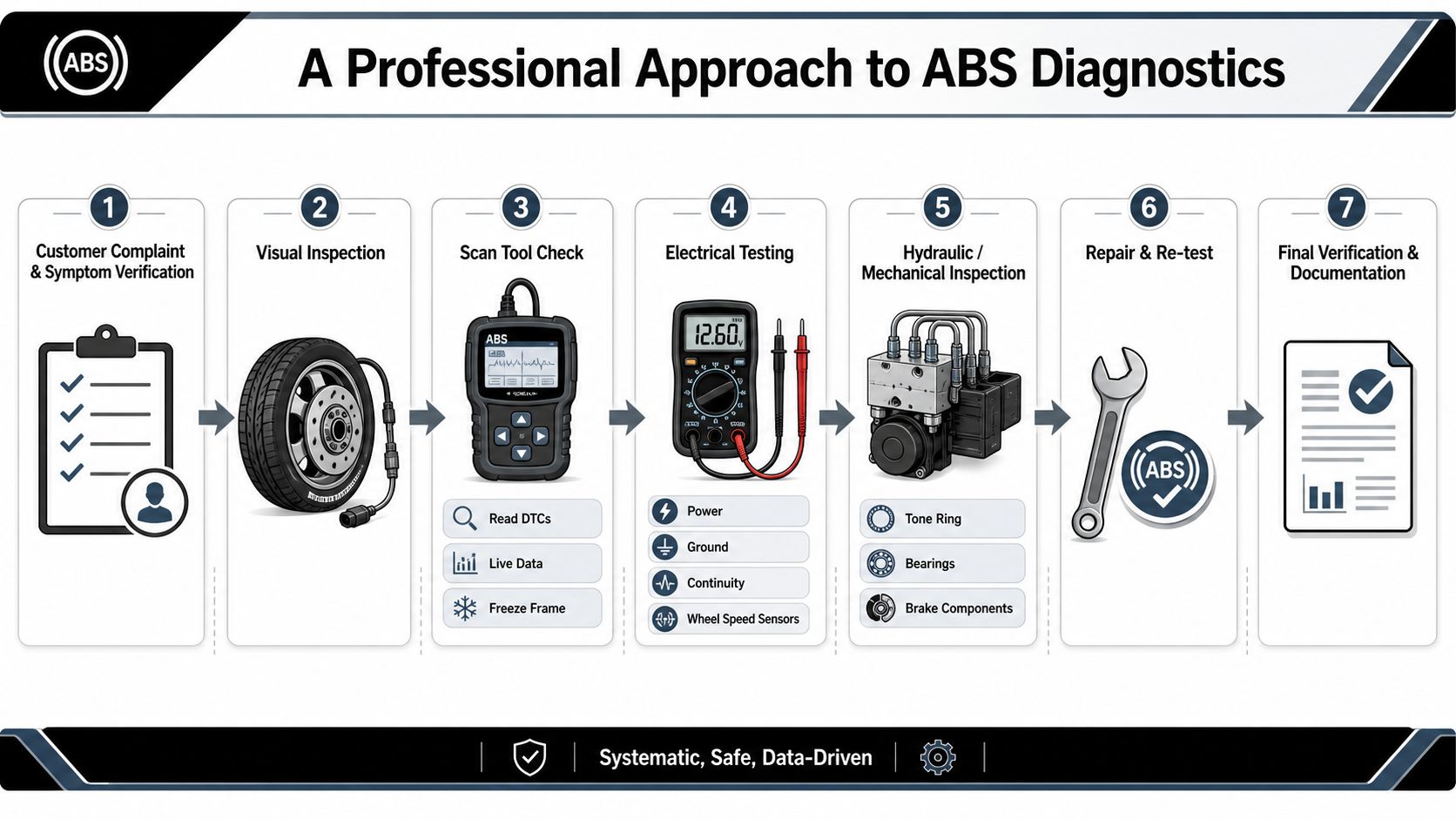
A proper ABS diagnosis is a chain of evidence. The scan tool gives the starting point. It doesn't give permission to throw a part at the car.
A technician typically works through the fault like this:
- Scan the ABS module: Read stored codes and live data with a capable scan tool.
- Confirm the complaint: Check whether the fault is current, stored, intermittent, or tied to vehicle movement.
- Inspect basics at the wheel end: Sensor mounting, connectors, corrosion, physical damage, debris, and harness routing.
- Test electrically with a DMM: Measure voltage or resistance where the service information says to test it.
- Backtrack the circuit: If readings are wrong, move step by step through the connector chain to isolate the failure.
- Verify the repair: Clear codes, road test safely, and confirm the fault doesn't return.
For vehicles that need deeper circuit work, computer diagnostics for cars is only part of the process. The scan tool points the technician in the right direction. The multimeter and wiring checks are what prove the fault.
Shop rule: A fault code names the circuit under suspicion. It doesn't automatically condemn the sensor, the module, or the harness.
Why procedure matters
The FPInnovations maintenance guide is clear on this point. Once the obvious checks are done, technicians should test resistance or voltage at the ECU connector with a digital multimeter and compare the reading to the latest service specifications. If the values match spec but the fault remains, the likely issue is inside the ECU. If the values don't match, the problem is in the wiring or connected component, and the circuit should be tested step by step from connector to connector.
That disciplined process is what separates diagnosis from guessing.
Common ABS Repairs and Typical Costs
Once the fault is identified, the repair itself is usually straightforward. The hard part is deciding what failed and what should be replaced rather than patched. With ABS, that distinction matters because small electrical weaknesses often turn into intermittent faults that are harder to find than the original failure.
The repairs seen most often
Four categories show up repeatedly in ABS system repair.
Wheel speed sensor replacement
This is one of the most common fixes. A sensor can fail electrically, lose signal because of damage or contamination, or produce erratic readings because it's not positioned correctly. On some vehicles the sensor is separate. On others it may be tied into a hub assembly or a more involved wheel-end repair.
ABS module repair or replacement
If circuit testing proves the inputs and outputs are correct but the module still flags the fault, attention shifts to the control unit. Some vehicles allow module-only service. Others require more involved replacement and setup. This is why guessing at a module early is expensive. It should be the conclusion, not the first move.
Hydraulic unit or pump service
A hydraulic fault can produce unusual ABS operation, poor modulation, or recurring warnings tied to fluid condition and internal valve problems. This kind of repair often requires careful bleeding procedures and a scan tool routine to return the system to proper operation.
The more integrated the system is, the less room there is for improvised repair steps. ABS work needs clean procedure from diagnosis through final bleed and verification.
Wiring repair versus wiring replacement
A lot of bad advice exists regarding ABS system repair. Many DIY guides still recommend cutting, soldering, and heat-shrinking damaged ABS wiring. That sounds reasonable until you remember how sensitive the system is to signal quality.
Industry guidance reported by FenderBender on collision repair and ABS is explicit: “WSSs with broken wires should be replaced rather than repaired because the wires must remain flexible to allow for suspension travel.” The same source explains that ABS units operate on very low-voltage signals, and a simple solder repair can introduce resistance or interference that affects system performance.
For winter-driven vehicles, that matters even more. Salt corrosion, pothole impacts, and repeated flexing are exactly what punish a repaired wire.
ABS System Repair Options at a Glance
| Repair Type | Typical Cost (CAD) | Typical Time | Complexity |
|---|---|---|---|
| Wheel speed sensor replacement | Varies by vehicle and sensor design | Usually shorter if access is straightforward | Low to moderate |
| ABS module repair or replacement | Varies widely by vehicle and programming needs | Moderate to longer | Moderate to high |
| Hydraulic unit or pump repair | Depends on component availability and bleed procedure | Moderate to longer | High |
| Wiring harness replacement | Varies by harness location and extent of damage | Moderate | Moderate to high |
For local brake and ABS-related service context, brake repair in Whitby is where many owners start comparing symptoms, inspection findings, and likely next steps.
What works and what doesn't
- What works: Scan data, circuit testing, proper connector inspection, clean hydraulic service, and replacing failed parts with the correct routing and installation.
- What doesn't: Battery resets, random parts swapping, and splicing wheel speed sensor wires that need to remain flexible and noise-resistant.
- Best trade-off: Spend more effort on diagnosis up front and less on repeat repairs later.
That's the true economy in ABS work. Not the cheapest first attempt. The correct first repair.
Why Whitby Drivers Trust Carmedics for ABS Repair
Whitby drivers deal with conditions that expose weak ABS repairs quickly. Salt gets into connectors. Slush finds damaged seals. Potholes pull on harnesses and punish anything that was “good enough for now.” If an ABS repair was done casually, winter usually reveals it.
That's why experienced owners don't want generic brake work when the ABS light is involved. They want a technician who understands that anti-lock braking faults aren't solved by clearing codes and hoping the light stays off. They're solved by reading the system properly, testing the circuit correctly, and following the repair through to final verification.

What careful owners usually value
Drivers who care about their vehicles tend to look for the same things in ABS system repair:
- Accurate diagnosis first: No guessing, no parts darts, no “let's try this”.
- Proper tooling: A capable scan tool, a digital multimeter, and a technician who knows how to use both together.
- Correct repair standards: Replacing damaged sensor wiring when industry guidance says replacement is safer than repair.
- Respect for the whole vehicle: Clean workmanship matters more on newer and performance-oriented vehicles because owners notice the details.
Why that matters locally
In a place like Whitby, the repair has to survive the next freeze-thaw cycle, the next storm, and the next rough stretch of road. A professional approach isn't about making the invoice bigger. It's about making the repair stick.
If you want a local shop that understands those standards and serves the Whitby community, visit Carmedics Autowerks in Whitby.
A good ABS repair restores confidence. The warning light is gone, the data checks out, and the system is ready to work when the road turns ugly.
If your ABS light is on, your brake pedal feels unusual, or you're tired of temporary fixes that don't last, book a proper diagnostic with Carmedics Autowerks Inc. We help Whitby drivers identify the underlying fault, repair it correctly, and put safety back where it belongs.