


You’re heading east on the 401 after work, traffic keeps bunching up, and every few brake applications you hear a noise that wasn’t there last week. It might be a light squeal pulling into a plaza in Whitby. It might be a rough grinding sound at the next red light. Either way, your attention goes straight to the brake pedal.
That reaction is a good one. Brakes usually give you warning before they become a much bigger problem. The trick is knowing which warning matters, which ones can mislead you, and what you can safely check yourself in the driveway before booking an inspection.
Around Whitby and Durham Region, brake wear isn’t just about mileage. Stop and go traffic, rough local roads, winter salt, and repeated short trips all work against pad life. If you want to know how to tell if brake pads are worn, you need to listen, look, and pay attention to how the vehicle feels when you stop.
Your Brakes Are Talking Are You Listening
Most drivers first notice brake wear through sound, not sight. It usually starts small. You back out in the morning, tap the brakes, and hear a quick chirp. A few days later, it happens more often. Then you begin wondering whether it’s just moisture on the rotors or whether the pads are getting thin.
That question matters more in Whitby than many drivers realise. In Ontario, where local driving often means congestion, lights, and frequent braking, brake pads typically last 30,000 to 70,000 kilometres, and urban conditions can accelerate wear by up to 40% compared to highway driving, according to Ontario brake pad wear guidance. The same source notes that pads should be at least 6 mm, because going below that risks rotor damage and can extend stopping distances by 20 to 30%.
The warnings usually come in three forms
Your brakes tend to speak in a few clear ways:
- Sound tells you something is changing. Squeals, scrapes, and grinding all mean different things.
- Feel tells you whether braking performance is staying consistent. A soft pedal or vibration is never something to shrug off.
- Sight confirms what’s happening. Pad thickness and rotor condition remove the guesswork.
We see a common pattern in the shop. A driver hears a noise, puts it off because the vehicle still stops, and then arrives later with rotor damage that could have been avoided with an earlier check.
Practical rule: If the noise is new, repeatable, and tied to brake pedal use, treat it as a brake issue until proven otherwise.
Why local conditions make the problem sneak up faster
Highway kilometres are easier on pads than local commuting. Durham Region driving means lane changes, traffic compression, school zones, plaza entrances, and winter road film that never really gives brake components a clean environment for long.
That’s why brake wear often feels sudden when it really isn’t. The pads have been thinning for months. The vehicle is only now speaking loudly enough for you to notice.
Interpreting Squeals Grinds and Vibrations
The fastest way to narrow down brake trouble is to match the symptom to the likely cause. Not every sound means immediate failure, but some noises mean you shouldn’t keep driving until someone checks it.
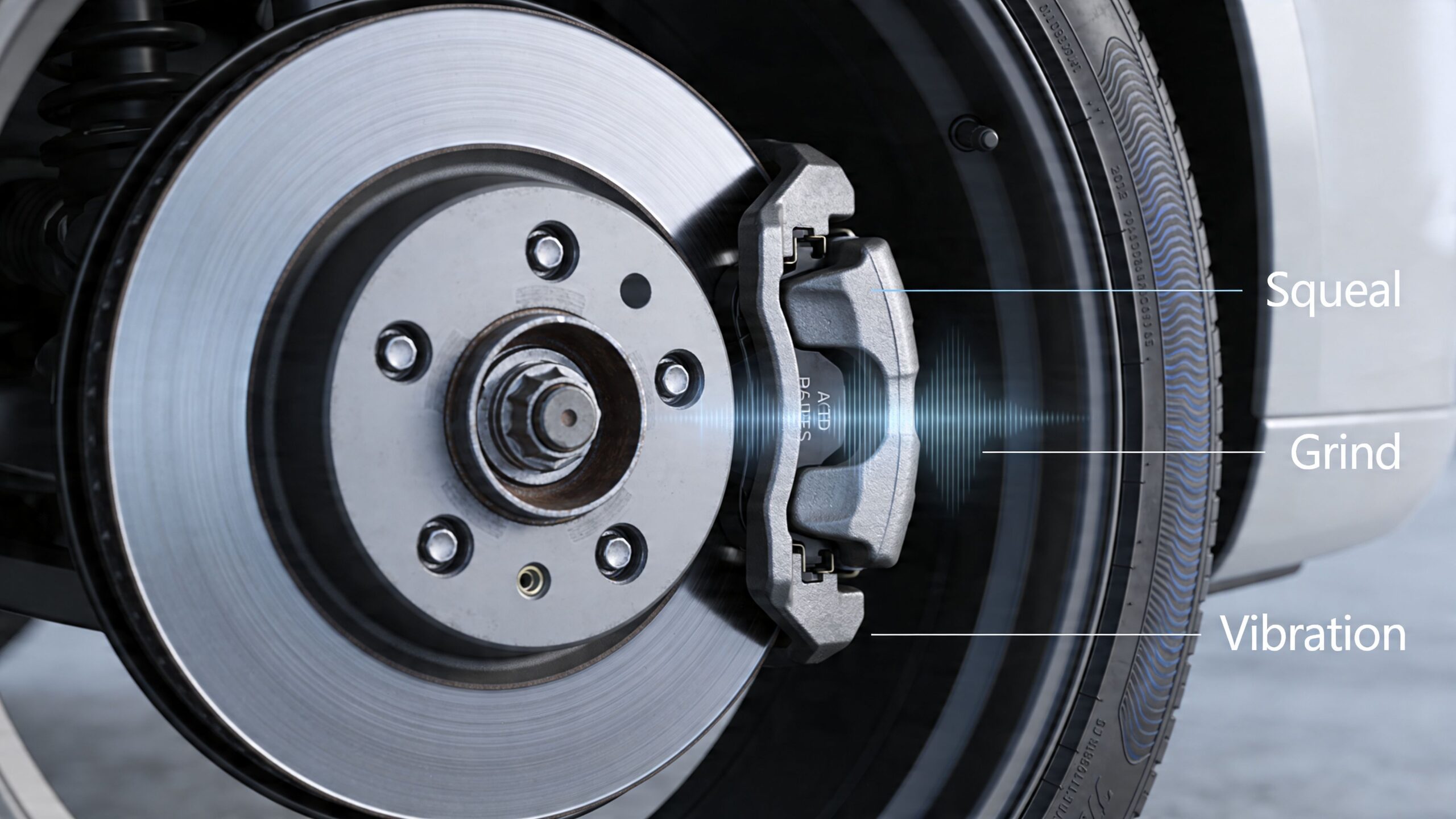
For Ontario vehicles, grinding or squealing noises signal worn brake pads in 95% of cases. A high pitched squeal usually comes from a metal wear tab contacting the rotor at around 3 mm of pad life remaining. A metallic grinding sound means the backing plate is contacting the rotor. A vibrating pedal often points to a warped rotor and can extend stopping distance from 100 km/h by 15 to 25 metres, based on Ontario brake warning sign data.
What a squeal usually means
A squeal is often the early warning. It’s unpleasant, but it’s useful. That little metal tab is designed to make noise before the pad is completely gone.
A few things to keep in mind:
- Intermittent squeal on brake application usually means the pads are getting low.
- Only hearing it after rain or a car wash can muddy the diagnosis. Moisture can make brakes noisy even when the pads still have life.
- A squeal that becomes more frequent deserves inspection soon, not next season.
If your issue is noise without obvious loss of stopping power, our guide on fixing squeaky brakes can help you sort out what’s normal and what isn’t.
What grinding means
Grinding is different. Grinding means the friction material may be gone or nearly gone, and metal is now contacting metal. At that point, the brake pad isn’t just worn. It’s damaging the rotor every time you stop.
That’s when a simple pad service can turn into a bigger brake repair. If you hear grinding, don’t test it for another week to see if it “gets worse.” It already has.
If the brake noise sounds expensive, it usually is.
What the pedal is telling you
Drivers often focus on noise and miss the pedal feel. That’s a mistake. Your foot can detect problems before your eyes do.
Here’s the simple read:
| Symptom | What it often points to | Urgency |
|---|---|---|
| Light squeal | Pad wear indicator contacting rotor | Book an inspection soon |
| Metallic grinding | Pad material worn through, rotor contact | Stop driving if possible |
| Pedal vibration or pulsation | Rotor damage or heat related distortion | Inspect promptly |
| Soft or longer pedal travel | Brake system issue that needs diagnosis | Inspect promptly |
Don’t ignore the dash light
Some newer vehicles also use electronic wear sensors or related brake warnings. If the brake warning light comes on with a noise or pedal change, take the hint. Dashboard warnings don’t tell the full story, but they do tell you the system wants attention.
A light on its own might point to more than pad wear. A light plus noise or vibration makes the case much stronger that you need the brakes inspected properly.
How to Perform a Visual Brake Pad Inspection
Sound gives you suspicion. A visual inspection gives you evidence.
The safest DIY brake task for most owners is inspection, not repair. If you’re comfortable using a flashlight and taking your time, you can often get a decent idea of pad condition without touching any hydraulic components.
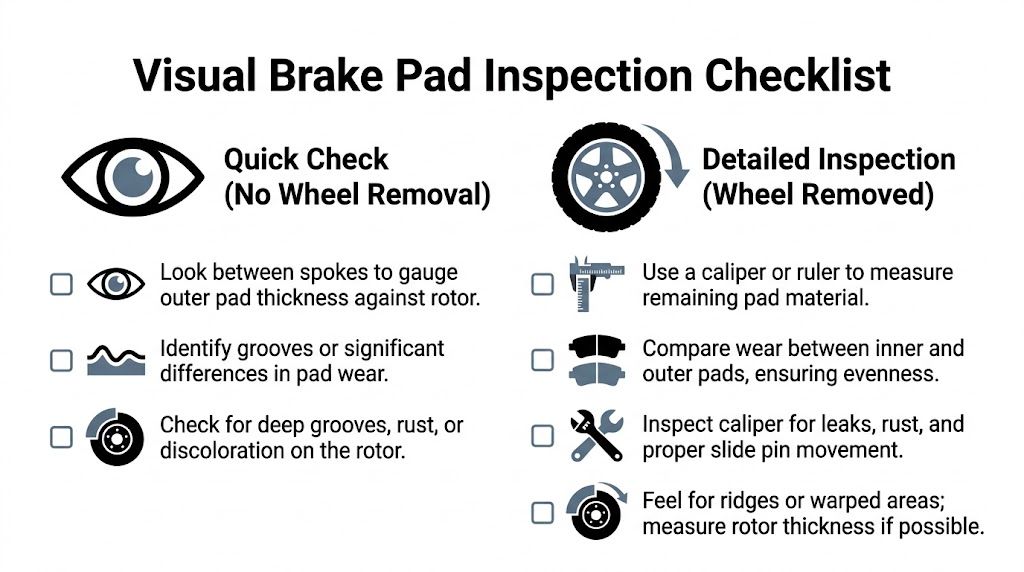
Under Ontario’s Highway Traffic Act, brake pads must have at least 1.5 to 2 mm of friction material. A wheel-off visual inspection is 95% effective for accurate measurement. New pads are typically 8 to 12 mm thick, and replacement is recommended at or below 3 mm. That process also helps spot uneven wear, which shows up in 30% of cases due to sticking calipers, according to this Ontario brake pad inspection reference.
Quick check through the wheel spokes
This is the driveway version. It won’t be as accurate as removing the wheel, but it’s useful when you want a fast first look.
Do it this way:
- Park on level ground and let the brakes cool. Don’t inspect hot brake parts right after driving.
- Turn the steering wheel if needed to improve visibility on the front wheels.
- Use a bright flashlight and look through the wheel spokes at the brake caliper and pad.
- Find the friction material, not the metal backing plate. You’re judging the actual pad material pressed against the rotor.
- Compare thickness visually. If it looks thin, assume it needs a closer check.
A healthy outer pad usually has clearly visible material. A thin pad can look like a narrow strip, and that’s where many drivers misread what they’re seeing.
What you’re actually looking at
The rotor is the shiny disc. The pad sits against it. The backing plate is metal. The friction material is what matters.
A quick visual check can help you catch:
- Thin outer pads that are obviously nearing replacement
- Deep grooves on the rotor that suggest metal contact
- Heavy rust or heat marks that point to a bigger issue
- Uneven left to right appearance that deserves a proper inspection
The limit of this method is simple. You usually can’t get a confident look at the inner pad, and inner pads can wear differently than outer ones.
Shop habit: If the outer pad looks borderline through the spokes, assume the inner pad could be worse.
The better method with the wheel removed
If you’re experienced, have the right tools, and know how to support a vehicle safely, removing the wheel gives you a much more honest answer.
Use a proper process:
- Chock the wheels and work on level pavement.
- Lift the vehicle safely with a jack at the proper lift point.
- Support it with jack stands. Never rely on the jack alone.
- Remove the wheel and inspect both the inner and outer pads directly.
- Use a caliper gauge or ruler to measure the thinnest point of the friction material.
This is where precision matters. At our shop, technicians use measuring tools rather than guessing by eye because small differences in thickness change the recommendation. If you’re trying to stay ahead of brake wear, that’s the difference between “monitor it” and “replace it now.”
For owners who want to avoid surprise repairs, a consistent service schedule matters as much as the inspection itself. A broader preventive maintenance plan for vehicles makes it easier to catch brake wear during routine service instead of after a warning noise starts.
A practical thickness guide
Here’s the simplest way to think about pad thickness:
| Pad condition | What it means |
|---|---|
| 8 to 12 mm | Typical new pad range |
| Around 6 mm | Still usable, but worth monitoring |
| 3 mm or less | Replace soon |
| 1.5 to 2 mm | Near or at minimum inspection threshold |
Don’t chase the absolute last bit of life from a pad. That rarely saves money. It usually does the opposite.
Check for uneven wear, not just low wear
This is the part many DIY checks miss. You’re not only checking whether the pad is thin. You’re checking whether both pads on the same caliper are wearing evenly.
Look for:
Inner pad thinner than outer pad
This often suggests caliper or slide movement problems.One side of the pad tapered
That can point to hardware issues or a pad that isn’t moving cleanly.One wheel much dustier than the other
Sometimes that corner is doing more work than it should.Rotor face marked differently on one side
Uneven contact often leaves clues on the rotor before the driver notices a pull or vibration.
If you remove a wheel and the wear pattern looks odd, stop there. That’s usually where DIY inspection should end and diagnosis should begin.
More Than Just Pads Common Related Brake Problems
Worn pads rarely travel alone. By the time a driver notices brake trouble, the pads may have already affected the rotor, caliper movement, or fluid condition.
That’s why a proper brake inspection looks at the whole corner, not just the thickness of the pad.
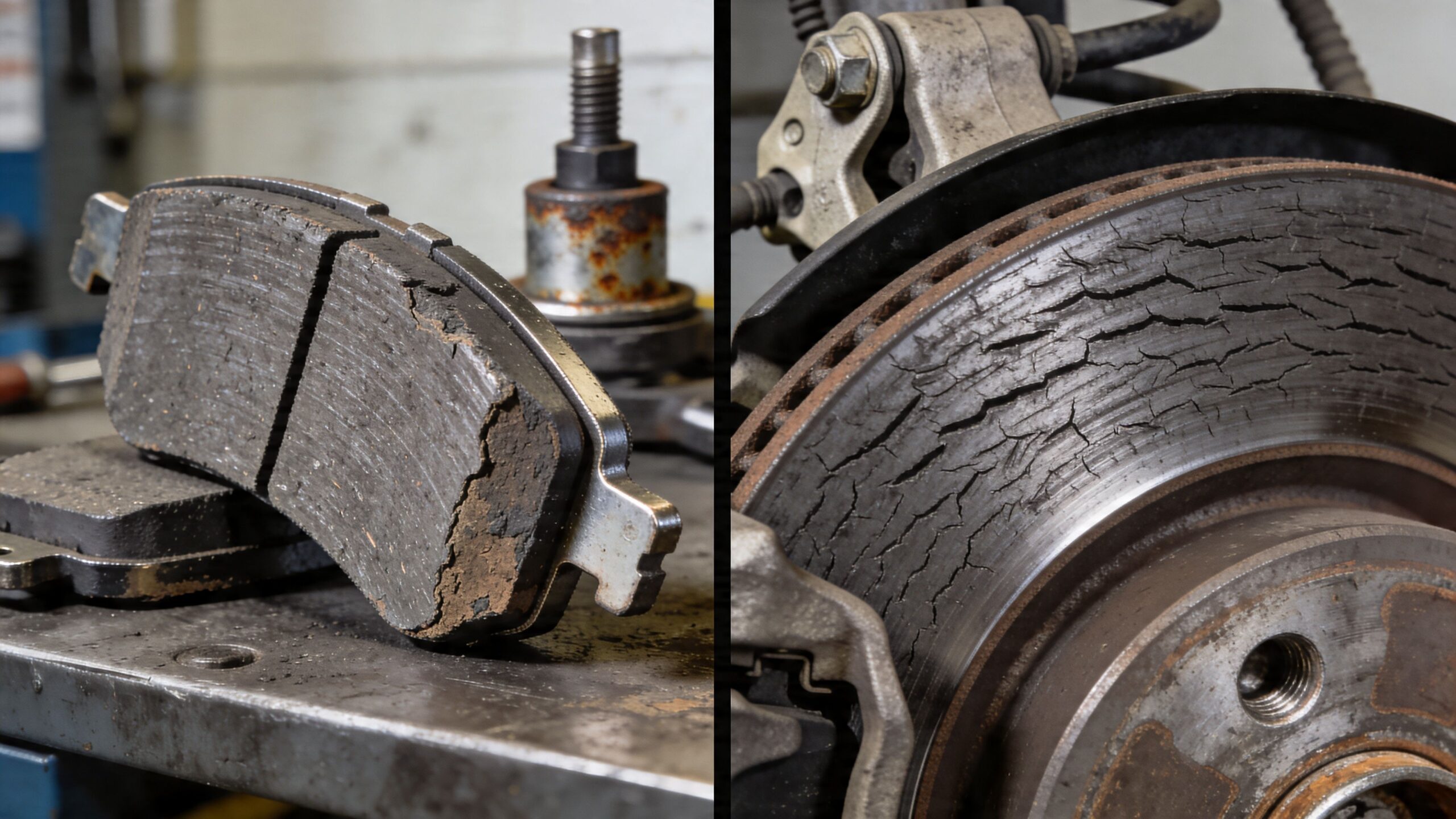
Ignoring worn pads frequently leads to rotor damage. In the Greater Toronto Area, uneven pad wear is found in 25% of professional inspections, often because of sticking brake calipers. That can lead to warped rotors and repairs costing over $800 CAD, as noted in this brake rotor and caliper wear reference.
Rotor damage changes the repair
A brake rotor should have a reasonably even surface. It won’t always look perfect, especially after winter, but it shouldn’t look chewed up, heavily ridged, or heat stained.
Common rotor clues include:
- Deep grooves that catch your fingernail
- Blue or dark heat marks
- Shiny glazed areas
- A lip at the outer edge
- Pulsation while braking
Once the rotor is damaged, replacing pads alone won’t restore proper braking feel. New pads pressed against a damaged rotor often lead to noise, poor bedding, and disappointing stopping performance.
Calipers and hardware matter more than many drivers think
A sticking caliper or seized slide pin can destroy one pad while the opposite side still looks serviceable. That creates a false sense that the brakes have life left when one corner is already in trouble.
If one pad is much thinner than its mate, don’t assume the pad brand is the issue. Usually the brake hardware or caliper operation is the problem.
A brake job that ignores a sticking caliper often becomes the same brake job twice.
Check the fluid too
Brake fluid doesn’t wear like pads do, but it tells you a lot about system condition. If the level is low, that can happen as pads wear down, but it can also point to a leak or another fault that needs diagnosis.
If you want to understand what healthy fluid should look like and when service makes sense, this guide to brake fluid service is a useful reference.
Brake trouble also raises a bigger safety question. If you ever experience a true loss of braking performance, knowing what to do when brakes fail is worth reviewing before you need it, not after.
When to DIY and When to Call a Professional
A lot of owners can inspect brakes. Fewer should replace them.
That isn’t gatekeeping. It’s just that brake work has a narrow margin for error. If you miss a seized pin, install parts incorrectly, or fail to diagnose rotor or caliper issues, the vehicle may stop poorly even if the new pads are technically installed.
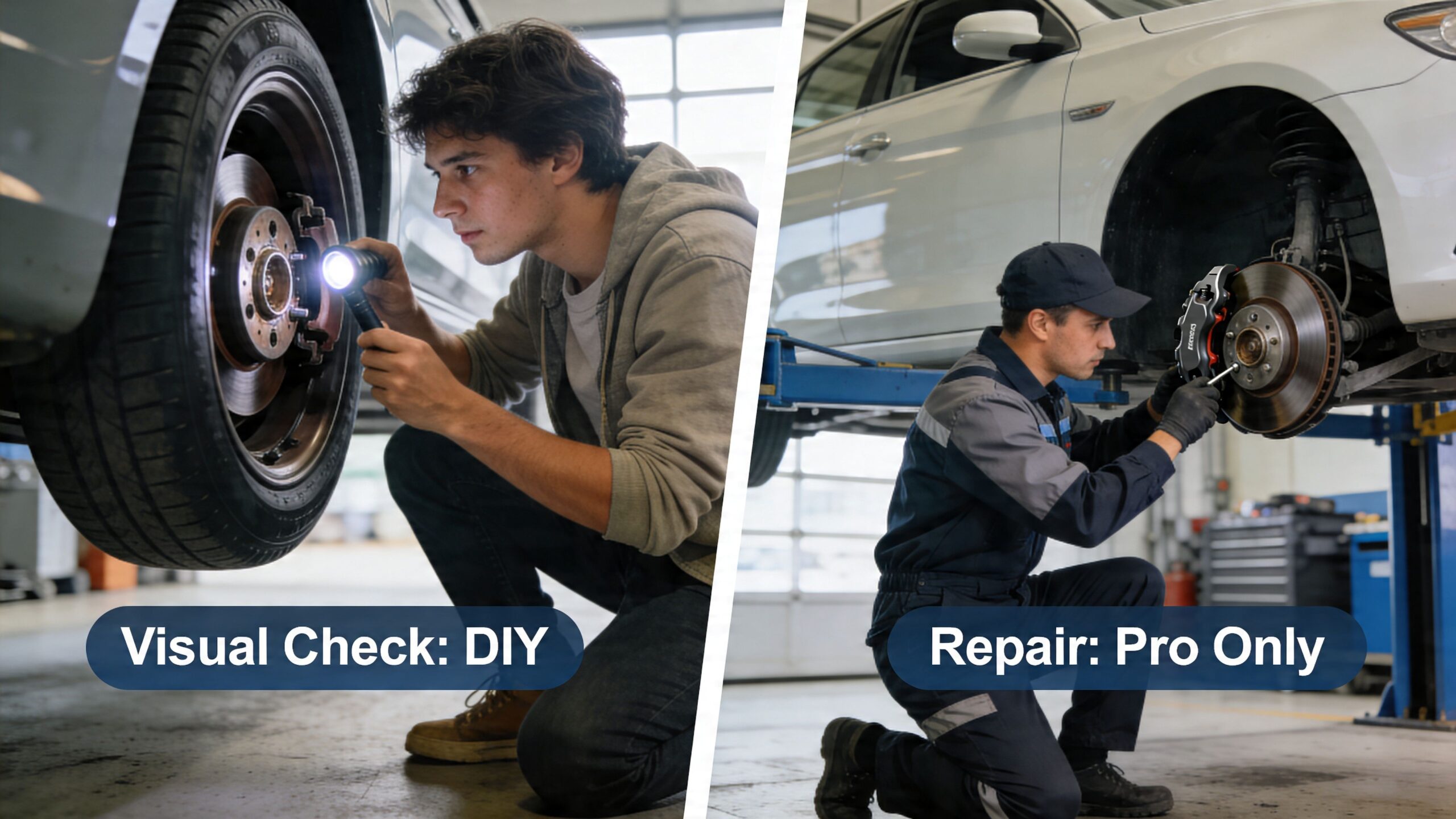
DIY makes sense when
A driveway inspection is reasonable if you can safely lift the vehicle, remove a wheel, and recognise what you’re seeing.
DIY works best for:
- Checking thickness when you hear a new brake noise
- Comparing inner and outer pad wear after a tire change
- Looking for obvious rotor damage
- Monitoring wear between routine services
That kind of inspection saves money because it helps you catch problems before they become rotor or caliper repairs.
Professional service makes sense when
Brake replacement should usually move to a shop when the repair goes beyond simple observation.
Call a professional if:
- You hear grinding
- The pedal vibrates or feels soft
- Wear is uneven
- The caliper won’t retract smoothly
- You’re not sure whether the rotor can be reused
- The warning light is on with any brake symptom
A proper brake service includes more than swapping pads. It means checking hardware movement, confirming rotor condition, inspecting related components, and torquing everything correctly.
If you’re comparing repair options, it helps to review the typical factors that affect brake pad replacement cost before you commit to parts or labour.
The real trade off
DIY can save labour. Professional service reduces risk.
For brakes, that trade off matters. Most drivers don’t regret getting a second set of trained eyes on the one system that must work every single time, in every season, on every road condition Whitby throws at you.
Keep Your Vehicle Safe with Proactive Brake Care
Good brake maintenance is mostly about timing. Catch wear early, and the repair stays straightforward. Wait until the pad is gone, and the job often expands to rotors, hardware, and sometimes caliper work.
The easiest routine is simple. Listen for changes. Look at the brakes during seasonal tire swaps. Pay attention to pedal feel. If something feels off, trust that instinct and have it checked.
A practical routine that works
Drivers who stay ahead of brake problems usually do the same few things consistently:
- Listen during low speed stops in parking lots and neighbourhood streets
- Inspect visually during wheel swaps when access is easiest
- Don’t postpone repeat symptoms just because the vehicle still stops
- Ask for pad and rotor measurements during regular service visits
If you want a plain language refresher on the basics, this article on understanding brake pads wear is a helpful companion read.
When in doubt, book the inspection
If you’ve checked your brakes and still aren’t sure what you’re seeing, that’s the point to stop guessing. A proper inspection is cheaper than replacing damaged parts later, and it’s a lot cheaper than finding out your stopping distance has changed when traffic suddenly locks up on the 401.
If you need a local option, brake repair in Whitby is the right next step when the noise, feel, or wear pattern doesn’t add up.
If your vehicle is squealing, grinding, vibrating, or not stopping the way it should, book an inspection with Carmedics Autowerks Inc. We’ll check pad thickness, rotor condition, and the rest of the brake system so you know exactly what needs attention and what can wait.