
You wash the car, step back, and it looks great. Then winter hits Whitby. Slush sprays into the wheel wells, salt mist coats the underbody, and every highway run leaves grime packed into seams you can't see without putting the vehicle on a hoist.
That's usually when people start searching for vehicle undercoating near me.
If you've just bought a new car or SUV, this matters more than most owners realise. Rust rarely starts where you notice it first. It starts underneath, inside folds, around mounting points, and behind trim where moisture and salt sit longer than they should. A proper undercoating job isn't cosmetic. It's a barrier between Ontario roads and the metal your vehicle depends on.
Protect Your Investment from Ontario's Harsh Winters
A lot of Whitby drivers think about rust protection only after they spot the first orange stain on a weld or the edge of a rocker panel. By then, the conversation changes. You're no longer talking about prevention. You're talking about slowing damage that has already started.
New vehicle owners face a different choice. They can protect the underside while the metal is still clean, or they can wait and let several winters decide for them. That's why undercoating belongs in the same planning category as seasonal tyres, brakes, and fluid checks. A solid seasonal maintenance checklist for Ontario drivers should treat corrosion protection as routine maintenance, not an afterthought.
What winter driving really does underneath
The problem isn't just snow. It's the combination of wet roads, packed slush, salt residue, freeze-thaw cycles, and repeated impact from grit thrown up at speed. Every trip on the 401 or around Durham Region adds another layer of contamination to the underside.
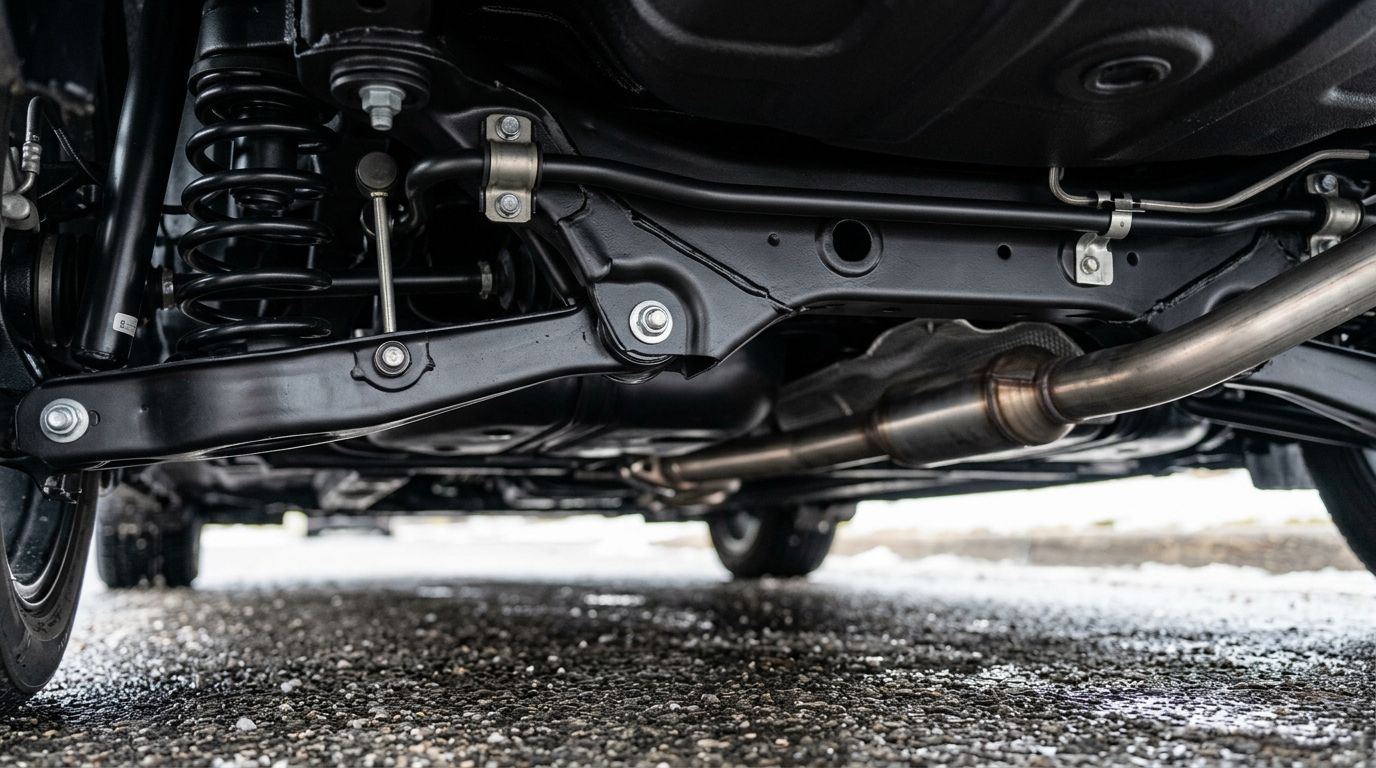
Drivers often notice the body first, but the undercarriage takes the beating. Floor pans, subframe areas, seams, brackets, and wheel well edges all live in the worst environment on the vehicle.
Practical rule: If you plan to keep the vehicle past a few winters, protect the underside early. Waiting usually costs more than doing it properly the first time.
Why this matters for long-term ownership
Undercoating doesn't make a vehicle indestructible. It lowers exposure and buys time. That's where its value lies. It helps preserve metal, slows corrosion in vulnerable areas, and makes it easier to keep the vehicle in better condition over the long haul.
For owners who care about resale, appearance, or avoiding needless rust repair, it's one of the more practical services available. Not glamorous. Very useful.
What Is Undercoating and Why It Matters on Whitby Roads
Undercoating is a protective layer applied to the underside of a vehicle to shield exposed metal from moisture, salt, and abrasion. The easiest way to think about it is as a weather barrier for the parts you rarely see but constantly rely on.
Whitby roads make that barrier worth paying attention to. Winter driving here isn't just wet. Roads are treated, slush is dirty, and the underbody gets blasted repeatedly. Even vehicles with factory corrosion protection can still become vulnerable over time, especially at seams, joints, and impact areas where coatings wear down.
Why local climate changes the decision
Ontario drivers don't deal with water alone. They deal with road salt and de-icing treatments that speed up corrosion. Because of that, applying undercoating before winter is widely recommended so protection is in place during the harshest salt exposure, as noted by Krown pricing and rust protection guidance.
That timing matters. A clean, dry underbody accepts product better than one that has already spent a season collecting residue. Good shops pay attention to that because adhesion and coverage are what separate a durable job from one that fails early.
If you want a broader outside perspective on rust prevention in another wet climate, Derek's Auto Detail has a useful piece on Seattle's Best Rust Prevention Service. The climate is different, but the logic is familiar. Moisture plus neglected metal always creates trouble.
What undercoating does and doesn't do
It helps by creating separation between corrosive road contamination and the vehicle's metal surfaces. It doesn't replace washing. It doesn't excuse ignoring drain points or existing rust. And it doesn't mean every product suits every owner.
Some drivers want a harder barrier. Others want a product that can work its way into seams and cavities. That's why product choice matters as much as the decision to undercoat in the first place.
For anyone researching options locally, it also helps to understand how undercoating fits with broader rust defence. A focused guide to the best rust prevention methods for cars in Ontario gives useful context before you commit to one approach.
A clean underbody in autumn is an opportunity. A dirty, rusty underbody in spring is a repair conversation waiting to happen.
Exploring the Different Types of Vehicle Undercoating
Most searches for vehicle undercoating near me produce a mix of shops, mobile applicators, and brand names, but the actual question is simpler. What type of coating are they applying, and is it right for your vehicle?
The products aren't interchangeable. They behave differently, age differently, and suit different owners.
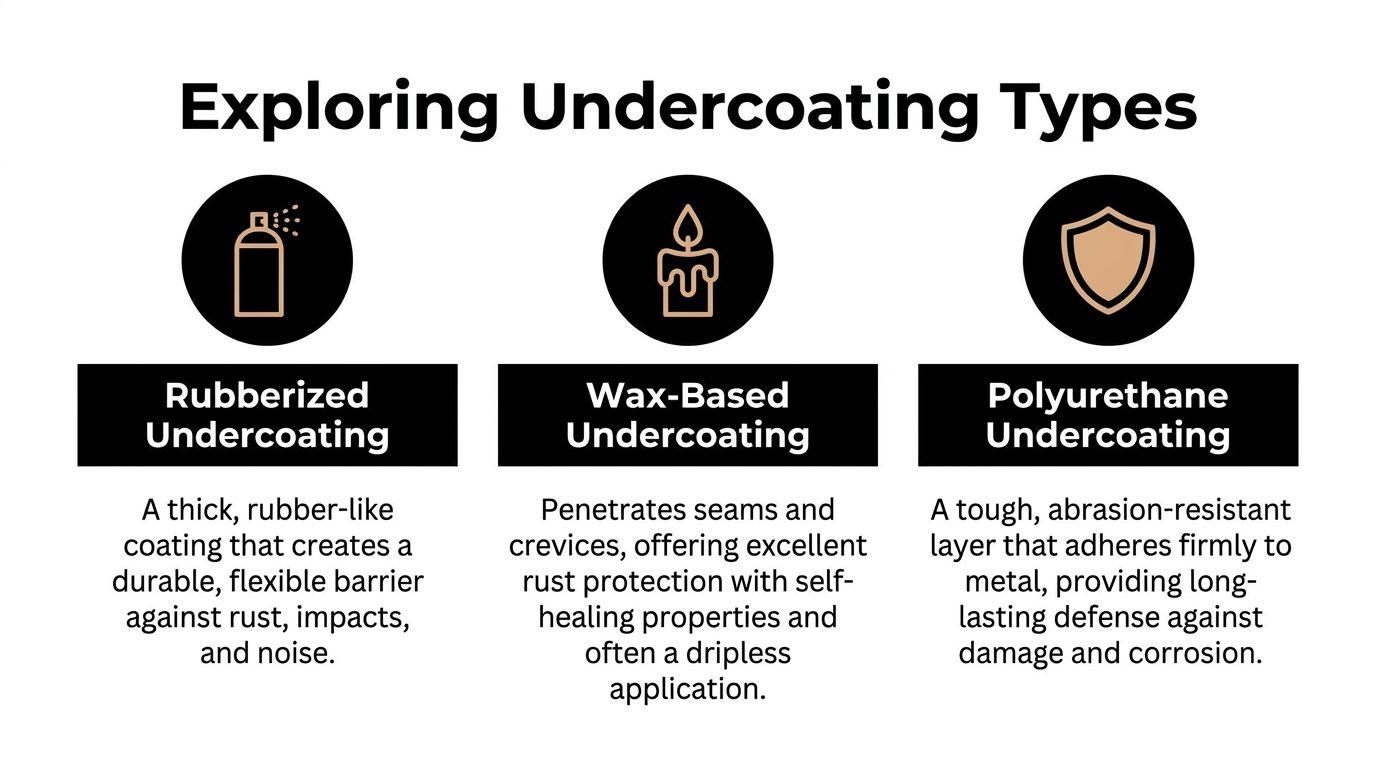
Asphalt and rubberized style coatings
These are the heavier coatings many drivers picture first. They form a thicker barrier on the underbody and are often chosen for physical protection against grit, spray, and road impact. In Ontario, a quality asphalt-based application can also reduce road noise by up to 25%, which gives it a comfort benefit as well as a protective one. That road-noise figure is discussed later in the FAQ where the source is linked.
The trade-off is prep quality. Thick coatings need a clean surface and careful application. If a shop sprays over contamination, loose scale, or hidden moisture, the coating can end up sealing trouble underneath rather than preventing it.
Drip-less waxy shell products
Drip-less undercoating uses a thick, waxy product that hardens into a shell. It's designed to resist chipping and peeling while creating a barrier that keeps water and salt off metal surfaces. Butterworth's explains this approach clearly in its overview of drip-less undercoating for Ontario roads.
This style appeals to owners who want a cleaner finish and less mess after application. The key is even coverage and proper drying time. If it isn't applied thoroughly, missed pockets become the weak points.
Oil-based rustproofing
Oil-based products solve a different problem. They don't rely on becoming a hard shell. They move. They seep into seams, folds, and hidden areas that a surface barrier can miss. That's their strength.
According to NH Oil Undercoating's explanation of undercoating pros and cons, oil-based rustproofing has a creeping capability that penetrates 4 to 6 inches into spot welds, seams, and folds. That matters on modern vehicles, where rust often starts in places you can't properly protect with a surface-only coating.
The maintenance trade-off is straightforward. Oil-based protection needs reapplication. Owners who don't want an ongoing schedule usually prefer a harder coating. Owners who want seam penetration often accept the repeat visits.
Electronic rust modules
These come up often in undercoating conversations, especially with newer vehicles. In practice, they don't inspire the same confidence as a well-applied physical coating. Drivers like the idea of a set-it-and-forget-it module, but most experienced body technicians still trust actual material on the metal more than theory alone.
If a shop is pushing electronics but can't show you how they handle the underbody itself, that's a reason to ask harder questions.
Vehicle undercoating comparison
| Coating Type | Pros | Cons | Best For |
|---|---|---|---|
| Asphalt or rubberized style | Strong physical barrier, good impact resistance, can help with noise reduction | Surface prep must be excellent, not ideal if corrosion is already active underneath | Newer vehicles, owners wanting a durable exterior layer |
| Drip-less waxy shell | Clean finish, hardens into a protective shell, good resistance to water and salt exposure | Coverage quality matters a lot, shell products don't offer the same seam-creeping behaviour as oil-based products | Drivers who want a tidy, shop-applied barrier |
| Oil-based | Reaches seams, folds, and inner cavities that harder coatings can miss | Needs reapplication, can remain messy compared with shell-type products | Older vehicles, seam protection, owners comfortable with maintenance |
| Electronic module | Low mess, easy to market | Effectiveness is debated, no physical barrier on exposed metal | Drivers who want supplementary protection, not a primary strategy |
If you're already protecting the visible paint, it makes sense to think about the underside at the same time. That's why many owners researching rust control also look into paint protection film for exposed exterior surfaces. The underbody and the outer body face different threats, but they're part of the same ownership plan.
How a Professional Undercoating Service Is Performed
A proper undercoating job looks methodical. A weak one looks fast.
The difference usually starts before any product is sprayed. Shops that take shortcuts on prep tend to produce the jobs that disappoint later. If you've ever looked under a vehicle and seen overspray on the wrong parts or coating laid over grime, that's not a product problem. That's an application problem.
Step one is cleaning and inspection
The underbody has to be clean enough for the product to bond the way it should. That means washing away mud, salt residue, oily buildup, and loose contamination. If the vehicle comes in dirty from winter use, prep takes longer, and that's normal.
Inspection happens at the same stage. A technician should be looking for existing rust, damaged shields, missing fasteners, wet areas from leaks, and spots where coating should not go.
Masking matters more than most owners think
Experienced applicators don't just spray everything underneath and call it done. They isolate sensitive or high-heat components and keep product off parts where it can cause problems later. Braking components, exhaust sections, some moving parts, and service points all need judgment.
Good undercoating is selective. Coverage should be thorough on the right surfaces, not careless on every surface.
This is one reason professional service beats a rushed DIY attempt for many owners. The challenge isn't just getting product underneath the car. It's knowing what to protect, what to avoid, and how thick the material should be in each area.
Application and curing
Once prep and masking are done, the chosen product is applied evenly to exposed metal areas. Drip-less materials need drying time so the coating can harden into its protective layer. Oil-based products behave differently and are judged more by penetration and coverage than by a hardened finish.
A good shop also checks the completed job before releasing the vehicle. That final look catches thin spots, missed edges, and overspray issues before the owner drives away.
What quality looks like afterwards
You should expect clear communication about drying time, odour, maintenance, and whether the product needs seasonal or annual follow-up. If a shop can't explain the care requirements in plain language, that's a warning sign.
Ask them what they do on vehicles that already show minor corrosion. The honest answer won't be “we spray over everything.” It'll involve prep, limitations, and what result you can realistically expect.
Typical Costs and Key Questions for Your Auto Shop
A low quote can look good in October and feel expensive by February.
Undercoating prices in Whitby depend on three things more than anything else. Vehicle size, product choice, and the amount of prep the shop has to do before spraying. A clean newer sedan with minimal corrosion is usually simpler to service than an older pickup that has already seen a few Ontario winters.
If you want a local reference point before booking, Carmedics outlines the usual price range in its Whitby vehicle undercoating cost guide. Use that as a starting point, then compare what each shop includes in the job.
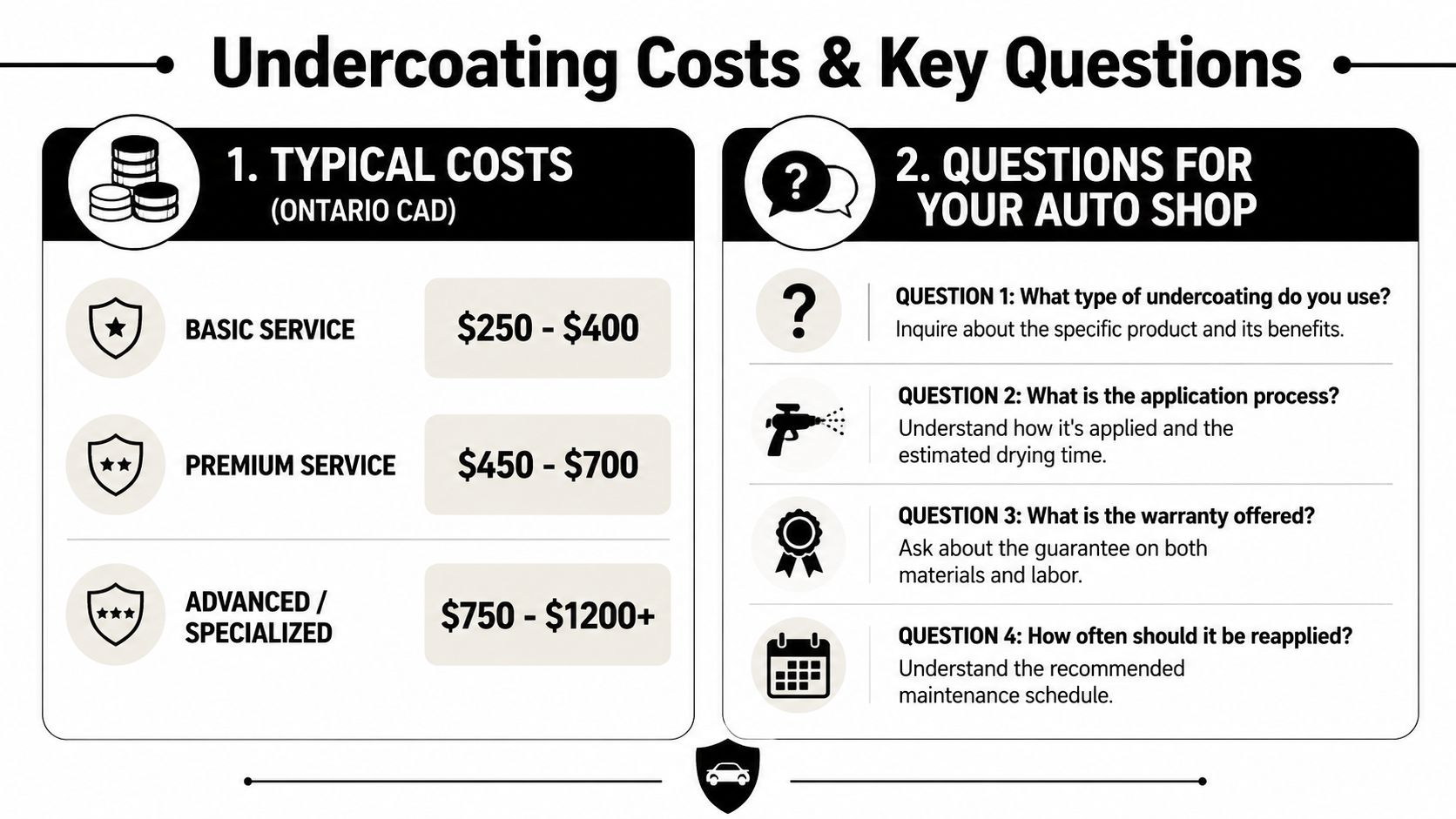
What changes the price
Bigger vehicles cost more because they take more time and material. Trucks, large SUVs, and vans also tend to have more underside area, more corners to reach, and more places where road salt collects.
The product matters too. An oil-based treatment and a thicker drip-less coating do not involve the same labour, follow-up schedule, or expectations. One may suit a daily driver that needs regular maintenance protection. Another may make more sense for an owner who wants a firmer barrier on selected surfaces and understands the prep has to be right.
Condition affects cost as well. If the underbody needs extra cleaning or there is existing corrosion that has to be addressed first, the price should reflect that. Good shops charge for the time required to do the job properly.
Questions worth asking before you book
Price is only one part of the decision. Ask the shop how they handle the work and how it fits into a bigger protection plan for the vehicle.
- What product are you using, and why is it right for my vehicle? The answer should match your driving habits, parking conditions, and ownership timeline.
- What prep work is included? Ask about washing, drying, inspection, and whether they deal with light surface rust before application.
- What areas do you avoid or mask off? Careful shops should be able to explain this clearly.
- How long before I can drive it normally or wash it? You need practical aftercare instructions, not a vague estimate.
- Will this need annual touch-ups or inspections? Some systems are maintenance-based by design.
- Do you offer other protection that works with undercoating? That question matters more than many owners realize.
That last question is where smarter long-term planning starts. Undercoating protects the underside, but total vehicle protection goes further. Stone chips around wheel arches, damage on lower doors, and constant UV exposure all shorten a vehicle's life in different ways. A shop that also understands PPF and tint can help you build a protection plan that works together, instead of treating rust prevention as a one-product purchase.
What a careful buyer looks for
Look for clear answers, realistic expectations, and a shop that talks openly about trade-offs.
A good shop will explain what undercoating can do, what it cannot fix, and whether another service should come first. That honesty usually matters more than saving a small amount on the initial bill.
Why Whitby Drivers Choose Carmedics Autowerks for Protection
Most rustproofing conversations stop at the underside. That's too narrow.
A vehicle doesn't age one panel at a time. Salt, chips, moisture, UV exposure, and daily wear all work together. That's why the strongest strategy is total vehicle protection, not a standalone undercoating appointment with no thought given to wheel arch impact, lower-body paint damage, or long-term exterior preservation.
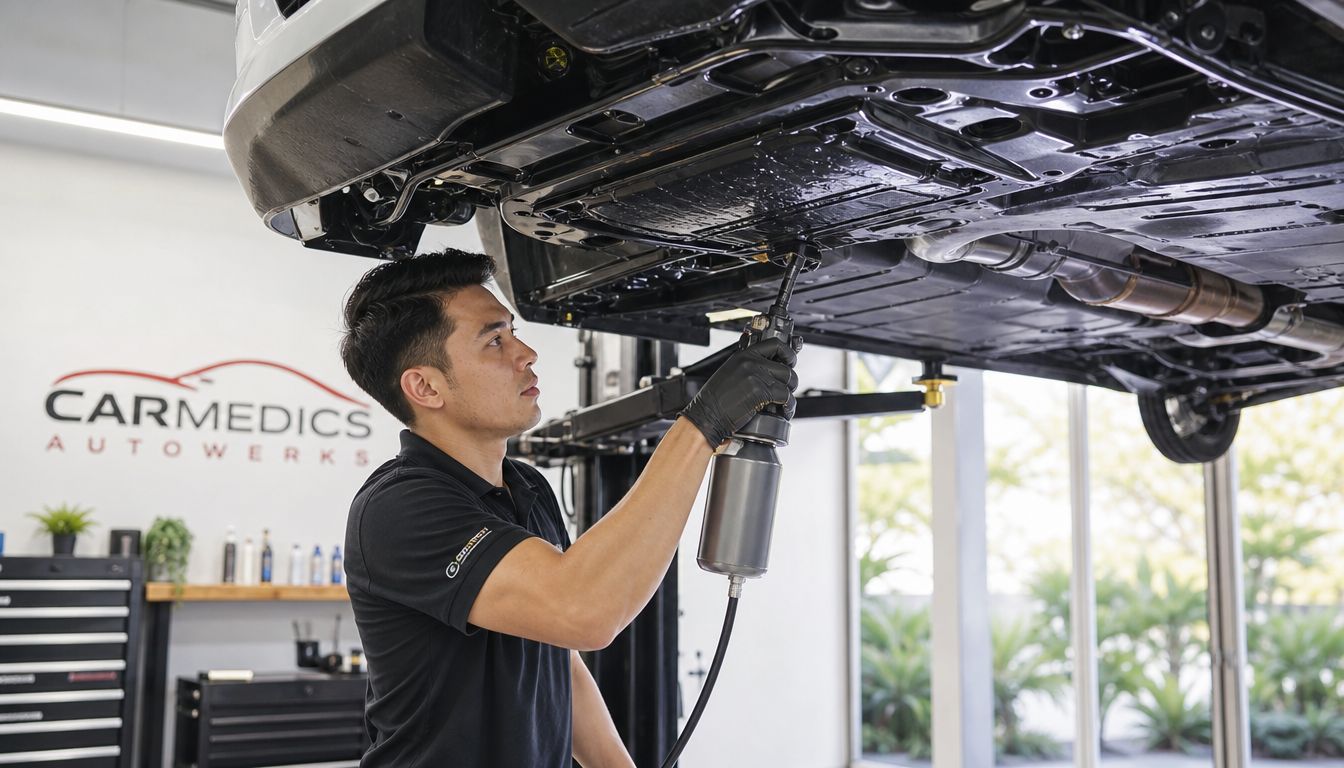
Why combined protection makes sense
Undercoating protects the underside. Paint protection film helps shield vulnerable exterior areas from chips and abrasion. Window tint supports interior preservation and everyday comfort. These aren't random add-ons. They address different paths of wear on the same vehicle.
That broader approach has measurable support. LINE-X's undercoating and rustproofing information cites emerging 2025 to 2026 trends showing that combined protection packages including tint, PPF, and undercoating reduce corrosion rates by 40% in high-salt regions, and that PPF sidewall protection helps prevent salt ingress at wheel wells, where 68% of rust starts.
For new SUVs and daily-driven cars in Whitby, that matters. Wheel openings, lower rocker areas, and splash zones get punished through the season. Treating the underside while ignoring the vulnerable outer edges leaves a gap in the plan.
Why local knowledge matters
A Whitby shop sees the same climate patterns, road treatment habits, and winter driving conditions that local owners deal with every year. That local experience changes recommendations. It affects product choice, timing, inspection habits, and how realistic the maintenance advice is.
Protection works best when the shop understands the roads you actually drive, not just the product label.
A specialist that handles repair, film, tint, and appearance protection can look at the vehicle as a whole. That usually leads to better decisions than treating rustproofing as an isolated upsell.
For drivers who want to speak with a local team that works on these protection issues every day, the Carmedics Autowerks Whitby location is the place to start.
Frequently Asked Questions About Vehicle Undercoating
Can you undercoat an older vehicle with some rust already showing
Yes, sometimes. The deciding factor is the condition of the metal before any product goes on.
Light surface rust can often be cleaned, treated, and then protected. Flaking scale, soft metal, or rust coming through seams is a different job. In those cases, coating over the problem can trap moisture and hide corrosion that should be repaired first. A shop that knows rust repair, not just spray application, will tell you where undercoating still helps and where body work should come first.
Does undercoating take long
Plan on leaving the vehicle for at least part of the day, and sometimes longer if the underside is dirty or the product needs more cure time.
Prep decides the timeline. The vehicle may need washing, drying, masking, and inspection before application starts. If a shop promises a very fast turnaround without talking about prep, ask more questions.
Will it smell afterwards
It can. Oil-based and solvent-based products often leave a temporary odour for a few days, sometimes longer in warm weather or if the vehicle is parked indoors.
That is usually normal. What matters is getting clear instructions on ventilation, cure time, and when the smell should fade.
Does undercoating help with noise
Some types do. Thicker underbody coatings can dull a bit of tire and road noise, especially on older vehicles with less factory insulation left underneath.
I would treat that as a bonus, not the reason to book the service. The main job is corrosion protection. If you want quieter driving and better long-term preservation, the better plan is total vehicle protection: undercoating for the underside, film in high-impact areas that get chipped, and tint that helps protect the interior while improving comfort year-round.
Is annual maintenance always necessary
No. It depends on the product and how the vehicle is used.
Oil-spray systems usually need regular reapplication because they creep, wash back, and are meant to stay active. Harder coatings need inspections to check for missed spots, damage from road debris, and wear around wheel wells, jacking points, and seams. In Ontario, that follow-up matters because salt, slush, and freeze-thaw cycles find weak spots fast.
If you want practical advice on the right protection plan for your car or SUV, Carmedics Autowerks Inc offers undercoating, PPF, window tinting, and repair services for Whitby drivers. Reach out for a quote and get a protection strategy that fits how you drive and how long you plan to keep the vehicle.