

You're on the 401 or Highway 12, the traffic is crawling, and your car starts hesitating between gears. The engine revs, the shift feels late, and for a second you're not sure whether to pull over or keep going. That uneasy moment is exactly where automatic transmission repair stops being abstract and becomes a real decision for Whitby drivers.
The hard part is that transmission trouble rarely starts with a dramatic failure. It usually begins as a small symptom, then grows into a repair that's far more expensive and more disruptive than it needed to be. A good shop will help you separate a minor fault from a major internal problem, then explain whether repair, rebuild, or replacement makes sense for your vehicle and budget.
Introduction to Transmission Repair
A driver usually notices transmission trouble before the transmission gives up completely. Maybe the vehicle pauses before moving, shifts feel rough, or a warning light appears after a commute through Whitby traffic. Those first signs matter because transmission issues often develop gradually, and delay gives the problem more time to spread through the unit.
That's why automatic transmission repair isn't just about fixing a bad shift. It's about catching the fault early enough to avoid turning a localised issue into major internal damage. If you want a quick reference point for general auto service support, Carmedics Autowerks has a helpful auto repair overview, but transmission work needs more specific diagnosis than a normal service visit.
For Whitby owners, the smartest move is to treat hesitation, slipping, or fluid loss as a prompt to ask questions, not to guess. A technician should be able to explain what they tested, what they ruled out, and why the next step is repair, teardown, or replacement. That clarity saves time, and it often protects the value of the vehicle.
Understanding Transmission Basics and Symptoms
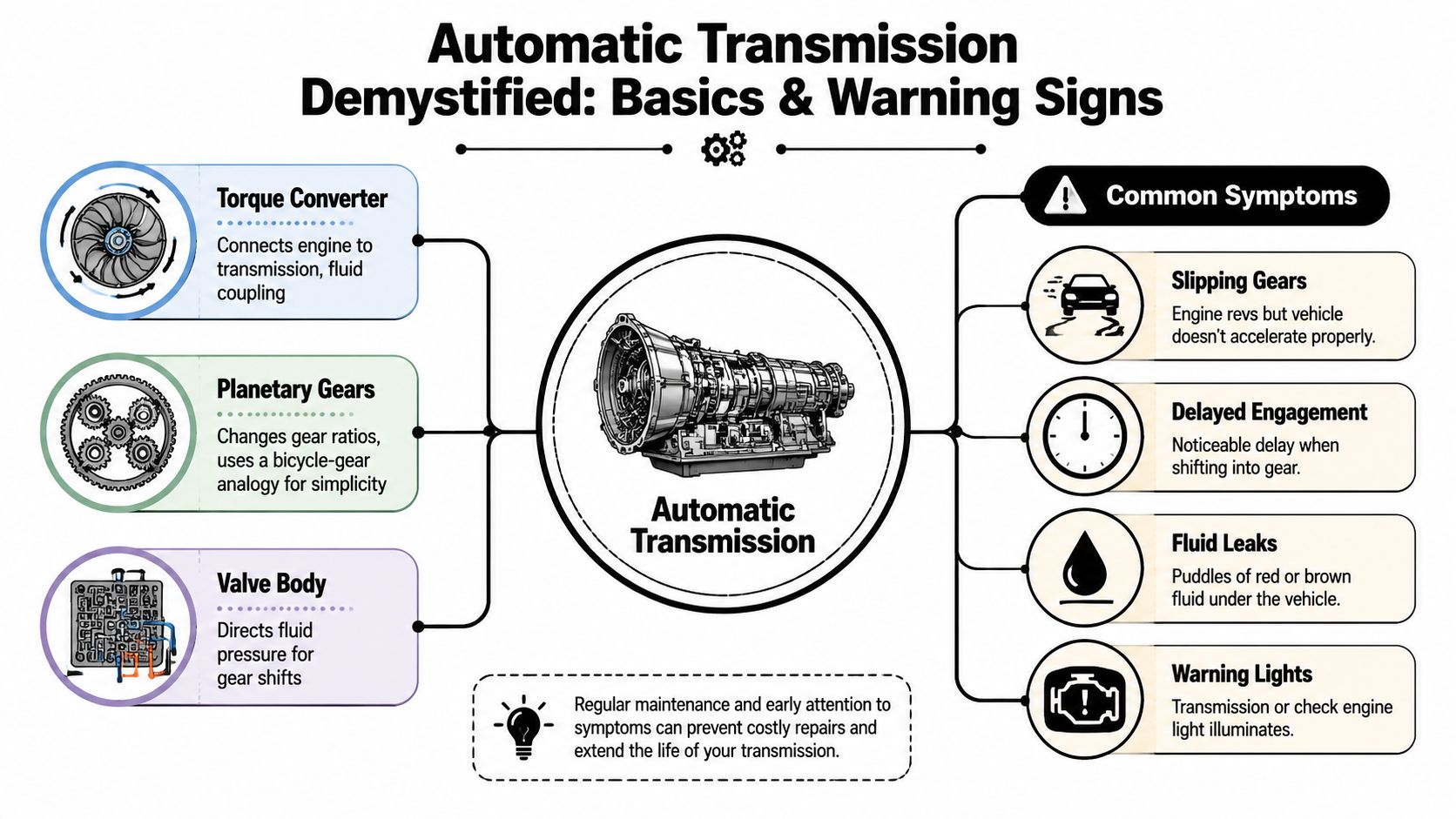
An automatic transmission works a bit like a bicycle drivetrain that changes effort depending on the road, except the shifting happens through fluid pressure, gears, and electronic control instead of your hand on a lever. Three parts show up again and again in diagnosis, the torque converter, planetary gears, and valve body. The converter links engine power to the transmission through fluid coupling, the gears change the ratio, and the valve body directs fluid where it needs to go.
Practical rule: when a car shifts badly, don't assume the gearbox itself is the only problem. The issue can come from fluid level, leaks, electrical control, or worn internal parts.
That's why symptoms matter so much. Slipping gears can feel like the engine is racing without matching road speed. Delayed engagement often feels like the car pauses before moving out of park or reverse. Fluid leaks usually leave a visible trail under the vehicle, and warning lights point to a fault the control system has already noticed.
A useful way to think about it is this, if the transmission is the delivery system, the fluid is the working pressure, and the control system is the traffic signal. If one part fails, the whole sequence gets confused. A technician who understands that relationship can trace the fault instead of swapping parts blindly.
If you want a plain-language reminder of how dashboard symbols can matter, Blade Auto Keys on Corsa spanner warnings is a useful example of how a warning light can point to service needs rather than a single broken part. For a closer look at checking fluid at home, this transmission fluid guide can help you spot obvious problems before you book a repair.
Diagnostic Steps in the Repair Shop
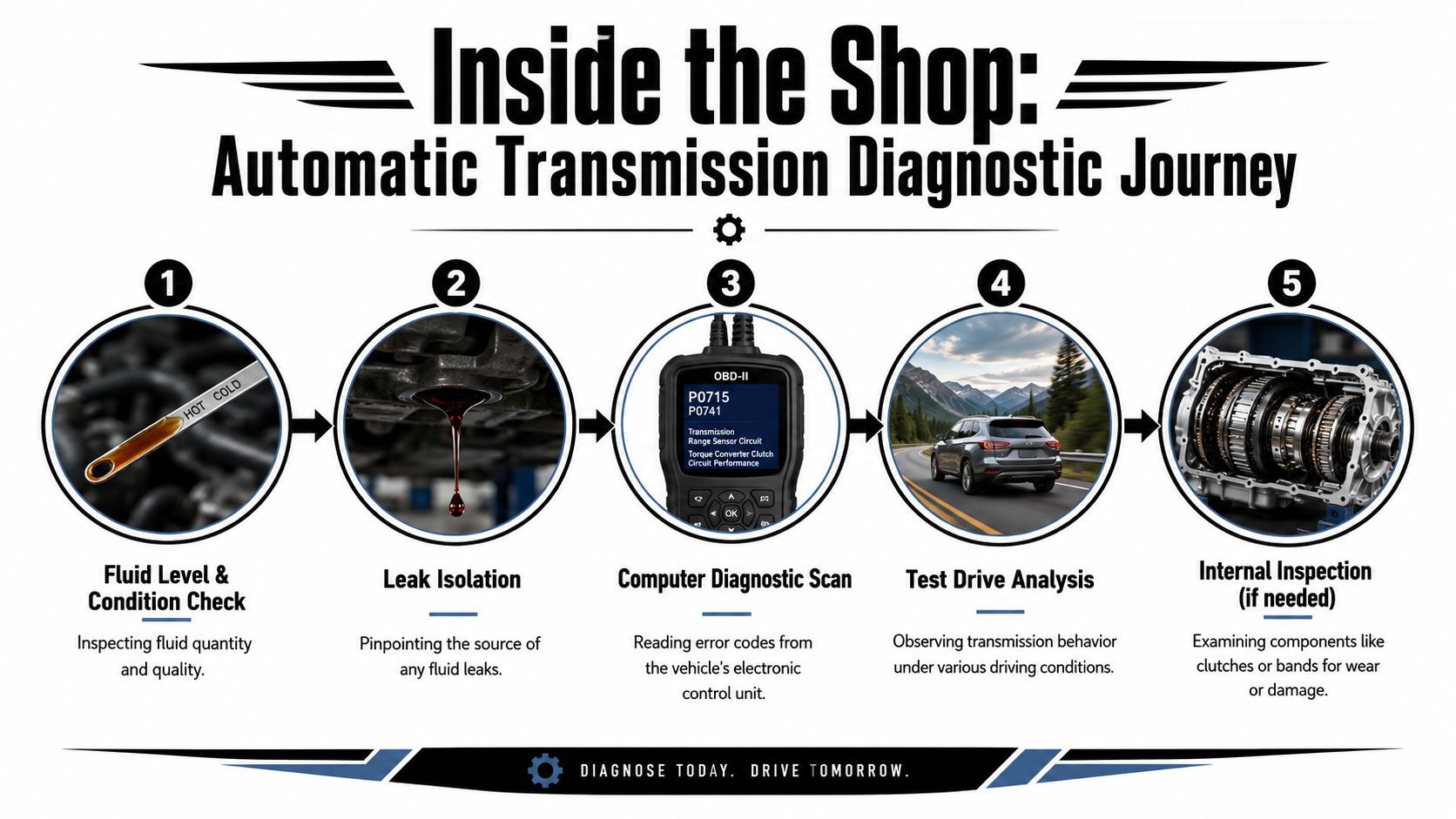
The first job in the bay is usually the simplest one, and it matters more than people expect. A technician checks fluid level and condition, because low, dark, or burnt-smelling fluid can point to heat, wear, or a leak path that deserves attention before anything is opened. If the level is off, there's no point guessing at internal failure yet.
How a technician narrows the fault
A proper diagnostic path often looks like this:
- Fluid level and condition check, to see whether the transmission is being starved or contaminated.
- Leak isolation, to find whether the problem is a seal, pan, cooler line, or another external source.
- Computer diagnostic scan, to read stored faults from the vehicle's control system.
- Test drive analysis, to feel how the unit behaves under load, throttle changes, and gear transitions.
- Internal inspection if needed, to confirm wear inside the unit before authorising major labour.
A scan tool tells part of the story, but the road test tells the rest. A transmission that looks fine on paper can still flare, slip, or bind under real driving conditions.
Technicians may use a scan tool, pressure gauge, or borescope-style inspection tool depending on what the symptom suggests. In Ontario, transmission technicians are formally recognised as specialists who inspect, maintain, and repair hydraulic, mechanical, and electronic subsystems in modern automatics, which accurately describes these roles. For a look at how computer-side checks fit into the process, computer diagnostics in car repair is a useful match.
That layered approach protects you from unnecessary work. If the diagnosis stops at a code reader, you may pay for parts that never needed replacing. If the technician checks the full chain, you get a better answer before the repair starts.
Comparing Repair Options and Decision Factors
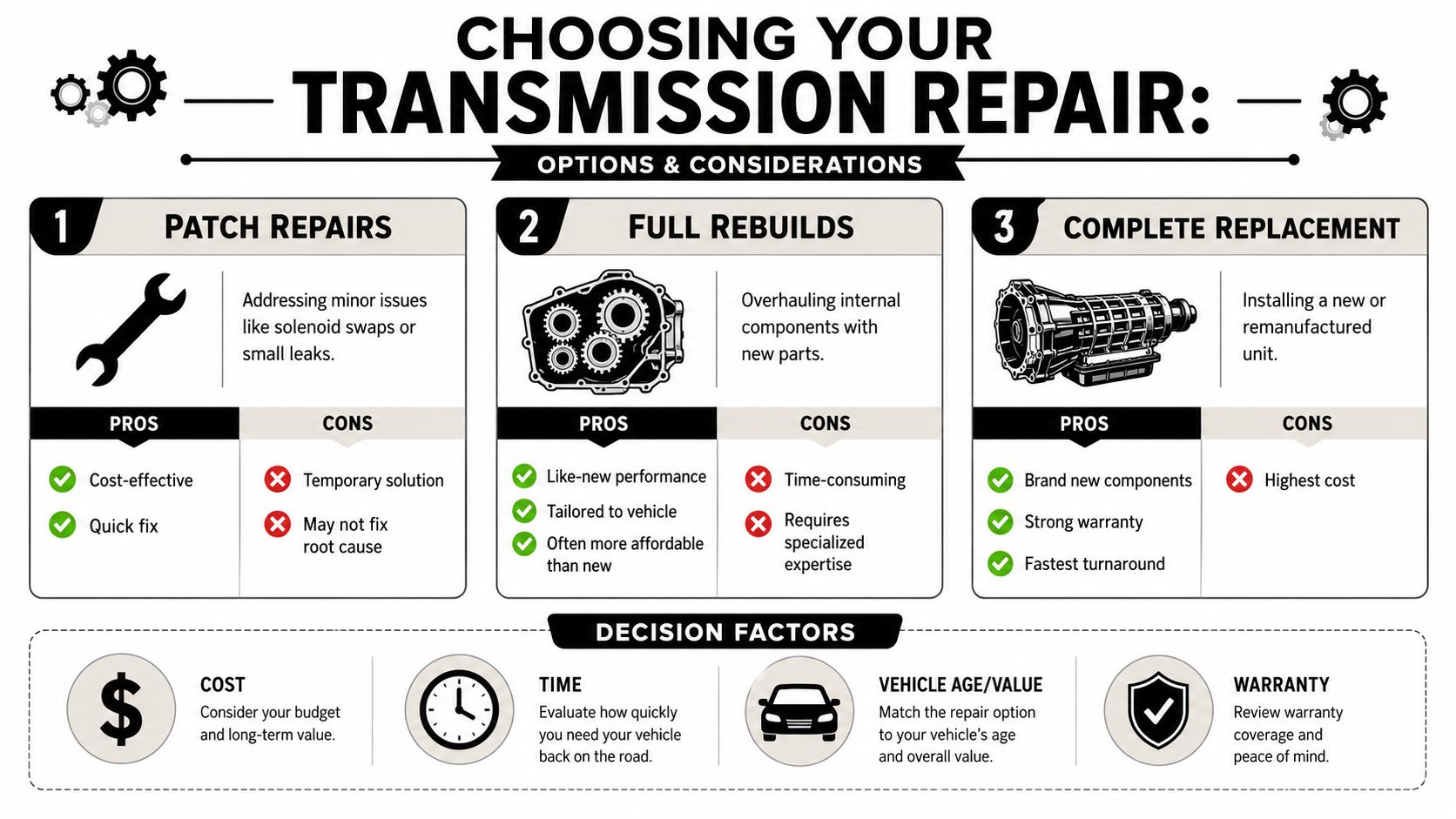
Not every transmission problem deserves the same fix. A small leak or a bad solenoid can sometimes be handled with a patch repair, while damaged clutch packs, hard parts, or contaminated fluid may push the job toward a full rebuild. If the case, electronics, or internal wear are too far gone, a complete replacement may be the cleaner route.
What each option really means
- Patch repairs deal with smaller faults. They can be the quickest path when the damage is limited, but they won't solve a deeper internal problem.
- Full rebuilds replace worn components inside the unit. They're more labour-heavy, but they let a technician tailor the repair to the actual damage.
- Complete replacements swap in a new or remanufactured unit. That can simplify the outcome, but the price tends to climb fast.
Independent guidance notes that transmission costs depend on the type of transmission, the extent of internal damage, the vehicle's age, and how long the problem has been developing. Those same factors decide whether a Whitby driver should spend on repair or walk away from the vehicle. The hard question isn't only “Can it be fixed?” It's “Does the fix match the car's value and future use?”
A shop should also explain how the vehicle's history changes the recommendation. A well-maintained transmission that failed early may justify different work than a unit that's been slipping for months. For drivers comparing service providers, a shop like Carmedics Autowerks' repair selection guide can help frame the right questions before you approve a quote.
Typical Costs and Timelines
The biggest cost surprise is usually not the diagnosis, it's the scope. A transmission can look like one failed part from the driver's seat, then turn into a major labour job once the case is opened and the technician sees what's worn. Replacing a transmission can cost about $2,900 to $7,100 on average, depending on the vehicle and repair scope, which is why getting the right diagnosis before authorising work matters so much.
A minor fix can often be quicker than a rebuild or replacement, but the timeline depends on parts availability, teardown results, and how much confirming work the shop needs to do first. Fluid service is a different conversation from internal repair, and it's one reason a shop may ask to inspect the unit before giving a firm answer. If you're budgeting around a service visit, this transmission fluid change cost guide is a useful starting point for the maintenance side of the equation.
| Cost and Timeframe by Repair Option | Repair Type | Cost Range | Timeframe |
|---|---|---|---|
| Cost and Timeframe by Repair Option | Patch repair | Usually lower than major work, varies by fault | Often the fastest option |
| Cost and Timeframe by Repair Option | Full rebuild | Mid to high, depending on internal damage | Longer, due to teardown and assembly |
| Cost and Timeframe by Repair Option | Complete replacement | About $2,900 to $7,100 on average | Often the most straightforward once chosen |
The cleanest takeaway is simple. If the quote seems high, ask what is being replaced, what's being reused, and whether the diagnosis proves internal failure or only suggests it. That conversation is where hidden cost thresholds show up.
Preventive Maintenance Best Practices
Transmission life usually depends on what owners do before trouble starts. Fluid breaks down over time, heat builds up, and old fluid stops doing its job as well as it should. Severe-duty use can justify much shorter fluid intervals than easy driving, so maintenance history matters more than many people think.
Good habits that protect the unit
- Use the right fluid, because the wrong specification can change shift quality and internal protection.
- Replace the filter when service calls for it, since a clogged filter can starve the system.
- Inspect the pan and magnet, because debris gives a clue about wear patterns.
- Check for leaks early, especially if the driveway starts showing red or brown spots.
- Ask for pressure testing when symptoms appear, since it can reveal wear that isn't obvious from a quick drive.
Transmission system readings mirror blood pressure for a transmission. The system may still move the car, but abnormal readings warn you that stress is building inside. A technician can spot small issues long before the symptoms become hard shifting or loss of drive.
Whitby drivers who tow, commute in stop-and-go traffic, or use a vehicle hard should be especially alert to service history. If the fluid hasn't been changed on time, or if the vehicle has been driven with a known issue, the repair conversation gets more serious fast. Prevention won't solve every failure, but it can delay the expensive ones.
Choosing the Right Shop and Questions to Ask
A transmission repair shop should be able to talk plainly about what it found, what it can prove, and what it still needs to inspect. If a quote comes back vague, push for detail. Ask whether the shop has transmission-specific experience, what warranty comes with the repair, and whether it uses OEM or aftermarket parts.
Ontario drivers should also ask how the repair aligns with vehicle safety inspection standards. Post-repair work isn't just about smooth shifting, it also has to leave the vehicle assembled safely, with no loose or hazardous adjacent components. That matters after transmission removal, because the reassembly work often affects surrounding hardware, shields, and clearance.
If a shop won't explain diagnosis, parts choice, and warranty in plain language, keep shopping.
For Whitby motorists, local knowledge matters too. Carmedics Autowerks Inc handles general auto repairs in Whitby and also offers transmission service and related drivetrain work, so it sits in the group of shops that can evaluate the transmission alongside nearby systems instead of treating it in isolation. That kind of broader repair view is useful when the symptom could involve electronics, fluid, or another component sharing the same fault pattern.
The best questions are the ones that force precision:
- What failed, exactly?
- What did you test before recommending repair?
- Is the unit repairable, rebuildable, or better replaced?
- What warranty applies after the work is done?
- Will the repair affect inspection readiness or other underbody components?
When a shop answers those cleanly, you're not just buying labour. You're buying a diagnosis you can trust.
Conclusion and Next Steps
Transmission trouble feels urgent because it can turn a normal drive into a risky one fast. The signs are usually familiar, hesitation, slipping, rough engagement, leaks, or a warning light, but the right response depends on diagnosis, not guesswork. Once a technician checks fluid condition, leak sources, electronic faults, and road behaviour, the repair path becomes much clearer.
For Whitby drivers, significant value comes from finding the point where repair still makes sense before the unit crosses into replacement territory. That's the hidden cost threshold many guides skip, and it's the decision that matters most when you're trying to protect both the vehicle and your budget. If you want a direct assessment from a local shop, the next step is to book a transmission inspection and ask for a written explanation of the findings.
A CTA for Carmedics Autowerks Inc.