

You've got the bottle in one hand, the reservoir cap in the other, and the warning light only started nagging after a cold Whitby morning or a long crawl on the 401. That's usually the moment people start asking the wrong question, which coolant colour should I buy, instead of the right one, what does my car call for?
Coolant types explained starts with a simple truth. The fluid in your radiator isn't just there to keep the engine from freezing on a January start. It also has to stop boil-over in summer traffic, slow internal corrosion, and keep the pump and metal passages from wearing out too early. If you want a quick reminder of why overheating problems happen at all, this overview on engine overheating causes is a useful companion read.
What Your Radiator Is Actually Fighting Every Day
A radiator in Ontario has a rough life. On a Whitby winter morning, the engine has to warm up without the fluid turning sluggish or freezing in the wrong place. A few months later, the same system may be idling in slow traffic on the 401 with hot coolant moving through metal that's already under load.
Four enemies, one fluid
Coolant has to handle freezing, boiling, corrosion, and cavitation at the same time. That's why “coolant” and “antifreeze” get used interchangeably, even though the fluid is doing more than winter duty. It's also why plain water is such a risky shortcut, because water alone can't give you freeze margin, boil margin, and corrosion protection in one package.
The system is really a heat-management loop. The engine makes heat, the coolant carries it away, and the radiator dumps it into the air. When the fluid is wrong, weak, or too diluted, the whole loop starts losing control.
Practical rule: if a car only needed “something in the radiator,” owners wouldn't see so many overheated engines and cracked components after a cold snap or a summer commute.
The liquid needs the right balance so it can move heat efficiently and also protect the metal surfaces it touches. That balance matters in both January and July, not just when the thermometer drops.
The Core Job of Coolant Beyond Just Not Freezing
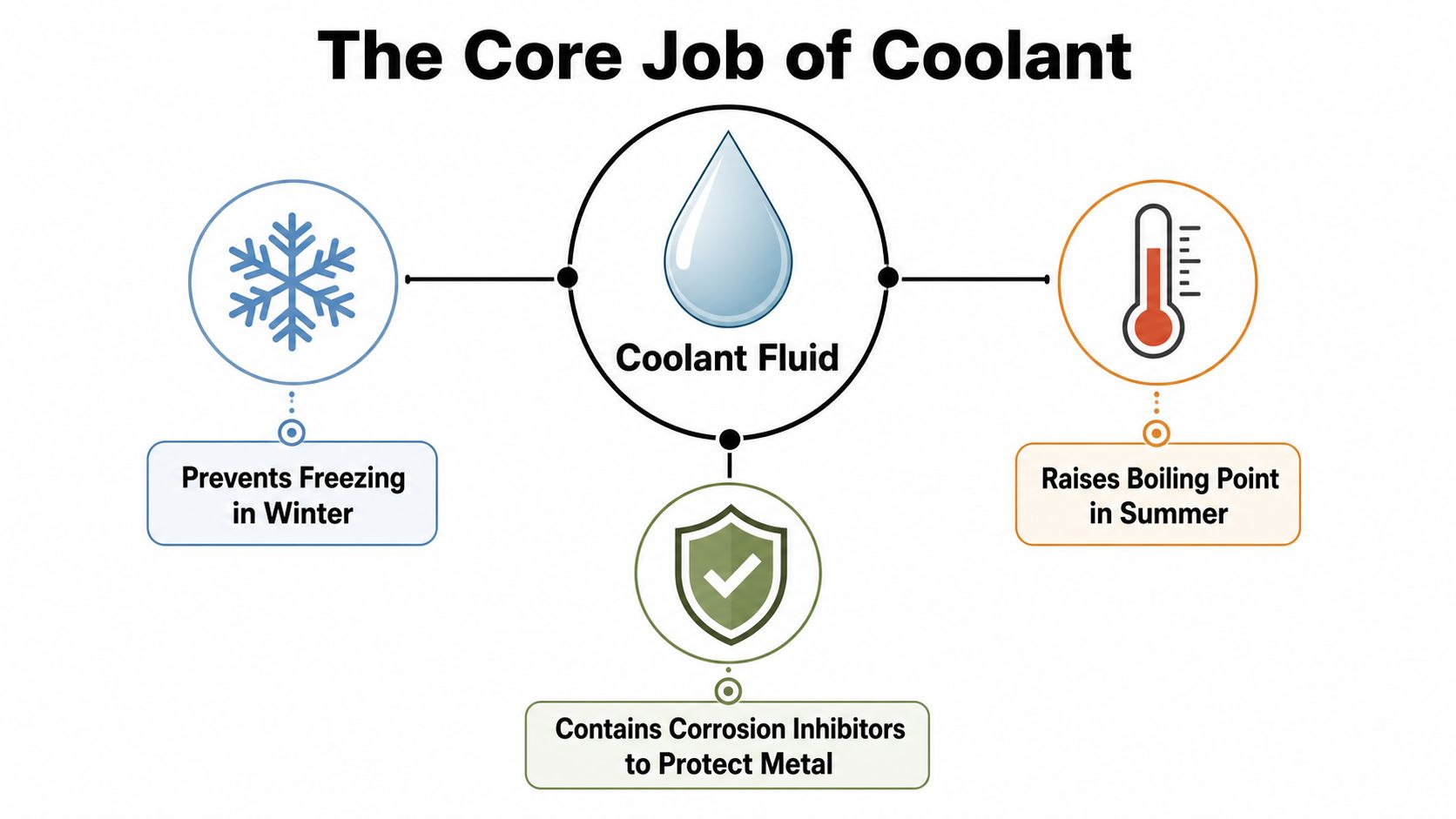
Open the radiator cap on a cold Ontario morning and you are not looking at “just antifreeze.” You are looking at a heat-moving blend that has to act like winter insurance, summer pressure control, and rust protection all at once. Water carries heat well, while ethylene glycol gives the mix the freeze and boil margin the engine needs in real driving.
Why 50/50 is the benchmark
A 50/50 antifreeze-water mix is the usual starting point because it balances freeze protection, boil protection, and heat transfer. One industry guide reports freeze protection to about -37°C and boil protection to about 129°C at 15 psi system pressure, which is why that mix comes up so often in Canadian service advice. The same guide also warns not to exceed 70% antifreeze, because too much antifreeze can raise the freezing point and make the system shed heat less efficiently. See the technical explanation in Alliance Chemical's antifreeze and coolant guide.
That surprises a lot of first-time owners. More antifreeze does not automatically mean more protection, because the water portion is doing part of the cooling work. On a July crawl through stop-and-go traffic, or after a thaw-freeze cycle leaves extra load in the system, a mix that is too heavy on glycol can work against the engine instead of helping it.
What the fluid is really protecting
Coolant also protects the metal inside the system. The inhibitors slow rust, help guard against corrosion where aluminium, steel, solder, and rubber seals all meet, and reduce the wear that builds up as the system heats and cools day after day. In an Ontario car, that matters through slush, road salt, short trips, and summer heat, because every temperature swing asks the system to work a little harder.
That is why coolant is better described as a heat-transfer fluid with corrosion control built in.
Bottom line: coolant is engineered, not improvised. The right mix helps keep the engine from freezing, boiling over, and slowly damaging itself from the inside.
If the thermostat is sticking, the fluid cannot do its job properly no matter how fresh it is. A worn thermostat can trap heat or hold the engine too cool, which is why the thermostat replacement guide fits naturally beside coolant maintenance.
IAT, OAT, and HOAT Compared Side by Side
Three coolant families show up again and again on bottles and service sheets, IAT, OAT, and HOAT. The names sound technical, but the practical difference is straightforward. Each one uses a different inhibitor strategy, and each one fits a different kind of engine, seal material, and maintenance plan.
A first-time owner usually wants a shortcut, but the better starting point is the owner's manual. That manual is the shop foreman's rulebook for what belongs in the radiator, because the wrong inhibitor package can fit the colour on the jug and still be wrong for the engine. In Ontario, that matters even more, since a car may see freezing mornings, salty slush, and a hot idle in summer traffic all in the same year.
The three chemistries in plain English
IAT stands for Inorganic Additive Technology. It uses inorganic inhibitors such as silicates and phosphates, and it is mainly associated with older engines and older maintenance schedules. Conventional engine coolants in North American service guidance have historically been green and typically used a phosphate and silicate inhibitor system, which is why they became the long-standing standard for older vehicles. That older chemistry builds a protective layer quickly, then gradually gives up its reserve, so the fluid needs to be replaced more often as the inhibitors are consumed. Source on conventional coolant chemistry and intervals
OAT means Organic Acid Technology. This is the long-life style many newer engines use. Its inhibitors work more slowly, more like a controlled coating than a fast blanket, so the fluid can stay in service longer while still protecting the metal. Prestone's coolant type guide notes that OAT was developed for newer engines, which lines up with the shift toward longer service intervals and less frequent fluid changes.
HOAT is Hybrid OAT. It blends the older and newer inhibitor ideas, often to support engines where aluminium protection is especially important. That mix gives the fluid a quicker initial shield than a pure organic formula, while still keeping some of the longer-life behaviour that newer engines want. In practice, it sits between the fast-reacting traditional coolant and the slower, longer-lasting OAT approach. AutoZone's coolant buying guide covers that distinction clearly.
| Quick comparison of IAT, OAT, and HOAT coolants | ||||
|---|---|---|---|---|
| Chemistry | Inhibitor Type | Typical Colour | Best For | Service Interval |
| IAT | Silicates, phosphates, and other inorganic inhibitors | Often green | Older engines | Shorter service life, commonly around two years or about 30,000 miles |
| OAT | Organic acids | Varies by maker | Newer engines and daily drivers | Long-life service, often described as up to five years or about 150,000 miles |
| HOAT | Hybrid blend of organic and inorganic inhibitors | Varies by maker | Modern aluminium-intensive engines | Long-life service, often described as about five to seven years or about 150,000 miles |
The easiest rule of thumb is still useful, even if it is not perfect. IAT for the older system, OAT for the long-life system, HOAT for the modern aluminium-heavy system. The core decision still comes back to the vehicle spec, because the engine design and the inhibitor package have to match. In Ontario, that match matters through winter cold starts, spring thaw, and summer heat soak, since each cycle asks the cooling system to protect metal in a slightly different way.
Dex-Cool, Silicates, Phosphates, and Other Labels Worth Knowing
Bottle labels can make coolant sound more complicated than it is. Dex-Cool is a good example. It's not a separate chemistry class, it's a named OAT formulation. That matters because drivers often treat brand labels like universal categories, when the actual question is whether the inhibitor package matches the car.
What the additive names are really saying
Silicates and phosphates are inhibitors, not random marketing words. They help protect metal, but manufacturers choose different combinations depending on what they want the fluid to do inside the engine. Some engines, especially older ones, have historically used silicate and phosphate-heavy blends. Others do better with formulas that lean harder on organic acids.
European and Asian applications often create the most confusion because owners hear broad rules like “use phosphate-free” or “use silicate-free,” then assume those words define every bottle. They don't. They're clues about the protection strategy, not a universal label system.
A lot of “universal” or “global” products are really HOAT-style hybrids marketed to fit several specs at once. That can be useful, but only if the bottle's specification matches the vehicle. Generic branding doesn't override the owner's manual.
How to read the label like a technician
If the bottle lists a named formulation such as Dex-Cool, think “one example of OAT,” not “magic coolant for every car.” If it calls itself universal, check whether it's covering several maker specifications or just using broad marketing language. If it mentions silicate or phosphate content, ask which engine family that chemistry was built for.
Best habit: read the spec line on the back, not the splashy colour name on the front.
The most useful label detail is still the vehicle maker's approval or the manual's spec. The rest is packaging. A smart top-up starts with compatibility, not with the prettiest bottle on the shelf.
Why Coolant Colour Is a Lousy Way to Choose
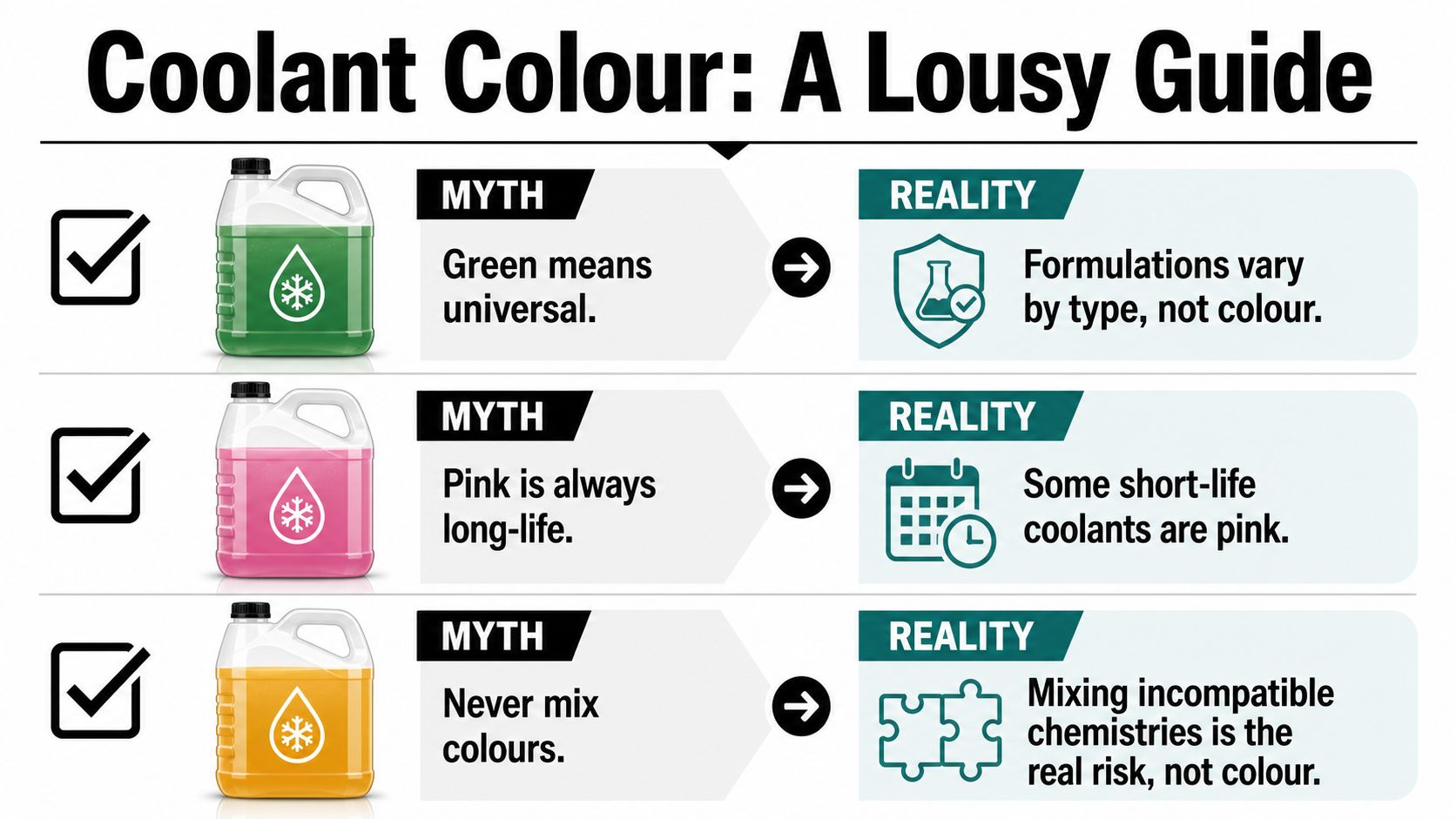
Colour causes most of the confusion because people use it as a shortcut. The problem is simple. Manufacturers can dye coolant any colour they want, and there's no universal colour standard that tells you the chemistry with certainty. That's why green, pink, orange, blue, and yellow coolants can mean very different things under the bonnet.
A practical way to identify the right fluid
Start with the owner's manual. That's the final authority because the car maker chose the chemistry, the metallurgy, and the service interval together. Next, look at the reservoir cap or label, then check service records if they exist. If those three sources disagree, trust the manual and the documented spec, not the colour you happen to see in the tank.
A Whitby driver can run into this exact mess. The reservoir looks pink, but the manual calls for a yellow HOAT. In that case, the colour in the tank doesn't win. The service spec wins, because the dye is just dye.
A few people still ask whether they can top up “by colour” in a pinch. Sometimes that answer is acceptable only if the chemistry and the spec really match. More often, colour matching gives a false sense of safety and invites the wrong fluid into the system.
The rule that saves engines
- Green does not mean universal. It might be IAT, but it might also be something else depending on the maker.
- Pink does not always mean long-life. Dye alone won't tell you the formulation.
- Colour is a clue, not proof. Compatibility depends on the inhibitor system and the OEM spec.
A bottle on the shelf can't tell you what your engine metal needs. The manual can.
Mixing Coolants and What Actually Happens Inside the System
Pour the wrong coolant into a closed loop and the problem is bigger than a messy colour blend in the reservoir. It is like putting the wrong brake fluid into a system that depends on clean, stable chemistry, because the fluid may still move but the protection inside the system starts to break down. In a radiator, incompatible inhibitors can fight each other, wear out faster than they should, and leave aluminium, steel, and rubber parts with less corrosion protection than the car maker intended. For the same reason, routine checks matter in other fluid systems too, which is why brake fluid maintenance guidance is worth a look alongside coolant care.
What the chemistry problem looks like
The hardest combination is usually IAT and OAT. Conventional IAT uses inorganic inhibitors, while OAT relies on organic acids, and those two protection packages do not always play nicely once they are blended together. In a cooling system, that can show up as weaker corrosion control, faster additive breakdown, and deposits or gel-like contamination that move through the passages like sludge in a drain.
A one-time emergency top-up with the wrong fluid usually causes less trouble than months of driving on a mixed system. A Whitby or Oshawa driver who is trying to get through a cold snap may be tempted to “make do” until the weekend, but that shortcut still carries risk. If the engine already runs hot, or the coolant looks cloudy, the system needs proper attention right away.
A simple compatibility rule
- Do not mix IAT with OAT unless the vehicle maker specifically allows it.
- Do not assume all OAT products are interchangeable, because the spec still has to match.
- Only treat HOAT as compatible when the specification matches, not just because the label sounds close.
If the label, the owner's manual, and the service record do not line up, the manual wins. That saves a lot of expensive guesswork. Coolant chemistry is one of those maintenance jobs where a cheap shortcut can turn into a bigger repair later, especially in Ontario cars that see aluminium components, winter freeze-thaw cycles, and long summer idling in traffic.
Service Intervals, Coolant Testing, and Warning Signs
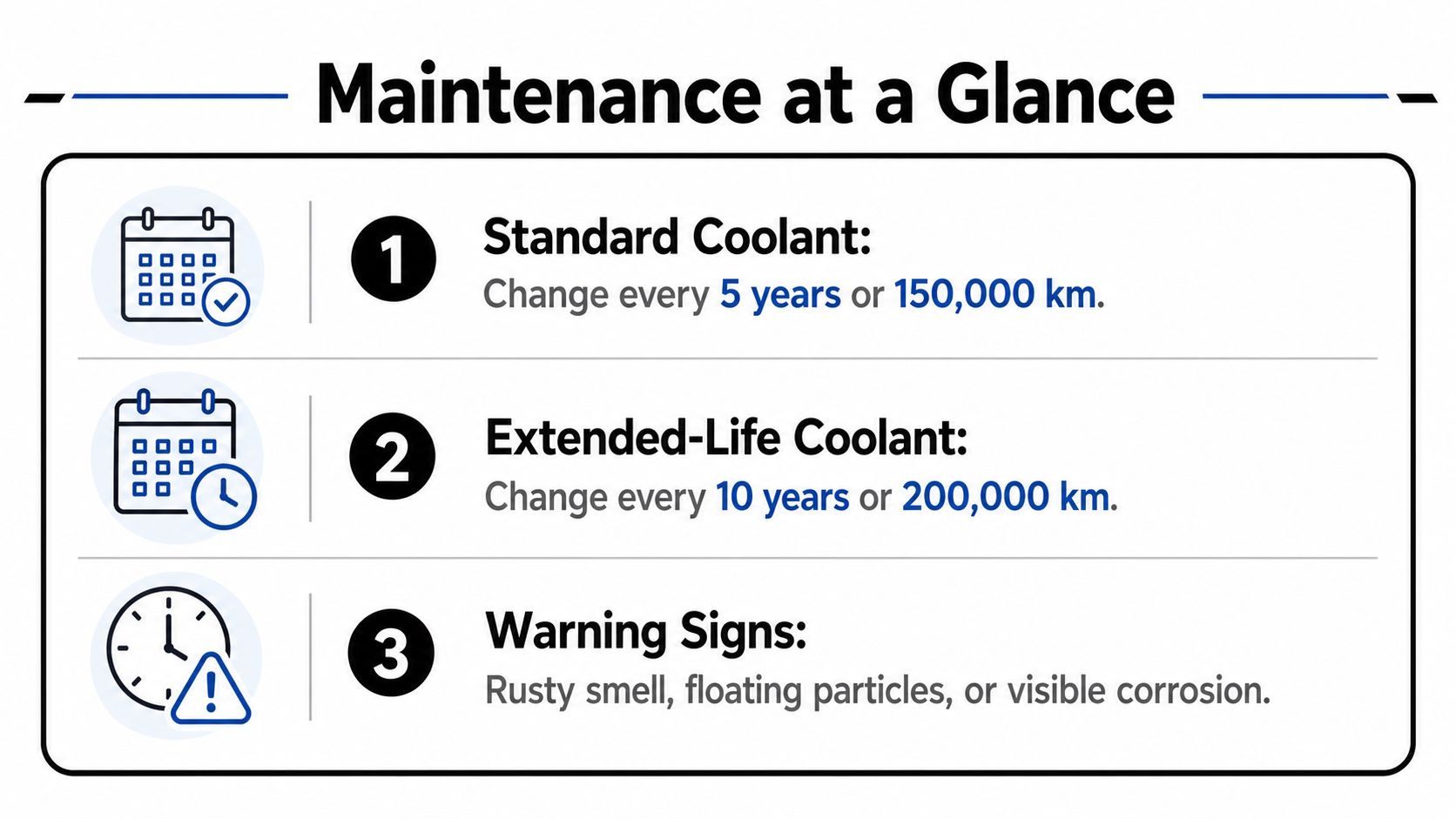
Coolant ages in more than one way. Time matters, mileage matters, and so does what the fluid looks like after a few Ontario winters and summers of stop-and-go driving. The owner's manual sets the interval, and that schedule matters more than the colour in the bottle. If you want a simple place to start, our guide to how often you should service your car helps put coolant work into the wider maintenance picture.
A fresh bottle does not always mean healthy coolant. In a van that spent months idling through Toronto traffic, or a commuter that has seen repeated freeze-thaw cycles outside Ottawa, the fluid can lose strength before it looks obviously wrong. That is why the service interval and the testing method both matter. They tell you whether the coolant still has enough protection for cold starts, hot summer runs, and the long waits in traffic that make a weak cooling system show its age.
What a shop checks during a coolant test
A proper coolant check goes beyond peeking into the reservoir. A technician can use a refractometer to check freeze protection, use test strips to get a read on additive strength, and inspect the fluid for rust, oil contamination, or suspended debris. A refractometer works like a precision eyeglass for coolant, it gives a clearer read on how well the mix will handle an Ontario cold snap than a glance at the bottle ever could.
That matters because coolant can look acceptable and still be tired. A reservoir with a clean surface can hide weak inhibitors, and a slightly discoloured tank is not automatically a problem if the chemistry still checks out. The key question is whether the fluid can still protect metal passages, seals, and the radiator core when winter mornings turn harsh or summer traffic backs everything up on the QEW or the 401.
Warning signs that deserve a closer look
Watch for these signs: sweet-smelling steam under the hood, a temperature gauge that creeps up in traffic, visible rust in the reservoir, floating particles, or a coolant level that keeps dropping.
A few symptoms deserve quick attention from a first-time owner. If the heater stops blowing hot air, air in the system or low coolant may be the reason. If the engine runs hot mainly at idle, the cooling system may be coping on the open road but struggling when airflow drops in stop-and-go driving. If the fluid looks muddy or oily, the vehicle needs a proper inspection before another long trip, especially before a winter highway run or a summer drive with the air conditioning working hard.
Use the manual for the schedule, a refractometer or test strips for the condition, and the warning signs for the practical-world check. If the coolant is overdue, contaminated, or mixed incorrectly, a flush is usually the safer call than adding another bottle and hoping the system sorts itself out.
Choosing the Right Coolant and When to Book a Flush
The right decision starts with one line in the owner's manual. Not the cap colour. Not the bottle dye. The manual. That's where the factory spec lives, and that spec tells you whether the car needs IAT, OAT, HOAT, or a manufacturer-specific formula.
How to choose without guessing
If the system takes a 50/50 premix, that's the easy top-up route. If the car calls for concentrate, you can mix it with distilled or reverse-osmosis water for a full flush, which is often the more cost-effective option. The key is to use the right chemistry first, because a perfect water mix won't fix a mismatched inhibitor package.
A daily-driven 2018 SUV on OAT is usually a straightforward case. If the service interval is still current and the fluid tests clean, a scheduled replacement or careful top-up may be all it needs. A 20-year-old pickup on IAT that's been topped up with whatever was handy is a different story. That truck is a much better candidate for a full flush, because the fluid history is already muddy.
A quick decision path
- Check the manual first. Match the spec before you buy anything.
- Match chemistry, not colour. Dye tells you very little on its own.
- Use premix for convenience, concentrate for full service. Both can be right when used correctly.
- Book a flush if the fluid is contaminated, mixed, or overdue. That's safer than hoping for the best.
A service log also helps. If you've lost track of what went in last time, write it down before the next top-up. The vehicle maintenance log is a simple way to stop guesswork from becoming a repair bill.
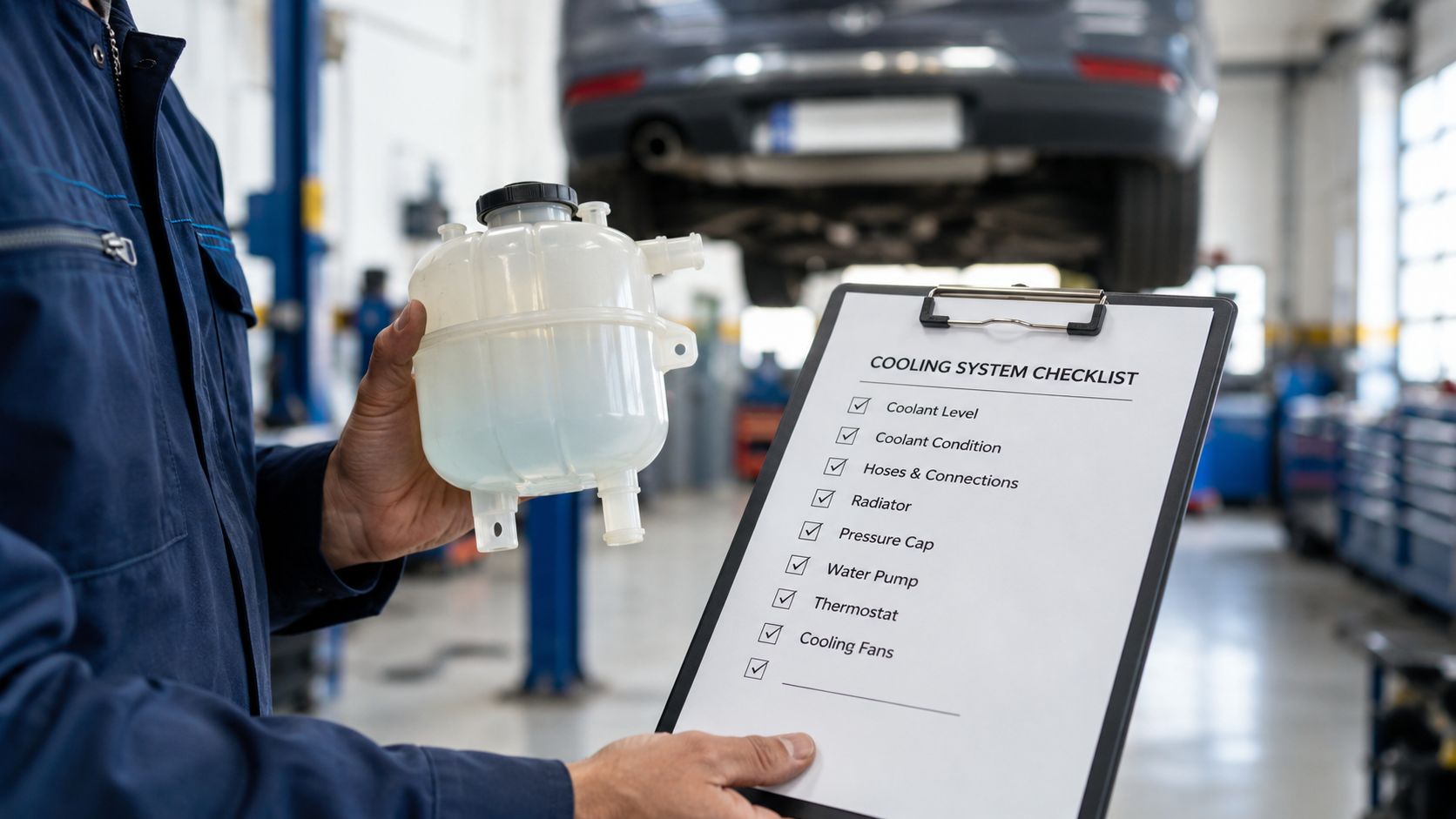
If you want a coolant check that's matched to your car, not just the colour in the bottle, Carmedics Autowerks Inc in Whitby can help with the right diagnosis and service plan. Their team works on the kind of cooling-system decisions that matter in Ontario weather, from proper coolant selection to full flushes and maintenance records. Visit Carmedics Autowerks Inc to book a visit and get your cooling system sorted before the next cold start or summer commute.