

In Ontario, a professional fuel injection cleaning service usually costs $120 to $200 for a standard vehicle, and that's the number most drivers should expect to hear first. Where the price moves is in the injector design, the cleaning method, and how much labour it takes to do the job properly.
If you're reading this, there's a good chance your car doesn't feel quite as sharp as it used to. It still starts, still drives, and nothing seems catastrophic. But the throttle feels a touch lazy, the idle isn't as smooth, or the engine seems to need a little more pedal than it did before.
That kind of change matters to people who pay attention to their cars. And it's exactly why fuel injector cleaning gets so much debate. Sometimes it's a useful maintenance service. Sometimes it's oversold. The difference comes down to diagnosis, method, and whether the service matches the actual problem.
Is Your Car Losing Its Edge
A lot of injector issues start in a way that's easy to dismiss. The car pulls cleanly most days, but one morning it hesitates leaving a stoplight. A week later, the idle feels a little rougher when you're parked. Then you start wondering whether the engine has aged a bit, or whether something in the fuel system isn't working as cleanly as it should.
That's often how clogged injectors show up. Not as a dramatic breakdown, but as a steady loss of crispness.
What drivers usually notice first
For an enthusiast, the first sign is often feel. The engine doesn't respond with the same clean, even pull. For a commuter, it may be the opposite. The car feels normal enough, but it's become fussier in traffic, colder starts are less settled, or the idle wanders more than it used to.
Injectors have one basic job. They need to deliver fuel in a controlled pattern at the right moment. When deposits build up around the tip or inside the injector, the spray pattern can become uneven. That doesn't always create a hard fault right away. It can make the engine feel less refined.
A fuel injector problem rarely announces itself politely. It usually shows up as a bunch of small annoyances that add up.
Why this service gets misunderstood
Some shops sell injector cleaning like it belongs on every visit. I don't agree with that. A vehicle with no symptoms and no supporting reason may not need anything beyond normal preventive maintenance.
But when a car has a rough idle, hesitation, or signs of uneven fuelling, injector cleaning can make sense. The key is matching the service to the condition of the injectors, not treating every vehicle the same way.
That's also why the bill can look different from one vehicle to the next. You're not just paying for fluid in a can. You're paying for a method, equipment, labour, and in some cases injector removal and testing.
Symptoms That Point to Clogged Fuel Injectors
The easiest way to think about dirty injectors is this. They restrict and distort fuel delivery the way buildup in a pipe changes water flow. The engine still gets fuel, but not as evenly or as precisely as it should.
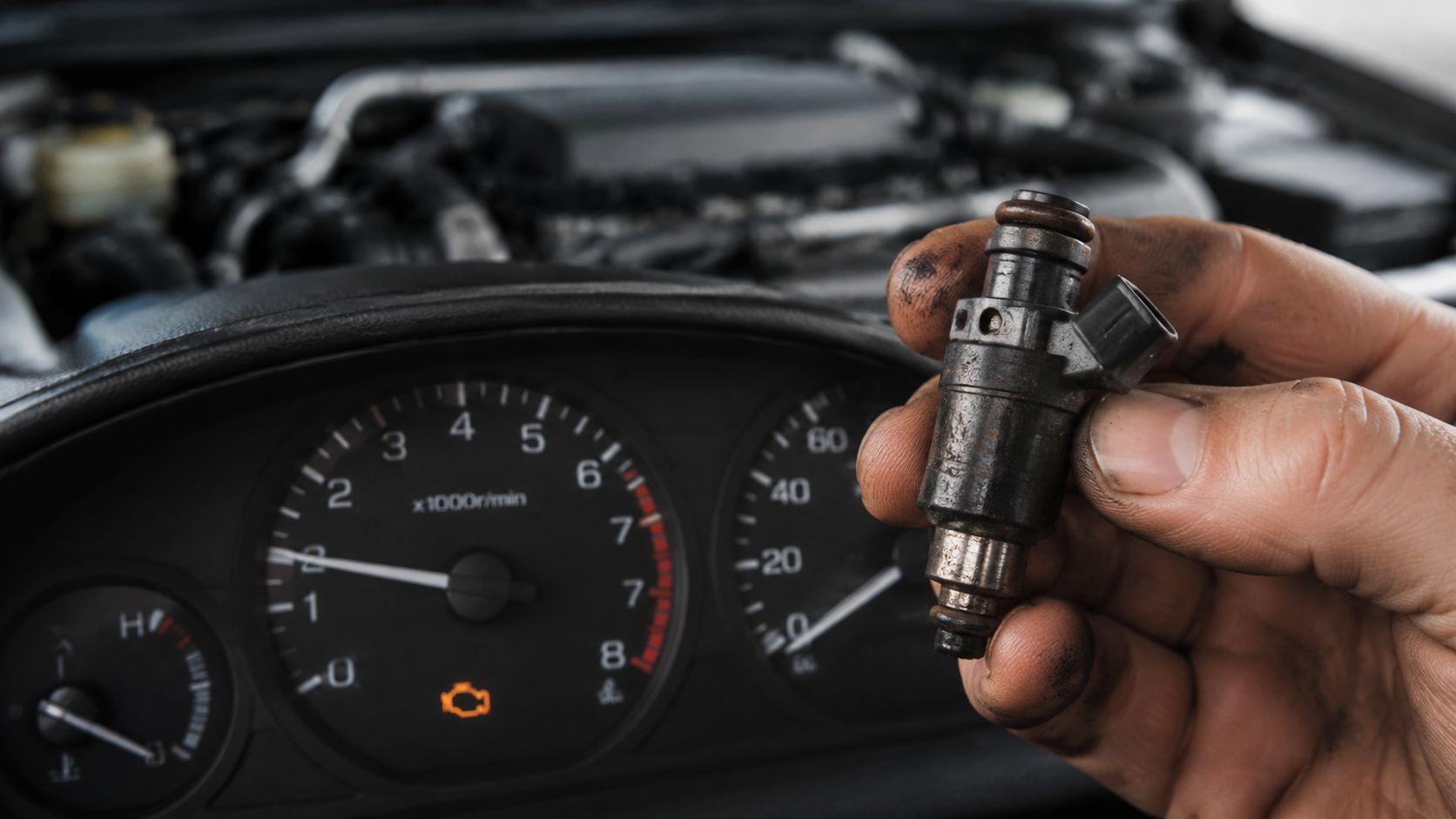
If your dash has already started warning you, it's worth understanding what an engine light can mean before assuming injectors are the only cause.
The common signs
Rough idle. The engine feels uneven at a stop, especially when cold or when the car is sitting in gear. If one or more injectors aren't atomising fuel properly, combustion quality changes cylinder to cylinder.
Hesitation under acceleration. You press the pedal and the response feels delayed, weak, or slightly jerky. That can happen when fuel delivery lags behind what the engine is asking for.
Poor fuel economy. Drivers often notice they're filling up sooner or working the throttle harder to get the same response. The engine may compensate for poor spray quality, but it won't do it elegantly.
Sputtering or stumble at low speed. Light throttle cruising, parking lot driving, and stop-and-go traffic often expose injector issues earlier than highway cruising.
Hard starting. If the injector pattern is poor, cold starts can become less clean because the engine is more sensitive to mixture quality when it first fires up.
What's happening inside the engine
A clean injector produces a controlled mist. A dirty injector can dribble, spray unevenly, or flow less than it should. That creates a less efficient burn.
Consider a garden sprayer. When the nozzle is clean, the mist is even. When it's partly blocked, the stream becomes patchy and uncontrolled. Engines react the same way. They lose smoothness first, then performance.
What dirty injectors are often confused with
These symptoms can overlap with other issues, which is why guessing gets expensive.
- Ignition problems such as worn plugs or coils can feel similar.
- Airflow issues like a dirty throttle body can also create rough idle.
- Sensor faults can change fuelling even when the injectors themselves are fine.
Practical rule: Don't approve injector cleaning just because the symptoms sound close. Approve it when the symptoms and the testing point in the same direction.
Breaking Down the Fuel Injection Service Cost
The fuel injection cleaning service cost makes more sense once you stop looking at it as one generic job. Shops price it based on how many injectors are involved, what type they are, and whether they can be cleaned on the car or need to be removed and tested.
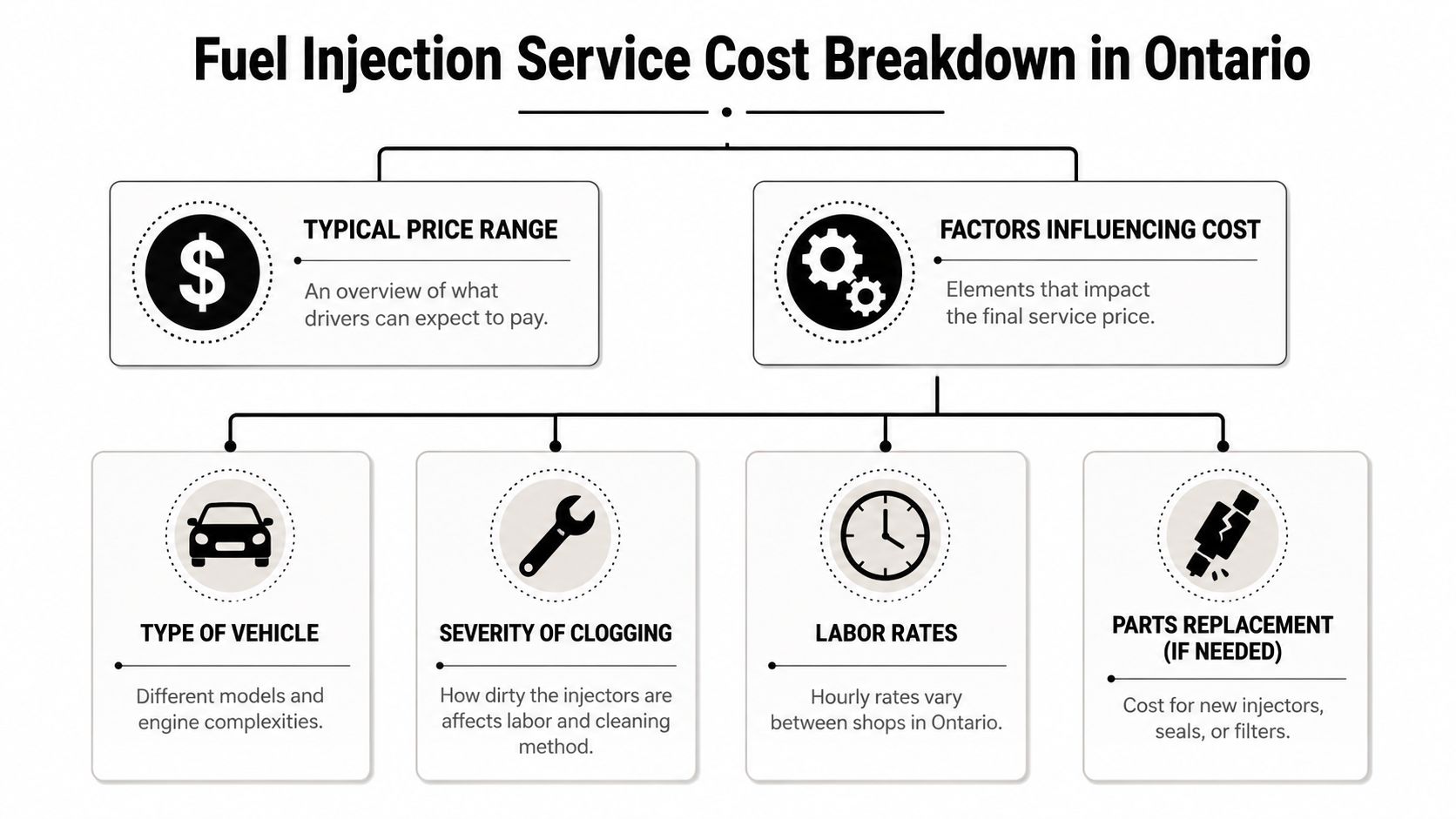
In Ontario, professional fuel injection cleaning for a standard 4-cylinder vehicle typically falls between $120 and $200, with top-feed direct port injectors starting at $29.95 per injector according to The Garage fuel injector service pricing in Canada.
If you're comparing repair estimates broadly, it helps to see injector service in context with other vehicle bills such as alternator repair cost.
What actually changes the price
The first cost driver is injector type. Standard top-feed injectors are usually simpler to service than high-performance, side-feed, or direct injection designs.
The second is access and labour. On some vehicles, getting to the injectors is straightforward. On others, intake components, covers, and surrounding hardware add time. That extra labour is part of why two cars with the same symptom can get different quotes.
Then there's the service level itself. A basic cleaning done as part of maintenance isn't the same as removing injectors, cleaning them individually, and checking how they flow afterward.
Why bundled prices and per-injector prices both exist
Shops often quote one of two ways.
| Pricing approach | How it works | What it suits |
|---|---|---|
| Bundled vehicle price | One price for the whole service | Standard maintenance on a typical vehicle |
| Per-injector price | Charged by injector cleaned and tested | More technical jobs or off-car cleaning |
That's why you may hear a simple vehicle-level estimate from one shop and a per-injector estimate from another. Neither format is wrong. What matters is what's included.
What usually justifies the higher end of the range
A higher quote is usually tied to complexity, not mystery.
- Direct injection or performance injectors often require more specialised handling.
- Heavier deposit buildup may push the job toward deeper cleaning methods.
- Testing and verification add labour, but they also tell you whether cleaning helped.
Paying more for the right method is smarter than paying less for the wrong one and still having the same problem.
One more thing customers should know. If a quote sounds vague, ask what the shop is doing. A proper answer should explain whether the injectors stay on the vehicle, whether they're removed, and whether the service includes cleaning only or cleaning plus testing.
Comparing Fuel Injection Cleaning Methods
Not all injector cleaning services do the same job, leading to widespread confusion. One driver thinks they're paying for a full restoration. Another is really buying a maintenance flush. A third is just getting a bottle poured into the tank.
Those are very different services.
For professional injector cleaning, standard MPFI top-feed injectors generally run $29.95 to $56.00 per injector, while more complex GDI and side-feed injectors typically run $35.00 to $56.00 per injector because the cleaning process is more technical, as outlined by Garage Auto Sports direct injector cleaning service details.
If the engine is already showing drivability problems, a proper car computer diagnostics service helps confirm whether the issue is fuelling, ignition, airflow, or a mix of them.
The three methods drivers usually get offered
Fuel tank additive
This is the simplest option. You pour a cleaner into the fuel tank and let it work gradually as the car runs.
It has a place. For a healthy vehicle with mild deposits, it can be part of routine upkeep. What it usually does not do is correct a meaningful injector imbalance or a stubborn clog that's already affecting how the engine runs.
On-car chemical flush
This method uses shop equipment to feed a cleaning solution through the fuel system without removing the injectors. It's more involved than an additive and usually more effective when the car has early to moderate symptoms.
Its biggest advantage is efficiency. Labour is lower than a full injector removal service, and on many vehicles it's the sensible middle ground.
Off-car ultrasonic cleaning
This is the most thorough process. The injectors come out, get cleaned individually, and can be checked for flow and spray pattern.
This method makes the most sense when deposits are heavier, the injector design is more demanding, or the vehicle hasn't responded to simpler cleaning. It also explains why some injector jobs cost more. Removal, specialised cleaning, and testing take time.
Fuel Injection Cleaning Methods Compared
| Service Type | Effectiveness | Average Cost | Best For |
|---|---|---|---|
| Fuel additive | Mild, preventive | Lower than professional service | Routine upkeep on a vehicle with no real symptoms |
| On-car chemical flush | Moderate | Often fits general service pricing | Early drivability issues and maintenance without injector removal |
| Off-car ultrasonic cleaning | Most thorough | Per-injector pricing varies by injector type and labour | Stubborn deposits, complex injectors, and cases where testing matters |
What works and what doesn't
A fuel additive works best when you use it before a problem becomes noticeable. It's preventive.
An on-car flush works when deposits are present but the injectors still respond well to a service done through the system.
An off-car ultrasonic clean works when the job needs precision. That's the service I'd want on a vehicle with persistent symptoms, unusual injector design, or a reason to verify each injector individually.
If a vehicle has a real drivability complaint, choose the method that matches the complaint, not the method with the smallest invoice.
The trade-off most owners care about
Drivers usually balance three things.
- Cost. Simpler methods cost less because they involve less labour.
- Downtime. On-car cleaning is faster than injector removal.
- Depth of service. Off-car cleaning gives the clearest picture of injector condition.
That's the honest conversation to have with your mechanic. Not “What's the cheapest injector clean?” but “Which cleaning method fits what this engine is doing right now?”
DIY Fuel Additives vs Professional Service
DIY additives are appealing for obvious reasons. They're easy, fast, and don't require booking shop time. For owners who like handling small maintenance items themselves, that can feel like the practical move.
Sometimes it is.
Where additives make sense
If the car is running well and you want to stay ahead of deposit buildup, an additive can be part of a sensible maintenance routine. It's simple preventive care. It may help keep a clean system clean.
That's very different from fixing a system that's already showing clear symptoms.
Where DIY falls short
A bottle in the tank can't tell you whether one injector is flowing differently from the others. It can't confirm spray pattern. It can't tell you whether the problem is ignition, a sensor issue, or intake contamination.
That's the line many people miss. DIY products are maintenance tools, not diagnostics.
- They're broad, not targeted. The cleaner goes through the whole system, whether the problem is mild, severe, or somewhere else entirely.
- Results are hard to verify. The engine may feel better, worse, or unchanged, and you still won't know exactly why.
- Modern systems are less forgiving. Newer engines, especially direct-injected ones, don't always respond well to guesswork.
Why professional service usually gives better value
A professional service gives you two things DIY can't. The first is method selection. A technician can decide whether the vehicle needs a simple flush, deeper cleaning, or no injector service at all.
The second is confirmation. Proper service work is tied to actual inspection, symptoms, and equipment.
That matters because unnecessary maintenance is still wasted money. Good shops don't just sell injector cleaning. They decide whether injector cleaning is the right answer.
For owners trying to keep a car sharp over the long term, a broader preventive maintenance plan for vehicles usually does more than chasing one symptom at a time.
Your Trusted Service at Carmedics Autowerks in Whitby
Whitby drivers usually want the same thing from this kind of service. Straight answers, fair pricing, and a fix that matches the car's condition. That's the right standard.
A proper injector service starts before any cleaning happens. The car's symptoms need to make sense. The fuel system has to be looked at in context. Rough idle, stumble, poor response, and warning lights can point toward injectors, but they can also point somewhere else. That's why the first job is narrowing the problem down, not selling the biggest service.
What a good shop visit should look like
You should expect clear communication on three points:
- What symptoms the technician is trying to confirm
- Which cleaning method fits the injector type on your vehicle
- What the service includes, and what it doesn't
That last point matters. Some injector services are light maintenance. Others are more involved. If the explanation is fuzzy, ask for specifics.
A practical way to manage cost
If the vehicle is due for regular maintenance anyway, bundling related work can make the visit more efficient. Fuel system service often makes the most sense when the car is already in for inspection or scheduled maintenance.
That's also where local familiarity helps. A shop that regularly handles daily drivers and enthusiast-owned vehicles can tell the difference between a car that needs injector cleaning now and one that needs normal upkeep.
One local option is fuel injection service in Whitby, which is offered as a professional cleaning service for the fuel system. The useful part isn't a promise of miracles. It's having the service available when symptoms and inspection support it.
The best injector cleaning job is the one done for the right reason, with the right method, at the right time.
When you approach it that way, the fuel injection cleaning service cost stops feeling arbitrary. You're not paying for hype. You're paying for labour, equipment, and a method that fits the problem.
If your car has lost some smoothness, throttle response, or idle quality, book an inspection with Carmedics Autowerks Inc. We'll help you figure out whether fuel injector cleaning is worth doing, what type of service fits your vehicle, and what the work should reasonably cost before anything moves ahead.