


You're probably here because your car still drives fine, mostly. Maybe it hesitates once in a while when you pull away from a light. Maybe the revs seem odd. Maybe a shop mentioned CVT service and you're trying to work out whether that's real maintenance or just another line item.
That's a smart question.
A CVT gearbox service isn't the same as routine engine oil work, and it isn't something I'd treat casually. CVTs can feel so smooth when they're healthy that owners often assume nothing is happening inside. In reality, the transmission is constantly adjusting under load, heat, and hydraulic pressure. When the fluid is right, it works beautifully. When the fluid is neglected, small drivability issues can turn into expensive mechanical ones.
Ontario drivers have another layer to think about. Stop-and-go commuting, winter cold, summer traffic, and short-trip driving are hard on transmission fluid. That means generic advice from a broad owner's manual often isn't enough on its own.
What a CVT Gearbox Is and Why It Is Different
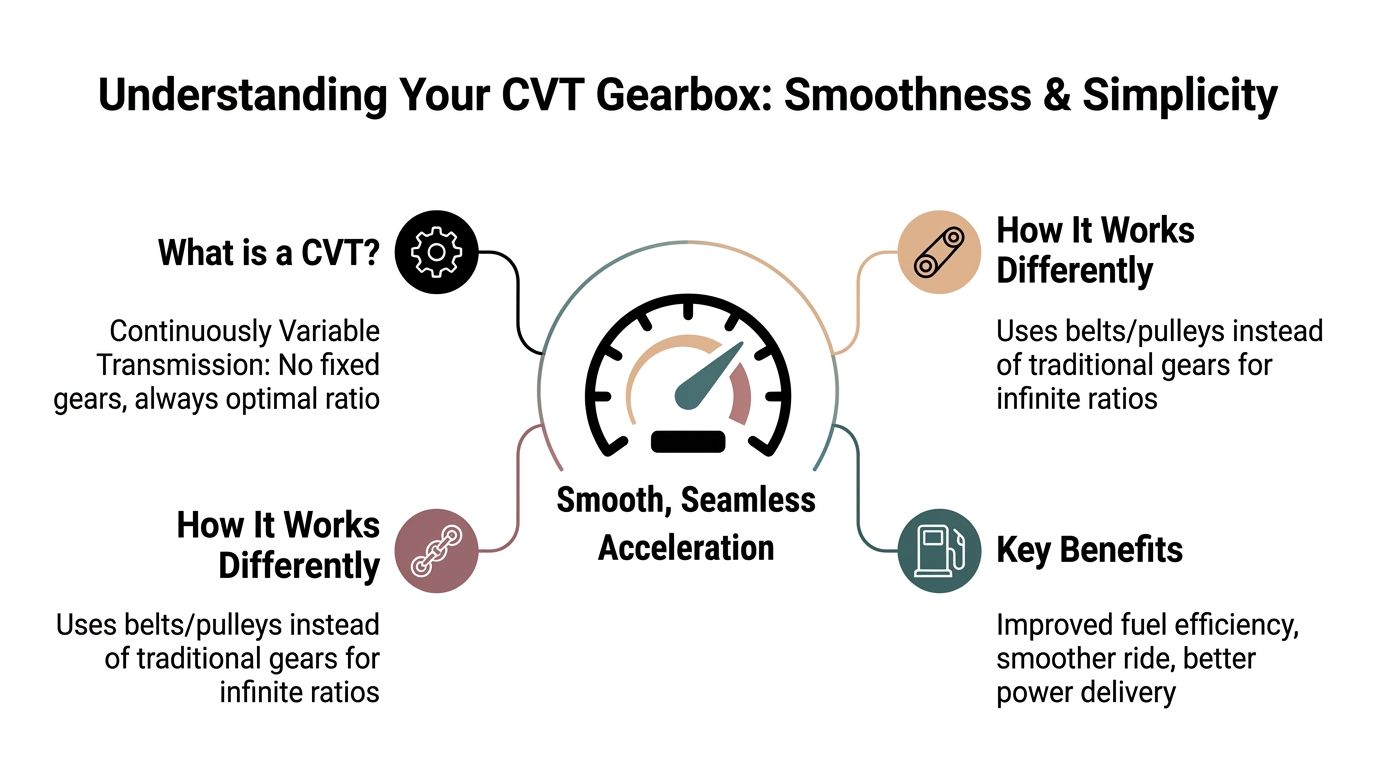
A Continuously Variable Transmission, or CVT, doesn't shift through a fixed set of gears the way a conventional automatic does. The easiest way to understand it is this: a traditional automatic is like a three-way bulb with a few set brightness levels. A CVT is like a dimmer switch. Instead of stepping from one gear to another, it can adjust continuously to the ratio the engine needs at that moment.
That's why a healthy CVT often feels unusually smooth. There's no obvious upshift, no pause, and less of that familiar stepped sensation people associate with older automatics.
How the mechanism actually works
The core layout is different from what most drivers picture when they hear “transmission.” According to Subaru's CVT technical overview, a CVT can achieve gear ratio transitions in as little as 5 milliseconds without reducing engine torque, and it uses a pair of variable-diameter, cone-shaped pulleys connected by a steel chain. That setup creates an effectively infinite range of ratios.
Think of two cones facing each other with a chain riding between them. As the pulleys change width, the chain rides higher or lower, which changes the drive ratio. It's elegant engineering. It's also demanding on fluid quality and internal precision.
If you've ever driven a vehicle where the engine holds a steady rev while the car keeps accelerating, that's the CVT doing its job. It's keeping the engine where it works best instead of chasing fixed shift points.
Why that difference matters for service
Because the CVT relies on precise hydraulic control, the fluid does more than lubricate. It helps manage pressure, heat, and pulley response. The transmission doesn't have much tolerance for the wrong fluid, contaminated fluid, or a poor level check.
Practical rule: Treat a CVT less like an old-school automatic and more like a hydraulic control system that happens to move your vehicle.
That's why a proper transmission repair service starts with understanding the design, not guessing based on habits from older gearboxes. What works on a conventional automatic doesn't always work on a CVT, and that's where many expensive mistakes start.
The Critical Importance of Regular CVT Maintenance
The same design that makes a CVT smooth also makes it unforgiving when maintenance is ignored.
A conventional gearbox can sometimes hide neglect for a while. A CVT usually can't. Its pulleys, chain or belt, valves, and fluid all depend on clean hydraulic control. Once the fluid breaks down, the transmission doesn't just get “a bit dirty.” It starts losing the precise behaviour it was built around.
The sealed-for-life myth
One of the most damaging ideas in modern transmission ownership is the phrase sealed for life. In practice, that wording has convinced many owners to leave the fluid untouched far too long.
A technician-focused video explanation notes that many manufacturers market CVTs as sealed for life, but that this can lead to transmission failure around 100,000 km if fluids aren't changed every 50,000 km (3 to 4 years), as explained in this discussion of sealed-for-life CVT claims.
That lines up with what mechanics see in the bay. The transmission may not leak. It may not trigger a fault right away. But the fluid still ages, carries debris, and loses the characteristics the unit depends on.
What neglect looks like inside a CVT
When old fluid stays in service too long, several things tend to happen:
- Heat builds faster because degraded fluid can't protect internal parts as well.
- Metal particles circulate and can contaminate narrow passages and sensitive control components.
- Pulley response becomes inconsistent, which shows up as hesitation, slipping, or odd engine behaviour.
- Wear accelerates until the vehicle develops a real drivability complaint, not just a maintenance reminder.
In plain terms, the fluid is the working medium. If it's worn out, the system loses accuracy.
Old CVT fluid doesn't retire quietly. It starts taking parts with it.
If you want a useful baseline on the service side of transmission care, this guide on how to check transmission fluid properly helps explain why condition and procedure matter so much. On many CVTs, guessing by sight alone or checking fluid cold can lead you the wrong way.
Why proactive service is cheaper than reactive repair
Drivers often delay service because the vehicle still moves and there's no warning light. That's the trap. A CVT can operate in a degraded state for a while, but every overheated trip and every contaminated cycle pushes the unit closer to a larger repair.
And once a CVT starts slipping because of wear, a fluid change may no longer solve the problem. Maintenance works best before symptoms become chronic. That's not upselling. That's the whole point.
Recommended Service Intervals and Fluid Types
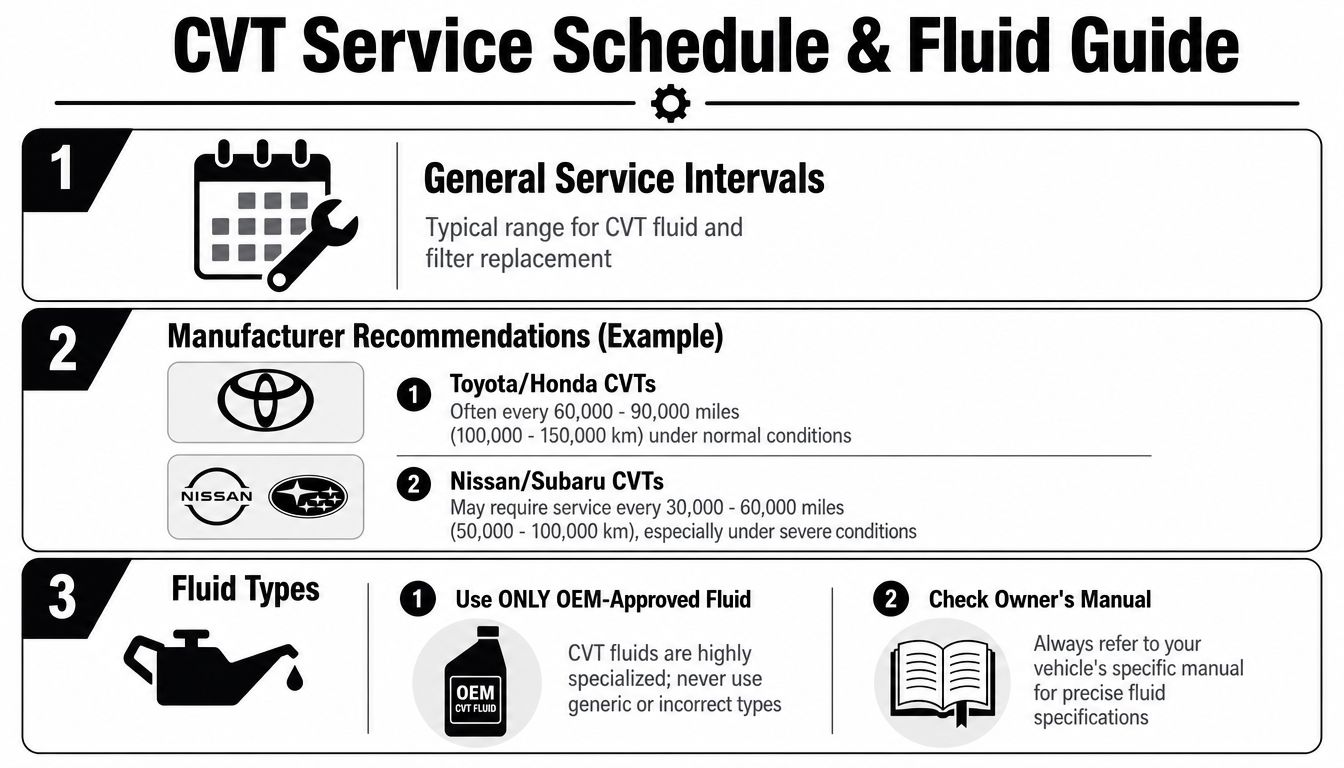
If you ask ten drivers when to service a CVT, you'll hear ten different answers. That confusion comes from one big problem: manufacturer recommendations vary widely, and Ontario driving often falls closer to severe use than is commonly assumed.
The interval range that matters
Most manufacturers recommend CVT service somewhere in the normal band of 30,000 to 60,000 miles, while Nissan may call for service as early as 25,000 miles. In Ontario stop-and-go traffic, some experts also advise inspecting the fluid every 15,000 miles, according to this Ontario-focused CVT service article.
That's the key trade-off. The longer interval may look attractive on paper, but urban commuting, short trips, and repeated heat cycling aren't paper conditions. They're real-world conditions.
A practical Ontario view
For a lot of drivers in Whitby, Durham Region, and the GTA, “normal driving” doesn't describe daily use very well. Frequent stops, traffic backups, cold starts in winter, and summer idling all load the transmission in ways that age fluid faster.
Here's a useful way to think about it:
| Driving pattern | Practical takeaway |
|---|---|
| Mostly short city trips | Treat the CVT as severe-service use |
| Heavy commuter traffic | Shorter intervals make more sense |
| Highway-heavy, steady driving | You may be closer to the longer end |
| Towing or repeated hard use | Don't stretch service timing |
If you're comparing service pricing while planning ahead, this breakdown of transmission fluid change cost considerations is a good place to start.
Fluid choice is not a place to improvise
The wrong fluid can create complaints that feel mechanical even when the original mistake was chemical. A CVT needs the exact fluid specification the unit was designed around. “Universal” sounds convenient. It's not a word I'd trust casually with a CVT.
Use these rules:
- Match the specification exactly. Brand and model matter.
- Don't mix fluids casually unless the service procedure specifically allows it.
- Don't rely on colour alone to identify fluid type.
- Don't assume all CVTs are alike. They aren't.
If a shop can't clearly tell you what fluid spec they're using, keep asking questions.
Common CVT Failure Symptoms and Diagnostics
Most CVTs don't fail out of nowhere. They usually start talking first. The problem is that they don't always talk in the old familiar language of hard shifts and obvious gear banging. Their warnings are subtler.
Symptoms drivers notice first
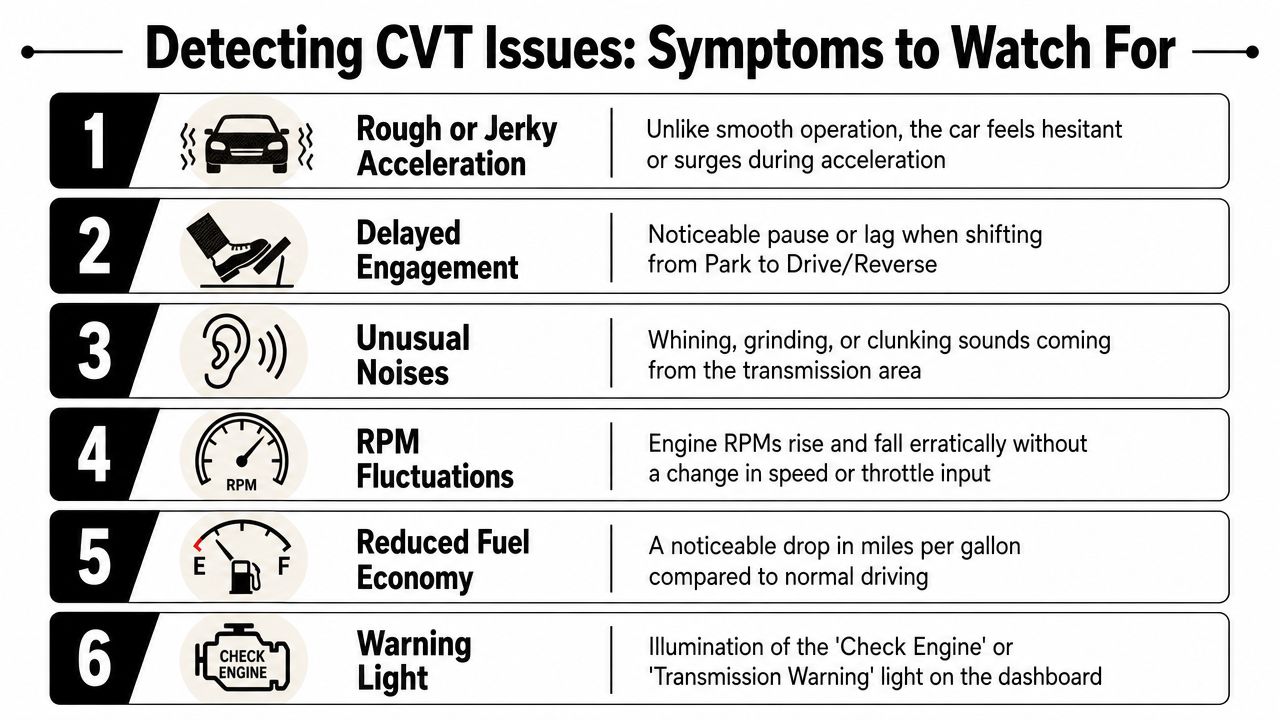
The most common early warning signs of fluid degradation include delayed engagement, unusual acceleration noises, burning smells, and fluid colour shifting from bright red to brown. Modern vehicles may also trigger temperature warnings or limp mode, as noted in this overview of CVT fluid degradation signs.
That shows up in everyday driving as things like:
- A pause selecting Drive or Reverse. You shift, wait, and then feel engagement.
- A rising engine note without clean response. The revs climb but the vehicle feels hesitant.
- A hot or burnt smell after traffic. That often points to overheated fluid.
- Dashboard warnings. If a CVT temperature alert appears, don't ignore it.
What those symptoms often mean
A delayed take-up often points toward fluid condition, pressure control issues, or wear that's affecting hydraulic response. Noise under acceleration can suggest belt or chain slip, pulley wear, or internal bearing trouble. A burning smell tells you heat is in the picture, and heat is never a minor detail on a CVT.
Some drivers describe the problem as “it feels weird, but I can't explain it.” That's fair. Healthy CVTs are so smooth that even a small loss of refinement stands out.
How a proper diagnostic process works
Good diagnosis starts with confirmation, not assumptions. A technician should want to know when the problem appears, whether it happens cold or hot, and whether the vehicle is setting any faults.
A solid workup usually includes:
- A road test to duplicate the complaint under the right conditions.
- A scan for transmission-related codes and live data.
- A fluid condition check for level, colour, and signs of contamination.
- A temperature-aware assessment if overheating is suspected.
If warning lights are involved, professional vehicle computer diagnostics matter because CVT faults can sit in modules and data streams the average DIY scan tool won't interpret well.
Don't keep driving a CVT in limp mode and hope it clears itself. The control system is trying to protect the transmission from further damage.
The CVT Service Process and Estimated Costs
A proper CVT gearbox service is more than opening a plug and pouring in fresh fluid. The exact procedure depends on the vehicle, but the principle is always the same: protect the transmission by servicing it in a controlled, accurate way.
What a typical service includes
For many vehicles, the starting point is a drain-and-fill. That removes a portion of the used fluid and replaces it with the correct specification fluid. On some models, technicians will also inspect or replace accessible filters or strainers if the design allows it.
Level setting matters just as much as the fluid itself. CVT fluid is temperature-sensitive, and some systems need the level checked at operating temperature. If it's filled incorrectly, the transmission may behave badly even with new fluid in it.
A technician may also inspect related items that affect CVT life, such as cooling system condition, leaks, and stored faults. In some cases, the vehicle may need a relearn or software-related procedure after service, depending on the manufacturer's process.
Drain-and-fill versus flush
For CVTs, I'm cautious about high-pressure approaches. A measured, correct-service drain-and-fill is often the safer path than trying to force a lot of movement through a sensitive unit. Owners hear “flush” and assume more is better. Sometimes more force is exactly what you don't want.
Here's the practical comparison:
| Service type | What it means in practice | Main consideration |
|---|---|---|
| Drain-and-fill | Removes part of the old fluid and replaces it carefully | Common and controlled |
| Flush-style service | More aggressive fluid exchange method | Not always the best fit for a CVT |
That doesn't mean every machine-assisted service is wrong. It means the procedure has to suit the transmission, not the other way around.
What it costs in Ontario
Ontario pricing can vary a lot depending on where you go. In this region, corporate dealers like Mississauga Subaru charge approximately $600 for a CVT drain and fill, while independent mechanics estimate a retail cost of $250 to $300 after taxes, according to this Ontario CVT service cost comparison.
That's a significant spread for the same basic category of service.
What you're paying for usually comes down to:
- Brand-specific fluid and procedure
- Shop labour rate
- Dealer overhead versus independent overhead
- Whether diagnostics or additional inspections are included
The cheapest invoice isn't always the best value. But a high dealer price doesn't automatically mean higher quality either. The real question is whether the shop understands CVTs, uses the correct fluid, and follows the correct temperature and level procedure.
Your Trusted CVT Service Partner in Whitby
Once you understand how a CVT works, the maintenance decision gets simpler. You want accurate diagnosis, the right fluid, the right procedure, and straight answers about cost.
That matters because CVT issues are easy to misread. One shop may call a problem normal. Another may jump too quickly to replacement. The best service partner sits in the middle: methodical, informed, and honest about what the transmission is telling them.
What to look for in a local shop
When choosing someone for CVT gearbox service in Whitby, I'd look for a few specific things:
- Clear fluid specification knowledge. They should know exactly what your vehicle requires.
- Temperature-correct level setting. That detail matters on CVTs.
- Diagnostic discipline. They shouldn't guess from a symptom alone.
- Transparent pricing. You should know what's included before work starts.
Why local expertise matters
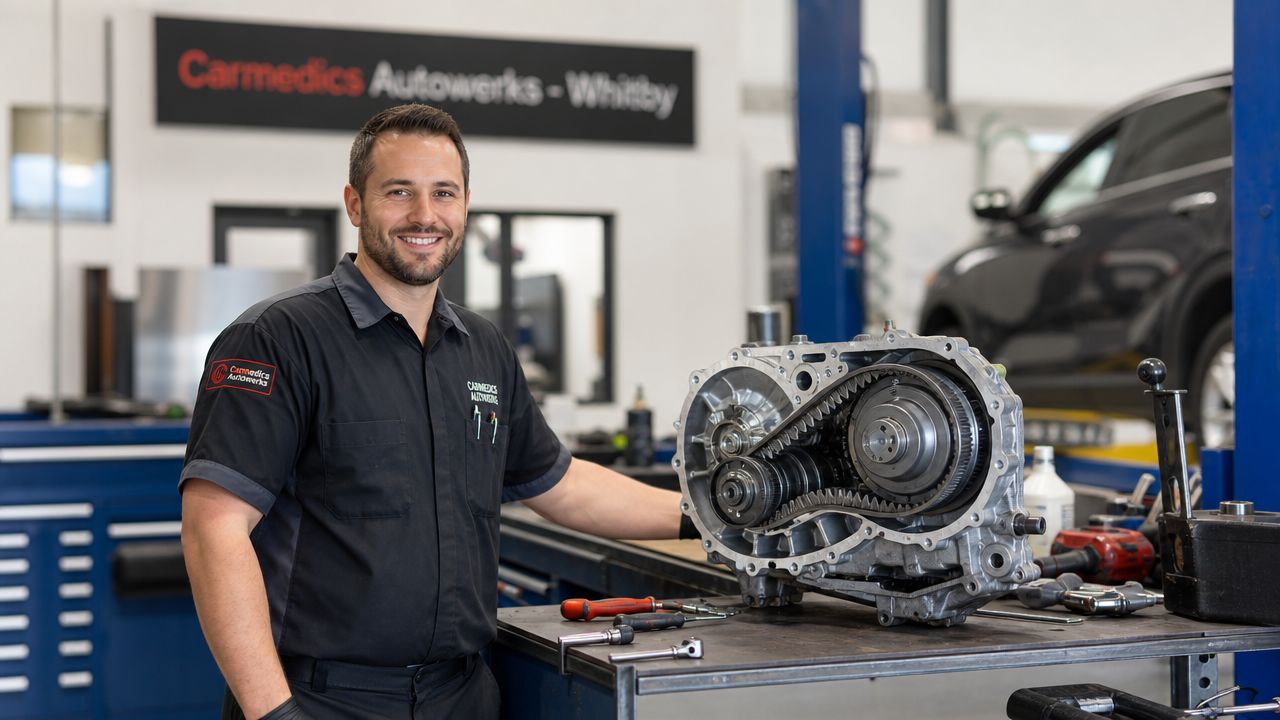
Ontario driving conditions are hard on fluids and cooling systems. A shop that regularly sees Whitby-area commuter vehicles understands what repeated stop-and-go use, winter starts, and mixed seasonal conditions do to transmissions. That local pattern recognition is useful. It helps separate textbook advice from practical maintenance timing.
If you want to learn more about the team and facility, visit Carmedics Autowerks in Whitby.
Good CVT service doesn't feel mysterious. A competent shop should be able to explain what they're doing, why they're doing it, and what they found.
CVT Gearbox Service Frequently Asked Questions
Is CVT service covered under warranty
Sometimes parts of the transmission may fall under extended coverage, but maintenance is still your responsibility. Subaru Canada offers a CVT Warranty Enhancement Program covering vehicles up to 160,000 km, and owners are often confused about what that changes. The same Subaru Canada material also notes that manuals can be unclear, while Honda recommends fluid changes every 80,000 to 160,000 km and Nissan advises about 40,000 km, as outlined in Subaru Canada's CVT warranty information.
The practical takeaway is simple. Warranty coverage doesn't replace maintenance. If the vehicle needs fluid service, skipping it because you assume warranty will handle everything is a poor bet.
Can I do a CVT service myself
Some owners can handle basic maintenance well, but CVT service has more risk than people expect. Fluid level can be temperature-sensitive. The wrong fluid can cause problems. Some models need a specific procedure for level confirmation, and scan tools may be needed when faults or temperature readings are involved.
DIY makes more sense when you already know the exact factory method for your vehicle and have the tools to follow it properly. If you don't, the cost of one mistake can wipe out any savings.
What's the difference between a drain-and-fill and a flush
A drain-and-fill removes some used fluid and replaces it. It's the more conservative service path and is commonly preferred for CVTs. A flush-style service aims to exchange more fluid, but the method matters. On a sensitive transmission, aggressive servicing can create its own problems if it isn't manufacturer-appropriate.
If you're unsure, ask the shop to explain the procedure in plain language. If they can't explain it clearly, I wouldn't hand them the keys.
What warning signs mean I should stop delaying service
Don't wait if you notice delayed engagement, unusual acceleration behaviour, hot smells in traffic, temperature warnings, or limp mode. Those aren't “watch it for a few months” symptoms. They're signs that the transmission needs attention before the problem becomes more expensive.
Is dealer service always better for a CVT
Not automatically. A dealer may have model-specific familiarity, but an experienced independent shop can often provide the same category of service with more personal communication and lower overhead. The important part isn't the sign on the building. It's the procedure, the fluid, and the technician's understanding of the unit.
If your vehicle is due for CVT gearbox service, or it's already showing hesitation, noise, or warning lights, Carmedics Autowerks Inc in Whitby can help you make sense of it. The team handles modern vehicle repair with a practical, no-nonsense approach, whether you need diagnostics, maintenance, or a second opinion before committing to major transmission work.