


You came in for something that sounds simple. A windshield replacement. A bumper repair. Maybe a wheel alignment after the car started pulling a bit. Then the shop says your vehicle may need ADAS calibration, and suddenly the invoice has a new line item you didn't expect.
That's the moment a lot of owners start wondering if this is real, or if it's just modern repair-shop language for extra cost.
It's real. And if your vehicle has lane keeping, automatic emergency braking, adaptive cruise control, blind spot monitoring, or similar driver-assist features, it matters more than commonly realised. The useful question isn't just what is ADAS calibration. The better questions are: does your specific repair trigger it, and what proof should you expect that it was done properly?
Your Simple Repair Just Got Complicated
A driver gets a stone chip. The windshield is replaced. The glass looks perfect, the car starts, no warning lights stay on, and everything seems fine. Then the shop says the forward camera may need calibration because that camera uses the windshield as part of its aiming reference.
To most owners, that sounds odd. You replaced glass, not a safety system.
But on many late-model vehicles, the glass, the bumper, the ride height, the wheel alignment, and the sensor mounts all affect how the car “sees” the road. ADAS stands for Advanced Driver-Assistance Systems. These are the cameras, radar units, LiDAR, and related electronics that support features like lane departure warning, automatic emergency braking, and adaptive cruise control.
A small repair can disturb a sensor's reference point without making the vehicle look damaged. That's where the confusion starts. The car still drives. The repair looks done. But the sensor may no longer be aimed exactly where the manufacturer intended.
Industry data shows this isn't rare anymore. A 2024 Q4 industry update found that 53% of collision repairs required ADAS calibrations, with that share projected to rise to approximately 65% in 2026 and 75% by 2027, according to Caliber's calibration update. That tells you something important. Calibration isn't a fringe service now. It's becoming standard repair procedure on modern vehicles.
Why owners get sceptical
Safety itself is rarely a point of contention. Surprises, however, draw objections.
If your repair estimate suddenly includes calibration after what seems like minor work, ask the shop to explain which sensor was affected, what repair triggered the requirement, and what procedure the manufacturer calls for. That's a fair question whether you're dealing with a windshield issue or a larger repair through a local auto body shop in Whitby.
Practical rule: If a repair changed a camera's mounting position, a radar sensor's placement, the vehicle's alignment, or the body geometry those sensors rely on, calibration may be part of finishing the job correctly.
What Is ADAS Calibration Really
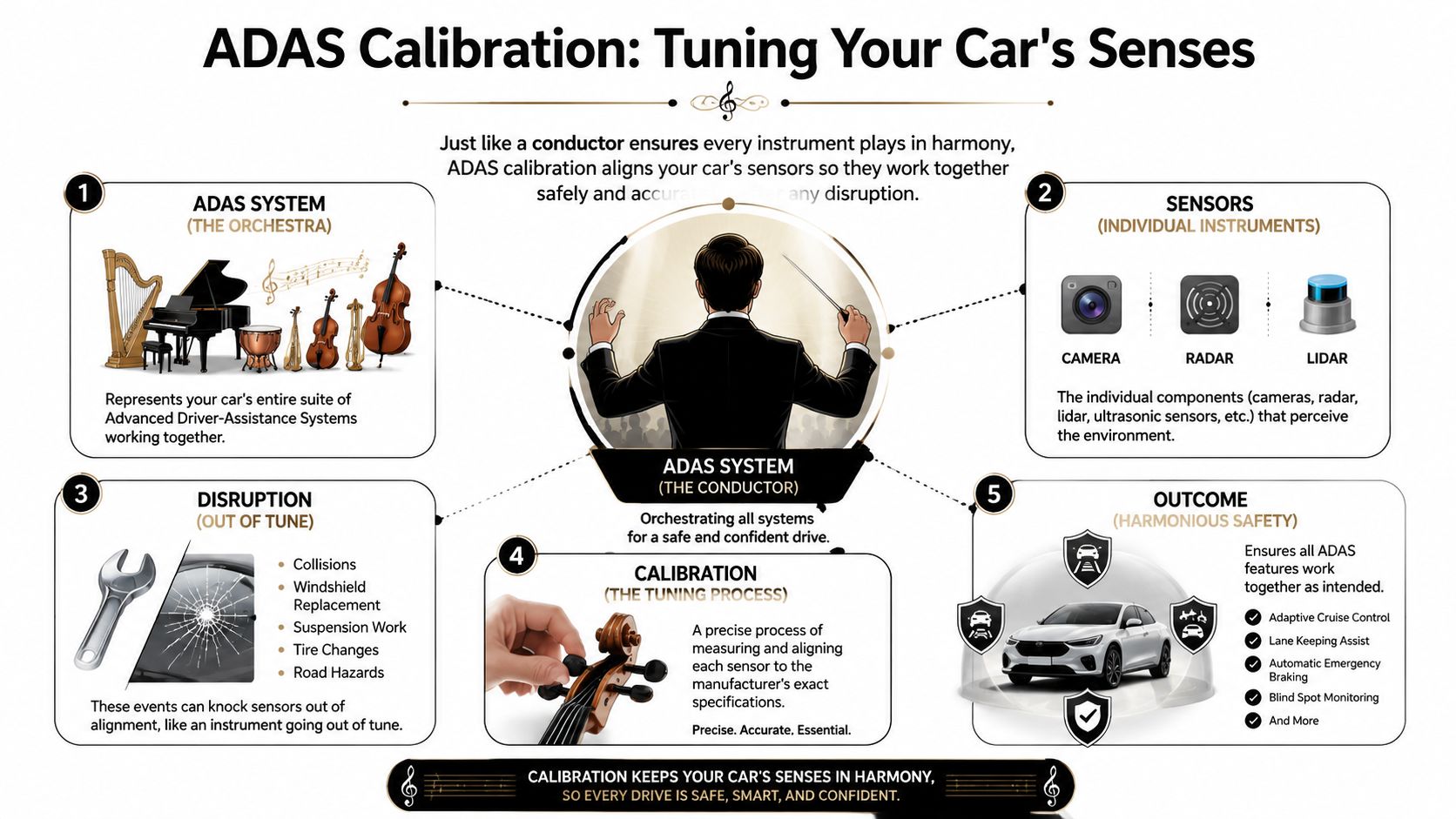
ADAS calibration is a post-repair verification process. It re-establishes the manufacturer-defined relationship between the sensors and the vehicle's geometry. That's the key idea explained in I-CAR's OEM calibration requirements guidance.
Consider the process of sighting in a rifle scope after the rifle gets bumped. The scope may still be attached. Nothing looks broken. But if it's no longer aimed precisely, the shot won't land where you think it will. Your car's camera and radar systems work the same way. They need to be pointed exactly where the manufacturer expects them to be pointed.
It's not a software reset
Many owners get tripped up by this. Calibration isn't the same as clearing a code or updating software.
Before the process can even begin, the vehicle often has to meet strict preconditions. That can include correct tyre pressures, verified ride height, and OEM-specified alignment. If those conditions aren't right, the calibration result may not be valid.
That's why an ADAS-capable repair often overlaps with other work. If a suspension component changed ride height or if the wheels aren't aligned to spec, a technician may need to sort that out first. Shops that handle advanced auto electrical repair in Whitby already know the electronics only tell part of the story. Sensor accuracy depends on the physical setup of the vehicle.
What the sensors are actually doing
Different sensors look at the world in different ways.
- Camera systems usually read lane lines, traffic signs, and visual patterns ahead.
- Radar systems track distance and closing speed, especially for adaptive cruise and forward collision functions.
- LiDAR and related sensors help build a spatial picture around the vehicle on some platforms.
The car's computer blends these inputs together. If one sensor is slightly off, the whole system can make poor decisions.
A misaligned camera doesn't have to be dramatically wrong to create a problem. It only has to be wrong enough that the car interprets the lane, vehicle ahead, or hazard differently than intended.
Why this matters after ordinary repairs
Owners often assume calibration only follows major collision damage. In reality, it's commonly required after windshield replacement, wheel alignment, suspension work, collision repair, or removal of a sensor or bracket.
That's why the phrase what is ADAS calibration isn't enough by itself. The practical version is this: it's the final step that tells you your driver-assist systems are aimed correctly again after something disturbed their reference point.
Static vs Dynamic Calibration Explained
Not all calibration happens the same way. That confuses people because they hear one term, ADAS calibration, and assume there's one standard process for every car.
There isn't. Some vehicles need a static calibration, some need a dynamic calibration, and some need a combination depending on the sensor and the repair.
Static calibration
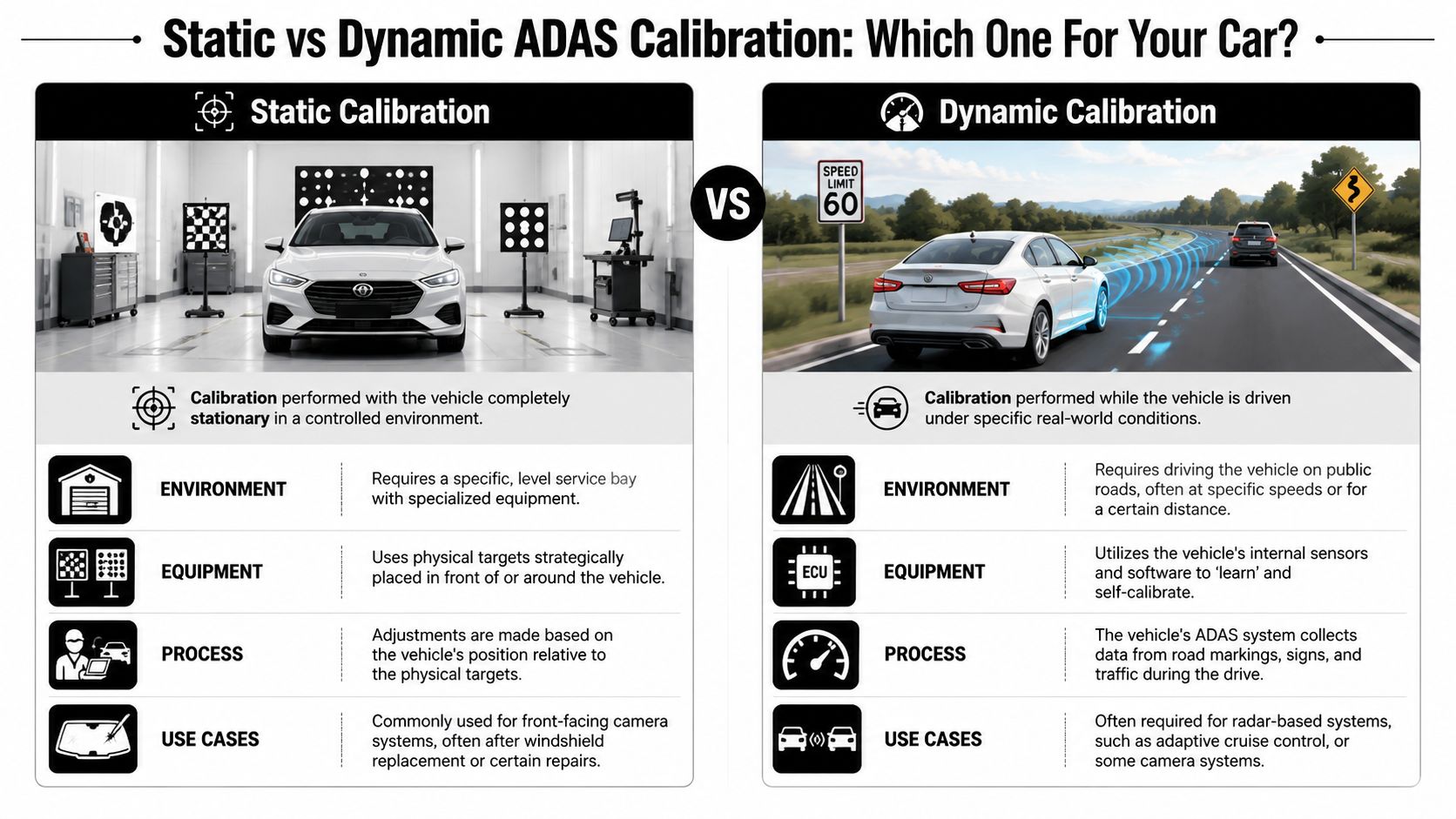
Static calibration is the workshop version. The car stays still in a controlled bay while the technician places precise targets at exact heights, distances, and angles specified by the manufacturer.
A good analogy is an eye exam in a clinic. The environment is controlled so the results are repeatable.
For static calibration to work, setup matters. The floor needs to be level. The measurements need to be exact. The vehicle conditions need to be correct. A front camera system after windshield replacement is a common example where static procedures may apply.
Dynamic calibration
Dynamic calibration happens on the road. The vehicle is driven under the conditions the manufacturer requires, and the system uses lane markings, traffic patterns, and real-world motion to complete the learning process.
This is closer to testing your vision outside the clinic. The system validates itself while moving through the environment it will operate in.
The road matters here. Clear lane lines, manageable traffic, and the right drive cycle all matter. If those conditions aren't available, the process may take longer or may not complete.
Side-by-side view
| Method | How it works | Best way to think about it |
|---|---|---|
| Static | Vehicle stays in the shop with targets and measuring equipment | Controlled test |
| Dynamic | Vehicle is driven so the system can validate inputs in real conditions | Real-world test |
If your car recently had wheel alignment and balancing services, that doesn't automatically tell you which calibration method applies. The manufacturer does. The shop should be following the vehicle procedure, not choosing whichever method is easier that day.
When Your Vehicle Absolutely Needs Calibration
This is the part most owners want. Not the theory. The trigger list.
A useful way to think about ADAS calibration is this. If the repair changed sensor position, sensor mounting, windshield relationship, alignment, ride height, or body geometry, calibration may be required. Car ADAS technical guidance notes that calibration isn't a single procedure and can involve static, dynamic, or initialization steps depending on the vehicle and the repair, as described in Car ADAS guidance on what ADAS calibration involves.
Repairs that commonly trigger it
Here's a practical owner-level guide.
| Repair or Service | Calibration Typically Required? |
|---|---|
| Windshield replacement | Often yes, especially if a forward-facing camera is mounted to the glass or near it |
| Front bumper repair or replacement | Often yes if radar or sensors are mounted behind the bumper |
| Collision repair | Commonly yes if body alignment, brackets, mounts, or sensor positions were affected |
| Wheel alignment | Can be yes on vehicles where alignment affects ADAS aiming |
| Suspension work | Can be yes because ride height and geometry can change |
| Sensor removal or replacement | Usually yes |
| Sensor bracket removal | Often yes |
| Minor cosmetic repair away from sensors | Maybe not, but the vehicle procedure decides |
The repairs people least expect
Windshield work surprises owners. So do wheel alignments and suspension repairs.
That seems backward until you remember that many ADAS systems care about angles, pitch, and geometric reference points. If the nose of the vehicle sits differently, or if wheel alignment changes the vehicle's path relative to its sensor assumptions, the system may no longer be operating from the baseline it was designed for.
The right question isn't “Was the repair minor?” The right question is “Did the repair affect anything the sensor uses to aim or interpret the road?”
Questions to ask before authorising the work
Bring these up with the shop:
- Which ADAS features does my vehicle have? Ask them to name the systems affected, not just say “the car has sensors.”
- What repair triggered the calibration requirement? Windshield, alignment, bumper removal, ride-height change, sensor replacement, and bracket removal are common answers.
- What type of calibration is required? Static, dynamic, initialization, or a combination.
- What documentation will I get afterward? You want proof, not a verbal reassurance.
If a shop can't explain why your specific repair affects your specific system, slow down. If they can explain it clearly, the recommendation usually makes much more sense.
For owners focused on keeping the front glass and driver-assist area protected after replacement, products like a windshield film protector can also become part of the conversation. The important thing is that any work around camera viewing areas and sensor mounting points is handled with calibration requirements in mind.
The Professional Calibration Process and Cost
A proper calibration job shouldn't feel mysterious. The line item makes more sense when you know what a qualified shop is doing.
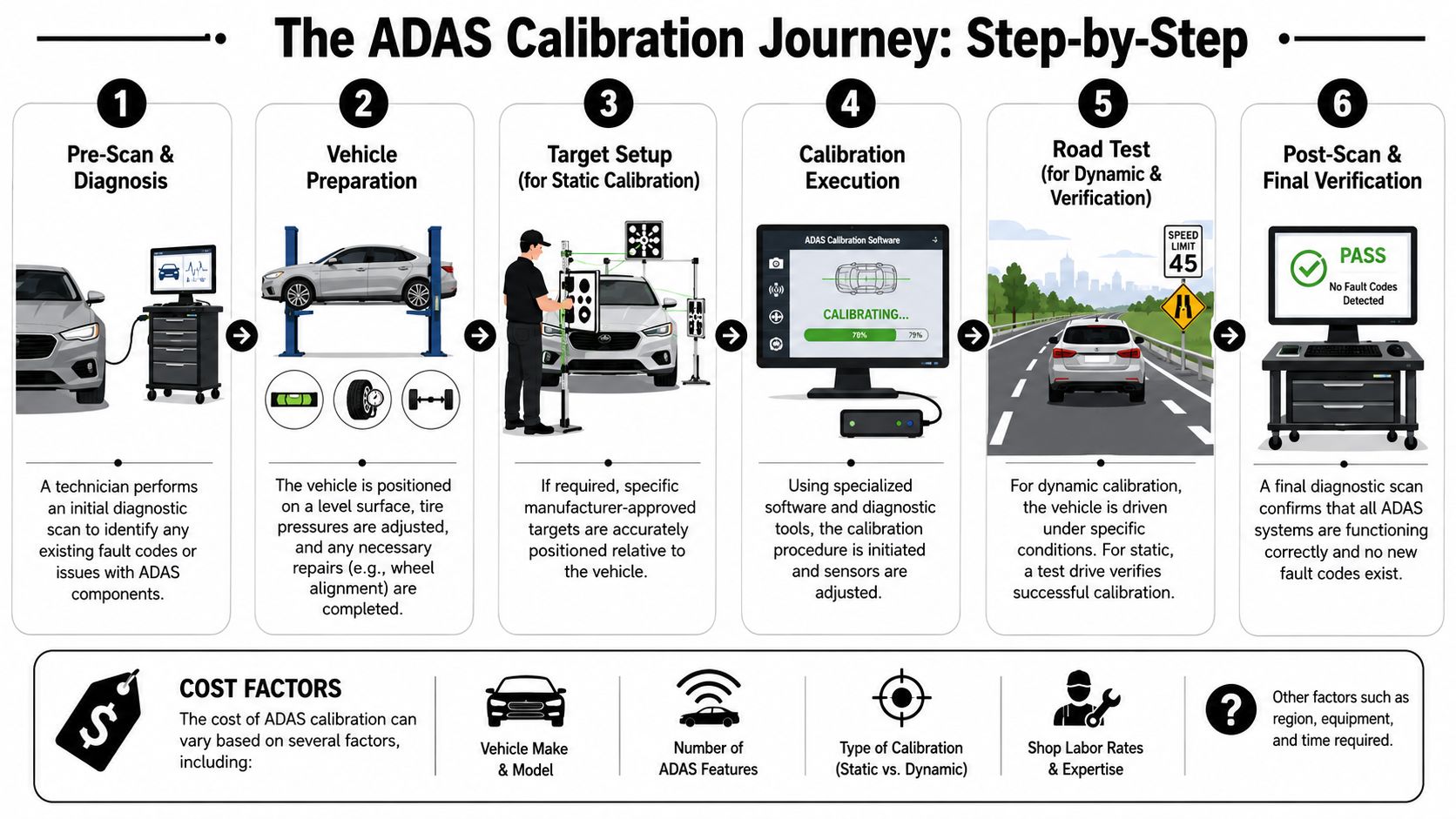
A professional process usually starts before the calibration itself. The technician checks for existing fault codes, verifies what systems the vehicle is equipped with, confirms the repair is complete, and makes sure the car meets the manufacturer's preconditions. Then the calibration is carried out using the required procedure, followed by verification and documentation.
What a proper workflow looks like
Pre-scan
The shop connects a diagnostic tool and checks for stored faults, communication issues, or ADAS-related warnings.
Vehicle preparation
Tyre pressures, ride height, alignment status, and other prerequisites are verified. If something is off, calibration may have to wait.
Setup
For static work, targets and measuring equipment are positioned exactly to spec. For dynamic work, the vehicle is prepared for the required road test.
Calibration execution
The technician follows the vehicle-specific procedure through the scan tool and calibration equipment.
Verification drive or completion cycle
Dynamic systems may need a road drive to complete. Static systems may still need functional verification.
Post-scan and proof
The shop checks for successful completion and should provide records showing the result.
A qualified certified auto repair facility in Whitby should be able to walk you through this sequence in plain language.
Why it costs what it costs
The average ADAS calibration cost is about $250 to $600 per incident, and a standard static calibration typically takes 30 to 60 minutes, while dynamic calibrations can take up to 2 hours, according to industry reporting on ADAS calibration time and cost.
That cost reflects several things:
- Specialised equipment that has to be accurate and maintained
- Technician time spent setting up, driving, verifying, and documenting
- Vehicle-specific procedures that vary by make, model, and sensor package
- Shop space requirements for level floors, target positioning, and controlled setup
What proof should you expect
You don't need to speak technician language to ask for the right evidence.
Look for:
- Pre-scan results showing the vehicle's status before the procedure
- Post-scan results showing successful completion and no unresolved relevant faults
- Procedure notes that identify what was calibrated
- An explanation tied to the repair so you know why it was necessary
A proper calibration job ends with evidence. “We did it” isn't enough on its own.
Why Skipping Calibration Is a Serious Risk
A skipped calibration doesn't just mean a feature might stop working. In some cases, it means the system may work incorrectly.
That's the main hazard. A system that gives a false sense of security can be worse than a system that clearly shows a fault.
Snap-on's technical guidance makes the central point plainly. If calibration is skipped, misaligned sensors can lead to dangerous system behaviour, creating a safety risk that didn't exist before the repair, as outlined in Snap-on's ADAS calibration technical focus.
What that can look like on the road
A front camera that's slightly off may interpret lane position poorly. A radar unit that isn't aimed correctly may judge distance or object location incorrectly. The driver may not notice anything is wrong until the moment the system is supposed to help.
That can show up as:
- Late intervention when the vehicle should have reacted sooner
- False warnings that train the driver to ignore alerts
- Unexpected braking or steering support at the wrong moment
- No intervention at all when the driver assumed the feature was available
The owner's job after a repair
You don't need to supervise the calibration itself. You do need to ask one very important question: What evidence do you provide that the calibration was completed successfully?
That question changes the conversation. It moves the issue from sales language to repair accountability.
If a repair affected an ADAS component or its reference point, skipping calibration means you're guessing that the system still sees the road correctly.
For a safety system, guessing isn't good enough.
Finding a Qualified Calibration Centre in Whitby
Choosing the right shop gets easier when you know what to listen for.
A qualified calibration centre should ask about your vehicle's ADAS features, identify which repair changed the sensor relationship, and explain whether the manufacturer calls for static, dynamic, or another calibration step. They should also be comfortable talking about prerequisites like tyre pressure, ride height, and alignment. If they act as if calibration is just plugging in a scan tool, that's a warning sign.
A simple checklist
Use this when you call or visit:
- Do they identify the affected systems clearly? “Your front camera” is better than “some sensors.”
- Do they follow manufacturer procedures? You want OEM-based process, not guesswork.
- Can they explain why your repair triggered calibration? The answer should connect directly to the work performed.
- Do they provide pre-scan and post-scan documentation? Proof matters.
- Can they tell you whether the vehicle needs static, dynamic, or both? That shows they understand the procedure path.
The best shops make a technical subject feel understandable. They don't hide behind jargon, and they don't brush off your questions. They explain what changed, what must be verified, and how they confirm the car is safe to return to the road.
If your vehicle in Whitby has had windshield work, collision repair, suspension changes, alignment work, or sensor-related repairs, Carmedics Autowerks Inc can help you sort out whether ADAS calibration is required and what proper documentation should look like. Their team works on modern cars and SUVs with the kind of diagnostic care owners expect when safety systems are part of the repair.