


The parts room is usually where a shop's habits show up first. A tech grabs a filter, a counter person promises it's “somewhere in stock,” and by Friday you've got a pile of unopened boxes, a missing core, and one urgent supplier run that should've never happened. That's not a storage problem, it's a parts inventory management problem, and in Ontario it matters because the repair network is large, the vehicle base is large, and the cost of being wrong is real.
Canada's aftermarket was valued at $43.9 billion in 2023, with 19,000+ independent aftermarket service locations and about 4,000+ parts distribution locations across the country, so inventory decisions directly affect how fast repairs move and how much cash gets trapped on shelves (Canadian aftermarket scale and inventory significance). Ontario's registered fleet also gives parts planners a very wide replacement base to work from, not just the last month of sales from one bay (Ontario vehicle fleet data and planning implications).
The shops that handle parts well don't start by buying software. They start by getting honest about what's already happening, what's leaking money, and where the work really stalls.
Diagnosing the Current Parts Operation Before Changing Anything
Before a single bin label moves, the shop needs a clean picture of what is on the shelves. Start with a full SKU list, then reconcile it against a physical count, the last 90 days of purchases and returns, and the parts that keep turning over while other lines sit untouched. That tells you where cash is tied up, where stock is missing, and where the system has drifted away from reality.
A useful diagnosis follows the part through the whole shop. Track how a request becomes an order, who receives the part, where it gets put away, whether it gets logged when it leaves the shelf, and who confirms it was installed. That path shows the weak point fast, whether the failure sits in receiving, put-away, bay hoarding, or the final write-up. It also exposes reverse-flow problems that many shops ignore, especially cores, warranty returns, and parts that come back in a box but never make it back into usable stock.
What to look for first
The first warning signs usually show up in the day-to-day grind. Supplier runs that should have been avoidable point to weak reorder discipline. Unbilled parts usually mean receiving is not tied tightly enough to the repair order. Techs holding parts in bays usually means they do not trust the parts room to have the right item at the right time.
Practical rule: if a part does not move through the shop on paper the same day it moves in real life, your counts drift and your reorder points stop reflecting reality.
Use the first pass to write a one-page baseline, not a process manual no one will read. Capture the parts categories that cause repeat pain, brake wear items, filters, fluids, common service hardware, and long-lead components that turn a routine job into a comeback. For Ontario fleets, segment SKUs by how often they move and how painful they are to miss, because a large fleet base changes the stocking math. A small shop can keep some items loose; a larger fleet operation needs tighter SKU segmentation, clearer bin control, and a harder line between fast movers, slow movers, and reverse-flow items that must be tracked back to credit or rebuild.
If you need a reference point for broader fleet maintenance thinking, the operational mindset behind fleet maintenance management is the same one that keeps parts from becoming a hidden bottleneck.
A simple diagnostic checklist
- Physical count: Compare the shelf to the system and note mismatches by SKU.
- Recent movement: Mark what sold, what sat, and what came back in the last 90 days.
- Workflow delay: Time how long it takes from request to install.
- Waste log: Flag damaged, obsolete, unidentified, and returnable stock before it gets buried again.
A strong diagnostic does more than surface errors. It gives the next decisions, from bin layout to reorder points to how you handle cores and returns, something real to stand on.
Designing the Parts Room for Speed and Accuracy
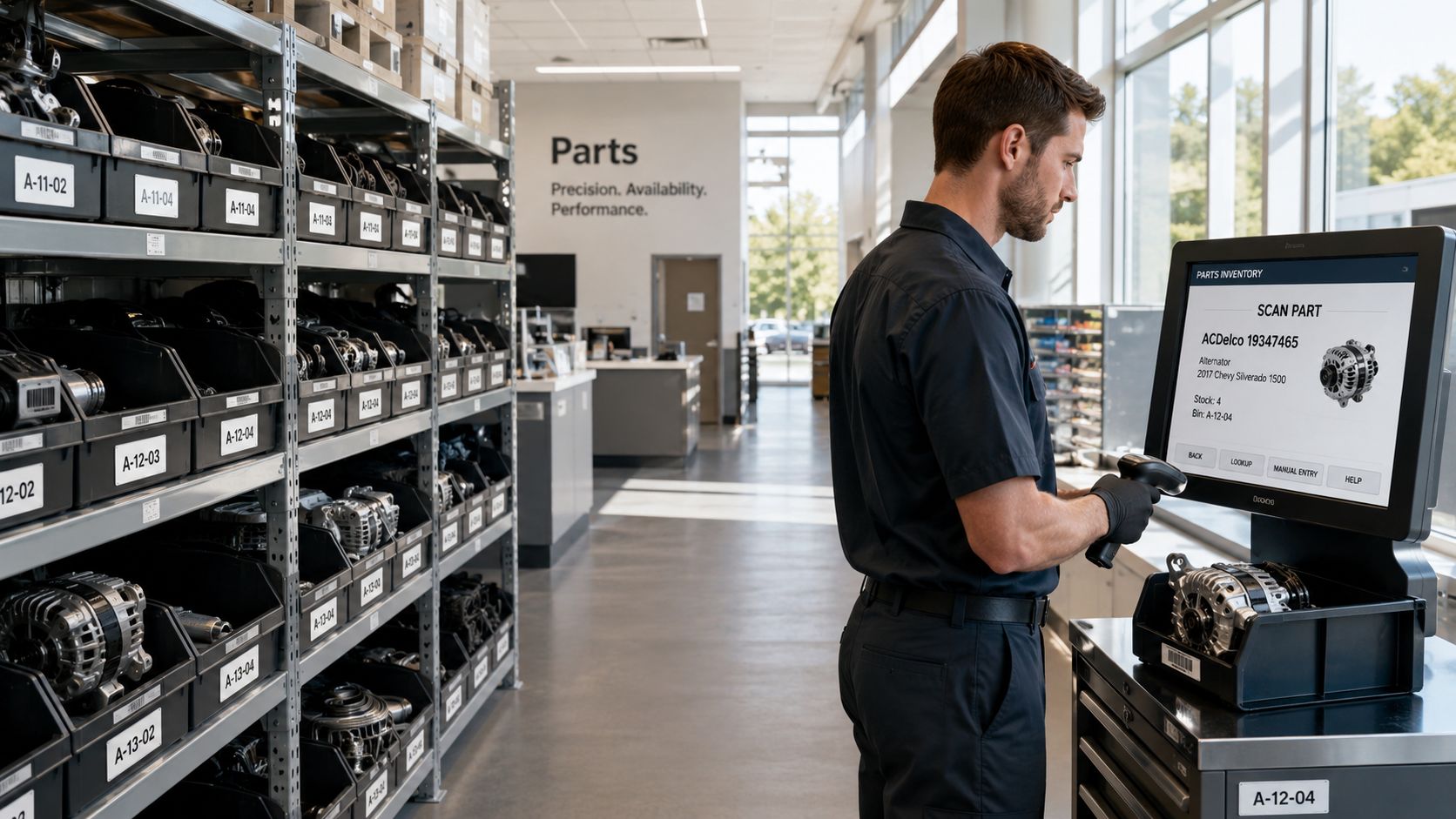
A parts room has to behave like a working process, not a storage closet. If a technician cannot find a part quickly, the layout is off, the labels are weak, or the issue rules are loose enough to let accuracy slip every day. Fixed bin locations solve more problems than polished shelving ever will, because every item gets one address and “I think it's over there” stops being part of the system.
Start by grouping parts by job family. Brake hardware belongs together, filtration together, fluids together, and fast-moving service items should sit where the counter person can reach them without crossing the room three times. Slow-movers need their own shelf or section, with a review before anything sits long enough to turn obsolete.
Make the room behave like the system
Barcode or QR identification matters because memory is not inventory control. Every bin should have a fixed location code, every SKU should have one home, and every issue or return should be posted the same day it happens. Practical storeroom guidance also points to minimum stock levels, bin-level location control, and keeping new stock separate from refurbished parts so sellable inventory does not get mixed up with returns or cores (spare parts inventory best practices).
A one- to four-bay shop does not need a warehouse design. It needs a parts room that prevents confusion when the day gets busy. That means one receiving spot, one return spot, one core holding area, and one shelf for slow-movers that gets reviewed before it turns into a graveyard.
Separate new stock, returnable cores, and refurbished parts physically. If they share space, they will share mistakes.
The reverse-flow side deserves the same discipline as the forward side. Cores, warranty returns, and rebuildable parts should move through a clearly marked path so credits do not get missed and usable material does not disappear into dead stock. That matters in Ontario fleet work, where volume is high enough that loose handling can hide real money in the bins.
SKU segmentation should follow the shop's scale, not a generic layout. A larger fleet operation needs tighter bin control on fast movers, a clearer cutoff between active and slow stock, and a separate lane for reverse-flow items that must be traced back to credit, rebuild, or scrap. Smaller shops can keep the layout simpler, but they still need the same logic so the room does not turn into a mixed pile of sellable parts and uncertain leftovers.
If the counter is the only place where transactions get posted, the whole room will drift. Train the team to record issues, returns, and credits before the next interruption lands. That discipline does more for accuracy than any new shelf system on its own.
Reorder Points and Safety Stock for Canadian Lead Times
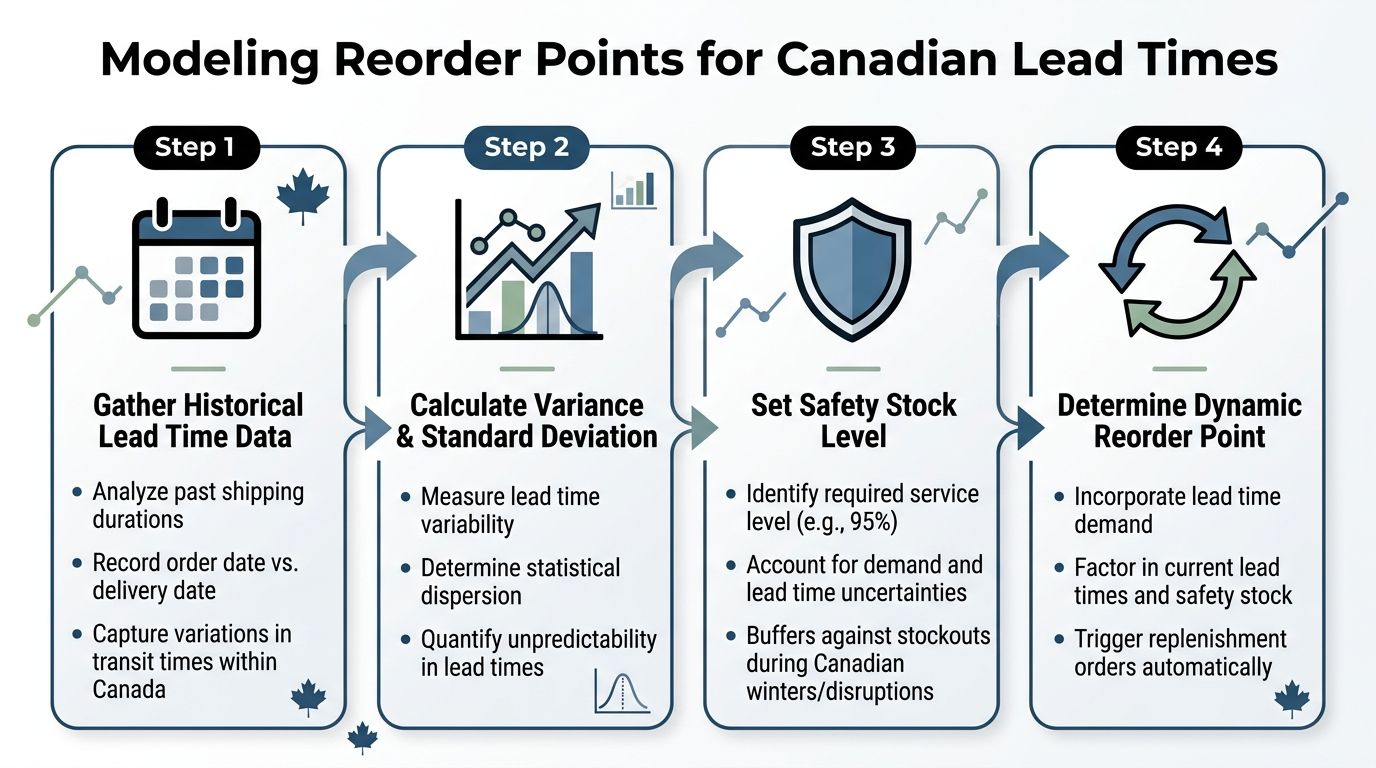
A parts room can look healthy right up until one late truck empties the shelf for a hard-to-source item. Canada makes that problem worse because the delay is not just delay, it is variance from weather, border friction, freight consolidation, and distributor scheduling. Average lead time can lull a shop into understocking the parts that hurt most when they miss.
Ontario fleet volume changes the sizing question. Fast-moving SKUs should be set against a broad replacement base, not just one shop's past month of receipts, because the demand pattern is bigger and less forgiving than a small counter assumes. That is why reorder points need to combine demand during lead time with safety stock, especially for common parts that stop a repair when they are missing.
How to think about the math
The reorder point starts with demand during lead time, then adds safety stock. If brake pads move steadily, use your own usage history to estimate demand, then add a cushion for late freight or a distributor that is out of the line you need. For a low-volume, high-criticality part, the average demand number matters less than the buffer, because one stockout can stall a repair bay and send the customer elsewhere.
Practical targets usually point in the same direction, even if every shop sets them differently. A healthy parts room aims for high fill rates on critical items, very few stockouts on the parts that keep bays moving, and solid inventory turns without starving the shelf (inventory KPIs and targets). Those targets are not magic, but they make the trade-off plain. If a part is critical and the lead time is unpredictable, holding a little extra is usually cheaper than paying for a rush shipment, a delayed job, and a frustrated customer.
The decision is SKU segmentation. A low-cost filter that arrives quickly can run lean. A hard-to-source sensor, module, or core-heavy component should carry more protection because the cost of being empty is bigger than the cost of the bin space. That is especially true in Ontario, where fleet scale means a missed fast mover can show up across more repair orders than a small shop expects.
Use judgment to override the formula when the part is rare, the supplier is erratic, or the vehicle mix creates spiky demand. In those cases, average lead time is a comfort blanket, not a planning tool.
The shops that get this right do not force every SKU into the same rule. They give fast-moving critical parts a wider cushion, keep slow movers honest, and treat lead-time variance as a real cost of doing business in Canada. For the reverse-flow side, that same discipline should extend to cores and returns, because a part that comes back for credit still has to be tracked before it becomes cash again. A simple maintenance history tied to the job record, such as the vehicle maintenance log, helps confirm what left the shelf, what came back, and whether the balance still makes sense after the repair closes.
Cycle Counting That Fits a Working Shop
A shop that waits for the annual count is usually counting old mistakes. By the time a full physical inventory finds the problem, the bad receipt, the missed return, or the part that vanished into a bay has already warped several reorder decisions. A rolling cycle count catches the error while someone still remembers what happened, which is the only time a fix has a chance to stick.
Use movement, not the calendar, to set the pace. Count A-items on a tighter schedule, B-items on a middle cadence, and C-items less often, with slow movers pulled aside for review when they have not moved in a long stretch, as covered in cycle counting and slow-mover review. That approach fits a working shop because it puts attention where the money moves fastest and leaves the dead stock less room to hide.
What makes a count useful
Count the bin, then fix the variance the same day. If the quantity is off, ask whether the part was received wrong, issued without posting, returned to the wrong bin, or carried into a bay and left there. If the same SKU is wrong again, the problem is usually in the process, not in the count.
For a shop that wants the parts record tied to real work, the repair history has to match the shelf. A vehicle maintenance log like the one at vehicle maintenance log should make it easier to confirm what was installed, when it was installed, and whether the shelf balance still makes sense after the job closes.
A cycle count sheet does not need bells and whistles. It needs SKU, bin location, system quantity, physical quantity, variance, reason, and initials. That is enough to stop the common pattern where shrinkage gets buried as a one-time mistake and then shows up again under a different label.
If you cannot explain a variance in plain language, do not hide it. Fix the receiving or issue process and count it again next cycle.
The other habit that pays is a quick review of parts that have gone stale. Obsolete stock turns cash into shelf clutter, and cycle counting is where you catch it before it keeps piling up.
Supplier Workflows and the Reverse-Flow Money Most Shops Leave Behind
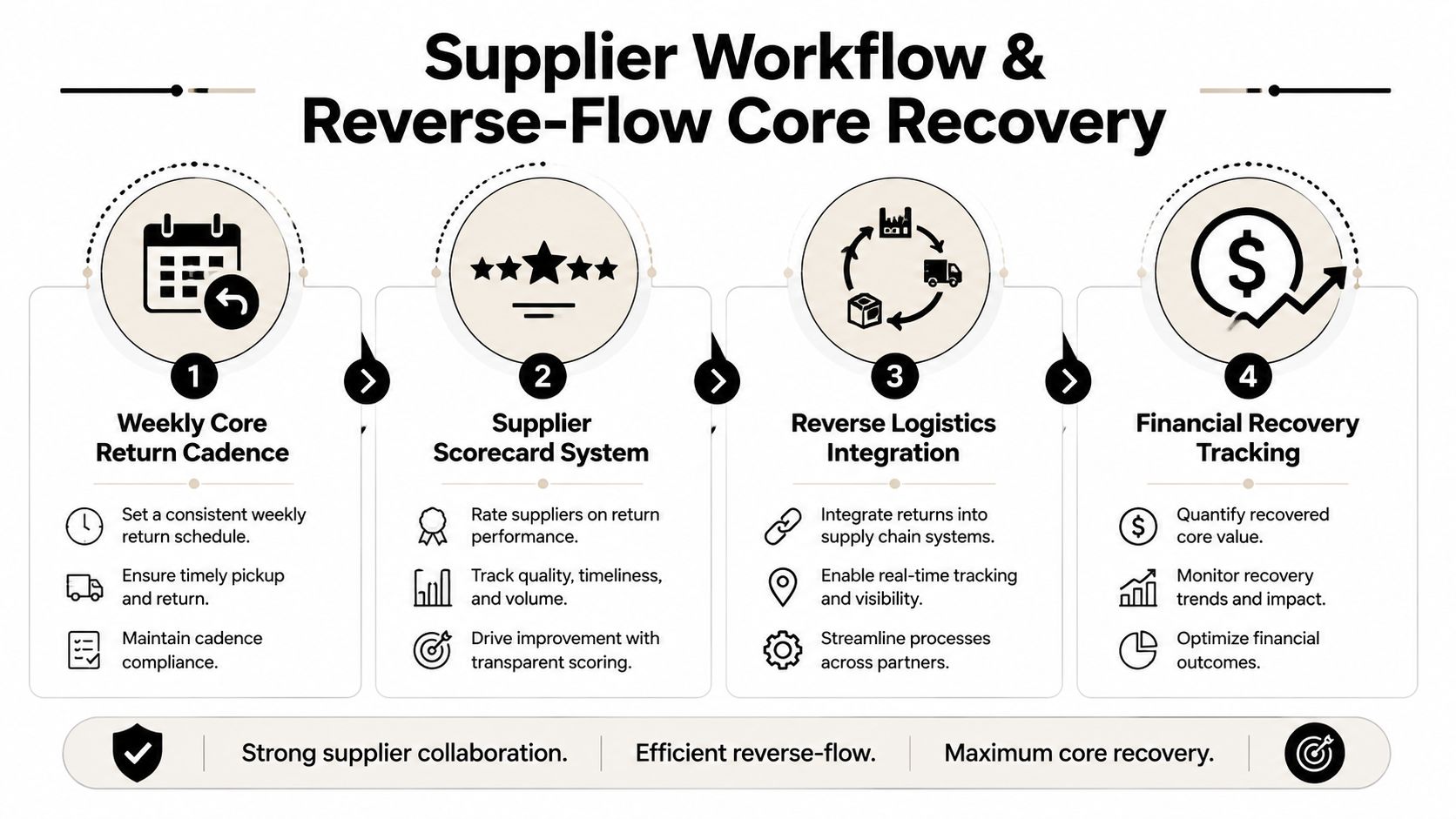
A shop can do a decent job on incoming stock and still bleed cash on the way back out. Returns, credits, deposits, and core shipments all sit in the same reverse-flow cycle, and if nobody owns that cycle, money stays trapped in bins, boxes, and supplier accounts.
The weekly rhythm matters more than the monthly apology. Review supplier statements, confirm credits, tie returns back to the original repair order, and push on anything that is drifting toward denial. If a supplier offers return privileges, dead-stock credits, or core allowances, get the terms in writing before the first dispute shows up.
Treat cores like inventory, not leftovers
Cores are inventory with a separate clock on them. They carry their own cycle time, their own shrinkage risk, and their own reconciliation work, and the margin leak starts when they get dumped into a corner with no clear owner. In remanufacturing-heavy workflows, that matters because the Canadian remanufacturing context ties recovered parts to longer product life, less waste, and circular-use goals.
Alternators, calipers, and starters are the parts that usually expose weak recovery habits. A missed deposit or core charge can erase the profit on a job if the return never gets logged, the wrong unit gets boxed, or the credit never lands on the account. The fix is plain enough: tag the core at removal, put it in one labelled area, reconcile it every week, and ship it on the schedule the supplier honours.
Reverse logistics needs discipline at the counter and in the bay. The technician who removes the part should know where the core goes, the parts person should know when it leaves, and the owner should know which credits are still outstanding. If your purchasing policy depends on the difference between original equipment and replacement parts, OEM vs aftermarket parts is a useful reference point when you set those rules.
A missed core return is often invisible until month-end, which is exactly why it keeps happening.
Shops that keep more of their margin do not just buy carefully. They close the loop carefully.
KPIs That Move the Bank Account, Not Just the Dashboard
A busy dashboard can still hide a weak parts room. The owner needs a short KPI set that gets reviewed every month and points to a clear action, not a pile of numbers that nobody touches. Fill rate, critical-item stockout rate, inventory turns, dead stock, and core return rate are the ones that usually pay their way.
SKU count by itself is a poor guide. A room can carry a long list of part numbers and still fail the bay when the right item is missing, or it can stay tight and fast because the stock is segmented properly. The better question is whether the inventory supports repair flow, trims slow movers, and brings recovered value back instead of letting it sit in a corner.
| Parts Inventory KPI Scorecard for Independent Repair Shops | |||
|---|---|---|---|
| KPI | Target band | What moves the number | Review cadence |
| Fill rate | 95%+ is a common benchmark | Better min-max settings, cleaner receiving, tighter supplier follow-up | Monthly |
| Critical-item stockout rate | Keep it below 5% for items that stop a job | Safety stock, lead-time review, faster issue posting | Weekly and monthly |
| Inventory turns | About 6 turns per year is a common healthy movement guide | Remove dead stock, reduce over-ordering, improve SKU segmentation | Monthly |
| Dead stock | Lower is better, especially for items not moving in 12 months | Obsolescence review, returns, supplier credit requests | Monthly |
| Core return rate | Higher is better, because missed cores drain margin | Tagging, storage discipline, shipping cadence, job close-out checks | Weekly and monthly |
The point of the scorecard is action, not report writing. If fill rate is soft, the fix is usually in receiving discipline, reorder settings, or supplier follow-up. If stockouts keep hitting the same items, the shop is probably carrying the wrong mix for its repair pattern, especially when Ontario fleet work pushes heavier use on certain SKUs and faster turnover on others. In that setting, fleet maintenance matters because it keeps the inventory conversation tied to uptime, repair frequency, and the parts that get used.
Dead stock deserves hard attention because it ties up cash and floor space. The clean-up work is usually practical, not dramatic, with a monthly review, a return request where the vendor will accept it, and a clear call on whether the item still belongs in the bin. Cycle count discipline supports that review, because a shop cannot trust its dead-stock list if bin accuracy is already shaky, and cycle count guidance is useful here for keeping the process consistent without turning it into a second job.
Core return rate is the reverse-flow KPI that most shops underuse. Every missed core is money that already left the building and never came back. Tag the core at removal, keep it in one marked location, reconcile it weekly, and make sure the person closing the job knows whether the return is still open. The link with mastering CMMS asset management is simple, the parts record, the work order, and the recovery trail all have to stay attached to the same job.
A KPI only earns its place if it changes behaviour. If a number does not change ordering, counting, or return habits, it is decoration.
Software Integration and a 30-60-90 Rollout That Sticks
Software won't fix weak discipline, but it will expose it faster. The goal is to tie the parts system, point-of-sale, and repair orders together so every part pulled from stock is linked to a work order and a technician. Double entry is where shops waste time, because the same part gets typed into three systems and still doesn't end up reconciled properly.
If you already run a CMMS or are building tighter maintenance discipline, mastering CMMS asset management is a useful companion read because the logic is the same: clean asset records, reliable work orders, and inventory data that stays attached to real jobs. Keep the software simple enough that the team uses it.
A rollout that won't stall
- First 30 days: run the diagnostic, label every bin, and give each SKU a fixed location.
- Next 30 days: set reorder points for the highest-use parts and start cycle counting A-items.
- Final 30 days: formalise core tracking, reconcile supplier credits, and review the monthly KPI scorecard.
The staff routine matters as much as the system. Opening should include checking yesterday's returns, open cores, and emergency orders. Closing should include posting issues, confirming receiving, and putting every part back in its assigned location.
Use the tag tracking and cost workflow to keep parts tied to the job from the moment they enter the shop. That keeps the inventory record honest and makes the write-up easier when the vehicle leaves.
A shop that sticks with this usually stops treating inventory as a side task. It becomes a daily habit, and that is what keeps parts from turning into a cash drain again.
Carmedics Autowerks Inc helps Whitby drivers keep repairs, fleet work, and collision jobs moving with disciplined service and dependable parts handling. If you want a shop that understands how inventory control affects turnaround time, visit Carmedics Autowerks Inc and see how that same attention to detail shows up in real repair work.