

If you're running a fleet right now, you probably know the pattern. One truck is down for an unscheduled repair. Another is overdue for service because dispatch needed it on the road. Fuel spend looks high, but nobody can tell you whether the cause is driver behaviour, tyre condition, idling, or a vehicle that should've been replaced months ago. The shop is busy, yet downtime still feels unpredictable.
That usually isn't a mechanic problem. It's a management problem.
A strong fleet maintenance manager changes the conversation from “Why did this truck break?” to “Why was this failure allowed to reach the road?” That shift matters in Canada, where fleet operations sit inside a large truck-based economy and where uptime, documentation, and preventive planning directly affect service reliability.
The Hidden Costs of a Disorganized Fleet
A disorganized fleet rarely looks disorganized on paper. There are invoices, repair orders, inspection sheets, and a service provider everyone calls when something goes wrong. From a distance, it can seem under control.
Operationally, it isn't.
The first hidden cost is downtime that spreads. One vehicle failure forces dispatch to reshuffle routes, drivers wait on replacements, customer commitments tighten, and another unit gets overused to fill the gap. The repair bill is only the visible part. The bigger loss is the chain reaction across labour, scheduling, and service reliability.
The second hidden cost is blind spending. Owners often see rising maintenance spend and assume the fleet is ageing. Sometimes that's true. Just as often, the underlying issue is poor maintenance timing, repeat repairs, weak vendor control, or no standard for when a vehicle should be serviced, parked, or retired.
Where the problem usually starts
In many operations, nobody owns the weekly decisions that keep vehicles available. Work gets done, but it isn't directed. The modern fleet maintenance manager isn't just booking oil changes. The role now includes vehicle life-cycle decisions, fuel analytics, vendor coordination, and driver behaviour monitoring. The practical question is what decisions that person makes each week to reduce downtime, as noted in this fleet maintenance manager overview video.
A fleet becomes expensive when maintenance is treated as a reaction instead of a control system.
That is why many businesses eventually move from ad hoc repair calls to a structured fleet maintenance programme. Not because paperwork looks better, but because unmanaged fleets create waste in places owners don't always measure early enough.
What owners usually feel first
Before they see a dashboard problem, owners feel an operations problem:
- Missed availability: Vehicles that should be ready aren't.
- Unclear repair patterns: The same unit keeps returning for similar issues.
- Driver frustration: Defects get reported, but closure is inconsistent.
- Budget drift: Spend rises without a clean explanation.
A good fleet maintenance manager turns those symptoms into specific actions. Which vehicles need immediate preventive work. Which jobs can be bundled to reduce downtime. Which defects point to driver habits, spec issues, or bad parts choices. Which outside vendor is helping, and which one is unduly extending downtime.
That's the difference between maintaining vehicles and managing fleet assets.
What a Fleet Maintenance Manager Actually Does
The role is easiest to understand if you stop thinking about the fleet maintenance manager as the head mechanic. In a well-run operation, that person acts more like a control centre for mobile assets. They decide what gets serviced, when it gets serviced, how work is documented, which failures need escalation, and whether the fleet is improving.
This visual captures the breadth of the job:
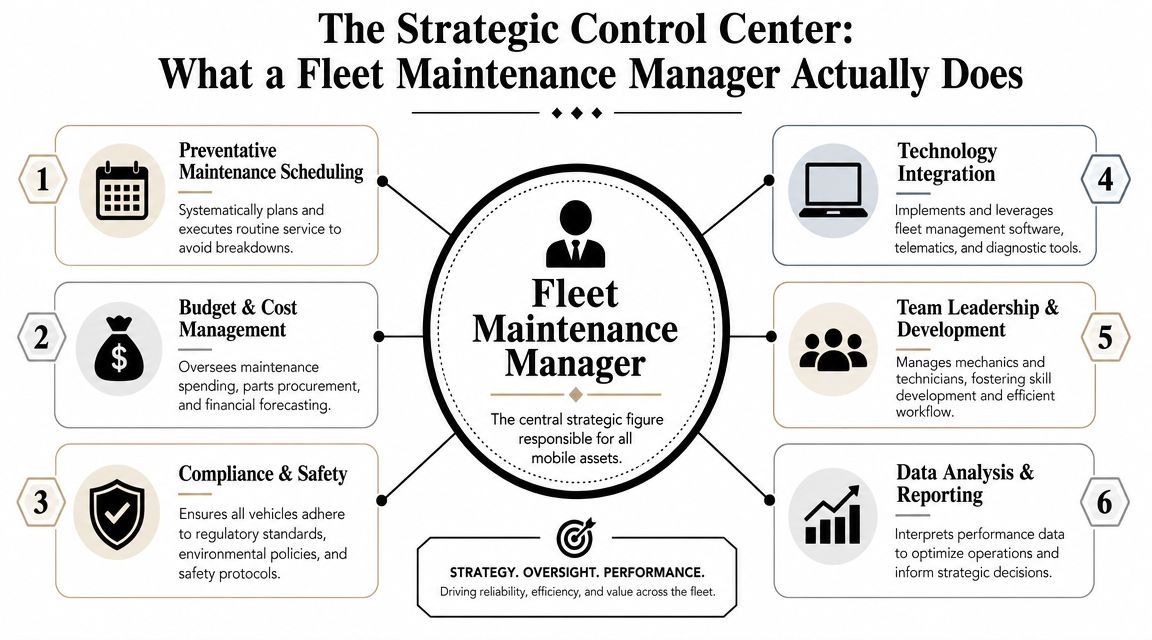
Recent fleet guidance describes a real shift in the role. It has moved from reactive shop scheduling to data-driven asset management, with metrics such as repair frequency, mean time to repair, cost per mile, and PM compliance used to prove control. It also notes that the North American fleet-management sector is projected to grow steadily, with telematics becoming central to operations, according to Geotab's fleet management KPI guidance.
Pillar one is uptime
The first job is keeping vehicles available for work. That doesn't mean avoiding maintenance. It means planning maintenance so the right unit is down at the right time for the right work.
A weak manager lets preventive work slip until the vehicle becomes a breakdown candidate. A strong one bundles inspections, schedules service around operations, and flags assets that are consuming too much shop time relative to their value.
Pillar two is cost control
Cost control in fleet maintenance isn't just finding cheaper parts. It's knowing what kind of spend is productive and what kind is waste.
That includes decisions like:
- Repair versus replace: If a vehicle is becoming a repeat visitor, another repair may be the wrong answer.
- In-house versus outsourced work: Not every task belongs in your own bay.
- Parts strategy: Cheap components can create repeat labour and more downtime.
For business owners comparing outside support options, it's worth reviewing what a dedicated fleet vehicle repair service in Whitby should provide. The right partner doesn't just complete jobs. They help reduce repeat failures and improve scheduling discipline.
Pillar three is safety and compliance
A fleet maintenance manager owns the condition of the vehicle as a business risk. That includes inspection follow-up, defect closure, record quality, and making sure units don't return to service with unresolved issues.
Practical rule: If a defect can't be traced from report to repair to sign-off, the process isn't under control.
Pillar four is vehicle life cycle management
Most owners think of maintenance as work done after a vehicle enters service. The better managers influence decisions before and after that point too. They look at duty cycle, wear patterns, replacement timing, and whether a unit still fits the work it is assigned to do.
The role in plain language
A capable fleet maintenance manager does six things at once:
- Sets preventive service triggers
- Controls repair workflow
- Keeps documentation usable
- Reads operating data
- Manages vendors and technicians
- Turns fleet condition into business decisions
That mix of mechanical understanding, process discipline, and financial judgement is what separates a busy shop from a managed fleet.
Key Skills and Qualifications for Success
A mediocre hire can keep work moving. A strong hire can change the economics of the fleet. The difference usually isn't résumé polish. It's whether the candidate combines technical credibility with operational judgement.
Mechanical knowledge that goes beyond parts swapping
The fleet maintenance manager doesn't need to be the best technician in the building, but they do need enough technical depth to challenge bad diagnoses, understand failure patterns, and set sensible service intervals.
That means they should be comfortable reading inspection findings, fault-code trends, and wear indicators. They should also understand what winter service exposure, stop-and-go driving, idling, payload, and route length do to brakes, tyres, fluids, and suspension components in Canadian conditions.
A candidate with hands-on repair background often earns trust faster with drivers and technicians. Still, mechanical skill alone isn't enough.
Business judgement matters just as much
Many fleets fail because nobody translates maintenance activity into operating decisions. A good manager can.
Look for someone who can discuss these trade-offs clearly:
| Area | Weak answer | Strong answer |
|---|---|---|
| Service timing | “We service everything on a calendar” | “Intervals should reflect usage and duty cycle” |
| Repair spend | “We fix what's broken” | “We track repeat repairs and question asset viability” |
| Vendors | “We use whoever is available” | “We compare turnaround, quality, and documentation discipline” |
| Reporting | “We have invoices” | “We need usable records for trends and accountability” |
A practical way to screen this is to ask candidates how they'd handle a unit with recurring defects, rising fuel consumption, and poor driver feedback. The best answers won't stay at the parts level. They'll talk about diagnosis, usage pattern, repair history, and whether the vehicle still belongs in the fleet.
Leadership is what makes the system stick
The role sits between owners, dispatch, drivers, technicians, and outside vendors. That means the fleet maintenance manager needs enough authority to enforce standards and enough communication skill to keep people cooperating.
Watch for signs they can do the following:
- Hold drivers accountable: They need defect reporting to happen on time and with enough detail to act on.
- Direct technicians clearly: Vague work orders waste hours.
- Push back on operations pressure: Sometimes the right decision is to keep a vehicle off the road.
- Standardise processes: Good managers reduce variation in how inspections, repairs, and approvals happen.
For businesses that value documented repair standards and consistent workmanship, using a certified auto repair facility in Whitby can support the manager's process. It gives them a clearer baseline for inspection quality, repair records, and return-to-service confidence.
The strongest maintenance managers don't just know vehicles. They know how to get drivers, techs, and owners working from the same facts.
The KPIs Every Manager Should Master
If the fleet maintenance manager can't show performance in a few core numbers, the operation is being run on opinion. Good fleets use a short dashboard, not a giant spreadsheet full of vanity metrics.
This is the simplest visual version of that dashboard:
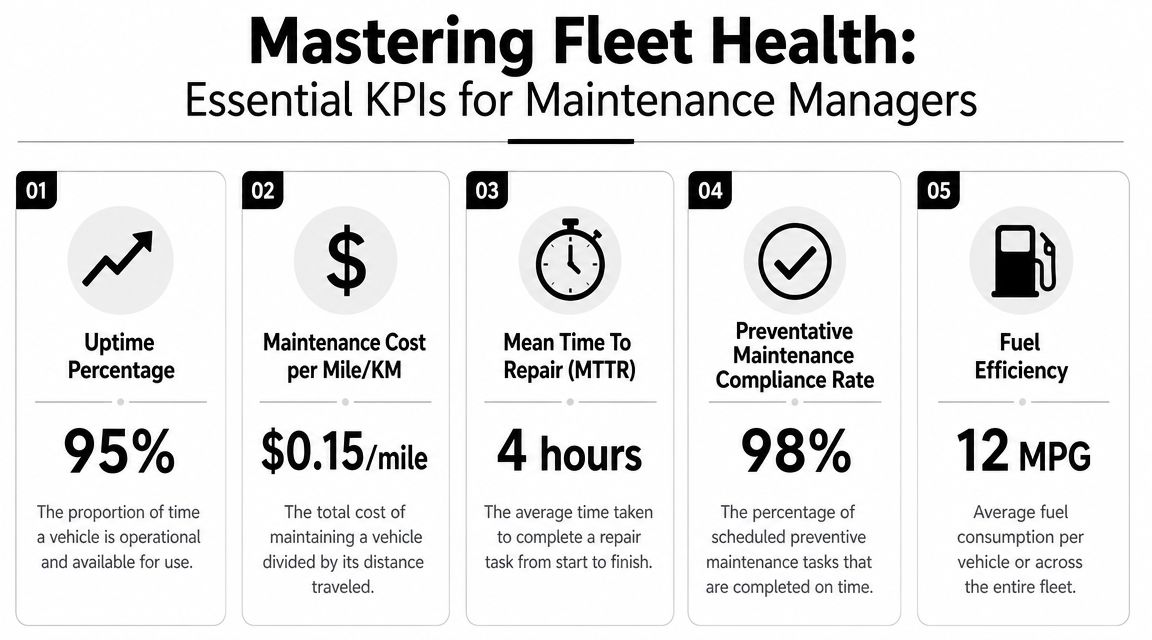
One benchmark matters immediately. Industry guidance identifies 95%+ fleet availability as a mark of a well-managed fleet, while below 90% signals serious maintenance problems. In Canada, where the trucking industry operates roughly 593,000 registered road motor vehicles, even small improvements in availability affect service continuity, according to this fleet maintenance KPI guide.
Availability tells you whether the fleet can earn
Availability is the top-line measure. If vehicles aren't ready, nothing else in the operation works cleanly.
For an owner, this KPI answers one question fast: can the fleet support demand without constant substitution, rescheduling, or rental dependence? When availability drops, the manager should immediately look at repeat offenders, parts delays, and whether preventive work is being pushed too far.
PM compliance shows whether discipline exists
Preventive maintenance compliance is one of the clearest measures of control. It tells you whether scheduled service is being completed when it should be.
A low number here usually predicts bigger trouble later. It means vehicles are being run past service points, work is being deferred, or the schedule doesn't fit real operating conditions. Any of those will eventually show up as road failures, longer repairs, or rising parts consumption.
MTTR reveals workflow problems
Mean time to repair isn't only a technician metric. It reflects diagnosis quality, parts readiness, authorisation delays, and whether the manager has built a realistic process.
When MTTR drifts upward, don't blame labour first. Check whether defect reports are clear, whether approvals sit too long, and whether the right jobs are being outsourced instead of tying up internal resources.
Cost per distance keeps spending honest
Cost per mile or kilometre is useful because it converts raw maintenance spend into a fleet-wide operating measure. A month with high invoice totals may be fine if heavy scheduled work was planned. A lower-spend month can still be bad if vehicles were not maintained.
For local operators using outside support, a fleet services provider in Toronto should be able to help organise reporting around actual operating metrics rather than just invoice totals.
Roadside breakdowns expose what the schedule missed
This KPI is blunt and valuable. Every roadside event means something escaped detection, was deferred, or wasn't documented properly enough to trigger action.
A roadside breakdown is rarely random. Most of the time, it's a maintenance signal that nobody closed in time.
A practical dashboard
A manager's weekly dashboard doesn't need to be complicated. It should answer:
- Are vehicles available when operations need them?
- Are scheduled services being completed on time?
- How long are repairs taking from report to return to service?
- What is maintenance costing relative to use?
- Which units are creating avoidable field failures?
Those numbers don't replace judgement. They sharpen it.
Essential Tools and Workflows for Modern Fleets
Good maintenance managers don't rely on memory, whiteboards, or text messages from drivers. They build a workflow that captures defects early, routes them into work orders, documents the repair, and feeds the result back into future decisions.
This is what that workflow looks like in a modern operation:
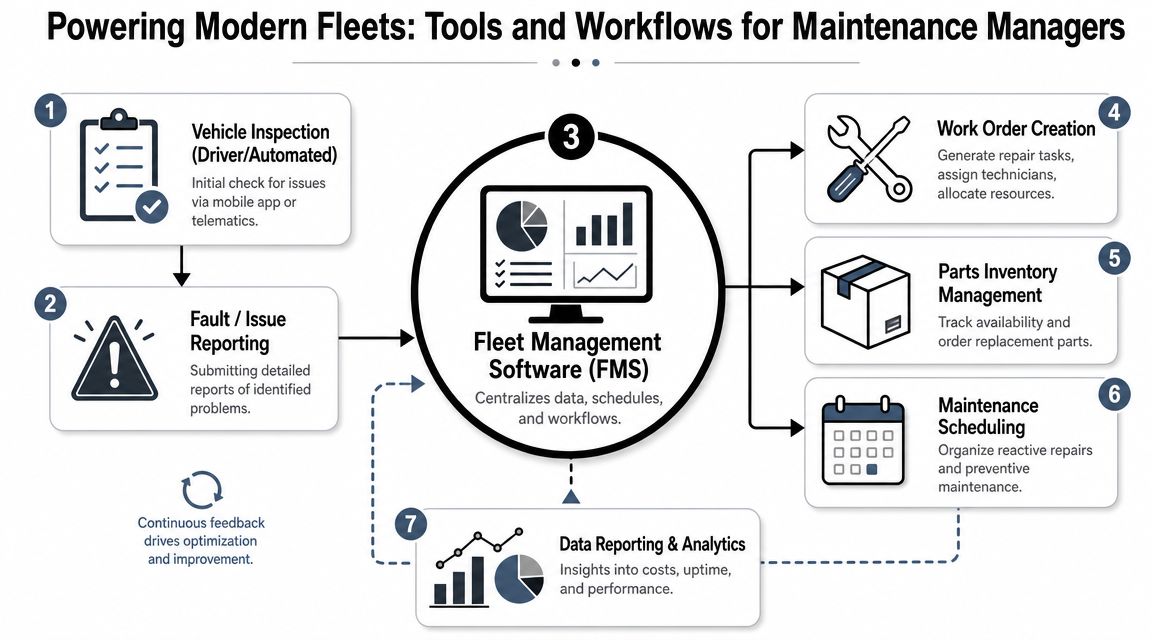
Best practice is to trigger preventive maintenance by mileage, engine hours, or time intervals, then log inspections, repairs, parts, labour, and return-to-service details in maintenance software. Capturing signals such as fault codes, brake wear, and fluid degradation helps managers convert reactive breakdowns into scheduled work, as outlined in this fleet maintenance workflow reference.
Start with a clean intake process
Most maintenance trouble begins before the wrench turns. Drivers report defects vaguely. Telematics alerts arrive with no owner. Someone verbally mentions a brake issue, but no work order gets created.
The fix is simple in concept and hard in discipline. Every issue needs one intake path. Driver report, automated alert, inspection finding, or fuel anomaly. It all has to enter the same system.
A good intake record includes:
- Vehicle ID: No ambiguity about which asset is affected.
- Fault detail: What was seen, heard, or measured.
- Severity: Can it operate, or must it be parked.
- Source: Driver, technician, telematics, or inspection.
- Timestamp: So nobody debates when the issue was known.
Use one source of truth for repairs
Once an issue is in the system, the fleet maintenance manager needs a central platform to assign work, reserve parts, and control status. That's where fleet management software earns its keep.
The software itself matters less than the process built around it. If teams use the platform only for invoicing after the fact, it won't improve uptime. It has to be active at the point of inspection, diagnosis, approval, repair, and sign-off.
For parts decisions inside that workflow, consistency matters. Managers need clear standards for quality, warranty, and fit. Comparing OEM and aftermarket parts is part of cost control because the cheapest option on the invoice can become the expensive option in downtime.
Build a closed loop from report to sign-off
Documentation needs to be audit-ready and operationally useful. In practice, that means no open-ended defects and no “done” status without verification.
A closed loop looks like this:
- Issue reported
- Work order created
- Technician assigned
- Parts allocated
- Repair completed
- Return to service verified
- Data retained for trend review
When fleets support mobile service or shop air tools across different jobs, even small equipment choices affect workflow reliability. For teams reviewing support gear, this guide for selecting air compressor kits is useful because it frames accessory selection around actual use, not just catalogue price.
Software doesn't fix a weak process. It exposes it faster.
One practical option for businesses that want outside repair support tied to a structured maintenance process is Carmedics Autowerks Inc. The shop provides fleet maintenance and repair support, which can fit into a manager-led workflow when a company doesn't want to build every capability in-house.
How to Hire the Right Fleet Maintenance Manager
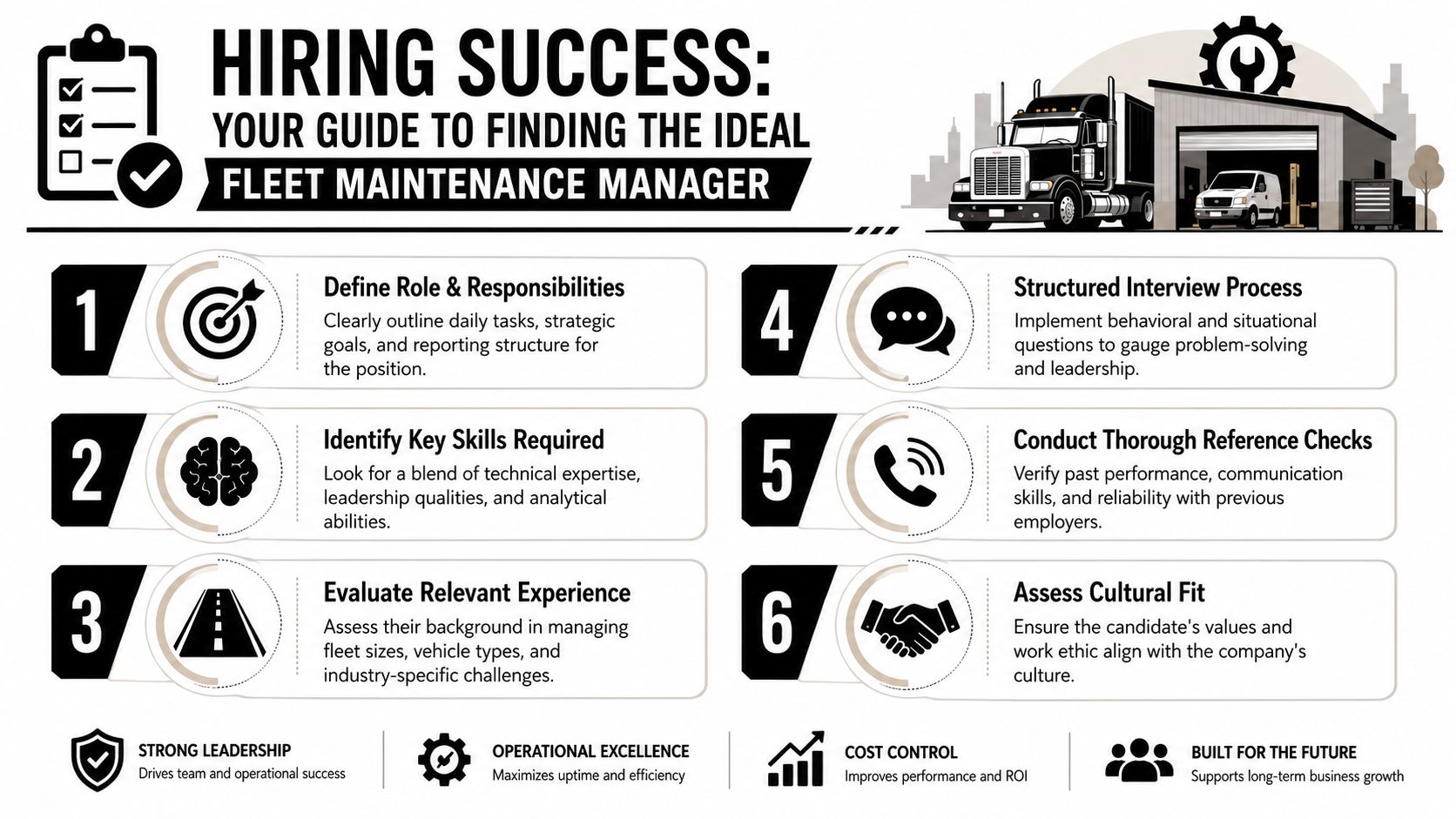
Hiring for this role goes wrong when owners focus on years in the trade instead of decision quality. Plenty of candidates have long experience. Fewer can explain how they would reduce downtime, tighten documentation, and control maintenance cost without creating safety risk.
This hiring visual is a useful summary:
What to screen for before the interview
The résumé should tell you more than where the candidate worked. It should hint at how they think.
Look for evidence of these traits:
- System thinking: They talk about programmes, schedules, workflows, and documentation, not just repairs.
- Operational awareness: They understand dispatch pressure, downtime impact, and vehicle utilisation.
- Vendor management: They have experience with outside shops, parts sourcing, or service-level expectations.
- Reporting discipline: They can discuss KPIs without sounding like they're reading software labels.
Be cautious with candidates who only describe activity. “Managed technicians,” “scheduled repairs,” and “handled budgets” don't tell you much unless they can connect those tasks to fleet performance.
Interview questions that reveal the real operator
The best interview questions create trade-offs. You want to see whether the person can balance uptime, cost, safety, and process.
Try questions like these:
| Question | What a strong answer includes |
|---|---|
| A vehicle keeps coming back for similar issues. What do you do first? | Repair history review, root-cause thinking, and a plan to stop repeat failures |
| Drivers submit poor defect reports. How do you fix that? | Driver accountability, simpler intake steps, and verification standards |
| One unit is needed for tomorrow's route but isn't road-ready. What do you do? | Willingness to protect safety and communicate alternatives clearly |
| An outside vendor is cheap but slow. Keep them or replace them? | Total-cost thinking, including downtime and rework risk |
| What should be on your weekly dashboard? | A focused set of operational metrics tied to decisions |
Reference checks should test behaviour, not personality
Most reference calls are too soft. Owners ask whether the candidate was reliable and easy to work with. That doesn't tell you whether the person can run a fleet.
Ask previous employers questions such as:
- Did this person improve process consistency?
- How did they handle pressure from operations when a vehicle shouldn't return to service?
- Were they organised with records and follow-up?
- Did technicians and drivers trust their judgement?
The right fleet maintenance manager acts like a business partner. They protect vehicle condition, but they also protect margin, service continuity, and reputation.
When to Outsource Fleet Maintenance to a Partner
Not every fleet should hire a full-time fleet maintenance manager and build an internal shop structure around them. For some businesses, that creates more fixed overhead than operational value.
Outsourcing starts to make sense when your fleet is large enough to need discipline but not large enough to justify full internal infrastructure. It also makes sense when you lack diagnostic equipment, parts control, record-keeping discipline, or enough management time to supervise repair quality properly.
Signs outsourcing is the better call
A partner model is often the better option when:
- Your vehicles are maintained inconsistently: Service happens, but not through one organised process.
- You rely on whoever can squeeze you in: That usually creates uneven quality and poor documentation.
- You don't want to manage technicians directly: The people burden is real.
- You need predictable support more than shop ownership: Many owners want results, not another department.
The right outside partner should still work like an extension of a managed fleet. That means clear scheduling, usable records, inspection discipline, and communication that supports operating decisions instead of just sending invoices.
For many businesses in Whitby and the Durham Region, outsourcing gives them access to established repair capability and maintenance structure without adding another full-time management layer. That is often the smarter move when the business earns more from serving customers than from trying to run a maintenance department internally.
If your fleet needs a more organised maintenance process, Carmedics Autowerks Inc in Whitby provides fleet maintenance support, general repairs, and service coordination that can help businesses improve uptime and reduce the chaos that comes with reactive vehicle care.