


A remote starter usually becomes a serious project on the first hard winter morning when the wind is cutting across your driveway in Whitby and the cabin feels like a freezer. That's when a lot of capable DIYers start searching how to install remote start on car and assume it's mostly a wiring job.
On older vehicles, that assumption was closer to the truth. On newer cars, trucks, and SUVs, the challenge is usually different. You're not just connecting power, ignition, and accessory circuits. You're trying to make an aftermarket module talk properly to factory security, immobilizer logic, and body control electronics without creating warning lights, no-start problems, or warranty headaches later.
If you're handy, patient, and comfortable reading wiring diagrams, some installations are still very doable. If your vehicle is late-model, push-button start, European, or heavy on driver-assist and networked electronics, the smart move is often to treat the job like software integration with trim removal attached.
Is a DIY Remote Start Installation Right for Your Car
The first decision isn't which remote starter to buy. It's whether your vehicle is a good DIY candidate at all.
Most modern cars can accept a remote start system, but the primary obstacle is often the security and anti-theft side of the vehicle, not the basic wiring. AutoZone's guidance puts it plainly: most modern cars can be fitted with a remote start, but the main hurdle is often the vehicle's security or anti-theft system, which makes correct programming and bypass integration the key part of the job, especially on newer models (AutoZone remote start guidance).
That matches what I'd tell any owner in the shop. If you're working on a newer Canadian-market vehicle, the make, model, year, trim, ignition style, and transmission matter more than your confidence with a crimp tool.
Cars that suit DIY better
A DIY install is more realistic when the vehicle has strong aftermarket support and a vehicle-specific T-harness is available. In that situation, you're spending more time on careful disassembly, module placement, and programming than on cutting into factory wiring.
A good DIY candidate usually looks like this:
- Popular platform: Common domestic or Japanese models often have better kit support.
- Clear compatibility listing: The module maker specifically lists your exact vehicle details.
- Standard security layout: The immobilizer integration is known and well documented.
- You've handled trim and electrical work before: Not guessing. Not “learning as you go” around critical circuits.
Cars that push the job toward a pro
Some vehicles turn a simple accessory install into a risk-management exercise.
- Late-model push-button start vehicles: These often rely heavily on data-bus communication and immobilizer programming.
- European brands: They can require more involved transponder handling and tighter integration.
- Luxury trims and advanced electronic packages: More modules, more networked systems, more chance of triggering faults.
- Vehicles under warranty: If you can't verify exactly how the system integrates and whether the installer or manufacturer supports it, proceed carefully.
Practical rule: If the product listing spends more time discussing firmware, data modules, and immobilizer learning than physical wire colours, you're dealing with an electronics project, not a simple add-on.
Pick the system around your use case
Not every owner needs the same remote start setup.
A one-way system is simple. You press the remote and trust the command went through. A two-way system gives feedback, which many people prefer in winter when the car is parked farther away. A smartphone-controlled system can be appealing if convenience matters more than keeping things basic, but it adds another layer of setup and dependency.
What doesn't work is buying on features first and compatibility second. That's backwards. The right order is vehicle match, immobilizer support, install method, then convenience features.
If you're trying to install remote start on car with a newer platform and can't confirm exact compatibility before purchase, stop there. That uncertainty usually causes more trouble than the install itself.
Choosing Your System and Gathering the Right Tools
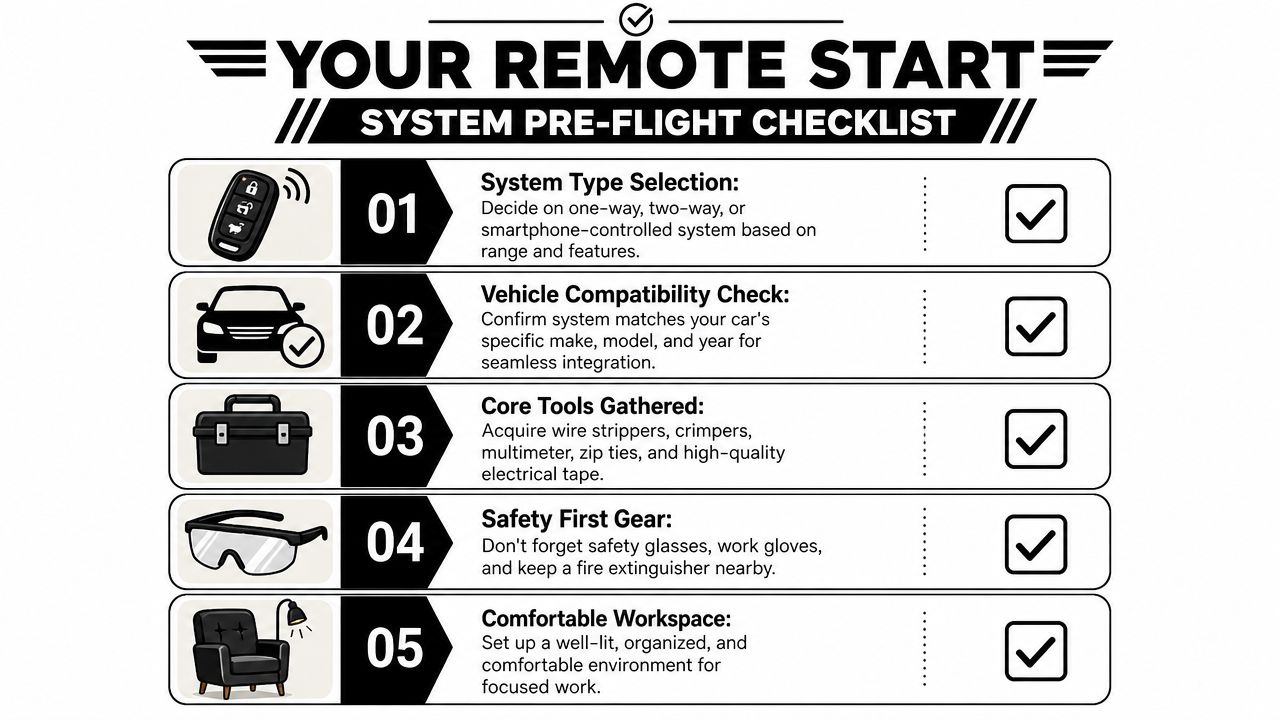
The cleanest installs start before a panel comes off. System choice decides whether your weekend stays organised or turns into a hunt for the right wire behind the dash.
T-harness versus universal kits
For most capable DIYers, a vehicle-specific T-harness kit is the smarter path. It plugs inline with factory connectors and usually limits how much cutting or splicing you need to do. That means cleaner work, easier reversal, and less chance of creating a bad connection inside the dash.
A universal splice-in kit gives flexibility, but it expects more from you. You need to identify the right circuits, confirm them properly, and make durable connections that won't loosen when the cabin goes from deep cold to warm and back again.
The practical difference is straightforward:
| System type | Where it helps | Where it hurts |
|---|---|---|
| T-harness kit | Cleaner installation, less cutting, easier to remove later | Depends heavily on exact vehicle support |
| Universal splice-in kit | Works across more applications | Requires stronger electrical skill and better documentation |
If you're also comparing parts quality in general, this guide on OEM vs aftermarket parts helps frame the bigger decision. In remote start work, aftermarket can be excellent, but only when the module and harness are matched properly to the vehicle.
Choose support, not just features
A flashy remote means nothing if the module maker doesn't support your exact car. Prioritise:
- Vehicle-specific application data: The listing should match year, make, model, trim, ignition type, and transmission.
- Bypass or immobilizer support: If the security side is vague, that's a warning.
- Update and programming access: Some systems are simple to pair. Others need extra configuration.
- Clear install material: Good diagrams beat glossy packaging every time.
One more practical point. If your vehicle already has factory remote start available through dealer activation or a factory-style upgrade path, check that before buying an aftermarket kit. On some newer vehicles, that route is simpler and less invasive.
Tools that actually matter
Don't start this job with a bargain test light and a flat screwdriver. A clean install needs the right hand tools and the right diagnostic habits.
Bring these to the bench:
- Digital multimeter: This is the tool that keeps you from guessing. You need it to verify circuits instead of trusting wire colour alone.
- Trim removal tools: Plastic pry tools help you remove lower dash panels, glove box sections, and kick panels without chewing up clips and trim surfaces.
- Socket set and screwdrivers: Most access work is basic fastener removal, but you need control, not improvised tools.
- Wire strippers and crimpers: If your system requires any hardwire connections, poor stripping and weak crimps will come back to haunt you.
- Electrical tape or heat shrink: Every connection needs proper insulation and strain relief.
- Zip ties: These keep the module and harness from rattling or dropping into moving components.
- Safety glasses and gloves: A dashboard is full of sharp edges.
Buy the kit after you confirm the vehicle. Buy the tools before you remove the first panel.
A comfortable, well-lit work area matters too. A lot of mistakes happen because someone is folded into a footwell, rushing, with poor lighting and a dead phone battery trying to read instructions.
The Core Installation Process Explained
The project transitions from planning to workmanship. The difference between a remote starter that behaves like factory equipment and one that creates random headaches usually comes down to access, wire verification, connection quality, and module placement.
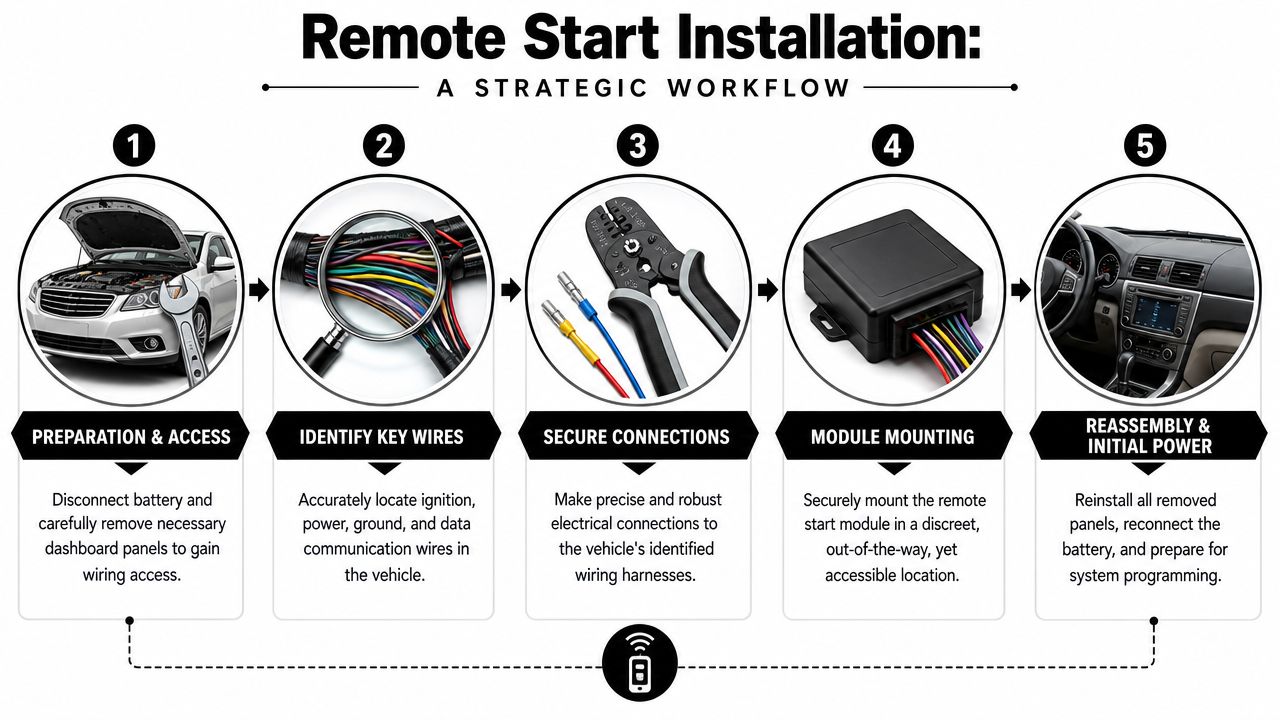
Quality Tire's install overview captures the safe sequence well: disconnect the battery, verify the vehicle's specific wiring with a multimeter before making any connection, create secure and insulated splices or T-harness connections, and only then reassemble and test (remote start installation process). That order matters. Skipping it is how people create avoidable faults.
Gain access without breaking the interior
Most installs start in the lower dash area or around the glove box, depending on where the BCM, ignition harness, or immobilizer connections sit. Remove panels slowly. Watch hidden screws, push clips, and trim tabs. Don't yank because one corner feels loose.
Keep fasteners sorted as they come out. I usually tell people to lay them out in removal order. That sounds basic, but it saves time when reassembly starts and every black screw suddenly looks the same.
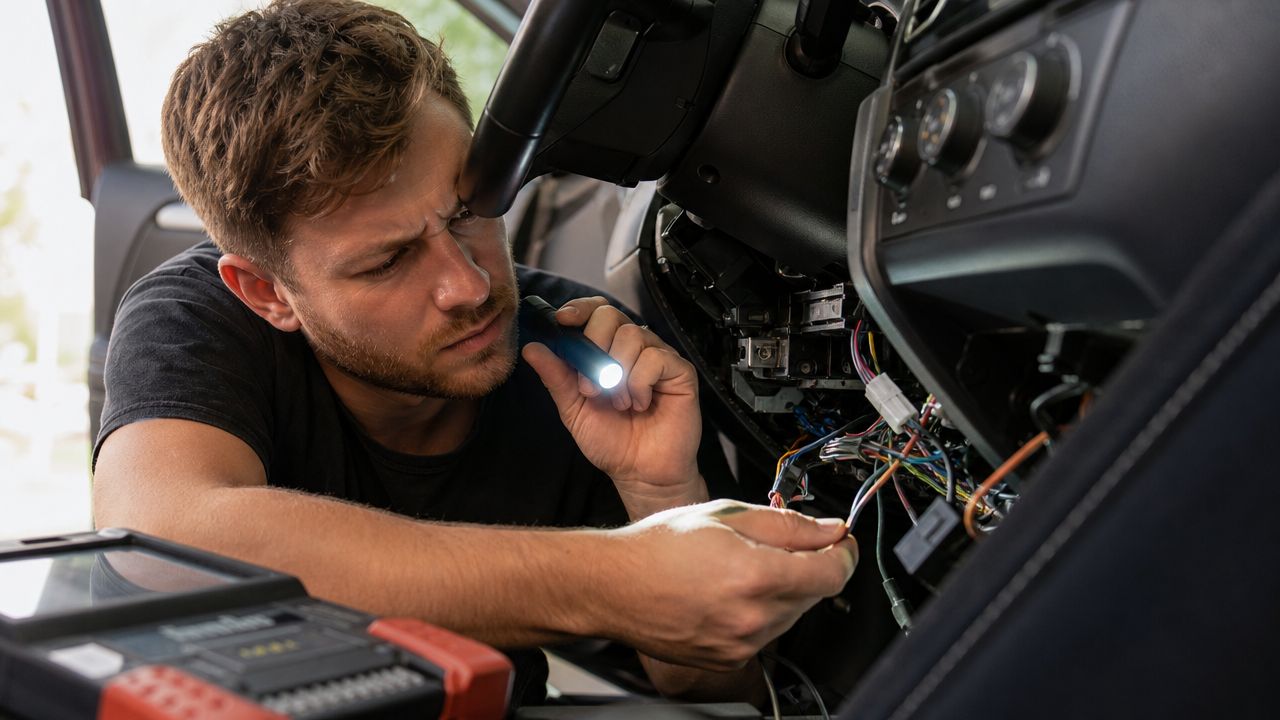
Verify wires, don't identify by colour only
Wire colour charts can help, but they're not enough on their own. Manufacturers change things across trims and production runs, and previous owners sometimes leave surprises behind.
Use the multimeter to confirm:
- Constant power
- Ground
- Ignition or accessory circuits
- Relevant lock or data connections
- Any trigger wires your specific system calls for
If you're diving deeper into vehicle wiring work, this overview of modern car electrical repair is worth reading. Remote start systems sit right in the middle of that world.
A wire that “should be right” is still unverified until the meter says it is.
Make connections like they need to last through winter
If your kit uses a T-harness, the job is mostly about seating connectors fully, routing the harness cleanly, and making sure nothing is pinched. Check that locking tabs click into place and that no pins are bent.
If your kit requires splicing, slow down. Strip only what you need. Make the connection mechanically secure before insulating it. Loose joins, exposed copper, and bulky tape balls under the dash are where intermittent faults start.
A durable connection should be:
- Tight: No movement when lightly tugged
- Insulated: No bare conductor visible
- Supported: Harness weight shouldn't hang from the splice
- Routed safely: Away from pedals, steering shafts, sharp brackets, and HVAC doors
Mount the module where it belongs
The control module should be hidden, dry, and secure, but still accessible if future service is needed. Don't leave it floating on the harness. Don't wedge it against sharp metal. Don't place it where it can rattle every time you hit a frost heave.
Before reassembly, pause and inspect the whole path of the harness. Make sure every removed panel can go back without crushing wiring. That final look saves a lot of second disassembly.
Programming the Module and Final System Testing
Physical installation is only half the job. On many modern setups, the module has to learn how your car thinks.
That's why a vehicle can be wired cleanly and still fail to remote start. The hardware may be connected properly, but the module doesn't yet understand the lock commands, security logic, or key data it needs to work safely.
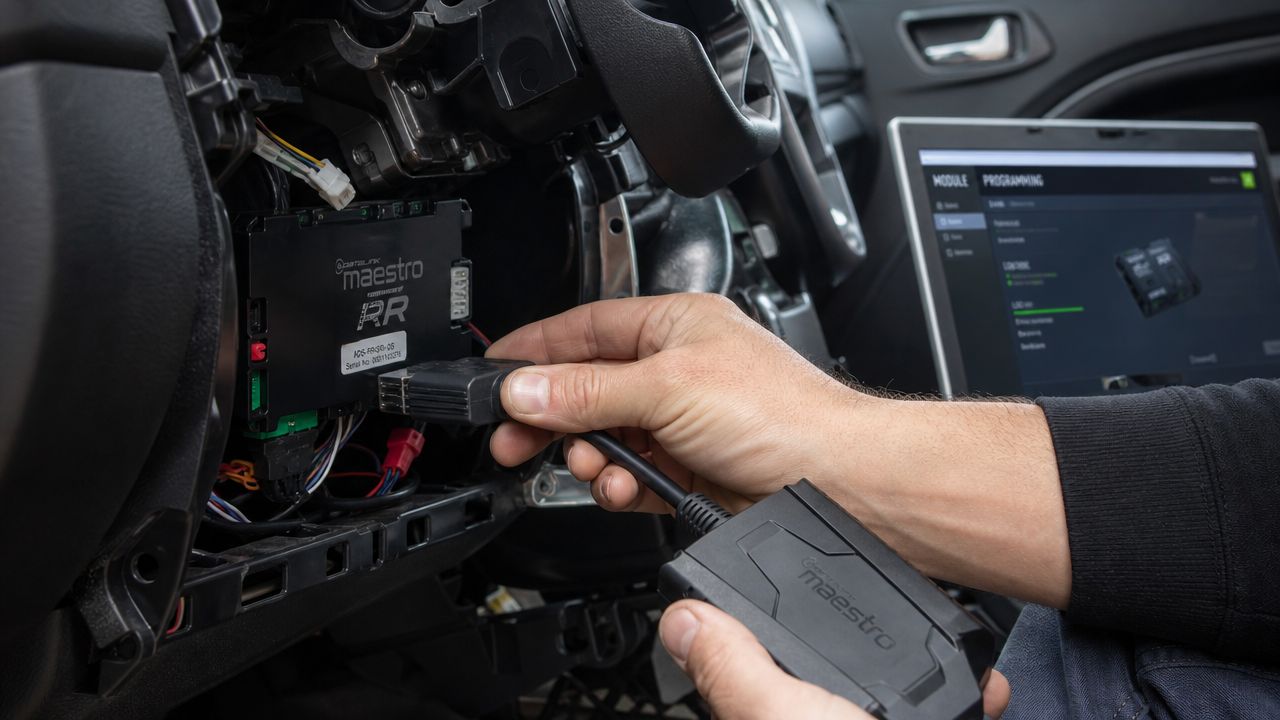
For many plug-and-play systems, the normal flow is to hold the module's programming button while plugging it in, wait for indicator LEDs to confirm pairing, and then run a key-fob lock-button learn or test cycle to teach the system the vehicle's commands (plug-and-play programming sequence).
What the module is doing
When you enter programming mode, the remote start brain is usually learning some combination of vehicle identity, immobilizer data, and command behaviour. On newer vehicles, that can involve the bypass side of the system as much as the starter side.
At this point, people get impatient and make mistakes. They cycle the key too quickly, miss an LED pattern, or assume one flash means the same thing on every brand. It doesn't. Follow the exact instructions for your kit, not a generic forum post for a different module.
If your vehicle starts to show electrical oddities during or after programming, stop and reassess. Issues like that often belong in a proper auto electrical repair service in Whitby, especially if the vehicle is newer and heavily networked.
Test before you button up the dash
Don't reinstall every panel and call it done after the first successful start. Test the system methodically while you still have access.
Run through the basics:
- Remote start command: Confirm the engine starts consistently from the remote or fob sequence.
- Remote stop command: Make sure shutdown works as intended.
- Climate response: Check whether the heat, blower, and defrost behaviour match your vehicle's normal retained settings.
- Door lock integration: Verify that lock and open commands still work correctly if your system interfaces with them.
- Driver takeover: Confirm the vehicle behaves properly when you enter with the authorised key or fob.
If the system starts the engine once but fails on the next attempt, don't call it a fluke. Intermittent behaviour usually means a connection, programming, or compatibility issue still exists.
Final checks that matter
Before the trim goes back on for good, confirm there are no warning lights, no unusual messages, and no harness movement under gentle hand pressure. Recheck that the module is secured and that no panel fastener is driving into the wiring path.
This is also the right time to label anything serviceable if the kit maker recommends it. The next technician working behind that dash will thank you.
Understanding Costs Safety Features and Legalities
Remote start pricing only looks simple from a distance. The kit itself is one part of the equation. Vehicle complexity, security architecture, and installation method decide where the final bill lands.
Consumer-oriented installer guidance notes that aftermarket remote-start systems typically cost about $200 to $330 installed, while vehicles with more complex electronics can reach as much as $700. The same guidance explains that modern systems include safety logic such as an automatic timeout after about 10 to 15 minutes and key-presence requirements before the vehicle can be driven (remote starter cost and safety details).
DIY cost versus actual cost
A lot of DIYers compare kit price to shop price and stop there. That's incomplete. The actual DIY cost includes tools you may not own yet, the time to verify compatibility, and the risk of needing replacement trim clips, extra connectors, or professional diagnosis if programming goes sideways.
This comparison keeps the decision honest.
| Aspect | DIY Installation | Professional (Carmedics Autowerks) |
|---|---|---|
| Up-front spend | Often lower if you already own tools | Higher labour cost built in |
| Vehicle-specific compatibility work | You handle research and fitment checks | Shop handles application matching |
| Wiring and integration risk | Falls on you | Handled by technician |
| Time investment | Can take a full weekend or more | Usually less owner time involved |
| Rework if something fails | You diagnose and reopen panels | Shop diagnoses installation issues |
| Best fit | Older or well-supported vehicles | Newer, complex, or warranty-sensitive vehicles |
If you want a more direct local pricing angle, Carmedics also has a page on the cost to install autostart.
The safety features people misunderstand
Modern remote starters are not meant to let a vehicle idle indefinitely or be driven away casually without authorisation. The built-in shutdown logic is a big reason the systems work safely in daily use.
Key safeguards usually include:
- Automatic timeout: If nobody enters and takes over properly, the engine shuts off after its timed cycle.
- Driver authorisation logic: The car requires the proper key or fob presence before normal driving can continue.
- Brake or gear-related shutdown behaviour: If the system doesn't detect the proper takeover sequence, it cuts the engine.
That's very different from the old myth that remote start leaves a car “running and stealable” in the driveway.
Legal use in Ontario
Used correctly, remote starters are a normal and practical upgrade for Ontario drivers. The legal and practical concern isn't the existence of the feature. It's whether the system is installed safely, behaves correctly, and doesn't bypass security in a sloppy way.
For newer vehicles, legal peace of mind often overlaps with warranty peace of mind. If you can't confirm the integration path confidently, that's a strong reason to hand the work to someone with the right tools and application data.
Troubleshooting and When to Call a Whitby Pro
Most failed installs aren't dramatic. The car doesn't explode. It just doesn't behave properly. Maybe it cranks and dies. Maybe the lights flash but the starter never engages. Maybe it works once, then refuses the next morning when you need it.
Those symptoms usually point to one of three areas: compatibility, connection quality, or programming. The frustrating part is that they can overlap.
Quick checks before you tear it all apart again
Start with the basics and verify them calmly.
- Ground integrity: A weak or poorly mounted ground causes all kinds of erratic behaviour.
- Connector seating: On T-harness systems, one connector not fully latched can stop the whole setup.
- Programming sequence: Re-read the exact procedure and compare it to what you did.
- Key and fob conditions: Low battery in the fob or an unrecognised takeover sequence can mimic bigger faults.
- Harness routing: A strained wire or pinched connector behind a panel can create intermittent problems.
Common symptoms and likely direction
| Symptom | Likely area to inspect first |
|---|---|
| Cranks but won't stay running | Immobilizer or bypass programming |
| Parking lights flash, no crank | Command programming, safety input, or connector issue |
| Starts once, then fails later | Loose connection or incomplete module learning |
| Factory functions act strangely | Incorrect integration or disturbed vehicle wiring |
Stop troubleshooting when each new guess requires more disassembly than evidence. At that point, guessing gets expensive.
When a professional makes more sense
If your vehicle is newer, under warranty, or loaded with electronics, there's a point where persistence stops being a virtue. Forcing an answer can create body control faults, battery drain issues, or a no-start condition that has nothing to do with the original kit anymore.
That's when it helps to find someone who works on these systems and on modern vehicle electronics generally, not just someone who “does accessories.” If you're at that stage, this guide on finding a car mechanic is a useful filter for choosing the right shop.
A good remote start should disappear into the vehicle. It should work quietly, predictably, and without drama. If your install is doing the opposite, handing it off is often the cheapest move left.
If you'd rather skip the trial-and-error and have the job handled properly, Carmedics Autowerks Inc in Whitby offers remote starter installation along with the electrical troubleshooting that often comes with newer vehicles. That's a practical option when compatibility, immobilizer integration, or programming has pushed the project past comfortable DIY territory.