
A professionally installed TAG system in Canada usually costs about $400 to $650 plus tax and commonly includes 5 years of protection. That matters because many other GPS-based systems look cheaper up front, then keep charging monthly service fees year after year.
If you're in Whitby or anywhere across the GTA, you've probably had the same conversation a lot of local drivers are having right now. Someone on your street had an SUV taken. A neighbour got hit with a high-theft insurance warning. Your insurer mentioned an approved anti-theft device, and now you're trying to figure out whether TAG tracking cost is reasonable or just another expensive add-on.
The short answer is that TAG usually makes the most sense when you stop treating it like a gadget purchase and start treating it like risk control. In high-theft areas, the sticker price is only one part of the decision. The pertinent question is what that one-time cost does for your insurance file, your recovery odds, and your long-term ownership costs.
The Real Tag Tracking Cost for Whitby Drivers
Whitby drivers usually aren't shopping for TAG out of curiosity. They're looking at it after hearing about another theft in Durham, after buying a vehicle that insurers flag as higher risk, or after seeing an insurance requirement tied to theft prevention.
The cost itself is fairly straightforward. In Canada, TAG is typically sold as a one-time installed recovery system priced around CAD $400 to $650 plus tax, and that package usually includes 5 years of tracking protection with no recurring subscription fee, which puts the effective annual cost at roughly CAD $80 to $130 before rebates according to MyChoice's TAG car tracking overview.
Why the sticker price doesn't tell the whole story
A lot of owners compare TAG to a consumer tracker the wrong way. They see a one-time installed system and compare it to a cheaper device they found online. That's not an apples-to-apples comparison.
TAG is generally bought for theft recovery and insurer acceptance. A consumer tracker is often bought for convenience features like map visibility, trip logs, or informal self-monitoring. Those are different jobs, and they create different cost structures.
Practical rule: If your main concern is insurer compliance and vehicle recovery, the cheapest hardware option usually isn't the cheapest ownership option.
That's why tag tracking cost needs to be looked at over the full protection period, not just at the counter on installation day.
What Whitby owners should ask before saying yes
Before approving any anti-theft quote, check these points:
- What's included: Confirm whether the quoted price includes installation, activation, and the full protection term.
- How long the coverage runs: A one-time fee tied to multi-year service can look expensive only until you compare it against monthly billing.
- What your insurer accepts: Some systems help with recovery but don't satisfy insurer requirements the way approved installed systems do.
- What other security layers you already have: If you've already upgraded visibility and evidence collection with something like a local dash cam installation, you still need to decide whether you want evidence, recovery capability, or both.
For most high-theft vehicle owners in Whitby, TAG isn't just an expense line. It's a calculated purchase intended to reduce exposure to a much bigger loss.
Understanding Different Tag Tracking Technologies
Most drivers hear the word "tracking" and assume all systems work the same way. They don't. The cost differences make a lot more sense once you separate recovery technology from convenience technology.
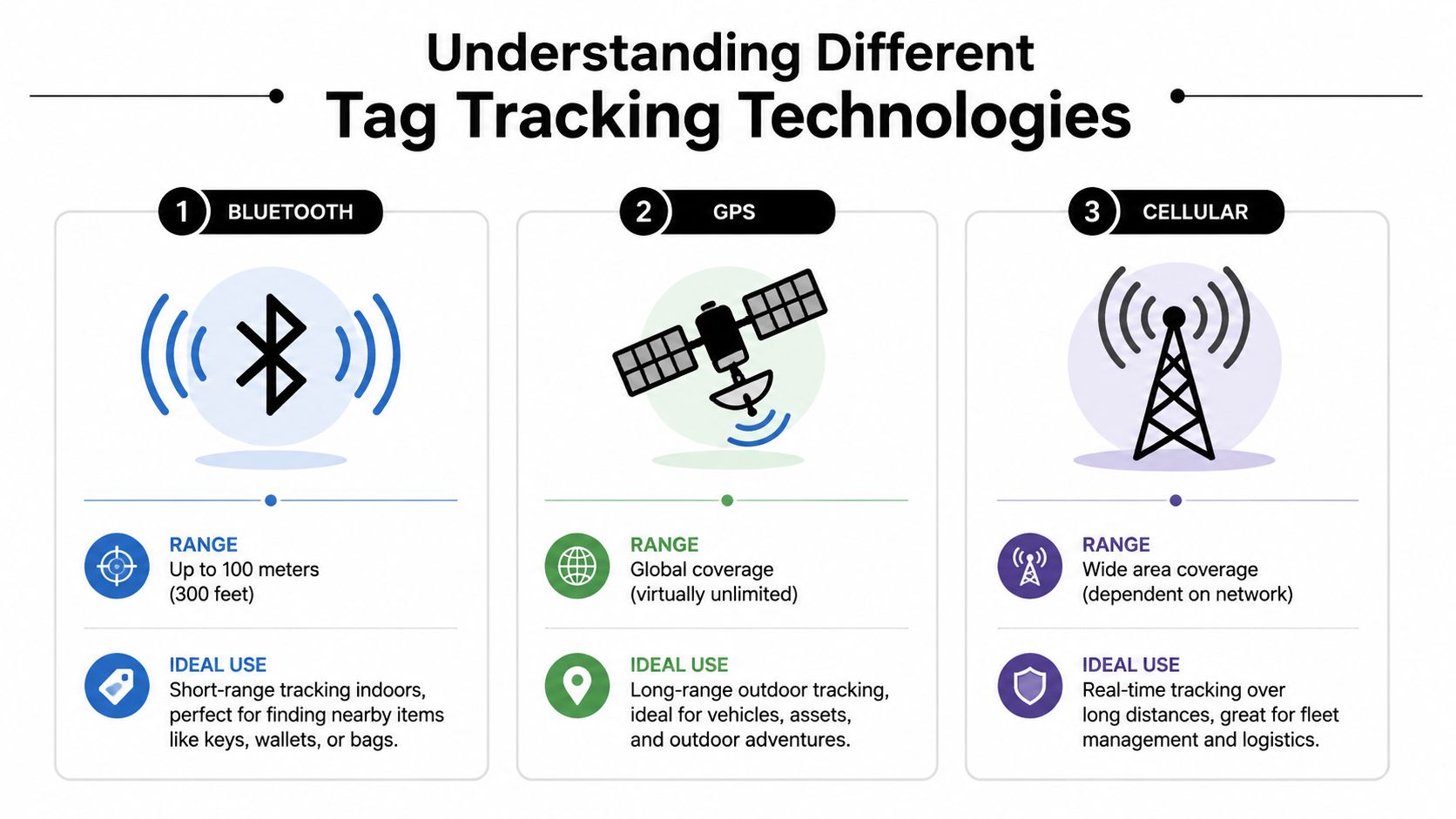
TAG versus GPS
Think of TAG as a hidden recovery beacon. It isn't mainly there to give you a consumer app full of vehicle analytics. Its job is to help recover a stolen vehicle through a professionally installed anti-theft setup.
Think of GPS tracking as a live map. It often suits fleet operators, parents monitoring a shared vehicle, or businesses that want trip history, route visibility, and location updates. That's useful, but it usually comes with ongoing service billing.
For a Whitby owner with a newer SUV, the practical question is simple. Do you want a system built around theft recovery, or do you want one built around day-to-day visibility?
NFC and LPR in plain language
Other technologies get mentioned in the same conversation, but they serve different roles.
- NFC: Near Field Communication works like a close-range verification tap. It's good for identification and access control, not long-range stolen vehicle recovery.
- LPR: Licence Plate Recognition acts more like a camera-based spotting system. It can help identify vehicles when they pass a reading point, but it isn't the same as having a dedicated installed recovery device in your own vehicle.
Why this matters for cost
People often overpay because they buy features they won't use. A daily-driven personal SUV in the GTA doesn't always need fleet telematics. On the other hand, a business vehicle that needs route records and dispatch visibility may not get enough value from a theft-focused solution alone.
That difference is where many quotes start to diverge.
| Technology | Best fit | Typical owner goal | Main trade-off |
|---|---|---|---|
| TAG | Personal vehicles in high-theft areas | Recovery and insurer-aligned protection | Less focused on live consumer mapping |
| GPS | Fleets or drivers wanting live visibility | Tracking, trip logs, route oversight | Often tied to recurring service costs |
| NFC | Access and identity use cases | Authorisation or proximity actions | Not designed for stolen vehicle recovery |
| LPR | Site, lot, or network-based observation | Spotting plate movement | Depends on camera coverage, not hidden in-vehicle protection |
A lot of owners don't need "more technology." They need the right technology for the loss they're trying to prevent.
If you're comparing options locally, it helps to start with the use case first, then narrow the hardware. That's the same logic behind choosing the right anti-theft device for car protection rather than buying whatever sounds the most advanced.
A Detailed Breakdown of Tag Tracking Costs
The easiest way to understand tag tracking cost is to split it into four buckets. Hardware. Installation. Service model. Maintenance.
That approach keeps you from getting distracted by a low advertised price that grows later.
Hardware and the device itself
With TAG, the hardware isn't usually sold as a loose consumer gadget. It's part of an installed anti-theft system. That means you're paying for a purpose-built setup rather than just a box with a battery.
Often, people misread value. A lower-cost retail tracker can seem cheaper because the advertised price shows only the device. It may not include professional concealment, theft-focused setup, or any insurer-recognised installation paperwork.
Installation labour matters more than people think
Installation changes the actual value of a tracking system. A badly placed or obvious unit can undermine the whole reason you bought it.
Canadian sources place TAG as a premium anti-theft system with a one-time cost of about $400 to $650+ depending on the retailer and installer, and that up-front amount can be partly offset because some carriers offer $100 off installation or remove a $500 high-theft surcharge according to Tanner Insurance's explanation of TAG vehicle tracking.
Professional labour does two things a cheap install often doesn't. It hides the system properly, and it produces the documentation you may need when you're dealing with your insurer.
The subscription question
This is where TAG and standard GPS systems really separate.
With TAG, the common Canadian model is a one-time installed package tied to a multi-year protection term. With many consumer GPS products, the hardware price is only the first payment. The owner then pays monthly for data connectivity and app access.
A useful way to think about it is this:
- TAG model: Higher entry cost, fewer billing touchpoints afterward
- Consumer GPS model: Lower entry cost, but recurring charges become part of ownership
- Fleet telematics model: Ongoing monthly cost can be justified if the business actively uses route, driver, and utilisation data
If you're trying to compare these structures outside the automotive world, the same principle shows up in other connected hardware. For example, anyone trying to find reliable trail camera cell service runs into the same issue. The device price is only part of the bill. Connectivity often decides the true long-term cost.
Maintenance and what people forget to ask
Some systems need more attention than buyers expect. App updates, battery charging, SIM management, account renewals, and troubleshooting all create friction over time.
TAG's appeal for many private owners is that it tends to be a cleaner ownership model. You install it, keep your paperwork, and treat it as a theft-recovery layer rather than another app-heavy device that demands constant attention.
Cheap hardware becomes expensive fast when the owner has to manage subscriptions, charging, and service interruptions just to keep it useful.
A good quote should answer all four cost categories clearly. If it doesn't, the number on the estimate probably isn't the actual number you'll live with.
Key Factors That Influence the Final Price
Two Whitby drivers can ask for "tracking" and receive very different quotes. That's normal. The final number depends less on the label and more on what the vehicle owner actually needs the system to do.
Scale changes the economics
A single personal vehicle gets priced differently from a multi-vehicle business setup. One install is straightforward. Several vehicles introduce scheduling, consistency, and system standardisation.
For a family with one new SUV, the goal is often simple theft protection. For a fleet manager, the quote may reflect a broader operating requirement across multiple units. That's why scale can either simplify cost or complicate it.
Accuracy depends on purpose
Not every owner needs the same level of location visibility or recovery capability. Some people want theft-focused protection. Others want constant movement history and driver oversight.
If your use case is insurer acceptance and recovery support, paying for extra telematics features may not improve your result. If your use case is business control, a basic recovery system may leave gaps.
A lot of buyers make better decisions when they use the same reasoning they would apply to OEM versus aftermarket parts. The right choice depends on fit, purpose, and long-term value, not just on the first number on the invoice.
Connectivity affects ongoing ownership
Connectivity is where many "affordable" systems become expensive. Some devices rely on constant network communication, app platforms, and service plans. Others are structured more like a dedicated installed recovery solution.
That difference changes your budget in practical ways:
- Low-connectivity ownership: Fewer recurring admin tasks, fewer billing events
- High-connectivity ownership: More features, but more chances for renewals, interruptions, and support issues
- Business use case: Ongoing connectivity may be worth paying for when the system is part of operations, not just theft protection
Integrations can raise or lower value
A tracking system on its own might be enough for one owner and incomplete for another. Integrations matter when you're trying to make the whole protection package work together.
For example:
- Insurance documentation: Some owners need installation records and proof for underwriting purposes.
- Vehicle security layering: Others want tracking paired with immobilisation, alarms, or camera evidence.
- Fleet workflow: A business may need platform compatibility with dispatch or asset monitoring tools.
The quote goes up when the system has to do more than one job. That's not automatically bad. It only becomes wasteful when the owner pays for integrations they won't use.
Calculating Your ROI and Unlocking Savings
The strongest argument for TAG in a place like Whitby isn't that it costs less on day one. It's that the cost can be easier to justify once you measure what it may help you avoid.
For high-theft vehicles, insurance treatment often has more impact on ROI than the hardware itself. Canadian insurers have recognised TAG's 99.82% theft-deterrence performance, and some will remove a $500 surcharge for high-theft vehicles once the system is installed. Others may offer a 30% discount on eligible private-passenger vehicles with approved anti-theft devices, according to Regal Insurance's overview of TAG tracking systems.
What ROI looks like in the real world
A lot of owners try to calculate ROI as if they're evaluating a stereo or wheel package. That's the wrong frame. This is closer to paying for controlled risk.
Here are the savings channels that matter most:
- Surcharge removal: If your vehicle attracts a high-theft surcharge, getting that charge removed can change the decision quickly.
- Premium reduction: If your policy qualifies for an anti-theft discount, the net ownership cost of the system can look much smaller over time.
- Loss mitigation: Recovering a stolen vehicle or reducing the chance of a total-loss insurance event can protect far more value than the install price itself.
You're not buying TAG to "make money." You're buying it to reduce the financial damage attached to theft risk.
A simple way to judge whether TAG makes sense
Use this practical checklist before you decide:
- Ask your insurer whether your model is treated as high theft. Don't guess.
- Ask whether an approved installed anti-theft system changes your premium, surcharge, or underwriting conditions.
- Compare net cost, not listed cost. The right comparison is your out-of-pocket cost after any insurer benefit.
- Consider your vehicle's replacement pain. Even when insurance pays, a theft claim creates downtime, hassle, and market uncertainty.
- Look at your parking reality. Street parking, commuter lots, and overnight exposure change the value equation.
How to maximise the return
The owners who get the best financial result usually do a few things right.
- Confirm insurer approval before installation: Don't install first and ask later.
- Keep all paperwork: Installation receipts and certificates matter when you're documenting eligibility.
- Match the device to the vehicle's theft profile: A high-risk SUV justifies a different decision than an older commuter car.
- Layer your protection: Many drivers also review insurance-facing anti-theft options for cars so the tracking system fits into a broader insurance strategy.
For many GTA drivers, the ROI isn't theoretical. It's visible in underwriting treatment, in avoided surcharges, and in a stronger protection position if the vehicle is targeted.
Your Next Steps with Carmedics Autowerks
The true lesson with tag tracking cost is that the cheapest-looking option often isn't the lowest-cost ownership choice. What matters is whether the system fits your theft risk, your insurer's rules, and how long you plan to keep the vehicle.
If you're driving in Whitby, Oshawa, Ajax, Pickering, or across the GTA, local context matters. A quote only becomes useful when it's tied to your actual vehicle, where it's parked, how your insurer classifies it, and whether you're solving for theft recovery, premium pressure, or both.
What to bring into the conversation
Before you book anything, have these details ready:
- Your vehicle information: Year, make, model, and trim
- Your insurer's requirements: Whether they requested an approved anti-theft system
- Your parking pattern: Garage, driveway, condo lot, or street
- Your ownership plan: Short-term lease, long-term ownership, or business use
Those four details shape whether TAG is a clean fit or whether another security setup makes more sense.
When a local installation discussion helps
A local shop can usually give better guidance than a generic online comparison because they see the same theft patterns and insurer questions every week. In Whitby, that matters. An owner with a newer SUV and surcharge pressure has a very different cost equation from someone with an older daily commuter.
One practical option for local drivers is Carmedics Autowerks in Whitby, which handles anti-theft related vehicle work alongside general protection services and can provide installation documentation used for insurance conversations. The key isn't choosing a flashy product page. It's getting a quote that reflects your vehicle, your insurer, and the level of protection you are trying to buy.
The right anti-theft decision usually feels expensive only until you compare it against the cost of one theft claim, one surcharge, or one unrecovered vehicle.
If you're evaluating tag tracking cost seriously, don't stop at the installed price. Ask what it replaces, what it prevents, and what it changes on your insurance side. That's where the value shows up.
If you'd like a vehicle-specific recommendation, contact Carmedics Autowerks Inc to discuss your car, your insurance requirements, and whether TAG or another anti-theft setup makes the most financial sense for how you drive and park in Whitby.