


You hear it first pulling out of a plaza in Whitby. A dull clunk from the front end. Then the steering feels a bit vague over a rough patch of road. Maybe the wheel shivers at highway speed, or the car wanders more than it used to. Most drivers don't start by thinking “ball joint.” They start by wondering if they can safely keep driving until next week.
That's where people get trapped. A worn ball joint can begin as an annoying noise, but it sits in the middle of your steering and suspension movement. If it's loose, the whole front corner of the vehicle can feel off. If it fails completely, the repair stops being about cost and starts being about control.
A lot of owners also get burned on the money side. They get quoted for extra work they may not need, or they try to save a few dollars with bargain-bin parts that don't belong on a safety-critical component. Ball joint replacement is one of those jobs where smart decisions matter just as much as the repair itself.
That Clunking Sound Your Car Is Making
The usual story goes like this. You back out of the driveway, turn the wheel, and hear a knock from one front corner. Later, going over a speed bump, there's another clunk. On the highway, the steering doesn't feel planted. The car still drives, so it's easy to tell yourself it can wait.
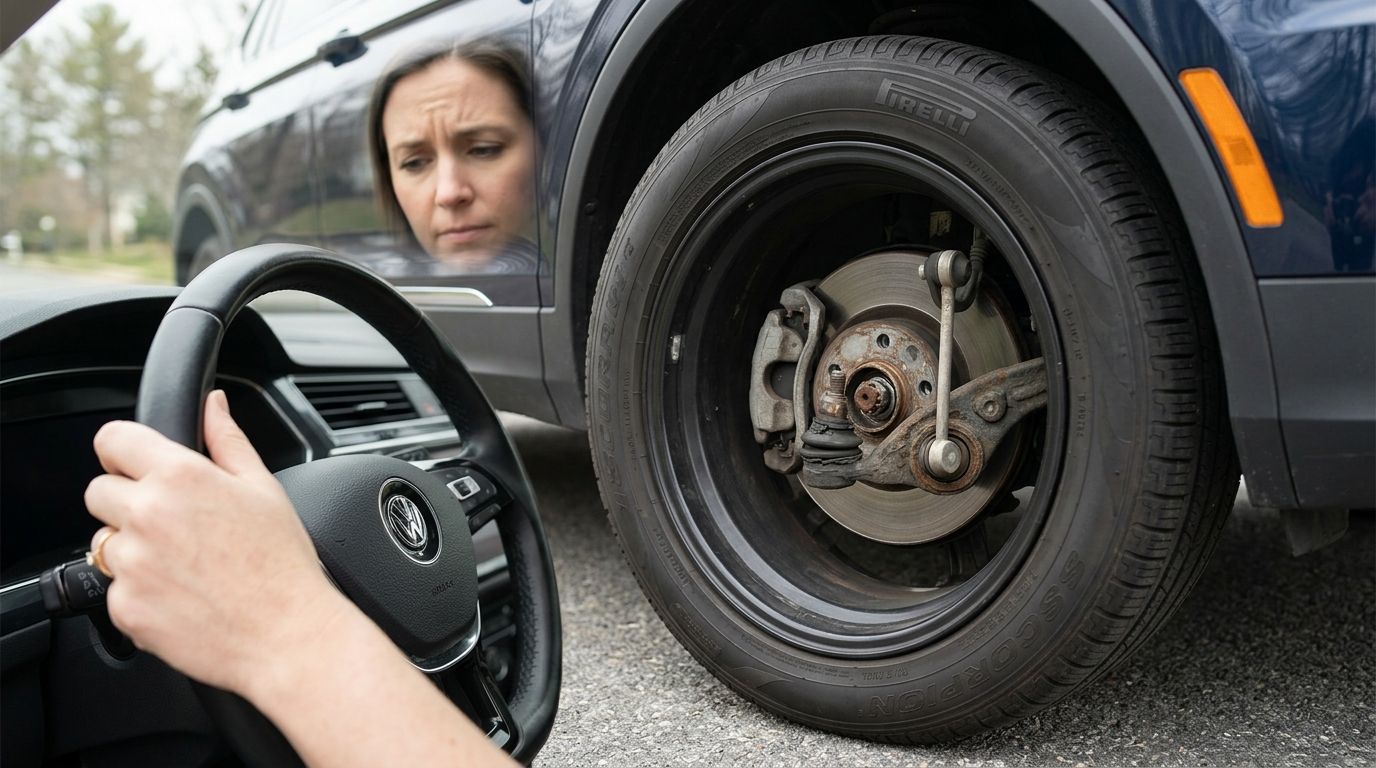
That pattern shows up all the time with front suspension issues, and a failing ball joint is high on the list. It often starts small. The sound might only happen when parking, turning into a driveway, or crossing broken pavement. Then it gets more frequent, and the handling starts to change with it.
What the car is telling you
A ball joint is one of those parts that doesn't ask for attention until wear becomes noticeable. By the time you can hear or feel it, the joint may already have play in it. That play lets the wheel move in ways it shouldn't.
Common complaints include:
- Clunks over bumps: Often heard from the lower front area of the vehicle.
- Popping while turning: More noticeable at slow speed in parking lots.
- Loose steering feel: The front end may seem less direct or less settled.
- Vibration through the wheel: Especially when road surfaces are uneven.
If those symptoms sound familiar, it's worth having the suspension checked properly instead of guessing. A good suspension repair inspection should confirm whether the issue is the ball joint itself, a control arm bushing, a tie rod, a sway bar link, or a mix of worn parts.
Practical rule: Front-end noises rarely fix themselves. If the steering feel changes with the sound, stop treating it like a minor irritation.
Your Car's Shoulder Joint Explained
The easiest way to understand a ball joint is to think of your shoulder. Your shoulder is a ball-and-socket joint. It supports movement in different directions while still carrying load. A car's ball joint works on the same principle.
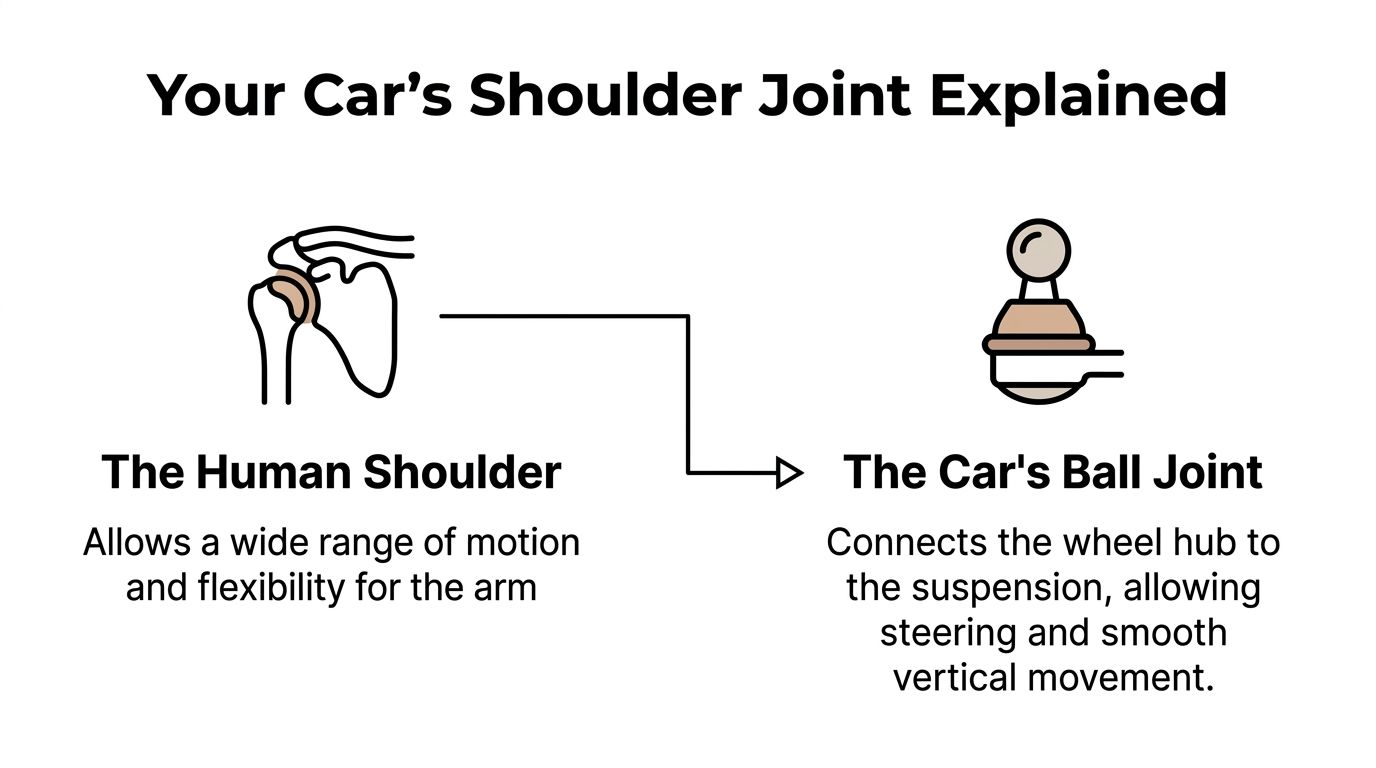
In your suspension, the ball joint connects the control arm to the steering knuckle. That connection has to do two jobs at once. It has to let the wheel move up and down with the suspension, and it has to let the wheel pivot when you turn the steering wheel.
Why that movement matters
If the joint were rigid, the suspension couldn't travel properly. If it were loose, the wheel wouldn't track properly. The part lives in a hard spot between flexibility and control.
That's why wear matters so much. Once the internal surfaces wear down, or the protective boot is damaged and contamination gets in, the joint can develop play. Then every bump, every turn, and every brake application puts extra stress on a part that's already losing precision.
Why they fail on Ontario roads
Ball joints usually wear out from a combination of age, mileage, impact, and contamination. They spend their lives taking hits from rough pavement, frost heaves, potholes, curb strikes, and water intrusion.
Typical failure paths look like this:
- Boot damage: The rubber boot tears or dries out. Grease escapes and dirt gets in.
- Road shock: Potholes and curb impacts load the joint harder than normal.
- Corrosion: Moisture and road salt create rust inside or around the assembly.
- Normal wear: The joint reaches the point where clearances open up.
Some vehicles have serviceable ball joints that can be replaced on their own. Others have them built into the control arm. That design difference matters a lot regarding cost, labour, and whether an alignment may be needed afterward.
A ball joint isn't just another hinge. It's a loaded pivot point that affects how the wheel turns, how the suspension moves, and how confidently the vehicle tracks down the road.
Why diagnosis matters before ordering parts
Proper inspection saves money. Owners sometimes hear one front-end clunk and jump straight to ordering parts online. But a sway bar link, outer tie rod, strut mount, or worn bushing can create a similar sound. Replacing the wrong component wastes time and leaves the actual problem untouched.
A proper inspection usually involves lifting the vehicle, checking for play under load, watching the joint move, and comparing what the wheel does against what the suspension should be doing. That's how you separate “noisy front end” from “ball joint replacement required.”
Warning Signs You Should Never Ignore
Some suspension problems stay inconvenient for a long time. A bad ball joint isn't one of the issues I'd gamble on. Once it starts showing clear symptoms, you need to take them seriously.
The signs drivers notice first
The sound is usually the first clue. Not always. But often.
You may hear a clunk when one front wheel drops into a pothole or climbs a curb edge. You may get a pop while turning into a parking spot. Sometimes the symptom isn't sound at all. The steering can start to feel lazy, the front end can wander, or the tyre can wear in an odd pattern because the wheel isn't staying where it should.
Look out for:
- Noise over uneven pavement: A repeated knock from the same corner.
- Steering that feels off-centre or vague: The wheel may not return cleanly after a turn.
- Front-end vibration: It can show up as a shake you feel through the steering wheel.
- Tyre wear that doesn't make sense: Especially if one side of the tread looks different from the other.
What catastrophic failure means
The reason mechanics get blunt about ball joints is simple. If the joint separates, the suspension corner can collapse. At that point the wheel is no longer being held in the intended position, and you can lose steering control immediately.
That's not a “keep an eye on it” issue. It's a tow-it issue.
There's another financial trap here. Once people hear “ball joint,” some start hunting for the cheapest possible part, including used pieces pulled from another vehicle. That's a mistake. Ball joints should never be purchased used, as they can degrade rapidly and cause catastrophic suspension failure. The same source also notes an analogy from medical implants, where metal-on-metal joints were found to be 1.6 times more likely to require early revision than other materials in that context, used to highlight why worn metal joint surfaces are a bad place to cut corners for critical components (discussion of used ball joints and failure risk).
Cheap parts can cost more than the repair
Used parts are the obvious red flag, but ultra-cheap new parts can create trouble too. Poor fit, poor sealing, and weak boots turn a low invoice into a repeat job. If the joint wears early or doesn't seat properly, you're paying labour again and risking tyre wear or worse in the meantime.
If you're already sorting out handling issues, it also helps to understand whether the car needs follow-up steering correction or not. A wheel alignment and balancing check can be part of the broader conversation, but it should only be sold when the repair affects geometry.
If a part can separate and drop a suspension corner, it isn't the place for scrapyard shopping or mystery-brand bargains.
Understanding Your Ball Joint Replacement Cost
This is the part most drivers want answered straight away. What should ball joint replacement cost in Ontario?
The short answer is this. A reasonable cost for ball joint replacement in Ontario should fall between $180–$650 per side, depending on the vehicle and whether the repair involves only the ball joint or the full control arm assembly. The same source notes that labour for ball joint replacement is often lower than labour for full control arm replacement, and some shops inflate the bill by bundling an alignment that isn't always required. In cases where unnecessary alignment fees are added, the final bill can be inflated by up to 60% (Ontario ball joint replacement cost guidance).
Where the money goes
The price changes because not every suspension layout is the same.
Some vehicles let you replace the ball joint on its own. That usually keeps parts cost lower, but the labour can still be involved because the old joint may need to be pressed out and the new one pressed in correctly. Other vehicles use a control arm with the ball joint built in. In that case, the part costs more, but the install can be more straightforward.
Here's a practical breakdown.
| Service Component | Estimated Cost (CAD) |
|---|---|
| Ball joint replacement per side | $180–$650 |
| Labour for ball joint replacement | $150–$300 |
| Labour for full control arm replacement | $200–$400 |
The alignment upsell that catches people
This is the trap I see most often. A driver is told that any ball joint replacement automatically requires an alignment. That's not always true.
If the repair changes control arm geometry, then yes, alignment may be appropriate. But for a standard ball joint-only replacement, alignment is not automatically required according to the Ontario cost guidance above. That distinction matters because plenty of owners pay for an extra service they didn't need.
Ask direct questions when you get a quote:
- Is the ball joint separate or integrated into the control arm?
- What exactly changes during the repair?
- Why is an alignment being recommended in this case?
- Are you quoting one side or both sides?
How to read a quote without getting burned
A good estimate should tell you whether the shop is replacing the joint alone or the arm assembly. It should make the labour line understandable. And if alignment appears on the invoice, the shop should be able to explain what suspension geometry changed and why that service is justified.
Parts quality matters too. A no-name component can make a cheap quote look attractive until the boot splits early or the fit is poor. That's where the broader OEM vs aftermarket parts comparison becomes useful. The right answer depends on the vehicle and the brand quality, but a safety-critical suspension part is not where you want to choose blindly.
Money-saving check: Don't compare quotes by total alone. Compare what part is being installed, whether the control arm is included, and whether the alignment charge is justified.
Should You Replace a Ball Joint Yourself
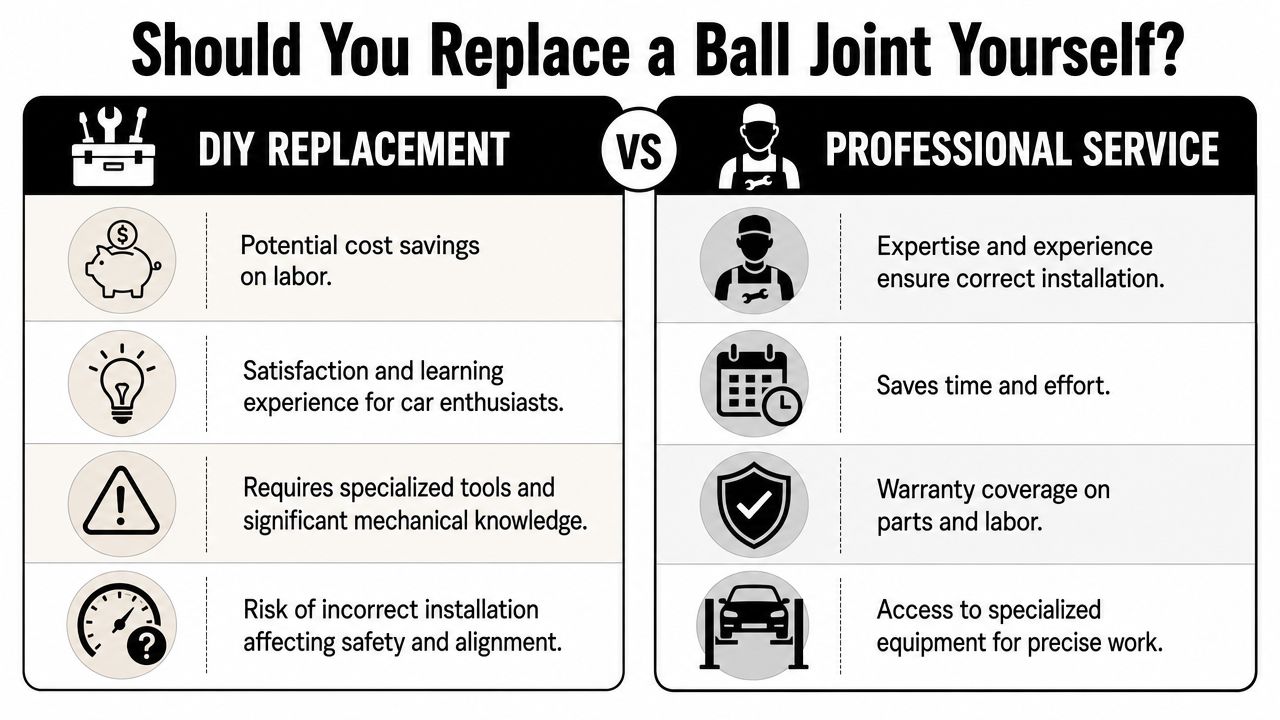
A lot of hands-on owners are tempted to do this job themselves, and I understand why. On paper, ball joint replacement looks like a way to save labour. In reality, it sits right on the line between capable DIY project and job that can go sideways fast.
What DIY gets right
If you've got solid mechanical experience, a safe place to work, and the proper tools, replacing some ball joints at home is possible. For enthusiasts, there's satisfaction in doing the work yourself and knowing exactly what went into the car.
DIY also gives you control over:
- Part selection: You choose the brand instead of accepting whatever is stocked.
- Inspection time: You can clean and inspect surrounding parts carefully.
- Pace: You're not rushed by shop scheduling.
Where DIY gets expensive
The hidden issue is tooling and risk. Many jobs need a ball joint press, separator tools, torque wrenches, proper stands, and enough experience to know when corrosion or seized hardware has turned a simple repair into a fight. A rusted pinch bolt or a tapered stud that won't release can change your whole afternoon.
Then there's the installation itself. If the joint doesn't seat correctly, if hardware isn't torqued properly, or if a boot gets damaged during the job, the problem doesn't stay theoretical. It becomes a steering and suspension safety issue.
Here's the side-by-side view that matters most:
| Option | Upside | Risk |
|---|---|---|
| DIY | Labour savings, personal control over parts | Tool cost, installation error, seized components |
| Professional service | Correct equipment, faster diagnosis, repair accountability | Higher invoice up front |
The calls that separate pros from hobby work
An experienced technician doesn't just swap the part. They check whether the play is in the ball joint. They inspect the control arm, tie rod, wheel bearing, and bushings around it. They know when a separate joint is worth replacing and when the full arm is the smarter call.
That wider diagnosis matters because front-end symptoms overlap. A car owner may think the rack is failing when the looseness is lower in the suspension, or blame the ball joint when the steering issue starts elsewhere. That's why related systems, including the steering rack and connected steering components, need to be considered during inspection instead of treating every clunk like a one-part problem.
Some jobs are about skill. This one is also about consequences. If brake pads are noisy after a DIY install, you hear it. If a ball joint is installed incorrectly, the outcome can be much worse.
A realistic rule for deciding
DIY makes sense if you already do suspension work comfortably, have the correct tools, and understand the torque and fitment details for your vehicle. If any of those pieces are missing, the labour savings can disappear fast.
If you're unsure, the smartest financial move is often paying once for a proper repair instead of paying twice after a part, tool, or installation mistake.
Booking Your Ball Joint Service in Whitby
When you're ready to deal with a suspected ball joint, the best repair experience is a straightforward one. No mystery quote. No padded invoice. No vague advice.

What a proper service visit should look like
First comes inspection. The vehicle goes up, the front suspension is checked for actual play, and the source of the noise or looseness is confirmed. That matters because replacing a ball joint that isn't bad won't solve anything.
Then the estimate should be clear. You should be told whether the vehicle uses a separate ball joint or a control arm assembly. You should know whether one side or both sides are being discussed. And if alignment is recommended, there should be a specific reason tied to what changed during the repair.
A good process usually includes:
- Mechanical confirmation of the fault so the right part gets replaced.
- Transparent quoting that separates parts, labour, and any related work.
- Quality replacement parts chosen for fit, durability, and safe operation.
- Post-repair checks and road test so the steering feel and front-end behaviour are verified before the car goes back out.
What savvy owners should ask before approving work
You don't need to be a technician to ask smart questions. In fact, the right questions usually tell you a lot about the shop.
Try these:
- What did you find during inspection?
- Is the ball joint available separately on this vehicle?
- Does this repair require an alignment? Why?
- What brand or quality level of part are you installing?
- Did you find any related wear in the surrounding suspension?
If the answers are specific, that's a good sign. If the explanation stays fuzzy, keep asking.
Local convenience matters too
A suspension issue isn't something one wants to drag out for weeks. If your car is clunking, wandering, or feeling unstable, local access matters. Being able to book with a Whitby auto repair shop that can inspect the front end properly and explain the quote clearly saves time and helps you avoid rushed decisions.
The best outcome is simple. Fix the right part, use the right component, and pay for the work you need. No more. No less.
If your vehicle is making front-end noise or the steering feels off, book an inspection with Carmedics Autowerks Inc. Their team in Whitby can check the suspension properly, explain whether you need a ball joint replacement or a different repair, and give you a clear quote without padding the job with unnecessary extras.