


You know the moment. The car has been baking in a parking lot, the seats are hot, the steering wheel feels like a stovetop, and the first thing you do is hit the AC button and turn the fan up. Then the vents blow air that feels barely cooler than outside.
For Whitby drivers, that failure usually shows up on the exact day you need cold air most. It’s not just uncomfortable. It makes the drive tiring, fogs up your patience in traffic, and takes the fun out of a vehicle that should feel sharp and sorted.
A lot of local content around cooling talks about houses, furnaces, and ductwork. That misses what car owners deal with in summer. Vehicle AC systems work under vibration, road grime, engine heat, and stop-and-go driving. They need a different diagnostic mindset. If you’ve been searching for air conditioning repair whitby ontario, the useful answer starts with how your car’s system fails in real local conditions, not how a home unit does.
That First Hot Day Your Car AC Gives Up
The first humid day in Whitby exposes weak AC systems fast. A car that seemed “fine enough” in spring suddenly can’t pull heat out of the cabin. You get lukewarm air at idle, maybe cooler air once you start moving, then a blast of disappointment at the next red light.

Why it happens here
Whitby summers put real stress on cooling systems. In Whitby, Ontario, air conditioning professionals earn an average base salary of $40.00 per hour, and that demand is tied to a climate where humidity often exceeds 70% and temperatures pass 30°C, conditions linked to common AC issues such as refrigerant leaks and compressor failures (CareerBeacon).
That local climate matters inside a vehicle even more than in a building. Your AC isn’t only cooling air. It’s also removing moisture so the cabin feels dry and clear instead of sticky and heavy. When refrigerant charge is off, condenser airflow is weak, or the compressor isn’t doing its job, the system loses that fight quickly.
What drivers usually notice first
Some cars don’t fail all at once. They slide.
- At idle it gets warm: Often a clue that condenser cooling or compressor performance is dropping.
- It cools on the highway only: More airflow over the condenser can mask a deeper problem.
- The cabin stays damp: The system may still blow air, but it isn’t dehumidifying properly.
- It takes forever to get comfortable: A weak system can’t catch up once the interior heat load climbs.
A helpful outside perspective on a car's AC giving up explains the kind of warning signs drivers often brush off until the first hot spell makes them impossible to ignore.
Practical rule: If your AC only works “well enough” in mild weather, it usually won’t survive a humid Whitby heatwave without proper diagnosis.
A working AC system isn’t a luxury in summer traffic. It affects comfort, focus, visibility, and how much you enjoy driving the car at all.
Symptoms Your Car AC Needs Professional Service
A complete loss of cold air is obvious. The harder cases are the ones that start small and tempt you to wait. That’s how minor faults turn into bigger repairs.
Smells, noises, and weak airflow
A musty smell from the vents usually points to moisture-related buildup around the evaporator or in the ventilation path. If the smell is sweet or chemical, the system needs closer inspection right away.
A rattle, chirp, or grinding sound when the AC is switched on isn’t normal. The compressor clutch, pulley, bearings, or internal compressor parts may be struggling. Sometimes the noise comes and goes with engine speed, which makes drivers assume it’s harmless. It isn’t.
Weak airflow can fool you into thinking the refrigerant is low when the actual problem is on the air side.
- Cabin air filter restriction: The system may be cold, but you can’t feel it properly.
- Blower motor weakness: Fan speed may sound normal at lower settings but fade under load.
- Evaporator blockage: Dust and debris can choke airflow across the cooling core.
For a closer look at what a proper inspection covers, this page on car air conditioning repair lays out the service area in practical terms.
Cabin water and temperature swings
Water on the passenger-side floor often points to a blocked evaporator drain. The AC naturally creates condensation. It should drain outside the vehicle, not into the cabin.
Temperature fluctuation is another big clue. If the vents go cold, then mild, then cold again, the system may be cycling abnormally because of pressure issues, a sensor fault, icing, or a failing component.
Don’t judge the system by the first minute after start-up. Judge it after the car idles, drives, stops, and restarts. Weak systems often reveal themselves in transitions.
Professional service makes sense when you notice any of these patterns:
- Cold air fades in traffic
- Airflow changes without touching the controls
- The windshield takes longer to clear in damp weather
- The AC works one day and not the next
Those are symptoms, not diagnoses. The right repair starts by separating an airflow problem from a refrigerant, compressor, or electrical fault.
Understanding the Common Causes of AC Failure
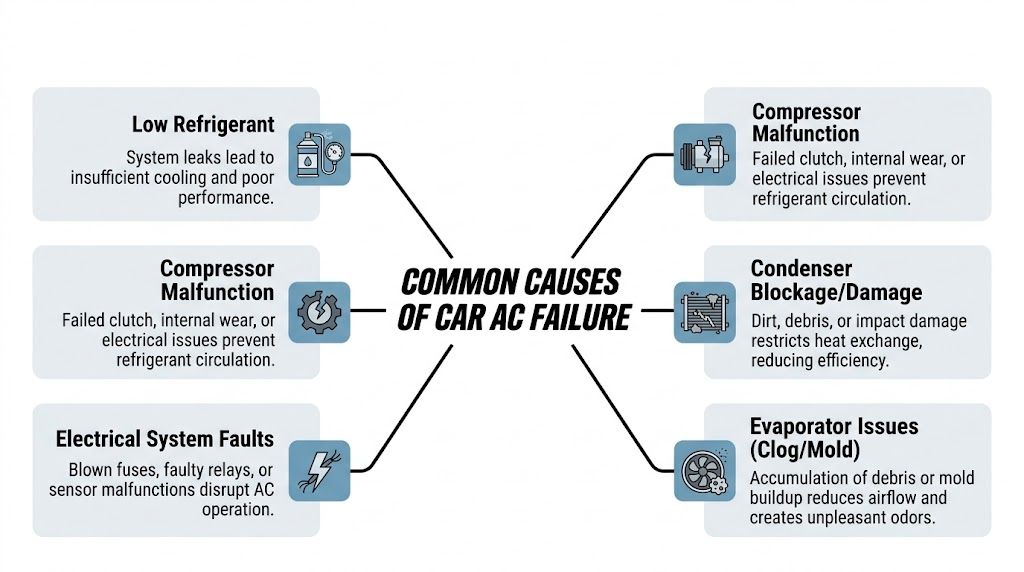
A car AC system is easiest to understand by comparing it to a circulatory system. The compressor is the heart. Refrigerant is the blood. The condenser and evaporator act like lungs, moving heat out of the cabin and releasing it elsewhere. If any part of that loop leaks, clogs, or stops pumping, the whole system suffers.
Whitby’s broader cooling trade is mature enough that Ontario directories list over 16 specialised contractors focused on the area, with some firms operating for over 35 years. That depth of climate-control experience exists because local systems regularly deal with airflow problems and climate-related faults, and the same diagnostic logic carries over to modern vehicle AC systems (HVAC Informed).
The failures seen most often
Refrigerant leaks are the most common culprit. The leak can be at an O-ring, hose crimp, condenser seam, compressor seal, or service port. Topping up the charge without finding the escape point is like refilling a tire with a nail in it.
Compressor problems come next. If the compressor can’t build and move pressure properly, cabin cooling drops fast. Some fail mechanically. Others lose clutch engagement or develop internal wear that shows up as poor performance before full failure.
Condenser damage is common in daily drivers. The condenser sits in a rough environment at the front of the vehicle, where stones, bugs, dirt, and bent fins reduce heat exchange. Even a system with the right charge won’t cool well if it can’t dump heat.
Faults that get missed
Electrical issues create some of the most frustrating AC complaints because they can mimic larger failures.
- Fuse or relay faults: The system may cut in and out.
- Pressure sensor issues: Control logic may shut the system down.
- Fan control problems: Condenser cooling suffers at low road speed.
Then there’s the air side of the system. A clogged cabin filter, blower issue, or evaporator contamination can make the AC feel weak even when the refrigeration circuit is still operating.
A bad diagnosis usually starts when someone assumes every warm-air complaint is “just low refrigerant.”
That’s why the system has to be tested as a whole. Pressure, temperature, airflow, control signals, and visible component condition all matter.
The Professional Diagnostic Process at Carmedics
The difference between a real repair and a temporary patch is the diagnostic process. “Top it up and send it” is cheap only until the same car comes back with the same complaint, plus a damaged compressor.
What gets checked first
A proper inspection starts with the basics that many shops rush past:
- Vent temperature behaviour: Not just “is it cold,” but how it changes at idle and while revving.
- Compressor engagement: Does the clutch engage cleanly, or is the command missing?
- Cooling fan operation: Weak fan performance can sabotage the whole system in traffic.
- Visible leaks or impact damage: Oil staining around fittings often tells part of the story.
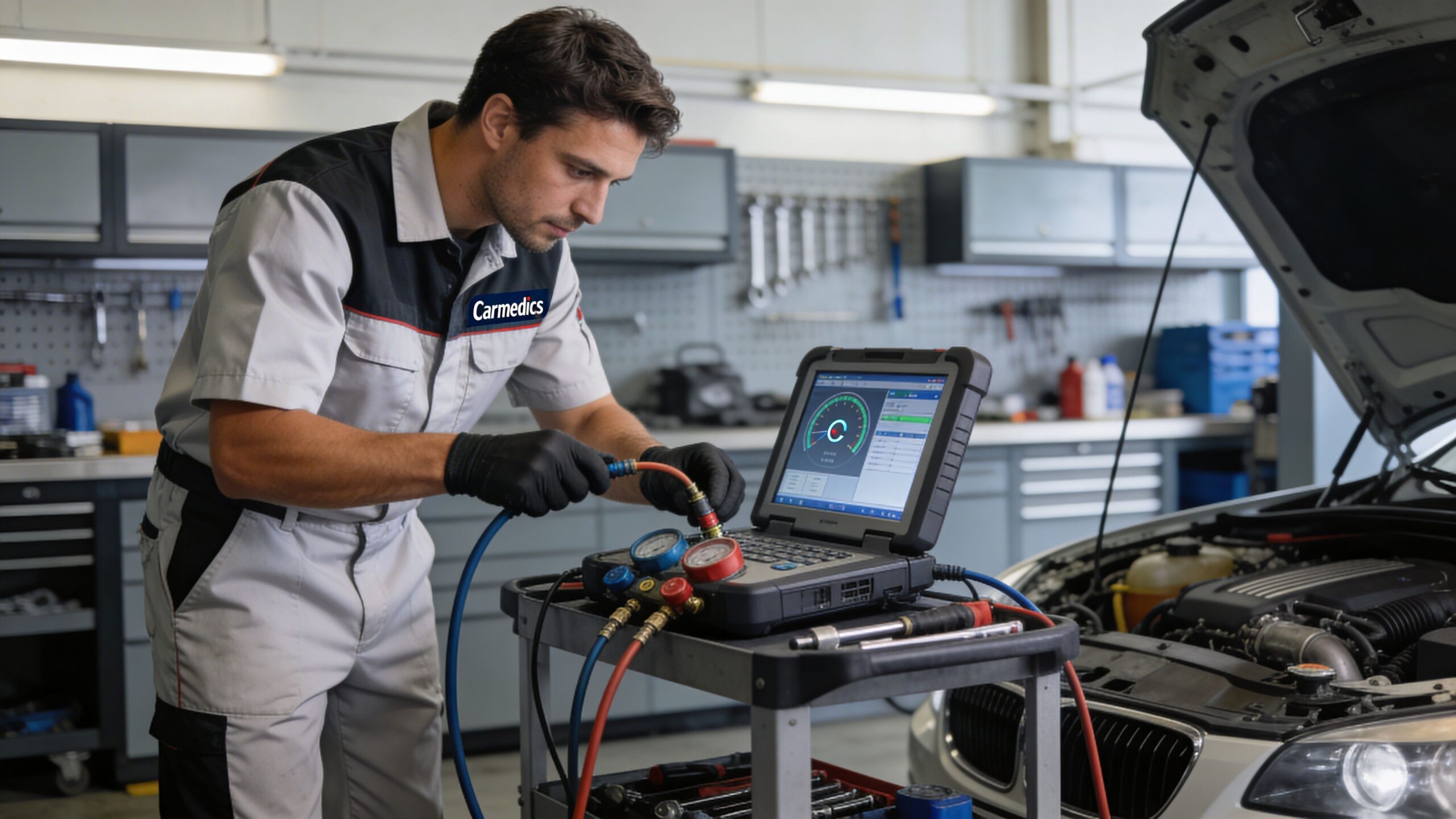
Then come the tools. Manifold gauges show high-side and low-side pressure behaviour. Those readings help separate undercharge, overcharge, restriction, compressor weakness, and airflow trouble. They don’t tell the whole story by themselves, but they point the technician in the right direction.
How small leaks are found
Tiny refrigerant leaks are where guesswork burns money. The right approach combines methods.
A technician may add UV dye and inspect the system with a UV light, especially around fittings, the condenser, compressor body, and service ports. Electronic leak detectors help identify refrigerant escaping in areas that are harder to see directly.
Electrical checks matter too. If the control side is the problem, the repair path may involve relays, wiring, switches, sensors, or fan circuit faults instead of the refrigeration hardware itself. That overlaps with broader vehicle diagnostics, which is why a shop with strong auto electrical repair in Whitby capabilities is often better equipped to solve AC faults cleanly.
Workshop reality: Pressure readings without leak testing are only half a diagnosis.
The goal is simple. Identify the exact failure point, fix the cause, confirm the repair under operating conditions, and avoid replacing good parts because a symptom looked familiar.
Common AC Repairs and Estimated Costs in Whitby
Cost questions are fair. AC work ranges from relatively light service to labour-heavy component replacement, and the right choice depends on what failed, how long it’s been failing, and whether collateral damage has spread through the system.
A recharge by itself can restore cooling if the system was only slightly low and the cause is known and corrected. A recharge used as a shortcut on a leaking system usually buys temporary relief, not a solution. That’s the trade-off.
What the common repairs involve
Some jobs are straightforward. Replacing a leaking service valve, fitting a new cabin filter, or clearing a blocked drain is usually far simpler than replacing a compressor or evaporator.
Other jobs get bigger quickly:
- Compressor replacement: Often requires inspection for contamination and related parts.
- Condenser replacement: Common after impact or corrosion damage at the front of the vehicle.
- Evaporator core work: Usually labour-intensive because of dashboard access.
- Leak diagnosis and recharge: Valuable when done methodically, wasteful when done blindly.
If you want a second perspective on how shops approach specialized AC repair services, it’s useful to compare what’s included in diagnostics versus what’s called a recharge.
For local budgeting, this page on car air conditioning repair costs is a practical reference point.
Estimated Car AC Repair Costs in Whitby (2026)
| AC Service / Repair | Estimated Cost Range (CAD) |
|---|---|
| AC system inspection and performance test | Varies by vehicle and fault |
| Refrigerant recovery and recharge | Varies by refrigerant type and system condition |
| Leak detection with dye or electronic testing | Varies by diagnostic time required |
| Cabin air filter replacement | Varies by vehicle and filter type |
| AC compressor replacement | Varies significantly by vehicle, parts quality, and related damage |
| Condenser replacement | Varies by access, part design, and whether additional components are affected |
| Evaporator core replacement | Typically one of the more labour-intensive AC repairs |
| Blower motor or resistor repair | Varies by fault location and component design |
| Electrical diagnosis for AC controls or fans | Varies by testing time and circuit complexity |
What changes the bill
The biggest cost drivers are usually vehicle design, part quality, and whether the failure contaminated the rest of the system. If a compressor comes apart internally, the repair often gets larger because debris can travel through the circuit.
The cheapest invoice isn’t always the cheapest outcome. A precise diagnosis prevents repeat visits, unnecessary recharges, and replacing parts that weren’t the problem.
Preventive Maintenance to Keep Your AC Ice-Cold
The easiest AC repair bill to live with is the one you avoid. Most systems don’t fail without warning. They lose efficiency first, then reliability.
A simple routine that works
Run the AC regularly, even when it isn’t hot outside. That keeps seals lubricated and helps the compressor stay active instead of sitting idle for long stretches.
Check the cabin air filter on schedule. A restricted filter makes a healthy system feel weak and pushes the blower harder than necessary.
Keep the front of the vehicle clean where the condenser sits behind the grille. Bugs, leaves, and road debris reduce heat transfer. Less heat rejection means weaker cooling, especially in traffic.
Good habits that save money
A practical maintenance plan looks like this:
- Use the AC year-round: Switch it on periodically in winter to keep the system exercised.
- Pay attention to airflow changes: If the fan feels weaker than it used to, don’t ignore it.
- Inspect after front-end damage: Even minor impacts can affect the condenser.
- Book routine checks: Performance testing catches weak systems before the first humid day exposes them.
Preventive maintenance for vehicles matters because cooling problems rarely improve on their own. They usually get more expensive, then pick the worst possible day to announce themselves.
The best time to deal with AC trouble is when the system is still cooling a bit. That’s when diagnosis is clearer and damage is often more contained.
If you care about keeping a vehicle sorted, preventive AC service belongs in the same category as fluid changes, brake inspections, and tire checks. It protects comfort, but it also protects components.
Why Choose a Whitby Auto Specialist for Your AC
A house AC technician and an automotive AC technician both work with cooling systems. That doesn’t make the work interchangeable. A vehicle adds vibration, engine load, airflow changes, electronic controls, compact packaging, and model-specific service procedures.
The local gap most content misses
Many Whitby-area cooling results focus on buildings, but over 85% of Whitby households own at least one car, and vehicle AC failures rose 25% during the 2025 heatwave. That gap is exactly why automotive-specific diagnosis matters for local drivers (Enercare).
If you’re serious about your vehicle, you already know some systems deserve specialist attention. You wouldn’t ask a home electrician to sort a modern vehicle network fault. AC is similar. The pressures, components, and logic are automotive-specific.
What specialist care changes
An auto-focused shop understands real-world trade-offs:
- Performance under idle conditions: Critical in traffic and drive-through lines.
- Integration with electrical systems: Fans, modules, relays, pressure sensors, and control heads all matter.
- Vehicle packaging: Access varies wildly from one model to the next.
- Related upgrades: Window tint and heat management can reduce cabin load and help the system work less.
For drivers comparing options, the local profile of Carmedics Autowerks in Whitby reflects a broader automotive service environment, not a generic cooling contractor approach. That matters if you own a newer SUV, a performance car, or any vehicle where you expect every system to feel dialled in.
An automotive AC system is a performance component. It should cool fast, stay stable at idle, dehumidify properly, and do it without strange noises or inconsistent behaviour. A specialist is more likely to chase the actual cause instead of treating the symptom.
Local Car AC Repair FAQs for Whitby Drivers
How long does car AC diagnosis usually take
Basic faults can often be identified fairly quickly, but leak tracing and intermittent electrical issues can take longer. The timeline depends on whether the problem is obvious or only shows up under certain operating conditions.
Should you recharge the AC every summer
No. Refrigerant isn’t a consumable like fuel. If the system is low, there’s usually a leak or another underlying issue that needs attention.
Can a bad cabin filter make the AC seem broken
Yes. Poor airflow can make a functioning AC system feel weak. It won’t create proper cooling if the refrigeration side has failed, but it can absolutely make a small problem feel bigger.
Why does the AC cool better while driving than idling
That often points to condenser airflow or fan-related issues, though other faults can contribute. More road speed gives the condenser extra airflow, which can temporarily hide a weakness.
Is it safe to keep using the AC if it’s making noise
It’s better to stop using it until it’s checked. Strange noises can mean the compressor or related drive components are under stress, and continued use can turn a repairable issue into a larger one.
Will AC problems affect defrost performance
Yes. Your AC system helps remove moisture from cabin air. When it isn’t working properly, window clearing can suffer in damp conditions.
If your vents are blowing warm, your airflow has dropped, or the system only cools when the car is moving, book an inspection with Carmedics Autowerks Inc. We handle auto repair for Whitby cars and SUVs, and that includes the kind of AC testing and fault-finding that makes sense for real summer driving, not guesswork.