


You notice it at the first red light. The fan is running, the controls look normal, but the air coming through the vents feels like it's been pulled off the road instead of chilled inside the dash. By the time you reach the next intersection, you're turning the temperature dial back and forth, hoping it's a setting problem.
That's usually when people start searching for an a/c car mechanic.
A good A/C mechanic doesn't just “add cold air.” The essential job is diagnosis. Modern vehicle A/C systems are sealed, pressure-managed systems with mechanical, electrical, and airflow-related failure points. From the driver's seat, several different faults can feel exactly the same. Warm air, weak cooling in traffic, a noisy compressor clutch, or air that goes cold and then fades can all send you in very different repair directions.
That matters because automotive A/C service sits inside a large repair trade, not a niche corner of it. In some large North American regions, the field employs over 40,000 technicians, and the profession is projected to have tens of thousands of openings annually across the U.S. and Canada, which reflects how central work like diagnostics and climate-control repair remains in everyday auto service, as noted in Kelley Blue Book's repair guide.
That First Hot Day Your Car A/C Fails
The first proper heat wave of the year creates the same rush every time. Drivers who ignored a weak A/C system through spring suddenly need it working now. What felt “not quite as cold as before” becomes obvious the moment the cabin starts heating up in traffic.
An experienced a/c car mechanic reads that moment differently than most drivers do. The complaint might be simple, but the cause often isn't. “Blows warm at idle but better on the motorway” points one way. “Cold for ten minutes, then not cold at all” points another. “Just recharge it” is sometimes the worst instruction a customer can give.
Why this work is more specialised than it looks
A/C repair overlaps with general auto repair, but it asks for a different kind of thinking. The mechanic has to understand pressure behaviour, heat rejection, refrigerant flow, electrical controls, and how all of that changes when the engine is idling versus cruising.
That's why the right technician acts more like a troubleshooter than a parts swapper.
A proper A/C repair starts with the question “why did cooling stop?” not “how quickly can we top it up?”
What car owners usually want to know
Most drivers don't come in asking about condenser efficiency or metering devices. They want answers to practical questions:
- Will it be a small job or a big one? Some faults are minor. Others involve major component replacement.
- Can I still drive it? Usually yes, but continued use with an unresolved fault can make diagnosis messier.
- Why did it work last month? Because A/C faults often worsen gradually, then become obvious all at once when outside temperatures rise.
The value of a good mechanic is clarity. You should leave the conversation understanding what failed, what was tested, and why the recommended repair makes sense.
How Your Car's A/C System Actually Works
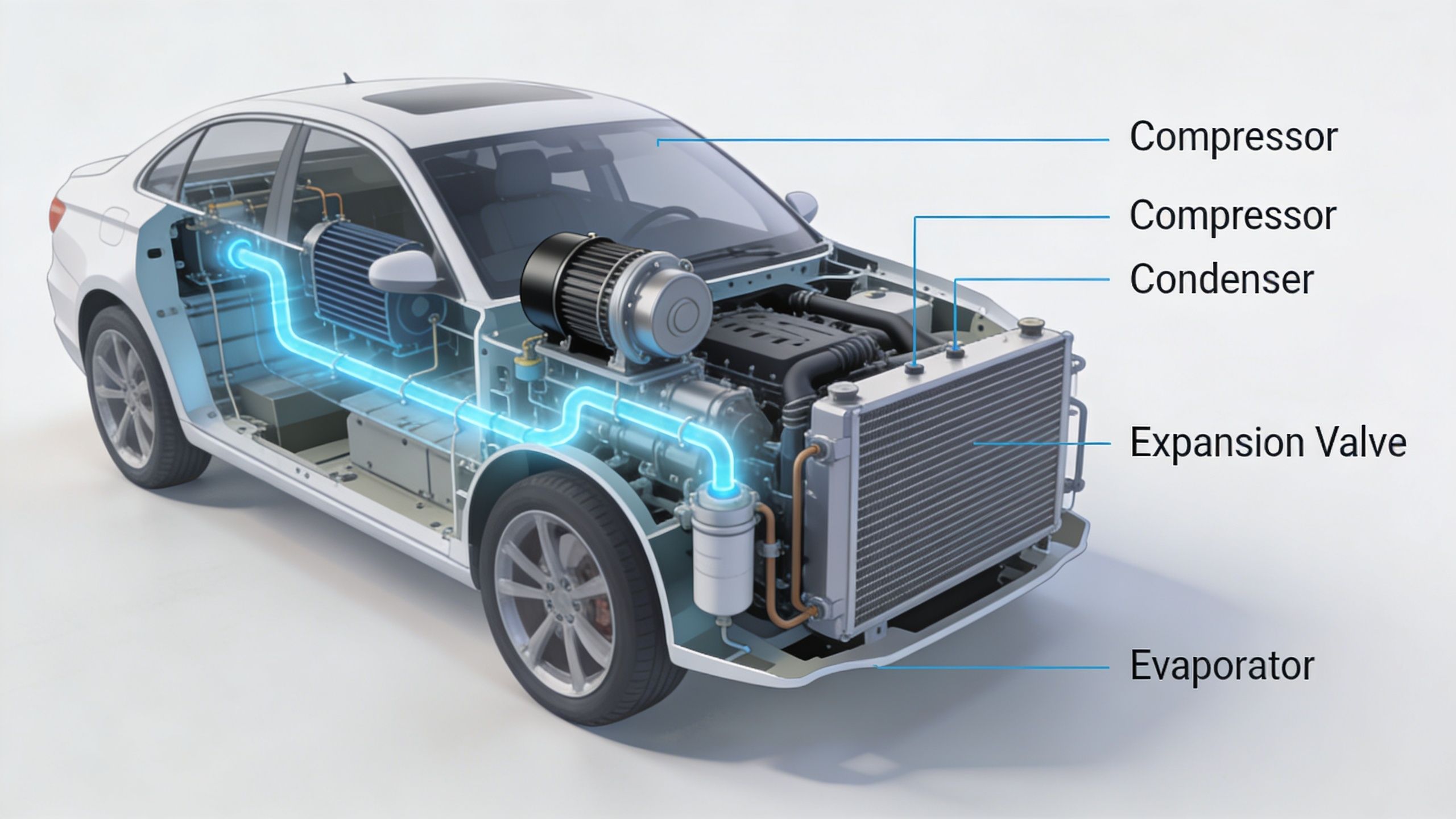
Your vehicle's A/C system works a lot like a compact refrigerator that travels with you. It doesn't “create” cold in the simple way people imagine. It moves heat out of the cabin by circulating refrigerant through a sealed loop.
If you're comparing repair options, it helps to start with a shop that treats A/C as a system problem rather than just a refill job, such as a dedicated vehicle air conditioning service.
The four main parts doing the work
According to UTI's explanation of automotive air conditioning, an A/C car mechanic views the system as a closed pressure loop. The compressor creates a high-pressure gas, the condenser turns it into a high-pressure liquid, and an expansion valve causes a pressure drop so the refrigerant can absorb cabin heat in the evaporator.
Here's what that means in plain language:
Compressor
This is the pump. It pressurises the refrigerant and keeps it moving through the system.Condenser
Mounted where it can shed heat, this part cools the high-pressure refrigerant and changes its state.Expansion valve or orifice tube
This is the restriction point. It drops pressure sharply, which is what sets up the refrigerant to absorb heat effectively.Evaporator
Hidden inside the HVAC box, the evaporator pulls cabin heat out of the air before the blower sends cooler air through the vents.
Why pressure matters more than most people realise
Most owners think in terms of vent temperature. Mechanics think in terms of pressure, phase change, and airflow.
If the condenser can't reject heat because airflow is poor, the system struggles even if the refrigerant charge isn't wildly off. If the metering device is restricted, the evaporator may be underfed. If the refrigerant isn't changing state properly, cooling suffers even when the dash controls seem fine.
Practical rule: Warm air from the vents doesn't automatically mean “low refrigerant.” It means the heat-removal cycle has been interrupted somewhere.
Newer vehicles also bring refrigerant changes into the picture. Many now use R-1234yf instead of older R-134a, which affects service procedures, equipment, and handling.
Common Car A/C Problems and Their Symptoms
Most owners experience A/C faults through one of four senses. What they feel, hear, smell, or notice in changing driving conditions. That's useful, but symptoms alone don't confirm the exact fault. They narrow the field.
A compressor problem, a leak, poor condenser airflow, and a restriction in the system can all produce “not cold enough” complaints. The difference is in the pattern.
If your system has started acting up, a more focused car air conditioning repair inspection should connect the symptom to testing, not guesswork.
What the symptom usually points to
The fastest way to make sense of A/C complaints is to separate them by behaviour.
| Car A/C Symptom Checker | ||
|---|---|---|
| Symptom | Potential Cause | Possible Solution |
| Blowing warm air | Low refrigerant from a leak, compressor not building pressure, condenser airflow issue | Leak diagnosis, system testing, repair before recharge if needed |
| Cold at speed, weak in traffic | Cooling fan problem, condenser airflow restriction | Inspect fan operation, inspect condenser condition and airflow path |
| Weak airflow from vents | Cabin airflow restriction, blower issue, HVAC door problem | Airflow inspection, blower and HVAC control diagnosis |
| Clicking, squealing, or rattling when A/C is on | Compressor or clutch issue, belt-related fault | Mechanical inspection and component testing |
| Musty smell at start-up | Moisture and organic build-up around the evaporator area | Cleaning approach and cabin-side inspection |
| Cold at first, then turns warm | Pressure imbalance, intermittent control issue, icing or flow problem | Full performance test under operating conditions |
The symptom that fools people most often
A lot of drivers assume a recharge is the answer when the air starts getting warmer over time. Sometimes the system is low. But when cooling returns briefly and then fades again, that often points to an underlying leak or another fault that the added refrigerant never fixed.
That's why “it worked for a week after service” is important information. It tells a mechanic the first visit may have treated the symptom but missed the cause.
Noises and smells matter too
Noises can steer diagnosis quickly. A harsh mechanical sound with the A/C engaged pushes attention toward compressor or clutch operation. A smell doesn't usually mean the refrigerant loop itself has failed, but it can tell you the cabin side of the system needs attention.
Don't ignore those clues when you describe the issue. The better your description, the faster the mechanic can separate airflow problems from pressure problems and mechanical faults from HVAC control faults.
The A/C Diagnostic and Repair Process Unveiled
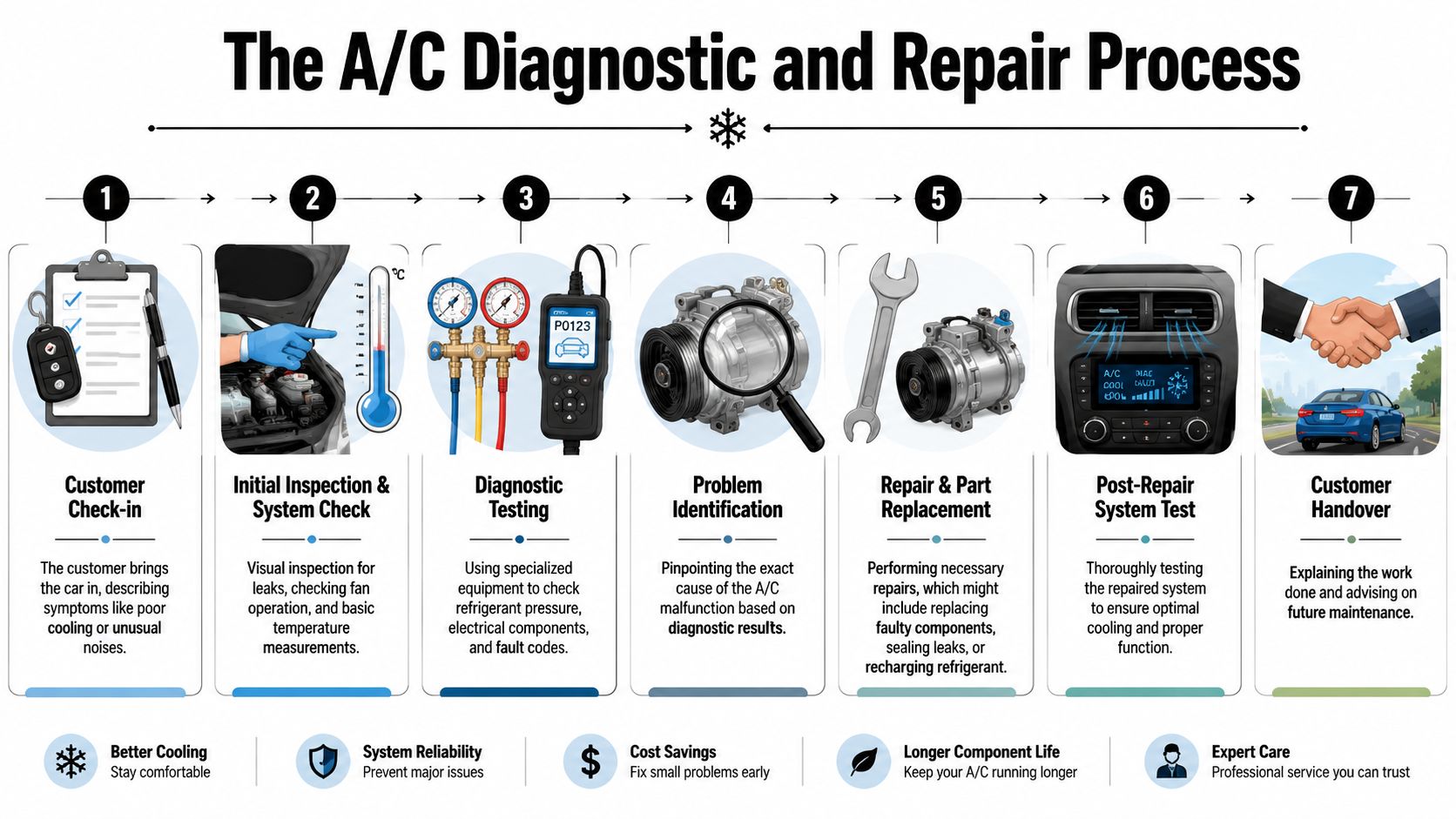
Customers often see the final invoice but not the logic behind it. Good A/C work follows a sequence. The technician starts broad, eliminates obvious faults, then narrows down the problem using measurements rather than assumptions.
If you've ever chased an electrical issue at the same time, it's worth remembering that battery and charging faults can confuse A/C complaints because low system voltage affects fans, controls, and clutch operation. This plain-English Blade Auto Keys battery guide is a useful reference on the battery side of that equation.
For vehicle owners comparing local repair options, a proper car A/C diagnostic and repair service should include this kind of workflow rather than a quick can-and-go approach.
Step one is listening properly
The first tool is the customer interview. When did it stop cooling? Does it fail only at idle? Did cooling drop off gradually or disappear suddenly? Was any previous A/C work done recently?
That matters because failure patterns save time. A system that cools on the motorway but not in stop-and-go traffic suggests a different path than one that never cools at all.
What the mechanic checks before connecting gauges
A proper inspection usually starts with what can be seen and heard:
- Drive belt and pulley condition if the design uses them
- Cooling fan operation with the A/C switched on
- Visible signs of leakage around hoses, joints, ports, and the condenser area
- Basic vent temperature behaviour to confirm the complaint
That first pass can expose obvious faults before deeper testing starts.
Good diagnosis is often subtractive. Rule out airflow, rule out control issues, then verify what the refrigerant loop is actually doing.
Pressure readings are only part of the story
Connecting manifold gauges or dedicated service equipment gives the mechanic a view into high-side and low-side behaviour. But those readings only make sense when matched with operating conditions, fan activity, ambient heat load, and how the system responds over time.
Weak shops often encounter trouble. They see an abnormal reading, add refrigerant, and stop there. A stronger technician asks why the reading is abnormal.
Leak detection separates repairs from temporary relief
If the system is low, the next question is simple. Where did the refrigerant go? Since the system is sealed, it doesn't need repeated topping up as a normal maintenance habit.
Shops may use UV dye, electronic leak detection, visual oil-trace inspection, or a combination. The exact method can vary by vehicle and fault pattern, but the goal is the same: identify the escape point before charging the system and sending the car back out.
After the repair, the system still has to prove itself
Replacing a leaking seal, repairing a hose, changing a condenser, or fitting a compressor isn't the finish line. The mechanic still needs to confirm the system now performs properly under real operating conditions.
That last check matters more than people think. A vehicle can leave with a new part installed and still have poor cooling if another issue was missed.
Understanding The Costs of Car A/C Repair
A/C repair prices vary because the job might be simple service, precise diagnosis, or major component replacement. Those are not the same thing, even when the customer complaint sounds identical.

If you want a rough sense of local service categories before authorising work, this guide to car air conditioning repair costs helps frame the difference between a routine service and a larger repair.
The numbers that show why diagnosis matters
Kelley Blue Book's repair guide lists A/C repair at $384 to $445, A/C recharge at $239 to $281, and A/C compressor replacement at $1,546 to $1,705, as summarised in this Car Talk statistics page referencing Kelley Blue Book data.
That spread tells you something important. If a shop guesses wrong, the cost difference between a minor service and a major repair is substantial.
What you're actually paying for
An A/C estimate usually reflects some mix of these factors:
Diagnosis time
Finding the fault is skilled labour, especially when symptoms overlap.Refrigerant handling procedures
A/C service isn't the same as topping up washer fluid. It requires proper recovery and recharge procedures.Parts access and labour
Some components are easy to reach. Others are buried and labour-heavy.System verification after repair
A proper job includes testing the result, not just fitting the part.
Cheap can become expensive quickly
The lowest quote isn't always the lowest final cost. If the shop adds refrigerant to a leaking system and the cooling fades again, you've paid for temporary relief and delayed the actual repair.
A recharge makes sense when the diagnosis supports it. It doesn't make sense as a substitute for diagnosis.
The best estimate is usually the one that explains the fault clearly, outlines what was tested, and separates confirmed needs from possible next steps.
Choosing Your Whitby A/C Mechanic and Simple Maintenance
Choosing an a/c car mechanic comes down to one question. Does the shop sell answers, or does it sell quick top-offs?
In Canada, refrigerant handling is regulated, and many repeat A/C failures come back to an underlying leak that wasn't diagnosed in the first place. Shops that focus on inspection and leak detection first are offering a more durable and environmentally sound repair path, as described in this auto A/C repair discussion on diagnostic-first service.
What to look for in a local shop
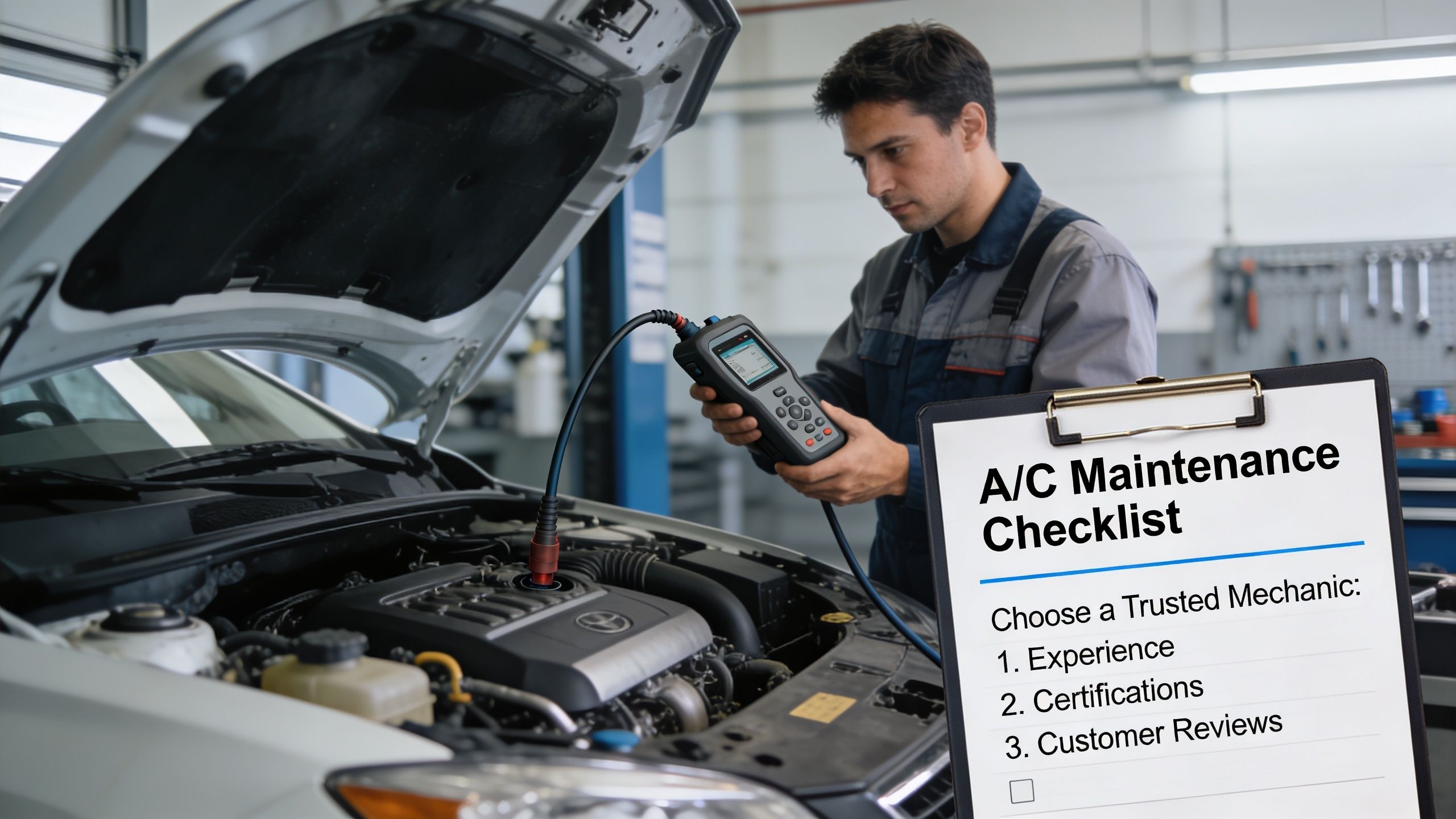
Use this checklist when you call or book:
Ask how they diagnose
If the answer is basically “we'll recharge it and see,” keep looking.Ask whether they look for leaks before recommending a recharge
That's one of the clearest signs you're dealing with a proper A/C process.Ask what happens after repair
The system should be tested again, not just reassembled and released.Ask who will work on it
A shop with broad mechanical experience is usually better equipped when the A/C fault overlaps with fan control, electrical supply, or engine-bay issues.
Where maintenance helps and where it doesn't
Owners can help the system, but only within reason.
- Run the A/C periodically even in cooler months, because regular use helps keep seals and moving parts from sitting idle for long stretches.
- Pay attention to changing behaviour. If cooling weakens in traffic, fades after a short time, or returns briefly after service, mention that pattern clearly.
- Don't treat repeated recharging as normal maintenance. A sealed system that keeps needing refrigerant needs diagnosis.
One practical local option is Carmedics Autowerks' mechanic service in Whitby, which covers general vehicle diagnostics and repair work alongside climate-control issues. That broader capability matters when an A/C complaint turns out to involve more than the refrigerant loop alone.
Skill matters more than hype
A strong A/C technician usually has the same habit you see in higher-level motorsport training. They learn to diagnose systems, not just replace parts. If you're curious how that mindset develops at the sharp end of the trade, this guide on the career path to join an F1 team is worth reading.
The point isn't that your road car needs an F1 pit crew. It's that disciplined mechanical thinking always beats guesswork.
If your car's A/C has stopped cooling properly and you want a clear diagnosis instead of a vague guess, Carmedics Autowerks Inc in Whitby offers auto repair services for cars and SUVs, including vehicle A/C diagnosis and repair. Reach out to discuss the symptoms you're noticing, and make sure the next repair addresses the cause, not just the discomfort.