


A basic serpentine belt replacement typically lands around $147 to $203 total, with $85 to $124 in labour and $62 to $79 in parts. In a real Whitby driveway, the belt is usually the cheap part, the labour is what pushes the bill into the low-to-mid hundreds.
You hear the squeal on a cold morning, or the dash reminder pops up, and suddenly the question isn't “How much is the belt?” It's “Why does a rubber belt turn into a proper repair invoice?” The answer is simple, the belt itself is rarely the expensive part of the job. The cost comes from getting to it, tensioning it correctly, and deciding whether the tensioner or idler pulleys need to come off with it.
Why Serpentine Belt Cost Is Higher Than the Part Price Suggests
A Whitby driver usually notices this repair the same way. The car starts squealing on startup, the belt looks glazed, or the shop catches it during a routine inspection. Then the quote lands, and the number looks higher than the price of a belt at the parts counter.
That reaction is normal. The belt itself is often only $25 to $75, while shop labour commonly adds $50 to $150 or more, which is why the bill moves into the $150 to $250 range once labour is included (serpentine belt replacement cost breakdown). You are not paying for rubber. You are paying for access, routing, and the time a technician spends working in a crowded accessory drive.
Practical rule: if the quote looks inflated, check whether you're being quoted a belt swap or a belt-system service.
What you're actually paying for
A serpentine belt runs the alternator, power steering, A/C, and in some vehicles the water pump, so the job depends on how the whole accessory drive is packaged. That's why a simple-looking replacement can take much longer on a tight engine bay than on a straightforward four-cylinder car. A shop is also accounting for inspection time, correct belt routing, and the chance that worn pulleys or a weak tensioner are part of the problem.
The useful mindset is to treat the belt as a wear item and the labour as the repair. If the vehicle is easy to work on, the quote should stay closer to the lower end. If the engine bay is cramped, the bill moves up fast.
Part choice matters, but access matters more. If you want a clean comparison between factory-grade and lower-cost components, see OEM versus aftermarket parts.
Breaking Down Parts and Labour Charges
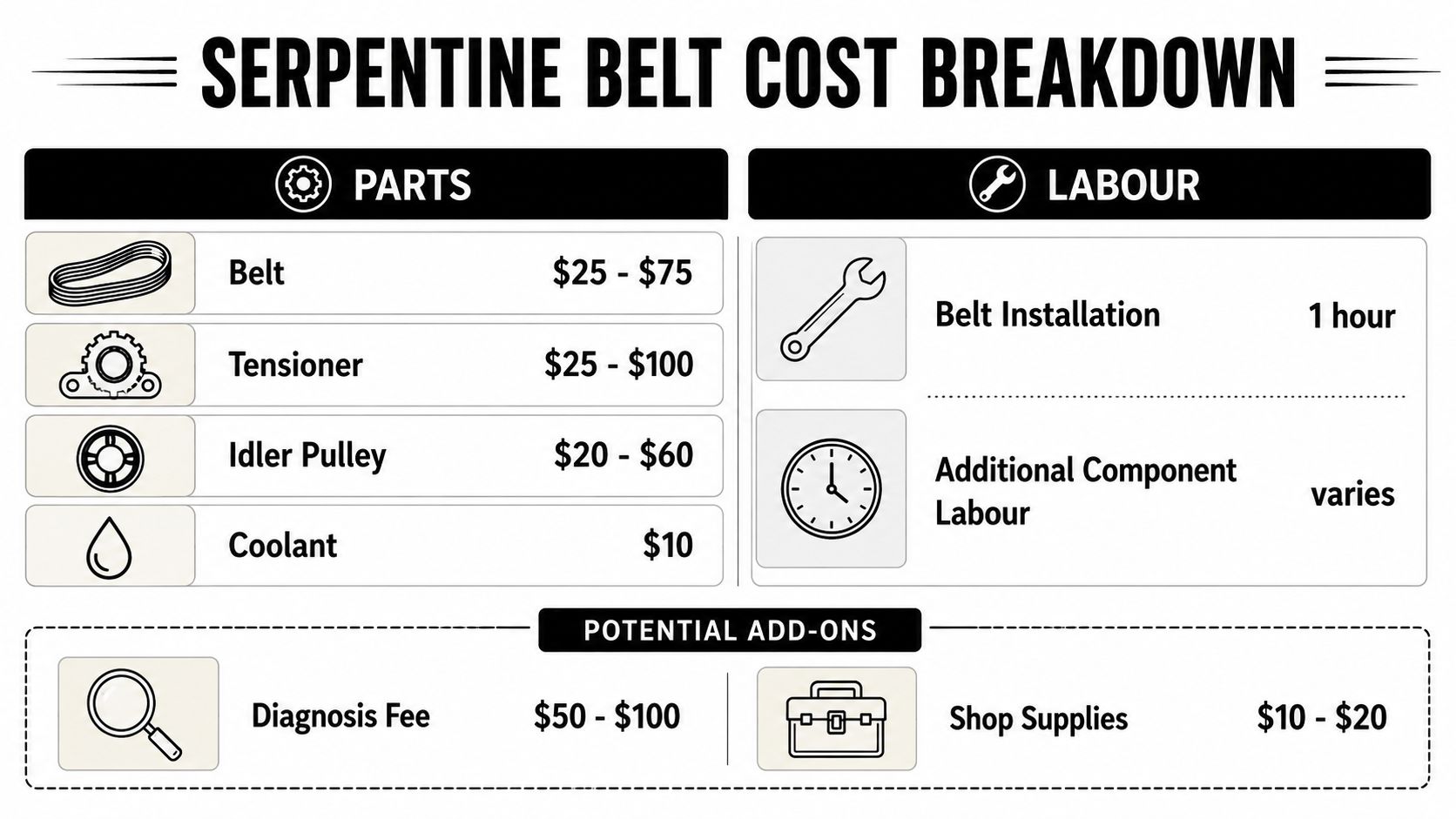
A serpentine belt quote usually looks simple on paper. In the bay, it rarely is. The belt itself is the cheap part. Most of the money goes into getting access, checking the accessory drive, and dealing with anything that is worn beside the belt.
What You're Paying For
The bill breaks into parts and labour, and labour is where the price moves. Independent-shop pricing for a belt service commonly lands around $90 to $250 total, with the belt itself usually $25 to $75 and labour adding $50 to $150 (serpentine belt replacement cost). That is the honest shape of the job. You are paying for the time it takes to reach the belt, route it correctly, and verify that the drive system is not hiding another problem.
Dealer pricing often runs 15% to 25% higher, so compare like for like. A belt-only quote and a belt-plus-tensioner quote are different repairs, even if the paperwork uses similar wording.
Part choice also shifts the number. Common modern applications show OEM list prices around $76 to $98, while premium aftermarket equivalents sit around $21 to $55 in the referenced catalog (serpentine belt replacement cost). That gap matters, but it does not usually drive the final invoice. Labour and access do.
Add-Ons That Push the Price Up
The tensioner is where a lot of owners get surprised. If it is worn, add another $45 to $185. If an idler pulley is noisy, add $18 to $62 per idler pulley (serpentine belt replacement cost). Those parts are small, but they change the job fast because the technician is already in the same area and the complaint often points to the whole belt drive, not just the belt.
A tight front-end layout can turn a quick service into a longer repair. That is the same reason accessory-drive work often climbs once the technician is inside the engine bay, as seen in alternator repair cost. Access and supporting parts drive the invoice, not the rubber strip itself.
Use this filter: if the quote only names the belt but the car has a noisy tensioner or rough pulley, the estimate is incomplete.
Shop Line Items You Should Expect
- Belt replacement labour, the core removal and installation time.
- Tensioner or pulley labour, only if those parts are being replaced.
- Diagnosis time, if the shop has to confirm the noise or wear source.
- Shop supplies, small charges that are common on many repair orders.
A clean estimate should tell you what is included before you approve the job. If a charge appears and the service writer cannot explain it in plain language, ask for the mechanical reason. On this kind of repair, that answer should be straightforward.
How Vehicle Make and Model Changes the Price
Two Whitby drivers can bring in the same complaint and get very different quotes. One drives a simple sedan with decent access to the accessory drive, the other has a tightly packaged SUV or a European vehicle with less room to work. The difference is not the belt brand. It's the platform.
Vehicle class changes the quote more than most owners realise
Recent price guides show compact cars around $80 to $140, midsize sedans around $100 to $160, SUVs and pickups around $120 to $200, and luxury or European vehicles around $160 to $300 or more (serpentine belt symptoms, replacement cost and more). That spread makes sense once you've worked on enough cars in a real shop. Tighter packaging means more labour, more disassembly, and more chances that adjacent components need attention.
| Serpentine Belt Cost by Vehicle Class | Typical Total Cost Range |
|---|---|
| Compact cars | $80 to $140 |
| Midsize sedans | $100 to $160 |
| SUVs and pickups | $120 to $200 |
| Luxury or European vehicles | $160 to $300 or more |
The belt itself is still a modest purchase. The trouble starts when the vehicle uses a longer multi-rib belt, a more complex routing path, or an engine bay that leaves little room for hands and tools. That's why a late-model SUV can cost more than an older sedan even when both need the same basic service.
OEM, aftermarket, and routing complexity
Part selection matters, but not in the dramatic way some people think. OEM belts tend to cost more, premium aftermarket belts less, and both can be perfectly sensible depending on the vehicle and how long you plan to keep it. The divider is whether the belt system is straightforward or buried behind other components.
Some vehicles also move into belt-system service because the tensioner or idler bearings are noisy. That's where the repair stops being a simple swap and starts looking like a front-end refresh. If you're pricing out a quote, ask the shop whether the engine layout makes access tight before you decide a number is too high.
A quote that seems high on a European car often reflects packaging, not markup.
If you're comparing repair options across shops, a certified local tech can usually tell you quickly whether your platform is cheap to service or a knuckle-buster. If you want that conversation with someone who works on daily drivers, fleet units, and newer vehicles, certified auto mechanic is the kind of service page you'd expect a practical shop to keep close by.
Signs Your Serpentine Belt Needs Replacement
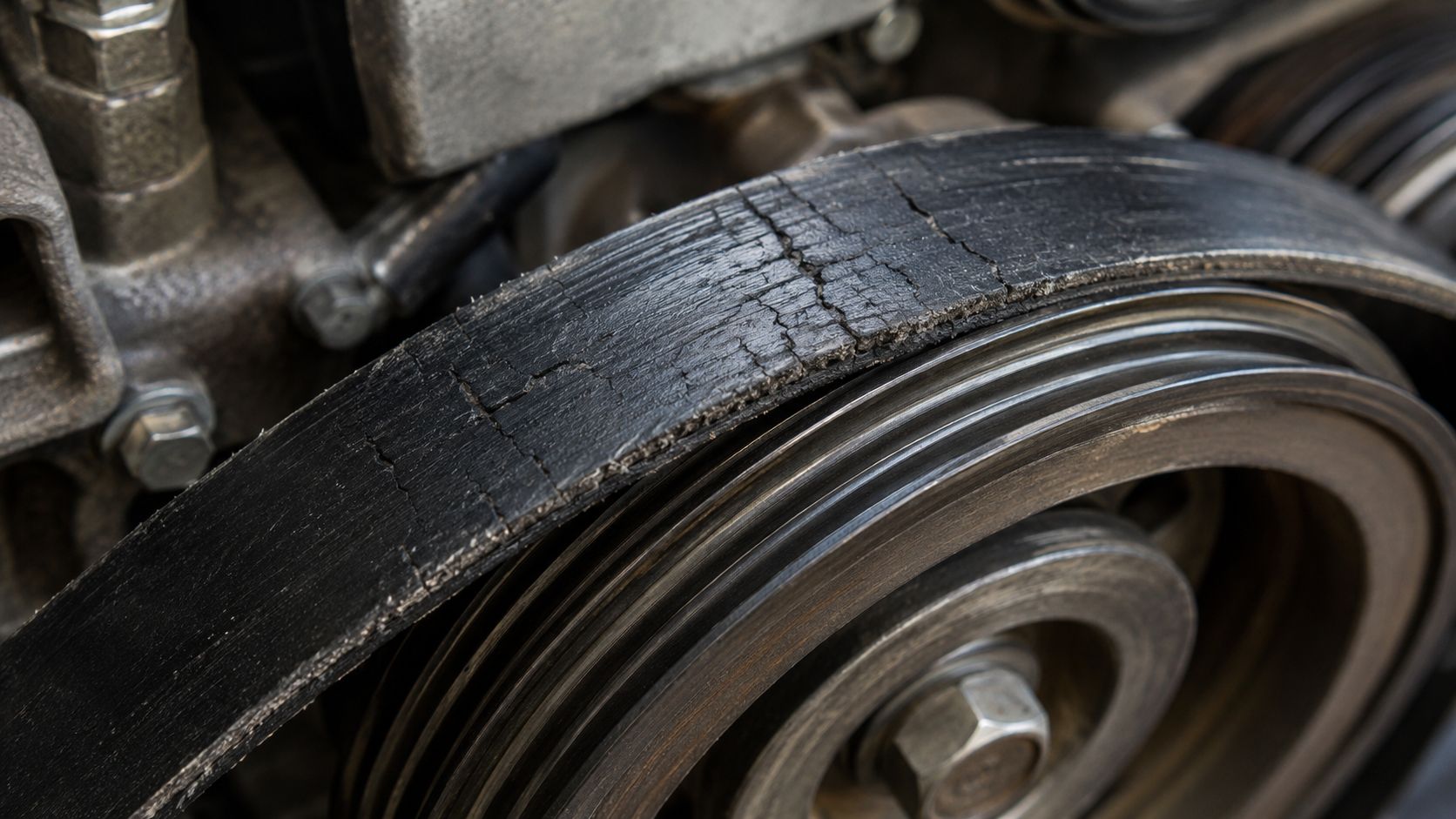
A bad belt usually gives you warning before it leaves you stranded on the road. The challenge is sorting the belt from the tensioner, idler, or pulley that is making the noise and pushing the repair cost higher than a simple parts swap.
What the symptoms usually mean
A squeal or chirp usually points to slip, weak tension, or a pulley that is not tracking cleanly. Cracking, fraying, or glazing means the rubber has aged or been stressed, and the belt is past the point where you should trust it. If accessories start acting up, the issue can be more serious, because the belt keeps alternator output, power steering assist, and A/C operation tied together (Car Care Complete Auto Care serpentine belt guidance).
A weak tensioner can make the same kind of noise as a bad belt. A rough idler pulley can do the same thing. That is why a proper inspection matters, and why guessing from sound alone usually wastes time and money.
A scan-based check also helps if the complaint is not obvious. For a closer look at how a shop sorts electrical and drivability issues before it starts swapping parts, see computer diagnostics car. That kind of check does not diagnose the belt by itself, it helps confirm whether the symptoms fit the actual fault.
When to stop driving
If the belt is visibly damaged, slipping badly, or throwing accessory performance off, get it looked at right away. Waiting can turn a straightforward belt replacement into damage to the parts the belt drives. If the belt breaks, the car may keep running only briefly before accessory loss becomes a bigger problem. A good overview of that warning pattern is covered in Car Care Complete Auto Care serpentine belt guidance.
If the battery light comes on with a squeal, do not treat it as a minor noise.
Vehicle-specific fitment matters here too, just like it does in parts sourcing for bikes and other vehicles. The logic behind why bike year matters for parts is the same principle you see in cars, the right part depends on the exact platform, not just the model name.
A proper inspection should separate belt wear from pulley wear, and that distinction affects both price and downtime. If the shop only looks at the belt and ignores the rest of the accessory drive, you are taking a shortcut that usually costs more later.
DIY Replacement Versus a Professional Shop
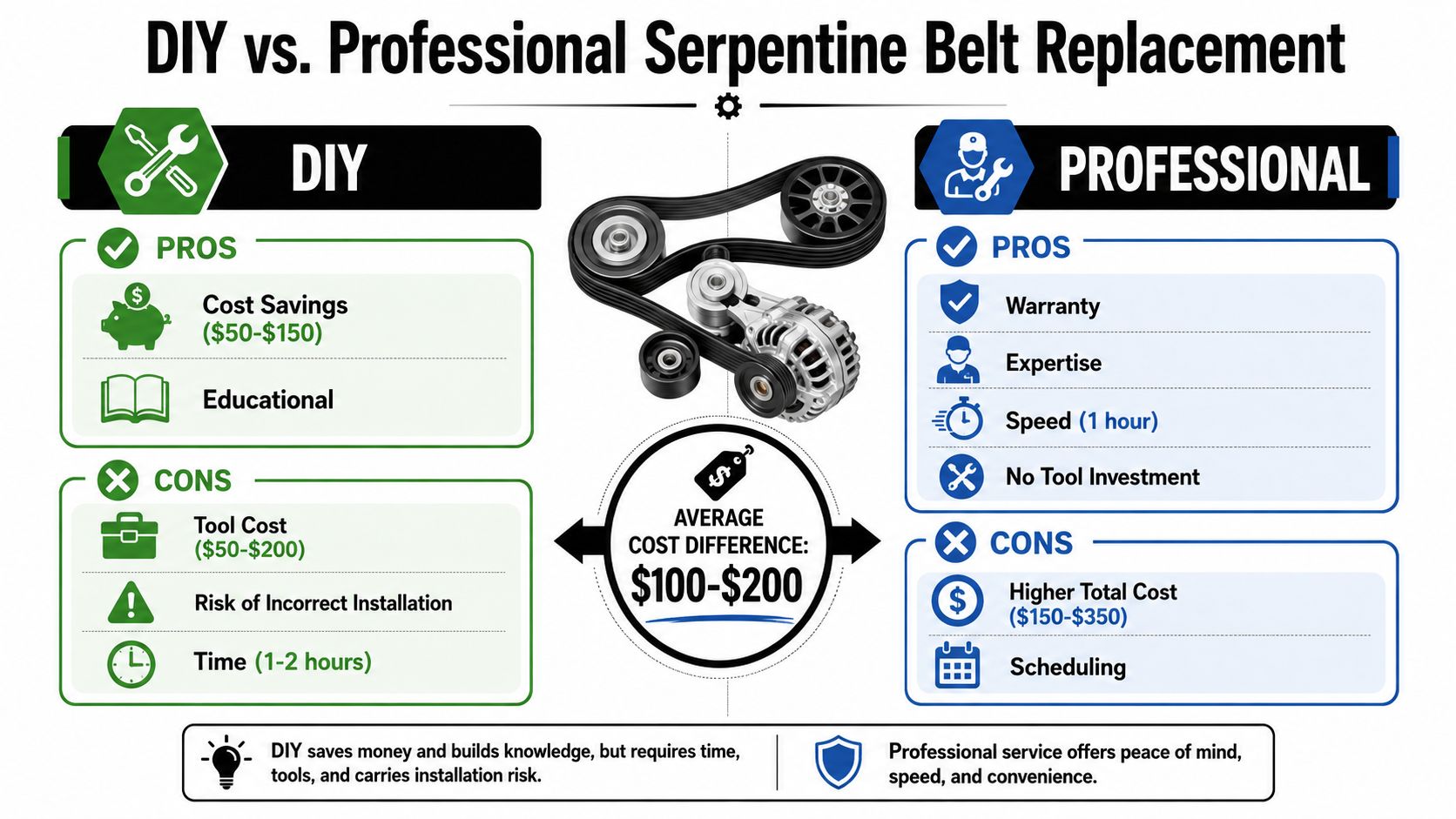
A belt swap looks cheap on paper until you price your own time, the awkward access on some engines, and the chance of getting the routing wrong. On an easy platform, DIY can make sense. On a cramped one, the savings can disappear fast.
What DIY really saves
Labour is the obvious savings. If you already own the tools and you can read the belt routing correctly, you may spend less than a shop invoice and learn your engine layout in the process. The catch is time, and a mistake on routing or tension can leave you with a new squeal, a damaged pulley, or a repair you have to redo.
The tool list is not huge, but it is not nothing. You are usually dealing with hand tools, a belt-routing reference, and sometimes a breaker bar or a tensioner tool, depending on the vehicle. If the tensioner sits in a bad spot or the front of the engine is crowded, the job gets difficult fast.
Why a shop makes sense on harder platforms
A professional shop has the lift, the experience, and the habit of checking the nearby parts while the belt is off. That matters because a worn pulley or a weak tensioner can take out a new belt early if nobody catches it. That extra inspection is part of what you pay for, and on some cars it is money well spent.
The time gap is real too. A simple job may move quickly for a tech who does these every week, while a DIY repair can drag on if you are working around coolant hoses, fans, or a tight accessory layout. If you are not confident, a shop quote is usually cheaper than a misrouted belt and a second tow.
If you want a local benchmark before you decide, a shop such as Carmedics Autowerks Inc can inspect the belt system, point out worn components, and tell you whether the car is a simple swap or a more involved service. A certified auto mechanic can also tell you whether the problem is really the belt or whether the tensioner, idler, or another pulley is driving the cost.
Smart Ways to Save and When to Book Service in Whitby
The cleanest way to control serpentine belt cost is to replace the belt before it becomes an emergency. That keeps you out of the breakdown lane and gives the shop a chance to inspect the tensioner and idlers while the car is already in for maintenance.
Don't pay for avoidable labour twice
The best savings usually come from planning, not from bargain hunting. If your vehicle is already due for scheduled maintenance, ask the shop to inspect the belt system then. Replacing the belt early, before it snaps or starts chewing up nearby parts, is usually the cheaper move.
Use the service interval guidance in how often should you service your car as your reminder to put belt inspection on the same calendar as oil service and other routine checks. A small inspection now is easier to absorb than a surprise repair later.
What to ask when you call a shop
- Ask whether the quote includes only the belt or the full belt system.
- Ask if the tensioner and idler pulleys were inspected for noise or play.
- Ask whether the part quoted is OEM or aftermarket.
- Ask whether the labour changes if access is tight on your specific vehicle.
If the answers are clear, you're dealing with a shop that knows the platform. If the answers are fuzzy, keep looking.
Good advice: never choose the cheapest estimate until you know what's included.
Whitby drivers with newer SUVs, European cars, or anything with a cramped front accessory drive should be especially careful. That's where labour dominates the bill, and that's where a cheap quote can turn into a second visit if the issue wasn't diagnosed properly the first time.
If you want a straight answer on your own car, bring it to Carmedics Autowerks Inc for an inspection and a quote that spells out the belt, tensioner, and pulley work clearly. Their team works on cars and SUVs in Whitby, so you'll get a practical read on whether your repair is a simple belt job or a full accessory-drive service. Visit Carmedics Autowerks Inc and book the inspection before a small squeal turns into a roadside problem.