You agree to buy a used car in Whitby. The seller says it runs great, the body looks clean, and the price feels fair. Then the paperwork conversation starts, and someone mentions a Safety Standards Certificate. Suddenly, a simple deal turns into phone calls, inspection bookings, repair questions, and one big worry: are you about to get stuck with delays or a shop that treats a safety inspection like a sales opportunity?
That happens all the time.
The same thing comes up when you're selling your current car, transferring ownership to a son or daughter, or putting an older vehicle back on the road after it's been parked. Most drivers don't spend much time thinking about car inspection stations until they need one quickly. Then every choice matters. The right station gives you a straight answer, a proper inspection, and a clear path forward. The wrong one wastes your time and muddies the whole process.
In Ontario, this isn't just a casual once-over. You need the right inspection from a licensed facility, and you need to understand what the certificate does and what it doesn't do. A proper inspection is about roadworthiness at the time of inspection. It's not a promise that nothing will fail later, and it's not a blank cheque for a shop to recommend every service on its menu.
Drivers in Whitby run into another issue that generic guides miss. Local convenience matters. If you're balancing work, family, and a registration deadline, you need a station that communicates clearly, books efficiently, and won't hide behind vague language. That's where knowing the warning signs helps.
When You Suddenly Need a Vehicle Inspection
A common Ontario scenario goes like this. You've found a buyer for your car, or you're about to buy one from a private seller. Everything feels settled until the question comes up: “Do you have the safety?”
That one question changes the timeline.
Without the right inspection paperwork, a deal can stall fast. Buyers get nervous. Sellers start guessing. Family transfers become more complicated than expected. If you're the one trying to sort it out, you're usually doing it under pressure and with just enough information to be dangerous.
The moment most drivers realise what matters
Individuals often don't start by asking whether a station is properly licensed, how the report will be documented, or whether the technician will explain a failure item. They start by searching for nearby car inspection stations and taking the first available appointment.
That's understandable, but it's where mistakes begin.
Some centres handle inspections the way they should. They inspect the vehicle against the required standard, show you what failed, and separate the inspection result from any repair recommendation. Others blur those lines. They use urgency, vague wording, or pressure tactics to steer you into work you haven't had time to think through.
Practical rule: If a shop can't explain why an item affects a safety certificate in plain language, slow the process down before approving repairs.
Why this feels more stressful than regular maintenance
An oil change is simple. A brake service is familiar. A safety inspection feels different because it affects ownership, registration, and timing.
That pressure can push drivers into two bad choices:
- Booking the cheapest option first: Low advertised pricing sometimes hides poor communication or aggressive upselling later.
- Assuming every failure means the car is bad: Many vehicles fail for correctable issues. A failed inspection report is information, not a verdict on the entire vehicle.
- Treating the certificate like a warranty: It isn't. The certificate speaks to condition at the time of inspection.
If you're in Whitby and trying to keep a sale or transfer on track, the smartest move is to understand the process before you hand over the keys.
Understanding Ontario's Inspection Requirements
Ontario drivers still use the old wording all the time. People ask for an “inspection sticker,” mention “emissions,” or say the car needs to “pass the MTO.” What usually matters in a private sale or ownership transfer is the Safety Standards Certificate, issued through a government-licensed inspection facility.
What a licensed inspection station actually does
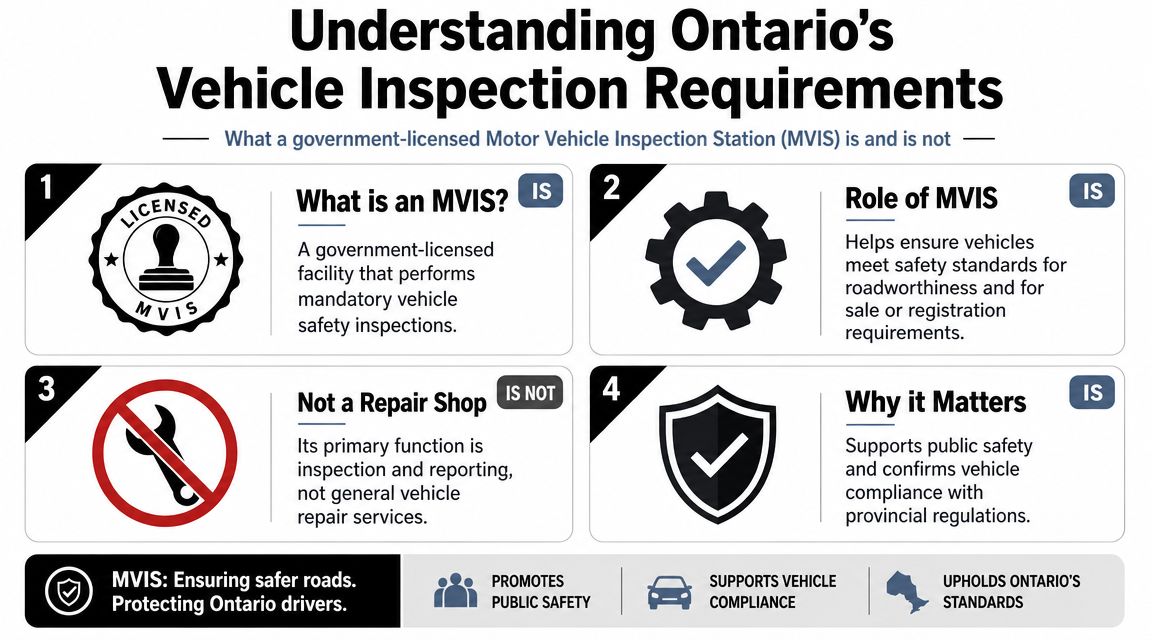
A Motor Vehicle Inspection Station, often called an MVIS, is a facility licensed to perform specific inspections and issue the required documentation when a vehicle meets the standard. That licence matters. It means the station isn't just offering an opinion. It's performing an official inspection within Ontario's regulatory framework.
A lot of confusion starts when drivers assume every repair shop functions the same way. It doesn't. A good general repair shop may also be a licensed inspection station, but those aren't automatically the same thing. For your purposes, the first question is simple: can this facility legally perform the inspection you need and issue the right certificate?
What the Safety Standards Certificate means
A Safety Standards Certificate, or SSC, confirms that the vehicle met Ontario's minimum safety standards at the time it was inspected. That's the key phrase.
It does not mean the car is perfect. It does not guarantee future reliability. It does not replace a full pre-purchase inspection if you're buying a used vehicle and want deeper insight into engine health, service history, or upcoming maintenance.
A safety certificate answers one legal question. It doesn't answer every ownership question.
That distinction matters when a seller says, “It already safetied, so you're good.” Maybe. Maybe not. If you're buying, you still need to know whether the car has rust concerns, seepage, uneven tyre wear, or suspension wear that may not stop a transfer today but could cost you money soon.
What it is not
Long-time Ontario drivers still remember Drive Clean. That emissions program created years of habit, and some people still talk as if safety and emissions are part of the same test. They aren't the same thing.
To see how different inspection frameworks can be elsewhere, California ties some compliance steps directly into vehicle administration through a centralised digital system, and many passenger vehicles remain in a biennial smog program, while newer gasoline vehicles that are six model years old or newer pay a $20 smog abatement fee each year instead of taking the emissions test, according to the California Bureau of Automotive Repair safety overview. Ontario drivers often don't realise how separate our current safety certificate process is from those emissions-based systems.
That distinction also matters for specialty vehicles. If you're working through registration questions for a recreational or off-road machine, a guide on how to convert your dirt bike for road use can help you understand why legal road use and mechanical readiness are related, but not identical, issues.
If you want more detail on Ontario documentation around annual inspection markings and related requirements, this overview of the annual safety inspection sticker in Ontario is a useful companion read.
The Official Inspection Process Step by Step
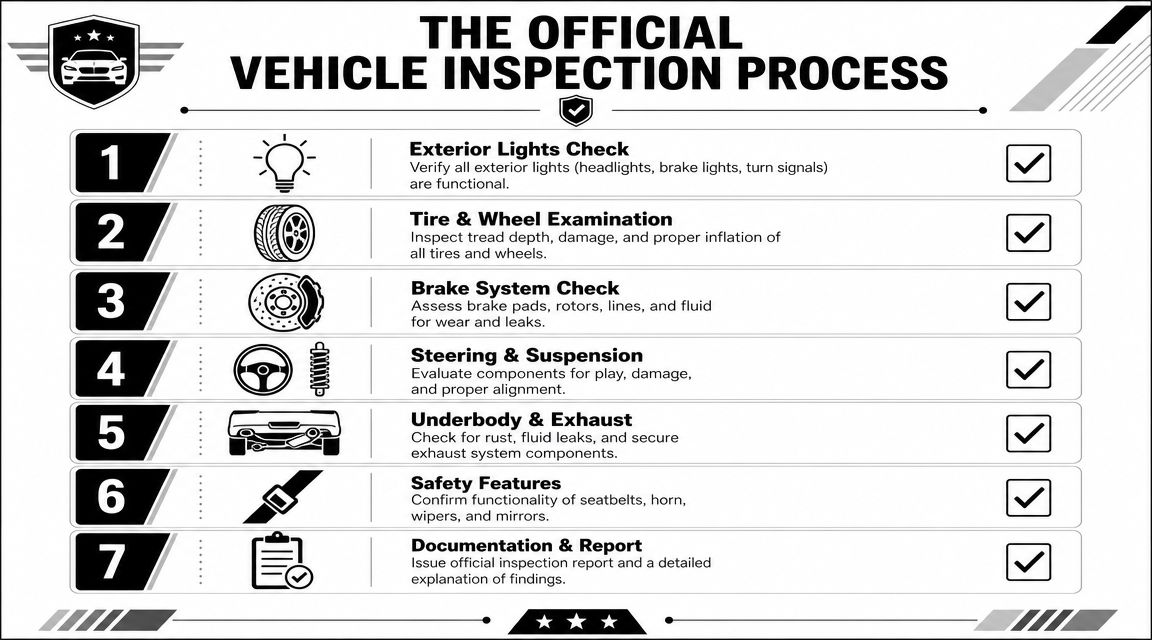
Drivers often imagine the inspection as a mystery checklist done behind a closed bay door. A proper one shouldn't feel that way. The best car inspection stations follow a structured process, document what they find, and can explain each failure item in plain language.
What gets checked on the vehicle
The inspection starts with the basics people can see from the outside, then moves into the systems that keep the vehicle controlled and safe.
- Lights and signals: Headlamps, brake lamps, turn signals, marker lamps, and related lighting need to function properly. This isn't cosmetic. Other drivers need to see your intentions clearly.
- Tyres and wheels: The technician looks for unsafe wear, damage, poor condition, and obvious issues that affect safe contact with the road.
- Windshield, mirrors, wipers, and horn: These are simple items until one fails in bad weather or traffic. Visibility and driver warning functions are part of real road safety, not filler on a checklist.
The systems that usually decide the result
The next group is where many certificates are won or lost.
Brakes matter for obvious reasons, but a proper inspection doesn't stop at pad thickness. The technician checks the condition of braking components, looks for leakage concerns, and verifies that the system operates safely. Steering and suspension are just as important. Excessive play, damaged components, or poor structural condition can turn a vehicle that “drives okay” into one that doesn't respond predictably in an emergency.
Underneath the vehicle, body integrity and mounting points matter more than many sellers admit. Rust is where some of the hardest conversations happen, especially in Ontario. Surface corrosion and structural corrosion aren't the same thing, and a trustworthy inspector will show you the difference instead of using the word “rust” as a scare tactic.
If a station says your vehicle failed for underbody or suspension concerns, ask to see the affected area on a hoist. A legitimate shop won't resist that request.
Why the process needs structure
Inspection speed sounds convenient, but speed without method creates problems. In commercial vehicle enforcement, the Level I inspection standard is the most thorough roadside inspection and includes credential checks plus a detailed mechanical review of brakes, steering, tyres, coupling devices, suspension, lighting, frame, driveline, fuel and exhaust systems, wipers, and cargo securement. A Level V inspection covers the same vehicle items without a driver present, which makes the station's own protocol a major factor in how quickly defects are isolated and documented, according to the Commercial Vehicle Safety Alliance inspection levels.
Passenger vehicle safety inspections in Ontario are a different legal process, but the lesson is the same. Structure matters. A station that has a repeatable inspection routine usually gives clearer answers than one that relies on memory and quick glances.
What you should receive at the end
At the end of a proper inspection, you should get a clear result and a clear explanation.
Here's what that conversation should include:
| What you should ask | What a good station should provide |
|---|---|
| Did it pass or fail? | A direct answer with no hedging |
| What items failed? | Specific components or conditions |
| Can you show me? | Visual confirmation where practical |
| What must be repaired for certification? | A distinction between required items and optional recommendations |
If you're comparing shops before booking, this guide to auto inspection cost helps frame the difference between the inspection fee itself and any repair work that may follow.
Preparing Your Vehicle and Managing Costs
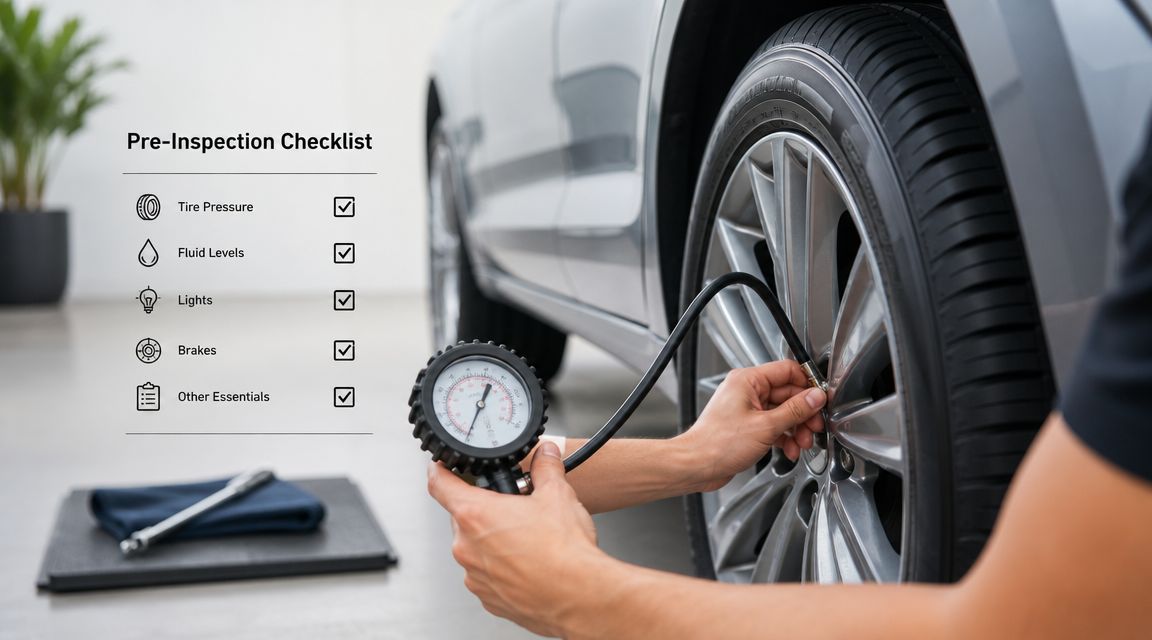
The easiest money to save on a safety inspection is the money you never spend on avoidable re-testing, repeat appointments, or simple defects you could've caught in your driveway. You don't need a scan tool and a hoist to do useful prep. You just need a few minutes and a habit of checking the obvious first.
What to check before you book
A quick walk-around catches more than is typically expected.
- Test every exterior light: Don't just look at the headlights. Check brake lights, reverse lights, turn signals, and plate lights. Get someone to help or back near a wall so you can see reflections.
- Listen to the horn and run the wipers: These are easy to forget until inspection day.
- Look at the tyres: You're checking for obvious damage, uneven wear, and anything that looks out of place.
- Scan for leaks under the parked car: Fresh drips are worth investigating before an inspection.
- Check mirrors, glass, and seatbelts: If something is loose, cracked, missing, or not functioning properly, deal with it early.
What usually saves time and what doesn't
Cleaning the car helps a bit. Repairing known faults helps a lot.
Drivers sometimes spend time vacuuming, polishing trim, or trying to make the vehicle look “inspection ready.” A clean vehicle is easier to work around, but appearance won't rescue a bad bulb, a worn suspension part, or a rusted structural area. On the other hand, replacing a failed lamp, topping up washer fluid, fitting new wiper blades, or fixing an obvious exhaust issue before the appointment can save a second trip.
Worth remembering: Pre-inspection prep works best when you focus on function, not presentation.
The cost side that catches people off guard
The inspection fee and the repair bill are two different things. Drivers get frustrated when they think the quoted inspection price should also cover the parts and labour needed to make a failed vehicle pass.
That's not how it works.
A fair station should separate the charges clearly. You should know what you're paying for the inspection, what repairs are required for certification, and what work is merely advised because it's smart maintenance. Those categories can overlap in conversation, but they should never be blended on the invoice to the point where you can't tell what's mandatory.
A lot of expensive surprises are preventable if the vehicle has been maintained consistently. If you want to reduce the odds of inspection-day problems, regular preventive maintenance for vehicles is still the most practical approach. Cars that get routine brake checks, tyre rotations, fluid services, and suspension inspections are easier to certificate than cars that only see a shop when something starts clunking.
How to Choose a Trustworthy Inspection Station
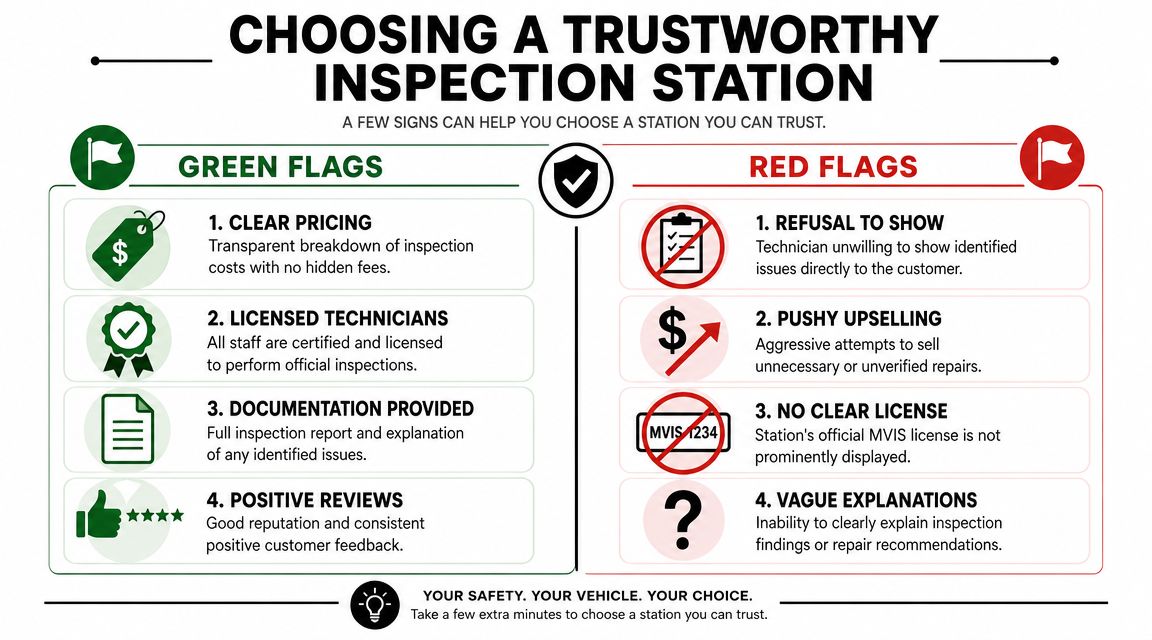
Many Whitby drivers get uneasy about safety inspections, and for good reason. A safety inspection gives a shop significant influence. They have your vehicle, your timeline, and your attention. If they're honest, that's fine. If they aren't, the pressure shows up fast.
Green flags you want to see
Start with what's visible before anyone touches the car.
- Licence visibility: The station should clearly present itself as an authorised inspection facility. If the licensing status feels vague, that's a bad start.
- Clear pricing before the appointment: You should know the inspection charge upfront.
- Specific explanations: A good technician can tell you what failed, why it matters, and whether it's a required repair for certification or just a recommendation.
- Willingness to show the problem: If practical, they should be prepared to walk you to the vehicle or provide useful visual proof.
A reliable inspection station also avoids one common trap. It doesn't treat every worn part as a safety failure. Some items may be worth doing soon without being immediate certification issues. Honest shops know the difference and explain it.
Red flags that should stop you
There are a few behaviours that almost always point to trouble.
First, watch for pressure. If the shop jumps from “it failed” to “sign here right now” without showing you the issue, step back. Second, watch for vagueness. A handwritten note that says “front end bad” or “unsafe rust” without identifying the actual concern isn't enough. Third, watch for defensiveness. If you ask reasonable questions and the response gets sharp, that tells you a lot.
For buyers dealing with remote purchases, the same caution applies outside Ontario too. If you're looking at a vehicle you can't inspect yourself, guidance on inspecting vehicles for out-of-state buys is helpful because it shows how important independent documentation is when distance limits your own verification.
A practical decision filter for Whitby drivers
Use this quick filter before booking with any of the car inspection stations on your shortlist:
| Question | Good answer | Bad answer |
|---|---|---|
| Is the station properly licensed for inspections? | Clear and direct | Evasive or unclear |
| Will you explain failed items? | Yes, with detail | “Just trust us” |
| Can I separate inspection from repair approval? | Yes | Pressure to bundle immediately |
| Will I get proper documentation? | Yes | Vague verbal summary only |
There's another practical point that doesn't get enough attention. Access and timing matter. In jurisdictions where inspection compliance is tied closely to registration, delays can create real headaches. California's system is a strong example because registration can't be completed until required smog requirements are met, and public guidance often focuses on station location more than real-world access gaps or peak renewal wait issues, as noted in this discussion of station availability and compliance delays. Ontario drivers face a similar practical problem even under a different system. If a station is impossible to book or slow to document, your paperwork timeline suffers.
If you're weighing service options locally, this look at finding a car repair shop near me can help you compare shops beyond just proximity.
Your Local Whitby Inspection Solution Carmedics Autowerks
If you're in Whitby or anywhere in Durham Region, the right inspection experience should be straightforward. You book the appointment, the vehicle gets inspected properly, the findings are explained clearly, and you know exactly what's required if anything needs attention. That's what drivers should expect. It shouldn't feel like a guessing game.
For local owners, the biggest difference usually comes down to transparency. You want technicians who understand Ontario safety requirements, communicate without jargon, and don't use the inspection as cover for a hard sell. You also want a facility that respects your time, because those booking an inspection often do it for a sale, transfer, or registration step that already has enough moving parts.
That's especially true for enthusiasts and careful owners. If you've looked after your car, kept up with maintenance, and want the inspection handled by people who care about mechanical condition, you notice quickly when a shop is organised and when it isn't. The cleanest inspection experiences usually come from teams that are methodical in the bay and honest at the front counter.
If you want a local option in Durham Region that matches the green flags described above, take a look at Carmedics Autowerks in Whitby. For drivers who want clear answers, proper documentation, and a no-nonsense approach to safety inspections, that's the standard worth looking for.
If you need a safety inspection in Whitby, Carmedics Autowerks Inc offers the kind of clear, professional process drivers want when timing matters. Whether you're selling a car, buying one, or transferring ownership, book with a team that will inspect it properly, explain the results clearly, and help you move forward with confidence.