
You've probably done this already. You type auto emissions testing near me into Google because your sticker date is coming up, your check engine light is on, or you vaguely remember Ontario used to require an emissions test before renewal. A lot of drivers in Whitby still think that way.
The problem is the search results often lag behind the rules.
If you drive a typical passenger car, SUV, van, or light truck in Ontario, the question usually isn't where to get an emissions test. It's whether you even need one, and if you don't, how to make sure your vehicle is still running clean, efficiently, and without hidden faults. That's where the conversation has changed.
The End of Drive Clean What Ontario Drivers Need to Know
If you're searching auto emissions testing near me, you're not asking a silly question. You're asking the question Ontario drivers were trained to ask for years.
Why the confusion still happens
A lot of people still remember Drive Clean as a normal part of ownership. If you owned a car in Ontario during that era, emissions testing felt tied to registration, repairs, and the stress of whether your car would “pass.”
That's why old habits stick. Drivers still assume there's a required local test centre somewhere nearby, especially when a dashboard warning light comes on or a used vehicle purchase is involved.
The practical reality for most Ontario drivers today is simpler. The mandatory emissions test that used to apply to most regular passenger vehicles is no longer part of routine ownership.

What matters now
For most drivers in Whitby, the old pass-or-fail emissions appointment has been replaced by something more useful. Vehicle condition matters more than test preparation.
That means paying attention to:
- Warning lights: If the check engine light is on, the vehicle is telling you something needs attention.
- How the engine runs: Rough idle, hesitation, poor acceleration, or hard starts often point to a fault that affects both performance and emissions.
- Fuel economy changes: If you're filling up more often for no obvious reason, the engine may not be operating as efficiently as it should.
- Exhaust smells or smoke: Those are signs worth checking promptly, even without a mandatory provincial test.
Practical rule: Don't treat the end of Drive Clean as a reason to ignore emissions-related problems. Treat it as a reason to catch them earlier, before they turn into drivability or repair issues.
When an inspection still makes sense
Even without a province-wide passenger-vehicle emissions test, inspections still matter. If you're buying used, selling, troubleshooting a warning light, or just want a baseline on an older vehicle, a proper shop inspection gives you far better information than the old “did it pass” mindset ever did.
If you want a sense of what a broader inspection can include, this guide on auto inspection cost is a useful starting point.
How to Keep Your Car Running Clean Without a Test
The smartest approach now isn't cramming for an emissions test that likely doesn't apply to your car. It's keeping the vehicle healthy enough that emissions-related faults never get a chance to snowball.
The better standard is vehicle health
Modern engines depend on sensors, ignition components, fuel delivery, vacuum integrity, and software logic all working together. When one part slips out of spec, the car might still run, but it often runs dirtier, less efficiently, and less smoothly.
That's why I tell drivers to stop thinking in terms of “How do I pass?” and start thinking in terms of “How do I keep this thing right?”
A basic routine catches more problems than is commonly realised.
| Check Item | What to Look For | Why It Matters |
|---|---|---|
| Engine oil | Correct level, reasonable colour, no burnt smell | Dirty or low oil can affect engine operation and long-term wear |
| Coolant | Proper level in reservoir, no visible leaks | Engine temperature affects efficiency and drivability |
| Tire pressure | Even pressure side to side, no visibly low tire | Underinflated tires increase rolling resistance and fuel use |
| Air filter | Excess dirt, debris, or restriction | A clogged filter can affect airflow and engine response |
| Fuel cap | Tight seal, no damage to cap or neck | A poor seal can trigger EVAP-related faults |
| Dashboard lights | Check engine, ABS, traction, battery warnings | Warning lights are often the first clue that a fault is stored |
| Exhaust note | New rattles, leaks, strong fumes | Changes can point to exhaust or combustion issues |
| Idle quality | Shaking, surging, stalling, roughness | Rough idle often signals a sensor, ignition, or air-fuel problem |
What drivers can do on their own
Some checks are worth making in your driveway before you book anything.
- Listen on cold start: A rough start, extended cranking, or obvious stumble can reveal issues before they become constant.
- Pay attention after fill-ups: If the light comes on after refuelling, the gas cap or EVAP system deserves a closer look.
- Notice pattern changes: If the car acts up only in traffic, only at highway speed, or only during damp weather, that pattern helps narrow the diagnosis.
- Don't ignore small symptoms: A slight hesitation today can become a much bigger repair later.
If you want extra context on the kinds of faults that often trigger emissions-related concerns, this article on how to troubleshoot failed emission tests is useful, even if Ontario drivers usually aren't dealing with the old mandatory test anymore.
What doesn't work
Guessing doesn't work. Throwing parts at a problem doesn't work. Clearing a code without finding the cause definitely doesn't work.
A healthy vehicle usually leaves clues early. Drivers get into trouble when they erase the clue instead of fixing the cause.
Routine service is still the closest thing to modern emissions prevention. This guide to preventive maintenance for vehicles lays out the kind of upkeep that helps drivers avoid both warning lights and expensive surprises.
Understanding Your Car's Check Engine Light
The check engine light is the closest thing your car has to an on-board emissions watchdog. That's why this light matters so much, even in a province where most passenger vehicles no longer line up for mandatory emissions testing.
What the light is actually telling you
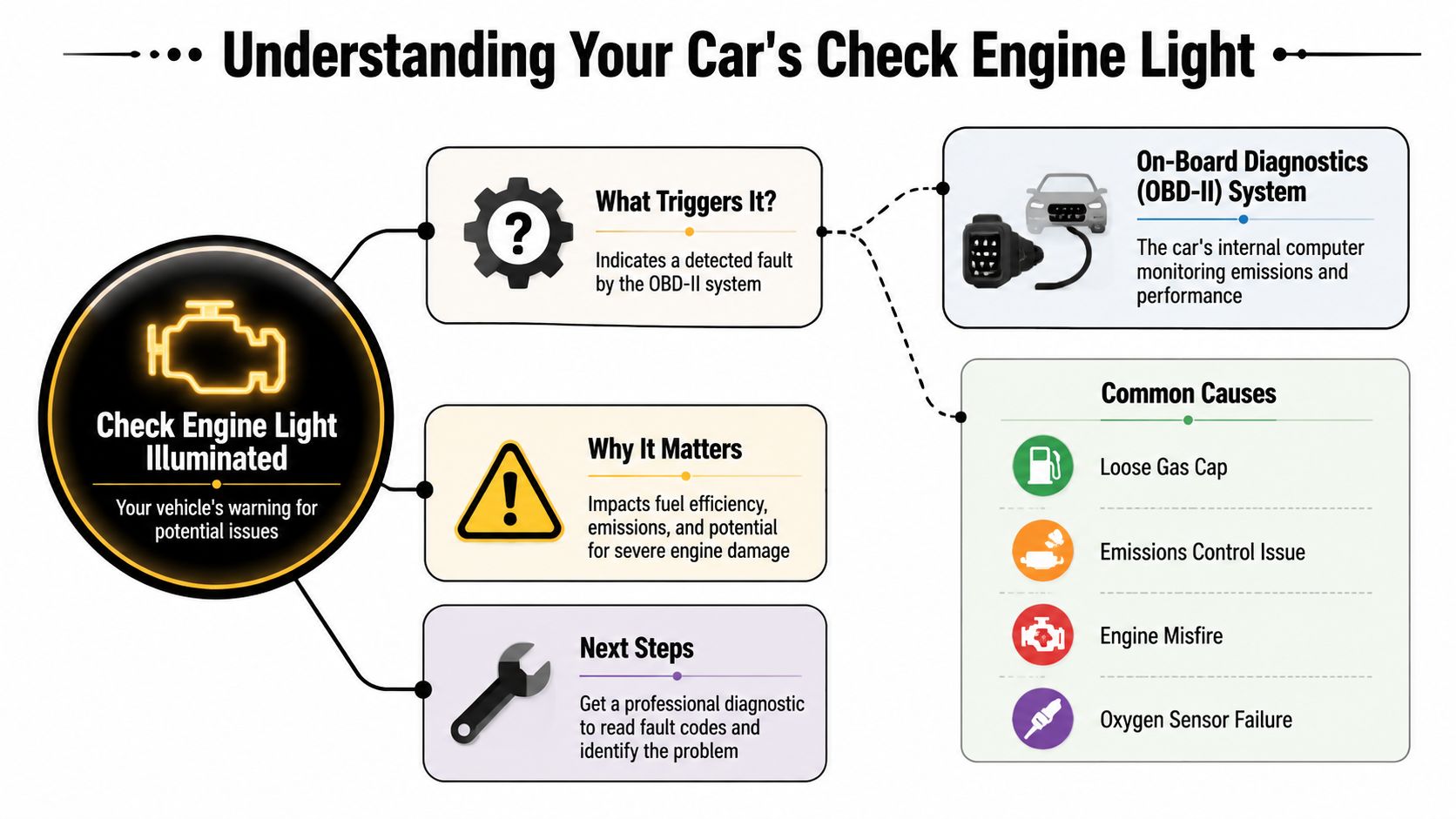
Your vehicle uses an OBD-II system, short for on-board diagnostics. It monitors engine operation, sensor signals, fuel control, ignition behaviour, and emissions-related systems. When the computer sees something outside expected limits, it stores a fault code and can switch on the light.
That doesn't automatically mean the engine is about to fail. It does mean the car has seen a problem worth tracking.
Common reasons it comes on
Some causes are minor. Some are not. The light itself doesn't tell you which one you're dealing with.
- Loose or failing gas cap: Often tied to the EVAP system.
- Oxygen sensor fault: The engine computer may struggle to manage fuel trim properly.
- Misfire: This can come from spark plugs, coils, fuel delivery, compression issues, or wiring faults.
- Air intake leak: Unmetered air can upset the air-fuel mixture.
- Catalyst-related issue: Sometimes the converter is the problem. Sometimes another fault damaged it first.
A good outside reference on this is this roundup of expert advice on engine light issues, which explains why the same warning light can point to very different root causes.
Why code readers only tell part of the story
A parts-store scan or cheap handheld reader can be useful, but it rarely finishes the job. A code points to a system or condition. It doesn't automatically name the failed part.
For example, a fault that mentions lean operation doesn't prove you need an oxygen sensor. The problem could be a vacuum leak, intake issue, low fuel pressure, or something else changing the mixture.
Worth remembering: A trouble code is a starting point, not a repair plan.
When to act quickly
You shouldn't sit on the light for weeks hoping it goes away. If the light is flashing, the car is running rough, or fuel economy suddenly drops, get it looked at.
If you need a better understanding of what that warning means and what to do next, this page on an engine light on situation is a practical reference.
Professional Diagnostics and Repairs at Carmedics Autowerks
When a vehicle comes in with an emissions-related concern, the first job isn't replacing a part. The first job is finding the fault accurately.
What a proper diagnostic visit looks like
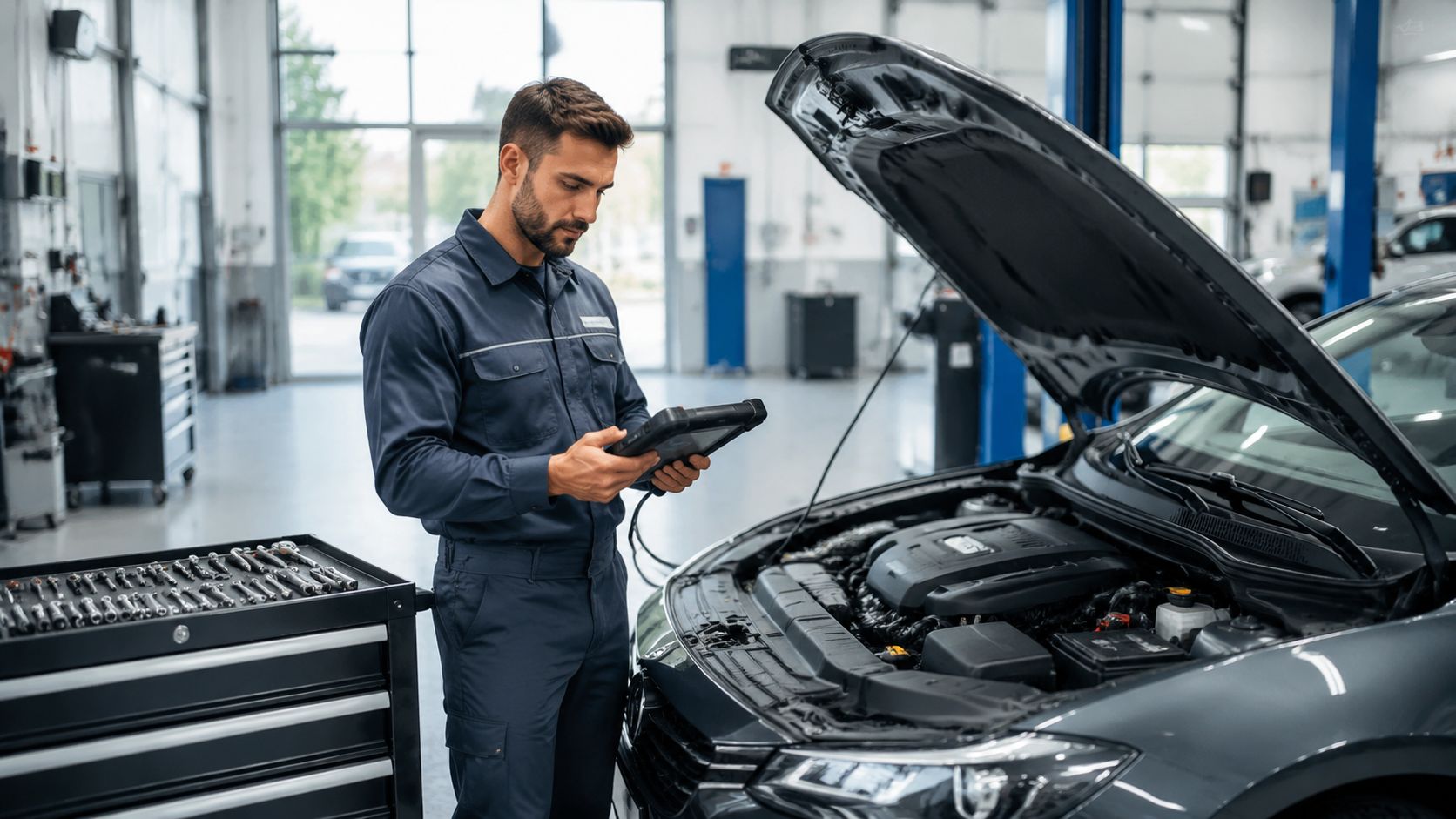
A technician starts by connecting a professional scan tool and checking stored codes, pending codes, and system data. That gives a direction, not a conclusion.
From there, the real work begins. The tech looks at freeze-frame information, live sensor readings, fuel trims, readiness status, and operating conditions tied to the complaint. Depending on the issue, the next step might be smoke testing the EVAP system, checking ignition output, inspecting wiring, verifying sensor signals, or confirming a vacuum leak.
Why experience matters more than the code
Many drivers encounter issues elsewhere. They're told what code showed up, a part gets installed, and the same light comes back.
A seasoned diagnostic process separates symptom, code, and cause.
For instance:
- A catalyst efficiency code may trace back to a long-term misfire problem.
- An EVAP leak code may come from a damaged hose, not the purge valve someone guessed at.
- A lean condition might be airflow-related rather than fuel-related.
- A recurring misfire can involve compression issues, not just ignition parts.
How repair decisions should be communicated
Drivers deserve a plain-language explanation. You should know what was found, how the fault was verified, what repair is recommended, and what happens if you delay it.
That's the difference between code-chasing and proper repair work. One approach tries to turn the light off. The other restores the vehicle's performance and reliability.
Good diagnostics save money by preventing unnecessary parts replacement.
If you want to know more about the shop itself, the Carmedics Autowerks Whitby location gives you a sense of the local service environment behind that process.
From Diagnosis to Done A Whitby Repair Scenario
Mark drives a midsize SUV around Whitby. Nothing dramatic happened. The vehicle still started, still drove, and still got him to work. But the check engine light came on, and he responded as many would. He searched auto emissions testing near me because he assumed some kind of local pass-or-fail test would tell him what was wrong.
That's not how it works anymore for most Ontario drivers, so the better move was a diagnostic appointment.
What the visit uncovered
The initial scan showed an evaporative emissions fault. That gave a direction, but not the answer. The follow-up testing narrowed it down to a leak in the EVAP side of the system.
That kind of issue is common enough to fool people. The SUV may run almost normally, but the computer still sees a problem and keeps the warning light on.
How the repair became clear
Instead of guessing, the technician verified the fault, explained the affected system in plain language, and outlined the repair needed to correct the leak. No mystery wording. No list of random parts.
Mark could see the difference right away:
- The diagnosis was specific: It named the actual issue, not just the code family.
- The explanation was understandable: He knew why the light was on and what the repair would fix.
- The repair path was focused: The work addressed the underlying fault rather than chasing symptoms.
After the repair, the warning light issue was resolved and the SUV returned to normal operation.
That's what most drivers want. Not a lecture. Not vague guesses. Just a clear answer and a proper fix.
If your situation points to a deeper mechanical issue rather than a minor fault, this engine repair service page gives a clearer picture of what that next step can involve.
Emissions and Vehicle Health FAQ
Do I need an emissions test to renew my regular passenger vehicle in Ontario
For most everyday drivers, no. That's the biggest reason people searching auto emissions testing near me end up confused.
Why is my check engine light still important if there's no routine test
Because the light usually points to a fault affecting drivability, efficiency, or emissions performance. The province may not require a routine test for your vehicle, but the car still monitors itself.
I'm selling my vehicle. Should I still get it checked
Yes, if you want to understand its condition before listing it or handing it over. An inspection can uncover issues that would otherwise become a last-minute negotiation problem.
Does a used vehicle buyer benefit from diagnostics
Absolutely. A road test alone won't always reveal stored faults, intermittent misfires, EVAP leaks, or sensor problems.
Are classic or enthusiast vehicles worth checking for emissions-related issues
Yes. Even if a vehicle isn't subject to a formal testing requirement, rough running, fuel smell, smoke, or poor tune quality are still signs the engine needs attention.
What if the car seems fine but the light is on
That's common. Many emissions-related faults don't create an immediate drivability complaint. The system can detect a problem before the average driver feels one.
Is every shop that works on cars also an emissions test centre
No. Shop capabilities vary. It's always worth confirming whether you need diagnostics, a repair inspection, or a specific commercial testing service.
Can a repair shop help even if it isn't an official heavy-duty diesel test facility
Yes. A repair shop can still inspect symptoms, diagnose warning lights, and repair many faults affecting engine operation and emissions-related systems. If you operate a vehicle that falls under a separate commercial or diesel requirement, confirm the exact service you need before booking.
If your vehicle has a warning light on, smells rich, runs rough, or just doesn't feel right, book a diagnostic visit with Carmedics Autowerks Inc. Whitby drivers don't usually need the old emissions test anymore, but they do need accurate answers when a vehicle starts showing signs of trouble.