


The first real heat wave in Whitby has a way of exposing problems fast. You leave work, the sun has been baking the car all afternoon, you start it up, hit the AC button, and instead of relief you get warm air and that stale smell that says something isn’t right.
That moment is frustrating because car air conditioning often feels mysterious to drivers. It’s hidden behind the dash, under the bonnet, and packed with components drivers rarely see. When it stops working, it’s hard to tell whether you’ve got a small maintenance issue or a repair that needs proper tools.
If you’ve been searching for air conditioning for car advice and finding the same vague tips repeated everywhere, this guide is for you. I’m going to explain it the way a seasoned Whitby mechanic would at the service counter. Plain language. Clear examples. No fluff. You’ll learn how the system cools the cabin, what common failures look like, what you can safely check yourself, and where expert diagnostics become necessary, especially in Ontario’s harsh climate.
That First Hot Day Your Car AC Gives Up
Around here, AC problems rarely announce themselves on a mild spring morning. They show up on the first sticky day when traffic on Dundas is crawling, the cabin is heating up, and the fan is blowing air that feels like it came from a hair dryer set on low.
That catches people off guard because the system may have seemed fine when the weather was cooler. In Ontario, a car can sit through deep winter cold, then suddenly get asked to deliver cold air during humid summer heat. That swing puts stress on seals, hoses, and moving parts. A weak system can hide for months, then fail the day you need it most.
A lot of drivers describe the same pattern:
- It cooled last summer, so I assumed it was fine
- The fan still works, but the air isn’t cold
- The airflow is weak, noisy, or smells musty
- The AC comes and goes depending on the drive
None of those clues means exactly the same thing. That’s where people get confused. The fan, the refrigerant, the compressor, the cabin filter, and the controls all affect cabin comfort, but they don’t fail in the same way.
Practical rule: If your AC suddenly stops cooling on the first hot day, don’t assume it only needs a quick recharge. Warm air is a symptom, not a diagnosis.
There’s also a local wrinkle that generic articles miss. Southern Ontario heat often arrives with humidity, stop-and-go traffic, and long idling periods. That combination makes a borderline AC system feel much worse than it did during a quick test in the driveway.
The good news is that once you understand the basics, the system stops feeling like a black box. You can listen better, describe the problem more clearly, and avoid wasting money on guesswork.
How Your Car's AC System Actually Works
Think of your car’s AC as a refrigerator on wheels. It doesn’t create cold out of nothing. It removes heat from inside the cabin and moves that heat outside. That one idea makes the whole system easier to understand.
Automotive air conditioning has been around a long time, but it wasn’t always common. Packard Motor Company pioneered factory-installed air conditioning in 1939, but the feature remained a rare luxury until the 1960s. By 1969, 54% of domestic automobiles in North America were equipped with air conditioning, which marked the shift from luxury option to normal equipment, as noted in the history of automotive air conditioning.
Here’s the cooling cycle in a form you can picture.
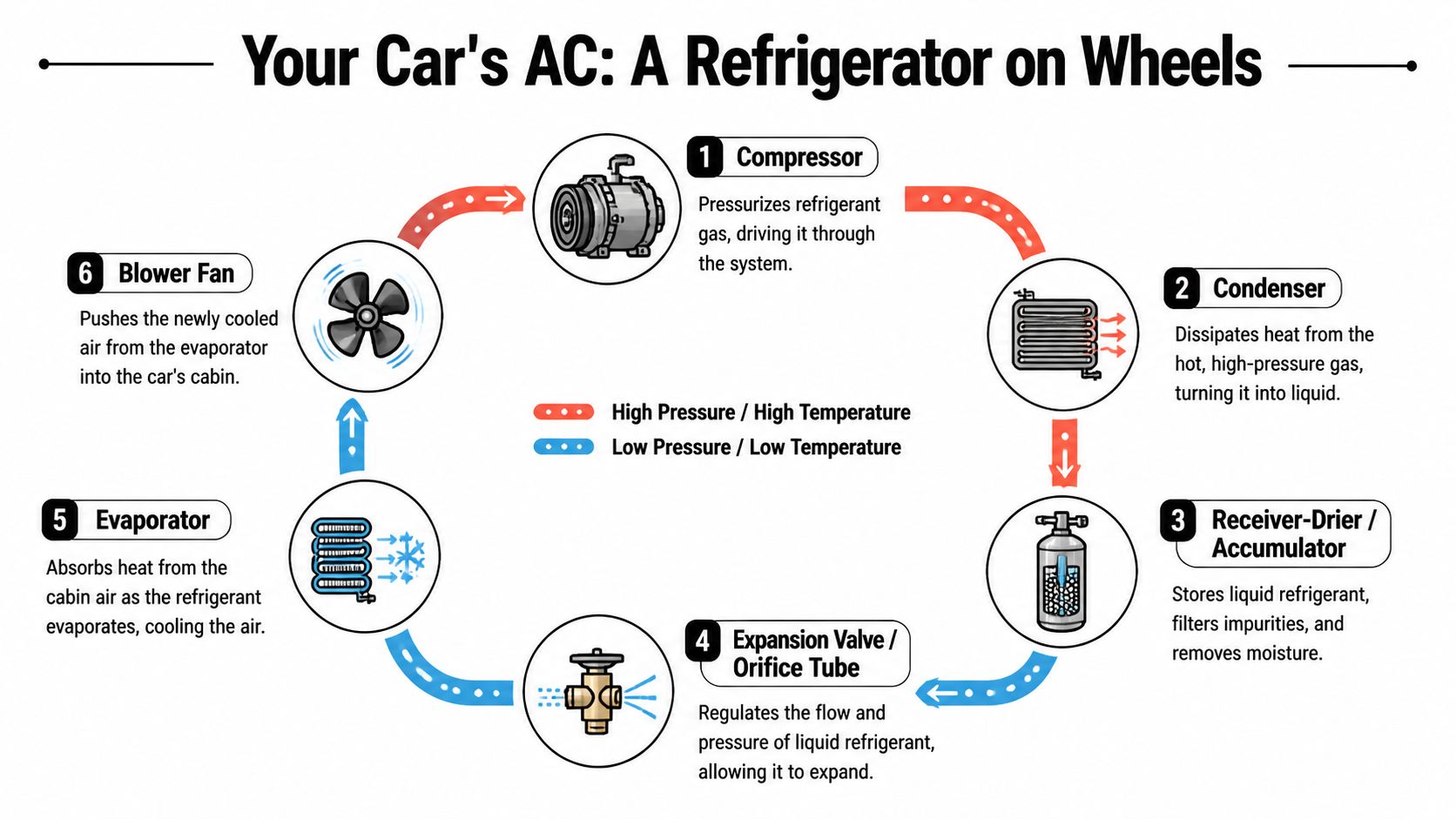
The basic idea
Your AC system circulates refrigerant in a closed loop. That refrigerant changes pressure and changes state as it moves through the system. When it changes the right way, it absorbs heat from the cabin and releases that heat outside the vehicle.
If that sounds technical, use this simpler picture. The system has a pump, a cooler, a filter, a tiny restriction point, and a cold coil under the dash. Air blows across that cold coil, then into the cabin vents.
The key parts under the bonnet and behind the dash
The compressor is the heart of the system. It pressurizes the refrigerant and keeps it moving. If the compressor can’t build and move pressure properly, the rest of the system can’t do its job.
The condenser sits at the front of the vehicle and works a lot like a radiator. Hot, high-pressure refrigerant arrives there, and the condenser sheds heat to the outside air.
The receiver-drier or accumulator acts like a cleanup station. It stores refrigerant, filters debris, and helps manage moisture. Moisture is bad news inside an AC system because it interferes with normal operation and can damage components.
The expansion valve or orifice tube is the metering device. It controls how much refrigerant moves into the low-pressure side of the system. It functions as a carefully managed pinch point.
The evaporator is the cold coil hidden inside the HVAC box under the dash. Cabin air blows across it, heat gets pulled out of that air, and the cooler air comes through the vents.
The blower fan then pushes that cooled air into the cabin where you feel the result.
A healthy AC system is really a heat-moving system. If any one part can’t manage pressure, airflow, or moisture properly, cooling drops off quickly.
Why pressure matters so much
Most AC confusion comes from one thing. People hear “refrigerant” and picture it as fuel that gets used up. It isn’t supposed to be consumed. It circulates.
So if refrigerant is low, that usually points to a leak somewhere in the system. That leak might be obvious, or it might be small enough that only proper diagnostic tools can confirm it.
Pressure also explains why two cars can have the same symptom and need different repairs. One may have a weak compressor. Another may have a restricted component. A third may have low refrigerant from a leak.
That’s why a proper car AC repair diagnosis and service process matters more than guessing based on vent temperature alone.
Why the air can feel cold one minute and weak the next
Cooling depends on more than refrigerant flow. Airflow matters too. If the blower is weak or the cabin air filter is blocked, the evaporator may get cold, but not enough air moves across it into the cabin. Drivers often call that “bad AC” even when the refrigeration side is partly working.
That’s the tricky part with air conditioning for car systems. You’re feeling the final result at the vents, but the actual problem may be under the bonnet, behind the dash, or in the control system.
Common AC Problems and Their Telltale Symptoms
Most AC faults announce themselves through temperature, airflow, smell, or noise. If you pay attention to which of those changed first, you can describe the issue much more clearly when you book service.
This is the kind of symptom pattern mechanics listen for before we even open the bonnet.

Warm air from the vents
If the fan is blowing but the air never gets properly cold, a few common causes move to the top of the list.
- Low refrigerant from a leak often causes weak cooling or cooling that fades over time.
- A compressor problem can stop the refrigerant from circulating properly.
- A pressure or control issue may keep the system from engaging the way it should.
Drivers often say, “It just needs a top-up.” Sometimes the system is low, but the more useful question is why it became low in the first place. Refrigerant doesn’t normally disappear for no reason.
Weak airflow even when the AC light is on
Many people mix up cooling and air delivery. The system might still be producing cold air, but not enough of it is getting into the cabin.
Common suspects include:
- A clogged cabin air filter
- A blower motor issue
- Debris in the ventilation path
- An evaporator problem that affects airflow across the core
A simple clue helps here. If the air feels a bit cool but barely comes out of the vents, think airflow first. If airflow is strong but the temperature is wrong, think refrigeration side first.
If you can describe whether the problem is temperature or airflow, you’re already helping the technician narrow the fault faster.
Strange noises when the AC runs
AC systems should have some normal mechanical sound, but they shouldn’t clatter, grind, squeal, or click aggressively.
Listen for these patterns:
- Clicking at engagement can point toward clutch or control issues.
- Grinding or growling can suggest compressor or bearing trouble.
- Squealing from the belt area may indicate belt tension or pulley trouble.
Noise matters because it often means a part is failing mechanically, not just underperforming. That can turn a comfort issue into a bigger repair if ignored.
Musty or stale smells
That damp, gym-bag smell from the vents usually points to moisture-related buildup around the evaporator area or in the ventilation system. The AC removes humidity, so moisture management is part of normal operation. When drainage or cleanliness becomes an issue, mildew odours can build up.
If the smell is more persistent and tied to old smoke exposure, cleaning the vents alone may not solve it. A separate guide on tackling stubborn car smoke residue can help you sort out whether the odour is coming from the HVAC system, the cabin materials, or both.
Intermittent cooling
This one frustrates drivers because it makes them doubt what they’re feeling. The AC works on one trip, struggles on the next, then seems fine after the car sits.
Intermittent faults can come from:
- An electrical connection issue
- A compressor clutch that engages inconsistently
- Sensor or pressure-related controls
- A system that performs poorly once heat load rises in traffic
That last point matters in Whitby and the GTA. A marginal AC system may look acceptable on a short moving drive, then fall flat in heavy traffic when outside heat and under-bonnet temperatures climb.
If you need a proper fault check instead of guesswork, a focused auto air conditioning repair inspection is the practical next step.
DIY Health Checks Versus Professional Diagnostics
There are a few smart checks you can do in your driveway. They’re useful because they can spot obvious problems and help you explain the symptom properly. But there’s a hard line between basic observation and actual AC diagnosis.
That line matters because modern AC systems depend on pressure, refrigerant recovery equipment, electrical testing, and leak detection methods the average driver doesn’t have at home.
What you can safely check yourself
Start with the simple things. They’re often overlooked.
- Look at the cabin air filter. If it’s packed with dust and debris, airflow can drop badly.
- Check the condenser area at the front of the vehicle. Leaves, dirt, and road grime can block airflow through the fins.
- Listen when the AC is switched on. Note whether engine idle changes, whether you hear a click, and whether unusual noise starts immediately.
- Watch for obvious belt issues. If the accessory belt looks damaged or loose, the compressor may not be driven properly.
- Pay attention to patterns. Is the air warm all the time, only in traffic, or only on very humid days?
Those checks are safe because they involve observation, not opening the sealed refrigerant system.
What drivers should not try
Many DIY videos make AC work look easier than it is. The trouble is that a symptom like warm air can have several causes, and the wrong shortcut can muddy the diagnosis.
Don’t treat these jobs like casual driveway fixes:
Guessing with refill cans
Without pressure readings and leak detection, you’re guessing. If the system is low because of a leak, adding refrigerant doesn’t solve the actual fault.Mixing products or sealers
Quick-fix additives can create bigger headaches for later service and don’t replace proper repairs.Opening lines or fittings
The system is sealed and pressurized. That’s not a place for trial and error.
A proper diagnosis answers three questions. Is the system engaging, is pressure behaving normally, and where is refrigerant being lost if there’s a leak?
What a shop checks that you can’t see
Professional diagnostics go beyond “is it cold?” A technician may inspect for leaks, verify pressure behaviour, confirm compressor clutch operation, and evaluate whether the issue is mechanical, electrical, or airflow-related.
That’s where a dedicated car air conditioning service appointment becomes useful. A shop can separate a simple maintenance issue from a component failure before unnecessary parts get replaced.
A quick decision guide
| Situation | DIY check makes sense | Professional diagnosis makes sense |
|---|---|---|
| Weak airflow | Yes, inspect cabin filter and vent output | Yes, if airflow stays weak after basic checks |
| Warm air with strong fan | Limited | Yes, pressure and leak testing are needed |
| Bad smell from vents | Yes, note when it happens and inspect filter | Yes, if odour returns or moisture issues persist |
| New noise when AC is on | Listen and note the pattern | Yes, mechanical faults need inspection |
| Cooling comes and goes | Observe when it fails | Yes, intermittent faults need testing under load |
If you remember one thing, remember this. Observation is a DIY job. Diagnosis is usually not.
Understanding Refrigerants and Environmental Rules
Refrigerant is the part of air conditioning for car systems that confuses people most. Drivers hear terms like R-134a and R-1234yf, then assume they’re interchangeable. They aren’t.
What matters to you as the vehicle owner is simple. Your vehicle was designed for a specific refrigerant, the service equipment must match it, and the wrong approach can damage the system or create legal and environmental problems.
Why the refrigerant type matters
Older and newer vehicles may use different refrigerants. That affects service procedures, equipment, and what a shop has to do during inspection and recharge work.
The key practical points are:
- They can’t be mixed
- The system must be identified correctly before service
- The technician needs the right recovery and charging equipment
- What looks like a simple top-up is a controlled service procedure
That’s why AC work isn’t like adding washer fluid. Refrigerant has to be handled properly, recovered properly, and measured properly.
Why this is not a casual home repair
A sealed AC system is part mechanical system and part environmental responsibility. If refrigerant escapes because someone opens the system improperly, that’s not just messy. It’s harmful and avoidable.
Professional AC service exists for good reason. Shops use dedicated equipment to recover refrigerant, assess system condition, and recharge to the correct specification for that vehicle. That protects the components and helps prevent unnecessary release into the environment.
What this means in real life
If your car isn’t cooling well, the right next step isn’t asking, “Can someone just throw some refrigerant in it?” The better question is, “Which refrigerant does this car use, is the system leaking, and can it be serviced correctly?”
That wording may seem small, but it changes the whole approach. Instead of masking a symptom, you’re looking for the underlying fault while staying compliant with proper handling standards.
The refrigerant circuit is sealed for a reason. If it needs service, the problem is usually bigger than low charge alone.
For drivers, the takeaway is straightforward. Know that refrigerant type matters, know that mixing is not acceptable, and know that proper AC service requires certified handling and the right equipment.
AC Maintenance and Repair Costs for Whitby Drivers
Ontario is hard on vehicles in ways that don’t always show up in national advice. Winter cold, summer humidity, stop-and-go commuting, and long shoulder seasons all affect how AC systems age. A car can spend months in deep cold, then get pushed hard once temperatures climb.
That local pattern matters because extreme temperature swings from -30°C winters to +30°C summers significantly impact AC system longevity. Neglecting seasonal maintenance often leads to costly emergency repairs, while proactive AC system health checks can help prevent common failures like compressor burnout or premature refrigerant leaks, as described in this Ontario-focused AC maintenance discussion.
Why preventative service makes sense here
Think of your AC system like a set of seals, hoses, bearings, heat exchangers, and controls that all have to cooperate after months of not being used heavily. If one weak point has developed over winter, the first humid summer run can expose it immediately.
That’s why Whitby drivers benefit from a pre-summer inspection mindset. You’re trying to catch:
- Early leaks before cooling disappears completely
- Restricted airflow before the system struggles in traffic
- Noises or engagement issues before a compressor fails
- Drainage or odour concerns before the cabin starts smelling damp
This doesn’t mean every car needs major work every year. It means regular checks are cheaper and calmer than waiting for the first scorching day to reveal a larger fault.
The cost question people really want answered
People often ask for exact AC repair prices before the vehicle is tested. That’s understandable, but AC pricing depends heavily on the actual failed part, refrigerant type, labour access, and whether the job is maintenance, diagnosis, or component replacement.
Because the source material provided here doesn’t verify specific Whitby price figures, it’s more honest to frame cost this way:
- A basic inspection or service is usually far less costly than a major component failure
- Leak diagnosis can take time because small leaks are often the hardest to confirm
- Compressor-related repairs tend to be among the more significant AC jobs
- Ignoring weak performance often leads to a more expensive repair path later
If you want model-specific expectations, the useful move is to start with a proper inspection and then review car AC repair cost guidance and service options based on what the vehicle needs.
Estimated Car AC Repair Costs in Whitby 2026
| Service | Estimated Cost Range (CAD) | Typical Time Required |
|---|---|---|
| AC performance inspection | Varies by vehicle and fault | Usually shorter than major repair work |
| Refrigerant recovery and recharge service | Varies by refrigerant type and system condition | Often moderate shop time |
| Leak diagnosis and repair | Varies widely depending on leak location and parts involved | Can range from moderate to extended |
| Compressor replacement | Varies widely by vehicle, parts access, and related components | Often one of the longer AC jobs |
| Cabin air filter replacement | Usually lower than sealed-system repairs | Often relatively quick |
The table is broad on purpose. Broad is better than fake precision.
What usually saves money over time
The cheapest AC repair is often the one that stays small. If the system has started blowing a little warmer than usual, making an occasional noise, or struggling in traffic, that’s the moment to act.
A simple routine helps:
Run the AC before peak summer arrives
Don’t wait for the hottest day to test it.Pay attention to airflow and smell, not just temperature
Small changes often show up there first.Book service when symptoms are mild
Intermittent faults are easier to manage before they become complete failures.Avoid refill-can guessing
Shortcut fixes can delay proper diagnosis.
Small AC symptoms don’t stay small for long in an Ontario summer. Heat and humidity expose weak systems fast.
For Whitby drivers, that’s the practical cost lesson. Preventative checks are easier on your schedule, easier on your comfort, and often easier on your wallet than emergency midsummer repairs.
Why Trust Carmedics Autowerks with Your Car's AC
By the time an AC problem reaches the cabin, the actual fault may involve pressure, refrigerant handling, airflow, electronics, or mechanical wear. That’s why this work rewards careful diagnosis more than guessing.
A proper repair process matters because mistakes can become expensive quickly. Overfilling, misidentifying a fault, replacing the wrong part, or opening the system improperly can all turn a manageable issue into a larger one.
What good AC service looks like
Good air conditioning work starts with clear symptom reporting and proper testing. The technician should care about what you noticed first, when the fault appears, and whether the issue is temperature, airflow, smell, or noise.
A solid AC visit usually involves things like:
- Verifying the complaint under real operating conditions
- Checking whether the system engages correctly
- Inspecting airflow components as well as sealed-system components
- Looking for leaks rather than assuming refrigerant loss
- Explaining findings in plain language before major work begins
That last point matters. Drivers don’t need a lecture full of jargon. They need someone who can say, “Here’s what failed, here’s why, and here are your options.”
Why older vehicles need an even smarter approach
Classic cars and aging vehicles deserve special mention because owners often face a different question. Not “How do I repair the factory AC?” but “Should I restore, retrofit, or use an aftermarket workaround?”
That decision shouldn’t be based on the cheapest kit you can find online. For older vehicles, a professional OEM-style retrofit often provides better cooling efficiency, stronger long-term durability, and more resale value than portable or lower-quality aftermarket kits. Hidden costs such as extra labour and electrical modifications can make lower-end aftermarket routes a weaker long-term investment, as discussed by Restomod Air’s guidance on retrofit quality.
That’s an important point for enthusiasts in Whitby. A clean, properly integrated retrofit usually feels more like part of the vehicle. Portable or makeshift alternatives often solve one problem while creating others, such as poor airflow, untidy installation, or electrical headaches.
Why local experience helps
A Whitby-area shop sees how Ontario weather changes what AC ownership looks like. Long winters, humid summers, road grime, and seasonal usage patterns affect how systems behave and when they fail.
Carmedics Autowerks appears as one local option for Whitby drivers through its shop information and service location details. For AC work, the practical advantage of a nearby repair facility is simple. You can describe the issue in local driving terms, whether that’s traffic-heavy commuting, a weekend cruiser that sits through winter, or a newer daily driver that suddenly lost cooling during a humid stretch.
The right AC repair isn’t the fastest guess. It’s the repair that explains the fault clearly and fixes the cause instead of the symptom.
If you’ve made it this far, you already know more than most drivers do about air conditioning for car systems. You know the main parts, you know the common symptoms, and you know why Ontario climate changes the maintenance conversation. That knowledge helps you ask better questions, avoid bad shortcuts, and get the right repair the first time.
If your car’s AC is blowing warm, smelling musty, making noise, or just not keeping up with a Whitby summer, Carmedics Autowerks Inc can help you start with a proper inspection and a clear explanation of what your vehicle needs.