


That sharp tick on the 401 or Taunton usually feels minor for about five seconds. Then you see the chip. If you drive in Oshawa year-round, you already know the problem isn’t just the impact itself. It’s what happens after one cold night, one slushy commute, and one more pothole hit.
Drivers looking for auto glass oshawa ontario advice usually get generic tips that could apply anywhere. Oshawa isn’t anywhere. Local commuter traffic, winter road treatment, and the mix of older daily drivers and newer ADAS-equipped vehicles change how you should judge a chip, a crack, or a full windshield replacement.
Your Guide to Auto Glass Repair and Replacement in Oshawa
A lot of windshield damage starts the same way. A stone gets kicked up, you hear the hit, and you tell yourself you’ll deal with it later. In Ontario, “later” is where small damage gets expensive. Glass moves with temperature changes, and local winter conditions are hard on both the windshield and the seal around it.
Oshawa has also grown into a serious service market for vehicle owners. Between 2001 and 2006, the city’s population increased by 7.7%, which helped drive demand for auto services across Durham Region, including windshield repair and replacement, according to Auto Glass Oshawa’s local market overview. That matters because you now have more shop options, but not all of them handle modern glass work the same way.
If you own a commuter car, a pickup, or a newer SUV with cameras behind the windshield, the right approach comes down to a few practical questions:
- How bad is the damage really: A chip can be repairable today and replacement-only after one freeze-thaw cycle.
- Where is it located: Damage near the driver’s sightline or close to an edge changes the decision fast.
- What else is tied to that glass: Rain sensors, lane assist cameras, tint, and protective film all affect the job.
- Who is doing the work: A general mechanical shop may inspect related issues, while a glass-focused technician handles the bonding, trim, and calibration side differently. If you’re comparing providers, it helps to understand the broader auto repair landscape in Oshawa Ontario.
Practical rule: Treat every fresh chip in winter as time-sensitive, even if it looks small.
The goal isn’t just to stop a crack. It’s to protect visibility, keep the vehicle structurally sound, and avoid hurting resale appeal with sloppy glass work.
Decoding Windshield Damage in an Ontario Climate
A windshield doesn’t fail in one dramatic moment most of the time. It usually starts with a small impact point, then spreads because the glass keeps getting stressed. In Oshawa, that stress comes from temperature swings, road vibration, slush spray, and the residue left behind by winter road treatment.
There’s also a local information gap here. UniglassPlus Oshawa’s local page notes that there is currently little to no content explaining how Ontario’s climate and winter road-salt regimen meaningfully increases windshield micro-cracking and how this affects long-term safety and resale value for drivers in Oshawa and Durham Region.
What the common damage patterns look like
When you know the pattern, you can judge urgency much faster.
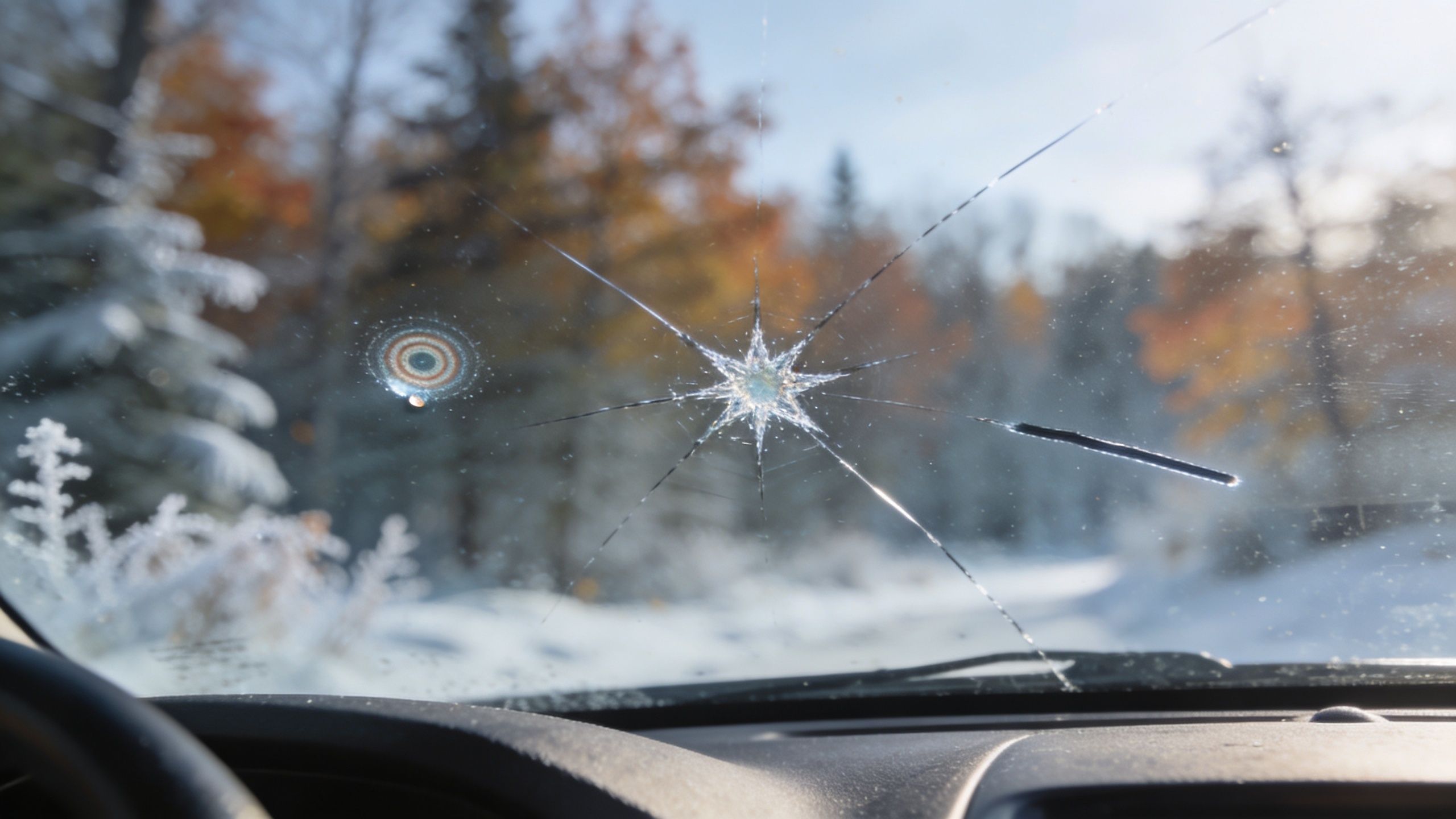
- Bullseye: This looks like a small circle around the impact point. It’s one of the cleaner chip types and is often repairable if caught early.
- Star break: Small legs radiate outward from the centre. These spread more easily because stress already has a path to follow.
- Combination break: Part bullseye, part star. These are less predictable and often worsen after rough driving or cold exposure.
- Surface pit: The outer layer takes the hit but doesn’t fully crack at first. These get ignored too often.
- Running crack: Once a crack starts travelling, the repair conversation usually changes quickly.
Why Ontario weather makes minor damage worse
Freeze-thaw cycling is hard on damaged laminated glass. Moisture gets into the chip, temperatures drop, the trapped moisture and surrounding layers react, and the damaged point expands under stress. Then the glass warms up again and shifts back. Repeat that over several commutes and the crack line often grows.
Road salt adds another problem. It doesn’t just make everything dirty. Salt-laden spray sticks around the glass perimeter and trim, and that grime can sit where the windshield meets the body. That doesn’t automatically mean instant failure, but it does create a harsher environment for the edges and seals.
If a chip has sharp legs, sits near the perimeter, or catches your fingernail, don’t “monitor it” through an Ontario cold snap. Book it.
What drivers usually get wrong
The most common mistake is judging damage by diameter alone. A small star break near the edge can be more serious than a larger-looking pit in the middle. The second mistake is cleaning too aggressively. Scraping, pressing, or blasting hot defroster air at a cold damaged spot can make things worse.
For resale, buyers notice glass quality fast. They may not know the trade terms, but they do notice distortion, visible repairs in the sightline, and poor trim fitment around a replacement windshield.
Repair or Replace Your Windshield The Smart Decision
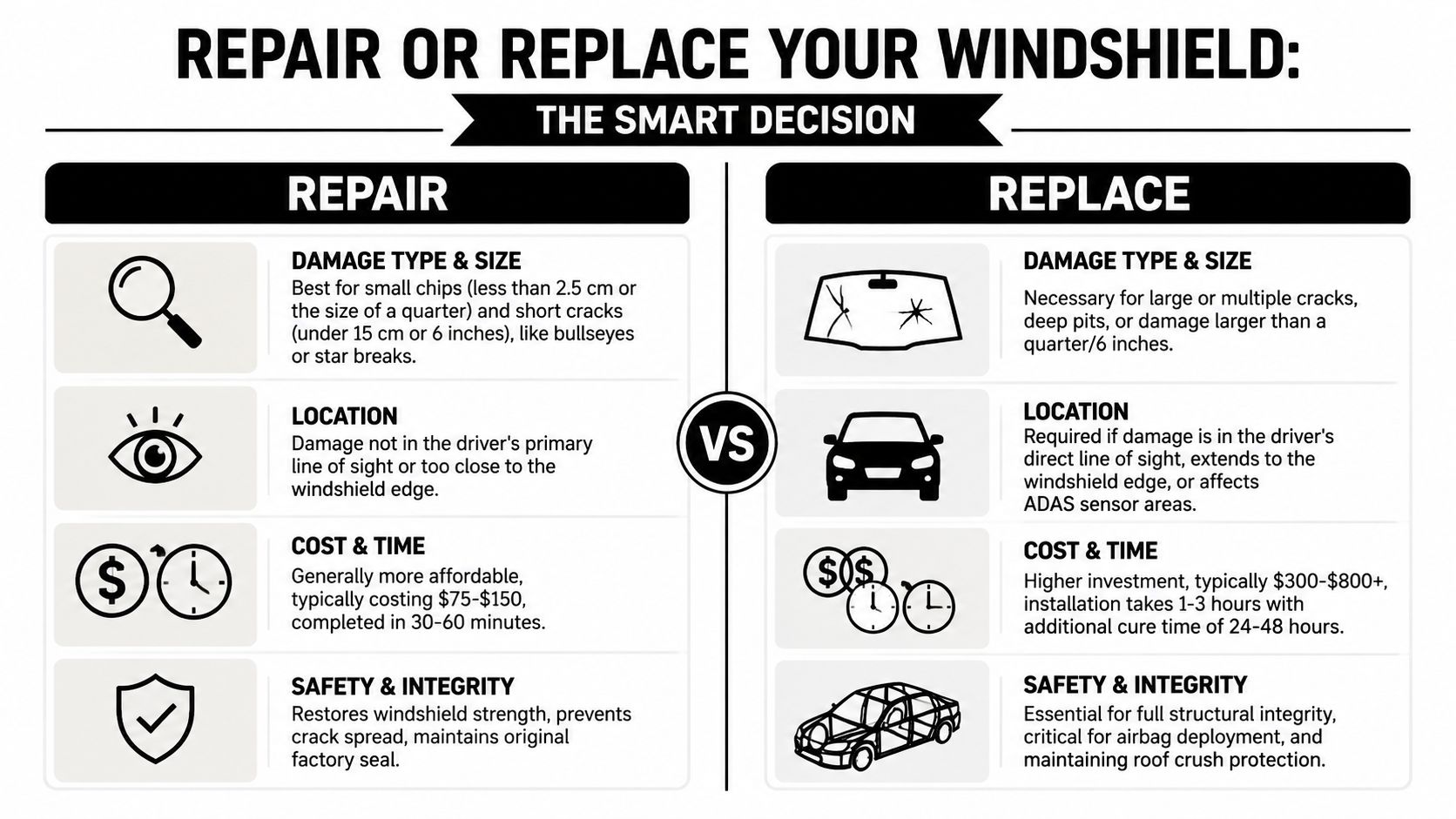
You don’t need a complicated formula to make the call. You need a clean view of three things: size, location, and crack behaviour. A repair saves the original factory-installed glass when the damage is stable and away from critical areas. Replacement makes sense when safety, visibility, or structural reliability are already compromised.
Start with a familiar benchmark. If the damage is around the size of a toonie or smaller, many drivers assume it’s automatically repairable. That’s not always true. A small chip in the wrong place can still justify replacement.
The decision points that actually matter
Here’s the quick version technicians use in practice:
| Factor | Choose Repair If… | Choose Replacement If… |
|---|---|---|
| Damage type | It’s a contained chip such as a bullseye or limited star break | It’s a long crack, multiple breaks, or damage with spreading legs |
| Location | It sits outside the driver’s main line of sight and away from the edge | It interferes with visibility, reaches the edge, or sits in a sensitive camera area |
| Glass condition | The surrounding glass is stable and the laminate hasn’t been heavily stressed | The glass shows wider stress, repeated impact points, or signs the crack is moving |
| Vehicle tech | No mounted systems are affected by the damaged area | The windshield supports ADAS hardware, rain sensors, or bracketed equipment in the affected zone |
| Goal | Preserve original glass and stop spread early | Restore full clarity, structural confidence, and proper system function |
What repair does well and where it falls short
A proper resin repair works best when the goal is to stop the chip from spreading and restore usable strength. It also keeps the original factory seal in place, which many enthusiasts prefer when the damage qualifies for repair.
What repair does not do is make every chip disappear. Most good repairs become less noticeable, not invisible. Star breaks usually leave some trace because light still catches the fractured pattern.
A repair is successful when it stabilises the damage and keeps the windshield in service safely. Cosmetic perfection is a bonus, not the standard.
When replacement is the smarter move
Replacement is the right move when the windshield can no longer do its full job. That includes clear vision, structural support, proper bonding to the body, and compatibility with mounted systems. If damage runs to the edge, I’d rather replace it than sell someone a repair that only delays the obvious.
For drivers comparing long-term value, it also helps to think beyond today’s bill. A compromised windshield can lead to another booking, another lost day, and more frustration if the crack keeps growing. Preventive thinking matters, especially if you’ve already had a chip and want to avoid repeat damage. A useful reference is this breakdown of windshield protection film vs replacement and which saves more time and money.
Navigating Costs and Insurance for Auto Glass in Ontario
Most drivers ask about price right after they hear “replace.” Fair enough. But the invoice isn’t just about the sheet of glass. It can include mouldings, clips, adhesive, disposal, sensor handling, and post-install procedures depending on the vehicle.
One useful local benchmark is service speed. Auto Glass Oshawa states that it completes stone chip repairs in under 60 minutes and offers same-day windshield replacement and repair services. That gives you a realistic sense of how quickly basic jobs can move when the part and schedule line up.
What changes the final cost
A simple chip repair is usually priced very differently from a full replacement because the labour, materials, and risk are different. The biggest variables are:
- Vehicle complexity: Newer vehicles often have more trim, brackets, sensors, and tighter installation tolerances.
- Glass type: Shops may offer OEM, OEM-equivalent, or aftermarket glass. The right choice depends on fit, optics, budget, and whether the vehicle has system-sensitive hardware.
- Extra procedures: Some cars need more than glass installation to be road-ready again.
- Mobile versus in-shop work: Mobile service is convenient, but weather and workspace conditions can affect what’s practical on the day.
How insurance usually plays out
In Ontario, the key question is whether your policy includes coverage that applies to glass damage. From there, the practical issue becomes your deductible and whether making the claim makes sense compared with paying out of pocket. The cleanest way to handle this is to ask the shop and your insurer the same questions, then compare the answers.
Use this short checklist before authorising work:
- Ask what your policy covers for glass.
- Confirm whether your deductible applies to this claim.
- Find out if the shop bills insurance directly or you pay first.
- Get the exact scope of work in writing.
- Ask whether calibration or sensor-related procedures are included.
If the damage is tied to a broader collision event rather than a simple road impact, the paperwork gets more layered. In that situation, this guide on dealing with car accident insurance is a practical companion for organising the claim side before details get muddled.
Don’t choose glass by price alone. Cheap glass with poor optics, weak fitment, or loose standards on adhesive cure time can cost more in aggravation than you save at the counter.
Why ADAS Calibration is Non-Negotiable After Replacement
If your vehicle has lane departure warning, forward collision support, traffic sign recognition, or automatic high-beam functions, there’s a good chance the windshield is part of that system. The camera often sits behind the glass, looking through a very specific mounting area. Change the glass, shift the bracket position slightly, alter the optical path, or interrupt the setup around it, and the system may no longer read the road the way it should.
That’s why calibration isn’t an upsell line item to shrug off. It’s part of restoring the vehicle to proper operating condition.

Why this matters more on newer vehicles
According to Autoglass Brilliant’s summary of Canadian Vehicle Manufacturers’ Association data, 2023–24 model years in Ontario increasingly feature advanced driver-assistance systems (ADAS) that rely on cameras and sensors mounted behind the windshield, which are sensitive to improper glass-replacement, tinting, or PPF installation.
That one point changes how you should evaluate any auto glass oshawa ontario shop. The glass is no longer just a panel. It’s part of a safety system.
What goes wrong when calibration is skipped
A small alignment error can create bad inputs. The camera may “see” lane markings at the wrong angle. Following distance support may react late or oddly. Automatic emergency functions may not behave the way the driver expects.
You might not notice it pulling out of the parking lot. You notice it on the road, in weather, in traffic, when you trust the system to assist.
- Poor lane positioning: The car reads lines inconsistently.
- False alerts: Warnings appear when there’s no real issue.
- Missed detection: The system fails to react when it should.
- Driver overconfidence: The most dangerous part is assuming everything works because no warning light appeared.
Calibration is about system accuracy, not just clearing a dashboard message.
Glass replacement, tint, and PPF have to work together
Many shops still think in silos. One shop replaces the windshield. Another applies tint. Another installs protective film. On a modern vehicle, those jobs affect each other.
If you’re running a newer SUV or performance-oriented daily, the clean process is coordinated from the start. The installer needs to know what sits behind the windshield, what can be applied where, and what can’t interfere with camera views or legal tint limits. That overlap is one reason some owners also look at shops that handle related systems work, such as auto electrical repair in Whitby, because modern vehicles rarely separate electronics from body and glass work cleanly.
Questions to Ask Your Oshawa Auto Glass Shop
A good shop won’t get irritated by detailed questions. They’ll answer them clearly. If the answers are vague, rushed, or evasive, keep looking.
The questions that reveal how the shop really works
Bring this list with you or keep it on your phone:
- What type of glass are you quoting me for: Ask whether it’s OEM, OEM-equivalent, or aftermarket, and ask why that option suits your vehicle.
- Will this vehicle need ADAS calibration after replacement: If the answer is “probably not” without checking the model and equipment, that’s a red flag.
- What adhesive are you using and what is the safe drive-away time: You want a direct answer, not “you’re probably fine in a bit.”
- Are you replacing mouldings, clips, and any damaged trim as needed: Reusing tired parts can lead to noise, leaks, or poor fit.
- How do you protect paint and the pinch weld during removal: Sloppy cut-out work can create rust problems later.
- What does your workmanship warranty cover: Ask specifically about leaks, wind noise, and installation defects.
- Do you do the calibration in-house or send it out: Either can work, but they should explain the process confidently.
- How do you handle mobile jobs in bad weather: A serious shop has a plan, not just a promise.
What a solid answer sounds like
You’re listening for specifics. Not polished sales language. A competent estimator or technician should be able to explain the sequence, the materials, and the limitations of the job in plain English.
One useful comparison point is to review general shop selection advice like this guide on how to find the best car repair shop near me. The same logic applies here. Clear communication, defined processes, and no guessing.
For owners who want glass work tied into other protection services, a shop such as Carmedics Autowerks can also be relevant because it handles auto repair, window tinting, and PPF in the Durham area. That matters when you want one conversation about fitment, legal compliance, and protecting the rest of the vehicle rather than separate guesses from separate vendors.
Protecting Your Investment and Staying Safe on the Road
The right move after windshield damage is usually the fast move. Not the rushed move. Fast means you inspect it, judge the location properly, and get a proper recommendation before Ontario weather turns a repairable chip into a full replacement.
The second part is thinking beyond the glass itself. On modern vehicles, the windshield affects visibility, cabin sealing, structural support, and driver-assistance hardware. On enthusiast-owned cars, it also affects appearance and resale confidence. Buyers notice poor installs.
If you want to reduce repeat damage and keep the front of the vehicle better protected, it’s worth looking at options beyond basic replacement, including windshield film protector solutions. The smartest owners in Oshawa and Whitby treat auto glass as one part of a broader protection plan, especially when the vehicle also runs PPF, tint, and camera-based safety tech.
Frequently Asked Questions About Oshawa Auto Glass Services
Will a windshield chip repair be invisible
Usually not. A good repair often makes the damage far less noticeable, but many chips still leave a faint mark. The goal is to stabilise the glass and reduce visibility of the damage, not promise a showroom-perfect disappearance.
Is mobile windshield service always a good idea
Not always. Mobile service is convenient, especially if the vehicle isn’t safe to drive. But weather, temperature, wind, workspace, and lighting all matter. Some jobs are better done indoors where the technician can control the environment and inspect fitment more carefully.
What does a lifetime workmanship warranty usually mean
It usually refers to installation-related issues such as leaks, wind noise, or defects tied to the workmanship. It often does not cover a new rock hit, fresh impact damage, or unrelated body movement. Ask the shop to explain the warranty in plain language before you book.
Can I wash the car right after a windshield replacement
It’s better to follow the shop’s aftercare instructions exactly. The adhesive needs proper time and conditions to settle. High-pressure washing too soon can create unnecessary stress around fresh trim and seals.
Does tint or protective film affect windshield systems
It can if the product choice or installation area interferes with cameras, sensors, or legal visibility requirements. That’s why glass replacement, tinting, and PPF should be planned together on newer vehicles instead of treated as unrelated add-ons.
If you want practical help from a local shop that works on auto glass, tint, PPF, and general vehicle repair in the Durham area, contact Carmedics Autowerks Inc and ask for a clear assessment of the damage, the replacement process, and any calibration or protection steps your vehicle may need.