

You’ve just bought a new car. The paint is clean, the cabin still has that new-car smell, and the next upgrade on your list is window tint. That part is easy.
The confusing part starts the moment you search the laws.
One site says your front windows can be darker. Another says no tint at all. A forum thread insists “factory tint is different,” but never explains why. Then you remember you drive in Ontario, but you also head into Quebec a few times a year, and now a simple cosmetic upgrade feels like something that could turn into a ticket.
The Allure of Tint and The Reality of the Law
Most drivers want the same things from tint. A cleaner look. More privacy. Better cabin comfort. Less harsh sun on leather, trim, and screens. On a new vehicle, it also feels like part of protecting the investment, especially if you’ve already started looking at film options and wondered whether ceramic tint is worth it.
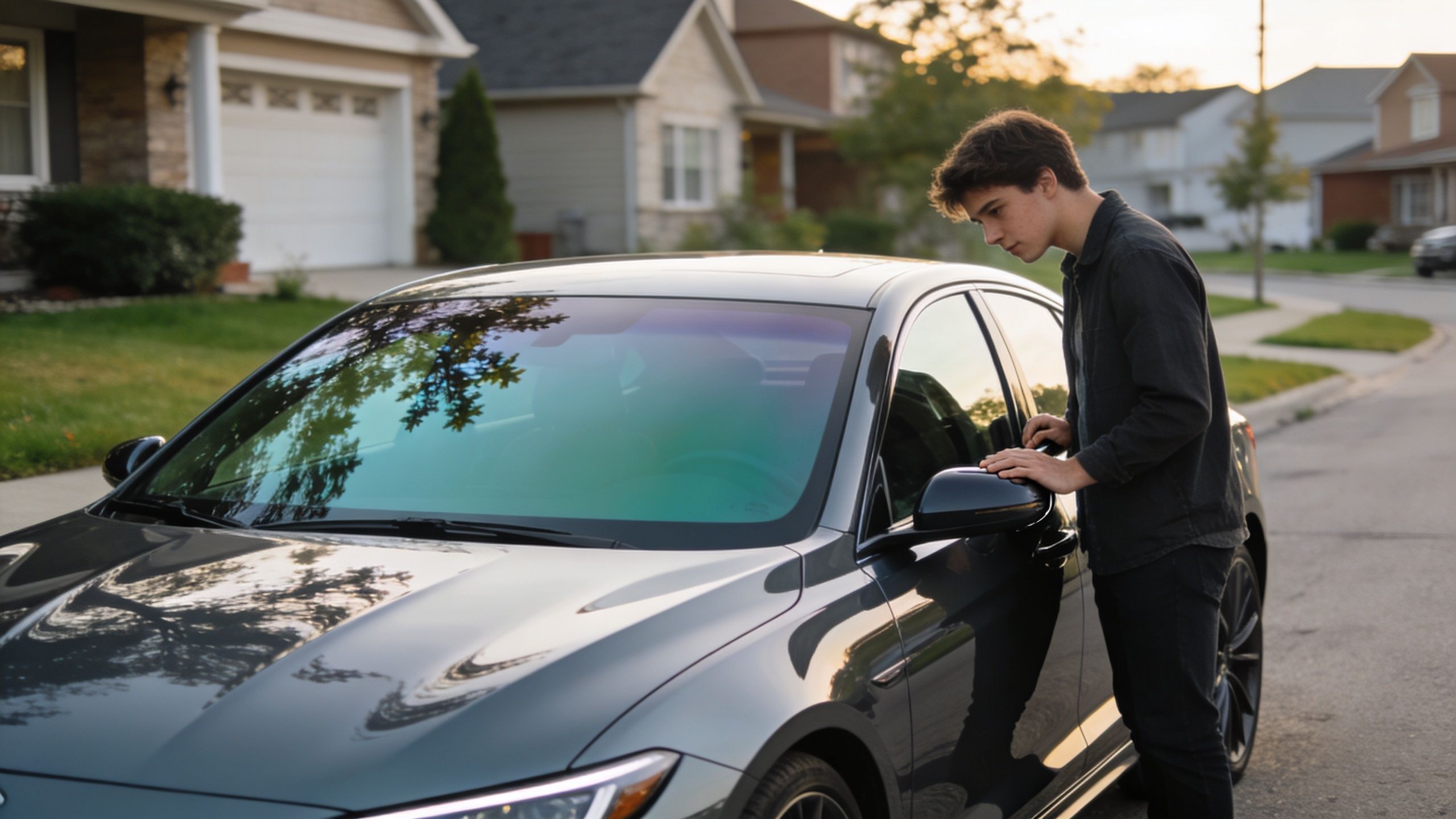
The problem is that window tinting laws in canada aren’t one simple national rule you can memorise once and forget. They work more like a patchwork. What passes in one province may create trouble in another, and the front windows are where most drivers get caught out.
From the shop side, I can tell you where people usually go wrong. They focus on how dark the film looks on the sample card. The law focuses on Visible Light Transmission, or VLT, after the film and the glass are combined. Those are not the same thing.
Practical rule: The legal answer usually isn’t “What film percentage did you buy?” It’s “What does the finished window meter at once the film is installed?”
A second mistake is assuming rear-window freedom means front-window freedom too. In many cases, it doesn’t. Canadian law tends to be much more restrictive at the front of the vehicle because that’s where driver visibility matters most, especially at night, in rain, and in winter glare.
If you want a smart result, you have to treat tint as both a styling choice and a compliance job. That’s how you avoid paying twice. Once for the install, and again to remove it.
Understanding Canada's Two-Layer Tint Law System
The biggest source of confusion is that two different rule sets affect your windows.
One applies when the vehicle is built. The other applies when you modify it after purchase.
Factory rules and aftermarket rules aren’t the same
A simple way to think about it is house construction. The builder has to follow one set of codes when the home is constructed. Later, if you renovate, your municipality may have its own bylaws and permit rules. Vehicles work in a similar way.
Federal standards apply to manufacturers. Provincial road-use laws apply to drivers and aftermarket changes. That’s why a vehicle can leave the factory with compliant glass, but that doesn’t mean you can automatically replicate the same look with add-on film.
Ontario is a good example of that distinction. One source notes that Ontario bans aftermarket windshield tint and requires 70% VLT on front side windows, while factory tints are treated differently under the Canada Motor Vehicle Safety Act framework. It also notes that post-2017 vehicles can’t exceed 30% block on the sides when checked by police meter, while older vehicles are treated differently in enforcement practice, which is exactly why factory versus aftermarket confusion keeps coming up for drivers (Audiomotive’s Ontario tint overview).
Why drivers get tripped up
A new-car owner sees slightly shaded glass from the factory and assumes adding a “light” film should still be fine. Sometimes it is. Sometimes it isn’t. The answer depends on the total VLT after installation, not on how harmless the film looks on its own.
That’s why it helps to understand automotive window tint percentages before you choose a film. A film can seem light in the roll and still push the finished glass below the legal threshold once it’s layered over factory glass.
Here’s the distinction that matters in practice:
- Factory glass: Built into the vehicle and governed at the manufacturing level.
- Aftermarket film: Added later and judged under provincial traffic laws.
- Roadside enforcement: Officers don’t care what the sales brochure called the glass. They care what the finished window reads.
If the meter says the front side glass is too dark, “but it came that way” often turns into a longer conversation than drivers expect.
What this means before you tint
If you’re shopping for film, don’t start with a colour swatch or a photo on Instagram. Start with three questions:
- What province do you register and drive in most often?
- How much light does your existing front glass already transmit?
- Will the finished combination still be legal once measured?
That approach saves you from the most common bad outcome in tinting. A vehicle that looks sharp in the parking lot but isn’t legal on the road.
Provincial Window Tinting Laws A Detailed Comparison
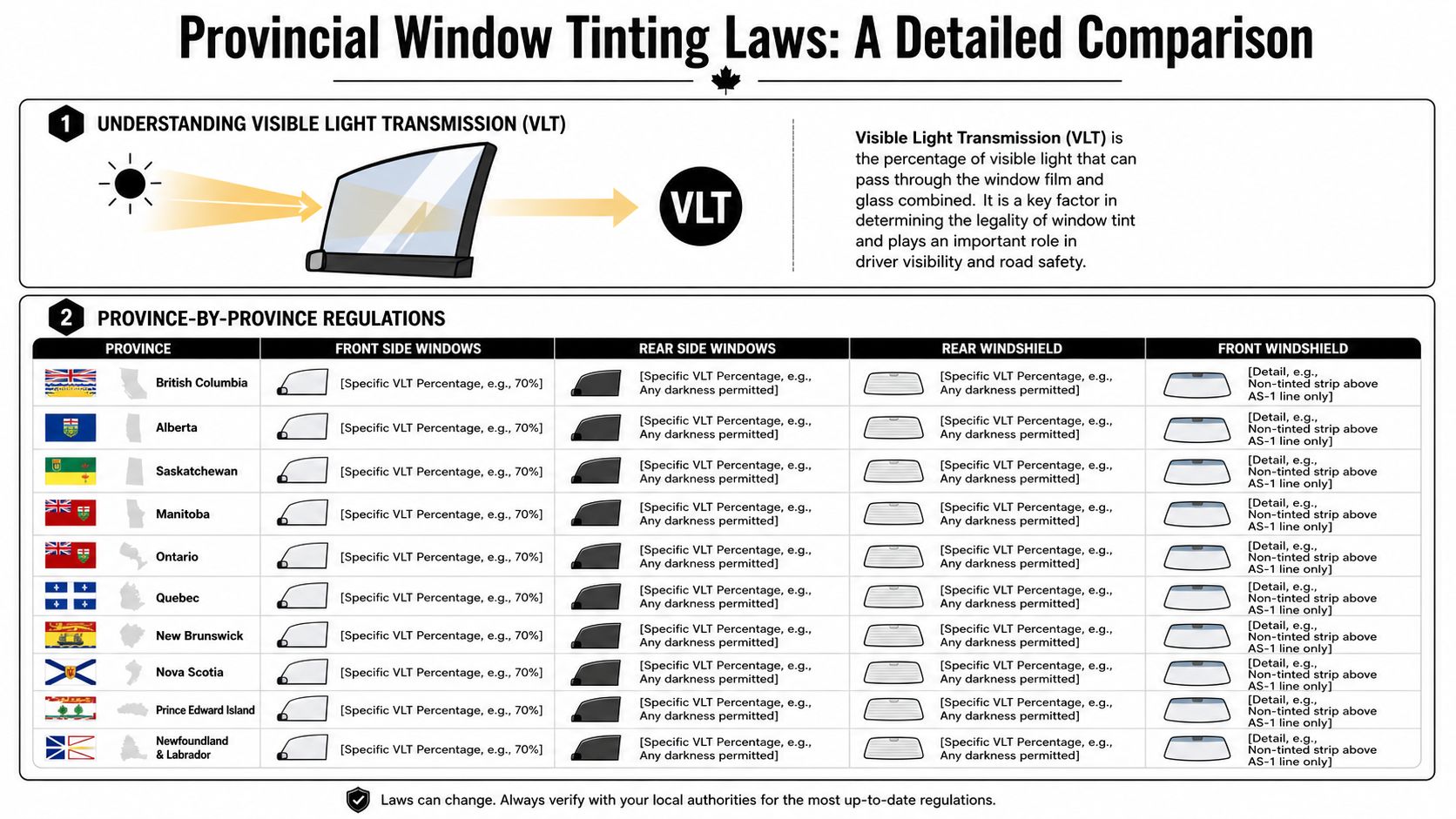
A driver buys a new SUV in Ontario, adds front tint that looks light enough, then heads to Montreal for a weekend trip. The car may pass casual inspection at home and still draw attention in Quebec. That is the practical problem with tint law in Canada. The rules are provincial, enforcement is local, and the finished glass is what matters on the road.
VLT means Visible Light Transmission. It is the percentage of light that passes through the completed window. Glass plus film. Higher VLT is lighter. Lower VLT is darker. If you want a quick reference before comparing provinces, this guide to the legal window tint percentage in Canada helps frame the numbers properly.
Canadian provincial and territorial window tint laws 2026
Instead of filling a national chart with gaps, it is more useful to separate provinces into two groups. First, provinces where the front-window rule is clear enough to shape an install decision. Second, provinces and territories where drivers should confirm the current wording before film goes on the car.
| Province | What drivers should know before tinting |
|---|---|
| Ontario | Public summaries can conflict on front side window limits, which is exactly why Ontario drivers should verify the rule being enforced and meter the finished glass before leaving the shop. Rear glass is generally treated more flexibly than front glass. Windshield tint is tightly restricted. |
| Quebec | Quebec is one of the clearest examples of a strict front-window standard. Front side windows must remain light enough to meet a high VLT threshold, while rear side and rear windows are treated more permissively. Police can measure the glass at roadside, so guesswork is a bad strategy. |
| Manitoba | Public summaries commonly place Manitoba in the stricter group for front side windows. That makes it a province where conservative front tint choices are the safer call. |
| Alberta | Alberta is often discussed because of medical exemption questions. Standard tint limits should still be checked against current provincial guidance before booking the work. |
| British Columbia | Confirm current provincial wording before installation, especially for front side windows and windshield film. |
| Saskatchewan | Confirm current provincial wording before installation, especially for front side windows and windshield film. |
| New Brunswick | Confirm current provincial wording before installation, especially for front side windows and windshield film. |
| Nova Scotia | Confirm current provincial wording before installation, especially for front side windows and windshield film. |
| Prince Edward Island | Confirm current provincial wording before installation, especially for front side windows and windshield film. |
| Newfoundland and Labrador | Confirm current provincial wording before installation, especially for front side windows and windshield film. |
| Yukon | Confirm current territorial wording before installation, especially for front side windows and windshield film. |
| Northwest Territories | Confirm current territorial wording before installation, especially for front side windows and windshield film. |
| Nunavut | Confirm current territorial wording before installation, especially for front side windows and windshield film. |
Quebec is the province travelling drivers should plan around
Quebec often catches drivers who assume a setup that looks reasonable will be treated the same everywhere else. It will not. The province is known for stricter front-window expectations and active enforcement.
For a client who crosses provincial lines, that changes the recommendation I give at the shop. I would rather set up a car to stay out of trouble in the stricter province than chase the darkest look that might slide by elsewhere. That approach protects the vehicle, avoids removal costs, and keeps a road trip from turning into a roadside inspection.
Ontario creates most of the day-to-day confusion
Ontario deserves special attention because it sits at the center of a lot of mixed public advice. Some summaries describe one front-window threshold. Others describe a stricter one. For the driver, the takeaway is straightforward. Do not buy film based on a forum post, a friend’s car, or what “looks light.”
From an installer’s perspective, Ontario is where process matters. Check the existing glass. Choose film based on the finished reading. Record the result. That is how you avoid the common mistake of installing a light film that still pushes the front doors below the legal limit once it is applied over factory glass.
What holds up best across provinces
Drivers who want fewer legal headaches usually do well with a conservative setup:
- Keep the windshield within clear legal limits.
- Be careful on the front side windows, because that is where enforcement usually starts.
- Use the rear glass for privacy and heat control if darker film is allowed.
- Ask for a meter reading on the completed vehicle, not just the film spec sheet.
- If you travel between provinces, choose for the stricter rule.
The national pattern is consistent even when provincial wording differs. The farther forward the glass is, the more attention it gets from enforcement.
Navigating Window Tint Rules in Ontario
If you drive in Whitby, the GTA, or anywhere else in Ontario, the front side windows deserve your full attention. That’s where most legal problems start, and it’s also where the technical side of tinting matters most.
One verified Ontario-specific source states that front side windows must maintain 70% VLT, the windshield can only be tinted on the top 7.5 cm (3 inches) or to the AS-1 line, and rear side windows and the rear windshield have no VLT restriction if the vehicle has dual side mirrors. That same source explains that VLT is measured on the finished window, and gives a practical example: 85% VLT factory glass combined with an 82% VLT film results in roughly 70% total VLT. It also notes fines for non-compliance can reach $500 plus mandatory removal (Ontario tint law guide).
What the law means in plain language
The front windows on your car can’t just “look light enough.” They have to meter legally after installation.
That’s why many light films still need to be chosen carefully. Factory glass already reduces some light. Add film on top, and the total number drops again.
If you want a clearer breakdown of what counts as a legal front setup, this guide to legal window tint percentage helps frame the decision before any film goes on the glass.
The windshield and rear window rules
Ontario is not the place to experiment on the windshield. The safe reading of the verified Ontario-specific source is that only the upper strip is permitted, either within the top 7.5 cm (3 inches) or to the AS-1 line.
For the rear of the vehicle, the verified source allows much more freedom, but there’s an important condition. If the rear side windows or rear windshield are darkened, the vehicle needs dual side mirrors. In practice, most newer vehicles already have them, but it still shouldn’t be assumed.
Dark rear glass is usually where you build privacy and style. Front glass is where you preserve legality and outward visibility.
What happens during enforcement
Ontario enforcement is practical, not theoretical. If an officer believes the front glass is too dark, the issue can move quickly from a conversation to a compliance problem. The key detail is that officers can evaluate the finished window, not just the film brand or invoice.
A few realities matter:
- Meters decide the argument: The installed window is what gets checked.
- The front pair gets the scrutiny: That’s where safety concerns sit.
- Removal is part of the consequence: A ticket is bad enough. Paying to strip bad film is worse.
- New vehicles aren’t exempt from bad installs: A premium car with a poor tint choice is still a non-compliant car.
Why Ontario drivers should think beyond the day of installation
Ontario weather changes how tint feels behind the wheel. Low winter sun, wet roads, snow glare, and early darkness all expose bad front tint choices quickly. A setup that looks acceptable in a bright showroom can feel very different on an unlit road.
That’s why the best Ontario tint jobs usually follow a simple split. Keep the front conservative and legal. Use quality film. Put the darker look farther back on the vehicle where the rules allow it.
When Health Needs Meet Window Tint Medical Exemptions Explained
Most tint articles stop at “here’s the legal limit.” That leaves out a real issue for drivers dealing with medical conditions affected by sunlight and UV exposure.
The important point is this. Standard tint rules are one thing. Medical exemptions are a separate question.
Alberta shows how a formal exemption can work
Alberta provides a clear example in the verified data. Drivers with conditions such as melanoma can apply for an exemption with a physician’s letter and a $55 fee. If approved, the permit allows a 50% VLT UV film on the front side windows, and the driver must carry the permit for police. That comes from Alberta’s public exemption process for vehicle window tint (Alberta vehicle window tint exemption).
That matters because it proves a darker front-window setup can be allowed in some circumstances when there’s documented medical need.
Ontario is less clear in public summaries
Ontario’s public-facing information is less straightforward in the verified material provided here. That doesn’t mean health-related concerns are unimportant. It means the process isn’t laid out as clearly in the sources most drivers find.
For someone with a legitimate medical need, guessing is the wrong move. The better route is to work from documentation outward:
- Start with your physician: Ask for a clear written explanation of the condition and the need for additional UV protection.
- Contact the province directly: Ask how Ontario currently handles medically necessary tint requests or related accommodation questions.
- Keep your paperwork in the vehicle: If an exception exists, you’ll want proof on hand.
- Choose film for the actual need: Some drivers need UV protection more than darkness. Those are not always the same thing.
Medical tint requests should be treated like a paperwork job first and a film-selection job second.
What drivers often misunderstand
A lot of people assume “medical tint” means blacked-out front windows. That’s not how responsible exemption use works. The goal is documented accommodation tied to a real condition, installed in a way that matches the approval granted.
That’s also why this topic deserves more attention in conversations about window tinting laws in canada. Health needs are real, but they don’t erase the need for compliance. They shift the path you take to get there.
For drivers dealing with a physician-managed condition, the safest approach is patient and precise. Get the medical guidance. Confirm the province’s process. Then choose the film based on the approval, not on what someone online says they got away with.
Ensuring Your Tint is Legal and Lasts
You buy a new car, book a tint appointment, and expect the job to be simple. Then the film goes on too dark for the glass you already have, or it starts peeling because the window seals were dragging grit through the channels. I see both problems far too often, and both are avoidable.
A legal tint job starts before the installer cuts film. The glass has to be measured with the factory shading in mind, especially on newer vehicles where the final VLT can drop faster than drivers expect. The install also has to hold up to daily use, winter temperature swings, and repeated window movement.
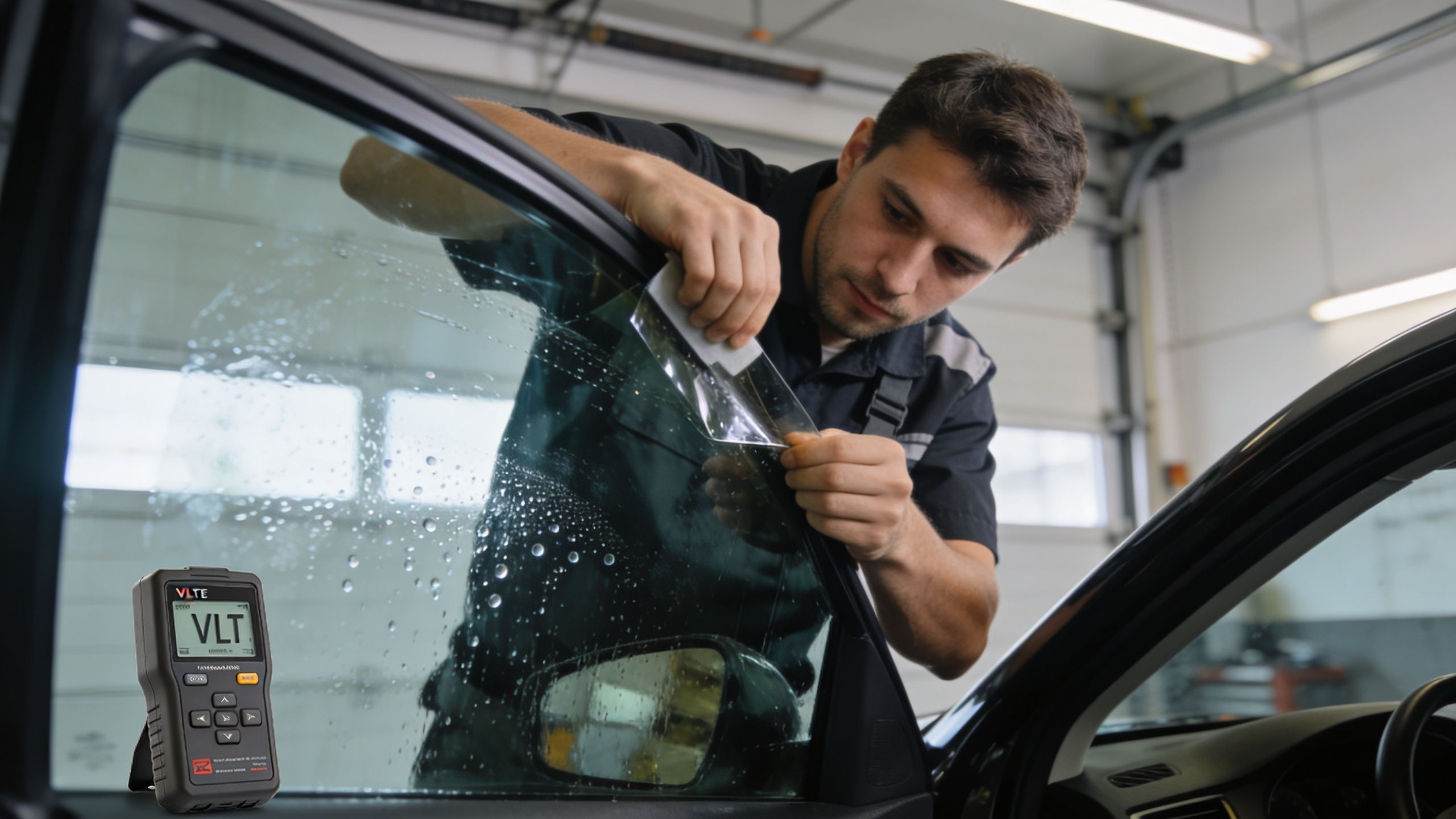
Ontario drivers already have enough to watch for with front-window compliance. The practical takeaway is simple. Check the likely finished result before installation, because fines, removal orders, and a failed safety conversation all cost more than doing the job properly the first time.
Start with the glass and hardware
Film only performs as well as the surface under it. Scratched glass, dirty channels, and worn rubber seals can all shorten the life of the install or leave visible flaws from day one.
If the seals are stiff, split, or dragging, fix that first. This guide on Step-by-step seal replacement is a useful reference for understanding how bad seals affect window operation and why fresh film often fails early on neglected door glass.
That prep work matters more than drivers think.
Choose film by use, not by the number on the box
A darker film is not automatically the better film. On front side windows, the smarter choice is often a higher-quality product that controls heat and UV well without pushing the glass past a legal limit.
Here is how that plays out in the shop:
- Ceramic film: A strong option for drivers who want heat rejection, cabin protection, and a cleaner legal margin on the front windows.
- Dyed film: Often chosen for looks and budget, but quality varies a lot, and lower-grade products tend to fade sooner.
- Cheap online film with vague specs: Risky. If the stated VLT is inaccurate, the finished glass is a guess.
- DIY kits on modern vehicles: Possible, but curved rear windows, tight seals, and frameless or close-tolerance glass expose mistakes fast.
If you want a clearer breakdown of material differences, this guide to automotive window tint films helps match film type to how the vehicle is used.
The install process that protects the result
Good tint work is mostly prep, measurement, and restraint.
A shop should be doing four things consistently:
Measure the starting glass
Factory tint and factory shading are not the same as aftermarket film, but both affect the final reading.Inspect the window path
Seals, channels, and glass condition all affect how cleanly the film sits and how long it lasts.Set different goals for front and rear glass
Many vehicles need a more conservative plan up front and a darker strategy in the rear.Verify the finished VLT
A meter reading gives the driver something real to work from if questions come up later.
That last step is where poor jobs usually get exposed.
Why a proper install usually costs less
The low-price job often turns into two jobs. First the removal, then the reinstall.
At Carmedics Autowerks Inc, the approach is straightforward. Measure the glass, account for the factory starting point, choose the film based on the target result, and install it with the window hardware in mind. Any shop worth trusting should be able to explain VLT, film construction, seal condition, and provincial enforcement in one conversation.
That is how drivers protect the look of the car, the lifespan of the film, and their chances of staying out of trouble after the install.
Answering Your Top Window Tinting Questions
Drivers usually have the same last few questions once the main rules are clear. These are the ones that matter most in day-to-day ownership.
Can I get pulled over just for tint
Yes, if your front windows appear too dark, tint can become the reason an officer takes a closer look. The practical issue isn’t whether the film looked good at installation. It’s whether the finished glass appears compliant and measures within the applicable rule.
Is factory tint always safe from enforcement
Not automatically in every situation, but factory and aftermarket tint are treated differently, and that distinction matters. The problem starts when drivers assume factory-looking glass gives them permission to add more film without checking the final VLT.
What’s the safest approach if I travel between provinces
Choose a conservative front-window setup and build the darker look into the rear of the vehicle where rules are often more flexible. For frequent Quebec travel, being especially careful with the front side windows is the smart move.
Should I tint a brand-new car right away
If you plan to keep the vehicle, early tinting can make sense because it helps protect the cabin and gives you the look you want from the start. The key is to do it once, with the right film, instead of treating a new car like a test platform.
Does darker always mean better
No. Drivers often discover that “better” really means a balance of appearance, comfort, night visibility, and legal compliance. On the front windows especially, a lighter high-quality film is often the smarter result than chasing the darkest possible look.
Will poor tint hurt resale feel
It can. Bubbles, purple fading, peeling edges, contamination specks, and knife damage around the glass all make a vehicle feel neglected. A clean, measured, professionally selected install usually ages much better than a rushed job.
How should I budget for tint
Budget for the whole decision, not just the film. That includes the film type, the number of windows, the condition of the glass, and the quality of the installer’s process. If you’re comparing options, this guide to car window tinting cost gives a practical framework for thinking about price versus result.
The cheapest tint is usually the one you never have to strip off and redo.
What should I ask a tint shop before booking
Ask questions that reveal whether the shop is working from real process or sales talk:
- How do you account for the factory glass before choosing front-window film?
- Will you explain the expected finished VLT, not just the film’s labelled VLT?
- What film type suits my use case and province?
- How do you handle vehicles with worn seals or sensitive trim?
Those answers tell you a lot. A serious shop talks about measurement, placement, and finish quality. A weak shop talks mostly about how dark it can make the car look.
If you want a legal, clean-looking tint setup for your new vehicle, Carmedics Autowerks Inc in Whitby handles window tinting with the practical details in mind, including film selection, compliance-focused planning, and installation that suits daily Ontario driving.