


You’re in traffic on a humid Oshawa afternoon. The vents were cold ten minutes ago, then the air turns lukewarm, then flat-out sticky. You crank the fan higher, but all that does is blow more damp air at your face. If you care about your car, that moment is more than annoying. It’s a warning that something in the A/C system isn’t doing its job.
That’s usually when drivers start wondering if they need a simple recharge, a compressor, an electrical fix, or something uglier hiding behind the dash. Fair question. Auto A/C problems can feel vague from the driver’s seat because several parts have to work together at the same time. One weak link changes the whole system.
This guide is built for people searching for air conditioning repair oshawa and wanting a straight answer. Not generic advice. Not vague “could be anything” talk. The goal is to show what the failure signs look like, why they happen so often around Oshawa and Durham Region, how a proper shop diagnoses them, and what real repair decisions look like when you’re trying to keep a daily driver, SUV, or enthusiast car comfortable without wasting money.
That First Hot Day When Your Car AC Fails
The first hot day of the season catches a lot of drivers off guard. The car made it through spring, everything seemed fine, and then the weather finally turns. You hit the A/C button expecting relief, but the cabin never cools down.
In Oshawa, that’s not a small comfort issue. It changes the whole drive. Stop-and-go traffic feels longer. Kids and pets feel it fast. If you’ve got a black interior, leather seats, or a larger SUV, the cabin starts holding heat like a parked greenhouse.
What makes it worse is that many A/C failures don’t start as dramatic breakdowns. They begin gradually. Cooling gets a bit weaker. The system takes longer to get cold. The compressor sounds slightly rough when it engages. Then the first real summer day exposes the problem all at once.
I’ve seen the same pattern with owners who know their cars well. They notice engine noises, brake feel, steering response, and tyre behaviour. But A/C issues get ignored because the system still “sort of works” until it doesn’t. By then, the repair can be more involved than it would’ve been earlier.
A car A/C system rarely quits without leaving clues first. Most drivers just don’t know which clues matter.
If your car is blowing warm air now, don’t guess. Start by reading the symptoms properly. That gives you a better shot at catching the actual fault instead of paying for a partial fix that doesn’t last.
Decoding the Signs Your Car AC Needs Service
A failing A/C system doesn’t always announce itself with hot air right away. Most vehicles give smaller signs first, and those signs can point you toward the likely problem.

If you want a baseline of what a proper vehicle service covers, this overview of car air conditioning repair services is useful before you book in.
What you notice from the driver’s seat
Some symptoms are obvious. Others are easy to dismiss.
- Air turns warm at idle. If the system cools while driving but struggles in traffic, the issue may involve condenser airflow, fan operation, or system efficiency under load.
- Weak airflow from the vents. Cold refrigerant can’t help much if the blower system or cabin filter is restricting air movement.
- Cooling comes and goes. Intermittent cold air often points to a pressure issue, a clutch problem, a sensor fault, or a control issue rather than a simple one-time glitch.
- The A/C cycles too fast. If the compressor clicks on and off repeatedly, the system may be reacting to improper pressure or an electrical command problem.
Smells and sounds matter
Drivers often focus only on temperature, but your nose and ears tell a lot.
- Musty smell usually points to moisture and contamination around the evaporator area or a neglected cabin filter.
- Sharp chemical smell can suggest refrigerant escaping, though that needs proper confirmation.
- Grinding, rattling, or clunking with A/C on often means a compressor or pulley issue is developing.
Practical rule: If the noise changes the moment you switch the A/C on or off, mention that first when you talk to the technician.
Signs enthusiasts tend to catch early
If you’re the type who notices how your car behaves, pay attention to these:
| Symptom | What it often suggests |
|---|---|
| Cabin cools slowly | Low efficiency, low charge, or weak compressor output |
| One side cooler than the other | Blend door issue or uneven system performance |
| Defogging feels weaker | Airflow or A/C performance problem |
| Engine idle changes sharply when A/C engages | Compressor load or control issue |
The key is this. A refrigerant recharge may restore cooling for a short time, but if the system leaked down, the leak still exists. Treating every warm-air complaint as “just needs gas” is how people spend money twice.
Why Vehicle Air Conditioners Fail in the Durham Region
Cars in this area deal with a rough mix of summer humidity, traffic, winter salt, and seasonal stop-start use. That combination is hard on A/C components, especially the ones mounted low in the front of the vehicle where debris, moisture, and corrosion live.
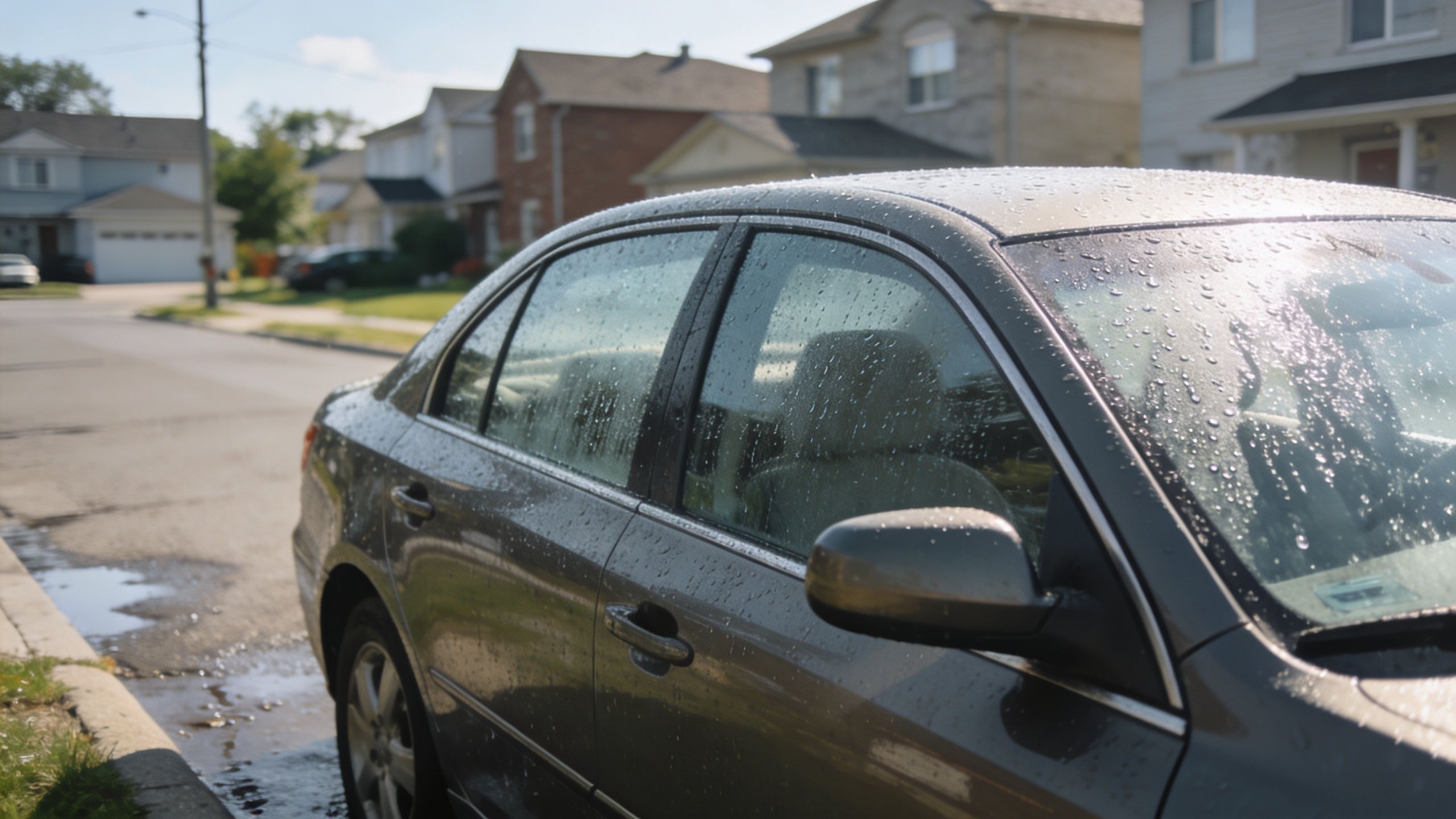
For local context, Durham Region summers put real strain on cooling systems. Average July temperatures reach 26°C (79°F), peak humidity often exceeds 70%, and Durham Region’s population increased 8.4% to 645,862 from 2016 to 2021, which has amplified demand for A/C service in the area, according to this Durham and Canadian HVAC market summary.
Humidity makes the system work harder
Dry heat and humid heat don’t feel the same because they don’t load the A/C system the same way. In Oshawa, the system isn’t just cooling cabin air. It’s also pulling moisture out of it. That extra work shows up fast in traffic, especially when the car is heat-soaked and idling.
A healthy system handles that. A marginal one won’t. That’s why a vehicle with a weak compressor, slight refrigerant loss, or poor condenser efficiency can seem acceptable on a mild day and miserable on a muggy one.
Winter damage shows up in summer
A lot of summer A/C failures often begin in winter. Road salt and slush attack metal lines, condenser fins, brackets, and fittings. The condenser sits right at the front of many vehicles, which means it catches stones, grime, and corrosion all year.
By the time hot weather arrives, that tiny corroded spot or weakened seal becomes a leak you finally notice. The owner feels warm air in June, but the damage often started months earlier.
Salt doesn’t care whether a part is for cooling, braking, or steering. If it’s metal and exposed, it’s on borrowed time.
Local driving patterns don't help
Short trips are common around Durham. So is a lot of stop-and-go use. That’s tough on A/C systems because they spend more time cooling a hot cabin from scratch instead of maintaining an already-stable temperature.
Then there’s seasonal neglect. Many drivers don’t use their A/C much through the colder months. Seals dry out, weak components go unnoticed, and the first heavy-use day becomes the test they fail.
For air conditioning repair oshawa drivers can trust, local context matters. A shop that understands humid summers, salt corrosion, and commuter traffic is less likely to treat every complaint like a generic warm-air issue.
The Professional Diagnostic Process at Carmedics Autowerks
A proper A/C diagnosis should feel like troubleshooting, not guesswork. The system has pressure, temperature, airflow, electrical control, and mechanical operation all interacting at once. If a shop skips steps, it can easily replace the wrong part.
Some A/C complaints also cross into wiring, relays, fuses, pressure sensors, or fan control. That’s why broader auto electrical diagnosis and repair sometimes becomes part of the job.
Step one starts with the obvious
The first pass is visual and operational. That means checking whether the compressor engages, whether the cooling fans come on, whether the belt drive looks healthy, and whether there are clear signs of oil residue around hoses or fittings. Refrigerant oil often leaves clues where the leak is.
The next part is verifying the complaint. Is the air always warm, only warm at idle, cold on one side, noisy under load, or inconsistent after the car has run for a while? The symptom pattern matters.
Pressure readings tell the story
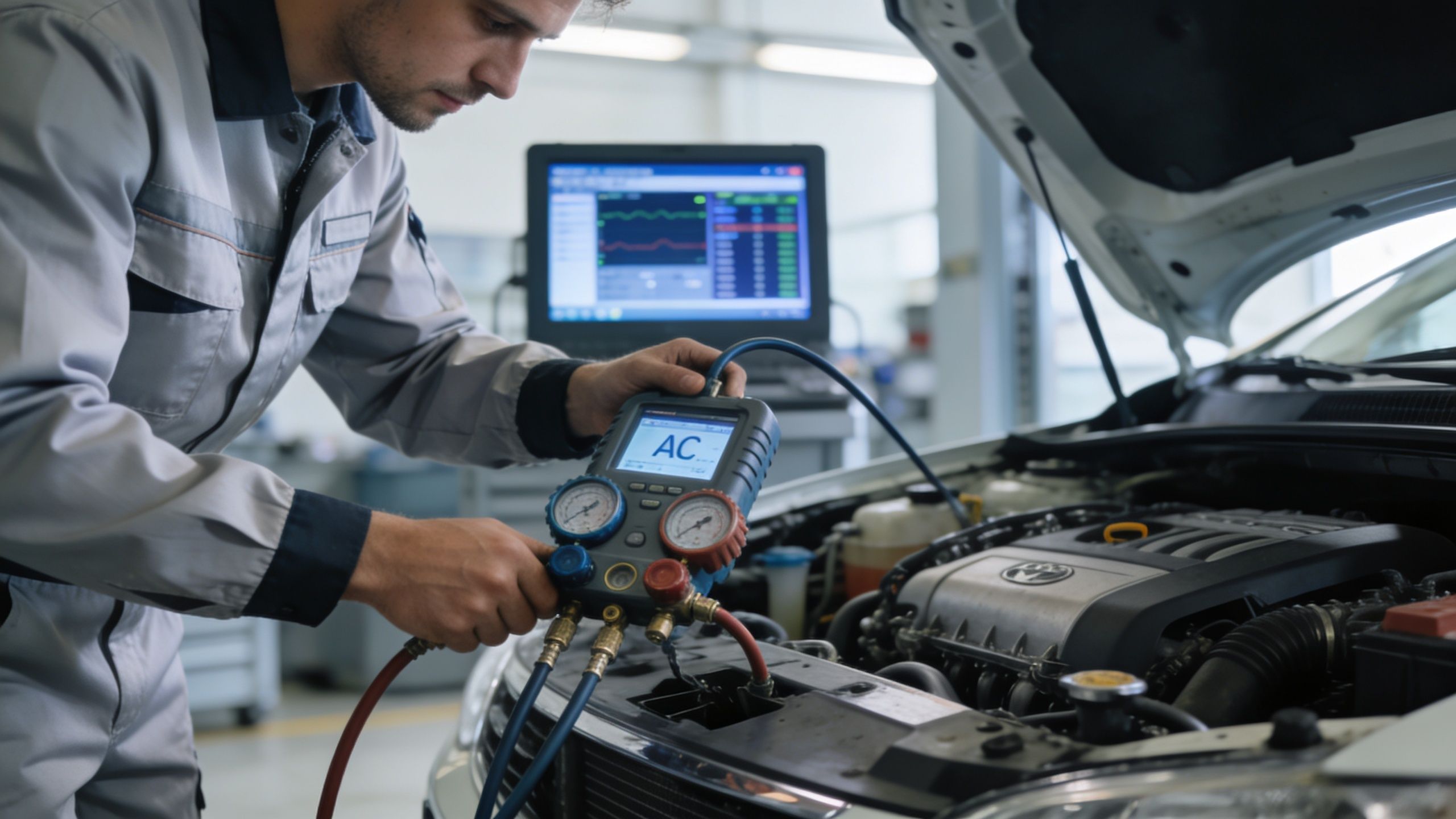
Manifold gauges and a digital gauge set become essential for diagnosis. The high side and low side pressures help show whether the system is low on refrigerant, overcharged, restricted, underperforming, or suffering from internal compressor trouble.
Pressure alone doesn’t solve the car, though. It’s one piece of the picture. A weak compressor can fool people. So can a blocked condenser, a stuck expansion device, or a control fault that causes erratic cycling.
Leak detection separates real repair from temporary relief
If refrigerant is low, the next question is why. A sealed system doesn’t consume refrigerant like fuel. It loses charge because it leaked.
A careful shop may use one or more of these methods:
- UV dye inspection. Fluorescent dye helps trace escaping refrigerant oil at hoses, condensers, service ports, and compressors.
- Electronic leak detector. Many techs call it a sniffer. It detects refrigerant presence around suspected leak points.
- Component inspection. Condenser damage, oily fittings, cracked hoses, and corroded lines often confirm what the tools suggest.
Shop-floor advice: A recharge without leak detection is a short-term answer unless there’s a clear, proven reason the charge was low.
Controls and cabin-side checks finish the job
Once the refrigerant side is understood, the rest of the system still needs checking. Blend doors, blower motor operation, cabin filter restriction, vent temperature response, and control head commands can all affect what the driver feels.
A place like Carmedics Autowerks fits in practically. It performs A/C diagnosis on cars and SUVs in the Whitby area, and that matters because many “A/C” complaints end up being part cooling issue, part electrical issue, or part airflow issue. A straight process saves time and avoids throwing parts at the car.
Common AC Repairs and Typical Costs in Oshawa
Most owners want the same answer right away. What’s the likely repair, and what’s it going to cost? Fair enough. A/C work ranges from modest service to major component replacement, and the difference usually comes down to whether the system has a minor leak, a major leak, a failed compressor, or a control problem.
If you want a separate breakdown focused on pricing factors, labour, and vehicle differences, this page on car air conditioning repair costs adds context.
The jobs shops see all the time
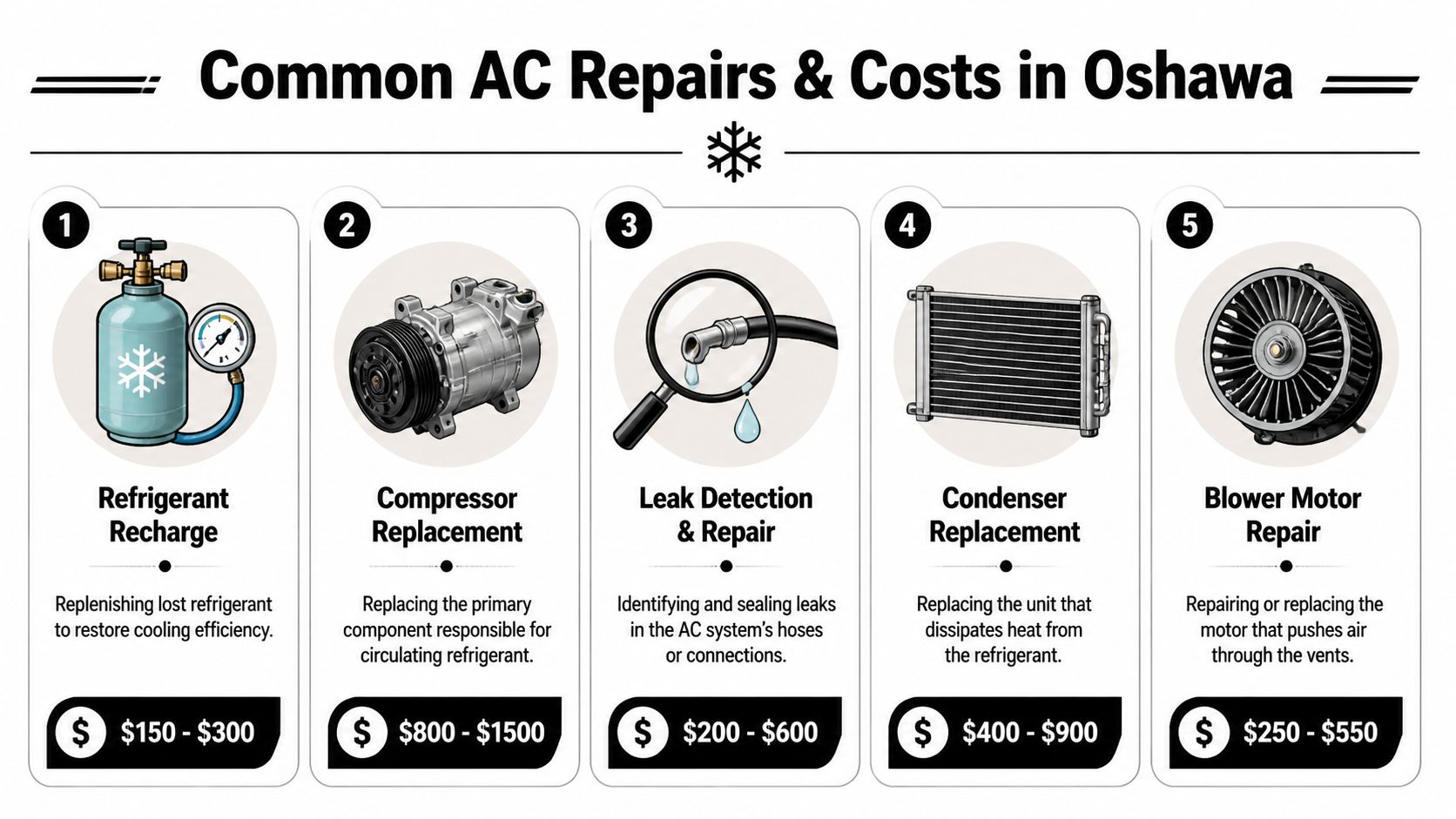
Here are the common repair categories and the ranges many Oshawa-area drivers are quoted for:
| Repair | Typical cost range |
|---|---|
| Refrigerant recharge | $150 to $300 |
| Compressor replacement | $800 to $1500 |
| Leak detection and repair | $200 to $600 |
| Condenser replacement | $400 to $900 |
| Blower motor repair | $250 to $550 |
Those ranges depend on vehicle access, refrigerant type, parts quality, and whether more than one failed part is involved.
What each repair really means
A refrigerant recharge sounds simple, and sometimes it is. But if the charge is low, there’s usually a leak somewhere. The recharge restores cooling. It doesn’t explain the refrigerant loss by itself.
A compressor replacement is the repair drivers worry about most, and for good reason. The compressor is the pump of the A/C system. If it fails internally, the repair can grow because debris can spread through the system and contaminate other components.
A leak repair varies wildly because leaks don’t all happen in easy places. One car has a visible hose seep. Another has a condenser puncture. Another has a fitting buried behind other components, which adds labour.
A condenser replacement is common in Ontario because the condenser sits in a vulnerable spot at the nose of the vehicle. It takes the abuse from road grit, moisture, and salt.
A blower motor repair is different from refrigerant-side repairs. The A/C may be producing cold air, but if the blower motor or resistor isn’t moving that air properly, the cabin still feels wrong.
Why compressor jobs come up so often
For Whitby and Oshawa drivers, compressor issues are a major part of the A/C conversation. Compressor failures make up 80% of auto A/C issues, spike 40% post-summer, and CAA records 25,000+ Ontario roadside A/C calls yearly, according to the referenced automotive A/C data summary.
That lines up with what many techs see in the bay. Summer pushes a weak compressor hard. If the clutch is slipping, the bearings are rough, or internal compression is dropping off, hot weather exposes it.
If you’re trying to understand compressor behaviour before authorising a larger repair, T1A Auto's AC compressor tips are worth reading because they explain clutch-related symptoms in plain language.
The cheapest quote isn’t always the cheapest repair. If one shop prices only the obvious failed part and skips contamination checks or leak confirmation, the car may be back for round two.
Proactive Maintenance to Prevent Future AC Breakdowns
A/C repairs get expensive when owners wait for total failure. Prevention won’t stop every breakdown, but it does catch weak parts earlier and keeps the system from sitting neglected.
The easiest habit is simple. Run the A/C periodically even in cooler months. You’re not doing it for cabin comfort. You’re circulating oil through the system and helping seals stay conditioned instead of drying out from long periods of inactivity.
Habits that actually help
Not all maintenance advice is equal. These are the habits worth keeping:
- Use the A/C in winter occasionally. Let it run long enough to circulate the system.
- Replace the cabin air filter on schedule. A plugged filter makes good A/C feel weak because airflow drops.
- Pay attention to small changes. Slightly weaker cooling, odd smells, or new noises are cheaper to investigate early.
- Book a warm-weather inspection before peak summer. It’s better to test the system before the first miserable heat wave than during it.
What doesn't work well
DIY top-up kits are where many problems start. They encourage people to treat every issue as low refrigerant, even when the actual problem is a leak, a compressor fault, or bad airflow. Some also make it harder to judge the system properly later because the charge condition is no longer known with confidence.
Skipping the cabin filter also hurts more than people think. Drivers focus on refrigerant because that sounds more technical, but poor airflow can mimic A/C weakness and put unnecessary blame on the wrong part.
If you already stay on top of oil changes, brakes, fluids, and seasonal checks, add A/C to the same routine. A broader preventive maintenance plan for vehicles makes more sense than waiting for a comfort system to fail when you need it most.
Small maintenance jobs don’t feel urgent. That’s exactly why they save money.
Oshawa Drivers AC Repair Frequently Asked Questions
Are DIY recharge kits worth using
Usually not. They can seem cheaper up front, but they don’t tell you why the system lost performance in the first place. If the issue is a leak, a weak compressor, a failed fan, or an electrical fault, adding refrigerant may only mask the symptom for a short time. They also make proper diagnosis harder if the system charge is no longer accurate.
How long does A/C repair usually take
It depends on whether the job is diagnostic, minor repair, or major component replacement. A basic inspection and test may be straightforward. A leak search can take longer because leaks aren’t always obvious. Compressor, condenser, or dash-related work can take significantly more shop time due to access and follow-up testing.
Can window tint help the A/C work less hard
Yes, in practical terms it can. Tint reduces solar load entering the cabin, which means the A/C has less heat to fight, especially after the car has been parked outside. It won’t repair a failing system, but it can reduce cabin heat buildup and improve comfort.
If the A/C still blows a bit cool, can I wait
You can, but it’s a gamble. Marginal performance often means the system is already on its way to a bigger failure. Catching a leak, fan issue, or clutch problem early is usually easier than waiting until the compressor is stressed by peak summer use.
Why does my A/C get colder when I’m moving
Because vehicle speed improves airflow through the condenser. If cooling improves on the road but struggles at idle, the problem may involve condenser efficiency, cooling fan performance, or a system that’s borderline on charge or compressor output.
Does a bad smell always mean mould
Not always. Musty odours often suggest moisture and contamination around the evaporator area or filter, but chemical smells can point toward other issues. Smell alone doesn’t confirm the fault. It’s a clue, not a diagnosis.
Your Next Steps for Reliable AC Repair
If your vents are blowing warm, airflow is weak, or the system is noisy, don’t treat it like a mystery that will solve itself. The right move is to identify the symptom pattern, understand the local wear factors that affect Oshawa vehicles, and get a proper diagnosis before a small issue becomes a larger repair.
If you need air conditioning repair oshawa drivers can approach with confidence, start with a shop that can test pressures, check for leaks, inspect electrical controls, and explain the repair clearly. For local help, this auto repair service in Oshawa and nearby Whitby is the practical next step.
If your car’s A/C has stopped keeping up with Oshawa heat, contact Carmedics Autowerks Inc for a proper diagnosis and a clear repair path. We work on cars and SUVs, and we’ll tell you whether you’re dealing with a recharge issue, a leak, a compressor problem, or an electrical fault before you spend money on the wrong fix.