

A lot of Whitby business owners are dealing with the same problem right now. The fleet is small enough that every vehicle matters, but busy enough that nobody has time for a van to sit in a bay waiting for a surprise repair.
That’s where fleet maintenance stops being a back-office task and becomes an operations decision. If you run service vans, delivery SUVs, sales cars, or light-duty work trucks in Durham Region, the goal isn’t just to fix what breaks. The goal is to keep vehicles available, control repair costs, and protect resale value while Ontario weather, road salt, traffic, and tight scheduling work against you.
The Cost of a Single Breakdown in Whitby
A single breakdown rarely stays a single problem.
One delivery van misses its morning route on the 401 side of Whitby. The driver calls in. A customer has to be rescheduled. Another staff member takes the overflow work. That second vehicle runs harder than planned. The office starts juggling calls. By the afternoon, the repair bill is only one part of the damage.
For a small fleet, the knock-on effects hit fast:
- Missed revenue: The vehicle that should be earning money is parked.
- Customer friction: Clients don’t care whether the issue was a failed alternator or a seized caliper. They care that you didn’t show up.
- Labour waste: Office staff, dispatch, and drivers all spend time reacting instead of doing paid work.
- Compounded wear: The rest of the fleet takes on extra routes and extra kilometres.
That’s why smart fleet maintenance starts before the warning light comes on. It’s less about “fixing cars” and more about protecting daily operations.
In Durham Region, a lot of fleet trouble builds unnoticed. Salt gets into brake hardware. Suspension parts take a beating. Cooling systems get ignored until a temperature swing exposes a weak hose or tired cap. None of that feels urgent until a vehicle is on the hook of a tow truck.
A breakdown doesn’t just pull one vehicle off the road. It pulls time, attention, and margin out of the whole business.
If you’re already dealing with recurring repairs, delayed service intervals, or vehicles that are becoming unpredictable, that’s the point where a proper fleet repair service in Whitby becomes an operating tool, not a discretionary expense.
What Fleet Maintenance Really Means for Your Business
Fleet maintenance is often misunderstood as oil changes, tire rotations, and occasional repairs. That’s part of it, but not the whole thing.
For a business, fleet maintenance is a system for keeping revenue-producing assets ready to work. It serves as a health plan for your vehicles. Regular checkups, planned treatment, and good records cost money up front, but emergency-room thinking costs far more.
Reactive maintenance costs more
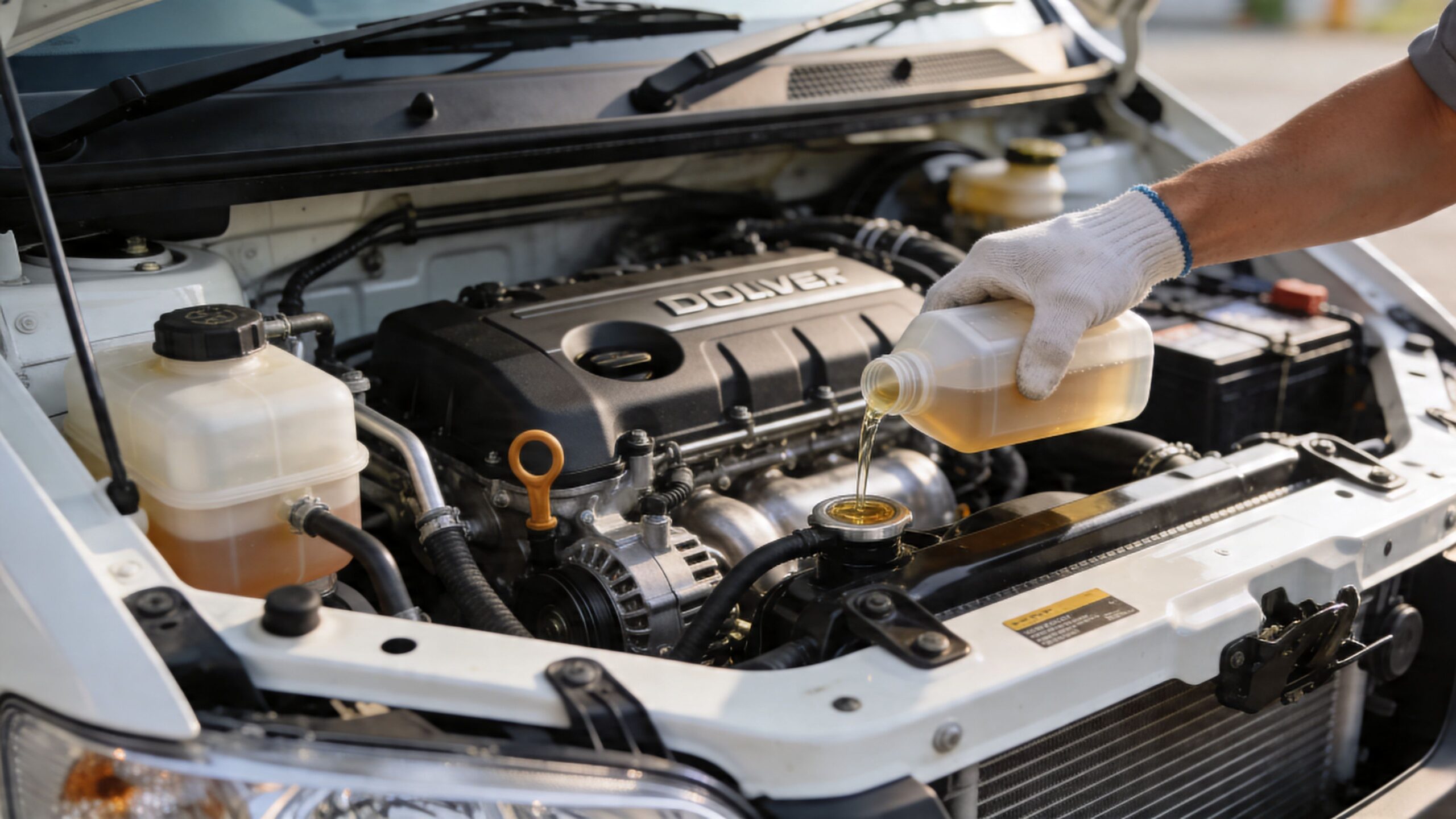
Reactive maintenance sounds simple. Wait until something fails, then repair it.
That approach usually feels cheaper in the short term because you’re postponing work. In practice, it creates a cycle of road calls, towing, rushed parts ordering, missed jobs, and uneven scheduling. For Ontario fleets, achieving a Fleet Availability Rate of 95% is the industry target, and poor preventive maintenance compliance pushes repair costs to 2 to 3 times scheduled service costs. Fleets that maintain 95% availability can reduce total ownership costs by 10% to 15% according to Fleetio’s fleet performance metrics guidance.
That’s the business case in plain terms. Vehicles that are predictably available are cheaper to own.
Preventive maintenance protects uptime
Preventive maintenance is planned work based on mileage, time, use, and condition. It includes the obvious items, but it also includes inspections that catch the expensive stuff before failure.
For a Whitby fleet, that means paying attention to:
- Brake condition: Salt, moisture, and stop-and-go driving are hard on pads, rotors, sliders, and lines.
- Fluid condition: Coolant, transmission fluid, brake fluid, and engine oil all tell you what’s happening long before a breakdown.
- Tires and alignment: Uneven wear usually means you’re not just buying tires. You may be masking suspension or steering issues.
- Battery and charging system health: Winter exposes weak batteries fast.
- Service history: If nobody can tell you what was done last and when, you don’t have a maintenance program. You have guesses.
If you want a plain-language overview of how a structured fleet vehicle maintenance program works, it’s a useful companion read because it reinforces the same core principle. Scheduled work beats emergency work.
What good maintenance looks like in practice
A proper program isn’t complicated. It is disciplined.
Use a repeatable preventive maintenance plan for vehicles that ties service intervals to each unit’s actual use, not just a sticker on the windshield. A sales SUV that does mostly highway driving won’t age the same way as a stop-and-go service van carrying tools and parts every day.
Practical rule: If the first time you inspect a component closely is after a failure, your fleet is operating reactively.
Building Your Preventive Maintenance Schedule
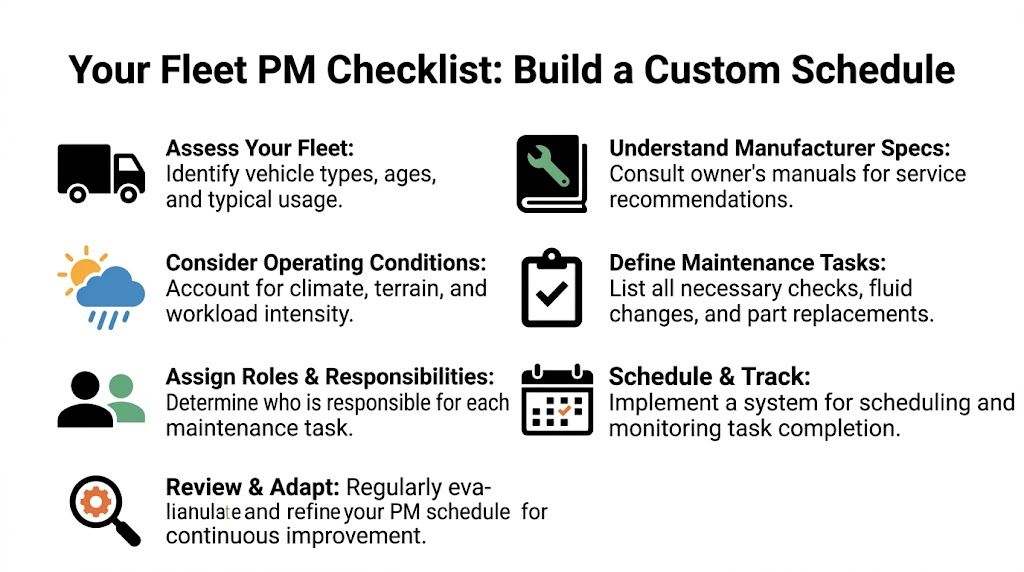
Most small fleets don’t need a complicated maintenance playbook. They need a schedule that people will follow.
The schedule has to match the vehicle, the work, and Ontario conditions. A light-duty SUV used by a sales rep doesn’t need the same cadence as a loaded van making local stops all day. A vehicle that sees mostly highway use ages differently from one that idles, brakes, and turns constantly in Durham traffic.
Start with the fleet you actually have
Before you schedule anything, sort your units into practical groups.
- Passenger cars and crossovers: Usually lower load, lighter duty, but still vulnerable to brake wear, fluid neglect, and winter corrosion.
- Service vans and cargo vehicles: More idle time, more stop-start driving, more weight, more brake and suspension stress.
- Light-duty trucks and SUVs: Often used as a hybrid of work and personal transport, which can hide true usage if records are loose.
Then note four things for every unit:
- Current mileage
- Average monthly kilometres
- Operating pattern
- Recent repair history
That last one matters more than many owners realise. A vehicle with repeat cooling-system or front-end issues needs a tighter inspection rhythm than one with a clean record.
Build around compliance, not intentions
The strongest programs are boring. They happen on time.
Top-performing Ontario fleet operations achieve 95%+ PM compliance, which can cut unplanned repair costs by up to 70%. Low PM adherence in Canada also correlates with CAD 2.1 billion in annual avoidable downtime losses, and unplanned maintenance costs 3 to 9 times more than planned work according to GOFMX fleet management metrics.
That’s why the schedule has to be simple enough to execute. If it depends on memory, it will drift.
A practical PM template for Whitby fleets
Use a mixed schedule based on kilometres and calendar time. Whichever comes first should trigger service.
Every week
- Driver walkaround: Check lights, visible tire condition, leaks, wiper performance, and warning lights.
- Fluid glance: Engine oil, washer fluid, and coolant overflow level.
- Cabin notes: New noises, vibration, pulling, weak heat, slow crank, or brake feel changes.
Every month
- Tire pressure and tread check: Especially important during temperature swings.
- Battery terminal inspection: Corrosion, loose clamps, hard starts.
- Brake visual inspection if use is severe: Delivery and service vehicles benefit from frequent checks.
- Undercarriage rinse plan: Salt removal matters. It’s cheap protection.
At regular service intervals
- Oil and filter service: Use the manufacturer baseline, then shorten it if the vehicle idles heavily or runs short trips.
- Brake inspection: Pads, rotors, sliders, hoses, hardware.
- Suspension and steering check: Ball joints, tie rods, bushings, links, shocks.
- Cooling system inspection: Hoses, clamps, cap, coolant condition, seepage.
- Tire rotation and alignment review
- Cabin and engine air filters
- Scan for fault codes if the vehicle has had any drivability complaints
A good starting point for owners who want a consumer-friendly reference is this guide on how often you should service your car. For fleets, the difference is that you tighten the schedule when usage is harsher.
Winter changes the schedule
Ontario winter maintenance isn’t just “do the same service, but in cold weather.” The season changes failure patterns.
In Durham Region, the practical adjustments are straightforward:
- Move fluid checks forward: Weak coolant, old washer fluid, and neglected brake fluid become winter problems fast.
- Inspect brakes earlier: Salt and moisture accelerate corrosion on hardware and backing plates.
- Watch batteries before cold snaps: Batteries that seem acceptable in mild weather often fail when temperature drops.
- Treat tires as a safety and uptime item: Waiting too long on winter tire installation creates avoidable downtime.
- Clean what you can’t see: Salt buildup under the vehicle is what starts the expensive corrosion story.
The best winter PM item is often a flashlight and ten extra minutes under the vehicle.
Don’t copy the manual blindly
Manufacturer schedules are the floor, not the ceiling.
If your vehicles carry weight, idle often, make short trips, or spend their days in stop-and-go service work, the manufacturer interval may be too optimistic for your real use. A fleet manager’s job is to adjust the schedule to reality.
A useful way to do that is to create three service categories:
| Usage type | Typical pattern | PM approach |
|---|---|---|
| Light use | Highway-heavy, low load | Follow standard interval closely |
| Moderate use | Mixed driving, regular local work | Shorten inspection intervals |
| Severe use | Idle-heavy, loaded, frequent stops | Tightest PM cadence and more frequent brake, tire, and fluid checks |
If a vehicle repeatedly needs “unexpected” repairs, that’s usually not bad luck. It’s a schedule problem, an inspection problem, or a record-keeping problem.
Controlling Costs and Maximizing Your Maintenance ROI
Fleet maintenance pays off when you measure the right things.
Many owners look only at the invoice in front of them. That’s understandable, but it hides the true cost of a vehicle. What matters is the full ownership picture over time. Repairs, downtime, tires, fluid service, corrosion, and replacement timing all belong in the same conversation.

Think in total ownership cost
During supply chain disruption, fleet repair expenses across North America increased by up to 20% in the first half of 2023, and high PM compliance helped offset that because unplanned repairs cost 3 to 9 times more than planned ones. Strong maintenance also extends asset life by 20% to 30% according to Holman’s fleet maintenance trends review.
That matters for small fleets because replacement timing is rarely ideal. When a business has to keep a vehicle longer than planned, maintenance quality becomes the difference between manageable ownership and a money pit.
The numbers to watch
You don’t need a finance department to track ROI. You need a few consistent measures.
Cost per kilometre
Take total maintenance and repair spend for a vehicle over a period and divide it by kilometres driven in that same period. Track it by unit, not just fleet-wide.
A vehicle with a rising cost per kilometre isn’t automatically a replacement candidate. But it does deserve inspection. Sometimes the issue is deferred maintenance. Sometimes it’s repeat poor-quality repairs. Sometimes the unit is aging out of its economical life.
Downtime pattern
Record when each vehicle is unavailable, why it was down, and whether the work was planned or unplanned.
Planned downtime is manageable. Unplanned downtime usually creates premium labour, emergency parts purchases, towing, schedule disruption, and customer headaches. That’s where your maintenance budget either saves money or fails to.
Repeat-failure rate
If the same component category keeps coming back, stop treating each visit as a separate event.
Look at:
- Brakes recurring too often
- Battery issues every winter
- Cooling-system leaks that were “patched”
- Tires wearing unevenly after replacement
Those patterns usually point to root-cause problems, not isolated defects.
Repair or replace
Often, owners get emotional. A familiar vehicle feels cheaper to keep because you already own it. That’s not always true.
Use a practical screen:
- Keep repairing when the vehicle has a clean history, predictable use, and repairs are restoring reliability.
- Replace soon when downtime is getting harder to schedule around, corrosion is spreading, or major systems are starting to fail in clusters.
- Replace now when the vehicle is affecting customer service, causing workflow disruption, or forcing emergency spending repeatedly.
Bottom line: The cheapest vehicle in your fleet is usually the one that starts every morning, finishes the day, and doesn’t need anybody to think about it.
Parts choice also affects ROI. If you’re balancing budget, warranty, and long-term reliability, this overview of OEM vs aftermarket parts is useful because the wrong part can make a low invoice expensive later.
In-House Repairs Versus Outsourcing to a Local Pro
Small business owners often assume in-house maintenance gives them more control. Sometimes it does. Often it gives them more overhead.
For small fleets in Ontario, outsourcing to third-party shops is often more cost-effective than maintaining your own repair capability. That decision gets harder because GTA shop rates average $150 to $200 per hour, and Ontario faced a 25% technician vacancy rate in 2025 according to Work Truck Online’s review of small business fleet maintenance challenges.
That combination creates a real trade-off. Labour is expensive outside your business, but it’s also hard and expensive to build internally.
The decision framework
The right answer depends on fleet size, complexity, and how critical vehicle uptime is to your operation.
If you have a few light-duty units, in-house repair usually works only for basic checks, minor consumables, and cleaning. Once diagnostics, drivability issues, brake work, suspension repairs, electrical faults, alignment concerns, or seasonal inspections enter the picture, outsourcing usually becomes more practical.
Here’s a straight comparison.
| Factor | In-House Maintenance | Outsourced to a Pro (e.g., Carmedics) |
|---|---|---|
| Upfront investment | Requires tools, space, storage, and admin systems | Little capital investment beyond your service budget |
| Labour management | You recruit, train, schedule, and retain staff | Shop handles staffing and technical workflow |
| Diagnostic capability | Limited unless you invest heavily in equipment and training | Better suited for modern diagnostics and repeatable process |
| Speed on basic tasks | Convenient for simple checks if staff are available | Depends on scheduling, but more efficient for larger repairs |
| Parts sourcing | Your team manages ordering, returns, and warranty follow-up | Shop often manages parts workflow and supplier relationships |
| Liability and documentation | Your business carries more direct process burden | Service records and repair documentation are built into the job flow |
| Downtime control | Can work well if you have spare units and internal discipline | Strong option when uptime matters and you need outside support |
| Scalability | Gets harder as fleet count and vehicle complexity grow | Easier to scale across multiple vehicle types |
What usually works for a Whitby small fleet
A hybrid model is often the most sensible.
Keep simple tasks internal if you already have the staff and discipline for them. Handle cleaning, fuel tracking, walkarounds, and basic condition checks in-house. Outsource the work that needs a hoist, scan tools, specialty knowledge, service records, and warranty-safe parts decisions.
That approach keeps your internal team focused on operations, not improvised repairs in the yard.
A simple rule for deciding
Ask two questions.
- Will doing this in-house reduce downtime?
- Can we do it to the same standard every time?
If the answer to either is no, send it out.
For businesses that need regular support, a local car mechanic in Whitby can function as an extension of your fleet process rather than a one-off repair stop. That only works if records are clear and service decisions are consistent, but when it’s set up properly, it removes a lot of strain from a small team.
Using Technology for Smarter Fleet Management
Technology helps most when it removes guesswork.
For a small fleet, that doesn’t mean buying a complicated platform on day one. It means building a clean record of what each vehicle is doing, what it costs, and when it needs attention. A spreadsheet can work at first. A basic CMMS or fleet app becomes worthwhile when the spreadsheet starts missing deadlines or hiding patterns.

Start with better records
Every unit should have a digital file that includes:
- VIN and plate details
- Current mileage
- Service dates
- Repair history
- Parts used
- Warranty notes
- Seasonal tire information
- Recurring complaints from drivers
That record changes how you manage the fleet. You stop relying on memory and start spotting repeat faults, overdue service, and poor parts choices.
Telematics makes scheduling more accurate
A lot of small fleets still schedule service by rough estimate. That creates two problems. Some vehicles get serviced too late. Others get brought in too early.
A GPS-linked maintenance system improves odometer accuracy and gives you a cleaner picture of actual use. Best-in-class fleets aim for vehicle uptime of 98% or higher, and each downtime day can cost $500 to $1,000 per vehicle in lost productivity. A CMMS with GPS that keeps the planned-versus-unplanned maintenance ratio above 70% can extend vehicle life by 25% according to FleetRabbit’s discussion of fleet technology performance.
That’s a practical gain, not just a reporting exercise. Better data means better timing.
Use data to make predictive calls
The useful signals are usually simple:
- A battery complaint before winter
- Brake wear trending faster on one route type
- Fuel economy dropping on one vehicle
- A service van that keeps eating front-end parts
- A transmission that starts behaving differently under load
Those clues help you intervene before the roadside failure.
Good fleet technology doesn’t replace inspections. It tells you where to look first.
A local shop can fit into that process too. For example, Carmedics Autowerks Inc can support fleet repair and maintenance for Whitby-area vehicles while the business keeps its own digital records and scheduling workflow. That setup works well for small fleets that want outside technical support without losing visibility into cost and history.
Your Local Fleet Partner in Whitby
Small fleet maintenance in Durham Region is rarely about one dramatic repair. It’s about dozens of small decisions made on time.
The fleets that stay efficient usually do a few things well. They inspect vehicles before minor issues become outages. They schedule service around real usage instead of rough guesswork. They protect the body as well as the mechanical systems. They keep records tight enough to make repair-versus-replace decisions without emotion getting in the way.
That last point matters more in Ontario than many owners expect. A mechanically sound fleet can still lose value early if road salt, stone chips, neglected damage, and poor cosmetic protection are allowed to build. For newer SUVs, cars, and service vehicles, asset protection belongs in the same conversation as oil service and brake inspections.
Why local context matters
Whitby and the wider Durham Region put a specific kind of stress on fleet vehicles.
You’re dealing with winter grime, salted roads, mixed highway and local driving, and busy schedules that don’t leave much room for unscheduled downtime. A generic maintenance template from another region won’t account for how quickly corrosion starts here or how often local work vehicles bounce between short trips and highway runs.
That’s also why bundling services makes operational sense. If a fleet vehicle is already in for mechanical work, it’s often the right time to handle related appearance and protection items that preserve the asset.
Mechanical care and asset protection belong together
For newer business vehicles, especially ones that represent your brand in front of customers, protection work has a real operational role:
- PPF helps shield paint from chips and road debris
- Tint can improve cabin comfort and reduce interior wear
- Collision repair coordination keeps damage from lingering and affecting value
- Consistent appearance supports a professional fleet image
A business owner who cares about vehicle longevity should care about both the underbody and the paint surface. One protects uptime. The other protects resale and presentation.
That’s the practical advantage of working with a local shop that understands both sides of fleet ownership in Whitby.
Fleet Maintenance FAQ for Ontario Businesses
How often should a small business fleet be inspected in Ontario
Base the schedule on usage, not hope.
Use manufacturer recommendations as your starting point, then shorten intervals for vehicles that idle, carry weight, make short trips, or do constant local stops. In Ontario winter, inspect fluids, brakes, batteries, and tires more aggressively because cold weather exposes weak points quickly.
Do daily driver checks really matter for light-duty fleets
Yes. They catch small issues before they become expensive ones.
To reduce unscheduled maintenance, fleets should use DVIRs, especially in winter. Ontario fleets also see 30% more winter breakdowns from neglected fluids, according to Fleetio’s best practices for unscheduled maintenance.
A simple driver check should cover lights, visible tire condition, leaks, warning lights, washer fluid, wipers, and any new noise or vibration.
Will third-party maintenance void my new vehicle warranty
Not by default, if the vehicle is serviced properly and records are complete.
The practical rule is simple. Use the correct parts and fluids, follow the required service intervals, and keep dated invoices and service notes. Poor documentation causes more warranty headaches than the location of the repair itself.
What should I do before winter in Durham Region
Don’t wait for the first storm.
Prioritise:
- Coolant condition and freeze protection
- Battery test
- Brake inspection
- Winter tires
- Washer fluid rated for cold weather
- Wiper blades
- Undercarriage cleaning and corrosion control
If the fleet has even one vehicle with a weak battery, marginal coolant, or overdue brake service, winter will find it.
Winter rule: Fluids and visibility items fail quietly until the temperature drops.
Do cheap parts save money on fleet vehicles
Usually not.
Low-quality generic parts are linked to 40% of repeat failures in Canadian fleets in the same Fleetio source above. For a small fleet, a part that fails early doesn’t just cost replacement labour. It creates another booking, more downtime, and another interruption to operations.
How should small fleets handle hybrids or EVs
Treat them as a separate maintenance category.
The core discipline stays the same. Track usage, document service, and inspect on a schedule. But don’t assume your gas-vehicle process maps over perfectly. Regenerative braking, battery cooling, charging habits, and manufacturer-specific procedures all affect maintenance planning. If you add hybrids or EVs, build a dedicated checklist instead of forcing them into the same template as your conventional units.
If your business needs a practical maintenance plan for cars, SUVs, or light-duty commercial vehicles in Durham Region, Carmedics Autowerks Inc offers fleet maintenance, general repair, window tinting, paint protection film, and collision repair in Whitby. For owners who want tighter uptime, cleaner service records, and better long-term vehicle protection, it’s worth having a local shop that can support both the mechanical side and the asset-preservation side of fleet ownership.