

Ontario recorded 37,041 vehicle thefts in 2022 according to Tanner Insurance’s overview of TAG vehicle tracking. That number changes the conversation. For drivers in Whitby, especially owners of newer SUVs, trucks, and enthusiast vehicles, theft prevention isn’t a nice extra anymore. It’s part of responsible ownership.
The problem isn’t just that more vehicles are being taken. It’s that organised theft crews don’t steal the way people imagine. They target vehicles that move quickly through chop shops, containers, and resale channels. That means old-school assumptions about factory alarms, steering locks, or a basic phone-based tracker often don’t match what’s happening on the ground. Tag car tracking is particularly relevant here. It’s built as a layered anti-theft system, not a single gadget trying to do every job.
The Rising Tide of Car Theft in Ontario
Ontario’s theft numbers are large enough to feel abstract until you park a desirable vehicle outside overnight. Then they become personal.
The reason many Whitby drivers feel uneasy is simple. The vehicles that thieves want are often the same ones owners value most. Late-model SUVs, pickups, and premium trims are practical, expensive, and easy to move when criminal groups know what they’re doing.
Why the old assumptions fail
A lot of owners still think in terms of visible theft attempts. Broken glass. Forced ignition. A loud alarm in the driveway. Modern theft often looks cleaner than that. The vehicle disappears and the owner is left wondering how it happened so fast.
That’s why a single layer of protection usually isn’t enough.
Factory security can help with casual tampering. It’s not the same thing as a system designed around organised vehicle theft.
For local drivers, the core question isn’t “Do I have some security?” It’s “Will my security still matter when thieves use more advanced methods than a basic smash-and-grab?”
Where tag car tracking fits
Tag car tracking is relevant because it’s designed around how modern auto theft happens in Ontario. Instead of relying on one obvious device, it uses a layered approach meant to deter theft, identify protected parts, and support recovery if a vehicle is taken.
That matters for drivers who’ve already invested heavily in their vehicle. If you’ve bought a newer SUV, upgraded wheels, added tint, or protected the finish, theft protection belongs in the same category as the rest of your protection plan.
There’s another practical reason to think this way. Theft incidents can lead to complicated legal and insurance issues, especially if a collision is involved before recovery. Drivers trying to understand their rights after an accident can get a useful legal overview from the law about car accidents in Ontario.
Understanding Tag Tracking A Multi-Layered Defence System
Often, hearing “tracking system” brings to mind one dot on a map. That’s not the right mental model for TAG. A better comparison is a modern home security setup. You don’t depend on one lock. You use visible deterrents, hidden sensors, and a response plan.

TAG has industry recognition behind it. It was voted Stolen Vehicle Tracking System of the Year in Canada for 2024 and has saved the insurance industry close to $200 million in Ontario and Quebec, according to Tag Tracking’s 2024 award announcement.
If you’re looking into a professionally installed anti-theft option, TAG anti-theft device installation shows what this type of system is built to do.
Layer one is visible deterrence
The first layer is the one thieves can see. TAG uses permanent window etching with its logo. That sounds simple, but simple matters. A protected vehicle becomes less attractive before the theft attempt even starts.
Thieves want speed and low resistance. If one vehicle announces that it carries specialised protection and another looks easier, they tend to favour the easier target.
Layer two is hidden identification
The second layer is what most owners never see after installation. TAG uses hidden identifiers on vehicle components. That matters because theft today isn’t always about the whole vehicle staying intact. Parts have value too.
This changes the risk for thieves. A system that marks components makes resale and part movement harder. For an owner, that’s important because it protects more than the shell of the vehicle.
Layer three is recovery support
The last layer is active recovery capability. Through this, TAG transitions from being just a deterrent product to a practical theft-response system.
If the first layer doesn’t stop the attempt, and if the second layer doesn’t stop the vehicle or parts from being moved, the third layer gives recovery teams something to work with. That’s the difference between “I had a tracker” and “there was a realistic path to getting the vehicle back.”
Practical rule: The best anti-theft setup doesn’t rely on one moment. It creates friction before theft, complications during theft, and options after theft.
Comparing Tracking Technologies TAG vs GPS and Bluetooth
Many owners compare tag car tracking to a GPS puck they can order online or a Bluetooth finder they already use for keys. That comparison is fair, but only if you look at real theft conditions rather than retail marketing.
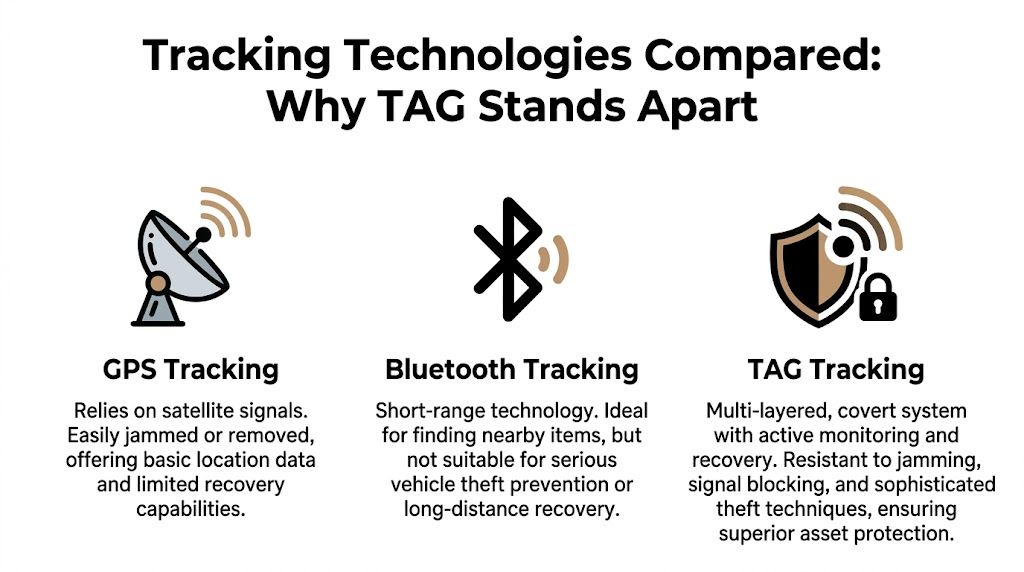
The core technical difference is this. TAG uses anti-jamming technology and RF triangulation, and its system delivers a 0.8 millisecond response time for real-time tracking. It also uses patented wireless nano-transponders that support component-level recovery, as described in Begin Insurance’s review of TAG and anti-theft devices.
A lot of consumer devices aren’t built for that kind of threat environment.
Why standard GPS often disappoints
A basic GPS tracker can help with fleet visibility, trip logging, or personal awareness. For theft recovery, the weak point is usually resilience. If the device is easy to find, easy to unplug, or vulnerable to signal interference, it may fail at the exact moment you need it.
That doesn’t mean GPS is useless. It means the quality of protection depends on the design, the install, and whether the system was engineered for criminal interference rather than convenience.
Where Bluetooth works and where it doesn’t
Bluetooth item finders are good at one job. They help owners locate nearby objects. Keys in a jacket pocket. A bag in the boot. A wallet left in the garage.
They are not serious anti-theft systems for stolen vehicles moving across long distances. They depend on short-range conditions and consumer ecosystems. That’s a different use case entirely.
For drivers considering a broader evidence and protection package, a dash cam installation option in Whitby makes sense alongside theft protection, but it solves a different problem. Cameras record events. Tracking systems help locate assets.
Practical comparison
| Feature | TAG Tracking System | Standard GPS Trackers | Bluetooth Item Finders |
|---|---|---|---|
| Primary purpose | Theft deterrence, identification, and recovery | Location tracking | Nearby item finding |
| Resistance to jamming | Built with anti-jamming technology and RF triangulation | Often more vulnerable in theft scenarios | Not designed for this threat |
| Power independence | Uses wireless nano-transponders for hidden identification | Varies by device | Device-dependent |
| Component tracking | Supports component-level recovery | Usually focuses on whole-unit location | No practical component recovery role |
| Suitability for organised auto theft | Purpose-built for it | Depends heavily on the unit and install | Poor fit |
| Practical range | Designed for vehicle recovery use | Broad if functioning normally | Short-range use case |
What actually works in the shop
From a technician’s standpoint, the biggest mistake owners make is buying for convenience instead of buying for failure conditions. They choose the tracker that’s easiest to set up on a phone, not the one most likely to keep working when a thief tries to defeat it.
If your theft plan depends on a device that’s easy to locate, disable, or jam, it may only work when nobody is trying very hard.
That’s the dividing line. TAG behaves like a specialised security system. Bluetooth and many off-the-shelf GPS products behave like consumer electronics.
The Real-World Benefits for Whitby Car Owners
Specifications matter, but owners don’t buy security because a data sheet looks impressive. They buy it because they want to keep the vehicle they worked hard for.
In Ontario, the TAG system reports a 99.82% theft deterrence rate and over 90% stolen vehicle recovery rate, according to TAG Tracking’s Ontario performance information. Those figures matter because they describe both sides of the problem. First, reducing the chance that thieves choose the vehicle. Second, improving the chance of recovery if they do.
The value goes beyond the vehicle itself
For many owners, the car isn’t just transport. It’s a major purchase, a hobby, and something they’ve spent time personalising. Theft doesn’t just create paperwork. It can wipe out upgrades, availability, and the sense of confidence that comes with owning something you enjoy driving.
That’s why tag car tracking has practical appeal for Whitby drivers with newer SUVs, pickups, and enthusiast vehicles. It protects the investment in a way a basic alarm doesn’t.
Insurance and ownership pressure
Some insurers look favourably on anti-theft systems, and many owners ask about that before they book an installation. The exact savings depend on the vehicle, insurer, and policy terms, so it’s worth checking directly with your provider. If you’re comparing options, this overview of anti-theft devices that may support insurance savings is a useful starting point.
The bigger benefit, in my view, is reduced stress. Owners in high-risk categories often change their habits when they don’t trust where they can park. They avoid leaving the vehicle certain places. They worry on trips. They check the driveway at night. A proper anti-theft system gives some of that freedom back.
Who benefits most
TAG makes the most sense when the vehicle checks one or more of these boxes:
- High desirability: Newer SUVs, trucks, and premium trims draw attention.
- Personal investment: You’ve added tint, PPF, wheels, or accessories and don’t want that value exposed.
- Frequent public parking: Work lots, plazas, transit parking, and overnight street parking increase concern.
- Long-term ownership plans: You intend to keep the vehicle and want durable protection rather than a temporary fix.
Security is easiest to justify before a theft. After a theft, owners usually wish they’d decided sooner.
Installation and Ownership What to Expect
Owners usually ask three things first. How long does it take, what does ownership look like, and will the system become a headache later. Those are the right questions.

What happens during installation
TAG installation needs to be done by a trained technician. That isn’t a formality. Placement matters. Discretion matters. The effectiveness of a specialised anti-theft system depends partly on how well the hidden elements are integrated into the vehicle.
From the owner’s side, the process is straightforward:
- Vehicle intake: The technician confirms the vehicle details and the protection package being installed.
- System installation: The visible and hidden elements are fitted in the vehicle by an authorised installer.
- Documentation: The owner receives the paperwork that confirms installation.
- Handover: The vehicle goes back into regular use without changing your daily driving habits.
The general ownership model is one reason many drivers like TAG. It’s commonly described as a one-time installation, with no monthly fees or recovery charges in the source material already noted earlier.
Day-to-day ownership
A good anti-theft system should be low drama. You shouldn’t need to charge it every few days, reset it constantly, or keep second-guessing whether it’s still functioning. TAG is built to be a professional installed system rather than a gadget that asks the owner to manage it.
That makes it easy to add during other vehicle work. Some drivers install it when the car is new. Others do it when booking electrical work, tint, or protection upgrades. If your vehicle already needs diagnostic or wiring attention, an auto electrical repair service in Whitby can be a logical point to discuss anti-theft installation planning.
A sensible part of long-term care
Drivers who think about anti-theft early usually treat their vehicle differently overall. They stay ahead on maintenance, protect the finish, and avoid small issues becoming expensive ones. For a broader ownership mindset, how to make your car last longer is a practical read because it frames protection as a long-term habit, not a one-time reaction.
One more point matters here. A properly installed system should fit into ownership quietly. The best result is that you stop thinking about it most days, but you’re glad it’s there every day.
Your Trusted Partner for Tag Tracking in Whitby
The hardware matters. The installation matters just as much.
A theft system built around hidden devices only works properly when placement stays confidential and the installer follows the required process carefully. That’s why owners should be selective about who touches the vehicle. The goal isn’t to “put a tracker in.” The goal is to integrate a theft-response system without creating obvious weak points.
Why installation quality changes the result
Two cars can carry the same branded system and still end up with different real-world protection if one install is rushed, poorly documented, or too predictable. Professional installation reduces those risks.
That’s also why some shops are a better fit for this work than others. A general service bay can change oil and brakes. Anti-theft installation asks for a different level of discipline and care around concealment, handling, and customer documentation.
For owners who already value complete vehicle protection, it makes sense to think holistically. Theft protection sits alongside the same ownership priorities as paint protection film, tint, collision repair, and ongoing mechanical care. A shop that already handles those categories tends to understand how customers use and protect higher-value vehicles.
If you want to speak with a technician who works on cars and SUVs in this market every day, a local Whitby car mechanic is the right starting point for discussing whether tag car tracking matches your vehicle, parking habits, and risk level.
Frequently Asked Questions About Tag Car Tracking
Is TAG the same as a normal GPS tracker
No. A normal GPS tracker usually focuses on location. TAG is built as a layered anti-theft system with visible deterrence, hidden identification, and recovery capability. That’s why it belongs in a different category from a generic consumer tracker.
Will tag car tracking void my manufacturer warranty
In normal use, owners choose this type of system because it’s designed for professional installation without functioning like an invasive hack into everyday vehicle operation. The key is using an authorised installer who follows the correct process and provides documentation.
Is it worth it if I already have a factory alarm
Yes, because a factory alarm and a specialised anti-theft system do different jobs. Factory alarms are part of standard vehicle security. TAG is intended to address modern theft tactics with a more specialised setup.
Can I just hide an AirTag or Bluetooth tracker in the car instead
You can, but that’s not the same level of protection. Bluetooth finders are useful for nearby item location. They aren’t purpose-built for organised vehicle theft, active recovery, or component identification.
What happens if the vehicle is stolen
The owner should report the theft through the proper channels right away and follow the response steps provided with the system. The benefit of a specialised recovery service is that there’s an established process rather than the owner trying to solve the problem alone with a phone app.
Is tag car tracking mainly for luxury vehicles
No. It makes sense for any vehicle that is desirable, expensive to replace, personally important, or exposed to higher theft risk. In practice, newer SUVs and trucks often come up first, but the decision should be based on risk and value, not badge alone.
Does the system require constant attention from the owner
No. The appeal of professional anti-theft hardware is that it should operate unobtrusively in the background. Owners generally want something installed correctly once, documented properly, and ready if it’s ever needed.
If you want practical guidance on whether TAG fits your vehicle and usage, contact Carmedics Autowerks Inc. We work on the kinds of cars and SUVs Whitby drivers want to keep protected, and we can help you decide whether a specialised anti-theft system makes sense for your ownership plan.