


You step outside in Whitby before sunrise, and the cold hits hard enough that your eyes water. The windshield is frosted solid, the steering wheel feels like metal pipe, and the cabin might as well be a freezer. That’s the moment most drivers start thinking seriously about how to install remote engine starter systems, not as a toy, but as a winter survival upgrade.
In the shop, this is usually when the conversation changes. People stop asking whether a remote starter is worth it and start asking what works in Ontario weather, what fails, and whether they should tackle it themselves. It's simple: A remote starter install can be a satisfying DIY job on the right vehicle, with the right tools, and with realistic expectations. It can also turn into a wiring mess fast if you treat it like a generic online tutorial written for a warmer climate.
The Ultimate Comfort Upgrade for Canadian Winters
You feel the value of a remote starter at 6:30 on a January morning in Ontario. The car is buried in frost, the seats are stiff with cold, and the windshield is fogged on the inside before you even back out. In that moment, remote start stops feeling like an extra feature and starts feeling like a practical winter tool.
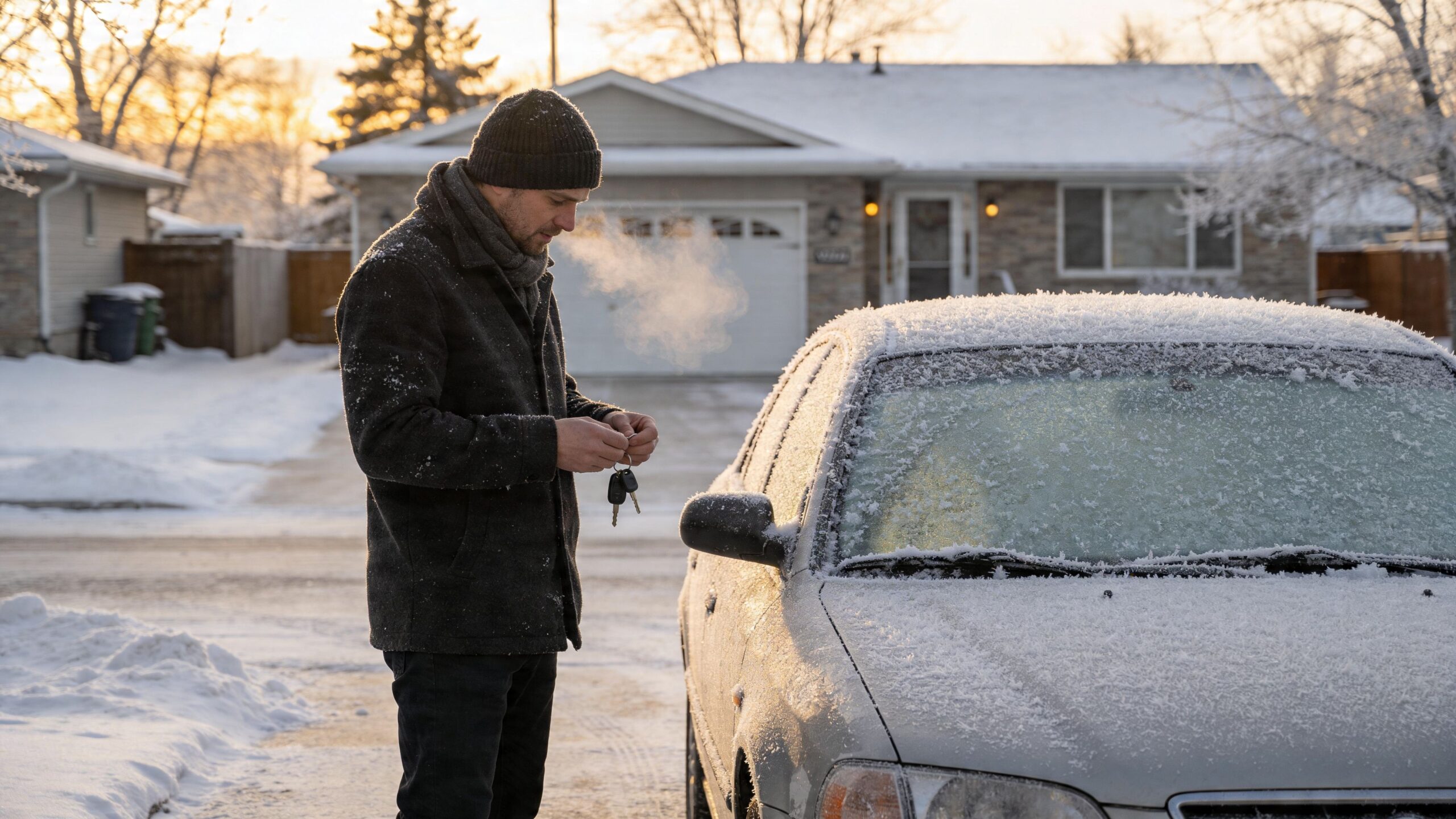
In the shop, the primary question is rarely comfort alone. It is whether the system will keep working after repeated cold starts, freeze-thaw swings, wet boots, road salt, and weeks of moisture working its way under the dash. That is where Canadian installs separate themselves from generic DIY advice written for milder weather.
What the upgrade changes day to day
The obvious benefit is stepping into a warmer cabin. The less obvious benefit is starting your drive with less rush and better visibility. If the starter is installed and programmed properly, the defroster comes on as expected, the blower behaves properly, and you spend less time waiting for the glass to clear enough to drive.
A good install can improve the daily routine in a few practical ways:
- Cabin heat before you get in: HVAC settings need to be set up with the vehicle’s real behaviour in mind, not guessed.
- Less scraping and less waiting: You still may need to clear snow, but you are not starting from a fully frozen cabin and windshield.
- Better winter reliability: Strong connections, correct antenna placement, and secure hood-pin wiring make the difference once the temperature drops hard.
Shop rule: In Ontario, a remote starter proves itself in February, not on install day.
There is also a cost side to this. Some vehicles need little more than the main module and proper wiring time. Others need bypass modules, extra programming, or more labour to integrate cleanly with factory security and push-to-start systems. A quick look at what affects the cost to install autostart gives a more realistic picture than judging the job by kit price alone.
Why Canadian DIY needs a different mindset
A lot of online install guides focus on getting the unit to start the car once. That is not the same as building an install that survives a Canadian winter. Cold changes how plastics flex, how adhesive-backed mounts hold, and how brittle cheap wire insulation gets when the cabin has been sitting below freezing all night.
Material choice counts. Low-temperature wire and proper connection methods hold up better than bargain kits with stiff insulation and quick taps. Antenna placement counts too. Mount it carelessly on a windshield with poor clearance or in a bad spot behind tint or metallic film, and range problems show up fast. The same goes for hood pins and grounds. If either one is marginal, winter moisture usually exposes it.
DIY can make sense on the right vehicle. Older keyed cars with straightforward wiring give you a better chance of success than newer vehicles with heavy module integration. But the standard has to be higher here. The job needs to work after slush, condensation, and weeks of sub-zero mornings, not just during a dry test in the garage.
Your Pre-Installation Blueprint and Toolkit
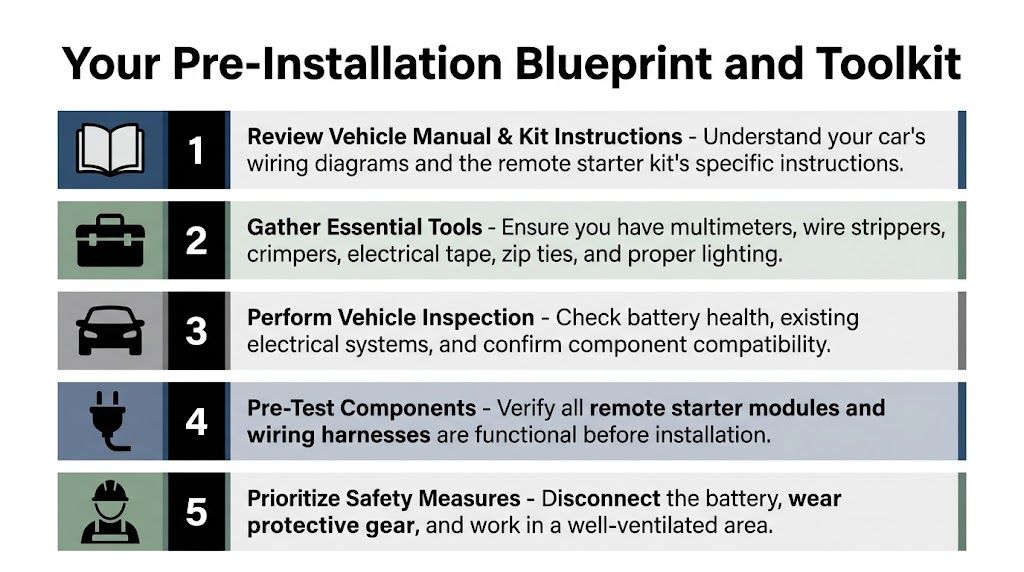
Most bad installs go wrong before the lower dash panel even comes off. The installer buys a kit first, checks compatibility later, and assumes every ignition system follows the same logic. It doesn’t. The prep work is what decides whether your install is clean or frustrating.
Start with the vehicle, not the kit
Before you compare brands or remote range, confirm what the car needs. The key questions are basic, but they matter:
- Transmission type: Automatic vehicles are more straightforward. Manual-transmission remote start setups need extra safety logic, and they leave less room for mistakes.
- Ignition type: A keyed ignition and a push-to-start system are not wired or programmed the same way.
- Factory immobilizer: Many newer vehicles need a bypass module that can talk properly to the car’s security system.
- Electrical complexity: If the vehicle has heavy module integration, factory alarm functions, or sensitive accessory circuits, your install plan gets more technical fast.
If any of that is unclear, stop and verify it through a proper wiring guide or a shop that handles auto electrical repair in Whitby and related diagnostics. Guessing under the dash is how DIY jobs turn expensive.
Choose the right remote starter style
Not every driver needs the same system. Some want basic start and stop. Others want confirmation, better range, or phone control. Keep the choice practical.
| Remote Starter Kit Comparison | Key Feature | Best For |
|---|---|---|
| 1-way kit | Sends command only | Older vehicles, basic budget installs |
| 2-way kit | Confirms the vehicle received the command | Drivers who park farther away or want feedback |
| Smartphone-controlled system | App-based control and status features | Daily commuters, multi-user households, newer vehicles |
What matters most isn’t flashy features. It’s whether the unit integrates cleanly with your vehicle and whether the support hardware is available for that specific platform.
Build a toolkit that suits winter-grade work
Cheap tools make electrical work harder than it needs to be. You don’t need a giant shop cart, but you do need tools that let you test circuits accurately and make durable connections.
Here’s the basic kit I’d consider essential:
- Digital multimeter: You need to confirm wires by function, not by insulation colour alone.
- Trim tools: These help remove panels without chewing them up.
- Wire strippers and proper crimpers: A poor strip or crushed terminal causes intermittent faults later.
- Soldering iron and heat shrink: If you want the strongest, most reliable joins, this is still the standard.
- Zip ties and loom: Loose wiring under the dash rattles, rubs, and eventually fails.
- Good work light: Most mistakes happen because someone couldn’t see clearly.
Then there are the materials generic guides often skip.
Materials that hold up better in Ontario
Ontario winter changes what “good enough” means. The verified guidance we use on this topic points to cold-weather failures involving battery drain, hood pin switch issues, and weather-related reliability problems. That’s why low-temp-rated wiring and insulated connectors matter more here than they do in a milder climate.
Use materials that won’t turn brittle or unreliable when the car sits outside in freezing weather:
- Low-temp-rated primary wire: Better for under-dash and pass-through work where temperature swings are common.
- Insulated T-taps: If you use tap-style connectors at all, use insulated versions instead of bargain-bin hardware.
- Adhesive-lined heat shrink: Better sealing against moisture and condensation.
- Quality hood pin hardware: Hood safety shutdown has to work every time, not most of the time.
Buy materials for February, not for the install day. A connection that looks neat in the garage can still fail once cold soaks, moisture, and vibration start working on it.
Pre-install checks that save time later
Before you tear into the dash, do a quick baseline check:
Battery condition
A weak battery creates false troubleshooting trails. If the battery is already struggling, remote start performance won’t tell you much.Factory functions
Confirm locks, ignition behaviour, and warning lights all operate normally before you touch anything.Kit contents
Open the box and verify every harness, antenna, module, and bypass piece is present.Programming access
Some systems need pre-flash or firmware setup before physical install. Check that early.Work environment
If you’re outside in the cold, small plastic clips, stiff wiring, and rushed hands will fight you all day.
A clean install remote engine starter job begins with patience. If the prep feels tedious, that usually means you’re doing it right.
The Heart of the Installation Wiring and Connections
A remote starter install is won or lost in the wiring. The module can be mounted neatly and the antenna can look perfect, but one bad ignition pick-up, one weak ground, or one cold-sensitive splice can leave the car dead on a February morning.
Open the dash carefully and keep the job controllable
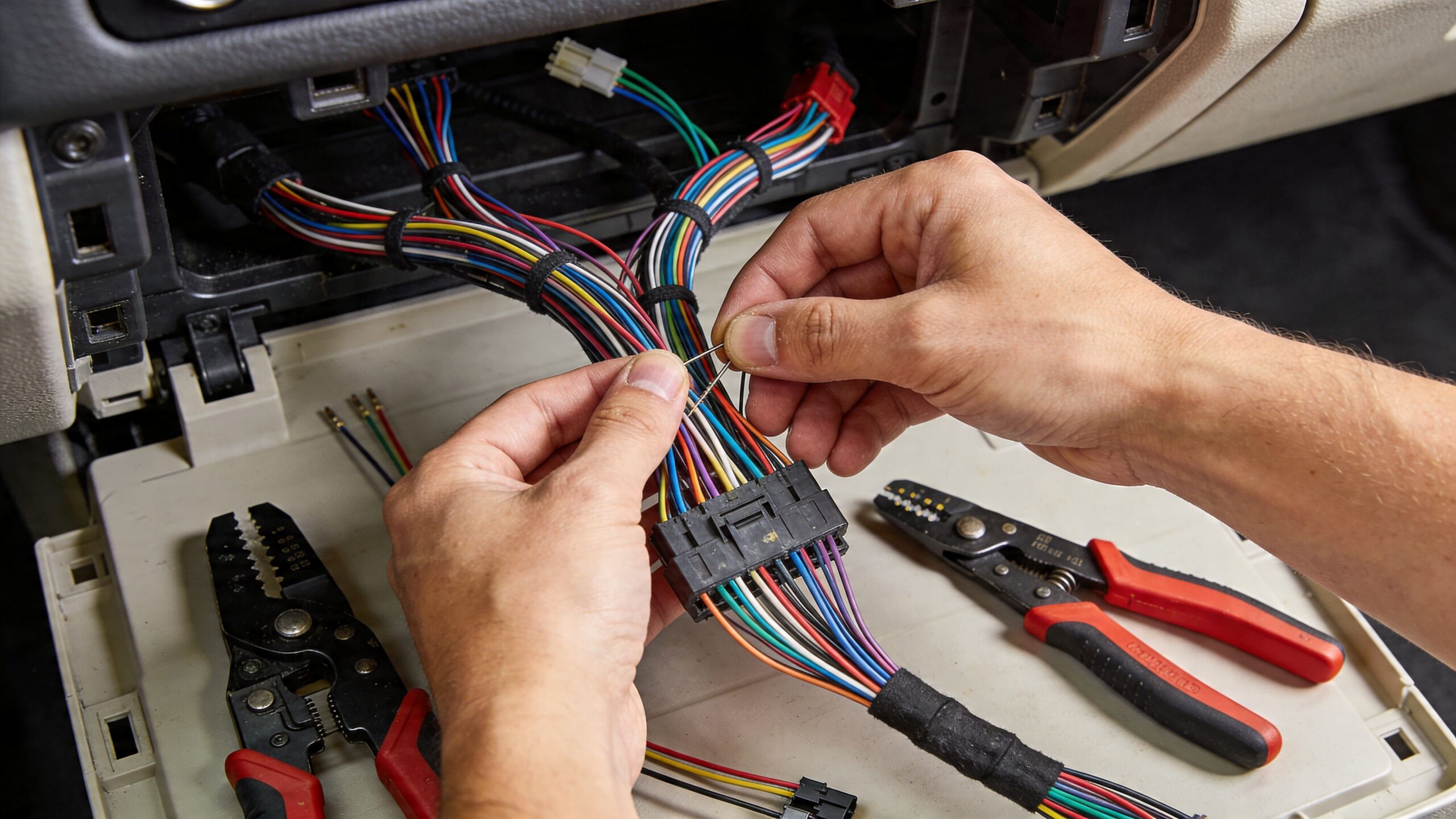
Getting access without breaking trim matters more than DIY guides usually admit. Under-dash plastics get less forgiving in the cold, clips crack easier, and one rushed pull can turn a wiring job into an interior repair.
Pull panels in a controlled order. Bag screws and clips as they come out. Keep enough room to work around the ignition harness, brake switch, parking light output, hood pin input, and any data wiring the vehicle uses. A messy footwell slows you down and increases the odds of pinched wires, damaged connectors, and missed fasteners during reassembly.
Verify every circuit with a meter
Do not trust wire colour alone. Manufacturers change colours between trims, mid-year production runs, and Canadian versus U.S. configurations. I have seen identical-looking harnesses in two cars from the same model line carry different functions.
Check each wire by what it does:
- Constant power: Live in every key position
- Ignition: Live in run and usually during crank
- Accessory: Live in run, often drops out during crank
- Starter: Live only while cranking
- Brake input: Changes state the instant the pedal is pressed
- Parking light or status circuits: Confirm polarity before tying in
That extra five minutes with a meter saves hours of fault tracing later.
Wire colour points you in the direction. The meter confirms the job.
Build connections for January, not for the garage
Connection quality is what separates a starter that works for a week from one that still works after three winters. In Southern Ontario, cold soak, salt, condensation, and vibration expose every shortcut.
The better approach is simple:
- Soldered or properly crimped joins on critical circuits
- Adhesive-lined heat shrink over exposed splices
- Harness support so the splice is not carrying the weight of the loom
- Split loom or abrasion protection near brackets and metal edges
- Grounds on clean, solid metal, not painted surfaces or random screws
The troublemakers are predictable:
- Loose tap connectors on ignition or starter wires
- Twist-and-tape splices
- Grounds stacked onto weak factory points
- Harnesses left hanging where the driver’s foot or lower trim can snag them
A mediocre connection often passes the first test. Then the car sits outside overnight at minus temperatures, copper contracts, resistance rises, and the comeback starts.
Winter changes the standard
Generic install guides are usually written for milder conditions. They skip the details that matter in Ontario. Cheap primary wire gets stiff in deep cold. Budget electrical tape lets go. Hood pin hardware that seemed fine in a dry garage starts sticking after slush and salt get into it.
Use low-temp-rated wire if you need to extend or repair a circuit. Seal exposed joins. Mount the hood pin where the hood closes it firmly and where direct spray is limited as much as possible. Keep antenna cables away from sharp edges and avoid routing them where meltwater can track into connectors.
Cold weather also punishes weak grounds faster than summer driving does. If the remote starter behaves inconsistently only in winter, I check the ground and the hood pin before anything else.
Bypass modules stop a lot of DIY installs
On older vehicles, the job was more straightforward. On many newer cars, the engine will crank and still refuse to run unless the immobilizer sees the right handshake. The bypass module handles that conversation.
That means two jobs have to be right at the same time. The wiring has to be correct, and the module has to be matched, flashed, and learned properly for that exact vehicle.
Common bypass mistakes include:
- Using the wrong module or firmware version
- Missing a required data wire
- Skipping pre-flash setup
- Running the learn procedure in the wrong order
- Assuming push-to-start systems behave like keyed ignitions
Crank-no-start complaints often start here. If diagnosis gets past basic checks, proper auto electrical repair support in Whitby saves a lot of guessing.
If you work on electrical systems long enough, the pattern stays the same across machines. Reliability comes from clean connections, correct protection, and proper routing. The same principle applies when you turn your bike into an electric bike, because weak splices and poor weather protection always come back as reliability problems.
Mount the hardware so it can survive and be serviced
A module shoved behind the dash is not a good install. Secure it so it cannot rattle, drop into pedal travel, or rub on heater ducts and brackets. Leave enough slack to service it later, but not so much that the harness can move around.
The antenna should be mounted cleanly, with the cable routed so trim does not crush it. The hood pin deserves the same level of care. If that switch loses contact, corrodes, or shifts position, the remote starter either refuses to work or becomes unsafe.
Add extra functions one at a time
Door locks, takeover mode, parking light flash, rear defrost, and trunk release are all useful. They also add more points of failure. The practical way to wire them is one feature at a time, with a test after each addition.
That is how experienced installers keep the job under control. Get the engine start and shutdown logic right first. Then add the convenience features without creating three new faults for every one function you wanted.
Programming Testing and Final Assembly
Wiring gets all the attention, but programming is where the vehicle decides whether it accepts your work. If the module, bypass, and vehicle don’t learn each other properly, the install won’t behave consistently. You might get one successful start, then a shutdown, a warning light, or no response at all.
Program in the right order
The exact sequence depends on the brand and vehicle, but the pattern is usually the same. Power the system, enter the programming routine, teach the bypass, then set feature options such as runtime, lock behaviour, shutdown logic, and takeover sequence.
Keep the instructions in front of you and follow them exactly. Don’t rely on memory after watching a video for a different vehicle. One missed ignition cycle or wrong menu choice can force you to reset and start over.
A sensible order looks like this:
- Confirm stable battery voltage
- Power the module and check indicator behaviour
- Program or learn the bypass module
- Set feature options one at a time
- Test basic remote start before adding extras
Test every safety input before closing panels
A remote starter that starts is only half tested. It also has to shut down when it should. This is not optional.
Check these items carefully:
- Brake shutdown: Pressing the brake without takeover should stop the remote start cycle.
- Hood pin shutdown: With the hood open, the system should refuse to remote start.
- Neutral and reservation logic where applicable: Manual setups need extra attention here.
- Door lock and access functions: If connected, confirm they work consistently from both factory controls and the new remote system.
- Parking light confirmation: Useful feedback, but only if it’s wired correctly.
If a safety input works intermittently in the garage, assume it will fail completely in bad weather.
Verify cold-weather functions, not just basic cranking
Don’t stop at “engine started once.” Test the setup in the way you’ll use it. Let the vehicle sit, then remote start it again. Confirm the heater, defrost, and seat functions behave the way the vehicle allows. Some cars retain the last HVAC setting well. Others need feature programming or owner habit changes to get the result you want.
This is also the right time to check takeover. Enter the vehicle, open or use the proper entry method, switch to normal drive-ready mode, and confirm the engine stays running as intended. If that handoff is sloppy, you haven’t finished the job.
Dress the wiring like it belongs there
Final assembly is where careful work separates itself from rushed work. Secure every added wire so it can’t drop near pedals, rub on brackets, or buzz behind trim. Re-wrap harness sections where needed, and leave enough service slack without creating loops of loose wire.
A few habits help:
- Bundle by path, not by convenience
- Keep added wiring away from steering shafts and pedal movement
- Reinstall trim gently and check for pinched harnesses
- Do one last function test after all panels are back on
If the dash goes together and suddenly a function stops working, a harness has probably shifted or been pinched. Pull the panel back off and fix it properly. Don’t leave a hidden fault for later.
Troubleshooting Common Installation Headaches
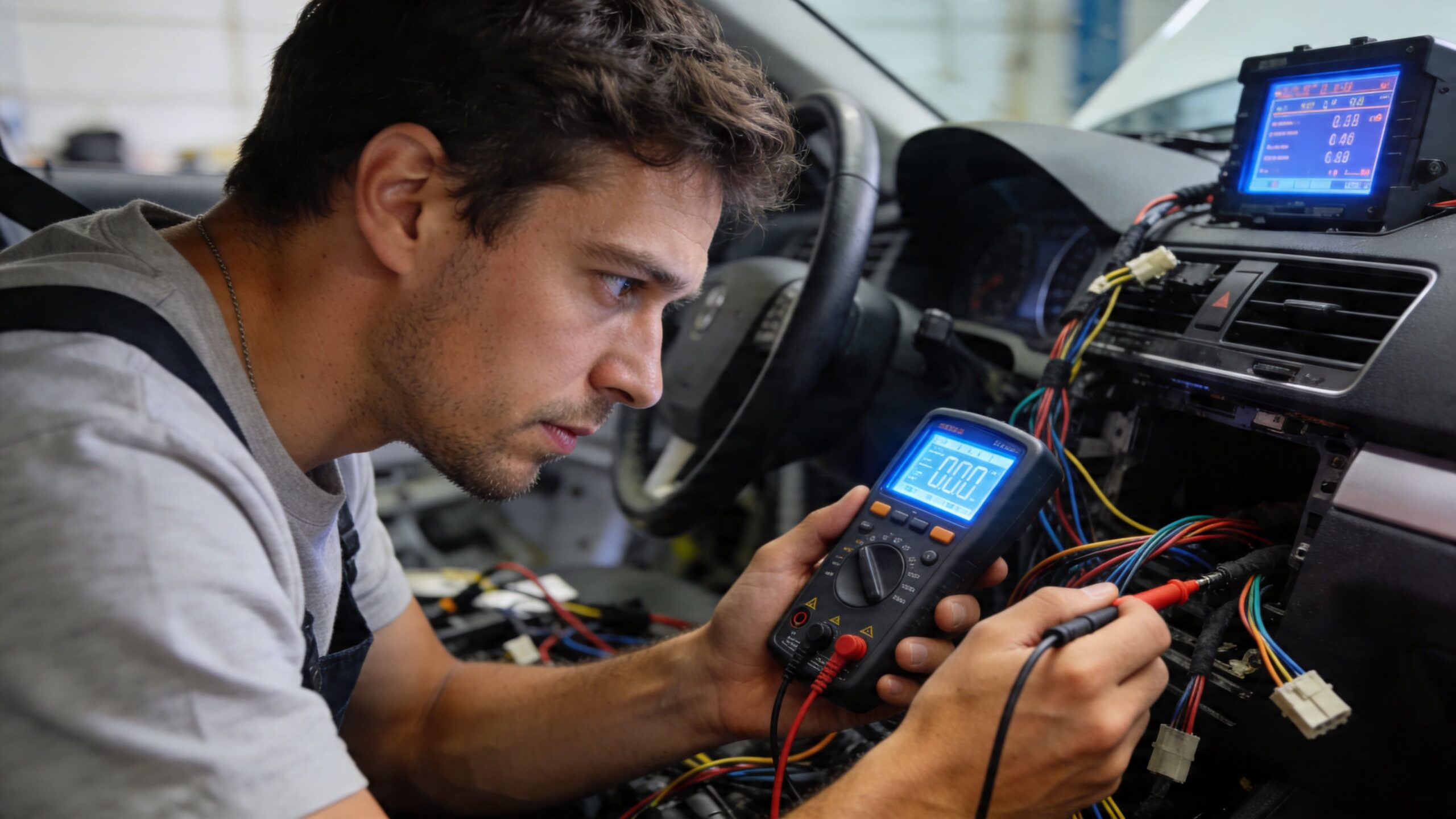
Some problems show up right away. Others only appear after the install seems finished. The trick is to diagnose by symptom, not by panic. Start with the simplest likely cause and work outward.
Lights flash but the engine doesn’t crank
This usually points to a missing or incorrect starter output connection, an unrecognised hood-open condition, or a programming issue that prevents the start sequence from completing.
Check these first:
- Starter wire confirmation: Re-test it with the multimeter.
- Hood pin input: A bad hood switch can block starting entirely.
- Ground quality: Weak grounds create odd behaviour fast.
- Module programming status: Some units won’t crank until the learn process is complete.
Engine cranks and shuts off right away
This is one of the most common headaches on modern vehicles. In many cases, the bypass module hasn’t learned properly, isn’t wired correctly, or isn’t the correct firmware for the vehicle.
Go back through the bypass steps carefully. Confirm every data connection. If the car starts normally with the key but dies on remote start, security integration is the first place to look.
Don’t start replacing parts when the symptom points to sequence or wiring. Most crank-then-stall issues are setup problems.
Remote range is poor or inconsistent
A weak range complaint often traces back to antenna placement or cable routing. The antenna should be mounted where the manufacturer recommends, usually high on the glass, away from heavy tint film or metallic interference if possible.
Also inspect:
- Antenna cable pinching behind trim
- Loose antenna plug at the control module
- Ice or contamination around the mounting area
- Vehicle battery condition
When you’re tracing electrical faults methodically, broad diagnostic habits from other vehicle systems still help. A practical overview of electrical troubleshooting techniques can be useful if you’re trying to stay systematic instead of jumping randomly between guesses.
Parking lights or locks don’t work after install
Convenience outputs are often where polarity mistakes or wrong wire selection show up. Re-check whether the circuit expects positive trigger, negative trigger, data control, or a relay-assisted connection. Don’t assume because the start function works that the rest of the harness is correct.
If the battery has also been weak during testing, rule that out before going deeper. Strange accessory behaviour and low-voltage problems often overlap, especially in winter. If that’s in play, get familiar with what affects car battery replacement cost and battery-related service decisions.
Unit won’t enter programming mode
This usually comes down to one of four things:
- Wrong ignition sequence
- Valet or programming button issue
- Incomplete power or ground connection
- Bypass or data module not ready
Slow down and repeat the steps exactly. Rushing often leads to wasted time. If the procedure says key on, button press, key off, then that order matters.
The DIY vs Pro Decision When to Call Carmedics Autowerks
It is 6:30 on a January morning in Ontario, the car is buried in frost, and a remote starter that worked fine in October suddenly refuses to crank. That is usually the point when the install quality gets tested for real. Cold-soaked batteries, stiff wiring, marginal grounds, and sloppy connections show up fast in Canadian winter.
The choice between DIY and professional installation comes down to vehicle complexity, your electrical skill, and how much downtime you can tolerate if the job goes sideways. Older keyed-ignition vehicles give you more room for error. Newer cars with push-button start, immobilizer integration, and CAN communication do not. A mistake on a modern vehicle can turn a convenience upgrade into a no-start diagnosis.
DIY makes sense in a narrower set of cases than many online guides suggest, especially here.
- You can read wiring diagrams and verify circuits with a meter
- Your vehicle is older and less network-dependent
- You have the right tools, including proper test equipment and quality connection materials
- You have indoor workspace and enough time to stop, test, and correct mistakes
- You understand that winter reliability depends on more than getting the engine to start once
Material choice matters more in this climate than generic guides admit. Low-temperature wire insulation, properly supported harness routing, and secure connections hold up better when plastic trim is cold and cabin temperatures swing hard. I have seen DIY installs function for weeks, then fail after a stretch of deep cold because a T-tap loosened, a poorly placed module got damp, or a bargain harness stiffened up and started stressing a splice.
Professional installation makes more sense when the vehicle is newer, the security system is integrated into several modules, or the car has to be dependable every weekday morning. It also makes sense if you do not already own the tools needed to test safely and program the bypass correctly. Saving money on labor disappears quickly if the result is a parasitic draw, intermittent crank issue, or a tow bill in February.
For drivers who want that work handled locally, Carmedics Autowerks in Whitby installs and diagnoses remote starters with the kind of circuit testing and winter-focused detail modern vehicles need.
The practical answer is simple. DIY can be a good project on the right vehicle with the right skill set. If the car is newer, valuable, or relied on every day through an Ontario winter, professional installation is usually the cheaper decision in the long run.
If you would rather skip the trial-and-error and have the job done with proper wiring, programming, and cold-weather reliability in mind, contact Carmedics Autowerks Inc. We service Whitby drivers who want a remote starter installed cleanly, tested properly, and ready for real Ontario winter use.