


You turn the key, hear one click, maybe a tired whir, and the dashboard lights stay on just long enough to make you think the battery's fine. That's the moment a lot of people start shopping for a starter motor, when the fault might be hiding in a cable, a ground, or a voltage problem upstream. Starter motor issues are frustrating because the symptom looks simple, but the diagnosis usually isn't.
Why Your Starter Motor Might Not Be the Real Problem
A car that won't crank feels like a starter failure, and plenty of drivers stop there. In the bay, that guess costs money. The starter is only one part of a chain that includes the battery, main cables, grounds, ignition switch, and the vehicle's control electronics, so a weak link anywhere in that path can create the same no-start complaint.
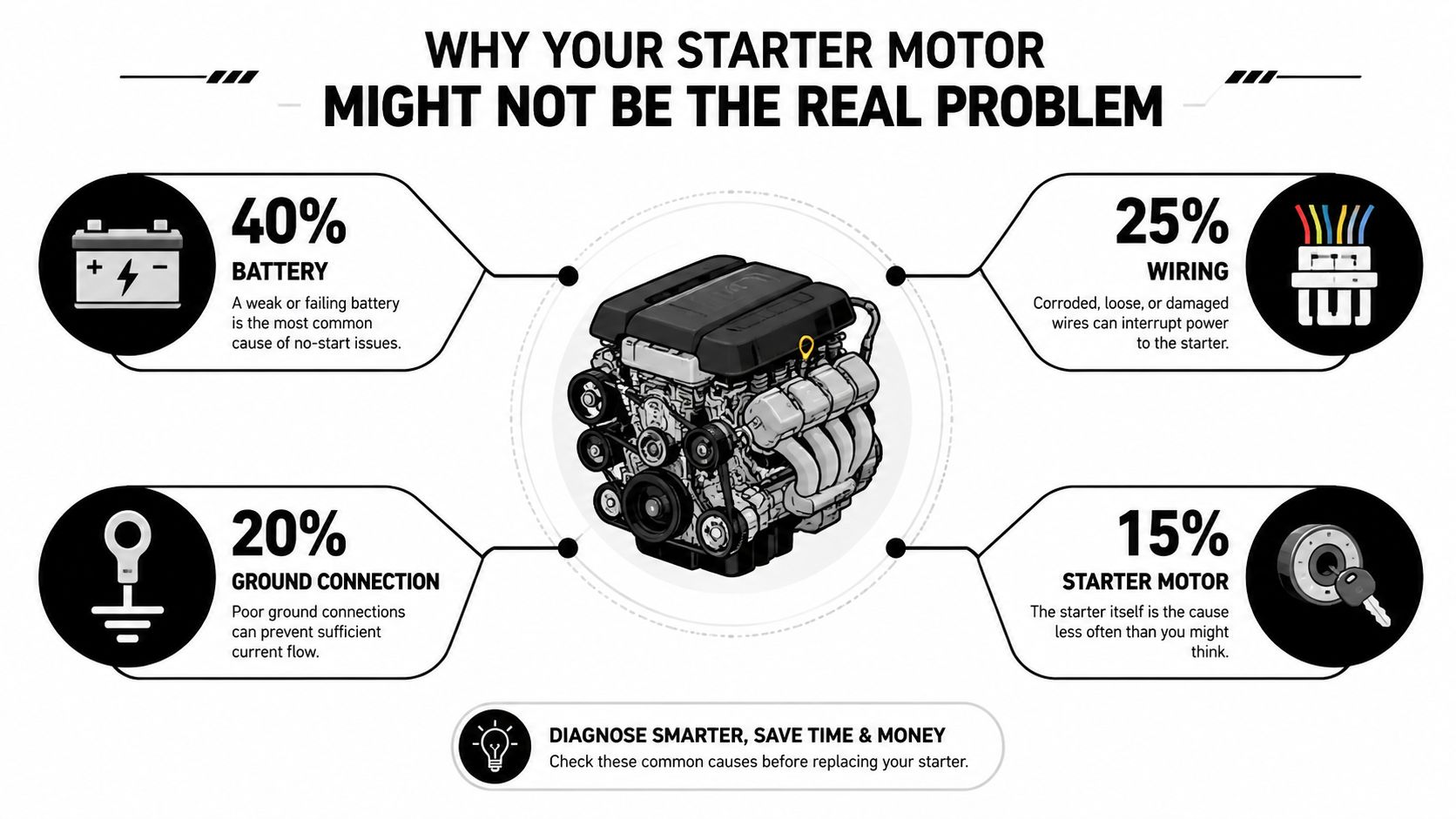
I've seen this go wrong in the same way more than once. A driver swears the starter is dead, replaces it, and the car still does nothing because the battery cable had hidden corrosion under the insulation. That's why a proper diagnosis starts with the electrical path, not the shiny replacement part.
Practical rule: if the engine won't turn over, test the circuit before you condemn the motor.
That's also why stop-and-go driving matters. Argonne National Laboratory notes that starters are designed to last over 30,000 cycles, with real-world failures typically showing up between 30,000 and 60,000 cycles, and that each extra start per day raises failure potential over a 10-year vehicle life (Argonne report). In dense urban driving, those extra restarts pile up fast, which is one reason starter motor issues show up long before the odometer looks “high.”
For a clear example of how battery maintenance affects repeated starting loads, the same logic applies to other starting systems too, such as charging RV batteries for travel. The principle is the same, stable power and low resistance matter more than many realise.
If you want local electrical diagnosis rather than guessing, auto electrical repair in Whitby is the kind of service that fits this job, because the issue usually sits in the system, not just the starter itself.
Recognizing the Key Symptoms of Starter Motor Issues
The sounds matter. A single loud click usually means the solenoid is trying to engage, but current isn't getting where it needs to go. That can point to weak battery output, high resistance in the cables, or a starter that's jammed internally. A slow, laboured crank tells a different story, it often means the starter is pulling hard but losing torque because voltage is dropping or the motor is worn.
A grinding noise is more serious. It usually means the starter drive gear and flywheel teeth aren't meshing cleanly, which can happen when the Bendix drive is worn or when the starter isn't mounting correctly. A freewheeling sound, where the motor spins without really turning the engine, points in the same direction, the drive is spinning but not engaging.
No-crank versus crank-but-no-fire
A no-crank complaint means the engine isn't being turned by the starter at all. A crank-but-no-fire complaint means the engine is spinning, but something else is stopping combustion. That distinction matters because plenty of people blame the starter for a problem that belongs to fuel, spark, or engine management.
An intermittent no-start is the one that wastes the most time. It comes and goes, then “fixes itself” just long enough to make the diagnosis messy. That pattern often tracks with loose grounds, heat-related expansion in wiring, or a starter that's getting weak under load.
A burning smell near the starter area usually means heat is building where it shouldn't. Treat that as a warning, not a nuisance.
For a plain-language diagnosis, use the symptom as your starting point and work backwards. Clicking, slow cranking, grinding, and intermittent failure each narrow the field, but none of them proves the starter is the only bad part. That's the trap. A starter can be the victim of a bad circuit, not the villain.
If you're trying to match the symptom to the repair path, the first question is simple, does the engine fail to rotate, or does it rotate and still refuse to start? Once you answer that, you're already ahead of most rushed parts-counter guesses.
Step-by-Step Diagnostic Checks You Can Do at Home
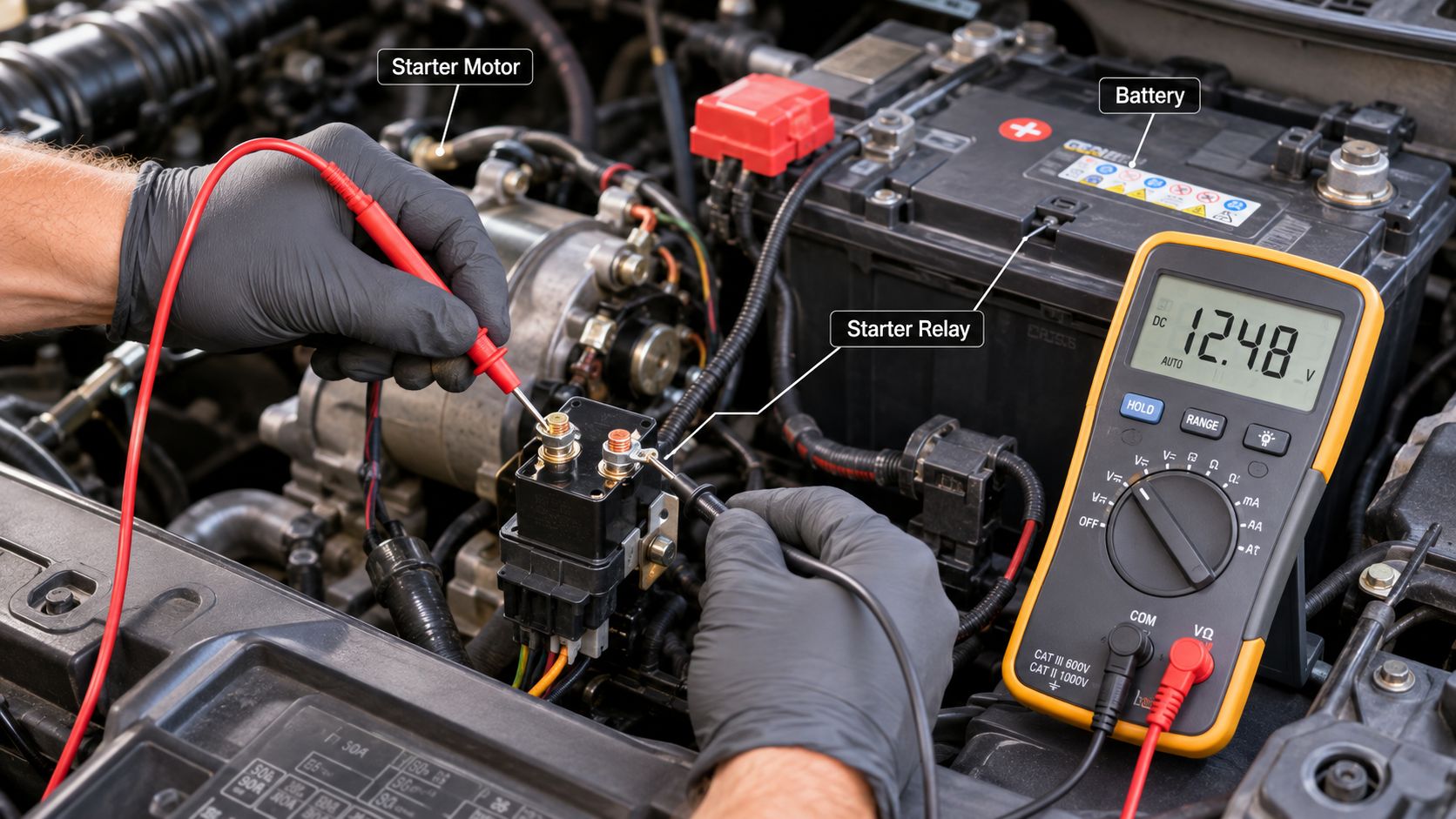
Start with the battery because it's the cheapest false positive to eliminate. A multimeter is the right tool here, and you want to measure battery voltage at rest and then watch it while someone turns the key. If the reading falls off hard during cranking, the starter may be innocent and the battery or cable path may be collapsing under load.
Check the battery and terminals first
Look closely at the terminals, not just the clamps. White or green corrosion, loose fasteners, or a cable that feels soft under the insulation can all create enough resistance to make a starter act dead. Clean the posts, clean the clamp surfaces, and tighten everything properly before moving on.
Shop rule: if the battery connections are dirty, test results are meaningless until you fix them.
Then follow the ground path. The negative cable should be clean where it bolts to the engine or body, because a poor ground can mimic a failed starter with almost perfect confidence. If the car is older or lives in a damp environment, this is one of the first places I inspect.
Use voltage drop, not guesswork
A simple voltage drop test tells you more than a quick “it has power” check. You're looking for resistance across the positive cable and the ground side while the system is under load. That's the difference between a cable that looks fine and a cable that delivers current.
If the starter is accessible, a bench-style check can help, but don't skip the basics first. High-current systems hide problems well, and a good-looking part can still fail when heat and load hit it together. Safety matters too, because you're working around hot exhaust parts and high-current terminals that can spark if you slip.
A basic test light is fine for simple power-or-no-power checks at the relay or trigger circuit. A multimeter is better for anything involving voltage drop, because the starter circuit can have enough resistance to stop cranking while still lighting a test bulb. That's why people replace parts and still end up stuck.
If you're weighing whether to test further or just book a visit, battery replacement cost guidance can help you compare the battery side of the decision before you spend on a starter. That comparison matters because the wrong part order is usually the expensive mistake.
Hidden Causes That Surprise Most Drivers
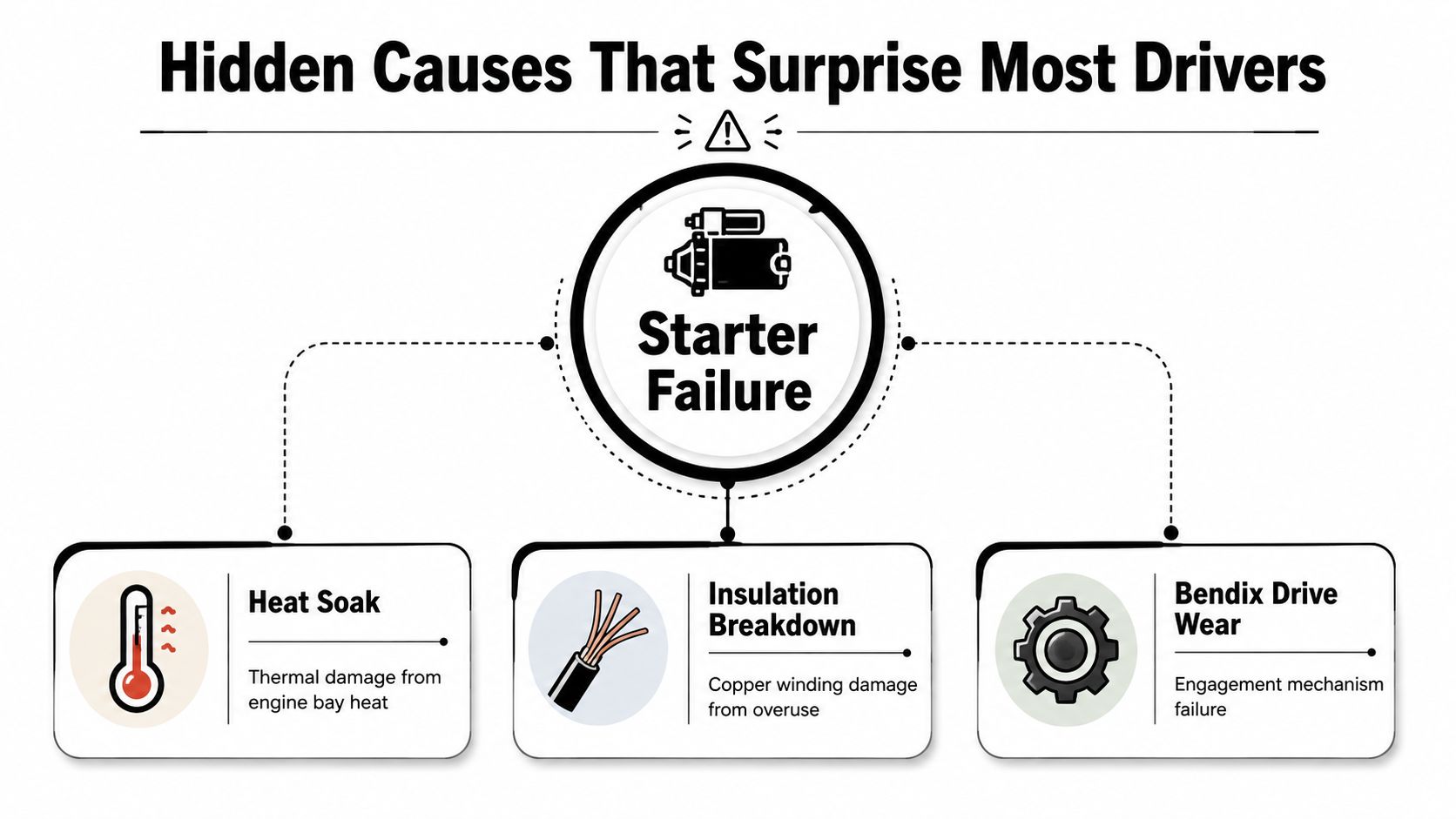
Some starter motor issues don't look like classic electrical failure at all. They show up after a hot drive, a long crank session, or an engine bay that bakes components in place. The starter is a heavy electrical load, and heat makes every weakness worse, from insulation inside the motor to the resistance in nearby wiring.
Heat soak and winding damage
One technical guide notes that extended cranking can overheat the starter enough to damage winding insulation, which can lead to short circuits or low torque. Another explains that high current draw with low cranking speed often points to internal wear, including layer shorts, worn brushes or bushings, or mechanical blockage (mechanic.com.au technical guide). The practical takeaway is simple, repeated no-start attempts can turn a borderline starter into a fully failed one.
That's especially relevant in tightly packed modern engine bays, where heat doesn't leave quickly. A starter that works cold can act weak hot, then recover after cooling down. That's not magic, it's a heat-related fault that changes resistance and mechanical drag.
Electrical noise can confuse the system
There's another wrinkle most owners never hear about. A failing starter can create voltage spikes that confuse crank-angle and cam-angle sensors, which can produce a no-start condition even while the starter is still cranking. That means the starter may be failing mechanically, or it may be interfering with sensor signals through electrical noise and low-voltage instability.
A workshop training note on starters affecting crank-angle sensors describes this kind of interaction and why structured voltage testing matters on modern vehicles (JAS Training Tech Tips). That's why a scan tool can matter even when the symptom sounds mechanical.
If the vehicle has intermittent behaviour, don't ignore the possibility that the fault lives in the control side. A weak starter can trip up the ECU's view of engine position, and that can make diagnosis look backwards. The starter isn't always the origin of the problem, sometimes it's the reason the rest of the system stops making sense.
For drivers dealing with repeated weird starts, anti-theft device for car is worth keeping in mind as a separate diagnostic path, because crank-and-no-start complaints can overlap with other immobilisation problems. Different fault, same driveway headache.
Repair Options and What They Actually Cost
The cheapest fix isn't always the wisest one. If the issue is a bad ground, corroded cable, or weak battery connection, cleaning and repairing the existing circuit is the right move. If the starter itself is failed, you're usually choosing between replacing the solenoid section, installing a remanufactured starter, or fitting a brand-new OEM unit.
| Starter Repair Options Compared | Typical Cost Range | Expected Lifespan | Best For |
|---|---|---|---|
| Clean and repair connections | Low | Depends on the rest of the circuit | Corroded terminals, loose grounds, cable resistance |
| Replace solenoid only | Moderate | Variable | Cases where the motor itself tests well |
| Remanufactured starter | Moderate | Mixed, depends on rebuild quality | Older vehicles, budget-conscious repairs |
| New OEM starter | Higher | Typically strongest long-term choice | Owners keeping the vehicle and wanting fewer repeat visits |
A remanufactured unit can make sense when the vehicle is older and the rest of the charging and starting system tests clean. A new OEM starter is usually the better long-term play if the car is dependable transport and you don't want to open the same job again soon. Rebuilding just the solenoid can be reasonable, but only when testing shows the motor is still healthy.
Decision point: if the circuit tests are clean and the starter still draws badly or grinds, replacement usually beats trying to nurse it along.
That's where many people need help translating diagnosis into a repair order. If you're dealing with an insurer or a shop estimate that feels off, how to dispute a lowball insurance estimate can be useful context for understanding the estimate side of the conversation, even though starter work is often a simpler repair than body damage.
If you want a broader comparison of labour and alternator-side pricing for similar electrical work, alternator repair cost gives a useful reference point for how electrical diagnosis and replacement jobs are usually framed. The key is to pay for the fault, not for assumptions.
Preventative Maintenance and When to Call a Professional
Starter life improves when the rest of the electrical system stays clean and stable. Keep battery terminals tight and free of corrosion, and don't sit on the key for long cranking sessions when the engine won't catch. Every extra attempt adds heat and stress, and that's how a marginal problem becomes permanent.
Oil contamination is another issue that doesn't get enough attention. The shop data in the brief shows oil contamination and thermal soak account for 14.2% of failures, which is a clear reminder that the starter's environment matters as much as the motor itself (starter failure dataset). If the engine leaks oil onto the starter area, fix the leak instead of just swapping the part.
Maintenance habits that actually help
- Keep battery clamps clean. Small corrosion deposits add resistance fast.
- Fix weak charging parts early. A tired battery or failing alternator forces the starter to work harder.
- Stop repeated key cycling. If it didn't start after a couple of tries, diagnose the fault instead of cooking the motor.
- Inspect cable routing. Heat and abrasion turn a good cable into a future no-crank complaint.
If you've already ruled out the battery and grounds but the car still behaves oddly, the fault may be in the ECU-side diagnosis, sensor signalling, or a wiring issue that needs circuit tracing. That's the point where professional tools earn their keep. A scan tool, a voltage-drop test under load, and a technician who knows how to read both together usually save time.
For routine upkeep on the vehicle side, preventive maintenance for vehicles is a sensible companion topic because the starter rarely fails in isolation. It usually fails inside a system that's been asking too much of it for too long.
If your car's acting up and the usual battery check didn't solve it, Carmedics Autowerks Inc in Whitby can trace the starting circuit, test the electrical system properly, and repair the fault without guessing. Visit Carmedics Autowerks Inc to book a starter system diagnosis or electrical repair appointment when you're ready to get the car starting the way it should.