


You turn the key on a Whitby morning, the engine fires, the fan comes on, and all you get through the vents is cold air. Then the windscreen starts to haze at the corners. At that point, a bad heater stops feeling like an annoyance and starts feeling like a real problem.
Most drivers first notice it when the cabin won't warm up. The more important clue is what happens to visibility. If the heater can't deliver warm, dry air to the glass, defrosting slows down and the drive gets more stressful than it should be. That's why heating system repair matters. It affects comfort, but it also affects control, visibility, and how confidently you can use the car in winter.
A lot of heater complaints sound the same at first. “No heat.” “Weak airflow.” “It gets warm only when I'm driving.” But those symptoms can come from very different faults. Some are simple. Some are labour-heavy. The trick is separating the easy checks from the problems that need proper testing in the bay.
Why Your Car Heater Is More Than a Creature Comfort
A working car heater earns its keep on the coldest days, but not mainly because it keeps your hands warm on the steering wheel. Its real job is helping you see.
In Whitby, a typical winter drive can include a cold start, damp air, slush spray, and a windshield that fogs faster than you expect. If the heater is weak, the cabin stays chilly and the glass takes longer to clear. If the blower works but the air never gets properly hot, the defrost setting can't do its job well. That's when drivers start wiping the inside of the windscreen with a sleeve at red lights. Nobody wants that.
Visibility comes first
Heat and airflow work together inside the car. The blower moves air. The heating system warms it. The ventilation doors route it where you need it. When any part of that chain fails, the first practical problem is often the front glass.
Practical rule: If your heater can't clear the windshield properly, treat it as a safety issue, not a comfort issue.
That's also why heater complaints often show up during routine seasonal service. Drivers come in saying the cabin is cold, but what they're really worried about is the morning commute and whether the car will clear up quickly enough to drive safely.
Small warning signs usually come first
Most heater failures don't arrive out of nowhere. The clues usually start small:
- Long warm-up time: The engine seems to take forever before any heat reaches the cabin.
- Inconsistent vent temperature: You get warm air at one stoplight and cool air at the next.
- Foggy glass that hangs around: Defrost runs, but the moisture doesn't clear quickly.
- Weak airflow on higher fan settings: The fan sounds busy, but not much air reaches you.
That's the point where basic maintenance becomes useful. Seasonal checks often catch cooling-system issues, airflow restrictions, and worn components before winter turns them into a daily aggravation. For drivers who want to stay ahead of that curve, a good preventive maintenance plan for vehicles makes a real difference.
How Your Car's Heating System Actually Works
Your car's heater is a clever recycler. It doesn't create cabin heat with its own burner the way a home furnace does. It borrows heat the engine already makes, then puts that heat to work inside the cabin.
That's why a heater problem is often tied to the cooling system. If the engine can't produce, control, or circulate heat properly, the cabin won't get warm either.
The basic heat path
The process is straightforward once you see it as a loop.
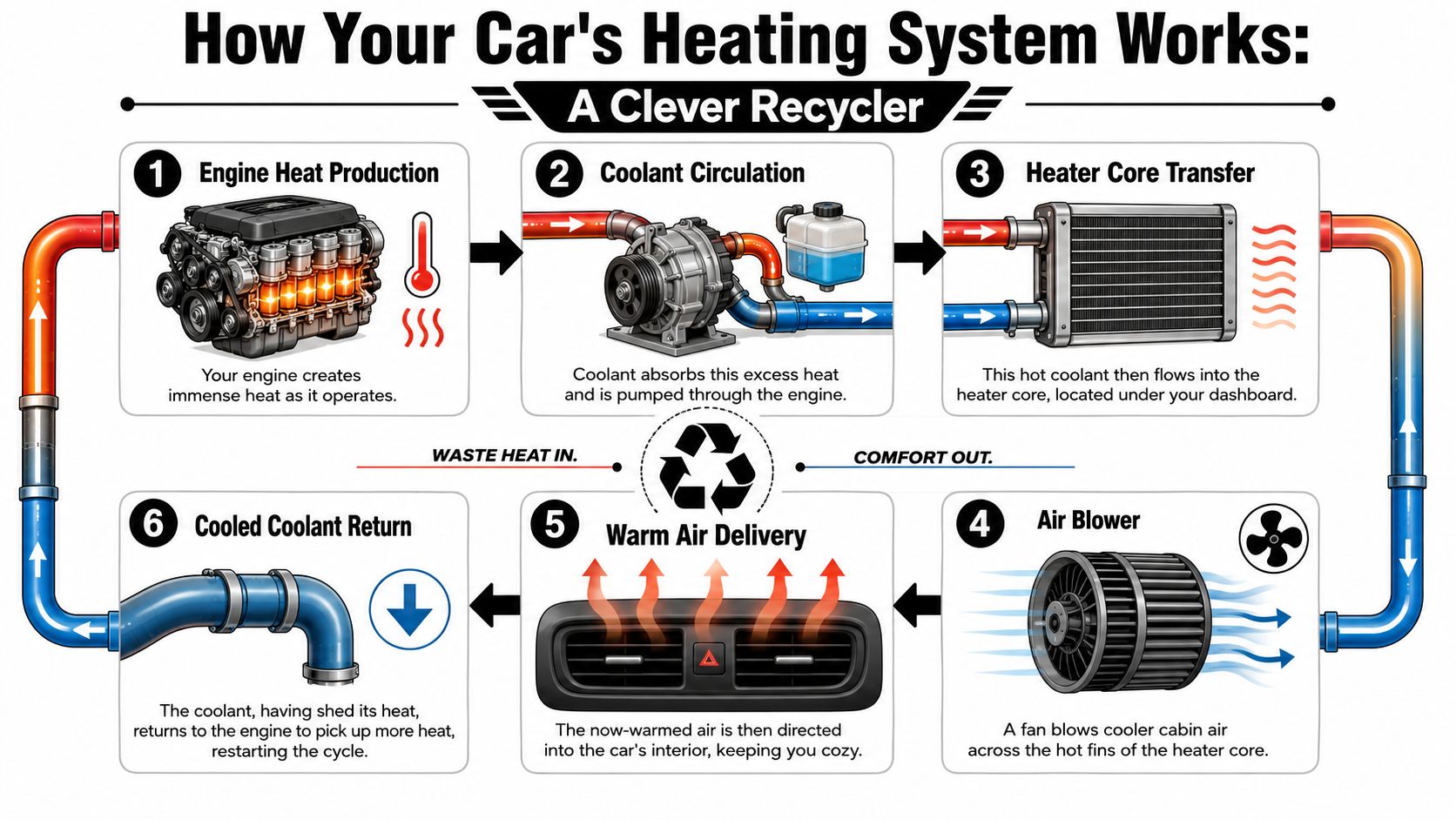
The engine creates a lot of heat while running. Coolant absorbs that heat and carries it through the engine passages. Once the engine reaches operating temperature, the thermostat allows hot coolant to circulate through the system, including the heater core, which sits behind the dashboard.
The heater core acts like a small radiator. Hot coolant flows through it. A blower motor pushes cabin air across its fins, and that warmed air comes out through the vents.
Then the coolant heads back through the system, picks up more engine heat, and the cycle repeats.
What each part contributes
A heater only works properly when several components do their jobs at the same time:
- Coolant: Carries heat from the engine to the heater core.
- Thermostat: Controls when coolant begins circulating so the engine can warm up properly.
- Heater core: Transfers heat from the coolant into the cabin air.
- Blower motor: Pushes air through the vents.
- Blend door and controls: Decide whether air passes through the hot heater core or bypasses it.
If one part fails, the symptoms change. Low coolant often means little or no heat. A stuck-open thermostat can make the engine run too cool. A clogged heater core can give you weak heat even when the engine itself is warm. A bad blower motor can leave you with heat trapped behind the dash but very little air reaching the cabin.
Think of it like the home heating world. Technicians don't just look at the furnace. They also check airflow, filters, heat transfer, and safety. For vehicles, the same mindset matters. One blocked path can make a healthy heat source feel broken.
Electrical faults can also enter the picture. A failed blower resistor, damaged wiring, or bad control signal can leave you with fan speeds that don't work correctly, or no airflow at all. If that side of the system is acting up, electrical diagnosis matters just as much as coolant diagnosis. That's where proper vehicle electrical repair testing becomes important.
The Four Main Reasons Your Car Heater Fails
Most heater complaints trace back to four root causes. They produce different symptom patterns, and that pattern is what helps narrow the fault before parts are replaced.
Low coolant or a coolant leak
No coolant means no heat transfer. It's that simple.
If the coolant level drops, the heater core may not get a steady flow of hot coolant. In some cars, that shows up as heat that comes and goes when turning corners or idling. In others, the heater blows cold even though the fan works normally. You might also notice the temperature gauge acting strangely or find dampness from a leak elsewhere in the cooling system.
This one matters because topping up coolant without finding the leak is only a temporary move. Coolant doesn't normally disappear.
A thermostat that won't regulate properly
The thermostat's job is to help the engine reach and hold operating temperature. If it sticks open, coolant starts circulating too early and the engine may run cooler than it should. The result is slow warm-up and weak cabin heat, especially in colder weather.
A stuck-closed thermostat creates a different problem. The engine can overheat because coolant can't circulate properly. In that situation, heater performance can also become erratic, but the bigger concern is engine temperature.
A clogged heater core
The heater core is a small heat exchanger with narrow passages. If debris, corrosion, or contaminated coolant restricts those passages, heat transfer drops.
One classic clue is when the engine reaches temperature but the cabin still gets only lukewarm air. Another is uneven heat output, where one side feels warmer than the other in vehicles with more complex climate control. In some cases, you may notice a sweet coolant smell inside the cabin or film on the inside of the windows if the heater core is leaking.
A failing blower motor or blocked airflow path
Sometimes the heat is there, but the air isn't moving. That points to the airflow side of the system.
A weak or failed blower motor can leave you with no air from the vents, airflow on only certain speed settings, or a fan that squeals, rattles, or cuts in and out. Restricted airflow can also come from a neglected cabin filter. In home heating, ENERGY STAR's maintenance guidance notes that a dirty filter can increase energy costs and damage equipment over time. The car version is similar. A clogged cabin air filter can make the blower work harder and may shorten its life.
If the fan sounds strong but airflow feels weak, don't jump straight to the heater core. Check the cabin filter and airflow path first.
Common car heater problems at a glance
| Problem | Common Symptoms | Typical DIY Fix | Professional Repair Focus |
|---|---|---|---|
| Low coolant | Little or no heat, heat comes and goes, possible temperature gauge changes | Check reservoir level only when the engine is cold | Pressure-test the cooling system, locate leaks, repair hoses, radiator, water pump, or related components |
| Bad thermostat | Slow warm-up, weak heat, unstable engine temperature behaviour | Observe how long the car takes to warm up | Confirm operating temperature, test thermostat function, replace and bleed system |
| Clogged heater core | Lukewarm air, poor heat with engine at temperature, possible coolant smell inside | Check for basic symptom pattern | Measure heater hose temperature difference, inspect for blockage or leakage, flush or replace heater core |
| Failing blower motor or airflow restriction | No air, weak air, fan works only on some settings, unusual noises | Check cabin air filter, cycle fan speeds | Test blower motor, resistor, fuse, relay, control circuit, and vent-door operation |
DIY Diagnostic Checks to Pinpoint the Problem
You can learn a lot about a heater fault without tools if you're careful and don't rush. The goal isn't to perform the repair in the driveway. The goal is to narrow the problem so the next step is obvious.
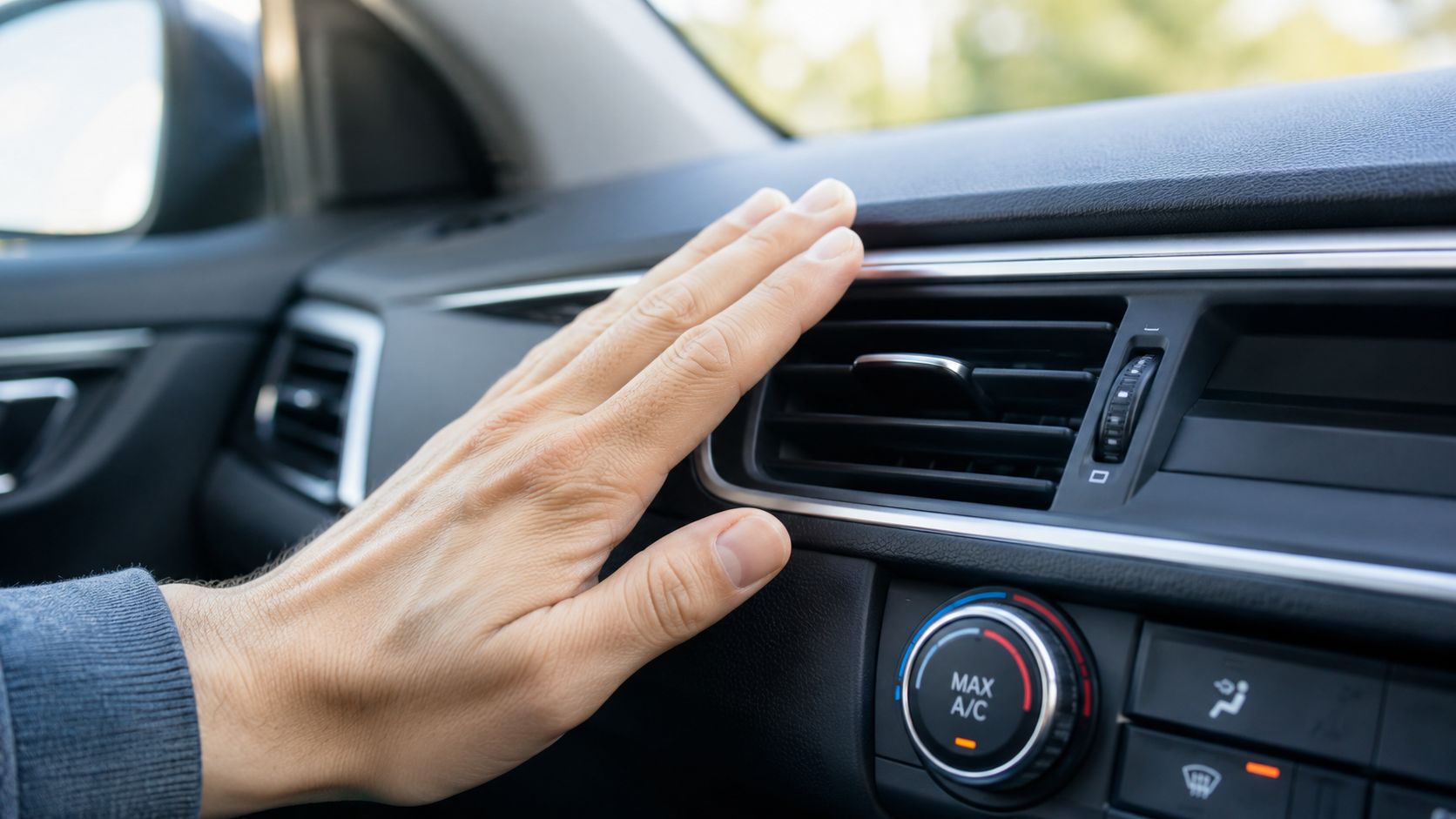
Start with what the system is telling you
Sit in the car and run through the controls methodically.
- Cycle the fan through every speed: If some speeds work and others don't, the issue may be electrical rather than coolant-related.
- Switch from face to floor to defrost: If airflow doesn't change direction properly, a blend or mode door problem may be involved.
- Set the temperature from cold to hot: If airflow stays strong but temperature never changes much, the heat-transfer side needs attention.
Listen, too. A healthy blower has a smooth fan sound. Chirping, grinding, or intermittent operation points you in a different direction than a quiet cooling-system fault.
Check coolant only when the engine is fully cold
This matters. Hot cooling systems are pressurised. Never open a radiator cap on a hot engine.
With the engine cold, inspect the coolant reservoir. If it's below the proper mark, that's a useful clue. Also look around the engine bay and under the parked car for signs of leakage or dried coolant residue.
If you've already been working through other basic winter checks, a guide to a DIY car battery health check can be useful alongside heater troubleshooting, because cold-weather complaints often involve more than one system at once.
Pay attention to warm-up behaviour
Drive or idle the car until it should reasonably be warm. Watch the temperature gauge.
If the engine seems to take a very long time to reach normal temperature and the cabin never gets properly warm, the thermostat becomes a strong suspect. If the gauge rises too high, stop and get it checked. Heater diagnosis should never come at the expense of overheating the engine.
Warm cabin air depends on stable engine temperature. If the engine never settles where it should, the heater is often just reporting that larger problem.
Use safe touch checks with caution
Once the engine has warmed up, you can sometimes learn a lot by carefully feeling the heater hoses under the bonnet. Use caution around moving belts, fans, and hot components.
In general terms, both heater hoses should feel hot when the system is working correctly. If one is hot and the other is much cooler, coolant may not be flowing through the heater core as it should. If neither feels warm after the engine should be fully up to temperature, the fault may be farther upstream.
For cases where symptoms overlap or warning lights are involved, proper scan-tool work helps. A modern engine diagnostics service in Whitby can confirm sensor data, cooling-system behaviour, and control faults that a driveway check can't see.
Understanding Heating System Repair Options and Costs
Heater repairs vary widely in complexity. Some fixes involve a compact part in an easy-to-reach spot. Others involve hours of labour just to gain access. That's why one quote can feel modest and another can feel surprisingly high, even when the failed part itself isn't expensive.
The broad cost logic is familiar across repair trades. Angi's HVAC repair guide says a typical service call can cost $100 to $250 for diagnostics alone, and labour can account for as much as 50% of the total project cost. That same pattern helps explain vehicle heater repairs too, especially a heater core replacement where access is often the hardest part.
The lower-complexity end
A thermostat replacement is usually on the simpler side of heating system repair. The part itself is small, and on many vehicles the labour is manageable. The primary work is in confirming that the thermostat is the fault, replacing it correctly, and bleeding the cooling system so air pockets don't create fresh problems.
A cabin filter service or blower resistor replacement also tends to land lower on the complexity scale. These jobs can restore airflow without major disassembly if the fault is caught early.
The middle ground
Cooling-system leak repairs sit in the middle because the bill depends on where the leak lives. A hose issue is one thing. A leak tied to a more buried component is another. The diagnosis matters because replacing visible parts without pressure testing the full system is how small leaks turn into repeat visits.
Blower motor replacement can also vary. Some cars allow straightforward access under the dash. Others require more trim removal and more time.
The expensive one people don't expect
Heater core replacement is the repair that catches many drivers off guard. The heater core itself may be compact, but it often sits deep behind the dashboard. Reaching it can involve significant disassembly, careful handling of interior components, and reassembly without introducing rattles, electrical issues, or air-distribution faults.
That's why the labour share can dominate the final bill. You're not paying for a fancy part. You're paying for access, diagnosis, and putting everything back together properly.
What a fair quote should explain
A useful estimate should separate the job into understandable pieces:
- Diagnosis: What testing confirmed the fault.
- Parts: What will be replaced, flushed, sealed, or refilled.
- Labour: Why access time is what it is.
- Related materials: Coolant, clamps, seals, or other required items.
If you want a broader sense of how climate-related vehicle repairs are priced, a comparison with car air conditioning repair costs can help frame why labour-heavy HVAC jobs on vehicles often vary more by access than by part price.
The Carmedics Autowerks Experience in Whitby
When a car comes in with a heater complaint, the best process is calm, methodical, and transparent. That matters because “no heat” can describe several different failures, and guessing wastes time.
The first step is listening to the pattern. Does the heater fail only at idle? Does airflow drop on certain settings? Is there a coolant smell? Has the temperature gauge changed? Those details help narrow the path before testing even begins.
Then the shop verifies the complaint, checks cooling-system behaviour, inspects airflow performance, and confirms whether the fault is mechanical, electrical, or a combination of both. That's what turns a vague symptom into a solid repair plan.

What good service should feel like
You should expect clear communication, not mystery. A proper visit should answer three questions plainly:
- What failed
- Why it caused your specific symptoms
- What it takes to fix it properly
That's especially important with heating system repair because some jobs are simple and some are labour-intensive. A good shop explains the difference before the work starts.
Pre-season checks beat mid-winter surprises
Home heating guidance often recommends annual service before the cold weather arrives. A Canadian heating service guide notes that the Technical Standards and Safety Authority recommends annual heating-equipment service, ideally in the fall before cold weather. The same mindset makes sense for cars. A proactive pre-season inspection helps catch weak airflow, coolant issues, and early heater faults before the first deep freeze.
For drivers in Durham Region, working with a trusted local shop matters because winter faults don't wait for a convenient day. If you want to know who you're handing the keys to, it helps to review the team and services at Carmedics Autowerks in Whitby.
If your car's heater is blowing cold, clearing the windshield poorly, or making winter driving more stressful than it needs to be, book a proper inspection with Carmedics Autowerks Inc. You'll get a clear diagnosis, practical advice, and a repair plan that matches the actual fault instead of guesswork.