

You're probably here because the car gave you a warning you couldn't ignore. Maybe it's a high-pitched squeal at the first stop sign of the morning. Maybe the pedal feels softer than it used to. Maybe you searched brake inspection near me because you want a straight answer before a small issue turns into a full brake job.
That's the right instinct. Brakes don't usually fail without leaving clues first. The problem is that many drivers get two kinds of unhelpful advice. One is panic. The other is a vague “you're probably fine.” Neither helps when you need to know what's wrong, what a proper inspection includes, and whether that “free brake check” is really free.
For Whitby drivers, especially those with newer vehicles, hybrids, and EVs, brake inspections have become more technical than most shop ads make them sound. A real inspection should tell you what's worn, what's still serviceable, what needs measurement, and what can wait. It should also make the pricing clear before anyone starts selling parts.
That Unsettling Noise When You Brake
The most common brake visit starts the same way. A driver hears a noise for the first time, turns the radio down, and starts listening at every light. It might squeal only in reverse. It might grind only after the car has warmed up. It might clunk once when shifting from park to drive and touching the pedal. Each sound points in a different direction, and that's why guessing gets expensive.

A squeal doesn't always mean you need everything replaced. Moisture, pad material, rotor condition, and hardware movement can all change the sound. A grind is more serious because it can mean the friction material is gone and metal is contacting metal. A clunk can point to loose hardware, caliper movement, or suspension play that shows up under braking.
What the noise usually means
The sound matters, but so does when it happens.
- Cold-start squeal often suggests surface rust or pad vibration.
- Noise only while braking downhill can point to heat-related rotor or pad issues.
- A constant scrape needs immediate inspection because it may be direct contact.
- A single knock or clunk can come from hardware that isn't holding the pad or caliper firmly.
If your brakes are noisy and you want a practical breakdown of one of the most common symptoms, this guide on how to fix squeaky brakes explains where the sound can come from and why the fix isn't always as simple as changing pads.
A brake noise is never “just a noise” until someone checks the parts behind the wheel.
Most drivers aren't wrong about the feeling that comes with it. You hear the sound and immediately think about safety and cost. That's exactly why a proper inspection matters. It replaces guesswork with measurements, part condition, and a clear repair decision.
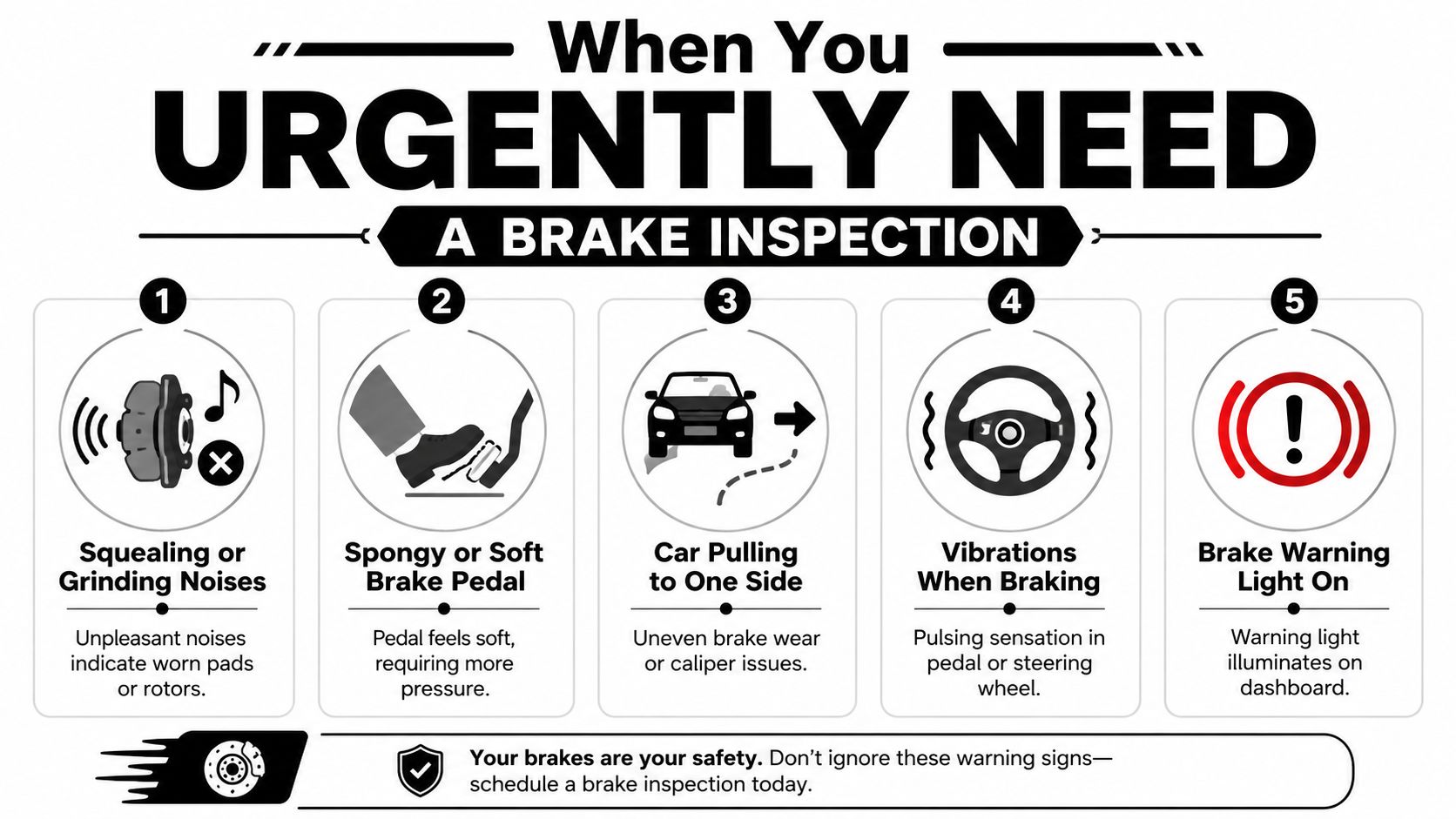
When You Urgently Need a Brake Inspection
Some brake symptoms mean “book it soon.” Others mean “stop putting this off today.” The difference matters because braking problems can escalate fast once the system starts wearing unevenly or losing hydraulic performance.
The bigger picture is hard to ignore. The NHTSA SaferCar campaign notes that brake-related issues account for approximately 15% of all vehicle crashes in North America, with many tied to inadequate maintenance or missed inspections.
Warning signs that need prompt action
Squealing or grinding noises
Squealing often means the brake system is asking for attention. Grinding is the point where damage may already be happening to the rotor surface.A soft or spongy pedal
If the pedal travels too easily or feels inconsistent, the hydraulic side of the system may be compromised. That can involve air in the system, fluid issues, hose problems, or an internal leak.The car pulls to one side under braking
That usually suggests uneven braking force. A sticking caliper, pad contamination, or uneven wear can all cause it.Vibration in the pedal or steering wheel
Drivers often describe this as pulsing. In real terms, it means the braking surfaces may not be meeting evenly, or another front-end issue is showing up most clearly during braking.A brake warning light
This is not a “monitor it for a few weeks” issue. The system has detected something outside normal operation.
What not to do
A lot of drivers try to self-diagnose by sound alone. That's risky.
- Don't assume new pads fixed recently means everything is fine. Pad replacement doesn't rule out rotor problems, seized slide pins, or fluid concerns.
- Don't keep driving because the noise comes and goes. Intermittent symptoms still count.
- Don't judge brake condition by pad life alone. The system includes hydraulics, hardware, rotors, hoses, sensors, and control modules on newer vehicles.
If you're trying to stay ahead of wear before symptoms become urgent, this article on how often to change brake pads helps put inspection timing into a more practical maintenance rhythm.
Practical rule: If the pedal feel changes, the vehicle pulls, or the warning light comes on, treat it as a braking system problem until proven otherwise.
The safest move is simple. Get the system inspected before the problem spreads from one worn part into several damaged ones.
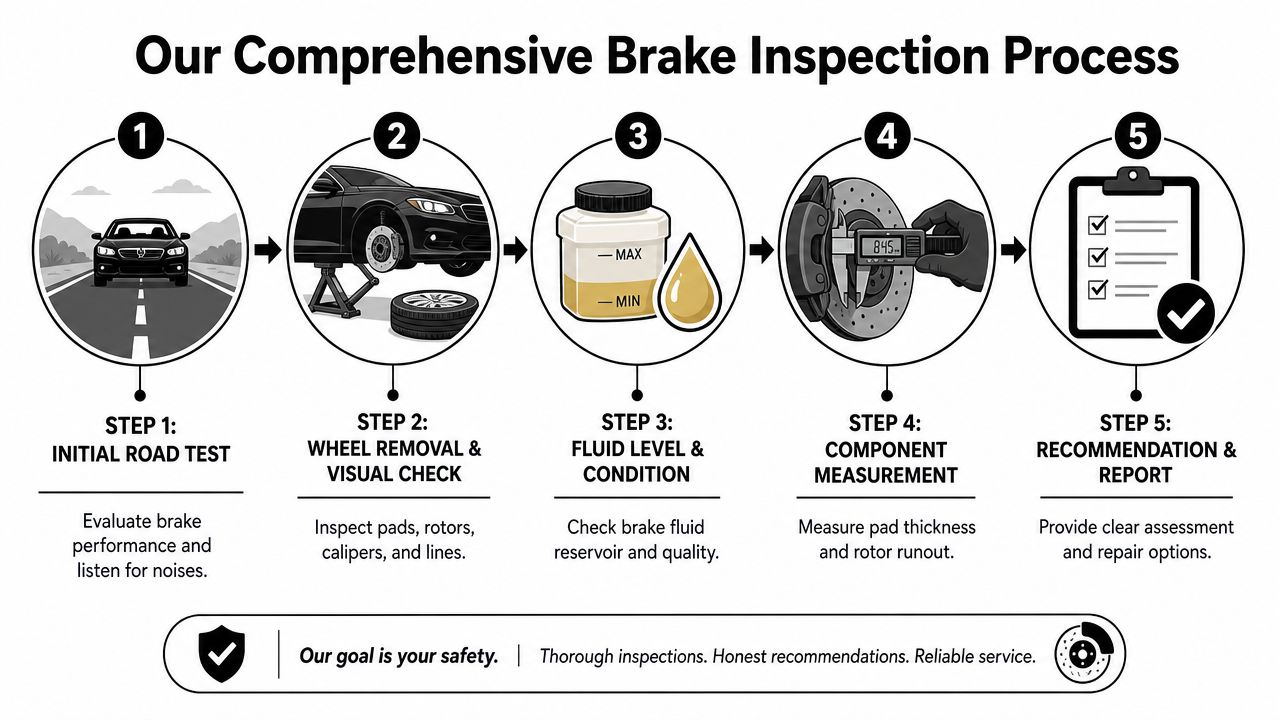
Our Comprehensive Brake Inspection Process
A proper brake inspection isn't a flashlight through the wheel spokes. It's a sequence. Each step answers a specific question about performance, wear, and hydraulic integrity. When a shop skips a step, it usually means they're guessing.
Step one starts before the hoist
The first clues often come from a short road test. A technician listens for noise, checks pedal travel, watches for pull, and feels whether the vehicle stops evenly, as some problems only show up under load and temperature, not while parked.
That road-test mindset lines up with broader reporting standards too. Good inspections are easier to trust when the findings are organised clearly, and these VekTracer vehicle inspection insights are useful for understanding what a proper written vehicle report should communicate.
Wheel removal changes everything
A real brake inspection means getting direct access. In New York State's inspection rules, at least one front wheel must be removed to inspect brakes properly under the New York State vehicle safety and emissions inspection program. Even though that regulation is specific to New York, the principle is solid everywhere. You can't assess pad edges, rotor surfaces, caliper leaks, and uneven wear properly through a quick peek.
Once the wheel is off, the technician checks:
- Pad thickness and wear pattern. Thin pads matter, but uneven wear matters just as much.
- Rotor surface condition. Scoring, heat marks, and cracks all tell a story.
- Caliper operation. Slide pins, piston movement, and hardware condition need to match the wear pattern.
- Hoses and visible lines. Cracking, swelling, or damp spots suggest hydraulic trouble.
The measurement step most quick checks skip
Rotor inspection must include actual measurement. According to the brake inspection guidance at Brake & Tire Check, a thorough inspection includes micrometer measurement of rotor thickness against the manufacturer's minimum safe thickness. The same guidance states rotors should be replaced if they show more than 0.002 inches of lateral runout or if the surface is scored deeper than 0.02 inches.
That sounds technical, but its practical meaning is simple. If the rotor is too thin, too warped, or too heavily scored, it can't manage heat or clamping force the way it should. The driver feels that as vibration, noise, weak stopping, or accelerated pad wear.
If a shop recommends rotor replacement but can't show you the measurement or the surface condition, ask them to.
Hydraulic checks save people from the wrong repair
A surprising number of brake complaints are hydraulic or hardware-related, not just pad-related. A hose can swell internally and restrict fluid movement. A caliper can stick and wear one pad much faster than the other. Brake fluid can be low, contaminated, or leaking from where the driver never sees it.
Brake fluid condition is part of this conversation because fluid transfers the force your foot creates at the pedal to the components at the wheels. If you want the fluid side explained in plain language, this overview of brake fluid service is worth reading.
The end result should be a clear report
The customer should leave with answers, not mystery.
A proper report should distinguish between:
- Immediate safety issues
- Wear items approaching service
- Parts still in acceptable condition
- Repairs that are recommended versus repairs that are optional right now
That's the difference between an inspection and a sales pitch.
Brake Inspection Cost and Timeframes in Whitby
Many drivers encounter a common disappointment. They search for brake inspection near me, see “free brake inspection,” book the visit, and then find out the free part was only a quick visual look. The detailed check that resolves the issue carries a diagnostic fee. That distinction isn't always explained up front.
The confusion is widespread. OMVIC data shows that 68% of auto repair complaints in 2025 stemmed from unexpected pricing after inspections, often because drivers didn't realise the difference between a visual inspection and a diagnostic inspection.
The difference that affects your wallet
A free or low-cost visual check can still be useful. It may confirm obvious wear, fluid level concerns, or visible damage. But it won't always answer a noise complaint, a pull under braking, or a vibration concern, because those problems often require wheel removal, measuring tools, and more technician time.
A paid diagnostic inspection costs more because it does more. It's supposed to isolate the cause, not just notice symptoms.
| Feature | Visual Check (Free/Low-Cost) | Full Diagnostic Inspection (Paid) |
|---|---|---|
| Access level | Usually limited external viewing | Wheel removal and direct component access |
| Pad and rotor assessment | Basic visible estimate | Measured wear and condition check |
| Noise diagnosis | Often limited | Better chance of isolating source |
| Hydraulic inspection | Basic glance | Closer inspection of hoses, calipers, leaks |
| Written findings | Sometimes minimal | Usually more detailed and itemised |
| Best use | Quick screening | Decision-making and repair planning |
What works and what doesn't
What works is asking the shop one direct question before booking: What exactly is included in the inspection fee?
Good answers mention actions. They'll tell you whether they remove wheels, measure rotor thickness, inspect calipers and hoses, road test the vehicle, and provide an estimate before repairs. Weak answers stay vague and rely on phrases like “full check” without naming the steps.
The cheapest inspection is often the one that leads to the most expensive misunderstanding.
Timeframes depend on the complaint and the vehicle, so broad promises aren't useful. A quick visual look is faster. A full diagnostic inspection takes longer because the technician has to access, measure, document, and verify. If the issue is intermittent, time may also go into reproducing the symptom.
If you're comparing repair estimates after the inspection, this guide on brake pad replacement cost helps you understand why two quotes can look different even when both mention “brakes.”
The key point is simple. Ask for the inspection type, what's included, and whether the findings will be itemised before you authorise anything else.
Why Whitby Drivers Choose Carmedics Autowerks
Modern brake work isn't just friction material and rotors anymore. On newer vehicles, especially hybrids and EVs, braking performance can involve software logic, regenerative braking behaviour, electronic boosters, and corrosion patterns that look very different from traditional wear.
That's where many shops fall behind. Recent data indicates 74% of EV owners in the Greater Toronto Area, including Whitby, have experienced inspection issues due to outdated friction-focused checks. It also indicates that 41% of brake service complaints in urban Ontario are linked to electronic system malfunctions misdiagnosed as mechanical wear. For drivers with newer vehicles, that's a serious reason to choose a shop that understands the difference.
Why EV and hybrid inspections need a different mindset
With regenerative braking, the friction brakes may see lighter routine use. That sounds like good news, but it can create a different inspection challenge. Pads may look less worn while rotors develop corrosion from underuse. A standard friction-only check can miss the actual complaint.
A solid EV or hybrid brake inspection should consider:
- Electronic brake booster behaviour
- Regenerative and friction brake transition feel
- Rotor corrosion from low friction-brake usage
- Caliper movement on components that may not cycle as hard as expected
- Stored system faults when the complaint doesn't match the visible wear
Trust comes from clarity
Drivers who know cars don't want theatre. They want a technician who can explain why one rotor is serviceable and the other isn't, why one pad wore differently, or why the problem isn't the pads at all.
That's why communication matters as much as wrench work. The best shops explain the findings in plain language, separate urgent items from future planning, and avoid bundling every brake concern into a one-size-fits-all estimate.
Some vehicles need pads and rotors. Some need diagnosis before parts. Treating those as the same job is how people overspend.
Local experience still matters
Shops serving Whitby drivers see the patterns that come with local use. Stop-and-go commuting, seasonal moisture, winter road contamination, and long periods of parked vehicle time all affect brake condition differently. Local familiarity helps a technician decide whether they're seeing routine wear, corrosion, or a component issue that needs deeper testing.
If you want to learn more about the shop itself, the Carmedics Autowerks Whitby location gives you the local background. What matters most in practice, though, is the shop's ability to inspect older hydraulic systems and newer electronically managed ones with the same discipline.
Brake Inspection FAQs and Your Next Step
A few questions come up in almost every brake conversation, especially when drivers are trying to balance safety, timing, and cost.
Common questions drivers ask
How often should brakes be inspected if nothing feels wrong?
At minimum, have them checked regularly as part of routine maintenance and any time wheel-off service is already being done. Even without symptoms, brake condition can change through uneven wear, corrosion, or fluid problems.
Is it safe to drive with a brake warning light on?
Treat it as unsafe until a technician confirms otherwise. If the light is paired with a soft pedal, poor stopping, or any obvious change in braking, don't keep driving unless you have no safer option than moving the vehicle carefully to get help.
Are aftermarket brake parts always worse than OEM?
Not always. The key factor is whether the part matches the vehicle's use, braking system design, and quality standard. Cheap parts can create noise, dust, poor pedal feel, or short service life. Good aftermarket parts can perform very well when selected properly.
What if the problem is caused by aggressive driving from another driver?
Brake-related incidents can turn into legal questions quickly after a collision. For a legal perspective on intentional braking behaviour and liability, this article on understanding Texas rear-end collision fault is a useful read, even though it approaches the issue from a different jurisdiction.
The practical next step is simple. If your vehicle is making noise, pulling, vibrating, or warning you on the dash, book an inspection that includes more than a glance. Ask whether the shop will remove wheels, measure braking components, inspect the hydraulic side, and itemise the findings before repairs begin.
If your brakes are making noise, feeling different, or you just want a proper answer instead of a vague “free check,” book a professional inspection with Carmedics Autowerks Inc. Their Whitby team works on modern cars and SUVs, explains findings clearly, and helps you make the right repair decision before a minor brake issue turns into a bigger one.