


You know the feeling. The car has been sitting in a Whitby parking lot, the cabin has turned into a kettle, and the air from the vents is either weak, lukewarm, or full of that damp smell that says the system's not happy. Most drivers assume the fix is a can of refrigerant. In practice, an air conditioner automotive problem is often a heat-rejection problem first, and a refrigerant problem second.
How Your Car's Cooling System Actually Works
A car's A/C works like a kettle and a fan in reverse. The system pulls heat out of the cabin, carries that heat to the front of the vehicle, and dumps it through the condenser before the cycle starts again. The loop is closed, so every part depends on the next one doing its job.
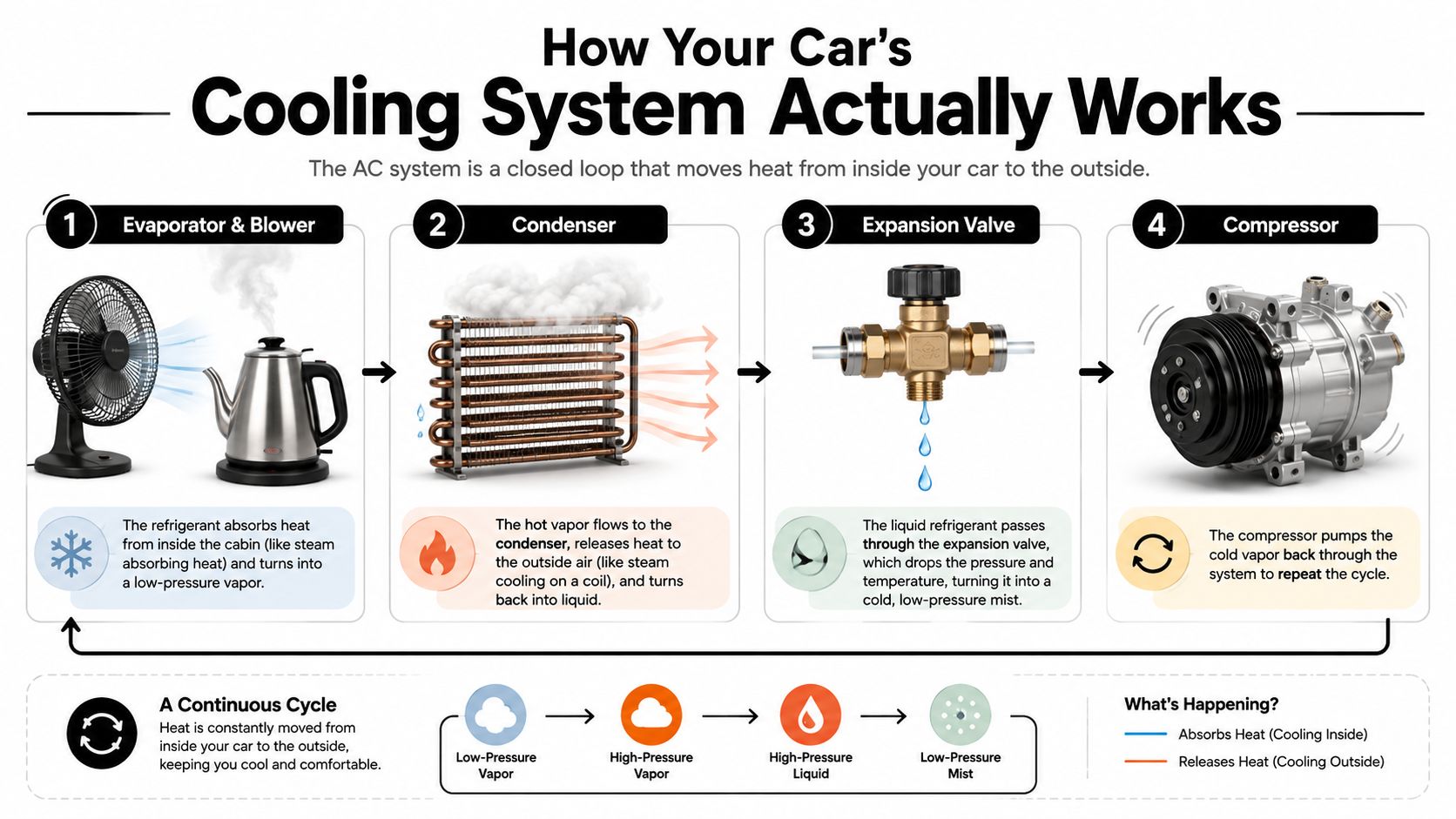
The easy way to picture the loop
The evaporator inside the dash is the cold surface that cools the cabin air. The blower motor pushes air across it, just like a fan moving air past a hot kettle to speed the transfer. The refrigerant then leaves the dash, gets squeezed by the compressor, and heads to the front of the vehicle where the condenser gives up heat to outside air.
That compressor is the system's main load. In automotive HVAC, the cooling circuit is a vapor-compression refrigeration system, and the compressor is the main parasitic load on the engine or the high-voltage system. Typical passenger-car systems are sized around 4.3 kW, about 14,700 BTU/h, while heavier-duty systems may be designed around roughly 27,000 BTU/h at 2,000 rpm (CED Engineering).
Practical rule: cold air at the vent means nothing if the condenser can't reject heat at the front of the car.
High side and low side in plain English
Think of the low side as the side that's allowed to get cold and boil inside the dash, and the high side as the side that's carrying hot, pressurised refrigerant to the front of the vehicle. The expansion valve or orifice tube creates the pressure drop that lets the refrigerant flash cold again. If that pressure balance is off, the whole system gets lazy, noisy, or warm.
That's why generic “top it off” advice misses the mark. A weak compressor, dirty condenser, blocked airflow, or wrong refrigerant charge can all make the same cabin complaint show up. In a real shop bay, the first question isn't “how much refrigerant went in,” it's “where did the heat stop moving?”
A Brief History of Automotive Air Conditioning
A car with working air conditioner automotive hardware used to signal luxury, not routine comfort. The first factory-installed automotive A/C system is widely dated to the Packard in 1940, which is why old systems still carry the marks of early engineering choices, bulky packaging, and service habits that came from a different era. By the time more drivers wanted relief from summer heat, adoption had climbed steadily, and AAA's history of car A/C shows how quickly the feature moved from specialty option to common equipment (AAA).
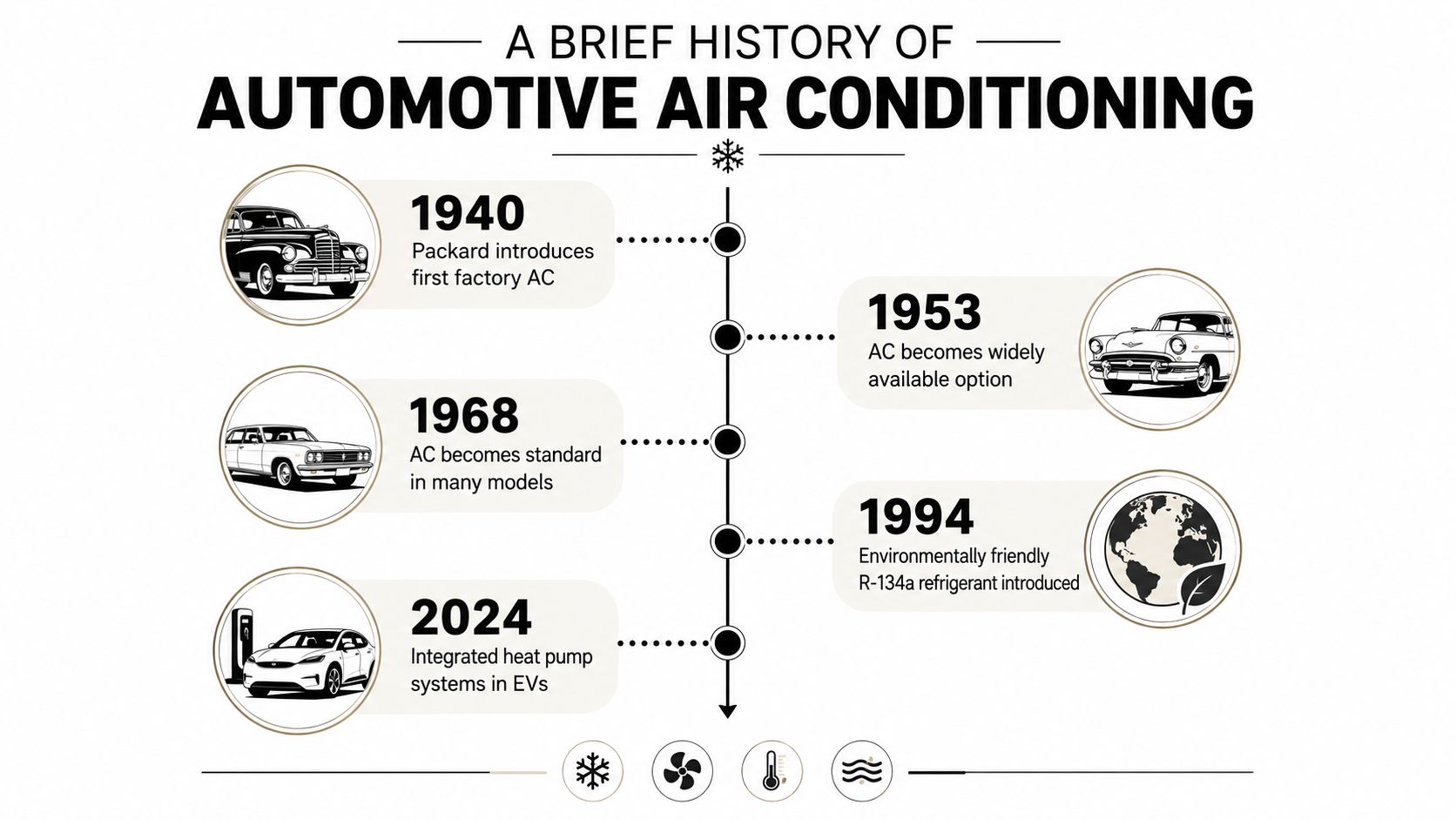
Why older cars behave differently
The hardware changed shape as the market changed. Once A/C moved from trunk-mounted luxury setups to front-mounted, engine-driven systems, it became easier to fit, easier to build, and easier to service in ordinary passenger cars. That shift helped make cooling a normal expectation instead of a special-order feature, and it still affects how technicians approach older vehicles today.
Climate pushed the change too. Warm-region buyers wanted relief first, and they were often willing to pay for it sooner than drivers in cooler areas. That is still true in spirit. Whitby drivers may not be shopping in the desert Southwest, but a sticky July cabin makes a car feel dated fast, and older vehicles on local roads often need more attention to airflow, seals, and component condition than a newer car with tighter packaging.
The useful takeaway is simple. Age changes the service picture. A 20-year-old system can have worn hoses, aged seals, and older refrigerant practices that a newer vehicle does not share, so two cars with the same complaint can need very different repairs.
Why the refrigerant story keeps changing
The refrigerant story keeps changing because the system is not frozen in time. As refrigerants and service standards changed, the repair process changed with them. A newer car may use a different refrigerant family and stricter service steps, while an older one may still reflect legacy assumptions that affect diagnosis, parts selection, and recovery procedures.
That is why a universal “recharge” approach causes so many mistakes. A weak compressor, a dirty condenser, blocked airflow, or the wrong charge can all create the same warm-vent complaint. A technician reading the system properly starts by asking where heat stopped moving, then works through the evidence in order. If you want a closer look at how a shop handles that kind of service, the air conditioning service for car guide from Carmedics Autowerks shows the kind of checks that separate a quick guess from a real diagnosis.
For owners, the practical rule is this. The age of the vehicle tells you what parts, fittings, and refrigerant workflow you are likely dealing with. It also tells you why blanket advice does not hold up in the bay. A system can be low on charge, but if the condenser cannot reject heat, or if contamination is slowing the circuit down, the fix starts somewhere else.
The Main Components and What They Do
The cleanest way to diagnose automotive A/C is to treat each part like a suspect with a job description. The compressor pumps refrigerant and raises pressure, the condenser dumps heat at the nose of the vehicle, the evaporator absorbs cabin heat, and the expansion valve or orifice tube meters flow so pressure can drop and cooling can happen. The receiver-drier or accumulator handles moisture and helps protect the rest of the system.
If you want a solid parts overview before comparing replacements, a practical guide to OEM parts from The Alloy Hub Ltd. helps explain why fit and specification matter more than just grabbing the cheapest box on the shelf.
Who usually causes the trouble
The compressor is often the first major component people notice because it's the one that makes noise, cycles oddly, or stops pumping enough. If it weakens, the vents go warm at idle or under load. A failing condenser looks different, because the cabin may cool better on the highway than in stop-and-go traffic, which points more to heat rejection than to charge alone.
The evaporator lives where nobody can see it, so its failures are sneaky. A dirty or restricted evaporator can cut airflow and create that clammy, underperforming feel. The receiver-drier or accumulator usually doesn't announce itself loudly, but once moisture gets into the system, you can get erratic performance, corrosion, and poor control of refrigerant behaviour.
Orifice tube versus expansion valve
Some systems use an orifice tube, others use an expansion valve. The job is the same, which is to create the pressure drop that makes the refrigerant cool down, but the hardware is different. An orifice tube is a fixed restriction, while an expansion valve meters flow more actively. That difference matters when you're chasing a complaint, because each design responds differently to contamination, oil issues, and charge errors.
If you're comparing service options and wondering how a shop handles the work, the process described on this air conditioning service page for cars shows the kind of inspection logic a technician should be following, not just the parts swap.
Practical rule: if a system cools badly only when the vehicle is idling, start thinking about airflow across the condenser before you blame the refrigerant.
Symptoms That Point to Specific AC Problems
The complaint usually points to the fault line. Warm air, weak airflow, foggy glass, a musty smell, or a vent noise each tells you something different about how the system is handling heat, moisture, and airflow. Drivers often buy refrigerant first and stay stuck there, because the problem is not always charge, it is the system's ability to reject heat.
| Symptom | Most Likely Cause | First Check |
|---|---|---|
| Warm air from vents | Low charge, compressor problem, or airflow issue at the condenser | Check whether the condenser face is blocked or dirty |
| Intermittent cooling | Weak compressor control, pressure fluctuation, or airflow changes | Watch whether cooling fades only at idle or in traffic |
| Weak airflow at idle | Cabin filter restriction, blower issue, or poor condenser airflow | Inspect the cabin filter and feel for airflow drop at the dash |
| Musty smell | Moisture, mould on the evaporator, or a clogged drain | Check for dampness and poor cabin filtration |
| Fogging windows | Weak dehumidification or evaporator performance | See if the A/C dries the air after a few minutes |
| Hissing | Refrigerant movement, leak, or valve noise | Look for oily residue near fittings |
| Clicking on startup | Compressor clutch engagement or relay behaviour | Listen for the compressor cycling when A/C is switched on |
| Water on the passenger floor | Blocked drain or condensate path | Check for a clogged evaporator drain tube |
What the symptoms usually mean
Warm air is the broadest complaint, and it can come from three places. The system may be low on refrigerant, the compressor may not be building enough pressure difference, or the front end may not be shedding heat well enough. If the air gets cooler once the vehicle is moving faster, the condenser side, fan operation, or grille blockage should be checked before anyone starts adding refrigerant. If you want to see how a professional air conditioning repair is diagnosed, the process on this air-conditioning-repair-for-car page shows the kind of step-by-step thinking a technician should use.
Intermittent cooling usually means the system is operating near its limit. A weak compressor, marginal pressure control, or a heat-rejection problem can make the vents swing from cold to warm without warning. Weak airflow at idle often points away from charge and toward the cabin filter, blower, or front-end airflow path. A system can be filled correctly and still feel weak if the air cannot move through the condenser and back into the cabin.
Moisture, odours, and noise
A musty smell is usually a moisture issue. If the evaporator stays damp or the drain is restricted, mould and mildew build up where the air passes through. Fogging windows matters because the A/C does more than cool the cabin, it also dries the air, and a weak evaporator or poor airflow will leave moisture hanging in the glass.
Hissing and clicking on startup are not random noises. They are clues. Hissing can be normal refrigerant movement, but it can also point to a leak or valve issue. Clicking can be the compressor clutch engaging, or it can be a relay cycle that shows the control system is reacting to a pressure fault.
Drivers with larger coach or RV systems run into many of the same symptoms, which is why a focused diagnostic resource like Central Texas RV air conditioning repair still makes sense even though the packaging is different.
Safe DIY Checks You Can Run at Home
A driver can sort out a few simple causes before booking a shop visit, and that matters because automotive A/C trouble is often a heat-rejection issue before it is a refrigerant issue. Start with airflow, then look for contamination at the front of the car, then check for obvious leaks or odd noises. That is faster than guessing, and it gives you useful information before anyone opens the system.
The checks that are worth doing
- Cabin air filter: Open the glove box area if needed, pull the filter, and inspect it for dirt, leaves, and packed dust. A loaded filter cuts cabin airflow and makes the system feel weak even if the refrigerant side is working normally.
- Condenser fins: Look through the grille for bent fins, bugs, leaves, or road film. A light rinse with a hose can help, but strong pressure can bend the fins further and make heat rejection worse.
- Leak inspection: Check around fittings, service ports, and under the vehicle for oily residue. Refrigerant carries oil, so greasy grime often gives the first visible sign of a leak.
- Compressor clutch: Turn the A/C on and off, then listen for a clear change near the compressor area. If nothing changes, that tells you the control side or compressor side needs proper diagnosis.
- Air temperature test: After a couple of minutes of A/C use, the vent air should feel noticeably cold. If it never does, the system has a real fault, not just a hot afternoon.
Practical rule: if the condenser face is packed with debris, no amount of refrigerant will turn that into cold air.
What not to do at home
Do not treat store-bought refrigerant as a cure-all. HFC-134a and HFO-1234yf are not interchangeable, and modern service equipment and procedures have to handle both correctly (Messe Frankfurt technical guidance). Under- or over-charging changes evaporator superheat, compressor discharge temperature, and cabin cooling performance, so a guess can make the system perform worse instead of better.
If you are tempted to clean the system with a quick spray and call it done, a careful air conditioning cleaning for car approach makes more sense when it is part of a real inspection, not a shortcut around diagnosis.
Typical Repair Costs and What Drives the Price
A cabin filter swap is usually a small job. A relay, fuse, or simple connector issue is also on the lighter end. Once the work turns into compressor, condenser, or leak repair, the price climbs because labour, refrigerant recovery, and parts handling all stack up.
The biggest mistake is comparing an A/C quote to a brake job or oil change. A/C work depends on whether the system has to be opened, whether refrigerant must be recovered, and whether the technician needs to replace one part or several pieces that failed together. That's why a cheap part can still become a mid-range bill once the labour and recharge steps are included.
Budget part or OEM part
A budget compressor may save money up front, but it can bring more noise, shorter service life, or fit issues if the tolerances are sloppy. An OEM compressor usually costs more because it's built to the original specification and is more likely to match the vehicle's expected output and mounting details. The same logic applies to condensers and expansion valves, because A/C systems are picky about flow and heat transfer.
Drivers often ask whether it's smarter to patch the current issue or replace the whole affected section. If the fault is a single clogged filter or relay, a simple fix makes sense. If the compressor has shed debris through the system, replacing just one part can become false economy because contamination tends to travel.
If you want a quote framed around real repair scope rather than guesswork, the pricing discussion on this air conditioning repair cost page is the kind of reference that helps drivers ask better questions.
When to Book a Professional AC Service in Whitby
A/C jobs that involve opening the system, recovering refrigerant, or tracking down a leak belong in a shop. Automotive A/C is a sealed, high-pressure system, so the risk profile is nothing like topping up washer fluid or swapping a wiper blade. If a line fails, refrigerant and oil can escape quickly, and the wrong handling method usually turns a manageable repair into a bigger one.
Modern refrigerant work also needs the right procedure, not a casual refill. Shop equipment and service information have to account for both HFC-134a and HFO-1234yf, and the system should be charged with the correct refrigerant and checked at the correct pressures, rather than treated like a universal top-off job (MAHLE Aftermarket guidance).
What a shop can measure that you can't
A technician can connect proper gauges, check temperature splits, inspect for leaks with the right tools, and confirm whether the condenser is rejecting heat. That matters because the same warm-air complaint can come from low charge, weak airflow, or a control fault. A DIY video often skips that distinction and goes straight to a recharge can.
The bay also gives you context that a driveway check cannot. If the compressor is cycling oddly, if the condenser is packed with debris, or if the blend door is not moving correctly, those clues change the repair plan fast. A home test can tell you something is wrong. It cannot tell you which part of the system is failing.
If the simple checks at home do not change the symptom, stop guessing and book proper help through air conditioning service near me. That is the point where a technician should sort out the cause instead of masking it.
Your Seasonal AC Checklist and Next Steps
Run the cabin filter check before summer. Clean the condenser face, glance for oily residue, and do the two-minute vent temperature test before the first real heat wave. Those small habits catch problems while they're still simple.

The biggest takeaway is straightforward. A/C is a heat-rejection system, not just a refrigerant system. Airflow and cleanliness matter as much as charge, and modern refrigerants need the right service method, not a guess in a parking lot.
If your vents still blow warm after the simple checks, or if the system has already been opened, it's time for a professional inspection. Carmedics Autowerks Inc in Whitby services vehicle heating and cooling systems, so you can get a proper diagnosis for older R-134a cars and newer R-1234yf models before the next stretch of humid weather hits.