

A truck is sitting on the shoulder near Highway 402. The driver has already called dispatch twice. Your customer wants an ETA you can't give. The shop says they can “take a look this afternoon,” but nobody can tell you whether the fault was preventable, whether the part is in stock, or whether this same unit was in for a similar issue last month.
That's the point where most Lambton County fleet managers realise they don't have a repair problem. They have a maintenance system problem.
In this region, downtime hits from all sides at once. Missed deliveries, overtime, rental units, driver frustration, and the slow damage to customer confidence. Add Ontario compliance pressure and winter conditions, and a loose maintenance process gets expensive fast. A fleet that runs well in July can still get exposed badly in January if records are weak, inspections are inconsistent, or service intervals were copied from a generic template instead of built around how the vehicles work.
Strong Lambton fleet maintenance isn't about being good at fixing broken vehicles. It's about building a shop and vendor process that prevents roadside calls, captures usable service records, and keeps units available when operations need them.
If you're tightening your operating discipline, it helps to compare your approach with broader effective fleet management practices, then translate those ideas into Ontario realities. The same goes for basic service discipline. A practical starting point is reviewing how a structured preventive maintenance program for vehicles supports uptime before you start layering on compliance and KPI tracking.
Beyond Breakdowns an Introduction for Lambton Fleet Managers
The usual mistake is treating maintenance as a back-office function. It isn't. It's an operating control. If maintenance planning is weak, dispatch feels it first, then finance, then your customers.
Lambton County fleets deal with a mix of operating conditions that punish generic schedules. Some units spend long periods on the highway. Others live in stop-and-go work, idle heavily, or carry seasonal loads that change wear patterns. If all of them follow the same service interval, you'll over-service some assets and miss failure patterns in others.
That's why the best maintenance programs start with one simple question. What takes vehicles out of service in your fleet?
Practical rule: Track the event that caused the downtime, not just the invoice that closed it.
A repair order that says “brake service completed” doesn't tell you enough. A usable record tells you which unit failed, what symptom appeared first, whether the defect was found on inspection or after a roadside issue, how long the vehicle stayed down, what labour and parts were used, and whether the same problem came back.
The difference between average and strong Lambton fleet maintenance is usually hidden in those details. Shops that document cleanly help you manage. Shops that only fix and release force you to guess.
Managers who get this right usually stop asking, “Who's the cheapest local shop?” and start asking better questions. Which provider helps us reduce repeat repairs? Which one gives us clear turnaround expectations? Which one supports inspection records and service history well enough that we can defend our process if a regulator, customer, or insurer asks for proof?
That shift matters more than any single repair.
Building a Data-Driven Preventative Maintenance Program
A preventive maintenance program fails when it's built from habit instead of evidence. “We always service them around this mileage” isn't a strategy. It's a placeholder.
The better approach is to divide the fleet by asset class, duty cycle, and failure history. Light-duty vans running short urban routes don't age the same way as heavier units doing long-haul work. A truck that idles, starts, and stops all day needs a different maintenance rhythm than one that spends most of its time at steady highway speed.
Here's the visual framework I use when helping fleets clean this up:
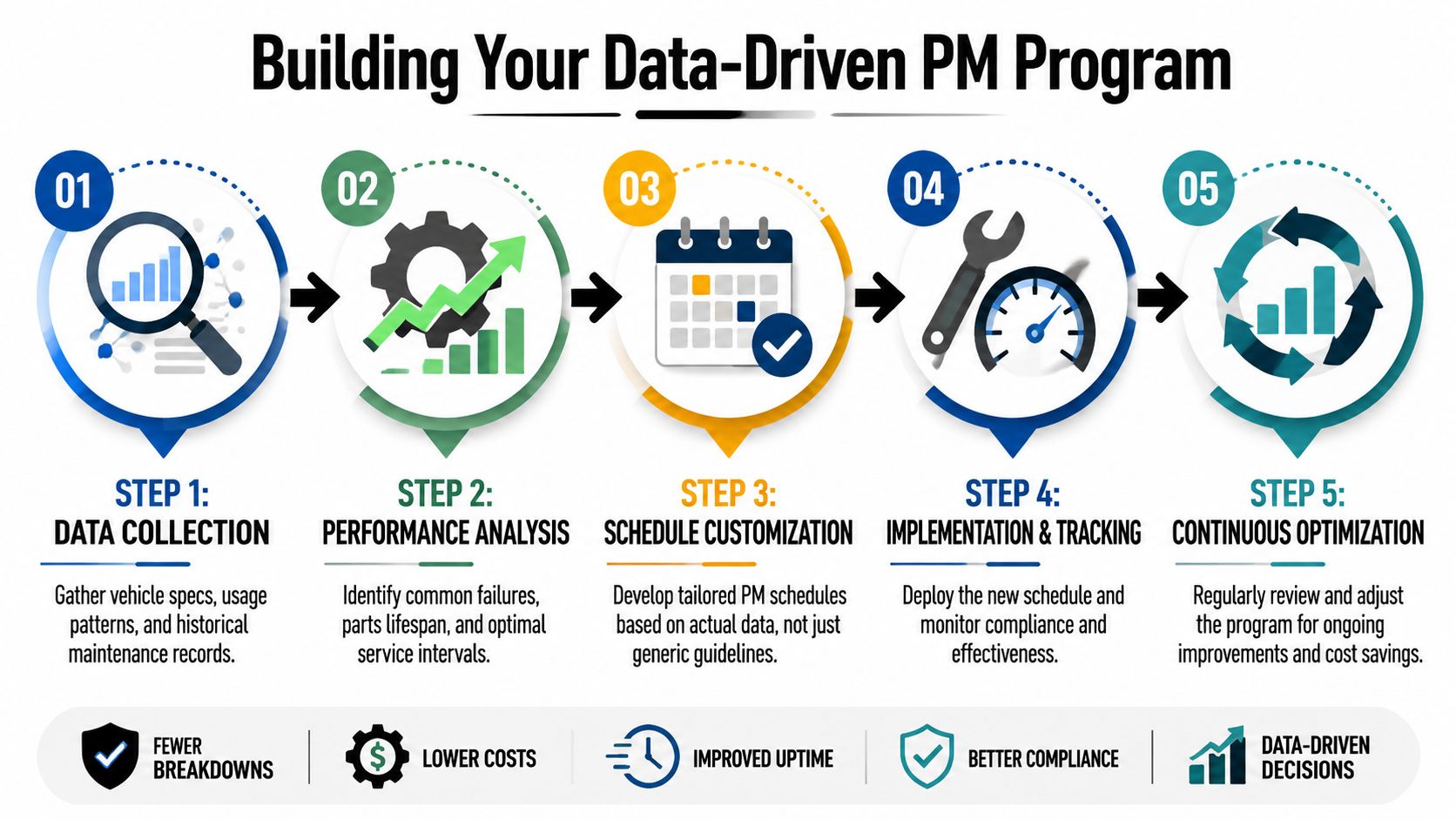
Start with the records you already have
You don't need perfect data to begin. You need usable categories.
Pull together service dates, odometer readings, labour hours, parts used, and costs for each event. Then sort the fleet into logical groups:
- Light-duty units: Sales cars, service SUVs, courier vans.
- Commercial work vehicles: Cube vans, pickups with equipment, mixed-route delivery units.
- Heavier assets: Trucks or vocational units with higher load and duty demands.
- Seasonal or high-utilisation vehicles: Assets that spike in use during winter or other peak periods.
The point isn't administrative neatness. The point is seeing whether one group burns through tires, brakes, batteries, or cooling components faster than another.
Build schedules around use, not folklore
A strong PM plan blends manufacturer guidance with local operating reality. If a unit works in urban Sarnia conditions with repeated starts, idling, and short trips, generic service timing often won't reflect the actual wear pattern. If another unit spends most of its life on consistent highway runs, servicing it on the same cadence may waste labour and parts.
Maintenance thinking from adjacent equipment categories can help. The discipline behind maintenance strategies for industrial hydraulics applies here too. Watch how the asset is used, monitor recurring failure points, and adjust service intervals based on actual operating conditions rather than a flat rule.
A practical way to structure the schedule:
- Set a baseline from manufacturer recommendations.
- Adjust by duty cycle such as highway, stop-and-go, idling, towing, or mixed use.
- Flag repeat defects that show the baseline isn't enough.
- Review seasonality so winter prep isn't treated as a last-minute add-on.
A PM schedule should protect uptime. If it only generates work orders, it's not doing its job.
Use benchmark logic, not guesswork
The operational case for preventive work is clear. In one fleet management benchmark, 54.5% of all service activity was scheduled preventive work, while 39.3% was unplanned repairs according to Fleetio's maintenance management guide. That split matters because it shows what organised fleets are aiming for: more planned shop time, fewer surprise failures.
That doesn't mean copying somebody else's template. It means understanding the direction of travel. Planned work is easier to schedule, easier to parts-plan, and easier to budget.
Close the loop after every service
A PM program isn't “set and forget.” Review what happens after each inspection and repair cycle.
Ask these questions every month:
- Which units are missing PM windows? That's usually a scheduling or dispatch problem, not a technician problem.
- Which failures still happen between services? Your intervals may be too long, or the checklist may be too generic.
- Which assets consume too much diagnosis time? That often points to poor fault histories or weak triage before the vehicle reaches the shop.
When fault tracing gets muddy, it helps to tighten your diagnostic process as well. A disciplined approach to engine diagnostics often exposes whether the fleet is dealing with one-off failures or recurring defects that the PM schedule should have caught earlier.
The fleets that get ahead don't just service on time. They learn from every work order and make the next schedule smarter.
How to Select the Right Fleet Maintenance Partner
Most fleets don't lose money because a shop's hourly rate is too high. They lose money because the vehicle sits, communication is weak, approvals drag, and the same unit comes back for the same issue.
That's why the cheapest option is often the most expensive one.
A good maintenance partner lowers operational friction. They know your asset types, they tell you what they found in language your team can act on, and they return the unit with records that support both future maintenance decisions and compliance obligations. Industry guidance makes the same point. Fleets should evaluate providers on more than price, including asset specialties, repair turnaround SLAs, and whether the shop can integrate with fleet software, because weak data sharing creates hidden downtime costs, as noted in Fleetio's guidance on choosing fleet service providers.
What strong providers do differently
A strong provider doesn't just say, “Bring it in.” They ask about duty cycle, recurring faults, approval limits, and how quickly the unit must return to service. They understand that a fleet vehicle isn't a retail walk-in job. The repair is only one part of the operating impact.
Weak providers usually reveal themselves early:
- Vague turnaround answers: “We'll see when it gets here.”
- Thin documentation: Invoice line items with little fault detail.
- No process for updates: Dispatch has to chase the shop.
- No pattern recognition: Nobody flags that the same unit has had similar work before.
Vendor Selection Checklist
| Evaluation Criteria | What to Ask | Why It Matters |
|---|---|---|
| Asset experience | Which vehicle classes and fleet types do you service most often? | A shop that understands your assets diagnoses faster and misses less. |
| Turnaround discipline | What's your typical process for booking, diagnosis, approval, and return to service? | Downtime often grows in the handoff stages, not the wrench time. |
| Communication | How will my team get status updates during the repair? | Dispatch and operations need visibility, not silence. |
| Documentation quality | What level of detail appears on your work orders and invoices? | Clear records help with trend analysis, warranty, and compliance. |
| Repeat repair control | How do you track comebacks or repeat faults on the same unit? | If the same issue returns, your true cost goes up fast. |
| Warranty handling | How do you manage labour and parts warranty claims? | Good warranty handling shortens arguments and protects uptime. |
| Parts approach | Do you recommend OEM or aftermarket by component category? | The wrong parts policy can create false savings. |
| Software compatibility | Can you share digital records in a way that fits our fleet process? | Clean data makes planning and reporting easier. |
| Escalation path | Who owns urgent jobs when a critical unit is down? | High-priority assets need clear decision authority. |
Price is a filter, not the decision
Use price to eliminate obviously unworkable vendors. Don't use it as the final decision tool.
Ask each provider to walk you through a real repair flow. How they receive the unit, inspect it, communicate findings, request approval, source parts, close the job, and document the work. That conversation tells you more than a posted labour rate ever will.
The right partner reduces downtime before they reduce invoice totals.
If your fleet still relies on general retail-style repair relationships, it may help to benchmark against a shop process built around commercial service expectations and professional mechanic support. You're looking for disciplined workflow, not just technical capability.
The provider you want in Lambton is the one that helps you stay available, informed, and audit-ready.
Implementing Effective Fleet Cost Controls
Cost control in fleet maintenance doesn't start with cutting spend. It starts with separating necessary spend from preventable spend.
That means your reports need more than a monthly total. Break maintenance costs into at least these buckets: scheduled PM, unscheduled repairs, tires, diagnostics, outside service, and parts by major system. Once those categories are visible, patterns show up quickly. One asset class may be expensive because of repeat brake work. Another may look cheap on paper until emergency callouts and downtime are included.
This is the management view you need to build:

Track the costs that actually move the business
The biggest mistake I see is treating PM as a fixed expense and unscheduled work as bad luck. It isn't luck. It's usually a signal.
If one vehicle keeps generating road calls, after-hours towing, rental substitutions, or missed work, its maintenance spend is only part of the story. The primary cost sits in interrupted operations. A practical benchmark from fleet maintenance guidance is that continuous preventive maintenance tuning can reduce vehicle downtime by about 20 to 30% when managers analyse breakdown patterns and adjust service intervals, according to this fleet cost control reference.
Put approval discipline in writing
Technicians and service advisors need room to work, but uncontrolled approvals create drift. Set clear rules around:
- Pre-authorised PM work: Routine service items with no extra approval needed.
- Threshold approvals: Anything beyond the agreed amount gets reviewed.
- Urgent return-to-service rules: Critical units have faster approval paths.
- Documentation standards: Every larger repair needs fault cause, recommended correction, and parts detail.
That structure speeds up decision-making because everyone knows the rules before the vehicle arrives.
Parts policy can make or break the budget
Not every component should be handled the same way. Some fleets overspend by insisting on one parts standard for everything. Others create comeback risk by choosing the lowest-cost option every time.
A better approach is category-based. Use your own failure history, warranty experience, and operating demands to decide where OEM parts make sense and where quality aftermarket options are acceptable. If you're tightening that policy, it helps to review the trade-offs in OEM vs aftermarket parts and apply them by system, not by ideology.
Good cost control doesn't ask, “What's cheaper today?” It asks, “What keeps this unit in service with fewer repeats?”
The fleets with the lowest maintenance stress usually aren't the ones spending the least. They're the ones spending deliberately.
Measuring What Matters With Essential Fleet KPIs
If your maintenance meetings rely on anecdotes, you're managing by memory. That's risky in any fleet, and it's worse when several managers, drivers, and vendors all touch the same units.
The core KPI set doesn't need to be large. It needs to be consistent. The most widely tracked operational measures are Fleet Availability, PM Compliance, and Repeat Repairs, with each one built from data such as service dates, labour hours, parts used, and vehicle status, as described in the U.S. DOT carrier snapshot reference tied to Lambton Fleet Maintenance Inc. That same record also identifies Lambton Fleet Maintenance Inc as a federally registered motor carrier with USDOT number 2724521, which is useful as a firm regulatory anchor when researching fleet-history context.
The visual below shows the kind of scorecard managers often want. Use it as a reporting model, not as a benchmark source:
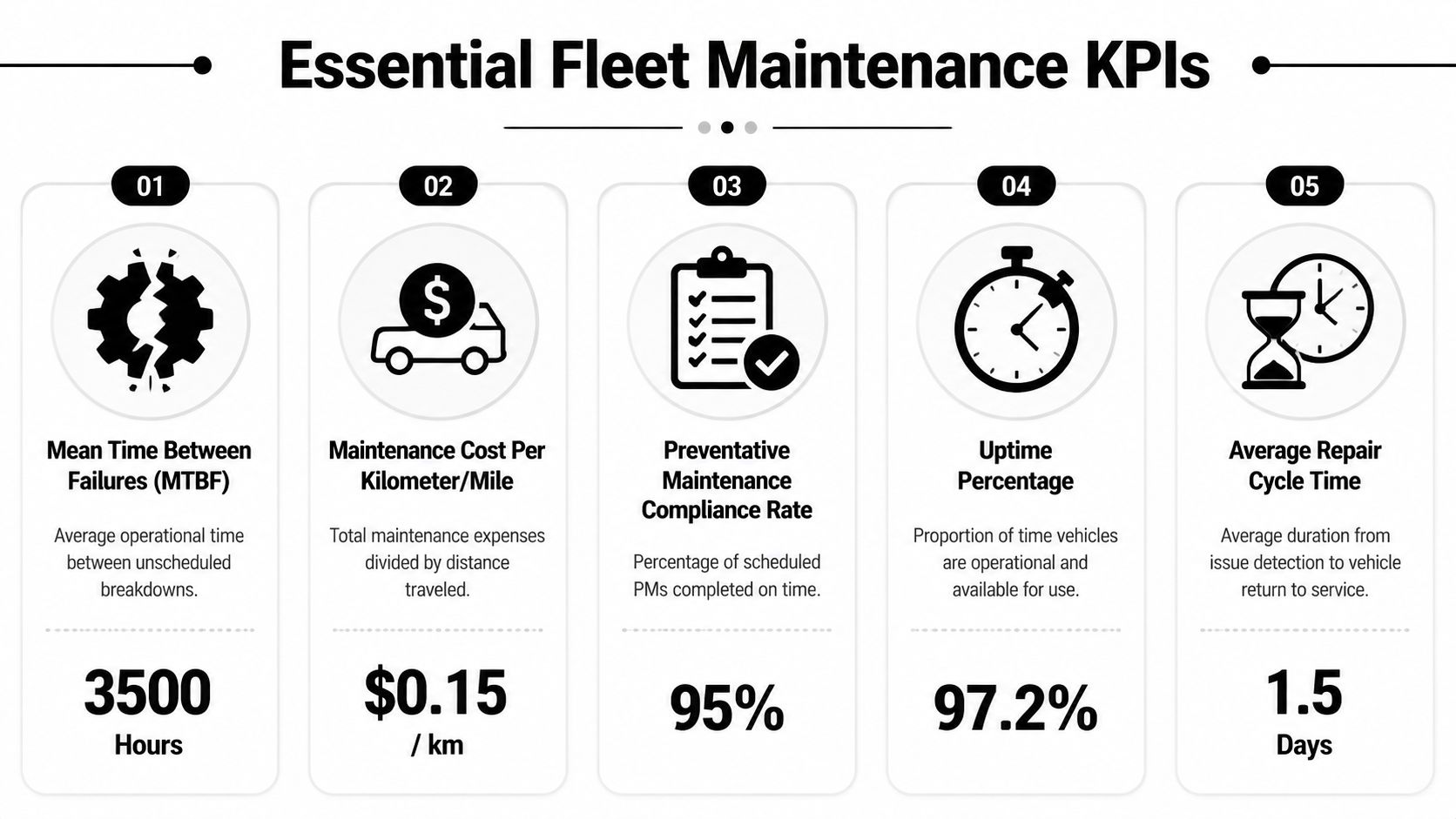
The three KPIs I'd put on page one
These are the first numbers I'd want from any Lambton fleet maintenance program.
Fleet Availability
Formula: vehicles ready for service / total fleet size.
This tells operations how much of the fleet is usable today. If availability falls, dispatch feels it before finance does.PM Compliance
Formula: on-time PMs completed / PMs scheduled.
This tells you whether the plan is being executed, not just whether the plan exists. If compliance is weak, don't blame the PM schedule until you inspect booking discipline and unit access.Repeat Repairs
Formula: repeat work / total repairs.
This exposes quality problems in diagnosis, parts selection, workmanship, or release testing. It's one of the best ways to spot false economies.
Supporting metrics that add context
Once the core three are stable, add supporting indicators that explain why performance is moving.
A useful short list:
- Repair cycle time: How long the unit stays out from intake to release.
- Downtime by asset class: Which category of vehicle consumes the most lost operating time.
- Cost per vehicle: A practical operating view when comparing similar assets.
- Failure notes by system: Brakes, cooling, electrical, tires, driveline, and so on.
Keep KPI definitions brutally simple
A KPI fails when different people calculate it differently. Decide once how each metric is counted and stick to it.
For example:
| KPI | Simple Definition | Common Mistake |
|---|---|---|
| Fleet Availability | Units ready to work today | Counting vehicles that are technically operable but waiting on safety work |
| PM Compliance | PM jobs completed on time | Including late PMs as “completed” without separating them |
| Repeat Repairs | Same fault or related fault returning after repair | Treating every comeback as unrelated |
| Repair Cycle Time | Time from write-up to return to service | Ignoring approval and parts delays |
| Cost per Vehicle | Total maintenance cost divided by number of comparable units | Mixing unlike vehicle classes into one average |
If you need a long explanation for a KPI, your team won't use it consistently.
Good KPI reporting does one thing well. It turns maintenance from opinion into management.
Navigating Ontario Compliance and Lambton Climate
In Ontario, maintenance discipline isn't only about uptime. It's also about being able to prove that the fleet is being operated, inspected, and corrected properly.
That changes the standard. A decent shop process is no longer enough. You need a recordkeeping process that supports the vehicle, the driver, and the operator.
Compliance starts before the vehicle moves
Ontario's Highway Traffic Act framework makes documented daily pre-trip inspections, defect reporting, and corrective action records a core compliance issue. For Lambton-area fleets, that means the maintenance team can't operate in a silo from drivers and dispatch. If a defect is reported in the field, there has to be a clear path from report to review to repair to documented closeout.
When that chain breaks, the problem isn't just operational. It becomes regulatory.
Use a simple compliance workflow:
- Driver inspects and reports before departure.
- Supervisor or dispatcher reviews the reported defect.
- Maintenance triages whether the vehicle can run, requires immediate repair, or must be held.
- Corrective action is recorded with enough detail to prove what was done.
- Return-to-service is controlled so nobody assumes the issue was handled when it wasn't.
If your process around annual and periodic inspection requirements needs tightening, review what's involved in an Ontario annual safety inspection sticker and make sure your own records line up with how the vehicle is being maintained.
CVOR performance is shaped by shop discipline
Fleet managers often treat CVOR as a driver management issue. It isn't only that. Your maintenance process influences vehicle condition, inspection reliability, and how quickly defects get closed. A weak handoff between operations and maintenance can show up as avoidable compliance exposure.
The practical standard is straightforward. If a defect is found, there must be a documented response. If a unit is repeatedly showing similar issues, the maintenance program should catch the pattern and escalate it. If records are scattered across paper notes, texts, and disconnected invoices, you'll struggle to prove control.
Ontario compliance rewards fleets that can produce complete records quickly, not fleets that insist they “usually handle it.”
Winter changes the maintenance equation
Lambton County may not face the same conditions every day across the season, but Southwestern Ontario still puts real stress on fleet equipment. Freeze-thaw cycles, cold starts, slush, corrosion exposure, and mixed urban-highway routes all increase the penalty for loose seasonal prep.
For local fleets, winterization should include checks on batteries, coolant systems, tires, and brake condition. These aren't optional extras. They're control points that prevent avoidable failures when temperatures drop.
A practical winter prep list should include:
- Battery condition: Weak batteries reveal themselves fast in cold starts.
- Coolant verification: Not just level, but condition and system integrity.
- Tire readiness: Tread condition, matching, pressure control, and seasonal suitability.
- Brake inspection: Wear, moisture-related concerns, and consistent performance under cold conditions.
- Cab heat and defrost: Driver visibility is a safety issue, not a comfort item.
- Wiper and washer system checks: Small items become major problems in dirty winter spray.
Tie climate prep to documented action
The common failure in seasonal planning is assuming technicians “know what to look at.” They probably do. The issue is whether the fleet has a repeatable checklist and whether the completed work is recorded in a way management can review later.
That's where Lambton fleet maintenance becomes more than repair execution. It becomes a system that connects weather risk, inspection discipline, and compliance proof into one operating routine.
For Ontario fleets, the best maintenance programs aren't the ones that only fix defects fast. They're the ones that make it hard for defects, missed inspections, and seasonal failures to slip through unnoticed.
Your Action Plan for a High-Performing Fleet
If you want a stronger fleet in Lambton, don't start by chasing a cheaper invoice. Start by tightening control.
Build your program around five operating habits:
- Separate assets by duty cycle: Mixed fleets need different PM timing.
- Choose vendors by uptime impact: Turnaround, records, and communication matter more than rate alone.
- Categorise spend clearly: Scheduled work, unscheduled work, parts, and downtime should never blur together.
- Track a short KPI set: Availability, PM compliance, and repeat repairs will tell you where to act.
- Treat Ontario compliance as daily operating work: Inspection records and corrective actions need the same discipline as repairs.
For any service agreement with a maintenance provider, make sure the SLA includes:
- Response expectations: Booking, diagnosis, and update timing
- Approval rules: Spending thresholds and escalation paths
- Documentation standards: Work order detail, fault notes, and digital record delivery
- Warranty handling: Labour and parts process for comebacks
- Priority asset rules: What happens when a critical unit goes down
- Parts policy: How OEM and aftermarket decisions are made
- Reporting cadence: Regular visibility into repeat repairs, turnaround, and open jobs
A high-performing fleet isn't built by reacting faster to breakdowns. It's built by making breakdowns, compliance misses, and repeat repairs less likely in the first place.
If your Ontario fleet needs a maintenance partner that understands structured service, quality repairs, and dependable vehicle care, Carmedics Autowerks Inc offers professional support for cars, SUVs, and fleet vehicles. Their team handles general repairs, fleet maintenance, and vehicle protection services with a practical focus on reliability, documentation, and long-term vehicle condition.