

You've got a new car, or one you've spent years keeping clean. Then the first Whitby winter shows up. Salt mist kicks up behind traffic on Highway 401, slush packs into the wheel arches, and every wash seems to leave behind a little more dullness than you remember from autumn.
That's usually when owners start asking about the best ceramic coating for cars. Not because they want another shine product, but because they've realised our climate is hard on paint. In Southern Ontario, protection isn't cosmetic. It's part of ownership if you care about gloss, easier maintenance, and resale condition.
Protecting Your Investment in a Harsh Climate
A lot of drivers treat paint protection like an add-on. In Whitby, that's the wrong way to look at it. Winter here means road salt, ice melt chemicals, dirty spray, and constant freeze-thaw exposure. Those aren't minor annoyances. They're the conditions that turn a clean finish into a tired one.
The same logic applies to anything left outside through a Canadian winter. If someone stores a small EV or utility vehicle seasonally, even something as simple as a proper golf cart winter cover matters because exposure always wins when surfaces are left unprotected. Cars are no different. They just cost more to ignore.
A ceramic coating makes sense when you stop thinking about it as a detailing upgrade and start treating it as a defensive layer. It helps keep contamination from sticking as aggressively, makes washing safer, and gives your clear coat a better chance of surviving the season in good shape.
Why Whitby owners need a plan
If you want long-term paint protection, you can't separate coating from corrosion awareness. Paint damage and rust risk aren't the same problem, but they're connected. Salt sits on every surface it can reach, and the longer it stays there, the more trouble it causes. If you want to deal with that side of ownership properly, this guide on how to prevent rust on your car is worth reading alongside any coating decision.
Practical rule: If your vehicle lives outside, sees winter commuting, or gets washed at drive-throughs, you need protection that fits your habits, not just your budget.
The right choice depends on three things. How perfect you want the finish to be. How much risk you're willing to take during application. How long you expect the protection to last before you're doing the whole job again.
What is a Ceramic Coating and How Does It Work
A ceramic coating is best understood as a microscopic glass-like shield for your paint. It isn't armour plating, and it isn't magic. It's a liquid coating, usually built around SiO2 or related chemistry, that cures into a hard, slick layer over the clear coat.
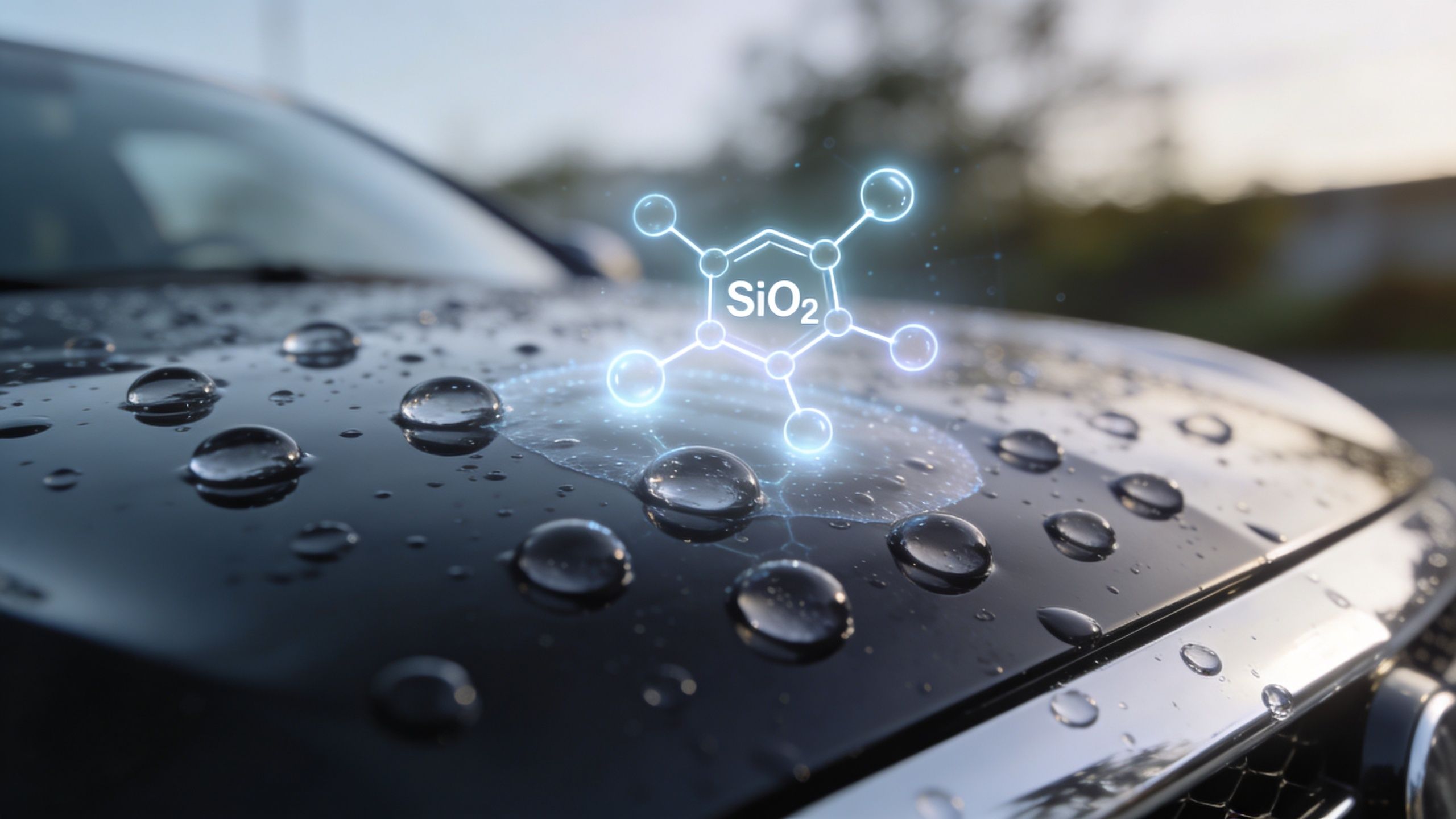
The important part is the bond. Wax sits on top of paint and wears away quickly. A sealant lasts longer than wax, but it's still temporary protection. A ceramic coating cures into a more durable layer that's designed to stay put through regular exposure, washing, and contamination.
What it actually does on the car
Owners usually notice three things first.
- Water behaviour changes: Water beads tighter and runs off faster, which means less standing grime on horizontal panels.
- Washing gets easier: Dirt releases more readily, so you need less aggressive scrubbing.
- Gloss looks sharper: Not because the product hides defects well, but because the surface becomes more uniform and reflective.
That last point matters. Coatings don't fix bad paint. If the finish already has swirls, haze, dealership wash marks, or light oxidation, the coating seals that condition in. That's why prep work matters more than the bottle.
Why prep is where most results are won
If the paint needs correction, do that before coating. A lot of owners skip this and end up disappointed because they expected the coating to create a flawless finish on its own. It won't. It preserves what's underneath it.
If you want a clear example of what correction work involves before protection, this breakdown on how to restore your vehicle's paint finish is useful. The same principle applies whether you're working on a daily-driven SUV or a weekend car.
For owners comparing protection methods more broadly, it also helps to understand where coating fits among other options such as films and traditional surface treatments. This overview of car paint protection options lays out that bigger picture well.
A ceramic coating is a finish protector, not a defect remover. The shine people love usually comes from the prep, then the coating locks that result in.
Evaluating Ceramic Coatings Key Performance Metrics
Marketing terms confuse a lot of buyers because they sound technical but rarely explain what they mean on a vehicle you drive through Ontario winter. The best ceramic coating for cars isn't the one with the flashiest label. It's the one whose performance matches your use case.
Hardness ratings
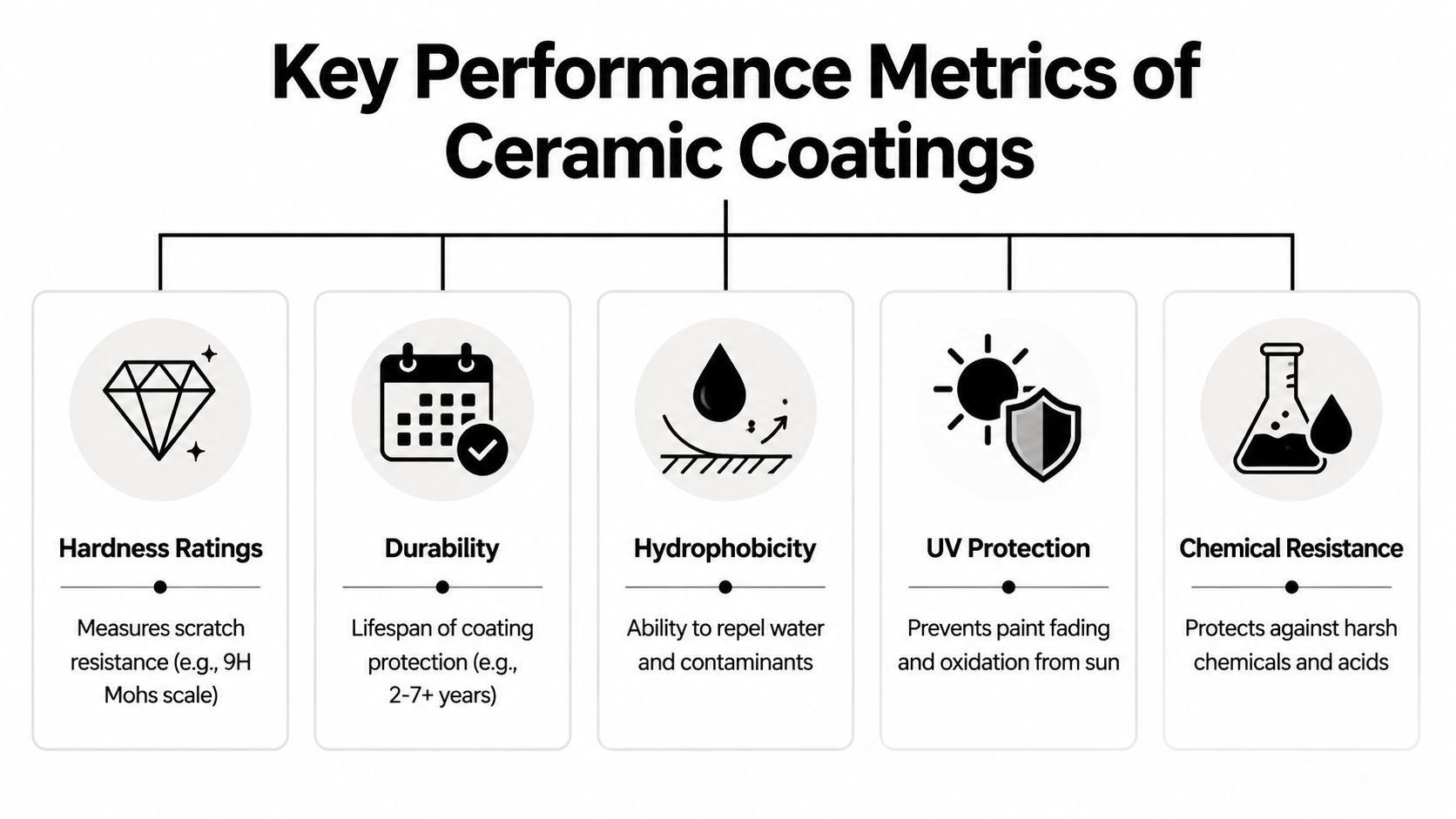
Hardness is the rating commonly fixated on first. It matters, but not in the exaggerated way many ads suggest. A harder coating won't stop a rock strike or a careless zipper drag. What it can do is improve resistance to the fine micro-marring and wash-induced swirls that slowly dull a finish.
Professional-grade coatings do show real variation here. Gtechniq Crystal Serum Ultra uses a 10H top layer with a 7H base layer, engineered to improve swirl resistance compared with standard 9H coatings, according to this overview of professional ceramic coating hardness ratings. For Whitby driving, that matters because winter grit and dirty wash media create exactly the kind of light abrasion that harder coatings are built to resist.
Hydrophobicity and contamination release
Hydrophobicity isn't just about nice-looking beads on Instagram. It affects how easily water, salt residue, and grime leave the surface during a wash. A slicker coating generally means less dragging contamination across the paint with your mitt or drying towel.
What doesn't work is chasing beading alone. A coating can bead impressively and still fall short in chemical resistance, application ease, or longevity. Good water behaviour is one metric, not the whole decision.
Durability in real life
Durability should always be read as a maintenance question. How long will this coating still behave like a coating after winter washes, summer sun, tree sap, and routine neglect? The answer depends on product quality, prep, cure conditions, and how the owner washes the car.
Some owners would be better served by combining a coating strategy with film on impact-prone areas. If you're weighing that route, this guide to how long paint protection film lasts helps frame where film outperforms coating.
The practical checklist I'd use
When comparing coatings, ask these five questions:
| Metric | What it means on your car | What to watch for |
|---|---|---|
| Hardness | Better resistance to fine swirls and wash marring | Don't confuse it with chip-proof protection |
| Hydrophobicity | Easier rinsing and cleaner washes | Water beading alone doesn't prove quality |
| Chemical resistance | More time before bird droppings or sap stain the surface | You still need to remove contaminants promptly |
| UV stability | Better defence against fading and oxidation | More important for outdoor parking |
| Application tolerance | How easy the product is to level and cure properly | DIY-friendly and pro-only coatings are not the same thing |
If a coating sounds perfect at everything, the marketing is ahead of the chemistry.
DIY Kits vs Professional Application A Cost and Results Analysis
Most owners get stuck at this point. They're not deciding whether ceramic coating works. They're deciding whether to buy a kit and do it themselves or pay for a professional install.
That's a fair question, because both routes can make sense. They just solve different problems.
The early comparison that matters
Before getting into the details, start with the split in performance. In a field test conducted from 2024 to 2026 in Whitby and surrounding GTA areas, the Ontario Auto Detailing Association found that consumer-grade SiO2 coatings cut maintenance washes by 50%, while professional graphene-infused coatings delivered 18 to 24 months of verified UV protection and showed 78% better resistance to bird droppings and tree sap. The same OADA testing is summarised in this review of ceramic coating durability and contamination resistance.
That tells you something important. DIY products can absolutely improve ownership. But professional-grade systems tend to pull ahead where contamination resistance, durability, and consistency matter most.
Comparison of DIY Ceramic Coating vs Professional Application
| Factor | DIY Kit | Professional Service (e.g., Carmedics) |
|---|---|---|
| Upfront spend | Lower product cost | Higher initial investment |
| Prep work | Owner handles wash, decontamination, polishing, panel wipe | Prep is usually built into the service |
| Skill required | Moderate to high, especially on dark paint | Handled by trained technicians |
| Risk of high spots and streaks | Higher | Lower |
| Finish quality | Good if prep and application are excellent | More consistent, especially on defect-prone paint |
| Time commitment | Significant, often spread across a full day or weekend | Minimal owner time beyond drop-off and pick-up |
| Durability ceiling | Usually lower than pro systems | Typically stronger long-term performance |
| Best fit | Hands-on owner who accepts some risk | Owner who wants repeatable results and less trial and error |
Where DIY works well
DIY makes sense for the owner who enjoys the process, has a controlled workspace, and understands that prep is most of the job. If you're comfortable washing properly, claying the surface, polishing where needed, doing a panel wipe, and applying the coating carefully panel by panel, a good DIY result is realistic.
DIY is especially reasonable when:
- The vehicle is a daily driver: You want easier washing and better gloss, not concours-level perfection.
- You already own detailing tools: A machine polisher, quality towels, lighting, and wash gear change the equation.
- You accept a learning curve: Small mistakes are recoverable if you know what you're looking at.
What doesn't work is the common shortcut approach. Wash it, wipe on the coating, and hope the shine covers everything. That's how you lock in swirls, leave high spots, or create an uneven finish that looks worse in direct sun than bare paint.
Where professional application earns its cost
Professional installation becomes the smarter buy when the vehicle is new, expensive, dark-coloured, or already carrying defects that you don't want preserved under a coating. You're paying for process control as much as the coating itself.
That process usually includes:
- Controlled prep: Decontamination, paint inspection, and correction as needed.
- Better lighting and environment: Critical for seeing residue and levelling the coating properly.
- Product access: Some coatings are not sold to casual users.
- Lower redo risk: Fixing a bad DIY coating can mean polishing the car again.
A lot of owners look only at the invoice and miss the cost of getting it wrong. If you're also considering whether impact protection belongs in the plan, it helps to compare the coating route against film costs. This article on paint protection film pricing is useful because it shows where coating and PPF should be viewed as complementary, not interchangeable.
DIY saves money when your technique is good. Professional work saves money when your time is limited, your standards are high, or the vehicle is too valuable to practise on.
Your Decision Framework Choosing the Right Protection
The best ceramic coating for cars depends less on the label and more on the owner. I usually see buyers fall into one of two camps.
The new car purist
This owner just bought something he intends to keep clean from day one. He notices dealership wash marks. He parks carefully. He wants the finish to stay sharp through winter and still look right under LED lighting in a garage.
For that owner, professional coating usually makes the most sense. Not because DIY is impossible, but because the margin for disappointment is small. If the paint needs refinement before protection, it should be corrected properly. If the coating flashes unevenly, the owner will notice it every time the light hits the panel.
This owner should also think strategically. Ceramic coating improves washability and environmental resistance, but it doesn't stop rock chips. If the front end sees highway use, pairing coating with selective film often gives a more complete protection plan.
The weekend warrior
This owner likes the work. He already washes with decent tools, probably owns a polisher, and gets satisfaction from spending a Saturday in the garage. He isn't chasing flawless under every light source. He wants a car that cleans up easier, looks better, and stays protected without handing the whole job to a shop.
DIY can be the right answer here. The key is being honest about standards. A careful enthusiast can get a very good result, especially on lighter colours and well-kept paint. But he has to treat the coating step like the final ten percent of a paint-care process, not the whole solution.
Three questions that settle it quickly
Ask yourself this:
How annoyed will you be by visible streaks or missed defects?
If the answer is “very,” go professional.Do you enjoy prep, or do you only like the idea of the finished result?
If you hate decontamination and polishing, DIY will feel long before it feels rewarding.Is this a car you're willing to learn on?
A commuter Civic and a black performance SUV are not the same gamble.
There isn't one universal winner. There's the right fit for your patience, standards, and ownership style.
The Carmedics Autowerks Advantage for Whitby Drivers
Whitby isn't a forgiving place for exposed paint. In the GTA, harsh Canadian winters cause up to 70% more paint degradation than milder climates, and a CAA study found that professional ceramic coatings helped vehicles retain 92% of original gloss after 24 months, repelled 85% more water and salt residue, and contributed to average paint-related repair savings of $1,200 over three years. That local climate context is summarised in this review of ceramic coating performance for GTA drivers.
Those numbers matter because they match what experienced detailers see in real service work. Salt doesn't only attack the underbody. It sits on rocker panels, lower doors, hatch edges, and every horizontal painted surface that catches winter spray. A coating helps because it makes contamination release easier and gives the surface more resistance to the mess we deal with for months at a time.
Why local application matters
A coating package in Whitby shouldn't be chosen the same way you'd choose one in a milder climate. The product has to suit outdoor parking, frequent wash cycles, and heavy seasonal contamination. Just as important, the prep has to account for what Ontario driving leaves behind on the paint.
That's where a local service has an advantage. Carmedics Autowerks in Whitby is one option for owners who want professional ceramic coating applied as part of a broader paint protection plan that can also include correction work, film, and post-install care.
The practical benefit of a shop approach
A good shop process solves three problems at once:
- Paint condition is assessed first: The coating goes onto a surface that's ready for it.
- Protection is matched to use: Daily driver, family SUV, performance car, or garage-kept vehicle all need slightly different thinking.
- The owner gets continuity: Coating, maintenance advice, and related protection services are handled under one roof.
Good ceramic coating work isn't just product selection. It's prep discipline, installation control, and choosing the right protection mix for how the car is actually used.
For Whitby drivers, that's usually the difference between a coating that looks good on delivery day and one that still makes sense after another winter.
Long-Term Care and Frequently Asked Questions
A ceramic coating lowers maintenance effort. It doesn't eliminate maintenance. The owners who get the best long-term result are the ones who wash properly and deal with contamination early.
Simple care checklist
- Use a pH-neutral wash soap: Strong cleaners can shorten the life of the coating or leave it behaving poorly.
- Wash with good technique: Clean mitts, proper drying towels, and gentle contact matter more than people think.
- Remove bird droppings and sap quickly: Even coated paint shouldn't be left with acidic or sticky contamination sitting on it.
- Avoid harsh brush washes: They're still one of the fastest ways to load paint with fresh swirls.
- Top up only with compatible products: If you use maintenance sprays, keep them coating-safe and simple.
Common questions
Does ceramic coating stop scratches and rock chips
No. It helps with minor swirl resistance and light marring, but it doesn't replace paint protection film for impact defence.
Can you wax over a ceramic coating
You can, but you usually don't need to. Many waxes add little value and can interfere with the clean, slick behaviour people want from a coating. If you want to maintain it, use products designed for coated vehicles.
Does a new car still need paint correction before coating
Often, yes. New cars regularly arrive with light wash marks, transport contamination, or dealer prep defects. A coating should go on after the paint is brought to the condition you want preserved.
Will water spots still happen
They can. A coating helps water move off the surface, but minerals can still dry on the paint if water sits there. Dry the vehicle properly and don't let hard water bake in the sun.
If you want a professional opinion on what makes sense for your vehicle, Carmedics Autowerks Inc can help you compare ceramic coating, correction, and film options based on how you drive and store the car in Whitby.