
Ontario doesn't have a collision repair labour problem at the margins. It has an industry-wide crisis. Auto body collision repairers and estimators made up 19% of all automotive trade job vacancies in Ontario in 2023, and automotive trade vacancies surged 424% between Q1 2016 and Q3 2022 according to Collision Repair magazine's coverage of the provincial study.
That changes the conversation around collision repair jobs.
If you're serious, there's room for you. But the shops that matter aren't hiring warm bodies. They want people who can learn systems, follow repair procedures, measure before they cut, and protect a customer's safety instead of guessing their way through a repair. In Ontario, especially around Whitby and the GTA, that standard is rising fast.
Exploring Collision Repair Career Paths
A modern body shop doesn't run on one type of talent. It runs on specialists who can hand work off cleanly, document what they find, and stay inside repair procedures without creating problems for the next person in line.
Some applicants chase “collision repair jobs” as if it's one title. It isn't. The better move is to decide where your strengths fit.
The main roles in a body shop
A collision repair technician handles structural and panel repair. This is the person pulling measurements, repairing or replacing damaged components, setting up welds, checking fitment, and making sure the vehicle can move to the next stage without hidden issues. If you like tools, geometry, teardown, and problem-solving, this path usually fits.
An automotive painter lives in prep, surface control, masking discipline, colour match, blending, and final finish quality. Painters need patience and consistency. A rushed painter creates expensive rework for everyone.
A damage estimator sits at the front end of the process. Estimators inspect damage, build repair plans, identify likely hidden damage, communicate with customers and insurers, and keep the job realistic from the start. If you're organised, observant, and strong with documentation, this can be a strong lane.
An auto detailer often gets underestimated. That's a mistake. Good detailers do final cleaning, inspect finish quality, catch flaws under lighting, and help make sure a repaired vehicle leaves looking complete rather than merely repaired. It's also one of the practical entry points for someone who wants to get inside a shop and prove work ethic.
| Role | Primary Focus | Core Skills | Typical Entry Point |
|---|---|---|---|
| Collision Repair Technician | Structural and panel repair | Measuring, disassembly, welding, fitment, repair planning | Apprentice, helper, junior body tech |
| Automotive Painter | Surface prep and refinishing | Sanding, masking, colour matching, spray technique, finish inspection | Prepper, paint helper |
| Damage Estimator | Inspection and repair planning | Documentation, parts knowledge, communication, system use | Front office trainee, estimator assistant |
| Auto Detailer | Final presentation and inspection support | Cleaning, finish spotting, consistency, care with completed repairs | Entry-level shop support |
How these paths compare in real life
The collision repair side usually suits people who don't mind hard teardown work and can stay methodical when the damage isn't obvious at first glance. The painter's path suits people who notice tiny defects before anyone else does. Estimating rewards calm thinking under pressure. Detailing rewards discipline and pride.
Practical rule: Pick the lane where you naturally care about quality without being reminded.
The strongest shops don't keep these roles isolated. A body tech who ignores paint needs creates extra prep time. A painter who doesn't flag poor panel fit sends a bad vehicle forward. An estimator who writes a thin repair plan burns shop time later.
If you want a niche later, collision repair can also branch into larger and more specialised work. Shops that handle larger vehicles and coach bodies require many of the same fundamentals, which is why studying examples of RV damage restoration can sharpen your understanding of panel size, substrate differences, and repair planning on more complex units.
Where the opportunity sits
Ontario's shortage isn't abstract. It means skilled people who show up prepared have a real shot. The opening is there, but so is the standard. Shops will forgive limited experience faster than they'll forgive sloppiness, poor attitude, or someone who thinks bodywork is just cosmetic.
If you're trying to break in, start by choosing the role that matches how you think. That decision shapes your training, your resume, and the kind of shop floor work you should ask to see.
Essential Skills and Certifications for Technicians
The difference between a hobbyist and a professional technician shows up in process. A professional measures first, confirms procedures, documents the repair, and knows when a job is outside their current skill set.
That matters because modern vehicles don't give you much room for “close enough”.
The skill set employers actually notice
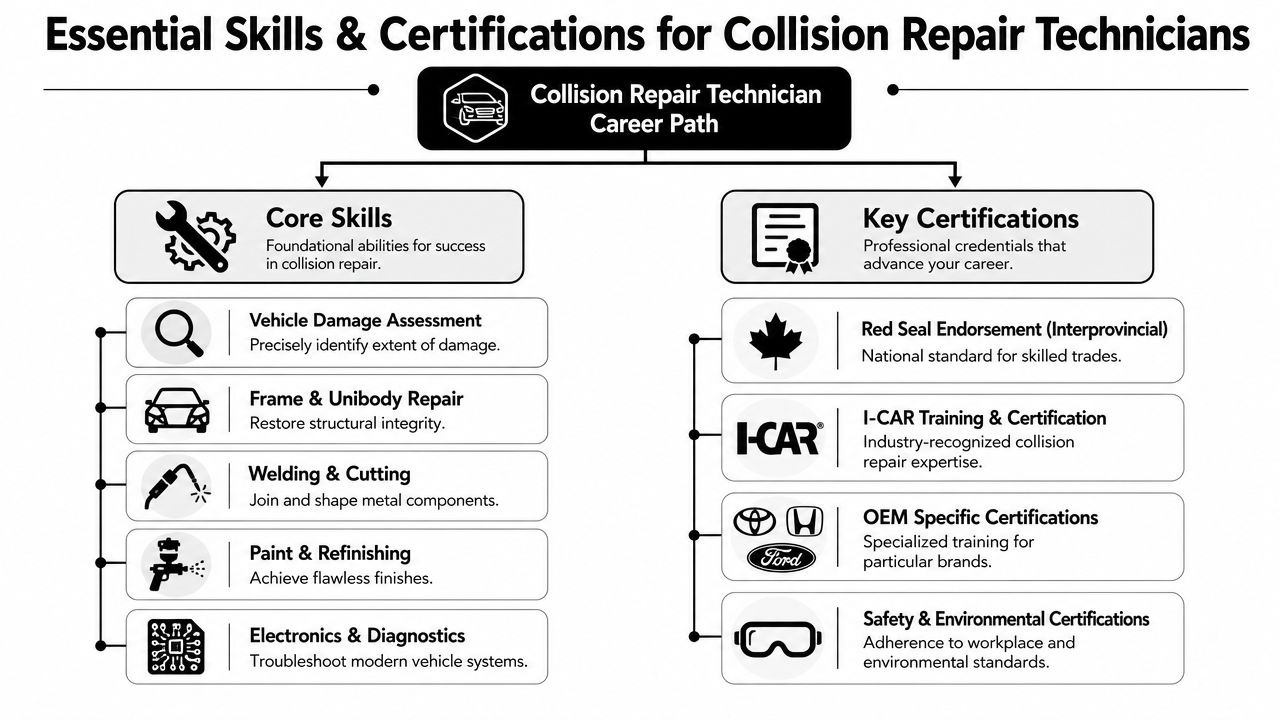
You need hand skills, but that's only the base layer. Good technicians read repair information, use measuring systems properly, understand material differences, and keep a clean workflow from teardown to reassembly.
Focus on building these first:
- Damage assessment: Learn to identify primary damage, likely hidden damage, and what must be measured before repair starts.
- Frame and unibody work: You need to understand pull strategy, anchoring, structural replacement decisions, and verification after correction.
- Welding and joining methods: Modern repair work can involve different joining procedures depending on the panel and manufacturer requirements.
- Refinishing awareness: Even if you aren't becoming a painter, you should know how your body repair affects prep, blend panels, and final finish.
- Electrical and diagnostic comfort: Late-model vehicles bring sensors, modules, and systems that don't tolerate careless handling.
Why precision isn't optional
One of the most important technical habits in Ontario collision work is confirming frame alignment with Computer-Aided Design measurements before welding. According to Fanshawe's auto body repair training material, deviations that exceed 3mm from OEM specifications lead to a 95% likelihood of structural failure in subsequent crash tests, and this standard is tied to OMVIC-certified repair expectations.
That single fact should reset how you think about the trade.
A clean-looking repair can still be an unsafe repair if the structure was never measured properly.
Inexperienced applicants often misunderstand the job. They think speed gets them hired. Speed only matters after accuracy becomes routine.
Certifications that separate you from the pack
Shops want trainable people first, but credentials help a manager trust that you take the trade seriously. A few matter more than others.
Red Seal and trade progression
If you plan to build a long career in Ontario, formal trade progression matters. It shows you aren't just trying the trade out for a season. It shows commitment to standards and mobility.
I-CAR and ongoing training
I-CAR matters because collision repair procedures keep changing. New materials, new joining methods, and new systems don't care about old habits. If you can show ongoing training, you're easier to place in a quality-focused shop.
OEM-specific certification
OEM repair procedures are where strong technicians separate themselves from parts changers. Vehicles from different manufacturers can require different repair logic, replacement thresholds, and calibration steps. That training becomes even more valuable on vehicles with advanced safety systems and mixed-material construction.
For applicants trying to understand what a quality-driven repair environment looks like, it helps to review the standards associated with a certified auto repair shop in Whitby. You'll get a better sense of the level of consistency professional shops expect.
What doesn't work
These habits hurt technicians early:
- Guessing instead of checking procedures
- Treating measuring equipment like a formality
- Hiding mistakes instead of flagging them fast
- Thinking older shop habits always transfer to newer vehicles
A shop can teach technique. It's much harder to retrain attitude. If you respect measurements, documentation, and repair procedures from day one, you'll move faster than the person who thinks talent alone is enough.
Your Training Roadmap From Apprentice to Pro
Many individuals enter this trade with the same problem. They're willing to work, but they can't find a clean first step.
That problem is real in Ontario. While some regions show plenty of entry-level postings, Ontario's collision repair sector has few publicised apprenticeship programs, even though a 2025 Ontario Ministry of Labour report found that 38% of GTA collision shops named “inability to train newcomers” as their top hiring barrier, as cited on this entry-level collision repair jobs page.
How a real training path usually starts
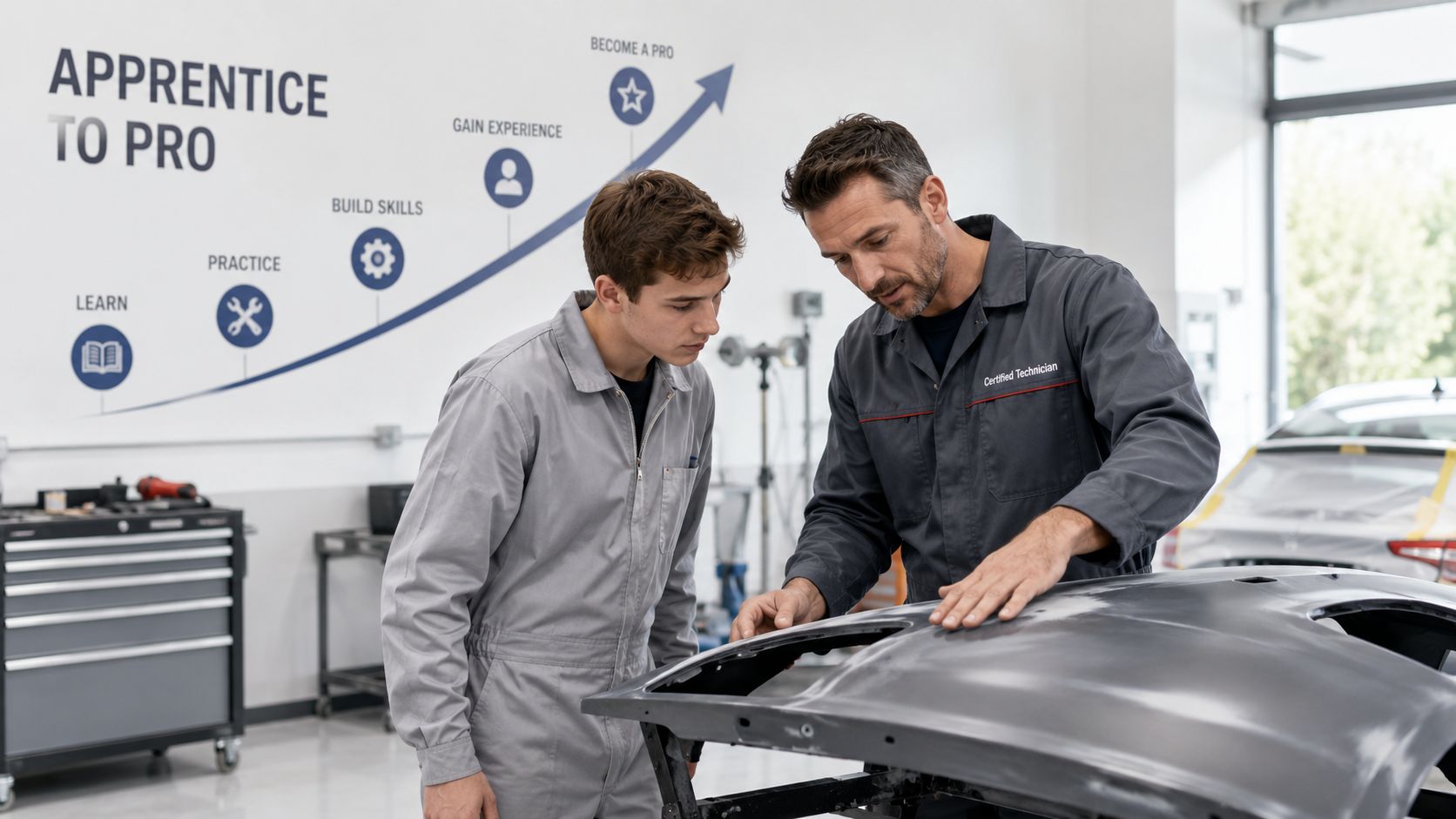
The cleanest path rarely starts with glamorous work. It starts with support tasks. Parts handling. Basic teardown. Cleaning weld areas. Sanding. Masking. Organising hardware. Learning where tools live and how jobs move through the shop.
That's not a bad sign. That's the trade testing whether you're useful.
The apprentices who move up fastest usually do three things well:
- They listen the first time. Senior techs will teach anyone who pays attention.
- They protect workflow. They put tools back, label parts, and don't create chaos around active jobs.
- They ask better questions. Not “What do I do?” but “Do you want this bagged by panel location?” or “Should I mark this for replacement or hold for inspection?”
College, shop floor, or both
Formal education helps because it gives you terminology, baseline safety habits, and exposure to repair concepts before you touch customer vehicles. But classroom time alone won't make you productive.
Shop-floor learning does the opposite. It teaches pace, hand position, sequence, and judgement.
The strongest route is usually a mix:
- Technical school for fundamentals: You learn tools, terminology, repair stages, and safety discipline.
- Hands-on apprenticeship for speed and judgement: You learn what damaged vehicles look like when the estimate was incomplete, parts are delayed, or hidden damage changes the repair plan.
- Self-study between shifts: Repair procedures, product sheets, measuring-system basics, and paint-material handling all reward repetition.
If you're early in your journey, this round-up of practical advice for apprentice mechanics is useful for understanding how to approach entry-level shop life with the right expectations.
How to approach shops that aren't advertising
Many shops need help before they post a job. They just don't trust random walk-ins. You need to remove doubt.
Bring a short resume. Wear clean work clothes. Ask for the production manager, shop foreman, or owner when the front office isn't flooded. Tell them exactly what you're looking for: entry-level body shop work, apprentice exposure, or support work that can grow into technician training.
Shop-floor truth: A lot of first opportunities go to the person who looked prepared, spoke plainly, and came back when asked.
Keep your pitch simple:
- State your intent: You want to build a career in collision repair, not just “find work”.
- Name your value: Reliable attendance, comfort with tools, willingness to start at the bottom.
- Show your seriousness: Mention any school training, personal projects, or time spent studying repair methods.
A good sign is a shop that talks openly about standards, safety, repair procedures, and who trains juniors. If you're researching local operations and want to understand the kind of environment that supports learning, reviewing a local auto body shop in Whitby can help you benchmark what a professional setup looks like.
What turns a beginner into a technician
Nobody starts as a pro. The jump happens when you stop needing reminders about the basics. You clean your repair area without being told. You protect removed parts. You double-check before drilling, cutting, or grinding. You learn that the boring habits are the ones that keep a vehicle safe.
That's the apprenticeship often overlooked. Not the paperwork. The mindset.
Building a Standout Resume and Portfolio
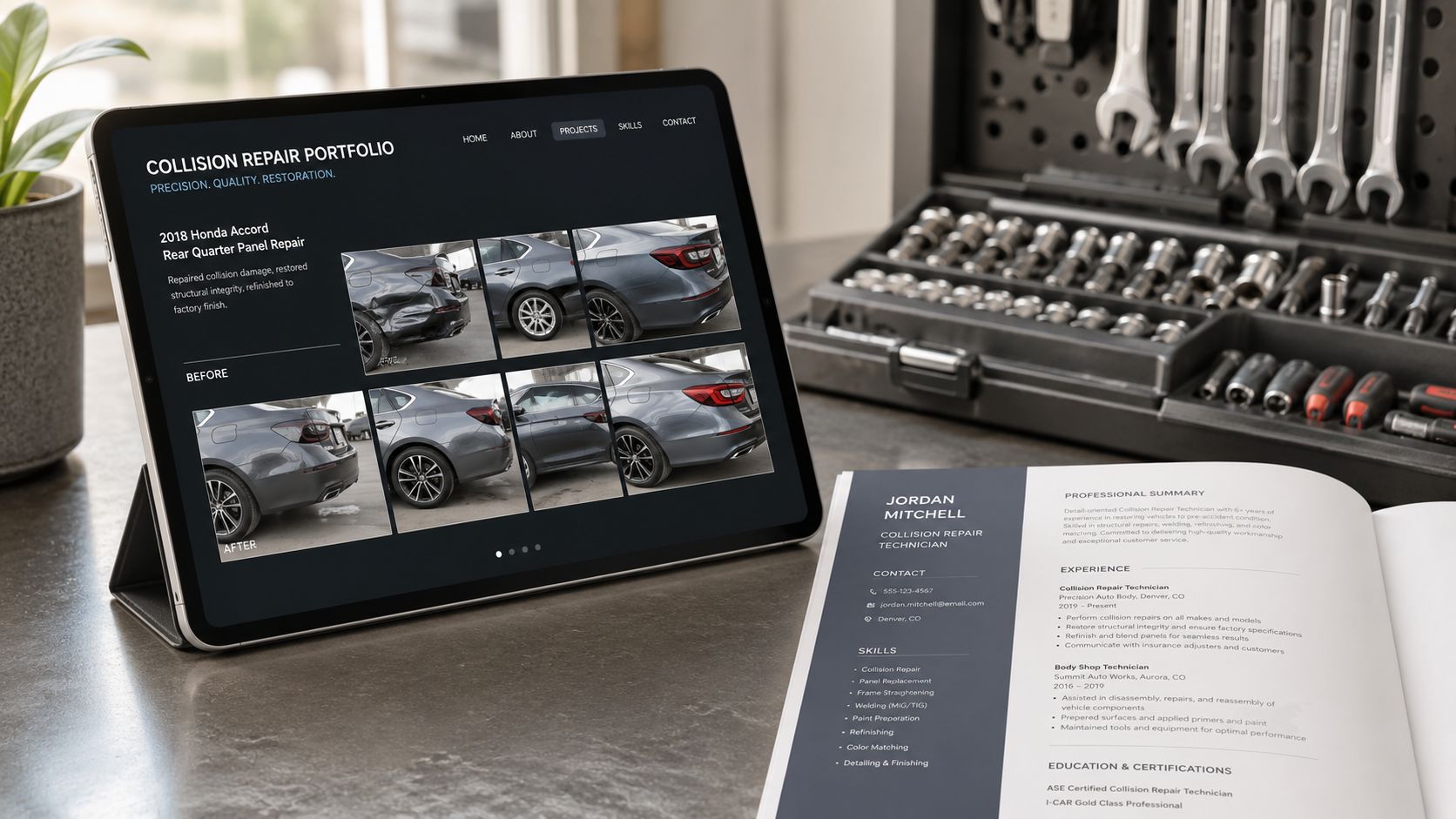
In collision repair, a resume gets you considered. A portfolio gets you remembered.
Too many applicants send a generic document full of vague lines like “responsible for body repairs” or “assisted with painting”. That tells a hiring manager almost nothing. Show the work.
What your resume should highlight
A collision repair resume should be tighter than a general labour resume. Put your trade-related value near the top.
Use a structure like this:
Start with a focused summary
Write two or three lines that name your direction clearly. For example, entry-level collision repair technician with shop-floor experience in teardown, panel prep, parts organisation, and safe tool handling. If you have formal training, say so.
List certifications and training before general work history
If you've completed safety training, trade courses, paint-material familiarisation, measuring-system exposure, or brand-specific modules, don't bury them. Put them high on the page.
Make your experience task-specific
Don't write broad duties. Write the actual work:
- Vehicle teardown and labelling
- Panel preparation and sanding
- Trim removal and reinstallation assistance
- Masking and refinishing support
- Documentation of repair stages with photos
- Shop clean-up tied to active repair bays
Build a simple portfolio that proves craftsmanship
A phone camera is enough if you use it properly. You don't need fancy editing. You need clean evidence.
Photograph repairs in stages:
Before work begins
Capture overall damage and close-ups of problem areas.During repair
Show teardown, damage exposure, panel fitment checks, prep stages, or protected adjacent panels.After completion
Take clear final photos in good light from the same general angles as the “before” shots.
Add short captions. One sentence is enough. Explain what you did or assisted with. Keep it honest. If you helped with prep and masking, say that. Don't present a team repair as if you completed the whole job yourself.
Hiring note: Clean documentation often says more about your professionalism than flashy wording ever will.
What to include besides photos
A useful portfolio can also contain:
- A skills page: List tools, shop systems, and repair tasks you've used.
- A training page: Include course names, certificates, and in-progress learning.
- A workmanship page: Show close-ups of panel alignment, masking quality, surface prep, or finished paint transitions if you have permission to document them.
If refinishing is one of your strengths, study how professional shops present services such as automotive paint repair in Whitby. It helps you understand what customers and managers both notice in finished work.
Common application mistakes
The fastest way to weaken your application is to overclaim.
Avoid these:
- Using trade buzzwords you can't explain in person
- Submitting dark, blurry, or poorly cropped project photos
- Listing every past job equally, even when most are unrelated
- Sending the same resume to a painter role and a body technician role
Tailor the application to the role. If you want body work, show measurements, fitment, and repair discipline. If you want paint, show prep quality, masking, and finish awareness.
Acing Your Interview and First 90 Days
A collision repair interview isn't just a test of knowledge. It's a test of judgement. Managers aren't only asking whether you can do the work. They're asking whether they can trust you around expensive vehicles, safety-critical repairs, and a tight production schedule.
That's why the interview has to work both ways.
Questions you should be ready to answer
Expect practical questions, not just resume review. A shop may ask how you'd handle hidden damage, what you do before removing parts, how you keep hardware organised, or how you respond when you realise you made a mistake on a job.
Good answers usually sound calm and procedural. You identify the issue, stop before making it worse, document what you found, and bring in the appropriate lead or manager if needed. Shops trust people who escalate problems early.
You may also get culture questions. Why this trade? How do you handle feedback from a senior technician? What kind of environment helps you learn? These matter because a skilled person who fights the process can slow down a whole bay.
Questions you should ask the employer
A strong applicant asks direct questions that reveal how the shop operates.
Try these:
- Who trains junior staff on your floor
- How do you handle repair procedures and quality checks
- What does a good first three months look like here
- Do entry-level staff rotate through teardown, prep, and reassembly
- How do you decide when someone is ready for more complex work
If a shop can't explain how it develops people, be careful. A place that says “you'll figure it out” often means nobody has time to teach and everyone is protecting their own throughput.
A useful benchmark is to look at how a professional mechanic in Whitby presents expertise and service standards. Even though collision and mechanical work differ, the same professionalism shows up in training culture, customer communication, and attention to process.
The best interviews feel less like a sales pitch and more like two sides checking whether the standards match.
Your first 90 days on the floor
Your first months aren't about impressing people with speed. They're about proving you're reliable, coachable, and safe.
Do these well:
- Be early and ready: Don't start the day hunting for gloves, notepads, or basic tools.
- Protect the process: Label parts, store fasteners, and leave the bay cleaner than you found it.
- Take notes: If a senior tech shows you a sequence once, write it down.
- Own small wins: Finish support tasks completely. Half-done work creates mistrust fast.
- Ask for feedback at the right time: Not while someone is buried in a repair, but when the bay settles.
Good first impressions in this trade aren't loud. They look like consistency.
The Whitby Job Market and Applying to Carmedics
Whitby sits in a part of Ontario where expectations are high. Drivers keep newer vehicles longer, insurers scrutinise repair quality, and shops need people who can handle both craftsmanship and modern systems without drama.
That creates a healthy tension for job seekers. There's opportunity, but you still need to earn your place.
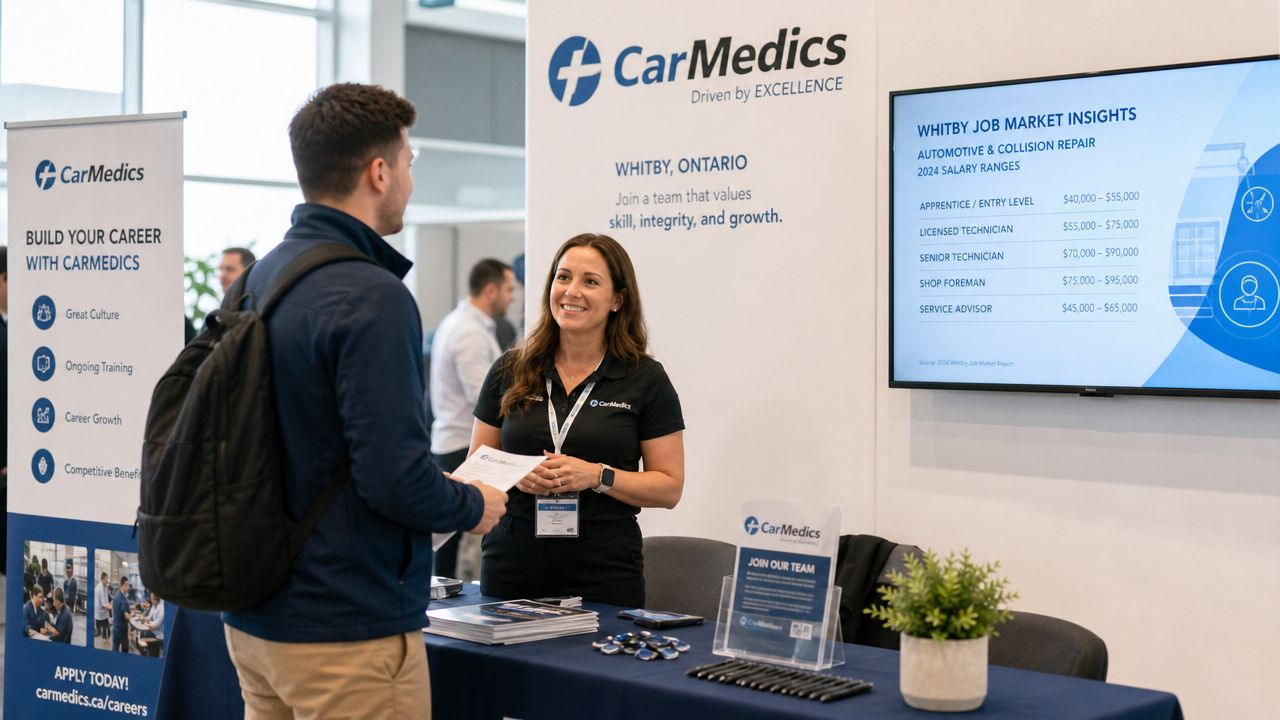
What pay looks like in Ontario
As of June 2026, the average annual salary for a Collision Repair technician in Ontario is $51,598, top earners reach $79,000, and the median hourly wage for auto body repairers in Ontario is $27.00, according to ZipRecruiter's Ontario collision repair salary data.
Those numbers matter, but they don't tell the whole story. Your pay trajectory depends on whether you become the person a shop can trust with difficult jobs, accurate documentation, and repeatable quality. In practice, the market rewards technicians who reduce rework, protect cycle time, and don't create avoidable problems.
What local shops tend to notice first
In the Whitby and Durham Region market, the applicants who stand out usually show a mix of technical respect and personal discipline.
Shops notice things like:
- Clean presentation: You don't need to look corporate, but you should look ready for a professional trade.
- Specific skill awareness: You can explain the kind of work you've done without bluffing.
- Evidence of standards: Photos, training records, references, or practical examples carry weight.
- Long-term intent: Shops invest more in candidates who clearly want a career, not a placeholder job.
How to apply with a stronger edge
Before applying anywhere, tighten the basics. Match your resume to the role. Bring a portfolio. Know the difference between structural repair, refinishing support, and estimating. Be ready to talk about quality control, not just tools.
If you're interested in opportunities connected to a professional Whitby facility, review Carmedics Autowerks in Whitby so you understand the kind of standards, services, and customer expectations that shape the work environment.
The strongest applicants usually do one more thing. They communicate like tradespeople, not marketers. Plain language. Honest skill level. Clear willingness to learn. That works.
If you're newer, say you're newer. Then prove you're serious with examples of what you've already done to get ready. If you've got experience, speak in terms of repair quality, workflow, and accountability instead of bragging.
Whitby has room for people who treat this trade like a craft.
If you're ready to pursue collision repair work with a quality-first shop, Carmedics Autowerks Inc is a strong place to start. We value precision, professionalism, and technicians who care about doing the job right the first time. Review the shop, prepare a resume that reflects real skills, and apply when you're ready to bring that standard to the floor.