
If you're in Ontario and searching for a "car safety inspection near me," you've probably hit a key milestone. Maybe you're buying a used car, selling your own, or bringing a vehicle in from out of province. In any of these cases, this inspection is usually a mandatory step.
It’s a thorough, top-to-bottom check to make sure a vehicle is up to snuff with Ontario's strict safety standards.
Why You Need a Car Safety Inspection in Ontario
Think of a car safety inspection as a mandatory health check for your vehicle, but one that’s legally required in certain situations. It’s not just about filling out a form; it’s about making sure a car is fundamentally safe for the road. Pass the inspection, and you get a Safety Standards Certificate (SSC)—the official piece of paper you’ll need.
This certificate is your proof that, at the time of the inspection, a licensed Motor Vehicle Inspection Station (MVIS) confirmed all your car’s key safety systems were in good shape. In many cases, you simply can't get licence plates or transfer ownership without a valid SSC.
When an SSC is Legally Required
So, when do you actually need to get one? The requirement for an SSC pops up during major changes in a vehicle's life, ensuring it's still roadworthy when it changes hands or moves into Ontario. Knowing when this applies helps you plan ahead and avoid headaches.
You will need a valid Safety Standards Certificate if you are:
- Registering a vehicle brought in from another province, territory, or country.
- Transferring ownership to someone who isn't your spouse.
- Upgrading a vehicle's status from "unfit" back to "fit."
- Registering a rebuilt vehicle.
For anyone in these situations, the SSC is a must-have. It's the province's way of setting a minimum safety benchmark for vehicles on our roads. This inspection is a crucial part of any good preventive maintenance for vehicles, forcing a close look at the parts that matter most.
The whole point of the inspection is to catch potential safety problems before they cause an accident. It’s a proactive step that keeps dangerous vehicles off the road, protecting drivers, passengers, and pedestrians.
Ultimately, this is about more than just bureaucracy; it's about public safety. By verifying the condition of critical systems like your brakes, steering, suspension, and lights, the inspection gives everyone peace of mind. It ensures that the used car you're buying or bringing into Ontario isn’t hiding a dangerous defect that could put you or others in harm's way.
What's On The Official Ontario Safety Inspection Checklist?
So, what exactly is a licensed technician looking at when they put a car up on the hoist for an Ontario Safety Standards Certificate? It’s a lot more than just a quick peek under the hood. The entire process is strictly guided by a detailed checklist from the Ministry of Transportation, which ensures every inspection is consistent, fair, and incredibly thorough.
Think of this checklist as the rulebook. It turns a simple once-over into a proper, systematic evaluation of your vehicle’s most critical safety systems. It’s less about trying to "pass a test" and more like a comprehensive physical for your car, where every vital sign is checked against a non-negotiable standard of roadworthiness.
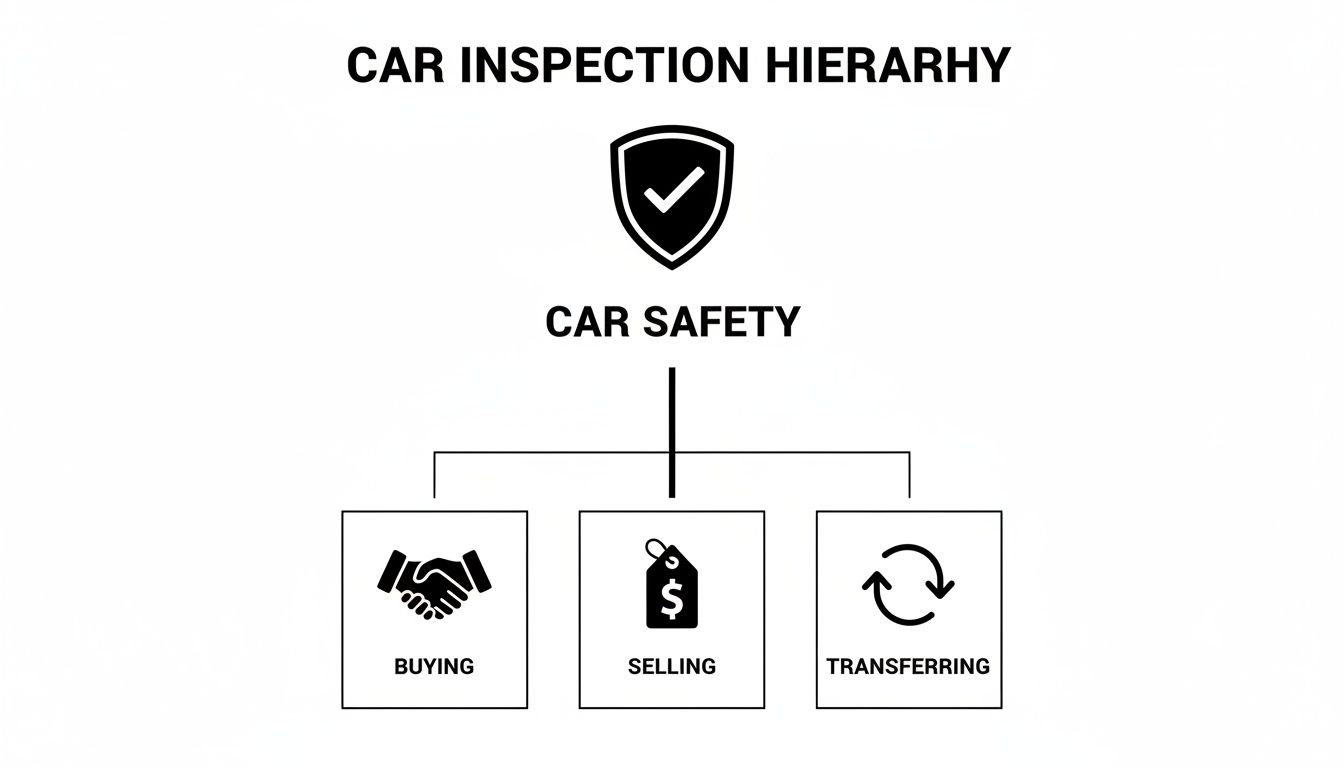
No matter why you need the inspection—buying, selling, or transferring ownership—the core goal is always the same: confirming the vehicle is fundamentally safe for the road.
To give you a clearer picture, we've put together a table that breaks down the main inspection areas and what our technicians are specifically looking for.
Key Inspection Areas and What Technicians Look For
| Component Category | What's Inspected | Common Pass/Fail Criteria |
|---|---|---|
| Powertrain | Engine, transmission, drive shaft, mounts. | No major fluid leaks. Mounts must be intact. Drive shaft and U-joints must be secure. |
| Braking System | Pads, rotors, lines, hoses, parking brake. | Pads/shoes must meet minimum thickness. Rotors must not be excessively warped or rusted. No leaks. Parking brake must hold. |
| Steering & Suspension | Ball joints, tie rods, shocks/struts, frame. | No excessive play in steering. Components must not be loose or leaking. Frame must be free of structural rust or cracks. |
| Wheels & Tires | Tires, rims, lug nuts. | Tire tread depth must be at least 2/32”. No bulges or cracks. Wheels must be straight and all lug nuts present. |
| Electrical System | Lights, horn, wipers. | All exterior lights must work (headlights, signals, brake lights). Horn must be audible. Wipers must clear the windshield. |
This table covers the highlights, but let's break down exactly why these areas are so crucial for your safety.
1. Braking System Performance
Let’s be honest, your brakes are arguably the single most important safety feature on your car. During a safety inspection, this system gets one of the most intense evaluations. We’re not just checking if the car stops; we’re looking at how it stops and how much life is left in the components.
A technician will measure the brake pad and shoe thickness to make sure there's enough friction material left. We also inspect the rotors and drums for heavy rust, deep grooves, or warping that could cause that shaky, pulsating feeling when you brake. Finally, we meticulously check all hydraulic lines and hoses for any cracks, bulges, or leaks. The parking brake gets a workout, too—it has to prove it can hold the vehicle steady on an incline.
2. Suspension, Steering, and Frame Integrity
If the engine is your car’s heart, the suspension and steering are its skeleton and reflexes. These parts dictate how your car handles bumps, corners, and your direct commands from the steering wheel. We get under the car and check for worn-out ball joints, loose tie rod ends, and any signs that your shock absorbers or struts are failing.
A vehicle’s structural integrity is everything. We inspect the frame and subframe for any cracks or advanced corrosion that could weaken the car's core. Any evidence of a previous, poorly repaired accident is an immediate red flag, as a compromised frame can fold in ways it shouldn't during a collision.
We also examine the steering system to ensure there’s no excessive "play" or looseness in the wheel. When you turn, the car needs to respond instantly and predictably. If you're curious about the requirements for commercial vehicles, our article on the annual safety inspection sticker in Ontario has more specific details.
3. Powertrain Components
The powertrain is what makes your car go—the engine, transmission, and all the bits that deliver that power to the wheels. An inspector is on the lookout for any significant fluid leaks from the engine or transmission. Leaking oil or coolant isn't just messy; it can be a serious hazard on the road for other drivers.
We also make sure the engine and transmission mounts are solid. A broken mount could cause the entire engine to lurch violently under acceleration, which can damage other parts or even affect your control of the vehicle. It's all about ensuring the heavy-duty parts stay where they're supposed to.
4. Wheels, Tires, and Electrical Systems
Finally, we inspect the parts that keep you connected to the pavement and visible to everyone else. Your tires are your car's only point of contact with the road, so they need to be in good shape. We check for a minimum tread depth of 2/32 of an inch, and look for any dangerous bulges, cracks, or cuts in the sidewall. The wheels themselves are inspected for bends or cracks, and we confirm every lug nut is present and properly torqued.
Your car’s electrical system is just as important. Every single exterior light—headlights (both high and low beams), tail lights, brake lights, and turn signals—has to work. Your horn needs to be loud and clear, and your windshield wipers and washer fluid system must be able to keep your view unobstructed, no matter the weather.
Common Reasons a Car Fails Its Safety Inspection
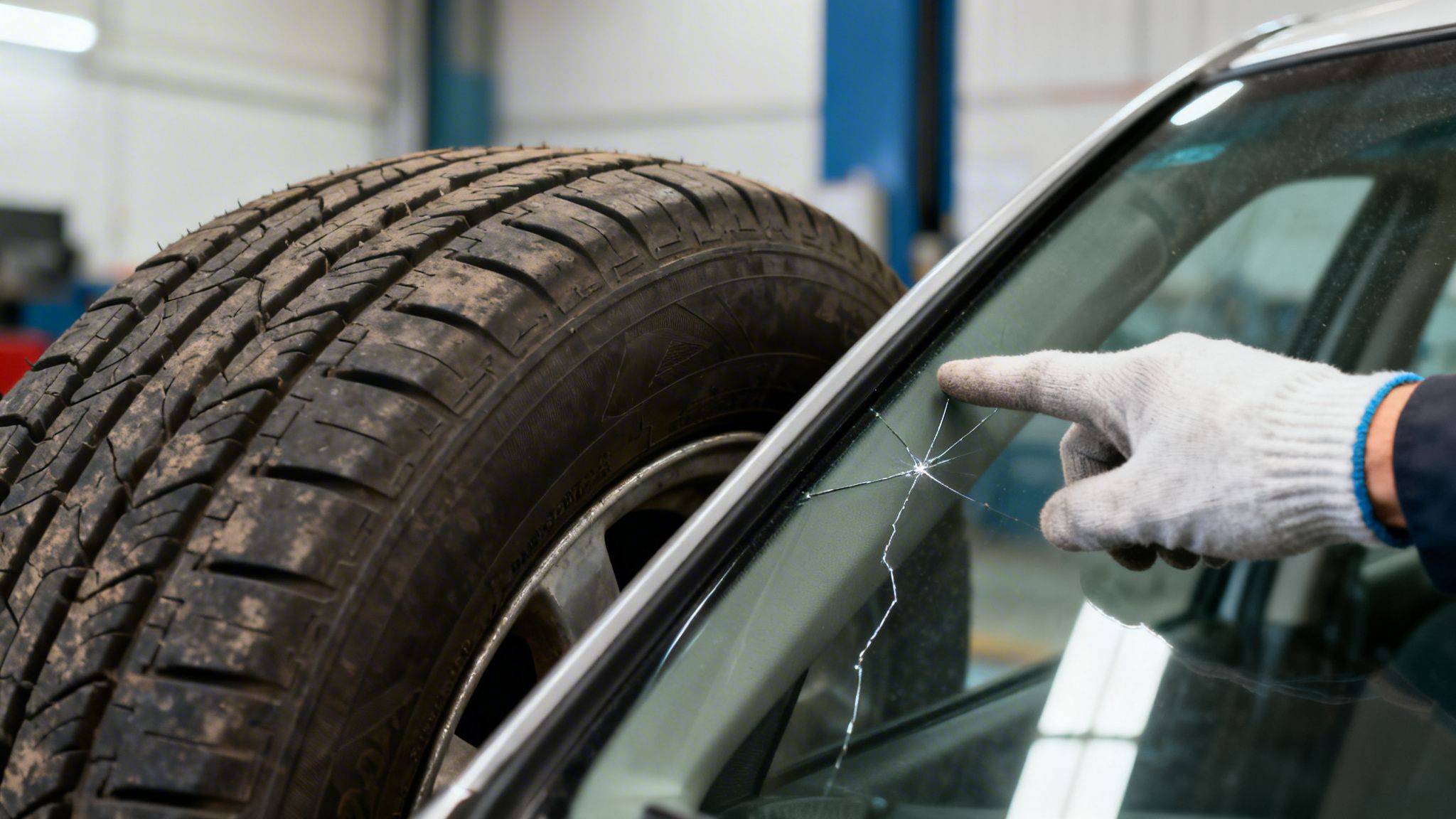
Let's be honest, nobody wants to hear their car has failed its safety inspection. The very idea can bring up images of huge, wallet-draining repairs. But in my experience, that’s rarely the case.
Most safety failures aren't caused by some catastrophic, hidden issue. They're usually down to a handful of common problems that are easy to miss during the daily grind. Once you know what inspectors look for, you can turn that worry into a simple pre-check and avoid the hassle of a second visit.
Brake System Wear and Tear
There's no surprise here. Your brakes are arguably the most important safety system on your car, so they get a thorough once-over during an inspection. It’s also one of the top reasons for a fail. A technician isn't just seeing if you can stop; they're measuring the lifespan and condition of every part.
Here are the usual suspects when it comes to brake failures:
- Worn Brake Pads: The material on your brake pads has a minimum required thickness. If they're worn too thin, they just can't generate the friction needed to stop your car safely and will need to be replaced.
- Warped or Damaged Rotors: If you feel a shudder or vibration through the brake pedal, you might have warped rotors. An inspector will also fail rotors with deep grooves, heavy rust, or cracks.
- Leaking Hydraulic Lines: Brake fluid is what gives your pedal its power. The technician will check all the lines for cracks, bulges, or any sign of a leak, which could lead to a total loss of braking.
If you’ve heard grinding sounds or your brake pedal feels squishy, it’s a good idea to have it looked at. Getting these sorted out is non-negotiable for safety. To see how we tackle these jobs, you can learn more about our process for expert brake repair in Whitby and what it takes to get things right.
Tire and Wheel Issues
Your tires are the only part of your car that actually touches the road, so their condition is a massive focus. An inspector will check each tire, and a few common issues can easily result in a fail.
One of the quickest ways to fail is tire tread depth. In Ontario, your tires need more than 2/32 of an inch of tread to pass. They'll also look for serious cracks or brittleness, as this shows the rubber is breaking down. It's helpful to know what causes tires to dry rot because it’s a sure-fire fail and a serious blowout risk.
An inspector is also trained to spot bulges on the sidewall of a tire, which points to internal damage and a high risk of failure. They’ll also make sure you aren't missing any lug nuts and that the wheels themselves aren't cracked or bent.
Problems with Lights, Wipers, and Visibility
It’s almost always the little things that catch people out. You'd be surprised how many cars fail their safety simply because of a burnt-out bulb or something blocking the driver's view.
An inspector will do a full walk-around and test every single exterior light. That means headlights (both high and low beams), turn signals, brake lights, reverse lights, and even the licence plate light have to work. A single dead bulb is an automatic fail.
Likewise, your windshield needs to provide a clear, unobstructed view of the road. That stone chip or crack that's been staring you in the face for months? If it’s in the driver’s direct line of sight, it’s going to be a problem. Your wipers also need to work properly and clear the glass without streaking, and your washer fluid sprayers have to be working, too.
What to Expect for Inspection Costs and Timelines
When you need a safety inspection, the first two questions on your mind are almost always, "How much will this cost?" and "How long will it take?" Let's clear that up so you can plan ahead without any added stress.
One thing to get straight right away is that while the Ministry of Transportation sets the rules for the inspection, they don’t set the price. That part is up to individual shops. This means the cost can vary a bit from one garage to another, even right here in Whitby.
Breaking Down the Inspection Fee
Here in the Durham Region, you can expect the inspection itself to cost somewhere between $100 and $150. This fee is for the technician's time and expertise to go through every single checkpoint on the list. Think of it as paying for the detailed diagnostic, not any repairs.
It's interesting to see how this varies by region. In Virginia, for example, the government caps inspection costs at a low $12 for motorcycles and $20 for other vehicles. It just goes to show how much local regulations can influence what you pay.
Crucial Point: The inspection fee purely covers the labour for the inspection. If your car needs new brake pads or a tire to pass, the cost for those parts and the work to install them is a separate charge.
For a more detailed breakdown, we’ve put together a guide on auto inspection costs.
Understanding the Timeframe
A proper, thorough safety inspection isn't a five-minute job. It usually takes between one to two hours. During that time, our technicians are meticulously checking everything from your brake lines and steering components to the structural integrity of your vehicle's frame.
If your vehicle ticks all the boxes, you'll get your Safety Standards Certificate on the spot and be on your way. But what if it fails? Don't worry, you don't have to start the entire process over.
The Ministry gives you a 10-day window to complete the required repairs. As long as you bring the vehicle back to the same shop within those 10 days, we only need to re-inspect the specific items that failed initially. This is much faster and more affordable than a whole new inspection. If you wait past the 10-day mark, you’ll unfortunately have to pay for a full inspection all over again.
How to Prepare Your Car for Its Safety Inspection
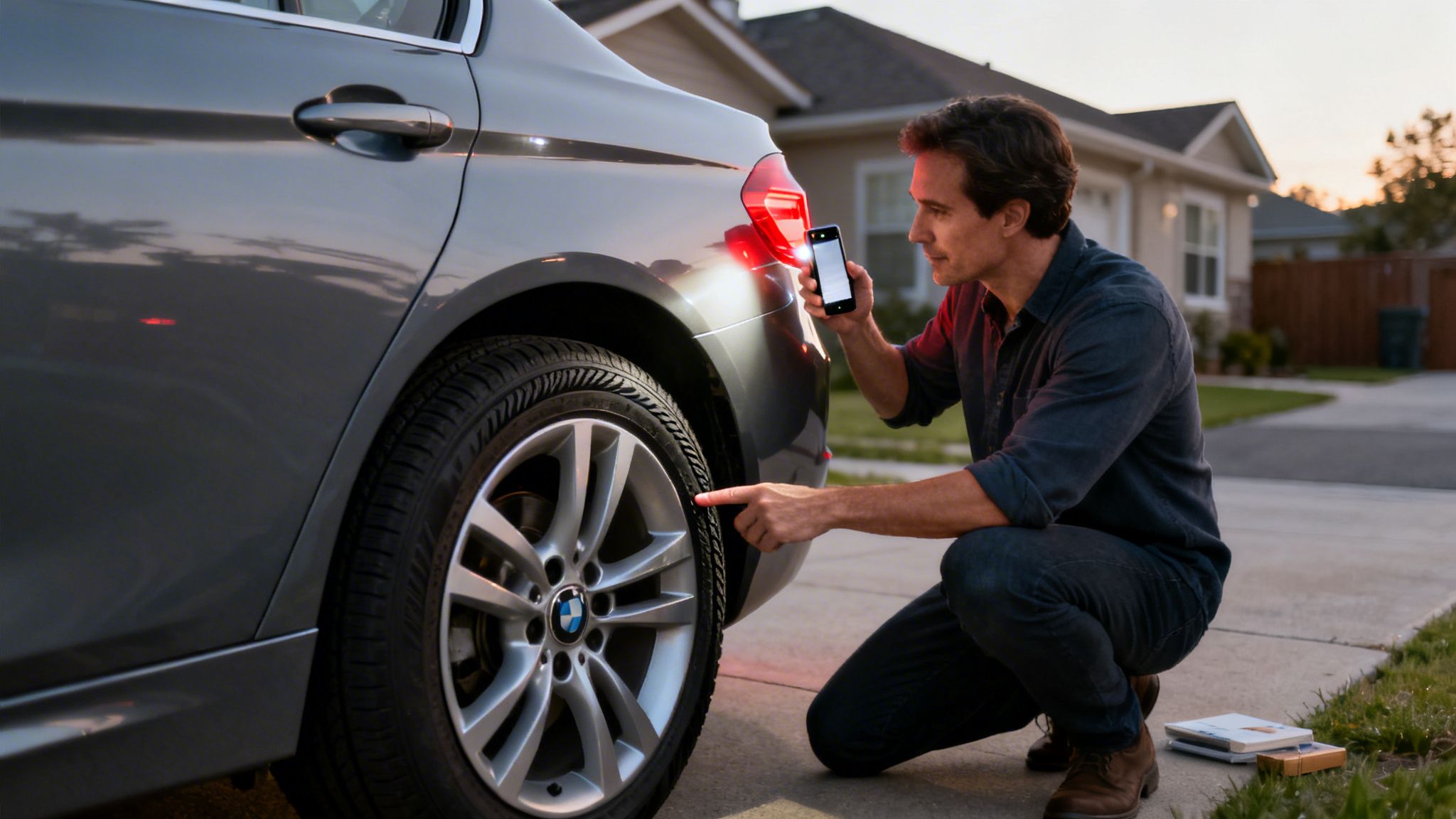
Heading to a safety inspection without a quick look-over is like walking into an exam you haven't studied for. You’re just hoping for the best. A simple 15-minute check-up at home can be the difference between a passing certificate and the headache of a failed test and re-inspection.
You can catch many of the most common—and obvious—fail items yourself. Think of it as a dress rehearsal. By spotting the low-hanging fruit first, you save yourself time, money, and the frustration of being told you failed for something as simple as a burnt-out bulb.
Your Simple Pre-Inspection Checklist
You don't need a hoist or fancy tools for this. Just a few minutes and maybe a friend to help you check the lights. Here’s a quick list of what to look for.
Test All Exterior Lights: This is hands-down the easiest fail to prevent. Have a friend watch from outside as you cycle through your headlights (high and low beams), turn signals (front, rear, and side markers), brake lights, and reverse lights. Don't forget the licence plate light—it’s a small detail that technicians are required to check.
Check Your Horn and Wipers: Give the horn a solid toot. It needs to be loud and clear. Next, run your wipers on every speed. They should sweep the windshield cleanly without leaving big streaks or skipping. If they’re not doing their job, looking into wiper replacement is a great idea. Don’t forget to test the washer fluid spray, too!
Inspect Your Windshield: Scan the glass for any damage. Small stone chips might pass, but any significant cracks or "stars," especially in the driver's direct line of sight, are an almost guaranteed fail.
Spending a little time on these checks puts you back in the driver's seat. You get to fix any minor issues on your own schedule, rather than being forced into a surprise repair after a failed inspection.
Look for Obvious Wear and Tear
Now, let's look a bit closer for the kinds of wear a trained inspector will spot right away. These are critical safety components, so they get a lot of attention.
First, your tires. Give them a good visual inspection. Are there any bulges on the sidewalls or deep cracks in the rubber? Take a glance at the tread. If the tires look smooth and "bald," they're almost certainly worn past the legal safety limit.
Next, peek under the car where you normally park. Do you see any fresh puddles? A little clear water from your A/C is perfectly normal, but dark oil spots or puddles of brightly coloured coolant point to active leaks that will fail your vehicle. It also pays to know how to protect your car from rust, as a vehicle's frame integrity is a major inspection point. Heavy corrosion on the frame or unibody isn't just a cosmetic issue—it's a straight-up safety failure.
Finding the Right MVIS in Whitby for Your Inspection
When you start searching for a "car safety inspection near me," you'll quickly realize it's about more than just finding the closest garage. It’s about trust. The first thing you absolutely must look for is the official green and white sign, designating the shop as a provincially licensed Motor Vehicle Inspection Station (MVIS). No sign, no official inspection. Simple as that.
But the licence is just the starting point. The real difference comes down to the people working on your car. You want experienced technicians who are happy to talk you through the process, not just hand you a bill. A great mechanic will take the time to show you the worn-out brake pad or explain exactly why a steering component isn't up to standard. That kind of transparency is where real peace of mind comes from.
Think of it this way: a one-stop-shop that can both inspect your vehicle and expertly fix any problems is a huge advantage. It saves you the headache of getting a fail slip and then having to find another shop to handle the repairs.
Why a Full-Service Shop Just Makes Sense
Choosing a place like Carmedics Autowerks, where we handle both the inspection and any needed repairs, streamlines everything. The same trusted team that spots a worn ball joint is the same team that has the expertise to replace it correctly.
This means no running around, no delays, and no questions about whether the repair will meet the safety standard. It's a seamless process that gets you back on the road safely and without the extra stress.
Your Top Questions About Car Safety Inspections, Answered
Even with all the details covered, a few common questions always pop up. We hear them from drivers all the time, so let's get you some clear answers.
How Long Is an Ontario Safety Certificate Valid For?
That little piece of paper—the Safety Standards Certificate (SSC)—has a surprisingly short shelf life. It’s only valid for 36 days from the day your vehicle passes.
This means you have a tight window to get the ownership transferred or the vehicle registered. If you miss that 36-day deadline, the certificate is void, and you'll have to start the entire inspection process over again.
Do I Need a Safety Inspection to Sell My Car As Is?
Nope, you don't. When you sell a vehicle "as is," you're not legally obligated to provide a Safety Standards Certificate. This is a big point of confusion for private sellers.
Selling "as is" simply means the responsibility for getting the car certified shifts to the new owner. They won't be able to put licence plates on it or legally drive it until they've taken it for an inspection and it passes.
Where Can I Get My Car Inspected in Ontario?
Your vehicle safety inspection has to be done at a shop that is licensed by the Ministry of Transportation as a Motor Vehicle Inspection Station (MVIS). You'll know you're in the right place when you see their official green and white sign.
Technically, any licensed MVIS in Ontario can perform the inspection. That's exactly why choosing a local, reputable shop you can trust is so important.
The inspection itself is a standardized checklist, but the quality of the service, the honesty of the advice, and the clarity of the communication can vary dramatically from one garage to the next. Finding a good partner makes the whole experience smoother.
For a car safety inspection in the Durham Region that’s transparent and professional, you can count on the certified team at Carmedics Autowerks. We’ll make sure your vehicle is road-ready and give you total peace of mind. Book your inspection with us today!