
Your Saturday disappears faster than the work itself.
You book an oil change with one shop. A week later, you call a tint installer. Then you notice a scrape on the bumper and start chasing collision quotes. Winter is coming, so now you also need rust prevention, tire service, and a check on the locks because the vehicle is parked outside half the week. None of these shops share notes. None of them sees the whole vehicle. You end up carrying the service history in your head.
That fragmented routine costs more than the invoice total. It costs time, repeat diagnostics, extra driving, and small risks that build up when one provider does not know what the last provider touched.
For drivers who care about how their vehicles run and how they hold value, One-stop auto service Whitby is not about convenience alone. It is about having one place that understands the vehicle as a system. In Whitby, that matters even more because local conditions are hard on cars. Salt, slush, highway debris, and rising security concerns all hit the same investment.
The End of the Endless Car Care Juggle
A lot of Whitby owners are stuck in the same pattern. The daily driver needs routine maintenance. The newer SUV needs paint protection before another winter. The family vehicle has a parking sensor issue after a light bump. The business van is due for service, but downtime is expensive. So the owner starts calling around.
One specialist handles repairs. Another does tint. A third will look at bodywork next Thursday. By the time the work is scheduled, approved, and completed, the vehicle has already made multiple trips across town. If one issue overlaps another, the advice can conflict. One shop says the warning light is electrical. Another says it is related to a prior repair. The owner is left sorting out who is responsible.
That problem has become more serious because security is no longer a side topic. Auto theft in Ontario increased by 48.2% between 2021 and 2023, and the Insurance Bureau of Canada has called car theft a “national crisis” (arXiv summary). For Whitby drivers, that changes the standard of care. Locks, alarms, access points, and general vehicle condition need regular attention, not afterthought attention.
A one-stop shop solves the practical mess first. One visit. One record. One team that can connect maintenance, protection, repairs, and appearance work. It also gives you a place that can keep an eye on emerging issues before they turn into larger ones.
If you are already searching for a car repair shop near me, the better question is broader. You do not just need a shop that can fix today’s problem. You need one that can manage the whole vehicle over time.
Key takeaway: The hidden cost of using multiple shops is not only money. It is lost time, broken continuity, and uncertainty when something goes wrong.
What a One-stop Auto Service Means
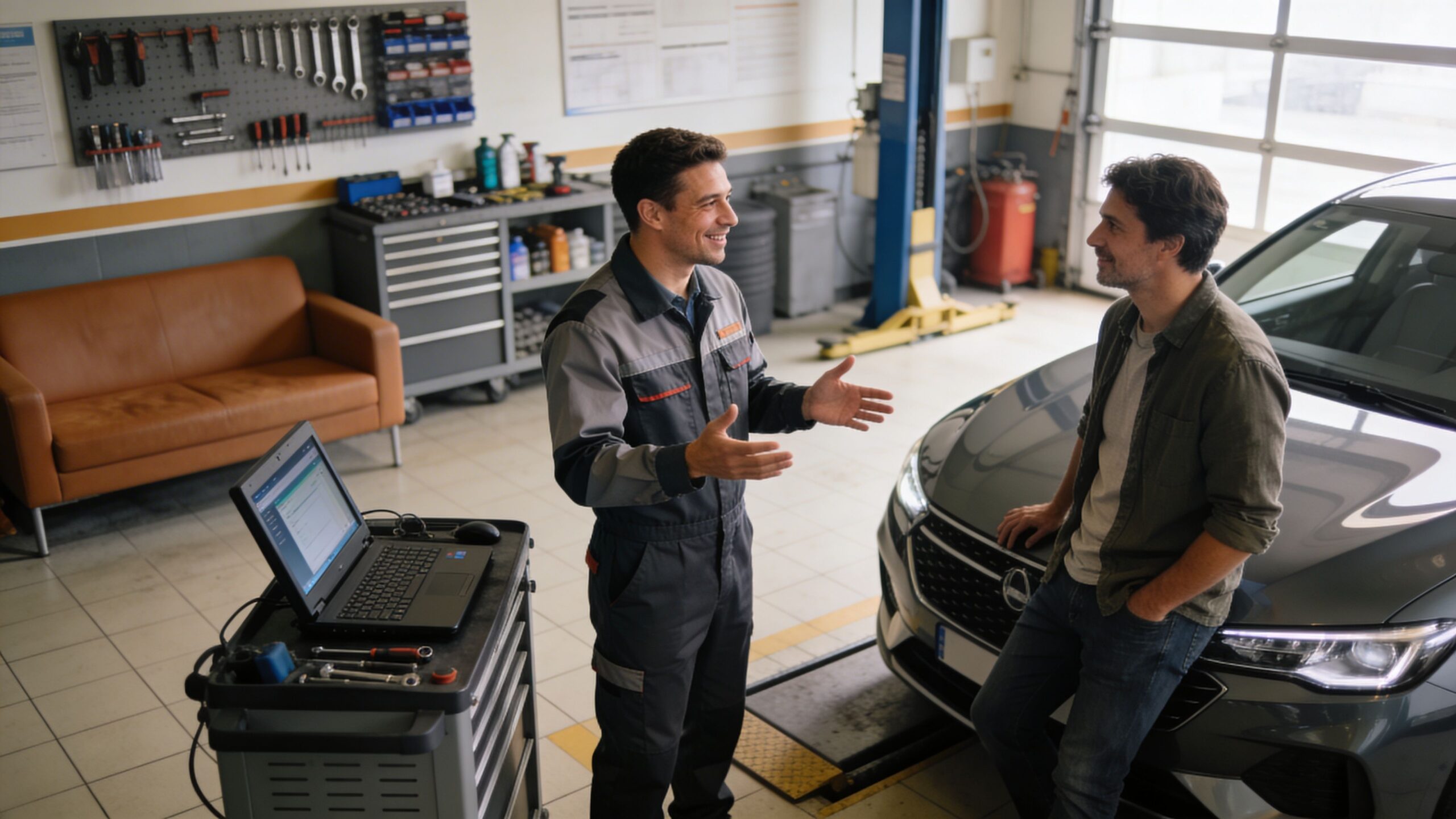
A genuine one-stop service centre works like a family doctor for your vehicle. You may still need occasional specialised input in rare cases, but your main provider should know the vehicle’s history, patterns, and priorities.
It is not just a long service menu
Any website can list ten services. That does not mean those services are integrated well.
A one-stop operation does three things consistently:
- Tracks the whole vehicle: The team knows what was repaired, what was protected, and what should be checked next.
- Applies one quality standard: Mechanical work, appearance work, and protection work should reflect the same level of care.
- Keeps responsibility clear: If a concern comes up, you are not chasing three different businesses for answers.
That matters because cars do not separate themselves into clean categories. A collision repair can affect sensors. A neglected seal can affect interior condition. Poor alignment can shorten tire life and change how the vehicle feels on the road. Paint damage that seems cosmetic can become a long-term corrosion problem after enough winter exposure.
Continuity is the key value
The biggest advantage is continuity.
When one shop has serviced your brakes, inspected your suspension, documented prior bodywork, and applied film or tint, it sees patterns faster. It can tell whether a sound is new or recurring. It can notice whether the front end is taking repeated highway impact. It can spot wear that suggests your use has changed, such as more commuting, more towing, or more commercial mileage.
That continuity also helps with planning. Instead of reacting to problems one at a time, you can bundle work logically. Seasonal prep can happen with maintenance. Appearance protection can be scheduled before harsh weather. Small issues can be fixed while the vehicle is already in the bay.
Practical tip: Ask a shop how it records service history across different departments. If the mechanical side and protection side work in separate silos, you are not getting the full one-stop benefit.
Trust is built through fewer handoffs
Every handoff creates room for delay, misunderstanding, or uneven workmanship. The fewer handoffs your vehicle goes through, the easier it is to maintain standards.
That is what One-stop auto service Whitby should mean in practice. Not more marketing terms. Better coordination, clearer accountability, and a complete view of your vehicle.
The Pillars of Full Vehicle Care
One-stop care has to stand on real capability. If a shop cannot handle the major categories of ownership well, the “all under one roof” idea becomes a shortcut instead of a benefit.
General repairs and preventive maintenance
This is the foundation. Without strong mechanical work, everything else is cosmetic.
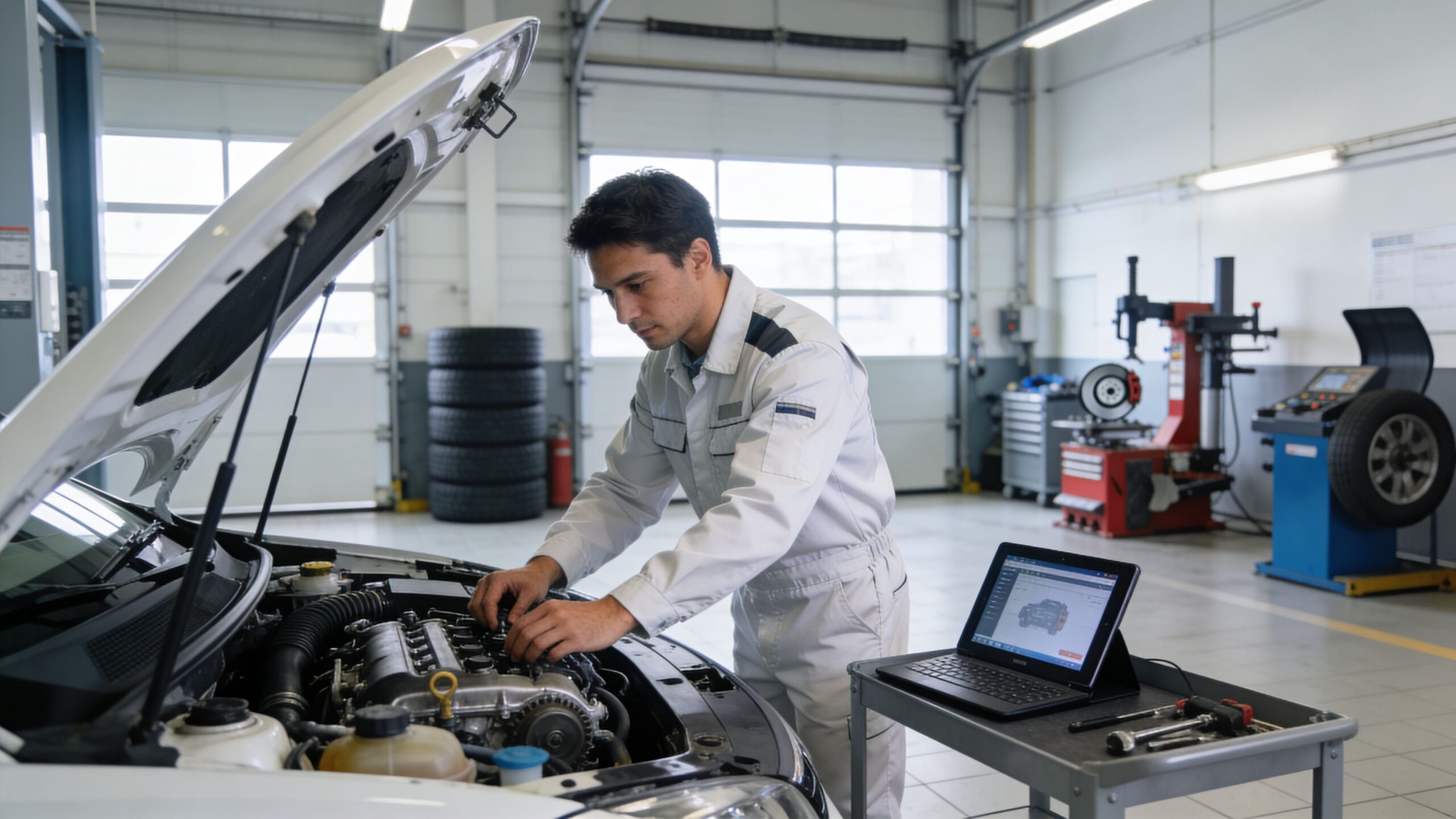
Good general service covers diagnostics, brake work, suspension concerns, fluid service, drivability issues, and routine inspections. The best shops do not treat these as isolated jobs. They look for connections. A vibration might involve tires, alignment, suspension wear, or brakes. A warning light might be simple, or it might point to a pattern in how the vehicle has been driven and maintained.
Preventive work is what keeps owners out of the expensive cycle of delayed repairs. That includes scheduled inspections, fluid condition checks, belt and hose reviews, and catching wear before it turns into a breakdown. For people serious about maintaining your vehicle, that mindset matters more than any single repair order.
For a practical overview of planned service, this guide to preventive maintenance for vehicles is a useful starting point.
Fuel system care fits here too. A professional fuel injection service typically takes one to two hours when it is done properly, with inspection, cleaning, and final verification rather than a rushed add-on (fuel injection service details). That timeframe says something important. Good work takes process.
Fleet maintenance for local business use
Fleet service is where a lot of shops fall short. They can repair a vehicle, but they are not structured to keep several vehicles organised and on the road.
Whitby and Durham Region businesses need something more disciplined. Scheduling has to be repeatable. Records have to be clear. The shop has to understand that a work vehicle sitting idle affects revenue and customer commitments.
The local gap is real. The Ontario Trucking Association reports that 68% of small fleets in the GTA, including Durham Region, face downtime costs averaging $500 per vehicle per unplanned repair in 2025 (referenced fleet report summary). Even without Whitby-specific providers publishing detailed fleet structures, the lesson is obvious. Reactive servicing is expensive.
Shops serving fleets also need proper diagnostic depth. One verified source notes use of CAN-bus OBD-II scanners with 98% fault code accuracy for post-2018 diesel SUVs, and that neglected EGR soot buildup is common in 25% of GTA fleets, contributing to 15-20% fuel efficiency loss when ignored (fleet maintenance reference). Those details matter because fleet work is not just oil changes on repeat. It is uptime management.
Vehicle protection and appearance work
A complete shop also protects what the mechanical work is preserving.
For Whitby drivers, that often means window tinting and paint protection film. Tint improves comfort and privacy, but film is the bigger long-term defence if you drive the 401 often or park outside through winter. Good PPF work is technical. One verified source describes self-healing thermoplastic polyurethane films at 8-12 mils (0.2-0.3 mm), applied with infrared heat guns at 120-140°C and installed to conform to body lines without messy seams (PPF process reference).
The benefit is not only visual. Protection work should reduce the wear that pushes owners toward repainting or panel correction later.
Collision and body repair
Collision repair is where fragmented service can become a serious problem.
A bumper scrape or front-end hit often affects more than paint. Mounting points, sensors, trim fit, and finish quality all matter. If one shop does bodywork and another has to sort out the related mechanical or sensor issues later, costs and confusion multiply.
A proper one-stop provider can manage the job as one event. Estimate, repair path, parts coordination, finish work, and post-repair checks stay connected. That lowers the chance of missed details and makes follow-up easier if anything needs adjustment.
Shop-owner view: The best repair plan is usually the one that avoids duplicate labour, duplicate diagnostics, and duplicate conversations. That is where integrated service pays off.
The Unified Advantage Over a Multi-Shop Approach
The strongest case for a one-stop model is simple. It reduces friction.
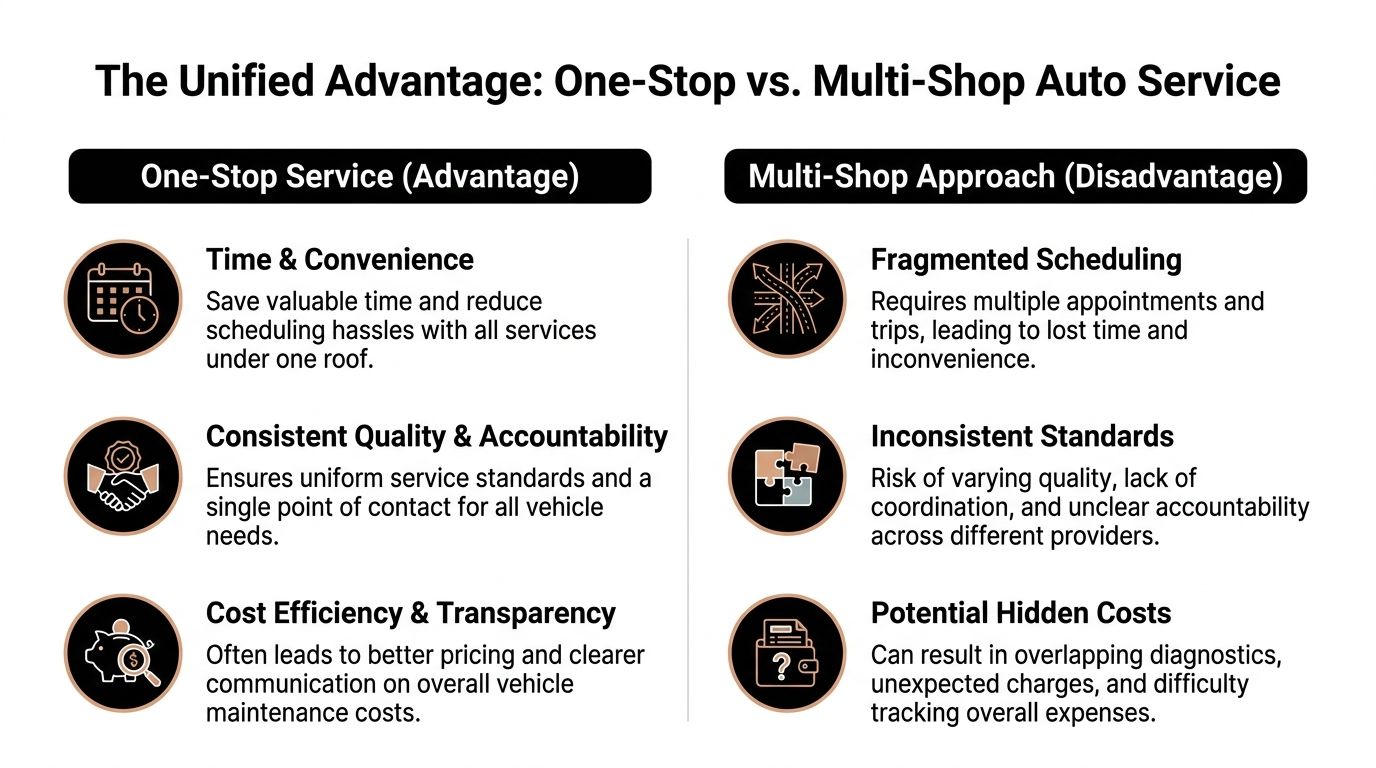
A multi-shop approach sounds smart on paper because every provider appears specialised. In practice, owners often end up managing the gaps between those specialists. They repeat the vehicle story several times. They approve overlapping inspections. They lose days to scheduling. If something is not right afterward, the responsibility can become blurry fast.
Where the hidden costs show up
The invoice at each shop may look reasonable. The overall ownership experience often does not.
Common hidden costs include:
- Repeat diagnostics: One shop checks an issue, another shop re-checks it because it has no baseline.
- Extra travel and waiting: Pickup, drop-off, calls, and rescheduling add up quickly.
- Uneven recommendations: One provider focuses narrowly on its service area and may miss the broader picture.
- Scattered records: Years later, you may not know when key work was done or by whom.
A unified provider creates a cleaner chain of responsibility. If your service record, bodywork history, and protection plan live in one place, decisions get easier. So do warranty conversations and resale conversations.
One-stop service vs. multi-shop juggle
| Factor | One-Stop Auto Service | Multiple Specialized Shops |
|---|---|---|
| Service history | Centralised and easier to review | Split across invoices, emails, and memory |
| Scheduling | Fewer appointments, better bundling | More trips and more calendar juggling |
| Accountability | One main point of contact | Responsibility can be unclear |
| Recommendations | Based on the full vehicle picture | Often limited to one shop’s scope |
| Long-term planning | Easier to prioritise work by season and budget | Usually reactive and fragmented |
Value is not only about price
Owners sometimes assume one-stop care must cost more. That is not necessarily the right frame.
If one coordinated visit prevents repeated labour, catches an issue early, or lets you combine services while the vehicle is already in the shop, the value improves even if the line items look similar. Time matters. Consistency matters. Fewer mistakes matter.
For enthusiasts and busy owners alike, the unified model wins because it removes operational chaos from car ownership.
How to Evaluate a Whitby Auto Service Partner
Choosing a shop is easier when you stop looking at marketing first and start looking at operating habits.

Start with questions that reveal process
A solid shop should answer practical questions without becoming vague or defensive.
Ask things like:
- Who will inspect the vehicle first: You want to know whether the initial assessment is organised or rushed.
- How are estimates written: Detailed estimates show thinking. Generic totals do not.
- What happens if new issues are found: Good shops contact you with context before adding work.
- How is service history tracked: One-stop care depends on records, not memory.
If you are comparing local options, reviewing a shop’s stated services and repair approach on pages like this car mechanic overview can help you see whether the business is broad in capability or narrow in scope.
Look for signs of mechanical depth
Do not judge a shop by the waiting room alone.
Mechanical depth shows up in how the team talks about diagnostics, inspections, and follow-up. A capable shop explains why a repair is needed, what else should be checked around it, and whether the issue is urgent, monitor-only, or worth bundling with future work.
That kind of communication matters more than polished slogans.
Check protection and bodywork standards separately
Many shops are decent mechanically but weak on protection or finish work.
If you want tint, PPF, or collision repair from the same provider, ask to see examples of edges, panel alignment, film fitment, and finish quality. The details matter. A neat install and a properly managed repair age better than flashy sales language.
Practical tip: Ask what the shop does when a job crosses categories, such as a bumper repair that also affects parking sensors. The answer tells you whether departments work together.
Review policies, not just promises
A few final checks help separate dependable providers from opportunistic ones:
- Warranty clarity: Parts and labour terms should be explained plainly.
- Turnaround expectations: Shops should give realistic windows, not optimistic guesses.
- Communication habits: You should know who updates you and when.
- Community reputation: Read reviews for patterns. Look for mentions of honesty, consistency, and problem resolution.
A Whitby service partner should make ownership easier. If the estimate is confusing, the answers are vague, or the process feels improvised, keep looking.
The Carmedics Autowerks Difference in Whitby
For local drivers who want repairs, protection, and appearance work coordinated in one place, Carmedics Autowerks in Whitby is one example of a shop structured around that integrated model.
The local context matters. Durham Region winters are hard on paint and underbodies, especially for owners who drive the 401 regularly or keep newer vehicles for the long term. Verified data tied to local weather impacts notes that Durham Region salt-induced corrosion claims rose 22% in 2025 after record freeze-thaw cycles, and that advanced PPF offers 5-10 year protection while reducing potential repaint costs by up to 40% (Ontario weather and protection summary). That is the kind of condition-specific issue a Whitby shop should be prepared to address with more than a generic wash-and-wax answer.
A practical one-stop operation also needs to understand different ownership patterns. The enthusiast with a new SUV does not have the same priorities as the contractor with several work vehicles. One wants long-term finish preservation, clean installs, and careful maintenance history. The other wants predictable scheduling, fewer interruptions, and vehicles that stay ready for the next job.
That is where integrated service has an advantage. General repair, fleet maintenance, tint, PPF, and collision work support each other when the same team can see the whole vehicle and the owner’s actual use.
For Whitby drivers, the difference is not abstract. It shows up in fewer loose ends, less running around, and better decisions made before weather, wear, or minor damage become costly.
Simplify Your Car Care and Protect Your Investment
Most owners do not need more shop visits. They need better coordination.
A one-stop model cuts down the wasted hours, duplicate inspections, and uncertainty that come with splitting your vehicle across multiple providers. It also gives you a clearer maintenance history and a better plan for protection, repairs, and long-term ownership.
If paint preservation is part of that plan, it helps to understand your options before damage sets in. This overview of paint protection film is a good place to start.
Your vehicle is one of the biggest investments you use every day. Treating it with a connected service strategy is usually the simplest way to protect both its condition and your time.
Frequently Asked Questions
Will using an independent one-stop shop affect my warranty
Routine maintenance and repair work should be documented properly and carried out to the correct standard. The key is clear records, quality parts where appropriate, and service that matches the vehicle’s requirements. Ask the shop how it documents work and what information appears on your invoice.
Can one shop really handle both performance-minded care and cosmetic protection
Yes, if the shop is set up for both mechanical and appearance work and can explain its process in each area. The important part is not the claim. It is whether the team can show consistent repair quality, clean installs, and organised records across categories.
Is one-stop service only for newer vehicles
No. New vehicles benefit from early protection and disciplined maintenance. Older vehicles benefit from continuity, especially when the owner is trying to prioritise repairs and avoid wasting money on duplicated labour or conflicting recommendations.
How do I get a quote for multiple services at once
Start with a full inspection and a clear list of priorities. Tell the shop what is urgent, what is seasonal, and what is cosmetic. A good provider can separate immediate needs from planned work so you can bundle services intelligently instead of approving everything at once.
What should business owners ask about fleet service
Ask how scheduling is handled, how records are tracked, and how the shop manages repairs that could interrupt operations. Fleet support is not just mechanical skill. It is organisation, communication, and the ability to keep multiple vehicles moving with fewer surprises.
If you want one place to handle repairs, fleet needs, tint, PPF, and collision-related vehicle care in Whitby, contact Carmedics Autowerks Inc to discuss your vehicle, your priorities, and the most sensible next service step.
If you're in Ontario and searching for a "car safety inspection near me," you've probably hit a key milestone. Maybe you're buying a used car, selling your own, or bringing a vehicle in from out of province. In any of these cases, this inspection is usually a mandatory step.
It’s a thorough, top-to-bottom check to make sure a vehicle is up to snuff with Ontario's strict safety standards.
Why You Need a Car Safety Inspection in Ontario
Think of a car safety inspection as a mandatory health check for your vehicle, but one that’s legally required in certain situations. It’s not just about filling out a form; it’s about making sure a car is fundamentally safe for the road. Pass the inspection, and you get a Safety Standards Certificate (SSC)—the official piece of paper you’ll need.
This certificate is your proof that, at the time of the inspection, a licensed Motor Vehicle Inspection Station (MVIS) confirmed all your car’s key safety systems were in good shape. In many cases, you simply can't get licence plates or transfer ownership without a valid SSC.
When an SSC is Legally Required
So, when do you actually need to get one? The requirement for an SSC pops up during major changes in a vehicle's life, ensuring it's still roadworthy when it changes hands or moves into Ontario. Knowing when this applies helps you plan ahead and avoid headaches.
You will need a valid Safety Standards Certificate if you are:
- Registering a vehicle brought in from another province, territory, or country.
- Transferring ownership to someone who isn't your spouse.
- Upgrading a vehicle's status from "unfit" back to "fit."
- Registering a rebuilt vehicle.
For anyone in these situations, the SSC is a must-have. It's the province's way of setting a minimum safety benchmark for vehicles on our roads. This inspection is a crucial part of any good preventive maintenance for vehicles, forcing a close look at the parts that matter most.
The whole point of the inspection is to catch potential safety problems before they cause an accident. It’s a proactive step that keeps dangerous vehicles off the road, protecting drivers, passengers, and pedestrians.
Ultimately, this is about more than just bureaucracy; it's about public safety. By verifying the condition of critical systems like your brakes, steering, suspension, and lights, the inspection gives everyone peace of mind. It ensures that the used car you're buying or bringing into Ontario isn’t hiding a dangerous defect that could put you or others in harm's way.
What's On The Official Ontario Safety Inspection Checklist?
So, what exactly is a licensed technician looking at when they put a car up on the hoist for an Ontario Safety Standards Certificate? It’s a lot more than just a quick peek under the hood. The entire process is strictly guided by a detailed checklist from the Ministry of Transportation, which ensures every inspection is consistent, fair, and incredibly thorough.
Think of this checklist as the rulebook. It turns a simple once-over into a proper, systematic evaluation of your vehicle’s most critical safety systems. It’s less about trying to "pass a test" and more like a comprehensive physical for your car, where every vital sign is checked against a non-negotiable standard of roadworthiness.
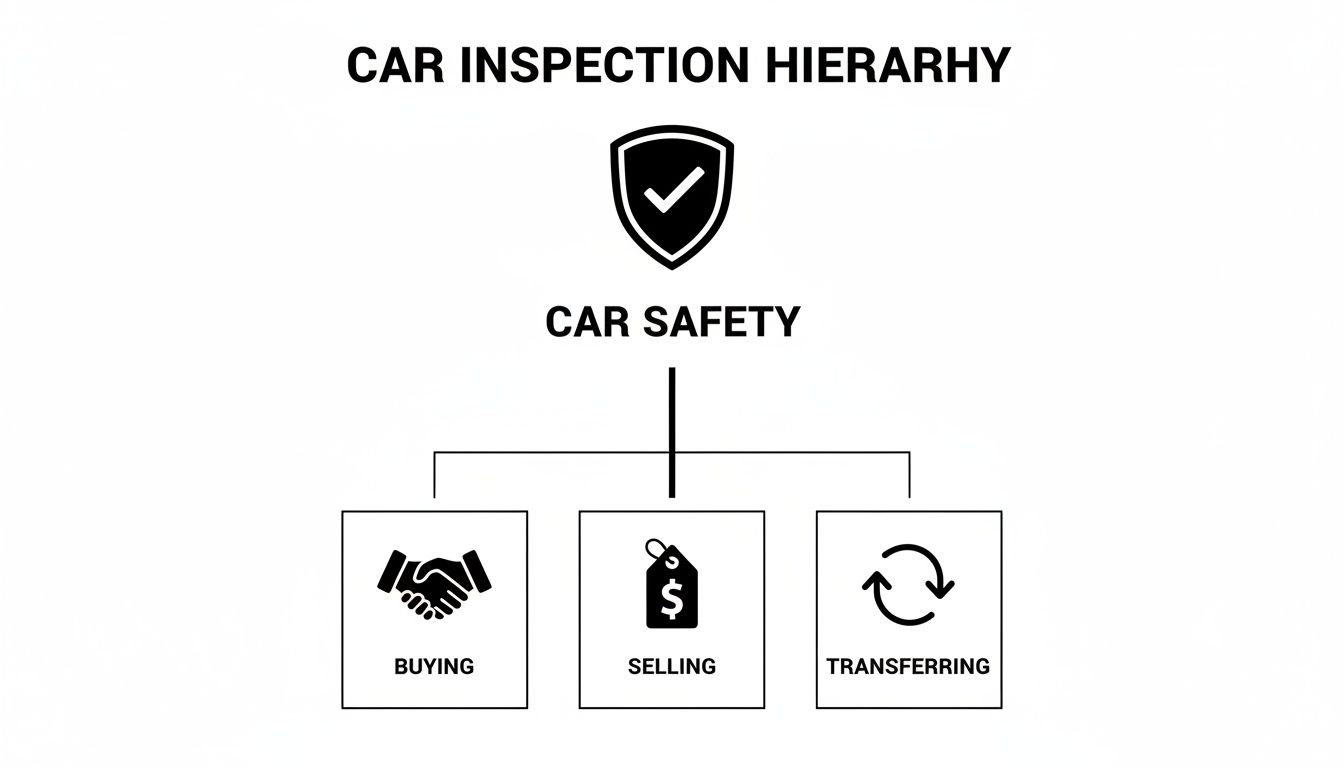
No matter why you need the inspection—buying, selling, or transferring ownership—the core goal is always the same: confirming the vehicle is fundamentally safe for the road.
To give you a clearer picture, we've put together a table that breaks down the main inspection areas and what our technicians are specifically looking for.
Key Inspection Areas and What Technicians Look For
| Component Category | What's Inspected | Common Pass/Fail Criteria |
|---|---|---|
| Powertrain | Engine, transmission, drive shaft, mounts. | No major fluid leaks. Mounts must be intact. Drive shaft and U-joints must be secure. |
| Braking System | Pads, rotors, lines, hoses, parking brake. | Pads/shoes must meet minimum thickness. Rotors must not be excessively warped or rusted. No leaks. Parking brake must hold. |
| Steering & Suspension | Ball joints, tie rods, shocks/struts, frame. | No excessive play in steering. Components must not be loose or leaking. Frame must be free of structural rust or cracks. |
| Wheels & Tires | Tires, rims, lug nuts. | Tire tread depth must be at least 2/32”. No bulges or cracks. Wheels must be straight and all lug nuts present. |
| Electrical System | Lights, horn, wipers. | All exterior lights must work (headlights, signals, brake lights). Horn must be audible. Wipers must clear the windshield. |
This table covers the highlights, but let's break down exactly why these areas are so crucial for your safety.
1. Braking System Performance
Let’s be honest, your brakes are arguably the single most important safety feature on your car. During a safety inspection, this system gets one of the most intense evaluations. We’re not just checking if the car stops; we’re looking at how it stops and how much life is left in the components.
A technician will measure the brake pad and shoe thickness to make sure there's enough friction material left. We also inspect the rotors and drums for heavy rust, deep grooves, or warping that could cause that shaky, pulsating feeling when you brake. Finally, we meticulously check all hydraulic lines and hoses for any cracks, bulges, or leaks. The parking brake gets a workout, too—it has to prove it can hold the vehicle steady on an incline.
2. Suspension, Steering, and Frame Integrity
If the engine is your car’s heart, the suspension and steering are its skeleton and reflexes. These parts dictate how your car handles bumps, corners, and your direct commands from the steering wheel. We get under the car and check for worn-out ball joints, loose tie rod ends, and any signs that your shock absorbers or struts are failing.
A vehicle’s structural integrity is everything. We inspect the frame and subframe for any cracks or advanced corrosion that could weaken the car's core. Any evidence of a previous, poorly repaired accident is an immediate red flag, as a compromised frame can fold in ways it shouldn't during a collision.
We also examine the steering system to ensure there’s no excessive "play" or looseness in the wheel. When you turn, the car needs to respond instantly and predictably. If you're curious about the requirements for commercial vehicles, our article on the annual safety inspection sticker in Ontario has more specific details.
3. Powertrain Components
The powertrain is what makes your car go—the engine, transmission, and all the bits that deliver that power to the wheels. An inspector is on the lookout for any significant fluid leaks from the engine or transmission. Leaking oil or coolant isn't just messy; it can be a serious hazard on the road for other drivers.
We also make sure the engine and transmission mounts are solid. A broken mount could cause the entire engine to lurch violently under acceleration, which can damage other parts or even affect your control of the vehicle. It's all about ensuring the heavy-duty parts stay where they're supposed to.
4. Wheels, Tires, and Electrical Systems
Finally, we inspect the parts that keep you connected to the pavement and visible to everyone else. Your tires are your car's only point of contact with the road, so they need to be in good shape. We check for a minimum tread depth of 2/32 of an inch, and look for any dangerous bulges, cracks, or cuts in the sidewall. The wheels themselves are inspected for bends or cracks, and we confirm every lug nut is present and properly torqued.
Your car’s electrical system is just as important. Every single exterior light—headlights (both high and low beams), tail lights, brake lights, and turn signals—has to work. Your horn needs to be loud and clear, and your windshield wipers and washer fluid system must be able to keep your view unobstructed, no matter the weather.
Common Reasons a Car Fails Its Safety Inspection
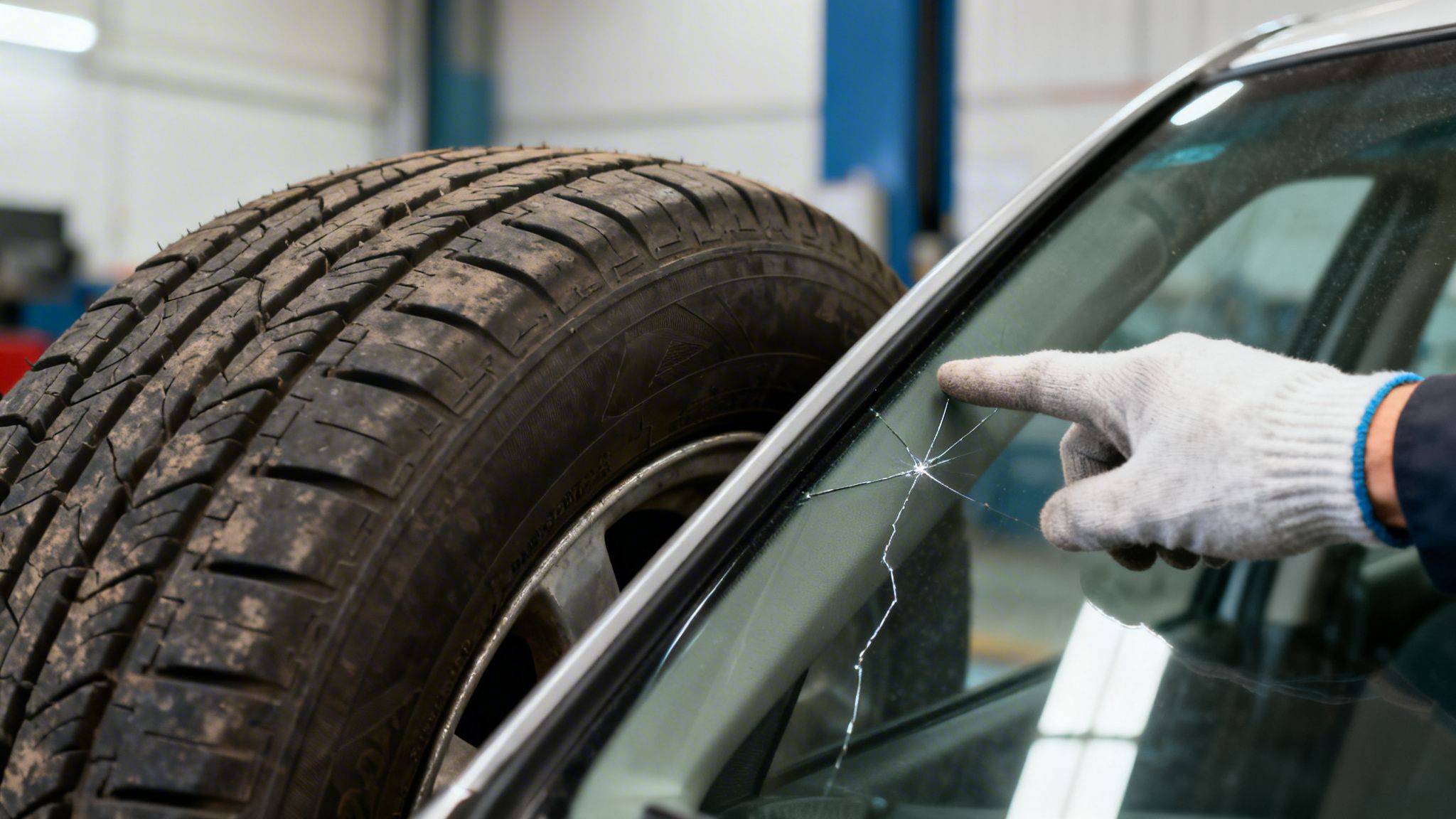
Let's be honest, nobody wants to hear their car has failed its safety inspection. The very idea can bring up images of huge, wallet-draining repairs. But in my experience, that’s rarely the case.
Most safety failures aren't caused by some catastrophic, hidden issue. They're usually down to a handful of common problems that are easy to miss during the daily grind. Once you know what inspectors look for, you can turn that worry into a simple pre-check and avoid the hassle of a second visit.
Brake System Wear and Tear
There's no surprise here. Your brakes are arguably the most important safety system on your car, so they get a thorough once-over during an inspection. It’s also one of the top reasons for a fail. A technician isn't just seeing if you can stop; they're measuring the lifespan and condition of every part.
Here are the usual suspects when it comes to brake failures:
- Worn Brake Pads: The material on your brake pads has a minimum required thickness. If they're worn too thin, they just can't generate the friction needed to stop your car safely and will need to be replaced.
- Warped or Damaged Rotors: If you feel a shudder or vibration through the brake pedal, you might have warped rotors. An inspector will also fail rotors with deep grooves, heavy rust, or cracks.
- Leaking Hydraulic Lines: Brake fluid is what gives your pedal its power. The technician will check all the lines for cracks, bulges, or any sign of a leak, which could lead to a total loss of braking.
If you’ve heard grinding sounds or your brake pedal feels squishy, it’s a good idea to have it looked at. Getting these sorted out is non-negotiable for safety. To see how we tackle these jobs, you can learn more about our process for expert brake repair in Whitby and what it takes to get things right.
Tire and Wheel Issues
Your tires are the only part of your car that actually touches the road, so their condition is a massive focus. An inspector will check each tire, and a few common issues can easily result in a fail.
One of the quickest ways to fail is tire tread depth. In Ontario, your tires need more than 2/32 of an inch of tread to pass. They'll also look for serious cracks or brittleness, as this shows the rubber is breaking down. It's helpful to know what causes tires to dry rot because it’s a sure-fire fail and a serious blowout risk.
An inspector is also trained to spot bulges on the sidewall of a tire, which points to internal damage and a high risk of failure. They’ll also make sure you aren't missing any lug nuts and that the wheels themselves aren't cracked or bent.
Problems with Lights, Wipers, and Visibility
It’s almost always the little things that catch people out. You'd be surprised how many cars fail their safety simply because of a burnt-out bulb or something blocking the driver's view.
An inspector will do a full walk-around and test every single exterior light. That means headlights (both high and low beams), turn signals, brake lights, reverse lights, and even the licence plate light have to work. A single dead bulb is an automatic fail.
Likewise, your windshield needs to provide a clear, unobstructed view of the road. That stone chip or crack that's been staring you in the face for months? If it’s in the driver’s direct line of sight, it’s going to be a problem. Your wipers also need to work properly and clear the glass without streaking, and your washer fluid sprayers have to be working, too.
What to Expect for Inspection Costs and Timelines
When you need a safety inspection, the first two questions on your mind are almost always, "How much will this cost?" and "How long will it take?" Let's clear that up so you can plan ahead without any added stress.
One thing to get straight right away is that while the Ministry of Transportation sets the rules for the inspection, they don’t set the price. That part is up to individual shops. This means the cost can vary a bit from one garage to another, even right here in Whitby.
Breaking Down the Inspection Fee
Here in the Durham Region, you can expect the inspection itself to cost somewhere between $100 and $150. This fee is for the technician's time and expertise to go through every single checkpoint on the list. Think of it as paying for the detailed diagnostic, not any repairs.
It's interesting to see how this varies by region. In Virginia, for example, the government caps inspection costs at a low $12 for motorcycles and $20 for other vehicles. It just goes to show how much local regulations can influence what you pay.
Crucial Point: The inspection fee purely covers the labour for the inspection. If your car needs new brake pads or a tire to pass, the cost for those parts and the work to install them is a separate charge.
For a more detailed breakdown, we’ve put together a guide on auto inspection costs.
Understanding the Timeframe
A proper, thorough safety inspection isn't a five-minute job. It usually takes between one to two hours. During that time, our technicians are meticulously checking everything from your brake lines and steering components to the structural integrity of your vehicle's frame.
If your vehicle ticks all the boxes, you'll get your Safety Standards Certificate on the spot and be on your way. But what if it fails? Don't worry, you don't have to start the entire process over.
The Ministry gives you a 10-day window to complete the required repairs. As long as you bring the vehicle back to the same shop within those 10 days, we only need to re-inspect the specific items that failed initially. This is much faster and more affordable than a whole new inspection. If you wait past the 10-day mark, you’ll unfortunately have to pay for a full inspection all over again.
How to Prepare Your Car for Its Safety Inspection
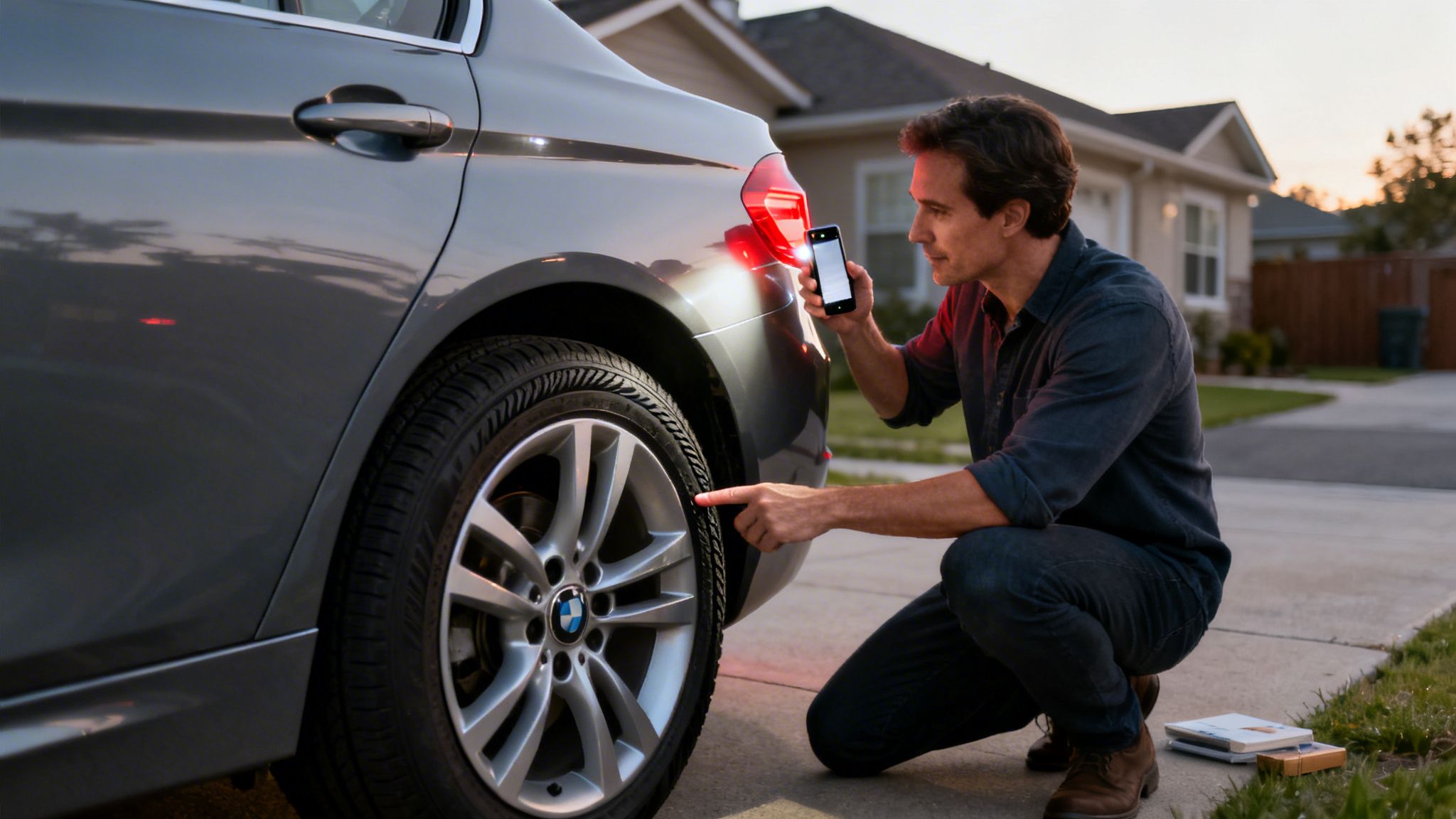
Heading to a safety inspection without a quick look-over is like walking into an exam you haven't studied for. You’re just hoping for the best. A simple 15-minute check-up at home can be the difference between a passing certificate and the headache of a failed test and re-inspection.
You can catch many of the most common—and obvious—fail items yourself. Think of it as a dress rehearsal. By spotting the low-hanging fruit first, you save yourself time, money, and the frustration of being told you failed for something as simple as a burnt-out bulb.
Your Simple Pre-Inspection Checklist
You don't need a hoist or fancy tools for this. Just a few minutes and maybe a friend to help you check the lights. Here’s a quick list of what to look for.
Test All Exterior Lights: This is hands-down the easiest fail to prevent. Have a friend watch from outside as you cycle through your headlights (high and low beams), turn signals (front, rear, and side markers), brake lights, and reverse lights. Don't forget the licence plate light—it’s a small detail that technicians are required to check.
Check Your Horn and Wipers: Give the horn a solid toot. It needs to be loud and clear. Next, run your wipers on every speed. They should sweep the windshield cleanly without leaving big streaks or skipping. If they’re not doing their job, looking into wiper replacement is a great idea. Don’t forget to test the washer fluid spray, too!
Inspect Your Windshield: Scan the glass for any damage. Small stone chips might pass, but any significant cracks or "stars," especially in the driver's direct line of sight, are an almost guaranteed fail.
Spending a little time on these checks puts you back in the driver's seat. You get to fix any minor issues on your own schedule, rather than being forced into a surprise repair after a failed inspection.
Look for Obvious Wear and Tear
Now, let's look a bit closer for the kinds of wear a trained inspector will spot right away. These are critical safety components, so they get a lot of attention.
First, your tires. Give them a good visual inspection. Are there any bulges on the sidewalls or deep cracks in the rubber? Take a glance at the tread. If the tires look smooth and "bald," they're almost certainly worn past the legal safety limit.
Next, peek under the car where you normally park. Do you see any fresh puddles? A little clear water from your A/C is perfectly normal, but dark oil spots or puddles of brightly coloured coolant point to active leaks that will fail your vehicle. It also pays to know how to protect your car from rust, as a vehicle's frame integrity is a major inspection point. Heavy corrosion on the frame or unibody isn't just a cosmetic issue—it's a straight-up safety failure.
Finding the Right MVIS in Whitby for Your Inspection
When you start searching for a "car safety inspection near me," you'll quickly realize it's about more than just finding the closest garage. It’s about trust. The first thing you absolutely must look for is the official green and white sign, designating the shop as a provincially licensed Motor Vehicle Inspection Station (MVIS). No sign, no official inspection. Simple as that.
But the licence is just the starting point. The real difference comes down to the people working on your car. You want experienced technicians who are happy to talk you through the process, not just hand you a bill. A great mechanic will take the time to show you the worn-out brake pad or explain exactly why a steering component isn't up to standard. That kind of transparency is where real peace of mind comes from.
Think of it this way: a one-stop-shop that can both inspect your vehicle and expertly fix any problems is a huge advantage. It saves you the headache of getting a fail slip and then having to find another shop to handle the repairs.
Why a Full-Service Shop Just Makes Sense
Choosing a place like Carmedics Autowerks, where we handle both the inspection and any needed repairs, streamlines everything. The same trusted team that spots a worn ball joint is the same team that has the expertise to replace it correctly.
This means no running around, no delays, and no questions about whether the repair will meet the safety standard. It's a seamless process that gets you back on the road safely and without the extra stress.
Your Top Questions About Car Safety Inspections, Answered
Even with all the details covered, a few common questions always pop up. We hear them from drivers all the time, so let's get you some clear answers.
How Long Is an Ontario Safety Certificate Valid For?
That little piece of paper—the Safety Standards Certificate (SSC)—has a surprisingly short shelf life. It’s only valid for 36 days from the day your vehicle passes.
This means you have a tight window to get the ownership transferred or the vehicle registered. If you miss that 36-day deadline, the certificate is void, and you'll have to start the entire inspection process over again.
Do I Need a Safety Inspection to Sell My Car As Is?
Nope, you don't. When you sell a vehicle "as is," you're not legally obligated to provide a Safety Standards Certificate. This is a big point of confusion for private sellers.
Selling "as is" simply means the responsibility for getting the car certified shifts to the new owner. They won't be able to put licence plates on it or legally drive it until they've taken it for an inspection and it passes.
Where Can I Get My Car Inspected in Ontario?
Your vehicle safety inspection has to be done at a shop that is licensed by the Ministry of Transportation as a Motor Vehicle Inspection Station (MVIS). You'll know you're in the right place when you see their official green and white sign.
Technically, any licensed MVIS in Ontario can perform the inspection. That's exactly why choosing a local, reputable shop you can trust is so important.
The inspection itself is a standardized checklist, but the quality of the service, the honesty of the advice, and the clarity of the communication can vary dramatically from one garage to the next. Finding a good partner makes the whole experience smoother.
For a car safety inspection in the Durham Region that’s transparent and professional, you can count on the certified team at Carmedics Autowerks. We’ll make sure your vehicle is road-ready and give you total peace of mind. Book your inspection with us today!
If you're typing "vehicle inspection stations near me" into your phone, chances are you've hit a key moment in your car ownership journey here in Whitby. In Ontario, this process isn't just a simple check-up; it revolves around getting a Safety Standards Certificate (SSC). This is the official document that proves your car is road-safe, and it’s issued by licenced inspection stations like our shop, Carmedics Autowerks.
Your Guide to Whitby Vehicle Inspection Stations
Unlike some other provinces, Ontario doesn't make you get an inspection every single year. Instead, a safety certificate is required at very specific times.
Think of it less like a yearly chore and more like a crucial snapshot in time. It’s the province's way of ensuring a vehicle meets minimum safety requirements right before it changes hands or gets put on Ontario roads for the first time. The whole point is to catch worn-out brakes, failing steering components, or other safety hazards before they can cause a problem.
When Is a Safety Certificate Required?
So, when do you actually need one? Most drivers will encounter this need during a few common scenarios. The system is set up to protect both buyers and sellers, as well as the general public.
To make it simple, here is a quick guide to when an SSC is legally required.
When You Need an Ontario Safety Standards Certificate
| Situation | Safety Certificate Required? | Key Detail |
|---|---|---|
| Selling a used vehicle privately | Yes | You, as the seller, must provide a valid SSC to the buyer for them to register the car. |
| Registering a vehicle from out-of-province | Yes | If you've moved to Ontario, you need an SSC to get Ontario plates for your car. |
| Rebuilding a "salvage" branded vehicle | Yes | To get a "rebuilt" title and put the car back on the road, it must pass a safety inspection. |
| Transferring plates to a new vehicle | No | You don't need a new certificate just to move your existing plates to another car. |
| Transferring ownership between spouses | No | A certificate is not required for transfers between spouses, as it's considered a family transaction. |
Ultimately, a Safety Standards Certificate is a professional mechanic's assessment of your vehicle's condition on the day of the inspection. It's our job to confirm that it meets the non-negotiable safety standards set by the Ministry of Transportation of Ontario.
This flowchart gives you a quick visual of the most common triggers.
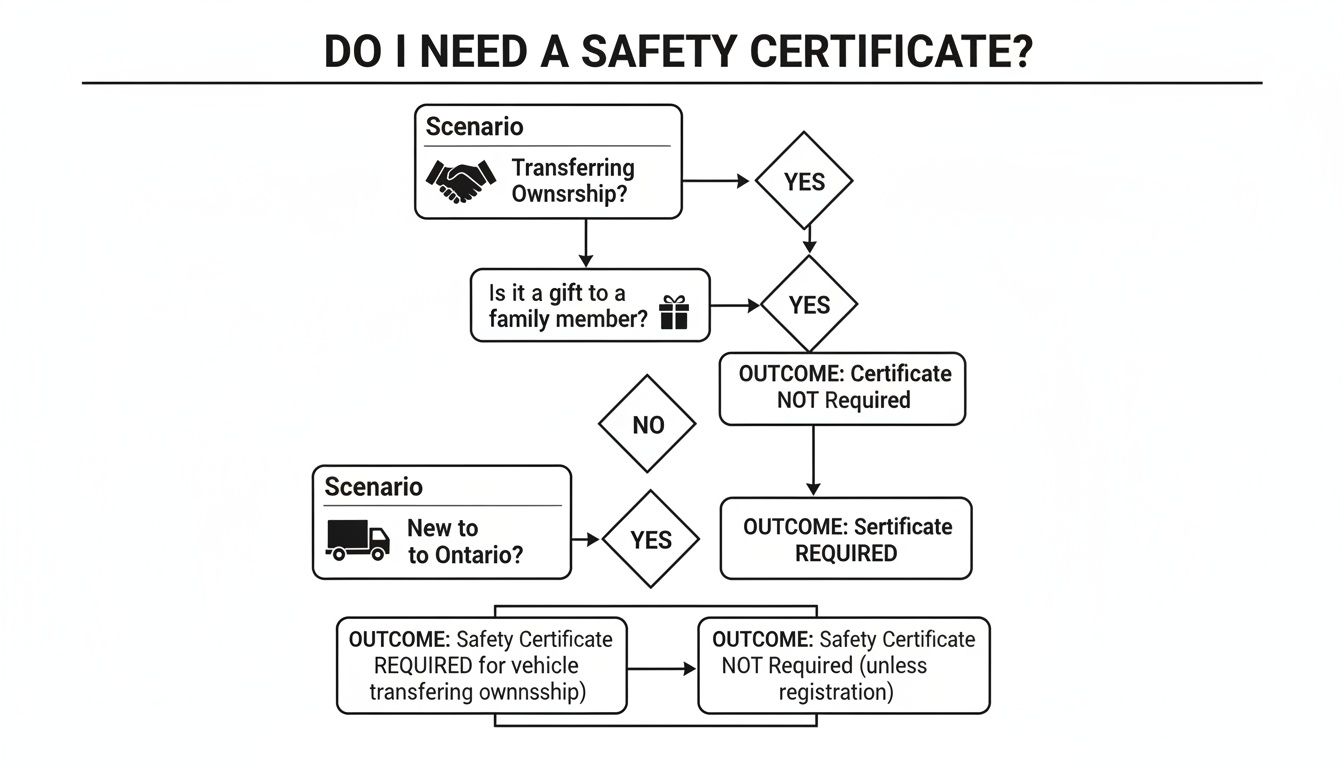
As you can see, the two big ones are transferring ownership to someone who isn't your spouse and bringing a car into the province.
While the fundamental safety checks are the same for most cars, it's interesting to see how general car inspection processes for specific vehicle types can sometimes vary for unique models, like a vintage camper. The core principles of mechanical fitness always apply, but experience with different vehicles definitely helps. And if you’re looking beyond inspections, we also offer expert auto repair in Whitby, Ontario for all your maintenance needs.
Decoding the Ontario Safety Standards Certificate
If you’re searching for "vehicle inspection stations near me," you’ve likely come across the term “Safety Standards Certificate.” So, what exactly is it? Let's break it down in plain English.
The Safety Standards Certificate, or SSC, is a mandatory inspection required by the province. It's designed to do one thing: confirm that a vehicle meets the absolute minimum safety requirements before it can be sold to a new owner or registered in Ontario after coming from another province or country.
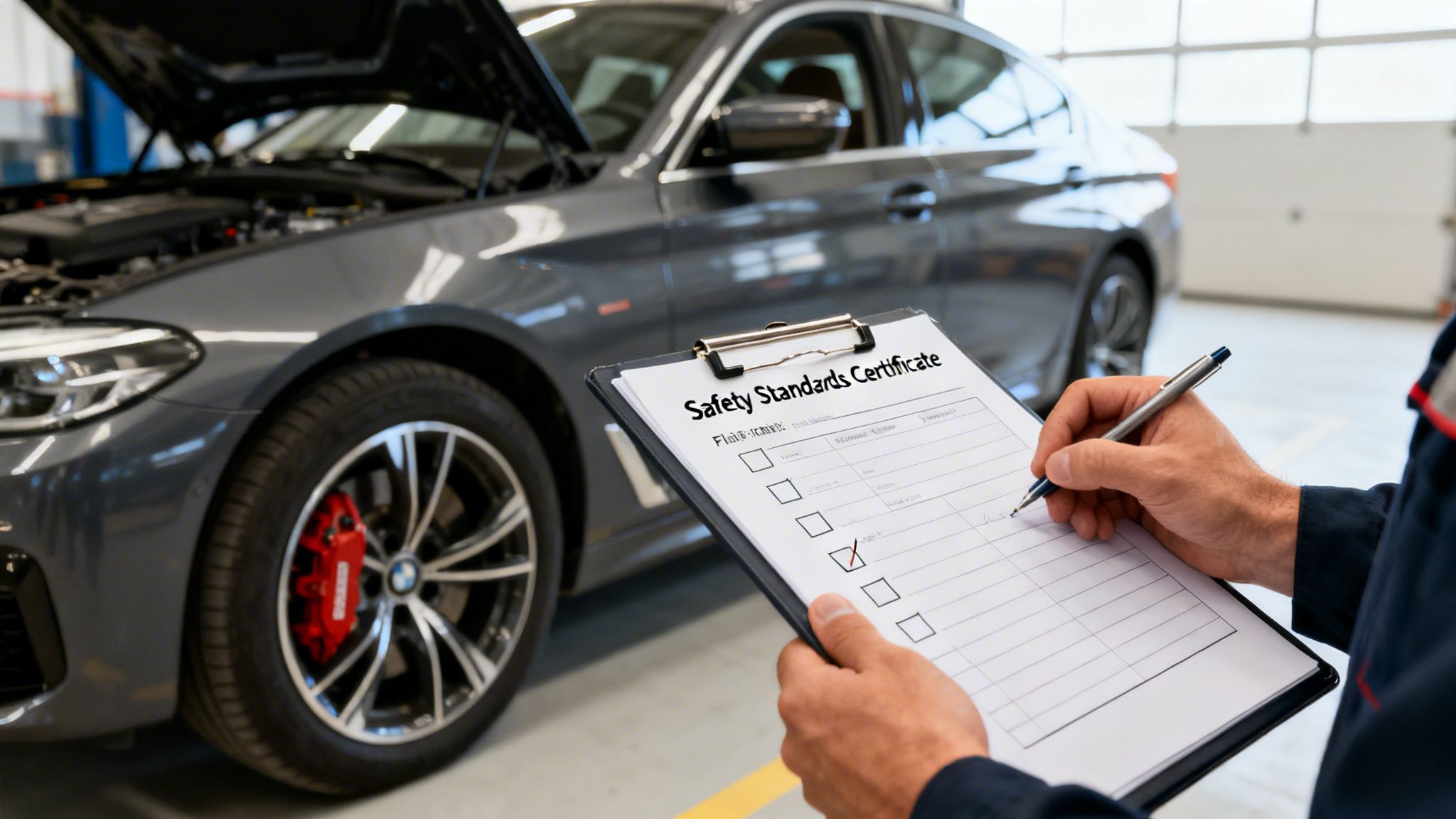
Think of it like an airplane’s pre-flight check. Before taking off, every critical system is meticulously examined to ensure the plane is safe for its journey. An SSC inspection does the same for a vehicle before it begins its new "journey" with you or another driver.
What the Inspection Covers
When you bring your car to Carmedics Autowerks, our licenced technicians follow a strict checklist mandated by the Ministry of Transportation. This isn't just a quick peek under the hood; it's a comprehensive review of all the components that keep you safe on the road.
We’re looking for any existing issues that could put you, your passengers, or other drivers at risk. The main areas we focus on include:
- Braking System: We measure the pads and rotors, check calipers for proper function, and inspect all brake lines to ensure your vehicle can stop on a dime.
- Steering and Suspension: This involves a close look at ball joints, tie rods, shocks, and struts. Any excessive wear here could compromise your control of the vehicle.
- Tires and Wheels: We check that your tires have adequate tread depth, are free of damage, and that the wheels are fastened securely.
- Lights and Electrical System: Every single light has to work—from your headlights and brake lights to your turn signals and licence plate light.
- Structural Integrity: The technician will thoroughly inspect the vehicle's frame and body for any significant rust or damage that could weaken its structure.
This detailed process guarantees that any vehicle getting a certificate from us meets Ontario's safety laws. For a complete breakdown of the checklist, our guide on the annual safety inspection sticker in Ontario provides even more detail.
A Snapshot in Time, Not a Warranty
Now, here’s something that trips a lot of people up: understanding what an SSC is not. It’s easy to mistake it for a guarantee of a car's overall health or a warranty against future repairs, but it isn’t either of those things.
An SSC is a professional assessment of a vehicle's condition on the specific day of the inspection. It confirms that the vehicle met the minimum legal safety standards at that exact moment in time.
This means a car can pass its inspection on a Tuesday, but a part could still wear out and fail by Friday. The certificate simply provides a crucial safety baseline for the moment of sale, giving everyone involved peace of mind that the car was road-legal when it changed hands. It’s a vital piece of consumer protection in Ontario’s vehicle market.
Common Issues That Cause Inspection Failures
Knowing what a technician is looking for can make all the difference when you bring your car in for a safety inspection. After years of doing these inspections here at Carmedics Autowerks, we’ve seen it all, and honestly, most failures come down to just a handful of common, predictable issues.
Think of this as getting the inside scoop. By understanding the typical trouble spots, you can do a quick check of your own vehicle beforehand. It’s the best way to avoid the headache and extra cost of a surprise failure.
Most of the time, the culprits are simply parts that wear down with everyday driving. Brakes are a classic example. A technician will physically measure your brake pads and rotors to make sure they're thick enough to stop you safely in an emergency. If they fall below the legal minimum, it's an automatic fail, no questions asked.
Worn Brakes and Tired Treads
When it comes to safety, nothing's more fundamental than your ability to stop and your tires' ability to grip the road. It’s no surprise, then, that these two systems are the top reasons for a failed inspection. They take a beating every time you drive.
Worn-out brakes are a huge red flag. As the pads thin out, they can't create the friction needed to stop your car effectively, which means you'll need more distance to come to a halt. If you’ve started hearing a high-pitched squeal or a low grinding sound when you press the pedal, that's your car telling you it's time for a check-up. You can see how we diagnose and fix these problems by checking out our guide on expert brake repair in Whitby.
Your tires are just as critical. The inspection looks for adequate tread depth to ensure your tires can push water away and keep you planted on wet pavement. A good way to picture it is to think of the grooves on your tires as tiny channels designed to prevent hydroplaning. When they get too shallow, the water has nowhere to go. We check for:
- Tread Depth: The tread must be over the legal minimum of 2/32 of an inch.
- Tire Damage: Any visible bulges, cracks, or exposed cords are an immediate fail.
- Matching Tires: All four tires need to be the right size and type specified for your vehicle.
Electrical and Exhaust System Problems
Beyond brakes and tires, a few other systems can trip you up during a safety inspection. These might feel like minor annoyances in daily driving, but the Ministry of Transportation considers them serious safety flaws.
One of the simplest yet most common failures is a burnt-out bulb. Every single exterior light has to work perfectly—headlights, high beams, turn signals, brake lights, and even the little bulb over your licence plate. A turn signal that’s out isn’t just a ticketable offence; it’s a recipe for a collision.
An exhaust leak is another instant failure. If there's a leak, dangerous carbon monoxide gas can find its way into your car's cabin, creating a major health hazard for you and your passengers. A technician will check the entire system for any leaks, significant rust, or cracks.
Finally, worn-out suspension components are a big one. Things like tired ball joints or leaking shock absorbers will get your vehicle flagged. These parts are what keep your tires firmly on the road, giving you stability and control. When they're worn, the car can feel unpredictable, especially when you need to swerve or drive over bumpy roads. Knowing about these key areas gives you a real head start on passing your inspection.
How to Prepare Your Car for a Successful Inspection
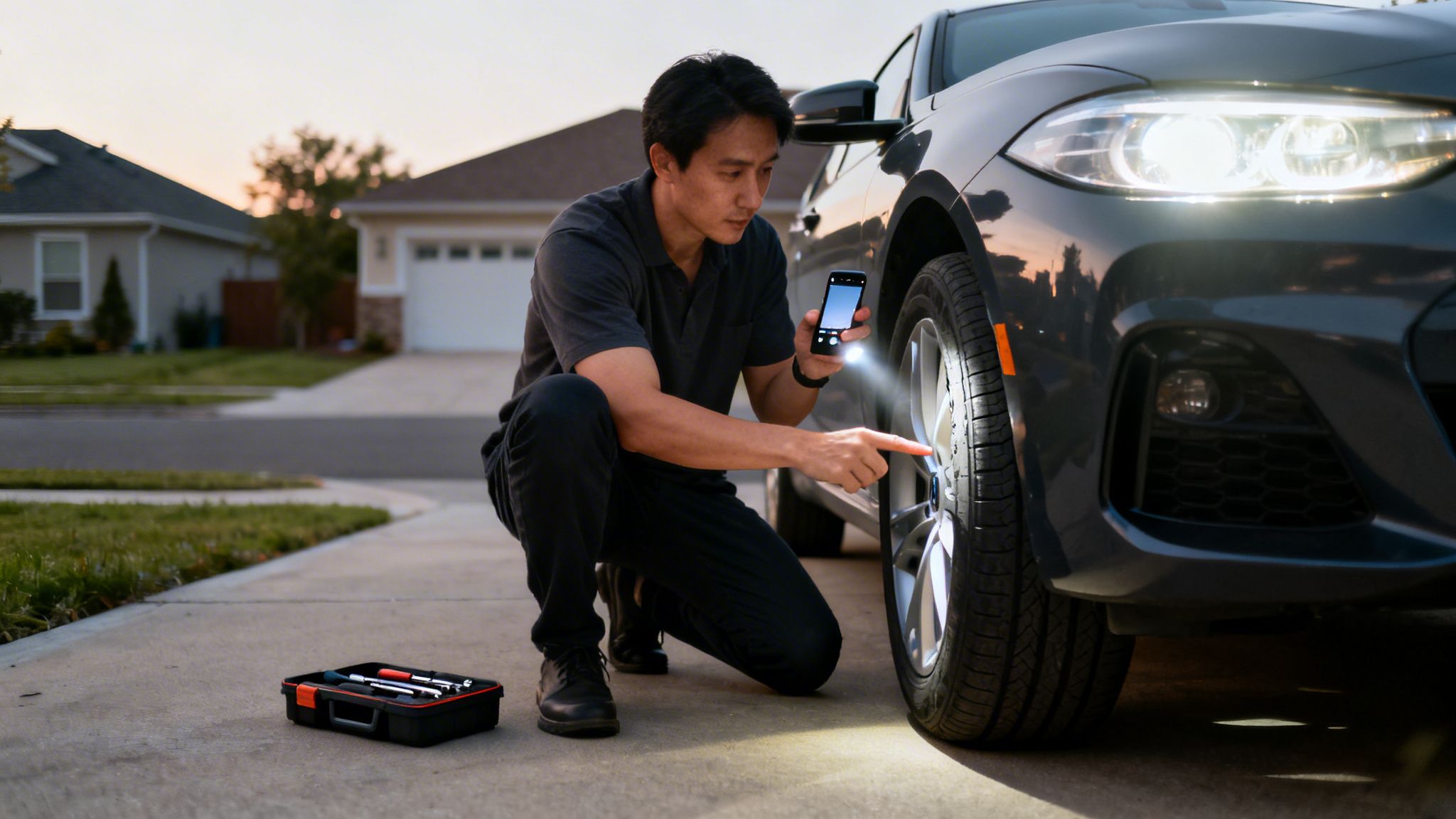
Heading into your Safety Standards Certificate inspection can feel a bit like a pop quiz. The good news? You can study for this one. A quick pre-inspection in your own driveway can make a world of difference, helping you pass the first time around.
This isn't about doing a full mechanical teardown. It’s simply about catching the easy-to-spot problems that are responsible for so many failed inspections. Spending a few minutes now can save you the time, money, and headache of a re-test.
Your Pre-Inspection Checklist
Before you book your appointment, run through this simple checklist. It covers the most common failure points we see and gives you a solid idea of where your vehicle stands.
| Component | What to Check | Pass/Fail Indicator |
|---|---|---|
| Lights | Check all exterior lights: headlights (high & low beams), turn signals, brake lights, and licence plate light. | All lights must be working. A single burnt-out bulb is an automatic fail. |
| Windshield | Look for cracks, chips, or damage. Pay close attention to the area cleared by your wipers. | Small stone chips are usually fine. Any crack in the driver's direct line of sight is a fail. |
| Wipers & Fluid | Test your wipers and ensure they clear the glass effectively. Check your washer fluid level. | Wipers must not be torn or skipping. You must have washer fluid. |
| Horn | Give it a quick press. | The horn must be clearly audible. |
| Tires | Check for obvious wear, bulges, or cracks. Use a toonie to check tread depth. | If the tread doesn't cover the silver border up to the bear's paws, your tires are likely too worn. |
| Brakes | Listen for squealing or grinding noises when you apply the brakes in a quiet area. | Squealing means the pads are low; grinding is a serious issue and a definite fail. |
Doing this quick walk-around puts you in a much better position. You can either fix the minor issues yourself (like a bulb or topping up fluid) or come to us with a clear idea of what needs attention.
Lights and Glass: The First Things a Technician Checks
It might seem small, but a burnt-out bulb is one of the most frequent reasons a car fails its safety. Technicians have to check every single light, so it’s the best place for you to start. Have a friend help you run through the list.
They can stand outside while you cycle through the controls:
- Headlights: Check both the low and high beams.
- Turn Signals: Make sure front and rear signals flash, and check the dashboard indicators, too.
- Brake Lights: Have your friend watch as you press the brake pedal—all three lights (left, right, and centre) must work.
- Licence Plate Light: This one is easy to forget, but it’s on the checklist.
Next, take a good look at your windshield. While small stone chips are generally acceptable, any crack that enters the driver's field of view—basically, the path your wipers cover—is an automatic fail. That needs to be repaired before the inspection.
Brakes and Tires: Listen and Look
Your car has ways of telling you something is wrong, especially with the brakes. Your ears are often the best tool here. On a quiet street, pay close attention to the sounds your car makes as you slow down.
A high-pitched squeal is often the first warning sign that your brake pads are getting thin. If you hear a deep, metallic grinding, that’s a much more serious problem. It means the pads are gone and you have metal-on-metal contact—a major safety hazard and a guaranteed fail.
Finally, give your tires a once-over. The key factor is tread depth. A quick way to check is with a toonie: stick it into a tread groove, and if the tread doesn't at least reach the bear's paws, your tires are probably below the legal limit. Also, scan the sidewalls for any noticeable bulges, cuts, or cracks.
Keeping on top of your car's condition is the best way to avoid surprise failures. You might even be causing wear without realizing it; these Ten Ways You're Destroying Your Car Without Knowing are worth a read. By tackling these common issues beforehand, the official inspection becomes less of a test and more of a final confirmation that your vehicle is safe and ready for the road.
What to Expect at Carmedics Autowerks
When you search for "vehicle inspection stations near me," you're really looking for a shop you can trust. Here at Carmedics Autowerks, we’ve earned our reputation in Whitby by making the safety inspection process refreshingly clear and honest. Our goal is simple: we want you to feel confident and in the loop from start to finish.
From the moment you walk through our doors, you’ll notice we do things a bit differently. We see the inspection not as a test, but as a partnership. It's about working with you to ensure your vehicle is truly safe for you and your family on Ontario’s roads—not about finding excuses to fail a car.
The Inspection Process: A Partnership
Our certified technicians carry out every inspection by the book, strictly following the provincially mandated checklist. This isn’t about guesswork or opinion; it’s a meticulous, step-by-step review of your car’s most critical safety systems. We check everything from brake pad thickness to the structural integrity of the frame, making sure each component meets the legal standard set by the Ministry of Transportation.
If your car passes with flying colours, we’ll get the Safety Standards Certificate processed right away so you can complete your vehicle transfer or registration without a hitch. But what happens if it doesn't pass? That’s where our commitment to you really shines.
We won’t just hand you a confusing report filled with technical jargon and send you on your way. Our service advisors sit down with you and walk through the details, explaining exactly what needs attention and, more importantly, why it's a safety issue.
Clear Communication After the Inspection
A failed inspection can feel stressful, but it shouldn't be a mystery. We believe in arming you with clear information so you can make the right decision for your vehicle and your budget. After explaining the required repairs, we provide a straightforward, no-pressure quote that details the costs to bring your vehicle up to code.
Here’s our promise to you:
- Detailed Explanations: We’ll show you the problem on your vehicle whenever possible. Seeing is believing, and it helps you understand the issue firsthand.
- Prioritized Recommendations: We’ll clearly separate what is legally required for the safety certificate from any other maintenance we might suggest for down the road.
- No-Pressure Quotes: You’ll get a detailed estimate for all necessary repairs. The decision to move forward is always yours—no surprises, no hidden fees.
We want to be your trusted partner for all things automotive. It’s a commitment that goes far beyond a single inspection. You can learn more about our local team and the values we stand for by reading about Carmedics Autowerks in Whitby. Our mission is to make sure your vehicle is not just road-legal, but genuinely safe, giving you total peace of mind.
Your Top Inspection Questions, Answered
When it comes to vehicle safety inspections, a bit of confusion is totally normal. If you've been searching for "vehicle inspection stations near me," you've probably got a few questions. We hear the same ones all the time from drivers here in Whitby, so let's clear the air and give you the straightforward answers you need.
Think of this as your go-to FAQ for getting your car ready and understanding the process from start to finish.
How Long Is a Safety Certificate Valid in Ontario?
This is, without a doubt, the number one question we get. The answer is critical for anyone buying or selling a used vehicle.
An Ontario Safety Standards Certificate (SSC) is valid for exactly 36 days from the day we sign off on it. This isn't a random number; it's your specific window to go to ServiceOntario and officially transfer the vehicle's ownership. If you miss that 36-day deadline, the certificate is void, and you'll have to start over with a brand-new inspection.
What Happens if My Vehicle Fails the Inspection?
First off, don't panic. A failed inspection simply means your vehicle needs a bit of work to meet the province's minimum safety requirements. It's a roadmap for what needs fixing, not a final judgment.
When a vehicle fails, we'll give you a detailed report that clearly lists every single issue. From there, you have a couple of choices:
- You're free to take that report to any licensed technician you trust to have the repairs done.
- Most people have us handle it right here. We'll give you a transparent, no-pressure quote to fix only what's needed to pass.
The key thing to remember is the 10-day window. You have 10 days to get the repairs done and bring the vehicle back to us for a re-inspection. If you're within that window, we often only need to check the specific items that were repaired, which saves you time and hassle.
Does a Safety Certificate Affect My Car Insurance?
Yes, it can, though it’s more of an indirect relationship. Your insurance company operates on the fundamental assumption that the car they’re insuring is legally roadworthy.
Think of it this way: if you get into an accident caused by a major mechanical failure—like worn-out brakes that would have been flagged during an inspection—your insurer could have grounds to challenge or even deny your claim. Keeping your vehicle in pass-worthy condition is simply part of holding up your end of the insurance agreement. Wondering about the financial side? We break it all down in our guide to understanding auto inspection costs.
Is an Emissions Test the Same as a Safety Inspection?
This is another common mix-up. The short answer is no, they are two completely different things.
Ontario's Drive Clean emissions testing program was largely discontinued for passenger vehicles back in 2019. The Safety Standards Certificate (SSC), however, is still very much a requirement for transferring ownership and other specific situations. The SSC is a mechanical fitness inspection. It's all about ensuring the core safety systems—brakes, steering, suspension, tires, lights, and frame—are in good working order and won't put you or others at risk.
At Carmedics Autowerks Inc., our job is to make your vehicle inspection simple and stress-free. If you still have questions or you’re ready to get your safety certificate, just give our Whitby shop a call. We’re here to help you get on the road safely and with total confidence. You can book your appointment online at https://www.carmedicsautowerks.com.
When you need auto repair in Oshawa, Ajax, or Whitby, you’re not just looking for a quick fix. You’re looking for a partner you can trust with one of your biggest investments. This guide is here to help you cut through the noise and find a shop that’s genuinely dedicated to the health and longevity of your vehicle.
Your Complete Guide to Vehicle Care in the Durham Region
Whether you’re a daily commuter or a weekend car enthusiast, finding a reliable auto shop can feel like a shot in the dark. There are dozens of garages across the Durham Region, so how can you tell the good ones from the great ones? The difference often comes down to their range of services, their honesty, and their commitment to quality work.
Choosing the right shop is more than just fixing what’s broken today. It’s about being proactive to keep your car safe, reliable, and valuable for years to come. The best shops get this, offering everything you need under one roof.
What to Expect from a Premier Auto Shop
A truly professional auto centre does more than just the basics. They act as a one-stop-shop for all your car's needs, blending essential maintenance with specialized services. This saves you the headache of running all over town and ensures you get consistent, high-quality work every time. Here’s what you should look for:
- Essential Maintenance and Repairs: This is the foundation. It covers everything from routine diagnostics and brake jobs to tricky engine work that keeps your car running smoothly.
- Advanced Protective Enhancements: Think of Paint Protection Film (PPF) as invisible armour for your car, shielding it from rock chips and harsh road salt. Professional window tinting also goes a long way, protecting your interior from UV rays and adding privacy.
- Comprehensive Collision Repair: If the worst happens and you're in an accident, you need a team with the skill to restore your vehicle to its original condition, paying close attention to every detail.
Think of your auto repair choice as a long-term partnership. A trustworthy local shop understands the specific challenges of driving in the Durham Region—from salty winter roads to stop-and-go traffic—and offers solutions tailored to protect your investment.
This guide will walk you through how to spot these top-tier shops. We’ll get into the details of what different services involve, what you can expect to pay, and how to check a shop’s credentials. A great place to start is by understanding the full scope of auto repair in Oshawa, Ontario to make a confident choice. Here at Carmedics Autowerks, we’ve built our reputation on being that trusted Whitby partner, delivering transparent, high-quality service for every vehicle that comes through our doors.
Getting to Grips with Your Local Auto Service Options
When you start looking for auto repair in Oshawa, Ajax, or Whitby, you’ll see plenty of choices. But keeping a modern car on the road is about so much more than just oil changes and new tires. A true full-service shop is an entire ecosystem designed not just to fix what’s broken, but to prevent problems from ever starting and protect your car's value.
It helps to think of it like your own healthcare. You have a family doctor for regular check-ups (that’s your general repair), but you also rely on specialists—an eye doctor for your vision (window tinting) or a dermatologist for skin protection (Paint Protection Film). A top-notch auto shop gathers all those experts under one roof for your vehicle.
This way, you get consistency and quality you can count on. Instead of trying to manage appointments at different places, you build a real relationship with a single team that knows your vehicle inside and out. Let’s break down the key services you should be looking for.
General Auto Repair and Diagnostics
This is the bread and butter of any great auto shop—the essential work that keeps your car running safely and efficiently. It’s not just about reacting to a problem; it’s about getting ahead of issues before they turn into something that leaves you stranded and facing a massive bill.
Proper general repair always includes:
- Advanced Diagnostics: Modern cars are rolling computers. We use specialized diagnostic tools to talk to your vehicle’s onboard systems, finding the exact reason for that check engine light instead of just guessing.
- Brake Services: From simple pad replacements to resurfacing rotors, this is a safety service with zero room for compromise. A good technician will inspect your entire braking system, not just the part that’s making noise.
- Engine and Transmission Work: This is the heart of your vehicle. We handle the complex mechanical work, from routine fluid services to major powertrain repairs, that keeps your car running for the long haul.
- Suspension and Steering: A smooth, controlled ride isn’t just about comfort; it's about safety. We address problems with struts, shocks, and alignment to make sure your car handles predictably on our local roads and highways.
Specialized Fleet Maintenance
For local businesses in Whitby and across Durham Region, a vehicle sitting in the shop means lost revenue. That’s why specialized fleet maintenance is so critical. It’s a proactive service built to keep commercial cars, vans, and trucks on the road where they belong.
This goes beyond standard car care. It’s about building a custom maintenance plan based on how your vehicles are used. A dedicated fleet partner handles everything from scheduled oil changes to unexpected repairs, ensuring your vehicles stay reliable, safe, and on the right side of compliance.
Protective Enhancements for Your Vehicle
Beyond the mechanical side, a truly comprehensive shop offers services to protect your investment's appearance and lifespan. These aren’t just cosmetic add-ons; they are practical solutions for the real-world driving conditions we face here in Durham.
Paint Protection Film (PPF): Think of PPF as a tough, invisible shield for your car’s paint. This clear, durable film is professionally applied to high-impact areas like the front bumper, hood, and mirrors. It takes the hit from rock chips, bug splatter, and the corrosive road salt we see all winter, keeping your factory paint pristine underneath.
Professional Window Tinting: This is so much more than just a style choice. A quality window tint is like putting a great pair of sunglasses on your vehicle. It blocks up to 99% of damaging UV rays, which not only protects you and your passengers but also stops your car’s interior from fading and cracking over time.
Comprehensive Collision Repair
Accidents are a fact of life. When one happens, you need a body shop that can meticulously restore your vehicle to its pre-accident condition, both structurally and visually. This is a highly specialized skill, from flawlessly matching the paint colour to recalibrating all the advanced safety systems that keep you safe on the road.
Finding a shop that excels in all these areas—from basic maintenance to specialized bodywork—is the goal. It shows a deep commitment to the entire life of your vehicle. And the industry is strong; in Canada, auto repairs accounted for 64.5% of the $40.9 billion repair subsector revenues in 2023. This allows dedicated shops to invest in the right technology and training to offer these diverse, high-quality services.
By understanding what’s available, you can find the perfect automotive service centre near you that can truly handle all your car's needs.
What Will My Car Repair Cost? A Transparent Look at Pricing and Timelines
Let's be honest—walking into a repair shop can feel a bit intimidating, especially when you have no idea what the final bill will look like or how long you'll be without your car. We want to clear the air and give you a straightforward guide to what you can expect for auto services here in the Durham Region. Understanding what goes into a quote is the best way to budget wisely and know you're getting a fair deal.
The final cost for any repair in Oshawa, Ajax, or Whitby really comes down to three things: your vehicle's make and model, the quality of the parts being installed, and the shop's labour rate. A high-performance European car will naturally require different parts and expertise than a domestic family sedan, and that's reflected in the price.
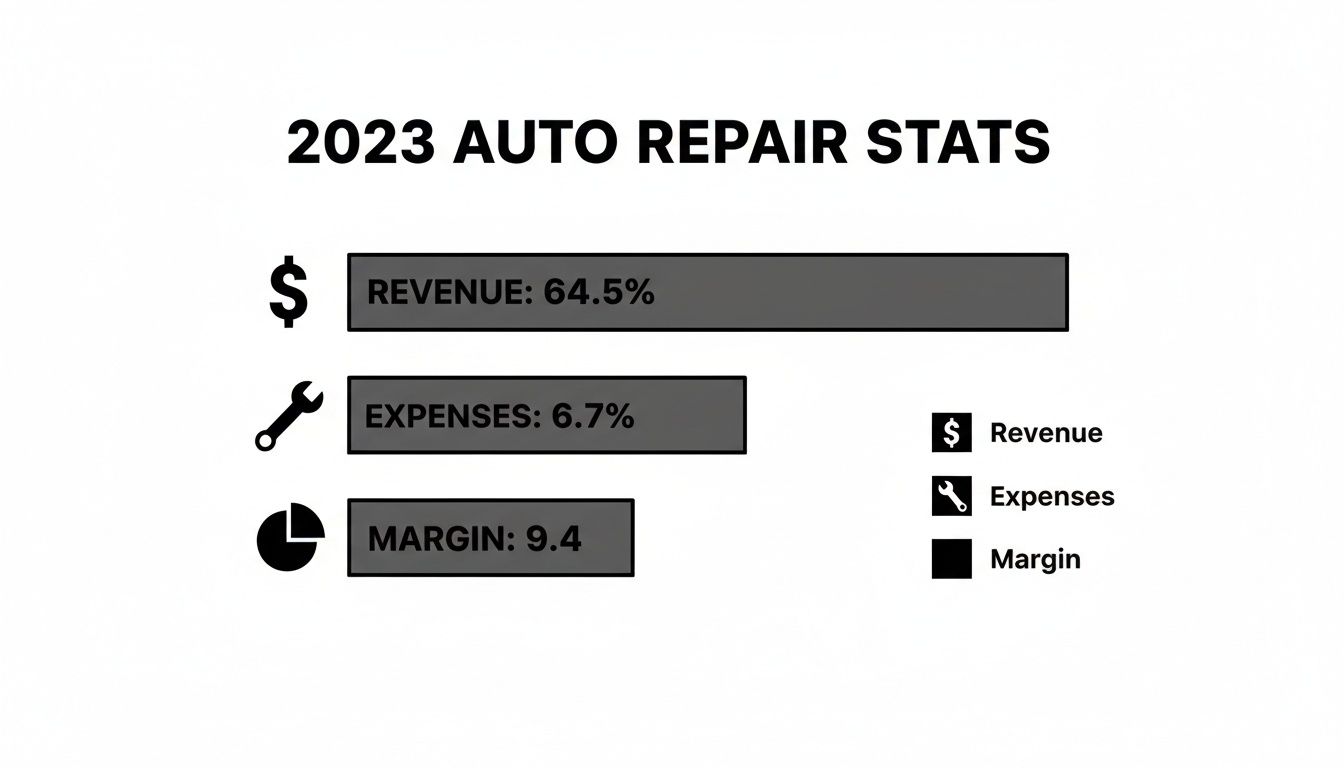
You might wonder why industry stats matter to you. A healthy 9.4% profit margin, like the one seen in 2023, means shops have the resources to invest in top-tier diagnostic tools and ongoing technician training. That investment directly translates to better, more accurate service for your vehicle.
A Closer Look at Repair and Enhancement Estimates
So, what should you budget for some of the most common jobs? Let's break it down.
Even a simple synthetic oil change, which usually takes around 30 to 45 minutes, can vary in price depending on the specific oil your engine needs. A high-end import often requires a more expensive, specialized oil compared to a standard daily driver.
Then there are critical safety services like brake replacements. This is one area where the quality of the parts really matters. Depending on your vehicle and the grade of pads and rotors you opt for, you can expect to pay anywhere from $400 to $800 per axle. We dive deeper into what affects this price in our guide to brake pad replacement costs.
But it's not all about repairs. For many car lovers in Whitby, protecting their investment is just as important. Services like window tinting and paint protection film (PPF) are fantastic for shielding your ride from Durham's tough road salt and sun damage.
The table below gives you a ballpark idea of what to expect for some of the most requested services in our shop.
Estimated Costs and Timelines for Common Auto Services in Whitby
| Service | Estimated Cost Range | Estimated Time in Shop | Key Value |
|---|---|---|---|
| Synthetic Oil Change | $80 – $150 | 30 – 45 minutes | Essential for engine health and performance. |
| Brake Replacement (per axle) | $400 – $800 | 1 – 2 hours | Crucial for safety; quality parts last longer. |
| Window Tinting (full car) | $300 – $700+ | 2 – 4 hours | Adds privacy, UV protection, and heat rejection. |
| Paint Protection Film (PPF) | $500 – $5,000+ | 4 hours – 3 days | Protects paint from chips, scratches, and stains. |
| Collision Repair | $750 – $10,000+ | 2 days – 3+ weeks | Restores vehicle to pre-accident condition. |
Of course, these are just estimates. A good shop will always provide a detailed, personalized quote after inspecting your vehicle.
The Value Behind the Price Tag
When it comes to protective services, the price often reflects the quality and longevity of the materials. Think of it as an investment in your vehicle’s future.
Window Tinting: A basic dyed film might save you money now, but it's prone to fading and bubbling. A premium ceramic tint costs more because it provides superior heat rejection, blocks nearly all UV rays, and is guaranteed not to turn purple. It's a classic "buy it nice or buy it twice" scenario.
Paint Protection Film (PPF): The cost here is all about coverage. A "front-end" package is a popular choice, protecting the high-impact areas like your bumper, hood, and mirrors from rock chips. A full-body wrap is a much bigger undertaking but offers complete, seamless protection that keeps your paint looking factory-fresh for years.
Choosing a service based on price alone can be a mistake. A cheap brake job with low-grade pads will just have you back in the shop sooner. A low-cost tint might bubble within a year, forcing you to pay to have it removed and redone properly. True value lies in quality work that lasts.
How to Choose a Trustworthy Auto Repair Shop

Finding an auto repair shop in Oshawa, Ajax, or Whitby that you can actually trust can feel overwhelming. There are dozens of options out there, but let’s be honest—they aren’t all created equal. The quality of work directly impacts your car’s safety and reliability, so this isn't a decision to take lightly.
Think of it like finding a family doctor. You need someone with proven expertise who you can build a long-term relationship with. It’s all about knowing what to look for—the tell-tale signs that separate a top-tier professional from just another garage—before you hand over your keys.
Look for Signs of Professionalism
In 2026, your first visit to a shop is almost always digital. A clean, professional website that’s easy to browse is a great first sign. It shows they invest in their customer experience and care about their image. You should be able to find their services, hours, and contact info without any hassle.
But your detective work shouldn't end with their homepage. Look for a gallery of their actual work. This is critical for cosmetic services like Paint Protection Film (PPF), window tinting, and collision repair, where the proof is in the finish. Photos of pristine, organized service bays and detailed shots of finished jobs tell you a lot about their standards and attention to detail.
A great shop is proud of its work and eager to show it off. If their website is bare or their social media is all stock photos, you have to wonder what they're hiding.
Finally, just give them a call. Ask a couple of basic questions and see how they respond. Are they friendly, patient, and happy to help? Or do you feel like you’re interrupting them? That initial phone call is often a perfect preview of the service you’ll receive in person.
Check Their Credentials and Guarantees
Beyond appearances, you need to verify their qualifications. In Ontario, the 310S Automotive Service Technician license is the benchmark for mechanics. It’s a government-recognized certification proving they have the skills to handle complex diagnostics and repairs. Don't be afraid to ask if their technicians are licensed.
Just as important is the shop’s warranty. Any reputable business will stand behind its service. Ask them directly about their warranty on both parts and labour. A shop that offers a clear, written guarantee is confident in their team's skills and the quality of the parts they install.
Online reviews are another fantastic tool. A quick search on Google will reveal what real customers in the Durham Region are saying. You’re not looking for perfection—every business gets an odd negative review—but you are looking for patterns. Consistent praise for honesty, fair pricing, and excellent results is a huge green flag. Conversely, repeated complaints are a clear warning sign.
A Quick Vetting Checklist
As you search for auto repair in Oshawa, Ajax, or Whitby, keep this simple checklist handy to make a confident choice:
- Industry Certifications: Does the shop employ licensed 310S technicians? For anything more than an oil change, this is a must.
- Clear Warranty: Do they provide a straightforward warranty on parts and labour? Make sure you can get it in writing.
- Positive Online Reviews: Is there a strong track record of positive feedback from local drivers?
- Professional Website: Is their online presence up-to-date, informative, and professional?
- Portfolio of Work: Can they show you real photos of their completed projects?
- Responsive Customer Service: Are they polite and helpful on the phone and in person?
Following these steps will help you look past the marketing and find a true partner for your vehicle. If you'd like to learn more about what separates the good from the great, check out our guide on how to spot the best automotive repair shop. It will give you the confidence to choose a team that’s genuinely committed to excellence.
Why Local Expertise Matters for Your Vehicle
When you're looking for an auto repair shop in Oshawa, Ajax, or Whitby, you’re choosing more than just a set of tools and a garage. You're choosing a team. A big-box chain might treat every car the same, but a local expert knows exactly how our unique Durham Region environment impacts your vehicle every single day.
Think of it this way: you wouldn’t follow gardening advice meant for Florida to grow a garden here in Ontario. Our soil, our seasons, our weather—it all demands a specific approach. The same goes for your car.
A shop that’s truly part of the community understands the real-world conditions your vehicle endures. We know what a daily commute on the 401 does to your brakes, how stop-and-go traffic on Taunton Road wears on a transmission, and what our four distinct seasons can do to just about everything else.
The Durham Region Climate and Your Car
Southern Ontario’s weather is a relentless stress test for any vehicle. From the humid, sticky air of our summers to the salty, bone-chilling winters, the climate is constantly working against your car's components. A technician who lives and drives here understands this on a personal level.
This firsthand knowledge means you get smarter, more practical advice. We aren't just reading from a service manual; we’re making recommendations based on what we see working for hundreds of your neighbours.
Harsh, Salty Winters: Road salt is public enemy number one for your car's metal parts. A local expert will be the first to recommend specific rust-proofing treatments or a high-grade Paint Protection Film (PPF) that can actually stand up to the constant salt spray. We see the damage every spring and know what it takes to prevent it.
Humid Summers: All that moisture in the air can strain your A/C system, encourage mould in your cabin filters, and make rubber hoses and belts break down faster. A local tech knows these are weak spots and checks them proactively.
Freeze-Thaw Cycles: The constant swing between freezing and thawing is brutal on suspension components and carves out the potholes that throw your alignment completely out of whack. A local shop is always on the lookout for these all-too-common issues.
A mechanic from out of town might not grasp just how corrosive our winter road salt really is. A local technician, on the other hand, has spent years seeing it eat through undercarriages, brake lines, and exhaust systems. That makes their preventative advice invaluable.
Beyond Repairs: A Community Partner
Choosing a local business like Carmedics Autowerks for auto repair in Oshawa, Ajax, or Whitby means you're working with people from your own community. Unlike an impersonal national chain that’s focused on hitting sales targets, a local shop thrives on the trust and satisfaction of the people it serves. Our reputation is built one car, one customer at a time, right here.
What that really means for you is more personal service. We get to know you and your vehicle, which allows us to offer advice that truly fits your needs and budget. We’re not just here to fix your car today; we’re here to build a relationship you can count on for years to come. That’s the real advantage of keeping it local.
Your Partner for Premium Auto Care in Whitby
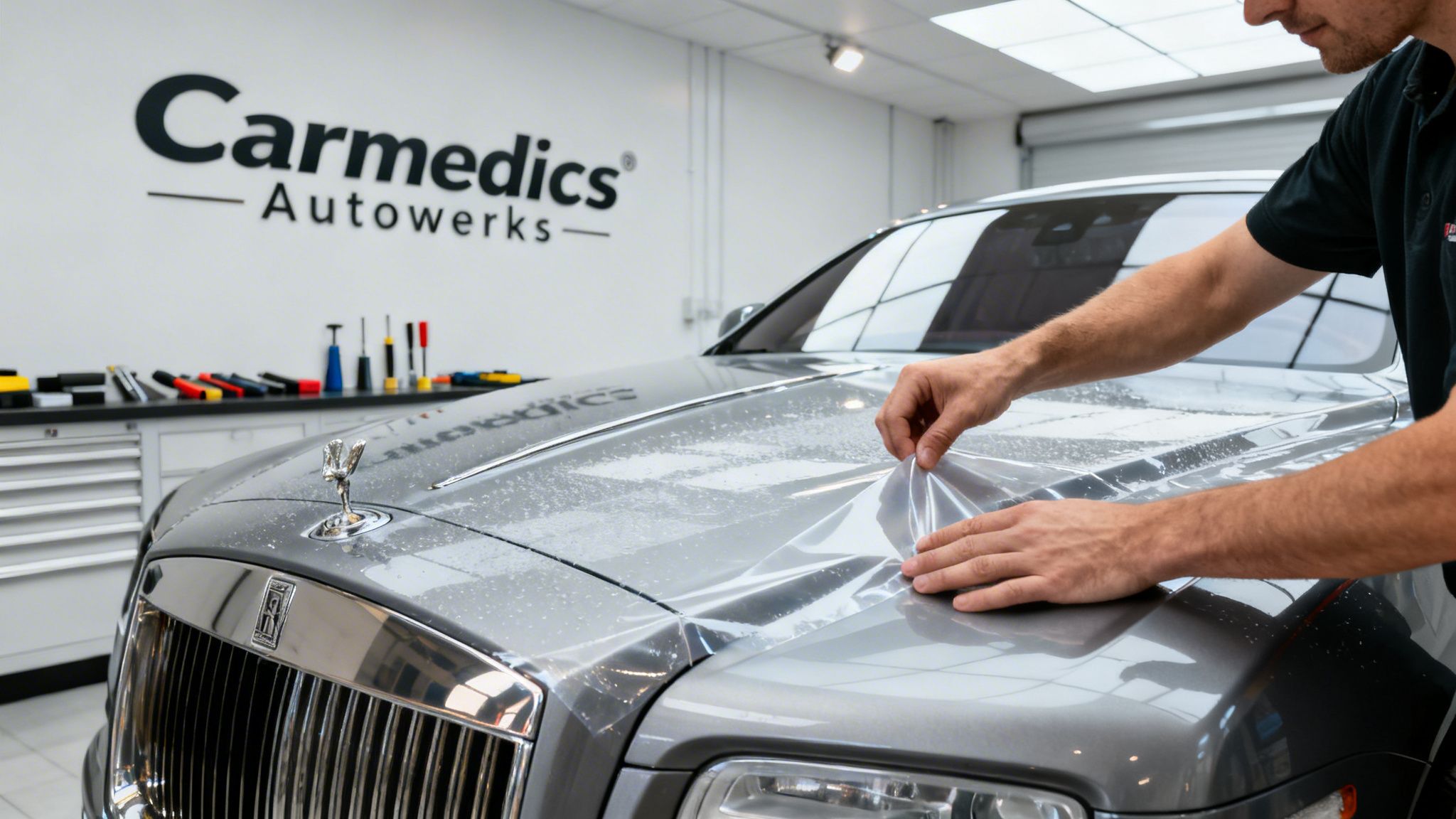
Finding the right auto shop in Oshawa, Ajax, or Whitby shouldn’t feel like a gamble. After all, you’re not just looking for a quick fix—you're looking for a trusted team that understands your vehicle is more than just a way to get from A to B. We’ve covered what to look for: fair pricing, honest timelines, and the value of true local expertise.
Now, it’s about putting that knowledge into practice. The best choice is always a shop that delivers on every promise, from clear communication to an unwavering commitment to quality work. It's about building a real relationship, whether you're trying to keep a brand-new car in pristine condition or you're a lifelong enthusiast who expects nothing less than peak performance.
Where Craftsmanship Meets Customer Care
At Carmedics Autowerks, we've structured our entire business around being that go-to solution. We bring together the certified technical skill needed for general repairs and fleet maintenance with the detailed artistry of high-end vehicle enhancements. It just makes sense to have every aspect of your car cared for by experts, all under one roof.
We’re car people, through and through. That passion drives us to specialize in services that not only protect your investment but genuinely make driving better:
- Paint Protection Film (PPF): Our installers meticulously apply PPF to shield your paint from the stone chips, salt, and grime that come with driving in the Durham Region.
- Professional Window Tinting: We work with premium films that do more than just look good—they enhance privacy, block damaging UV rays, and help keep your car’s interior from overheating in the summer.
- Certified Repairs and Maintenance: From a simple oil change to complex engine diagnostics, our licensed technicians handle it all with an expert touch.
A top-tier auto care partner in Whitby knows that details matter. That’s why we also offer specialized aesthetic and safety services, like professional headlight restoration services to restore clarity and brightness. This complete approach is what separates a standard garage from a true autowerks.
Your vehicle is one of your biggest investments. Partnering with a shop that offers a full spectrum of care—from mechanical integrity to aesthetic perfection—is the smartest way to protect its value and ensure your peace of mind on the road.
Ready to see what dedicated, expert care really looks like? We invite you to see why we are the trusted choice for auto repair in Oshawa, Ajax, and Whitby. You can learn more about our philosophy and team at Carmedics Autowerks in Whitby. Give us a call for a personalized quote, or even better, stop by the shop to chat about how we can help protect and perfect your vehicle.
Frequently Asked Questions About Auto Repair
Let’s be honest—navigating the world of car maintenance can feel a little overwhelming. It’s completely normal to have questions, especially when you’re dealing with the unique driving conditions here in the Durham Region. Whether you're a new driver in Oshawa or a seasoned commuter in Ajax or Whitby, getting clear, honest answers helps you make the best decisions for your vehicle.
We hear a lot of the same questions from our customers, so we’ve put together some straight-up answers to help you out.
How Often Should I Really Be Servicing My Car Around Here?
Your owner’s manual gives you a good baseline, but it doesn't account for life in Ontario. The mix of bumper-to-bumper traffic and our famously harsh, salty winters puts a lot more stress on your car than you might think.
A good rule of thumb? Bring your vehicle in for a check-up more often than the manual suggests, especially before winter digs in. This lets a technician catch any small issues with your battery, brakes, or tires before they leave you stranded on a freezing morning.
For drivers in the Durham Region, we typically recommend:
- Oil Changes: With modern synthetic oil, you’re looking at every 8,000 to 12,000 kilometres. If you do a lot of short trips, aim for the lower end of that range.
- Tire Rotations: Get them rotated every 8,000 to 10,000 kilometres. This ensures they wear down evenly, which is critical for good grip on wet or icy roads.
- Brake Inspections: At least once a year, have a professional look at your brake pads and rotors. Don’t wait for the squealing to start.
Is Paint Protection Film Actually Worth the Money?
Yes, one hundred percent. If you care about keeping your car looking new and protecting its resale value, PPF is one of the smartest investments you can make. Think of it as a tough, invisible shield for your paint.
Every time you merge onto the 401, your front end gets sandblasted by tiny rocks and road debris that leave behind ugly chips. In the winter, that corrosive road salt just eats away at your clear coat. PPF takes all that abuse, keeping your factory paint job looking flawless underneath. It’s a must-have for any new car owner who wants to avoid expensive paint correction work later on.
A professional PPF installation isn’t just a cosmetic choice; it's a defensive strategy. It guards the most vulnerable parts of your car—the bumper, hood, and mirrors—from the kind of daily damage that slowly chips away at its value.
Do You Work on All Car Makes and Models?
We sure do. At Carmedics Autowerks, our certified technicians have the experience and the right tools to service a huge range of vehicles. It doesn’t matter if you’re driving a Ford or GM truck, a reliable Toyota or Honda, or a European model from BMW or Mercedes-Benz—we’ve got you covered. We also know that unexpected things happen, and people often have questions about the right quick steps to take if you put the wrong fuel in your car.
We invest heavily in ongoing training and advanced diagnostic equipment. That’s how we stay on top of the complex technology in today's cars, ensuring we can pinpoint any problem and fix it right, just as the manufacturer intended.
Have another question? Or just want to talk about what your car needs? Trust the experts at Carmedics Autowerks Inc.
Book Your Appointment Today
If you're looking for top-notch auto repair on Hopkins Street Whitby, you’ve come to the right place. We're Carmedics Autowerks, and we're not just another garage—we're your neighbours, dedicated to keeping your vehicle running perfectly, right here in Whitby's best-known automotive corridor.
Your Trusted Choice For Auto Repair On Hopkins Street Whitby
When something goes wrong with your car, you need more than just a quick fix. You need a team you can trust, one that combines technical skill with genuine, honest advice. That’s the foundation we’ve built Carmedics Autowerks on. We're the go-to shop for everyone from daily commuters and passionate car enthusiasts to new owners who want to protect their investment from day one.
It’s no accident we’re on Hopkins Street. This area has been the heart of the auto service industry in the Durham Region since the early 2000s, growing right along with the town. As Whitby's population jumped by an incredible 24.6% between 2011 and 2021, we've been right here at 311 Hopkins St, proudly serving our growing community.
Our Core Services
We've deliberately focused our expertise on a handful of key areas to ensure we deliver exceptional quality, every time. Whether your car needs to be put back together after a collision or you're looking to protect its factory-fresh paint, our certified technicians have you covered.
Our primary services include:
- Complex Collision Repair
- Proactive Fleet Maintenance
- Aesthetic Window Tinting
- Paint Protection Film (PPF)
To give you a better idea of what we do, we've put together a quick summary of our main services. We believe in being upfront about how we can help keep your car safe, reliable, and looking its absolute best.
Carmedics Autowerks Service Snapshot
This table outlines our core auto repair and enhancement services available right here on Hopkins Street.
| Service | Best For | Key Benefit |
|---|---|---|
| General Repairs | Daily drivers needing reliable fixes | Restores vehicle safety and performance. |
| Collision Repair | Anyone involved in a vehicle accident | Seamless restoration to pre-accident condition. |
| Window Tinting | New car owners and enthusiasts | Enhances privacy and protects the interior from UV rays. |
| PPF Application | Protecting a new or valuable vehicle | Shields paint from chips, scratches, and road salt. |
| Fleet Maintenance | Local businesses with multiple vehicles | Maximizes uptime and reduces costly breakdowns. |
From essential repairs to cosmetic perfection, our goal is to provide a complete solution under one roof. You can also explore the full range of services at Carmedics Autowerks in Whitby to see everything we have to offer.
Comprehensive Maintenance for Total Vehicle Health
Think of your car's maintenance schedule like your own health plan. You go for regular check-ups to catch things early, right? Your car needs the same proactive care to stop small problems from snowballing into massive, wallet-draining emergencies. That's the core belief behind every job we do, especially for folks looking for reliable auto repair on Hopkins Street Whitby.
Our process always starts with a deep dive, a thorough diagnostic check. We're not just looking for what’s broken right now; we’re actively hunting for signs of future trouble. Our certified technicians use their years of hands-on experience, along with top-tier equipment, to inspect every critical system. We want to catch that minor bit of wear before it leaves you stranded on the side of the 401.
At Carmedics Autowerks, we see maintenance as a partnership. Our job is to give you a clear, honest picture of your vehicle's health. That way, you have all the information you need to make smart decisions that keep it safe and reliable for the long haul.
Built For The Canadian Climate
Driving in Ontario subjects your vehicle to a special kind of punishment. The endless freeze-thaw cycles, heavy snow, and a constant barrage of road salt take a serious toll. That’s why our maintenance services are laser-focused on the parts that suffer the most from our Canadian weather.
We put extra attention on these key areas to make sure your car is ready for whatever the forecast throws at it:
- Brake Systems: We make sure your pads, rotors, and calipers are in top shape for confident stopping on slick, icy, or wet roads. Regular inspections are non-negotiable for safety.
- Suspension Components: Potholes and rough roads are a fact of life here, and they can wreak havoc on shocks, struts, and ball joints. We check for wear that ruins your ride quality and handling.
- Exhaust Systems: Road salt is incredibly corrosive, and your exhaust is right in the line of fire. We meticulously inspect for rust and leaks that kill performance and can let harmful fumes into the cabin.
A Commitment To Quality
Our expertise doesn't mean much without the right parts. We have an unshakeable commitment to using high-quality components that meet or exceed the original manufacturer's specifications. We know that the durability of a repair is just as important as the skill that went into it.
When you bring your vehicle to Carmedics, you can be absolutely certain we’re not just fixing it for today—we’re protecting your investment for the thousands of kilometres ahead. This dedication builds trust and keeps your car where it belongs: on the road.
To get a better sense of our proactive philosophy, we've put together a guide on the benefits of preventive maintenance for vehicles. Let's work together to keep your car in peak condition for years to come.
Specialized Collision Repair That Gets You Back on The Road
A car accident is always a shock, and the last thing you need is a repair process that adds even more stress to your plate. We get it. That's why our approach to collision repair is built around making things as straightforward and painless for you as possible, combining quality workmanship with clear, honest communication.
From the moment your vehicle is brought in for auto repair on Hopkins Street Whitby, our team gets to work. We don't just patch up the visible dings and scratches. We perform a comprehensive assessment to find any underlying damage that might cause problems down the road. You’ll be kept in the loop every step of the way, so you’re never left guessing about what’s happening with your car.
This simple breakdown shows how we look at your vehicle's health—it's a continuous cycle.
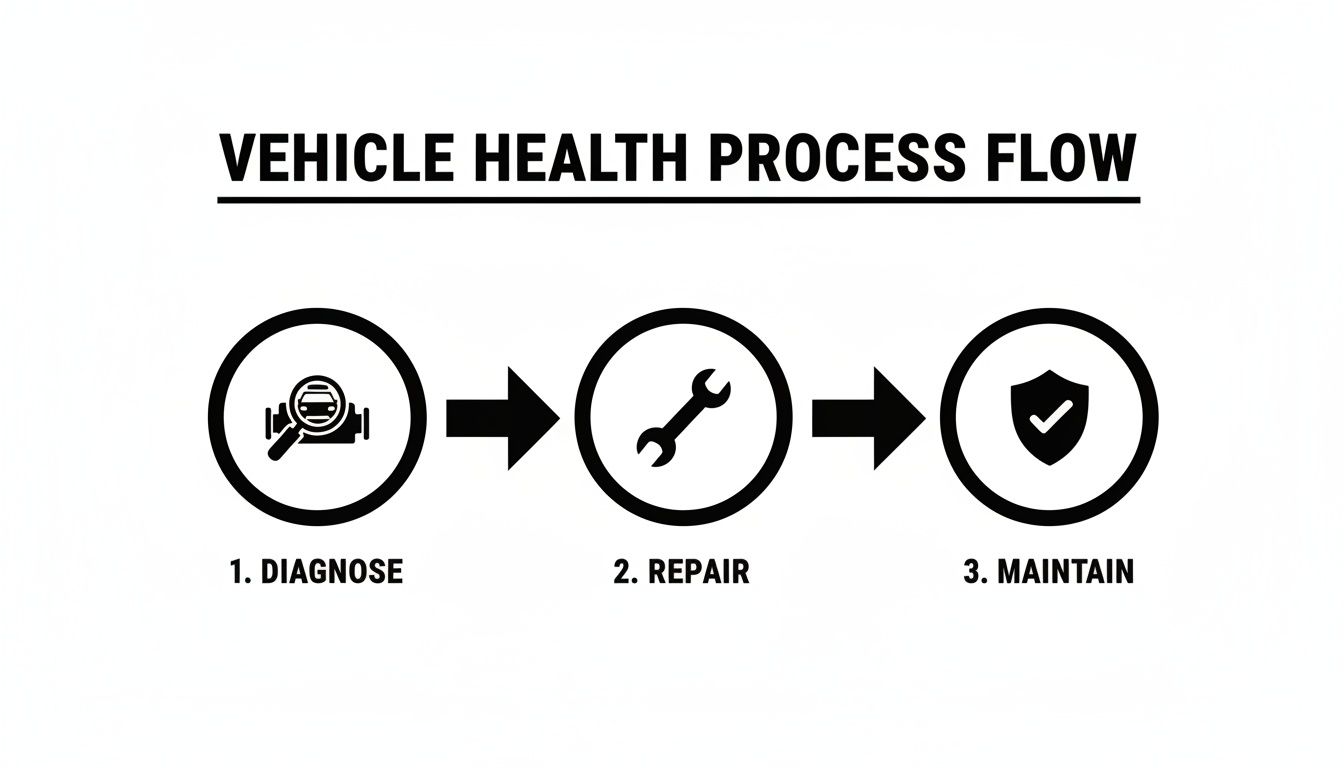
We start with diagnosis, move to a precise repair, and then focus on the maintenance that keeps your car running perfectly long after you leave our shop.
Speed and Precision You Can Count On
We know that life doesn't stop when your car does. Being without your vehicle is a massive inconvenience, especially if you rely on it for your daily commute on Highway 401. Our entire workflow is designed for efficiency, getting you back on the road safely and quickly without ever cutting corners on quality.
When we talk about speed, we have the numbers to back it up. Our average collision repair turnaround is just 3.5 days, which is an impressive 40% faster than the Ontario industry standard of 6 days. Since 2020, our shop has successfully completed over 1,500 repairs with a 98% first-time fix rate.
That success rate isn't an accident. It’s the result of having experienced technicians, using modern repair methods, and following a strict quality-check process before any car is returned to its owner. We pride ourselves on getting it right the first time. You can learn more about how we handle everything from small dents to major structural work on our https://carmedicsautowerks.com/auto-body-shop-near-me/ page.
After we've taken care of the repairs, we know the aftermath of an accident can be complex. If you were in a situation like a rear-ender, you may also need legal advice after a rear-end collision to handle insurance and other claims. When you trust Carmedics with your vehicle, you're not just another repair order—you're getting a dedicated partner committed to making a tough situation feel a whole lot easier.
Protecting Your Investment With PPF and Window Tinting
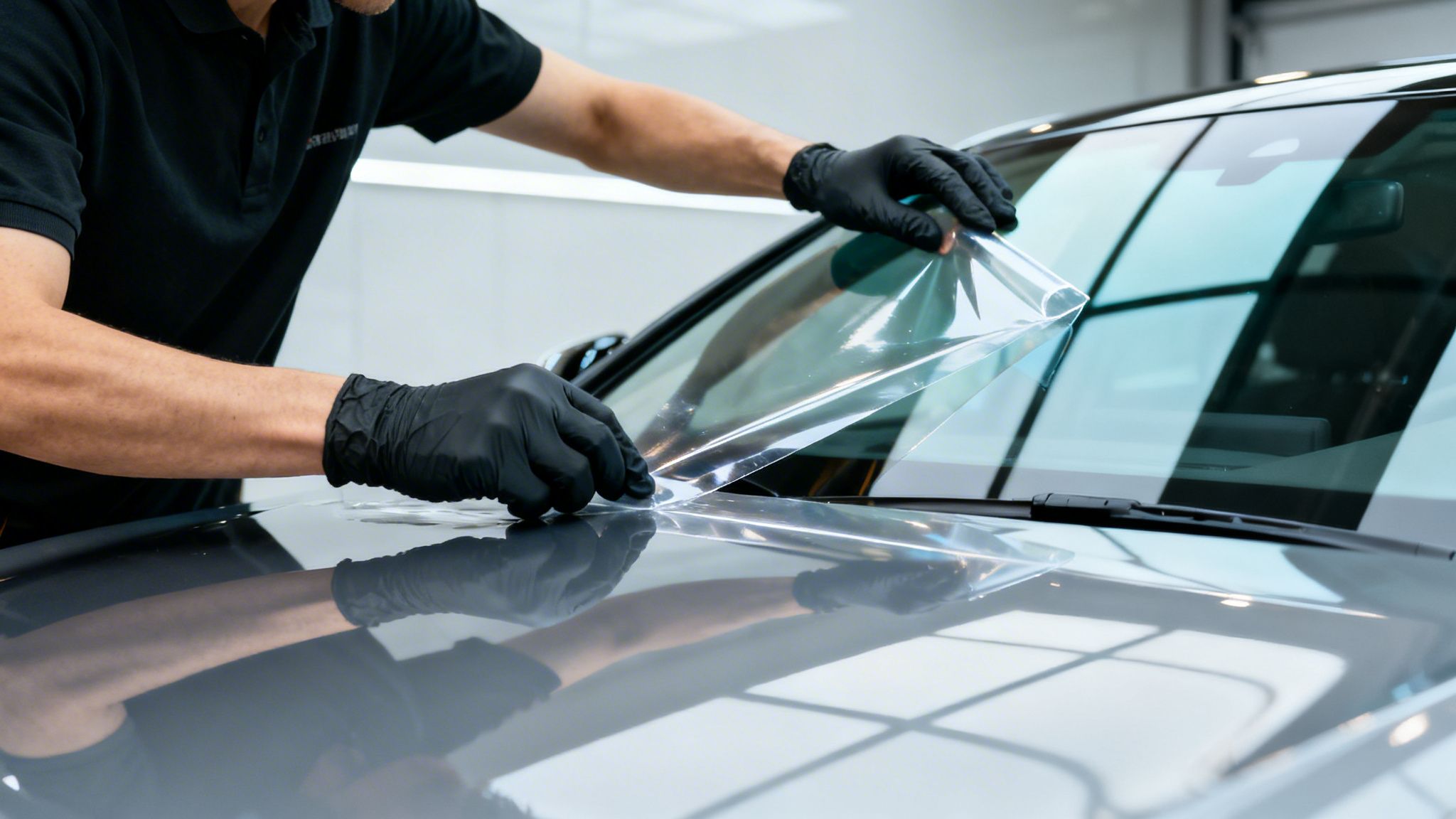
Let's be honest—for most of us, a car is more than just metal and wheels. It’s a major investment, a point of pride, and something you want to keep looking brand new for as long as possible. That fresh-off-the-lot feeling is priceless, and our protective services are the single best way to preserve it.
Think of these services not as cosmetic add-ons, but as your car's first line of defence against the real world.
So, what is Paint Protection Film (PPF)? It’s basically an invisible, self-healing shield for your vehicle's paint. It’s a tough, transparent layer that our technicians meticulously apply to guard your finish against the daily grind of driving in Ontario. We’re talking about everything from stone chips flying up on the 401 to the harsh, corrosive road salt we all deal with in winter. PPF creates a barrier that keeps your original paint job looking immaculate.
This is especially critical for anyone who spends a lot of time on the highway or simply wants to lock in their vehicle's resale value. There's no question about it: a car with flawless factory paint is always worth more.
More Than Just Good Looks
While PPF takes care of the outside, window tinting is all about protecting the inside. A lot of people think tint is just for looks or privacy, but the practical benefits are what really count. A high-quality tint film acts as a powerful barrier against the sun's damaging UV rays. Those rays are what cause your dashboard, leather seats, and other interior materials to fade, crack, and age prematurely. It’s like putting sunscreen on your car's cabin.
On top of that, a professional tint job cuts down on dangerous glare from the sun and other headlights, making your drive safer and far more comfortable. It also keeps your car's interior significantly cooler during those sweltering summer months, which means your air conditioning doesn't have to work nearly as hard. We guarantee that all our tinting services are fully compliant with Ontario's provincial regulations, so you get all the perks with zero legal headaches.
When you combine PPF on the outside and window tinting on the inside, you're essentially creating a complete protective bubble for your vehicle. It’s a two-pronged approach that has become a must-have for drivers across the GTA who want to maintain that showroom look and protect their car's future value.
These proactive solutions are a key part of the auto repair on Hopkins Street Whitby experience we offer at Carmedics. It’s all about smart, preventative care. You can discover more about our Paint Protection Film services and see how we help safeguard your investment. This isn't just about looking good now—it's about keeping your vehicle protected for all the years to come.
Reliable Fleet Maintenance for Local Businesses
If you run a business in Whitby, you know your vehicles are more than just a way to get around—they're the lifeblood of your operation. A van off the road isn't just an inconvenience; it means lost revenue, unhappy clients, and a hit to your reputation. We get it. That's why we don't just fix fleet vehicles; we build a maintenance plan to keep your business running without interruption.
Think of us as part of your team, the expert mechanics dedicated to keeping your company profitable. Our entire goal is to shift you away from scrambling with costly, last-minute emergency repairs. Instead, we'll get you onto a predictable, scheduled maintenance system that fits your budget. This simple change means less downtime and no more surprise invoices, which ultimately protects your bottom line. We provide the expert auto repair on Hopkins Street Whitby that local businesses count on.
A Proactive Partnership That Works for You
A single broken-down truck can throw your whole day's schedule into chaos. Our fleet service is built to prevent exactly that. We create a proactive maintenance schedule based on your specific vehicles and how you use them, catching wear and tear before it can cause a major failure.
This puts you back in control. You can plan for service on your terms—not in the middle of a customer emergency. We’ll work with you to book appointments during your fleet’s off-hours or slower periods, ensuring your operations never miss a beat.
By keeping your vehicles on a regular service schedule, you are actively extending their operational lifespan. A well-maintained fleet not only avoids costly downtime but also retains a higher resale value, making it a smarter long-term investment for your business.
From light-duty courier vans to heavy-duty work trucks, our shop has the space, equipment, and expertise to handle the diverse vehicles that keep your business moving.
Real-World Benefits for Your Bottom Line
Choosing Carmedics for your fleet brings clear, measurable advantages that show up right on your balance sheet.
- Minimized Downtime: Our proactive approach reduces unexpected breakdowns by over 70% for many of our partners, keeping your vehicles on the road where they belong.
- Predictable Costs: Swap the stress of huge, unplanned repair bills for a manageable, budgeted maintenance plan.
- Enhanced Safety: Regular checks on brakes, tires, and steering systems are non-negotiable. We help ensure your drivers are safe and your business meets its safety obligations.
- Extended Vehicle Life: Consistent, professional maintenance is the single best way to prolong the life of your fleet and maximize the return on your investment.
To see how a custom plan can support your specific business needs, find out more about our fleet vehicle repair services in Whitby. Let's work together to keep your business on the move.
Why Hopkins Street Is Whitby's Automotive Epicentre
Anyone who’s lived in Whitby for a while knows that certain streets just are the place to go for specific things. When it comes to your car, that place is Hopkins Street. It’s not just a random collection of shops; it’s a genuine hub that’s grown over the years into a one-stop destination for vehicle owners.
Think of it like a specialized medical building. You wouldn't want to drive to one clinic for a check-up, another for an X-ray, and a third for physical therapy. Hopkins Street offers that same convenience for your vehicle, bringing together all the experts you might need in one place. It saves you time and the headache of running all over town.
This reputation wasn't built in a day. The street’s growth mirrors Whitby's own evolution. As our town grew, so did the need for reliable car care. In fact, between 2010 and 2020, the area saw a 30% rise in local garages. We were proud to be part of that wave, opening Carmedics Autowerks to bring a modern, full-service approach to the community. This growth has built a solid foundation of trust, combining long-standing specialists with newer, comprehensive shops. You can see the deep roots of the local business community through resources like the Better Business Bureau.
Your Go-To Spot for Auto Repair on Hopkins Street, Whitby
We’re right in the middle of it all at 311 Hopkins Street, Unit 5. We made sure our shop is easy to find and has plenty of parking, so you won’t have to circle the block or worry about finding a spot when you arrive for your appointment.
Our spot on Hopkins makes us a convenient choice for drivers all over Whitby and the Durham Region. Honestly, being part of such a well-regarded automotive community pushes us to be better every day. We all share in the street's reputation for quality, and we take that responsibility seriously.
We believe getting your car serviced shouldn't be a hassle. From our accessible location and clear communication to how we run our shop, everything is designed to make your experience straightforward and stress-free.
Whether you're stopping in for a quick oil change, need detailed collision work, or want to set up a maintenance plan for your company's fleet, our team is here to provide the expert service that Hopkins Street is known for. We're ready to be your go-to partner for keeping your vehicle in top shape.
A Few Common Questions We Get
Choosing the right shop for auto repair on Hopkins Street Whitby comes with a lot of questions. We get it. You want to know you’re making the right choice. We've put together some answers to the things we’re asked most often to help you feel confident before you even walk through our doors.
Do I Need to Make an Appointment?
It’s always best to book ahead, yes. An appointment guarantees we have a dedicated spot for you and the right technician on hand to look at your car. It’s the best way for us to give your vehicle the focused attention it deserves.
Of course, emergencies happen. If you're in a tough spot, give us a call directly. We'll always do our absolute best to fit you in.
How Long Will My Repair Take?
That’s the million-dollar question, isn't it? The honest answer is: it depends. A quick oil change can have you in and out in under an hour. A more complex job, like tracking down an electrical gremlin or a full collision repair, will naturally take longer, sometimes a few days.
Once we’ve had a chance to properly diagnose the issue, we'll give you a clear, realistic timeline. We believe in keeping you in the loop, so you’ll know exactly what’s happening and when to expect your car back.
Our promise is transparency. We provide a clear, upfront estimate of the time required for your vehicle's service, ensuring you can plan accordingly without any surprises.
What Kind of Warranty Do You Offer?
We’re proud of the work we do, and we stand behind it. Every repair we perform comes with a comprehensive warranty that covers both the parts we use and the labour our technicians put in.
The exact terms can differ depending on the specific job, but we lay everything out for you in plain English before we even pick up a wrench. Your peace of mind is our top priority.
For quick answers to other common inquiries about vehicle services, you might find these frequently asked questions helpful.
Do You Work with Insurance Companies for Collision Repair?
Absolutely. We have years of experience working with every major insurance provider in Ontario. Dealing with insurance claims can be a headache, so we take that stress off your plate.
We’ll handle the paperwork, talk directly to the adjuster, and manage the entire process for you. Our job is to make a stressful situation as seamless as possible so you can get back to your life.
At Carmedics Autowerks Inc, our doors are always open for a good conversation. We're here to provide clear answers and even better service. Book your appointment or get an estimate today by visiting us at https://www.carmedicsautowerks.com.com.
Let's get one thing straight: just because Ontario's mandatory Drive Clean program is a thing of the past doesn't mean vehicle safety checks are. For drivers in Whitby, searching for a reliable "auto inspection station near me" is more important now than it has ever been. This isn't about passing a test anymore; it's about making sure the car you drive is safe for you, your passengers, and everyone else sharing the road.
Why Proactive Car Inspections Are Essential in Whitby
When the Drive Clean program ended, the responsibility for vehicle safety shifted entirely to us, the owners. This calls for a change in how we think about our cars—moving away from a reactive, "I just need this to pass" mentality to a proactive, "I need to know this is safe" approach. Being proactive is your single best defence against sudden breakdowns, wallet-draining repairs, and, most importantly, serious accidents.
Even if you're driving a newer car packed with advanced safety features and complex computers, it's not invincible. Wear and tear is a reality for every vehicle. Problems with sensors, brake systems, and other electronic parts can creep up silently, giving you no warning signs until it’s far too late. It takes an expert eye to spot these hidden issues before they turn into genuine safety hazards.
The Shift from Mandatory to Preventative
Back before 2019, the Drive Clean program served as a regular, if sometimes inconvenient, safety net. The data from that time shows it caught a lot of real problems. In Durham Region alone, for example, 8.3% of the 250,000+ vehicles tested failed on their first try. That number gives us a clear baseline of how many cars on the road had underlying safety issues.
Now that the mandate is gone, a worrying trend has emerged.
According to province-wide OPP data, accidents tied to mechanical failure saw a 7% increase between 2019 and 2023, accounting for 9,800 incidents. What's truly concerning is that brake-related failures were a factor in 35% of those cases—that's 3,430 accidents that could have been prevented.
This isn't just about statistics; it's about understanding the real-world risk. A regular, thorough inspection is just as fundamental to responsible car ownership as getting your oil changed or rotating your tires.
The Benefits of a Preventative Mindset
Looking at your vehicle's health proactively gives Whitby drivers some very real advantages. It goes way beyond just avoiding a potential fine; it’s about being a smart car owner.
- Enhanced Safety: It means catching those worn-out brake pads, failing suspension components, or dangerously bald tires before they fail on the 401.
- Improved Reliability: You can head off a surprise breakdown on your morning commute or, worse, in the middle of a family road trip.
- Long-Term Savings: It’s always cheaper to fix a small issue, like a minor fluid leak, than to deal with a catastrophic engine or transmission failure down the line.
- Higher Resale Value: Nothing tells a potential buyer your car has been well-cared-for like a documented history of regular, professional inspections.
This preventative philosophy is the foundation of everything we do at Carmedics Autowerks. We see an inspection as a conversation about your vehicle's health, not just a pass/fail checklist. Our goal is to arm you with knowledge so you can drive away with total confidence. You can learn more about this approach by reading our guide on the importance of preventive maintenance for vehicles.
How to Find a Reputable Inspection Station in Whitby
When you need a safety certificate, your first move is probably typing "auto inspection station near me" into your phone. But that simple search is just the beginning. How can you be sure the shop you pick is actually trustworthy and not just good at online marketing? Finding a reliable facility in Whitby means doing a little bit of homework to separate the pros from the rest.
The most important first step is checking for official credentials. In Ontario, any legitimate inspection facility must be licensed under the province's DriveON program. This system is how the Ministry of Transportation (MTO) ensures shops meet strict standards for both safety and emissions testing. You can easily verify a shop's licence on the official DriveON registry, giving you immediate peace of mind.
Just to give you an idea, the Durham Region has about 450 licensed auto inspection stations listed in the 2023 DriveON registry. But here’s the catch: only about 60% of those are actually set up to handle the comprehensive Safety Standards Certificate (SSC) inspections. Knowing this helps you filter out the shops that can't even perform the service you need. If you're curious about how these programs evolve, you can find some interesting insights on state inspection programs and their history.
Evaluating Reviews and Asking the Right Questions
Once you've shortlisted a few licensed shops, it's time to see what their customers have to say. Don't just glance at the star rating on Google or Yelp; dive into the actual comments. You're looking for a story.
Look for recurring themes in reviews. Are customers mentioning honesty, thoroughness, and good communication? Or are there complaints about upselling and surprise charges? A few negative reviews are normal, but a consistent pattern is a major red flag.
When you call a shop or drop by, don't hesitate to ask some direct questions. It’s a great way to gauge their professionalism and expertise before you commit. Here are a few things I always tell people to ask:
- "Are your technicians 310S certified?" This is the mandatory license for auto mechanics in Ontario. If they can't answer "yes" immediately, that's a problem.
- "Can you walk me through what your safety inspection covers?" A good technician will be happy to explain their checklist and process.
- "Will I get a detailed report even if my car passes?" Transparency is crucial. You want a clear breakdown of your vehicle’s condition, not just a pass/fail slip.
At the end of the day, you're not just looking for a one-time service; you're looking for a trusted partner for your vehicle’s long-term health. You need a team that takes your safety as seriously as you do. For more advice on what to look for, check out our guide on choosing an automotive service centre near you.
Preparing Your Vehicle for a Smooth Inspection
Nobody enjoys the surprise of a failed safety inspection. You book the time, drive down to the shop, and then get the news that you have to come back because of a burnt-out bulb. It’s frustrating, and honestly, it's often completely avoidable.
As mechanics, we see this all the time. The good news is that a little bit of prep work in your own driveway can catch most of the common, easy-to-fix issues. Think of it as a quick dress rehearsal before the main event. It saves you time, money, and the headache of a re-test.
The 10-Minute Driveway Pre-Check
Before you even think about booking your appointment, grab your keys and spend a few minutes with your vehicle. This simple walkthrough covers the very things that cause the most frequent, and preventable, inspection failures.
Let's start with the lights. It sounds basic, but you’d be amazed how many people miss this. Have a friend or family member help you run through the cycle:
- Headlights (check both your low and high beams)
- Brake lights (make sure they pop on when the pedal is pressed)
- Turn signals (front, rear, and on your mirrors if you have them)
- Reverse lights
- Your license plate light—this is the one everyone forgets! A single burnt-out bulb here is an automatic fail.
Next, give the horn a quick tap. Does it work? Good. Now check your wipers. The rubber blades shouldn’t be cracked, split, or peeling away. Top up your washer fluid and give it a spray to make sure the nozzles aren't clogged and are aimed at the windshield.
A Look at Your Tires, Fluids, and Paperwork
Tires are one of the most critical safety components on your car, and they get a lot of attention during an inspection. You can get a good sense of your tread depth with a toonie. Just slide it into the tread; if the tread doesn't cover the polar bear's paws, your tires are getting dangerously low and likely won't pass. While you're down there, scan the sidewalls for any cracks, bubbles, or bulges.
Under the hood, you don’t need to be a mechanic to spot obvious problems. Simply check your fluid levels—engine oil, brake fluid, coolant, and power steering fluid—using the reservoir markings or dipstick. Low levels can sometimes point to a leak, which is a definite safety issue. Also, take a quick look under the car for any new drips or puddles on your driveway. A fresh leak is a red flag.
To help you keep track, here's a simple checklist of what you can do at home. Catching these things yourself is far better than having us find them during the official inspection.
Your Pre-Inspection Checklist for Success
| Component to Check | What to Look For | Why It Matters |
|---|---|---|
| All Exterior Lights | Burnt-out bulbs, cracked lenses. | All lights must be functional for visibility and signalling. This is a common and easy-to-fix failure point. |
| Tires | Low tread depth (use a toonie), cracks, or bulges. | Worn or damaged tires are a major safety hazard, affecting braking and handling. |
| Horn & Wipers | Horn not working, torn wiper blades, empty washer fluid. | Your horn is a key safety device, and clear visibility through the windshield is non-negotiable. |
| Fluid Levels | Low oil, brake fluid, or coolant. | Drastically low fluids may indicate a leak, which is a serious safety concern that will fail an inspection. |
| Under the Vehicle | Puddles or fresh drips of oil, coolant, or other fluids. | Active leaks are an automatic failure and point to a problem that needs immediate repair. |
| Important Documents | Vehicle Ownership (green slip) and proof of insurance. | The inspection cannot legally begin without these valid documents present. |
By taking these few simple steps, you're not just trying to pass a test; you're taking an active role in your own safety on the road. A simple bulb replacement you do yourself is a five-minute fix. Finding out about it at the inspection station means a failed test, a possible re-test fee, and another trip to the shop.
Doing this prep work helps us focus on the complex systems—the brakes, suspension, and frame—that truly keep you safe on Whitby's roads. For a full breakdown of every item on the official checklist, our guide to the annual safety inspection sticker in Ontario is a great resource.
What a Thorough Vehicle Inspection Actually Involves
So, your car is finally up on the lift, and the technician starts their work. What's really going on under there? A proper vehicle inspection is a lot more than a quick once-over. It’s a meticulous, point-by-point examination of every system that keeps you safe on the road. This isn't just about getting a sticker; it's a comprehensive health check for your car.
The process starts with the very bones of your vehicle: the frame and unibody structure. We're looking for any signs of excessive rust, stress cracks, or hidden collision damage that could compromise the car's integrity. Here in Whitby, where road salt is a reality for months on end, this check is non-negotiable. A weakened frame simply can't protect you the way it was designed to in an accident.
This is a detailed process, and knowing what’s involved helps you understand what you're paying for. If you're curious about how these services are priced, you can learn more about auto inspection costs in our detailed guide.
From Brakes to Ball Joints
With the frame cleared, the focus shifts to the parts that control your car's every move. The braking system is at the top of the list. A technician will measure the thickness of your brake pads and rotors, hunt for any fluid leaks in the lines and calipers, and test the emergency brake. It’s all about making sure you have the stopping power you need for that sudden stop on a busy Durham Region road.
Next up are the steering and suspension systems. This is where we check for any looseness or wear in crucial components like tie rods, ball joints, and control arms. Even a tiny bit of play in these parts can make the steering feel vague or unstable—a huge safety concern when you’re on the 401 in heavy rain or wind. We’ll also inspect your shocks or struts for leaks and check the springs for any cracks.
This chart shows a few simple but vital things you can check yourself before you even come to the shop.
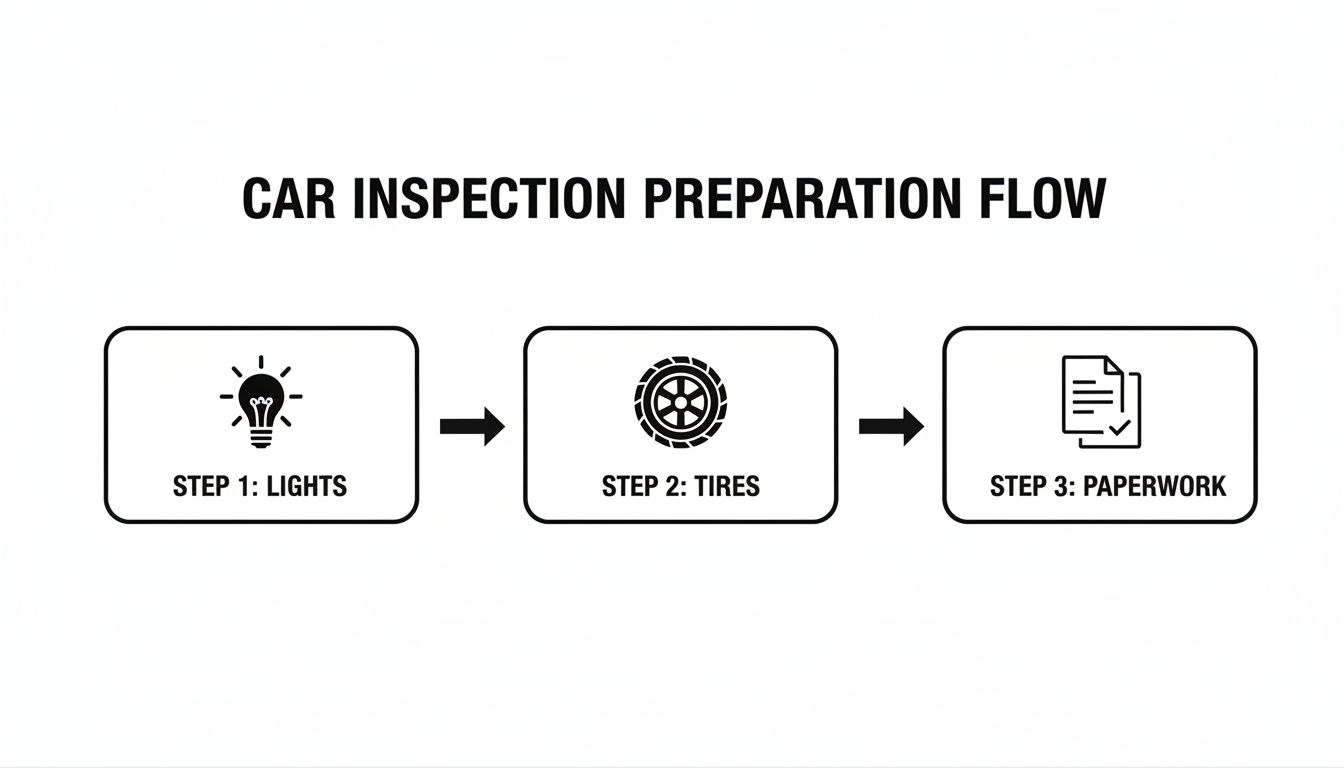
As you can see, taking care of the basics like lights, tires, and your paperwork can save you the time and headache of a failed inspection.
The Final Checks for Roadworthiness
The inspection doesn't stop there. We also give the exhaust system a full rundown, looking for leaks, cracks, or holes from the engine all the way back to the tailpipe. A leak isn't just noisy; it’s a pathway for dangerous carbon monoxide to seep into the car's cabin. The fuel system is also inspected for any leaks, which pose a serious fire hazard.
A proper inspection connects the dots between your car's mechanical condition and your safety on the road. Every single checkpoint, from the tires to the exhaust, answers one question: Is this vehicle truly safe to drive?
Finally, the wheels and tires get a thorough review. A technician confirms the tire pressure is correct, measures tread depth to ensure it's above the legal minimum of 2/32 of an inch, and looks for odd wear patterns that often point to alignment issues. They'll also check the wheel bearings for any looseness and make sure the windshield is clear of major cracks that could block your view.
Knowing what technicians look for can make the whole process feel less mysterious. For a deeper dive, especially if you're buying a used car, this guide on things to look for when inspecting a used vehicle offers some great pointers. It gives you an inside look at the inspection mindset.
Navigating Common Inspection Failures and Fixes
That sinking feeling when you see 'FAIL' on your inspection report is something no driver wants. Your mind probably goes straight to worst-case scenarios: huge repair bills and the headache of rescheduling everything. But a failed test from a good shop isn't a punishment—it's actually a clear, actionable plan to get your vehicle back to being safe and reliable.
Honestly, most failures aren't catastrophic. In my experience, they almost always fall into a few common, predictable categories. Knowing what to look out for, why it matters, and what the fix looks like can take a lot of the stress out of the process.
Think back to the old Drive Clean program. While that was about emissions, the data gives us a good idea of vehicle health in general. Back then, over 2.5 million cars were tested each year in the GTA, and the pass rate was around 92%. Those that failed? The culprits were almost always the same wear-and-tear items we see today: brakes, tires, and exhaust systems. You can even explore government reports on inspection programs to see how common these issues are.
The Most Common Culprits
When a car doesn't pass its safety check, it’s usually for parts that are simply designed to wear out. The whole point of an inspection is to catch these things before they become a real danger on the road.
Here are the top reasons we see vehicles fail day in and day out:
- Brake System Problems: This is, without a doubt, the number one reason. We see everything from brake pads and rotors worn past their minimum thickness to leaky brake lines. Sometimes it's a spongy pedal, which tells us there’s air in the system. Any one of these issues can seriously increase your stopping distance.
- Tire Issues: Your tires need at least 2/32 of an inch of tread to pass—no exceptions. We also fail tires for visible cracks, dangerous bulges in the sidewall, or funky wear patterns that often point to a bigger issue with alignment or suspension.
- Exhaust System Leaks: The road salt we use here in Whitby is absolutely brutal on exhaust systems. We're constantly finding rusted-out pipes, cracked manifolds, and blown muffler gaskets. A leak isn't just loud; it can let deadly carbon monoxide seep into your car's cabin.
- Suspension and Steering Component Wear: Worn-out ball joints, loose tie rods, and leaking shocks or struts are instant fails. These components are what keep your car stable and under control. Any "slop" or excessive play makes the vehicle feel unstable, especially at highway speeds.
From Failure to Fix
So, what’s the next step if we find one of these problems? A trustworthy mechanic won't just hand you a fail slip and wave goodbye. We’ll bring you into the shop, show you the worn-out part on your vehicle, and explain exactly why it’s a safety risk. Then, we'll give you a clear, detailed estimate for the repair.
A good shop's goal isn't to fail you—it's to make sure you're driving a safe vehicle. A failure is just the first step in a transparent repair process that gets you back on the road with confidence.
Let's say your brake pads are worn too thin. The fix is a straightforward replacement. A skilled technician can do the job right, giving you back the stopping power you rely on. You can learn more about what that involves in our comprehensive guide to brake repair in Whitby. In another common scenario, a leaky exhaust often doesn't require a full system replacement—we can typically fix it by replacing just the damaged pipe or component.
Understanding these common failure points helps take the fear out of your annual inspection. When you bring your car to an expert auto inspection station, you’re not just getting a pass or fail grade; you’re gaining a partner in your vehicle’s long-term safety.
Your Ontario Vehicle Inspection Questions, Answered
Getting your head around vehicle safety standards can feel a bit overwhelming, we get it. Even with the basics covered, a few questions always seem to pop up. We hear them all the time from drivers here in Whitby, so let's clear up some of the most common points of confusion.
How Much Does a Safety Inspection Cost in Ontario?
This is usually the first question on everyone's mind. There's no flat fee set by the Ministry of Transportation (MTO), so the price is up to the individual inspection station. Generally speaking, you can expect to pay somewhere between $120 and $150 for the inspection itself here in the Durham Region.
The key thing to remember is that this price only covers the inspection service. If the technician finds issues that need fixing to meet the safety standard, the cost of those repairs—parts and labour—is extra. Always ask what the inspection fee is when you book. No one likes a surprise bill.
How Long Is a Safety Certificate Valid For?
Once your vehicle passes the inspection, the technician will issue a Safety Standards Certificate (SSC). From that moment, the clock starts ticking: the certificate is valid for exactly 36 days.
This is a strict, non-negotiable deadline from the MTO. That 36-day window is your time to complete whatever transaction you need the certificate for, like finalizing the registration of a used car you just bought. If you let it expire, you have to start all over with a brand new, full-price inspection.
Do I Need an Inspection to Sell My Car Privately?
For most private sales, yes. In Ontario, the seller is legally on the hook for providing the buyer with a valid Safety Standards Certificate. It's a required part of the ownership transfer paperwork.
The main exception is if you sell the car "as is." This means the buyer is knowingly taking on the responsibility (and cost) of getting the vehicle inspected and certified themselves. If you go this route, it must be clearly written on the bill of sale to be legally binding.
Are All Mechanic Shops Licensed for MTO Inspections?
Nope, and this is a crucial detail. Your neighbourhood mechanic might be great at oil changes, but they can't issue a safety certificate unless they are an official Motor Vehicle Inspection Station (MVIS). These shops are registered under the government's DriveON program.
Licensed stations are easy to spot—they'll have a prominent green and white sign that says "Motor Vehicle Inspection Station." Before you book anything, double-check that the shop is licensed. It guarantees the certificate is legit and will be accepted by ServiceOntario without any headaches.
When you need an inspection you can count on, the expert technicians at Carmedics Autowerks Inc. are here to help. We believe in transparent, thorough inspections that put your safety first. Book your appointment with us today and get the peace of mind you deserve.