


You're sweating in the cab, the vents are pushing warm air, and the last thing you want is to start buying refrigerant on a guess. That's where most truck A/C repairs go sideways. The fastest way to fix truck air conditioner problems is to stop treating the compressor as the first suspect and start with airflow, electrical checks, and a proper system diagnosis.
Why Your Truck AC Fails and What to Check First
A hot cab can make a short run feel endless, especially in stop-and-go freight where the A/C has to fight heat soak, idle time, and constant load. The common mistake is to see warm air and assume the system just needs a recharge. In truck HVAC diagnostics, refrigerant loss is the most common failure mode cited across multiple truck-service sources, but that doesn't mean refrigerant is always the first thing to touch.
One fleet-oriented guide estimates refrigerant leaks or low charge at about 25% of summer HVAC problems, while another truck AC article says up to 40% of truck air-conditioning failures stem from inadequate refrigerant levels (Keynnect Logistics). The catch is that expensive compressor failures are often blamed when the primary issue sits elsewhere. A teardown analysis of 500 failed fleet truck AC compressors found that 92% of failures were caused by system issues like oil starvation, electrical resistance, or debris contamination, while only 8% were true manufacturing defects (RVAC Unit).
The diagnostic mindset that saves money
A technician doesn't condemn a compressor just because the cab is warm. Belt drive, clutch engagement, condenser airflow, and cabin-air restriction all get checked first because a blocked or underperforming system can mimic a low-charge complaint. That order matters even more in California, where long hot seasons and stop-and-go freight routes make cooling-demand spikes more likely.
Practical rule: If the system can't move heat out of the cab, adding refrigerant won't cure it.
That's why the right starting point is a full visual and functional check before any gauge set goes on the truck. If you want a broader refresher on how A/C service is approached on passenger vehicles, the process described in this air-conditioning overview lines up with the same diagnostic logic used on light trucks.
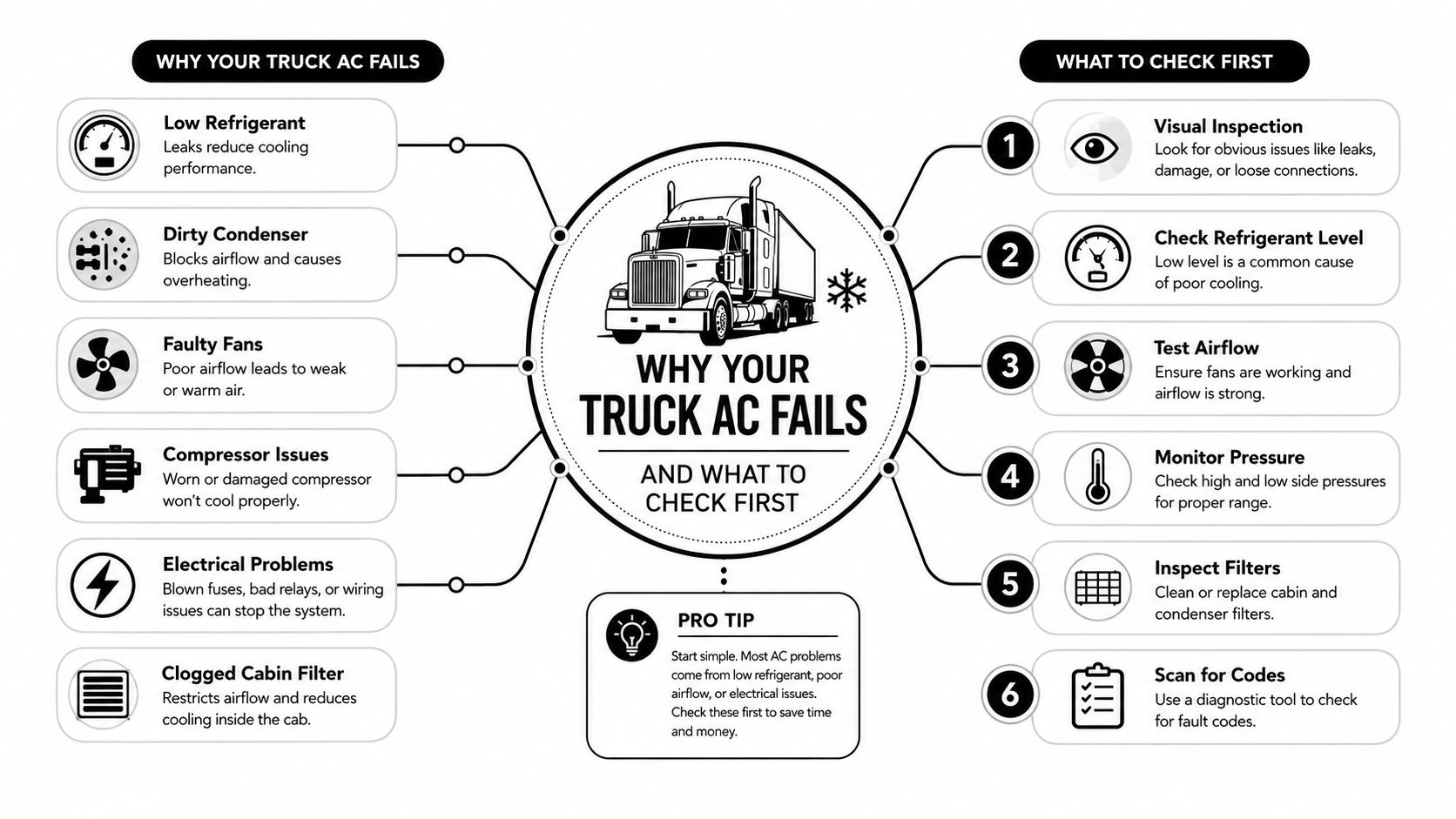
For DIY work, the odds shift in your favour. If the compressor is healthy but airflow is poor, you can spend a lot of money chasing the wrong fault. A slow leak, a dirty condenser, or an electrical control problem can all look like a “bad A/C” until you separate the system into parts.
For a quick diagnostic reference, the step-by-step deck board repair resource is a useful example of how a good troubleshooting flow breaks a job into verifiable steps instead of guesses.
Pre-Recharge Inspection Checklist for Truck AC Systems
Start with the simplest proof of failure, a vent thermometer. A healthy system should deliver vent air at least 30°F below ambient (Road Choice). If your truck is blowing air much warmer than that, you've confirmed a real cooling problem, not just a comfort complaint.
Check airflow before you blame charge
Look at the condenser first. Bugs, road grime, bent fins, or a dead fan can cut heat rejection hard enough to make a fully charged system seem underfilled. That's why airflow verification is the highest-value pitfall to avoid. A blocked condenser or failed fan can create the exact same symptom as a refrigerant leak.
Next, inspect the cabin air filter and the grille path feeding the HVAC box. If the filter is loaded with dust or debris, the evaporator may never get enough airflow to cool the cab properly. Then check the belt condition and tension, because a slipping belt can let the compressor spin without delivering stable performance.
If the truck cools a little at speed but struggles at idle, don't reach for the recharge kit yet. That pattern often points to airflow or fan control, not refrigerant.
Confirm clutch engagement and basic system response
Turn the system on and watch the compressor clutch. You're looking for engagement, disengagement, and any obvious chatter or delayed response. If the clutch never pulls in, the fault may sit in the control side, not in the refrigerant circuit.
Use a simple thermometer and your eyes before using refrigerant tools. That gives you a baseline and helps you avoid the common DIY trap of topping off a system that was never low. The job gets more expensive fast once you start treating symptoms instead of verifying the cause.
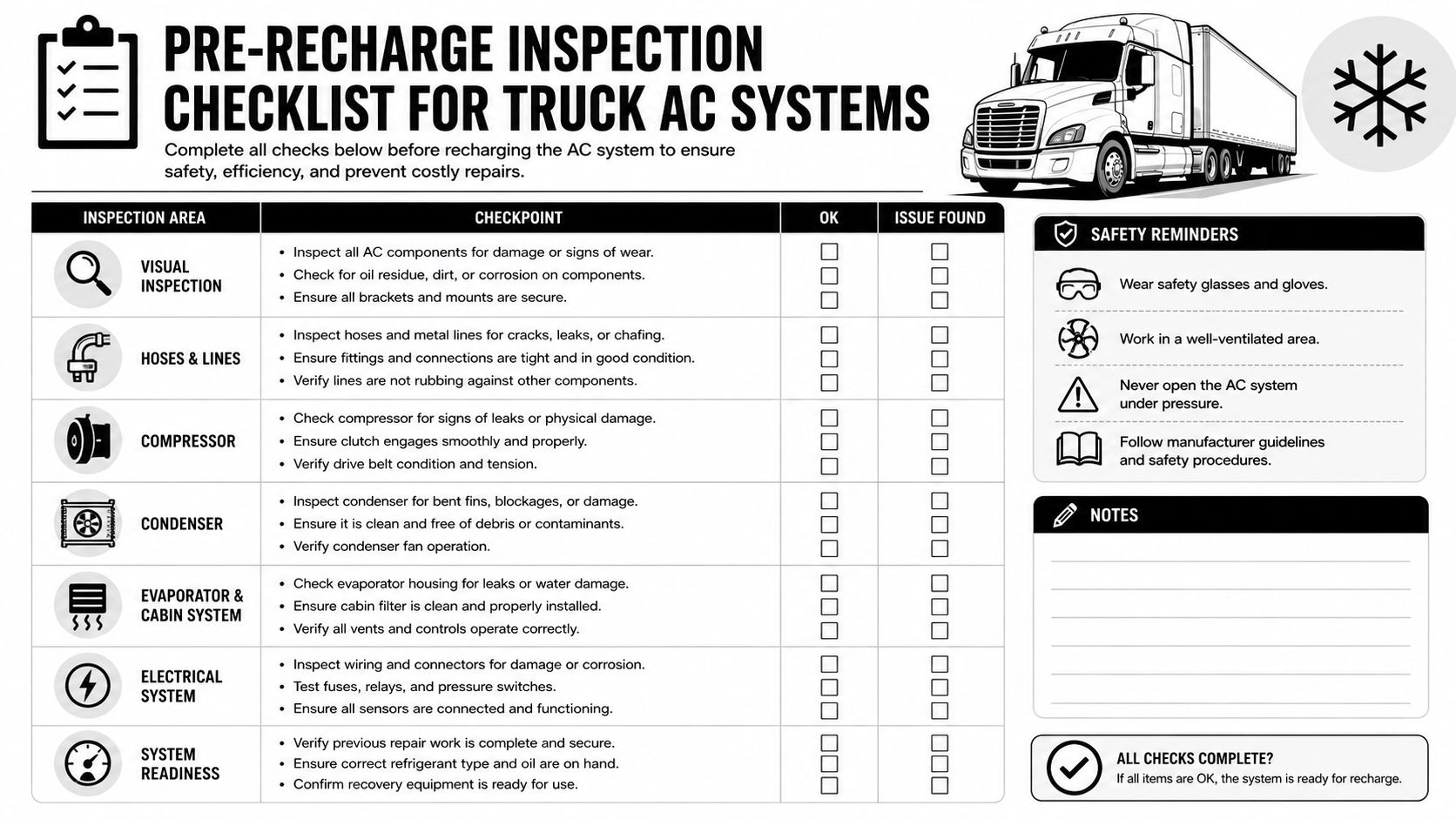
If the system passes these checks and still cools poorly, the next move is to confirm refrigerant-side behaviour. For a vehicle-level service reference, this air-conditioning service page is a useful reminder that a clean inspection sequence matters more than jumping straight to parts replacement.
Reading Manifold Gauge Pressures and Diagnosing Flow Problems
Gauge readings only help if you know what problem pattern you're looking at. High-side and low-side pressures work together, because one gauge alone can lie to you. That's especially true on truck systems where airflow, clutch cycling, and ambient heat all influence what the numbers mean.
What the readings are telling you
A low-low/low-low pattern usually points to undercharge or a leak. A low-low/high-high pattern suggests a restriction, while high-low/high-high usually pushes you toward compressor or condenser problems. The important part is not memorising a single “right” pressure, it's matching both sides of the circuit to the symptom on the truck.
On most vehicles made before 2018, refrigerant service commonly involves R-134a, while most newer vehicles use R-1234yf (Wilson Muffler). That matters because the refrigerant type, charge weight, and expected behaviour aren't interchangeable. If you guess, you can make a good system act worse.
Don't chase the low-side number alone
A common mistake is adding refrigerant until the low-side gauge “looks right.” That can hide the actual fault, especially if airflow is weak or the system has a partial restriction. Watch clutch engagement and the pressure relationship together, because the clutch may prove the system has reached minimum operating charge without you overfilling it.
Practical rule: A stable pressure pattern tells you more than a single gauge reading ever will.
If pressures are odd, inspect for visible leak points and use UV dye or an electronic sniffer if loss is suspected. That's the difference between a one-time correction and a repeat failure. Truck A/C work gets expensive when the wrong diagnosis sends you in circles.
Evacuating and Recharging Your Truck AC to Factory Spec
Once the system has been proven low or repaired for a leak, evacuation comes first. A vacuum pump needs to run for at least 30 minutes to pull out moisture and non-condensable gases (Road Choice). Skipping that step leaves contamination in the system, and contamination is one of the reasons a recharge doesn't hold up.
Recharge by weight, not by guess
The correct refrigerant charge is the manufacturer's exact specification, not “close enough.” Guessing creates high-side pressure problems and can mask the original fault. The right process is simple in principle, strict in practice, and unforgiving if you hurry it.
Use the correct refrigerant for the vehicle, then charge the system to the exact listed weight. After that, verify vent temperature in the same ambient environment where you tested it before. You're not looking for a random cold blast, you're checking for a stable pressure and temperature relationship after repair.
Verify success the way a tech would
Run the truck at idle and watch the clutch, vent temperature, and gauge behaviour together. If the system cools but the pressures drift oddly, something's still wrong. That could mean a leak wasn't fully found, airflow is still weak, or the charge is still off.
When a system loses refrigerant again after a top-off, that's a clue, not a coincidence. A simple refill can hide a leak and reintroduce air and moisture, which means the next failure may arrive faster than the first. If you're working on a truck in your driveway, use this step to decide whether the job is a recharge or whether the truck needs deeper leak diagnosis.
For a service-side reference point, this A/C repair pricing guide is useful when you're comparing the cost of doing it yourself versus handing the job to a shop with recovery and leak-testing gear.
When the Problem Is Not Refrigerant at All
A truck that cools on the highway but not in traffic usually isn't screaming “add refrigerant.” It's usually telling you the system can't shed heat at idle. Cooling fans, condenser airflow, and fan control all matter here, because highway speed can hide a problem that shows up the moment air movement drops.
Airflow and fan control failures
Check that both radiator and condenser fans cycle on with A/C engaged. If they don't, the system may be mechanically fine but unable to reject heat when the truck is stationary. A blocked condenser can do the same thing, which is why this complaint is so often misdiagnosed as a refrigerant issue.
That's also where a clogged or dirty front-end stack hurts you twice. It reduces heat rejection and can make gauge readings misleading. A truck can look low on charge when the actual fault is poor airflow through the condenser.
Electrical faults and cabin control problems
If the compressor clutch never engages, start with fuses, relays, and wiring resistance. Electrical control faults are common enough that they deserve a real diagnostic branch, not a guess. A weak connection can stop the compressor from operating even though the refrigerant charge is fine.
Intermittent failures after a repair often point to blend-door issues or sensor problems. If the air temperature changes unpredictably inside the cab, the refrigerant circuit may be working while the HVAC box is not directing air correctly. That's a different repair path entirely.
A truck that won't cool in one driving condition but works in another is often telling you where the fault lives.
For more advanced electrical diagnosis and control-side troubleshooting, a shop-level check through auto electrical repair in Whitby can save a lot of trial and error when the compressor itself isn't the issue.
DIY Repairs Versus Professional Shop Service and Costs
A DIYer can handle inspection, visual checks, filter replacement, and some basic diagnostics. Once the job involves refrigerant recovery, vacuum evacuation, leak testing, or compressor replacement, the tools and risk level climb fast. That's where shop service starts making more sense.
What the numbers say
Common A/C repairs are often in the $150 to $300 range for a recharge or leak-related service, while compressor-related work can jump to $500 to $1,200 or more. Some sources put heavy-duty truck compressor jobs at $1,000 to $2,500 (Keynnect Logistics). Those ranges show why replacing parts before diagnosing the system is a costly habit.
What a proper shop brings
A good shop brings recovery equipment, manifold gauges, nitrogen leak testing, electronic diagnostics, and the experience to separate airflow faults from refrigerant faults. It also brings accountability. If the truck leaves the bay still failing, the shop can trace the work back to the actual fault instead of just another guess.
For comparison shopping, this repair-cost page gives a useful sense of how service pricing is usually framed. In Whitby, Ontario, Carmedics Autowerks Inc is one option for air conditioning diagnosis and repair when the job goes beyond driveway tools.
When to stop at home
If the truck needs a filter, a basic visual inspection, or a clear airflow check, DIY makes sense. If it needs evacuation, refrigerant recovery, electrical diagnosis, or a compressor that may have failed from a system problem, hand it over. A failed compressor is rarely just a compressor problem, and the earlier sections show why.
If your truck's A/C still isn't cooling after the basic checks, bring it to Carmedics Autowerks Inc in Whitby for a proper diagnosis and repair plan. They handle auto air conditioning service alongside general repair work, so you're not guessing at the next part, you're getting the fault traced the right way.