

In local search, complete Google Business Profiles generate 7x more clicks than incomplete profiles and 70% more in-store visits according to Google Business Profile statistics. That's why google business profile optimization isn't a branding exercise for auto shops, it's a conversion system that turns a map listing into calls, messages, bookings, and drive-ins. For a Whitby repair business, the profile is often the first proof that the shop is real, active, and worth contacting.
The hard part is that most shops still treat the profile like a directory stub. They upload a logo, confirm the phone number, and stop there, even though Google's own dashboard tracks the actions that matter most, including calls, website clicks, messages, bookings, and search terms through the same performance signals highlighted in local profile statistics. For a driver searching “collision repair near me” or “window tinting Whitby,” that gap is the difference between being found and being ignored.
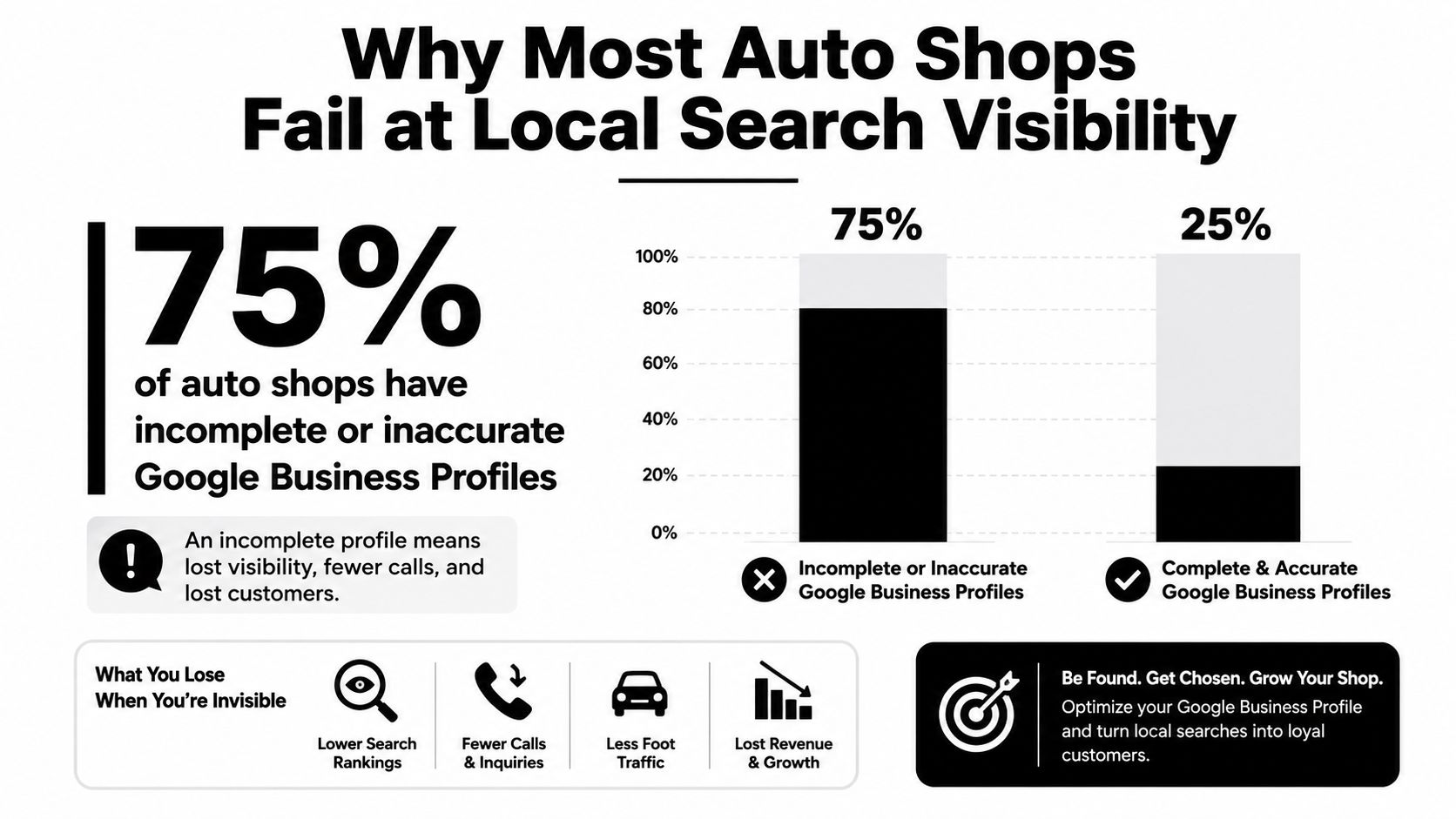
Why Most Auto Shops Fail at Local Search Visibility
The local search gap is bigger than most owners realise. Only 11% of local businesses describe their profiles as fully optimised in the profile optimisation breakdown. The rest are split between partial setup, inconsistent management, or no active management at all, which means a huge share of competitors are leaving easy signals on the table.
For auto shops, that failure usually looks boring on the surface. The listing exists, but the category is too broad, the hours are stale, the service list is thin, and the photo gallery says nothing about the work the shop wants to sell. A Whitby driver comparing collision repair options on mobile won't study that profile out of curiosity, they'll scan it for trust and move on fast.
Visibility without completeness is weak visibility
Google's local ecosystem rewards profiles that are complete and correct, because customers act on what they see right inside search and Maps. The same profile can drive a call, a website visit, or a booking without the user ever landing on the site, which makes the listing a direct revenue channel rather than a passive citation. That's especially relevant in Canada, where Google dominates local discovery and profile completeness has a measurable impact on in-store behaviour as shown in the local discovery statistics.
Practical rule: if the profile doesn't clearly answer “what do you do, where are you, and how do I book,” it's underperforming.
That matters more for an auto service business than for many other local categories, because the buyer intent is usually specific. Someone shopping for tinting wants to see tinting. Someone looking for PPF wants evidence of film work, not generic car photos. Someone comparing collision repair wants proof the shop handles structural and cosmetic work, not just oil changes.
For local owners in Whitby, the cost of a weak profile is lost short-listing. Drivers don't usually compare ten shops in detail, they compare a few strong-looking ones and choose the one that feels easiest to trust. If the listing is incomplete, it drops out of that first decision set.
This guide to choosing a car repair shop near me is useful because it mirrors what customers do when they search. They look for signals, not promises. That's exactly why the profile has to be treated like a measurable storefront, not a digital brochure.
Auditing Your Entity Data Before Adding Content
Before adding photos, posts, or polished copy, the profile needs a clean entity-data layer. That means the business name, address, phone number, website URL, categories, services, and hours all need to match across surfaces. Google's own guidance says complete and correct profile information matters more than keyword stuffing, and it also stresses using a valid staffed address and accurate hours rather than promotional wording in its business profile help documentation.
For auto shops, this layer decides whether Google sees one clear business or a messy set of signals. A Whitby shop that lists tinting on one page, PPF on another, and collision repair somewhere else, but uses slightly different names, phone numbers, or addresses across citations, makes the profile harder to trust. That hurts before any new photo or service post has a chance to help.
The same problem shows up on the customer side. A driver comparing shops for window tinting or paint protection film is looking for a specific service, a real location, and a clear way to book. If the profile data is inconsistent, the shop looks less established, even if the work is strong.
Audit the core fields first
Start with the profile as the source of truth, then compare it against the website and major citations. The name should be the actual business name, not a name padded with keywords. The address should be valid, staffed, and formatted consistently. The phone number should be the same one customers see elsewhere, and the website should point to the most relevant page for the location, such as the Whitby shop page.
Here's the order I use when cleaning up an auto shop profile:
- Business name: keep it exact, because keyword additions can create guideline issues.
- Address: confirm the listing is a real customer-facing location, not a loose approximation.
- Hours: verify normal hours and update special hours before holidays or closures.
- Phone number: use one main number everywhere so calls don't fragment across sources.
This isn't busywork. It keeps the profile from conflicting with itself. Once the entity data is clean, the shop can add services, photos, and updates without sending mixed signals to Google or customers.
The category set belongs in the same audit pass. If the profile says one thing and the service menu says another, relevance gets muddy. For a Whitby business, that could mean a shop that does tinting and PPF but still reads like a generic repair garage, which misses the search intent of people looking for specialty work.
A quick check of the website and location page should confirm the same business identity in both places. The profile and the site should feel like one operation, not two versions of the same shop trying to speak separately.
Choosing Categories and Writing Descriptions That Rank
Category choice shapes the searches a profile can qualify for. A primary category that is too broad pushes a shop toward generic visibility. One that is too narrow, or mismatched, can keep the business out of the searches it wants, including tinting, PPF, or collision repair.
For an auto business, the cleanest setup usually starts with the category that matches the main revenue line, then adds secondary categories that reflect real services. That keeps the profile from saying only, “we fix cars,” and instead tells Google what kind of work matters most. A shop that handles window tinting, paint protection film, and collision repair needs category logic that reflects those services, not just general repair.
A good category set also has to match the entity data on the rest of the profile. If the services, photos, and landing pages point in one direction, but the category set points somewhere else, the listing gets harder to trust. That mismatch shows up fast in Whitby markets where a shop does specialty work but still presents itself like a generic garage.
Use the description to clarify, not to sell
Google gives 750 characters for the business description, but the first 250 characters carry the most weight because they appear first before the truncation point according to profile optimisation guidance. The opening should read like a clean identity statement, not a slogan. Lead with the primary service, Whitby location, and the core niche, then use the rest of the space for differentiators and proof.
A workable pattern looks like this:
- First 250 characters: primary service, Whitby location, and the core niche.
- Middle section: specialisms like PPF, tinting, or collision repair.
- Final section: practical proof, such as experience, equipment, or service breadth.
Treat the description like a compact entity summary. Promotional copy gets in the way, and it usually weakens the profile because the language no longer matches the services, reviews, photos, and updates around it. A description that reads clearly is easier for customers to trust and easier for Google to interpret.
Attributes and service labels deserve the same level of care. They help the profile fit filtered searches and niche intent. If a shop handles fleet maintenance as well as consumer repair, that should be visible in the profile structure instead of buried somewhere on the website.
A quick reference point is the Whitby auto service and location page. The page shows the kind of alignment that works better than a generic one-paragraph blurb. A user should be able to tell quickly what the business does, where it operates, and which services are worth calling about.
Structuring Services and Visual Content for Auto Repair
A strong service menu does more than list capabilities, it maps intent. If a driver searches for collision repair, the profile should surface collision repair. If someone is comparing tinting options, the profile should present tinting clearly, with visual proof that supports the decision. That one-to-one alignment between search intent, listing content, and landing page content is where many shops leave money on the table.
In Whitby, the service path changes with the job. A parking lot scrape leads to a collision repair question. A new vehicle owner looking to protect paint before winter road grit starts hitting the finish is asking about PPF. Those are different jobs, different worries, and different conversion paths, so they should not be lumped into one generic services bucket.
Match each service to a landing page
The cleanest setup is straightforward. Each core service in the profile should have a dedicated landing page on the site, and the page should use the same language as the profile entry. That gives Google a consistent signal and gives the customer a direct path from search to answer to booking. It also keeps the shop from sending every visitor to a catch-all page that forces them to hunt for the right service.
A practical auto shop structure often looks like this:
- Window tinting: one service entry, one page, one set of photos.
- Paint protection film: one service entry, one page, one before-and-after gallery.
- Collision repair: one service entry, one page, one explanation of process and turnaround expectations.
Practical rule: if a service deserves its own phone call, it deserves its own page.
That same logic applies to the visual library. Photos should show the work in progress, the clean bay, the finished result, and the kind of vehicle the shop services. For tinting and PPF, before-and-after shots do real work because they reduce uncertainty. For collision work, the shop should show repair stages, panel alignment, and the finished car from multiple angles. In real shop audits, that mix of images usually does more than a polished banner ever will.
A good photo gallery answers the questions a nervous buyer won't always say out loud.
Short videos help too, especially when they show the car in the bay, film being applied, or a repaired panel under good light. The goal isn't cinematic polish. The goal is credibility. A real photo shot in the service bay usually beats a stock image because it proves the shop handles actual vehicles, not just marketing assets.
For service alignment across the site, the finding a car mechanic guide is a useful reference point. The same structure can support specialty work like tinting and PPF without making the profile feel cluttered.
Building Reviews and Engagement That Sustain Rankings
A profile can look complete on day one and still fade fast. Reviews, owner replies, posts, and Q&A activity are what keep it relevant after launch, especially for auto shops that need to show real work instead of polished claims. Google's local tools reward a business that appears active and useful, and customers trust a profile that reads like a working shop, not a listing left alone.
For Whitby auto service profiles, the review path should follow the job itself. A tint customer leaving after a clean pickup, a PPF client who can see the finished edges on the vehicle, or a collision customer who has just reviewed the repair with the advisor is far more likely to respond. That timing matters more than any scripted ask. Keep the request simple, and make it specific enough that the customer understands which experience you want them to describe.
A stronger profile also depends on what the review content supports on the rest of the listing. If the shop is trying to rank for tinting, PPF, or collision repair, the reviews should reflect those services in plain language. That makes the entity-data layer clearer, because Google can connect the service names people mention with the service entries and landing pages already in place. For a local shop, that connection usually carries more weight than generic praise.
Use responses to reinforce confidence
Owner replies should sound like the shop itself. Short, specific, and calm works best. A reply that names the service, thanks the customer, and acknowledges the outcome feels real. A long branded statement usually does not.
Negative reviews need a steadier tone. Address the concern without arguing, keep the facts clear, and move the conversation offline if there is a detail to resolve. The public reply is not the place to relitigate the job. It is the place to show that the shop pays attention and does not hide when a problem shows up.
A practical response pattern looks like this:
- Positive review: thank the customer by name and mention the service they used.
- Negative review: acknowledge the concern, avoid defensiveness, and invite offline contact.
- Suspicious review: respond professionally while you evaluate whether it needs to be flagged.
Posts can support that same trust work, but only if they reflect actual shop activity. Service spotlights, seasonal maintenance reminders, and before-and-after showcases usually make more sense than broad promotional updates. A post about fresh tinting work or a completed PPF install gives the profile a clearer job focus than a generic company message, because it shows the kind of work the shop wants to attract.
The Q&A section is often ignored, and that leaves easy trust signals on the table. Seed it with the questions customers already ask about estimate flow, service scope, and product-specific details such as tint grades or film differences. Answer plainly. Avoid filler. A direct answer does more for confidence than a polished but vague paragraph.
Messaging and booking options matter for the same reason. Many customers comparing shops from a parking lot or driveway do not want to call right away. They want a quick way to ask about availability, pricing range, or whether a tint, PPF, or collision job fits the shop's workflow. If the listing gives them that path, they are less likely to leave before making contact.
This guide to finding a car mechanic matches that behavior because it mirrors how people compare trust signals before they commit. Reviews, replies, and quick interactions are not decoration. They shape the decision.
Tracking Performance and Maintaining Your Profile Monthly
The profile should be managed like a live asset. Google's performance dashboard tracks the actions that matter for a local service business, including calls, website clicks, messages, bookings, and search terms through the same measurement framework noted in the local profile statistics. That means optimisation can be checked against actual customer behaviour instead of guessed from rankings alone.
The most useful data point is usually the search term list. It shows what people typed before finding the profile, which can reveal service demand the shop isn't presenting clearly enough. If people are finding the listing for a service that's underdeveloped on the profile, that's a signal to tighten the service entry, photo set, or landing page.
Use a monthly rhythm instead of random updates
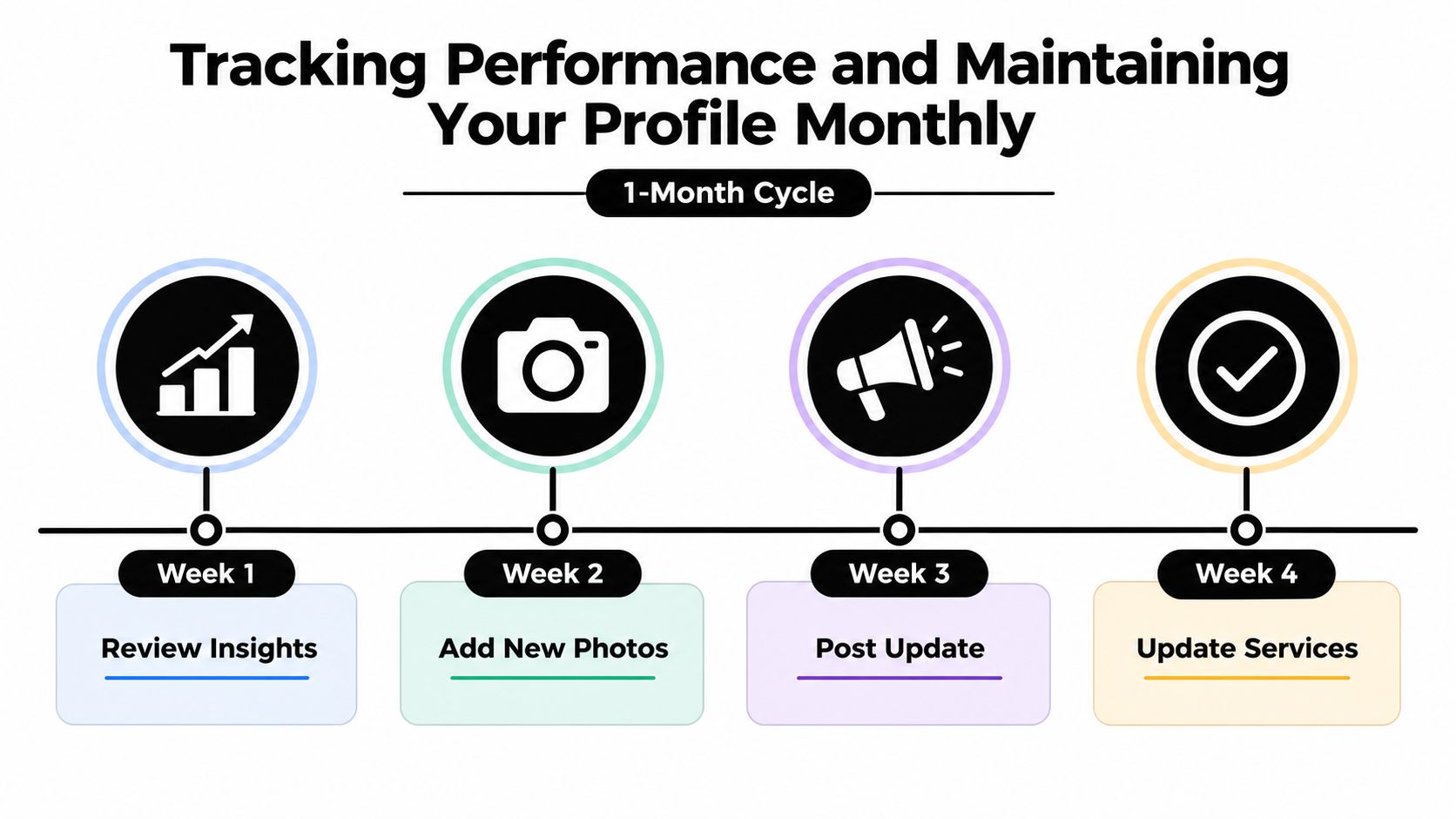
A sustainable profile needs recurring maintenance, not occasional attention. Weekly photo uploads, regular posts, and quick Q&A checks keep the listing fresh. Monthly, the service menu and review responses should be reviewed for accuracy and tone. Quarterly, the category fit and citation consistency deserve a deeper audit.
Local citations still matter because they reinforce the same entity data across the wider web. If the business name, address, or phone number drifts across directories, the profile has to work harder to prove itself. Keeping those details consistent makes the Google listing easier to trust and easier to connect with the website.
The fleet maintenance page is a good reminder that service menus can shift as a business grows. If a shop adds or removes service lines, the profile has to be updated with the same discipline. A stale service menu makes the profile look abandoned, even when the business itself is busy.
A simple maintenance cadence keeps the whole system from sliding backward:
- Weekly: add a photo, publish a post, and check new questions.
- Monthly: review Insights, confirm services, and answer every new review.
- Quarterly: compare categories, citations, and competitor profiles.
That routine turns google business profile optimization into a habit, not a project. For an auto shop, that's the difference between a listing that fades and a listing that keeps generating calls.
Carmedics Autowerks Inc offers Whitby drivers general auto repairs, fleet maintenance, window tinting, paint protection film, and collision repair, all from a team that understands how local trust starts online and finishes in the service bay. If you want a shop that takes both vehicle care and profile credibility seriously, visit Carmedics Autowerks Inc and see how a well-run auto business should present itself to local searchers.