


You're in Whitby, it's the first proper hot day of the season, and the cabin feels like it's been parked inside a greenhouse. You start the car, turn the fan up, hit the A/C button, and wait for that cold blast.
Instead, you get warm air.
That's the moment most drivers ask the same question. What's this going to cost me? And the frustrating answer is that car air conditioning repair cost can be modest for one fault and substantial for another, even when the symptom feels identical from the driver's seat.
A weak charge, a leaking seal, a damaged condenser, a failing compressor, moisture in the system, the wrong refrigerant, or an electrical control issue can all produce “my A/C isn't cold”. The invoice depends on which of those is happening, how long it's been happening, and what your vehicle uses for refrigerant.
That's why the most useful way to look at air conditioning repair cost isn't as a generic price list. It's as a chain of decisions. Diagnose properly. Identify the underlying fault. Match the repair to the vehicle. Avoid paying twice for a temporary fix.
That First Hot Day When the A/C Fails
The calls usually start as soon as the temperature swings up. A driver has gone all winter without thinking about the A/C. Then one warm commute, one school run, or one weekend trip down the 401 makes the problem impossible to ignore.
At first, people hope it's something minor. Maybe the system just needs a recharge. Maybe it will “kick in” if they drive a little longer. Maybe the air only feels warm because the car was sitting in the sun.
Then the pattern becomes obvious. The air never really cools. The vents might blow hard, but the temperature stays wrong. Or the cooling fades every time the car sits at idle.
Practical rule: If your A/C has stopped cooling on the first hot day, don't assume the cheapest fix. Warm air is a symptom, not a diagnosis.
That's where a lot of confusion starts. Online price lists make it sound simple, but real vehicles don't fail in neat categories. Two cars can arrive with the same complaint and need completely different repairs.
For Whitby drivers, the smart move is to have the system checked before the hottest stretch of summer hits. A proper car mechanic in Whitby should be looking at system pressure, refrigerant condition, visible leaks, clutch or compressor operation, cooling fan behaviour, and whether the car is even requesting A/C properly through the controls.
The driver who understands that process usually makes better decisions. Instead of chasing the lowest number, they ask the right question. What am I paying for, and does it solve the actual problem?
Anatomy of Your Car's A/C System
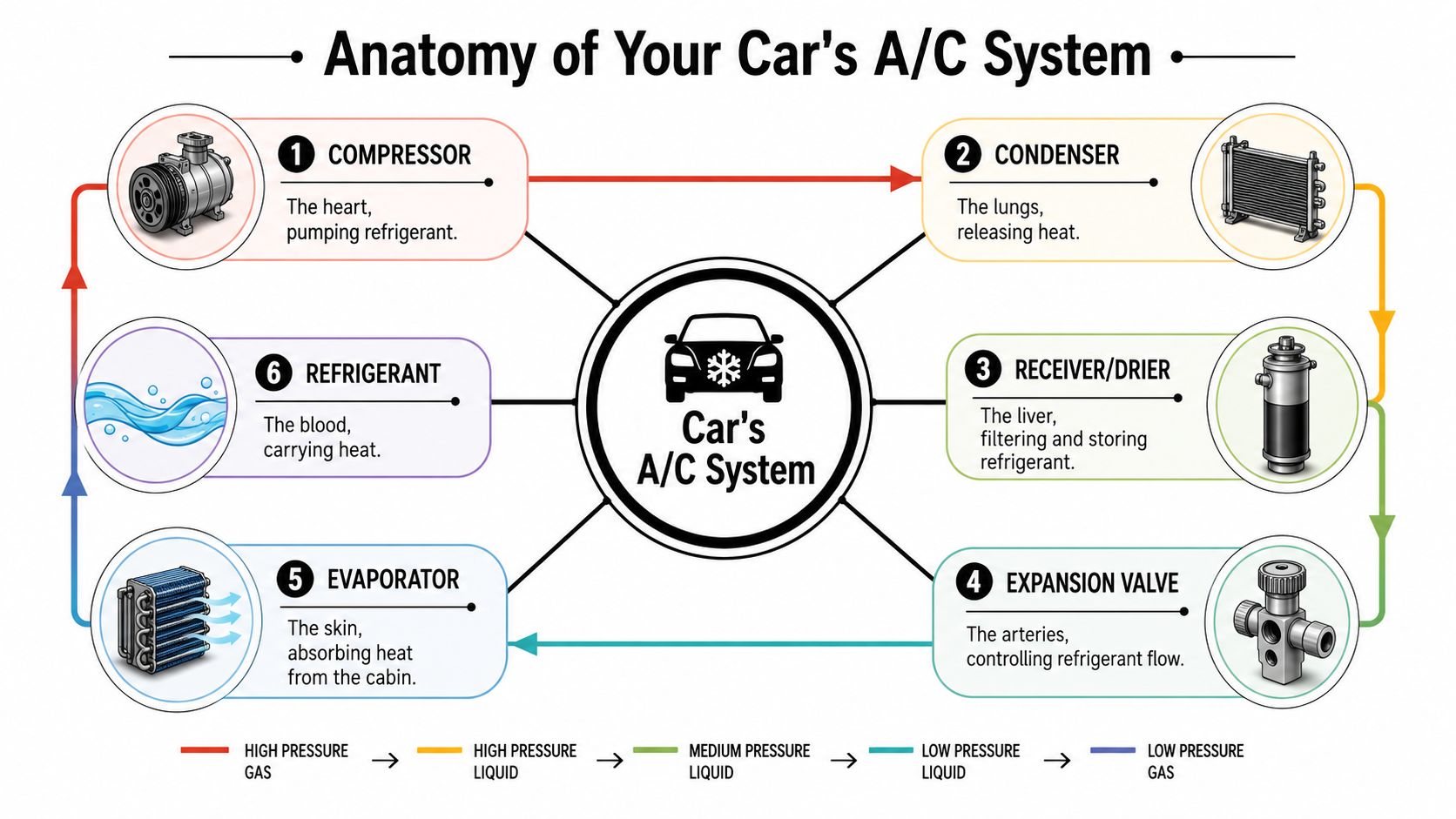
A car's A/C system makes more sense when you stop thinking of it as a mystery box and start thinking of it as a sealed circulation loop. It works a lot like a body moving blood through organs that each do a specific job.
The parts that matter most
The compressor is the heart. It pumps refrigerant through the system under pressure.
The condenser sits near the front of the vehicle and sheds heat. Think of it as the part that releases unwanted heat to the outside air.
The evaporator lives deeper in the dash area. That's where cabin heat gets absorbed, which is what creates the cold air you feel through the vents.
The expansion valve or metering device controls flow. It helps the refrigerant change pressure at the right point in the cycle.
The receiver/drier or accumulator filters and manages refrigerant, while also helping keep moisture out of the system. Moisture is bad news in A/C work because it contaminates the sealed circuit and affects performance and component life.
Why a small problem can become a large bill
A/C systems are sealed. If refrigerant is low, it usually means it escaped somewhere. That's why “just top it up” often doesn't hold for long.
A tiny leak can sit in an easy spot like a service port seal, or it can hide inside a hard-to-reach component. Access changes everything. A condenser at the front is one kind of job. An evaporator buried behind the dash is a very different one.
That's also why professional car air conditioning repair starts with diagnosis, not guesswork. Replacing the wrong part because the symptom looked familiar is one of the most expensive mistakes in this category of repair.
Typical Auto A/C Repair Costs in 2026
The cleanest benchmark available comes from Kelley Blue Book. It reports the average cost of car A/C repair at $384 to $445, with a common A/C recharge at $239 to $281, while compressor replacement averages $1,546 to $1,705 according to Kelley Blue Book's car A/C repair cost guide.
Those figures are useful because they show the spread between routine service and major component failure. They are a benchmark, not a promise for every vehicle in Whitby. Local labour, vehicle design, refrigerant type, and part quality all affect the final invoice.
Estimated car A/C repair costs in 2026
| Service | Typical Cost Range (CAD) |
|---|---|
| A/C system diagnosis and performance check | Varies by shop and vehicle |
| Refrigerant recharge | Around the benchmark recharge range once converted and adjusted for local factors |
| Leak detection service | Varies by fault, test method, and time required |
| Compressor replacement | Often aligns with or exceeds benchmark major repair levels |
| Condenser replacement | Varies widely by vehicle and access |
| Evaporator core replacement | Often among the highest-cost repairs because of labour intensity |
The reason some rows stay qualitative is simple. A diagnosis fee, leak search, condenser replacement, or evaporator replacement can't be stated accurately with a single number here unless verified data exists for it. In the shop, these jobs vary sharply.
What the benchmark does and doesn't tell you
A recharge price sounds straightforward, but it only solves the problem if the refrigerant level dropped for a manageable reason and the rest of the system is healthy. If there's an active leak, a recharge can restore cooling temporarily while the refrigerant escapes again.
A compressor replacement is the opposite. It's a clear example of a repair that quickly moves into major-expense territory. On many vehicles, once the compressor has failed, the repair may also require more system cleaning, more parts consideration, and stricter contamination control.
If the quote seems much higher than you expected, ask which part failed, how the technician confirmed it, what refrigerant your car uses, and whether the system showed signs of leakage or contamination.
For practical planning, think in tiers:
- Lower-cost work: Performance checks, minor diagnosis, and some straightforward recharge situations.
- Mid-level work: Leak detection and accessible component replacement.
- High-cost work: Compressor failure and repairs involving deep dash access or extensive contamination concerns.
If you're comparing quotes from a general auto repair shop, make sure each estimate describes the same scope. One quote might cover diagnosis only. Another might include refrigerant handling. Another may already assume a part replacement. Comparing a one-line estimate to a detailed one usually creates more confusion, not savings.
Key Factors Driving Your Repair Cost
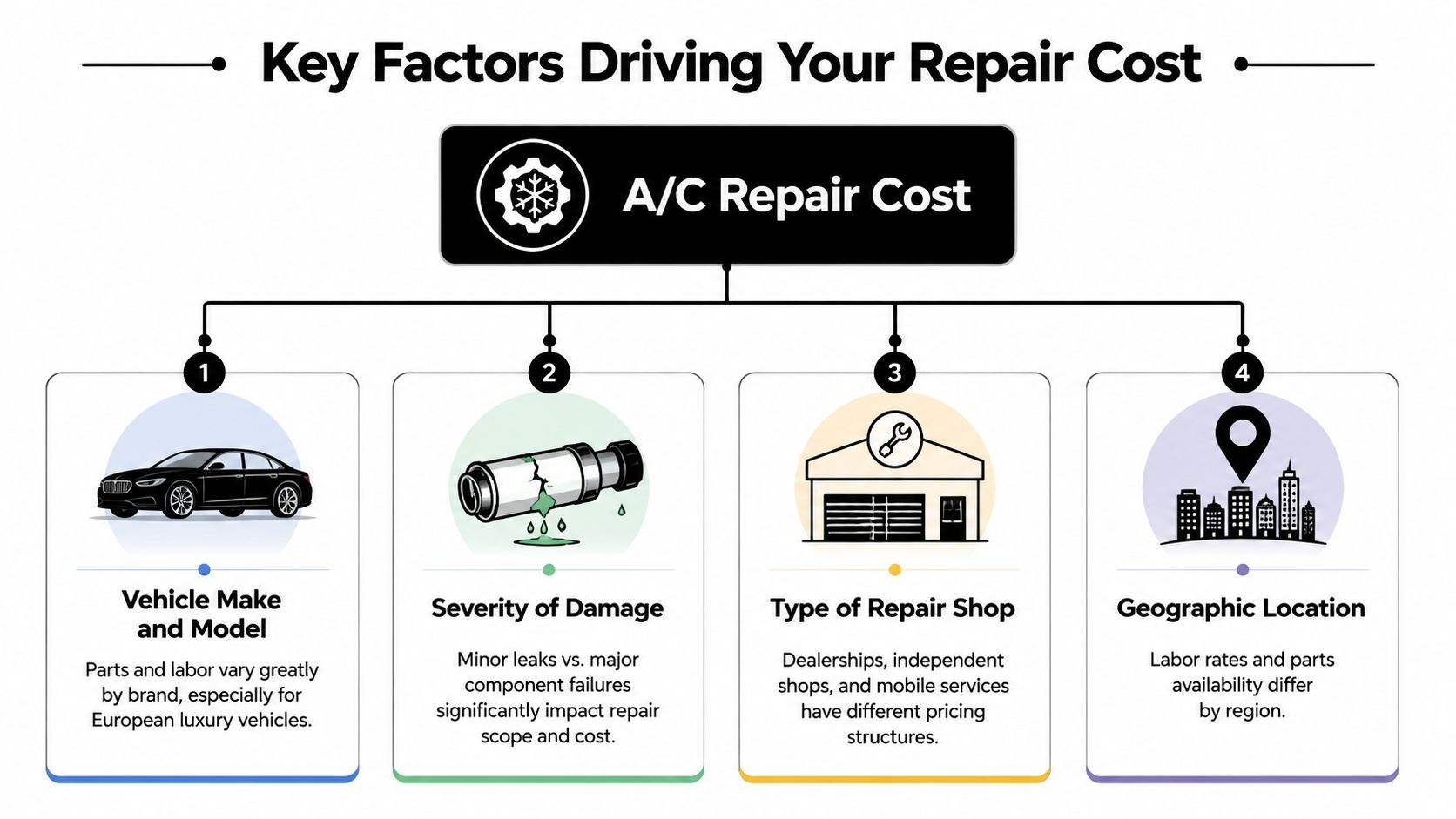
The biggest mistake drivers make is assuming the part itself is the whole story. In A/C work, diagnosis, refrigerant, access, and labour time can matter just as much as the component name on the invoice.
Refrigerant type changes the math
One of the least understood cost drivers is refrigerant type. Older systems commonly use R-134a. Newer vehicles increasingly use R-1234yf, and that matters because the refrigerant itself can become a major part of the bill.
As noted in Trane's discussion of air conditioning repair cost, the cost of refrigerant has become a major variable, and newer systems using R-1234yf can make what looks like a simple recharge surprisingly expensive. For a driver, the key point is practical. Two recharges are not equal if the vehicles use different refrigerants.
Vehicle design matters more than most people expect
A compact commuter car, a German luxury vehicle, and a newer SUV may all need an A/C repair, but they won't consume the same labour time or parts budget.
Some cars place major components where they're relatively easy to reach. Others bury them under trim, structural pieces, or much of the dashboard. A technician may need substantial teardown time just to confirm the fault and gain access.
That's why a quality estimate should separate:
- The failed part
- The labour needed to reach it
- The refrigerant required
- Any supporting items needed to complete the repair properly
A lot of owners also ask whether aftermarket parts make sense. In some cases they do. In others, fitment, durability, or system sensitivity makes the decision more complicated. In such cases, a clear conversation about OEM vs aftermarket parts matters more than broad rules.
Labour and diagnostic skill are real costs
Shops don't charge only for the wrench time you can see. A/C diagnosis requires equipment, training, refrigerant handling procedures, and enough experience to avoid replacing parts by guess.
That's especially important with intermittent complaints. If the system cools sometimes, loses performance at idle, or stops working only under certain conditions, the technician has to reproduce the fault and verify the cause. That takes time, and time is part of the repair cost.
Shop-floor reality: The cheapest quote is often the one that skips the hardest part, proving what failed before parts go on the car.
Warning Signs Your Car's A/C is Failing
Most A/C failures don't start with total shutdown. They start with clues that are easy to ignore until the cabin gets unbearable.
The symptoms drivers notice first
Warm air from cold settings is the obvious one. But pay attention to whether the air is always warm or only warm at idle, in traffic, or after the car has been running a while. That pattern can help narrow the fault.
Weak airflow is different from poor cooling. If barely any air comes out of the vents, the issue may involve the blower, a blockage, the cabin filter area, or an evaporator-related airflow restriction rather than a straightforward refrigerant problem.
Strange noises with the A/C on deserve attention quickly. Clicking, rattling, squealing, or grinding can point toward compressor or pulley trouble, and those faults tend not to improve with waiting.
The signs people dismiss
A musty smell from the vents often means moisture and contamination around the evaporator area. It may begin as an air quality complaint, but it still affects how the system performs and how comfortable the cabin feels.
Water inside the cabin is another one. Drivers sometimes think it's a weather seal issue when the evaporator drain is the actual problem.
Watch for these combinations:
- Cold air that fades: Often points to a deeper performance issue, not just a one-time low charge.
- Noise plus weak cooling: Raises concern about compressor-related trouble.
- Bad odour plus poor airflow: Suggests the problem may involve more than refrigerant level alone.
The earlier you bring those symptoms in, the more likely the repair stays targeted. Waiting often means the original fault is joined by a second one.
Smart Ways to Save on A/C Repair Costs
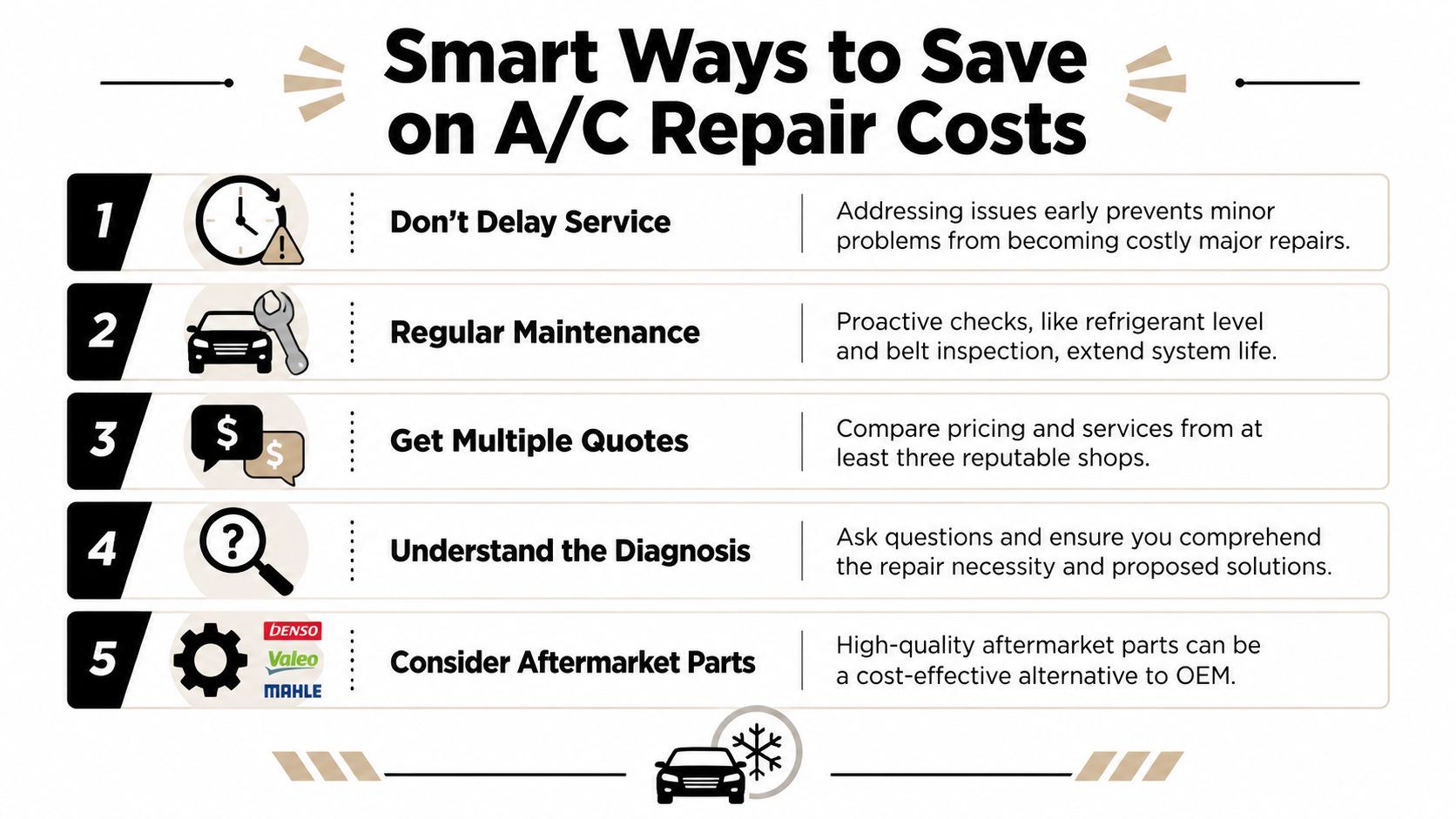
The cheapest A/C repair is usually the one that happens before the system forces your hand in the middle of a heatwave. Saving money here has less to do with bargain hunting and more to do with timing and discipline.
What works
- Deal with weak cooling early: If the air has started getting less cold, don't wait for complete failure. A small leak or performance issue is usually easier to isolate before the system is empty or a major component has been stressed.
- Run the A/C through the year: Even in cooler months, turning it on periodically helps keep seals lubricated and keeps you aware of changes in performance.
- Ask for a proper written quote: You want the diagnosis, parts list, refrigerant type, labour, and any extra fees explained clearly.
- Book scheduled service when possible: Planned repairs are almost always easier to manage than urgent same-day breakdowns.
- Understand the repair goal: Temporary cooling and a complete fix are not the same thing. Make sure you know which one you're authorising.
What doesn't work
Chasing the lowest phone quote rarely works because A/C repairs are hard to price accurately before inspection. If one shop says “it probably just needs gas” without seeing the vehicle, that isn't meaningful certainty.
Waiting for the hottest week of the year also tends to backfire. The principle of an emergency premium is well established in service work. As discussed in Angi's HVAC repair cost article, urgent timing can increase costs because emergency scheduling and secondary damage turn manageable repairs into bigger expenses. The same logic applies to cars. A problem that could have been booked calmly can become an urgent repair when you suddenly can't tolerate the drive.
Scheduled diagnosis almost always beats panic repair. Timing is one of the few cost variables a vehicle owner can control.
There's also value in using a shop that explains findings clearly. For example, Carmedics Autowerks Inc can inspect the system, identify the fault, and provide written repair options so the owner can decide whether a short-term fix or a full repair makes more sense for the vehicle's age and condition.
DIY Recharge Kits vs Professional Service
DIY recharge kits are tempting because they offer a fast, low-effort answer to a miserable problem. The can goes on, the gauge gives you a reading, and the hope is that cold air returns in a few minutes.
Sometimes it does. That doesn't mean the problem is solved.
Why DIY appeals to people
The attraction is obvious. It feels cheaper than booking a shop visit, and for someone comfortable doing basic maintenance, it seems no different than topping up another fluid.
Some minor car tasks are perfectly reasonable to handle at home. If you want a useful comparison of what belongs in the DIY category and what doesn't, this guide on car issues you can fix is worth reading.
Where DIY kits go wrong
A/C systems are not a casual top-up system. They are sealed, refrigerant-specific, and sensitive to charge amount.
Here's where owners get burned:
- Wrong refrigerant risk: If you don't know whether the car uses R-134a or R-1234yf, you shouldn't be adding anything.
- Overcharging the system: Too much refrigerant can hurt performance and add stress.
- Leak still unresolved: If refrigerant escaped, there's a reason. Adding more treats the symptom.
- Sealant contamination: Some retail products contain additives that can create bigger problems in professional service equipment and system components.
- Moisture left in the system: Proper A/C service includes recovery, vacuum, and precise recharge. A can from the parts store doesn't replace that process.
Professional auto air conditioning service uses dedicated equipment to recover refrigerant, measure charge accurately, remove moisture under vacuum, and verify whether the system is holding pressure and cooling properly afterward.
That's the difference between making the vents feel cold for a short time and repairing the system in a way that lasts.
Your Trusted A/C Repair Partner in Whitby
By the time most drivers look up air conditioning repair cost, they're already uncomfortable, short on time, and worried they're about to overpay. The best protection against that isn't a miracle coupon. It's a diagnosis that tells you exactly what failed, what it takes to fix it, and which options are worth your money.

What a good A/C visit should feel like
You should be able to ask simple questions and get straight answers.
What refrigerant does my vehicle use?
What test confirmed the fault?
Is this a recharge, a leak repair, or a component replacement?
If I delay it, what's the risk?
Those answers matter more than a vague promise to “get it cold again”. Good A/C work is methodical. The technician checks system behaviour, verifies pressures and operation, inspects for leakage, and avoids replacing expensive parts without proof.
Why local context matters
Whitby drivers deal with stop-and-go traffic, hot parking lots, highway driving, and family use that puts a premium on dependable cabin cooling. A car that's uncomfortable in spring becomes miserable in midsummer.
That's why clear communication matters as much as technical skill. If a shop can show you what it found and explain the trade-offs in plain language, you're in a much stronger position to approve the right repair and skip the wasted spend.
If your A/C is blowing warm, cycling oddly, making noise, or fading when you need it most, don't wait for the problem to force an emergency decision.
If your vehicle's A/C isn't keeping up, book an inspection with Carmedics Autowerks Inc. You'll get a clear assessment, a written explanation of the repair path, and practical guidance based on what your car needs.