


You’re probably reading this while thinking about the next cold morning in Whitby. The car sits outside, the windshield ices over, and you’re weighing two options. Spend another winter scraping glass and sitting in a freezing cabin, or finally book a remote start for car installation and make the vehicle ready before you even step outside.
A remote starter sounds simple from the driver’s seat. Press a button, engine starts, cabin warms up. Under the dash, it’s not simple at all, especially on newer vehicles with push-button start, factory immobilizers, multiplex wiring, and modules that don’t forgive sloppy work. That’s where most bad installs begin.
Why a Remote Starter is Your Next Favourite Upgrade
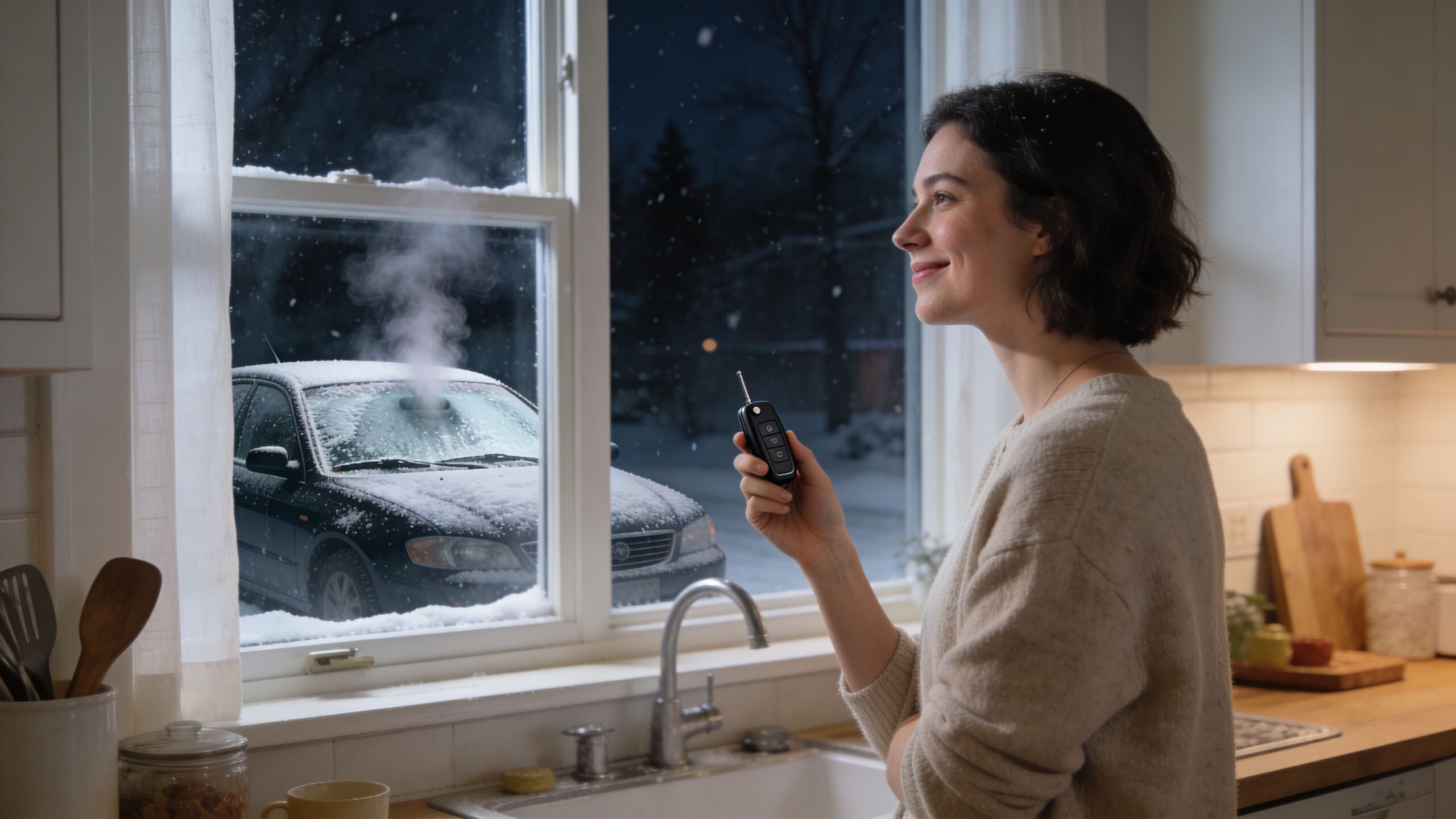
At 6:45 on a Whitby winter morning, the value of a remote starter gets obvious fast. The car is outside, the glass is frosted, and the cabin feels like a freezer. Starting the vehicle before you leave the house gives the heater and defroster a head start, so you spend less time scraping, less time idling in the driveway, and less time waiting for the interior to become usable.
Drivers in cold parts of Canada have been using remote starters for years for a simple reason. They solve an everyday problem. As noted earlier in Carmedics' remote starter installation overview, remote starters became common much earlier in colder provinces, and professional installs in Southern Ontario consistently outperform DIY attempts on newer CAN-bus vehicles. That lines up with what we see in the shop. The newer the vehicle, the less forgiving the install.
Comfort is only part of it.
A properly selected and installed system improves daily use in ways owners notice right away. Defrost starts working sooner. Heated seats and rear defoggers can be tied in on compatible vehicles. Parents loading kids into the car, commuters leaving before sunrise, and shift workers heading home late all get the same benefit. The vehicle is closer to ready when they reach it.
Modern vehicles change the conversation, especially anything with push-button start, smart key access, factory immobilizers, or advanced driver-assist features. On those cars, remote start is not just a convenience add-on. It is an electronics integration job that has to communicate properly with the body control module, ignition logic, security system, and in some cases the factory telematics setup. In Whitby, range can also be affected by dense residential RF interference, apartment parking structures, and big-box commercial lots. Harsh weather adds another layer. Weak battery condition, poor antenna placement, and marginal wiring show up faster in January than they do in October.
A key question is whether your vehicle is a realistic DIY candidate. On an older vehicle with straightforward ignition wiring, maybe. On a newer SUV, truck, or sedan with encrypted data networks, one mistake can lead to a no-start, warning lights, battery drain, or factory functions that stop working properly.
Security matters too. A remote starter has to work with the vehicle’s theft deterrent system, not around it. If that integration is handled poorly, you can create nuisance alarms, inconsistent starting, or an avoidable security gap. That is why some owners look at remote start and vehicle anti-theft protection options at the same time, especially if the car stays outside overnight.
Choosing the Right Remote Start System for Your Car
Not every remote starter fits every driver. The right setup depends on where you park, how far away you are when you start the car, what factory features your vehicle already has, and how much integration you want. A basic system can be perfectly fine. A high-feature system can also be worth it if you use the extras.
One-way, two-way, and app-based systems
A one-way system sends a command from the remote to the car. It’s straightforward. Press the button and the remote transmits the start command. These systems suit drivers who usually park close by, such as in a driveway or small lot.
A two-way system sends a command and also gives feedback. That feedback matters more than people think. In a large parking lot, underground structure, or dense residential area, confirmation saves you from wondering whether the car started.
Then there are smartphone-controlled systems. These appeal to drivers who want control beyond the key fob. If you park far from your workplace, leave the vehicle at the airport, or want added convenience from your phone, app-based control can make sense. It’s less about novelty and more about your routine.
Here’s a simple way to understand:
| System type | Best for | Main trade-off |
|---|---|---|
| One-way | Close-range everyday use | No confirmation back to the driver |
| Two-way | Larger lots and uncertain range | Higher complexity and cost than basic setups |
| Smartphone-based | Long-distance control and added convenience | Depends on account setup and system compatibility |
OEM versus aftermarket
Some drivers assume factory-branded means better. It doesn’t always. Factory systems can be clean and well integrated, but they can also be limited in range, features, or compatibility with the way you use the vehicle.
Aftermarket systems often give you more flexibility. That can include better remote options, keyless entry add-ons, trunk release, rear defrost activation on supported vehicles, or tighter customisation around the vehicle’s existing electronics.
The choice should come down to fit, not branding. The same logic applies when weighing OEM versus aftermarket parts in other repairs and upgrades. The right answer depends on the vehicle, the feature set, and the quality of integration.
The best remote starter isn’t the one with the longest feature list. It’s the one that works cleanly with your vehicle and matches how you actually park and drive.
Match the system to your parking life
A lot of buying mistakes happen because people shop for features before they think about use. Start with your actual day.
- Driveway parking: A simple fob-based unit may be enough if the car is always close.
- Apartment or condo living: You may want stronger signal reliability and confirmation that the command went through.
- Large workplace lot: A two-way or app-based setup usually makes more sense than a basic one-way remote.
- Shared family vehicle: Extra convenience features like lock control can matter more than raw range.
- Newer push-start vehicle: Integration quality matters more than the remote style.
Features that are worth paying for
Some add-ons earn their place. Others just complicate the install. Features that usually make sense include:
- Keyless entry integration: Useful if you want one control system instead of multiple remotes.
- Rear defrost support on compatible vehicles: Valuable in Canadian winters when the system supports it properly.
- Trunk release: Worth considering on sedans and family vehicles where convenience matters.
- Security integration: Helpful when it works with factory systems instead of fighting them.
Features that don’t match your routine become clutter fast. A good installer will ask how you use the vehicle before recommending hardware. That’s how you avoid paying for options that look good on paper but won’t improve your daily drive.
Your Essential Pre-Installation Checklist
A remote starter job is won or lost before any wiring starts. On late-model vehicles, especially push-button start cars, the main risk is not getting stuck on one wire. It is ordering hardware that does not talk properly to the vehicle, missing a firmware step, or chasing an electrical problem that was already there before the install.
Around Whitby, winter puts extra strain on batteries, door lock circuits, and signal performance. Condo parking, busy subdivisions, and commercial lots can also create RF interference that exposes weak remote systems fast. Preparation matters more on these vehicles because modern ignition, security, and body control systems do not forgive guesswork.
Confirm compatibility first
Year, make, and model are only the starting point. Trim level matters. Factory alarm configuration matters. Push-button start matters. Smart key systems, transponders, and data-controlled locks all change what the install requires.
According to Crutchfield’s guide to choosing and installing a remote start system, remote start compatibility often depends on vehicle-specific harnesses and USB-programmed modules that can interface properly with factory immobilizer systems, and aftermarket systems typically cost $200 to $330 including parts and labour for standard vehicles, with some European vehicles running higher.
If the correct interface module, firmware file, or harness is not available for the exact vehicle, stop there. A generic “close enough” fitment approach is how DIY installs turn into no-starts, warning lights, or factory features that quit working.
Know what parts the job actually requires
On a modern vehicle, the box with the remote is rarely the whole job. Many installs also need a data interface, a vehicle-specific harness, an antenna, and access to programming software before anything will work.
Use this checklist before buying parts:
- Main remote start module: Handles the start, run time, shutdown, and safety logic.
- Vehicle-specific harness or T-harness: Reduces cutting and usually makes for a cleaner install.
- Bypass or data interface module: Required on many vehicles with immobilizers or encrypted key systems.
- Programming cable or USB access: Needed when the module has to be flashed with the correct firmware.
- Antenna and receiver components: Placement affects range, especially in dense residential areas and large parking lots.
- Wire protection supplies: Heat shrink, loom, tape, and tie points help the install last through vibration and winter use.
Missing one of these pieces usually means delays, improvised wiring, or a system that works inconsistently.
Gather the right tools, not just basic ones
Tool quality shows up in the finished job. Cheap meters give bad readings. Weak soldering irons make poor joints. Metal pry tools leave scars on trim that the owner will notice every day.
The basic tool set should include:
- Digital multimeter: For verifying ignition, accessory, brake, and status circuits properly.
- Quality soldering iron: Stable heat helps produce dependable connections.
- Heat shrink tubing: Better protection than loose electrical tape over exposed splices.
- Non-marring trim tools: Prevent damage to dash panels and column trim.
- Small picks and terminal tools: Helpful for depinning connectors and working in tight spaces.
- Panel clip storage tray: Keeps hardware organized during disassembly.
If you cannot positively identify the correct circuits with a meter, the install should not start.
Check battery and electrical health before the install
Remote starters are sensitive to voltage drop. A weak battery, poor ground, charging issue, or existing parasitic draw can make a good system look faulty. In cold Whitby weather, that problem shows up faster.
Check battery condition first. If the vehicle already struggles on cold mornings, fix that before adding accessories. Many owners start by reviewing car battery replacement cost factors because stable voltage is a basic requirement for reliable remote start operation.
Set realistic expectations
Older key-start vehicles usually leave more room to work and fewer systems to integrate. Newer push-button vehicles are tighter under the dash, heavier on data communication, and less tolerant of mistakes. One wrong connection can trigger immobilizer faults, key recognition issues, or intermittent no-start complaints that are hard to trace later.
That is the essential checklist. Confirm the platform. Confirm the parts. Confirm the electrical health. Do that properly, and the installation has a fair chance of working like it should. Skip it, and there is a good chance the dash comes apart twice.
The Wiring and Installation Process Explained
The physical installation is where people find out whether they prepared properly. This isn’t just connecting a few wires behind the steering column. A proper remote start for car installation follows a sequence, and each part depends on the one before it being done correctly.
Start with disassembly and planning
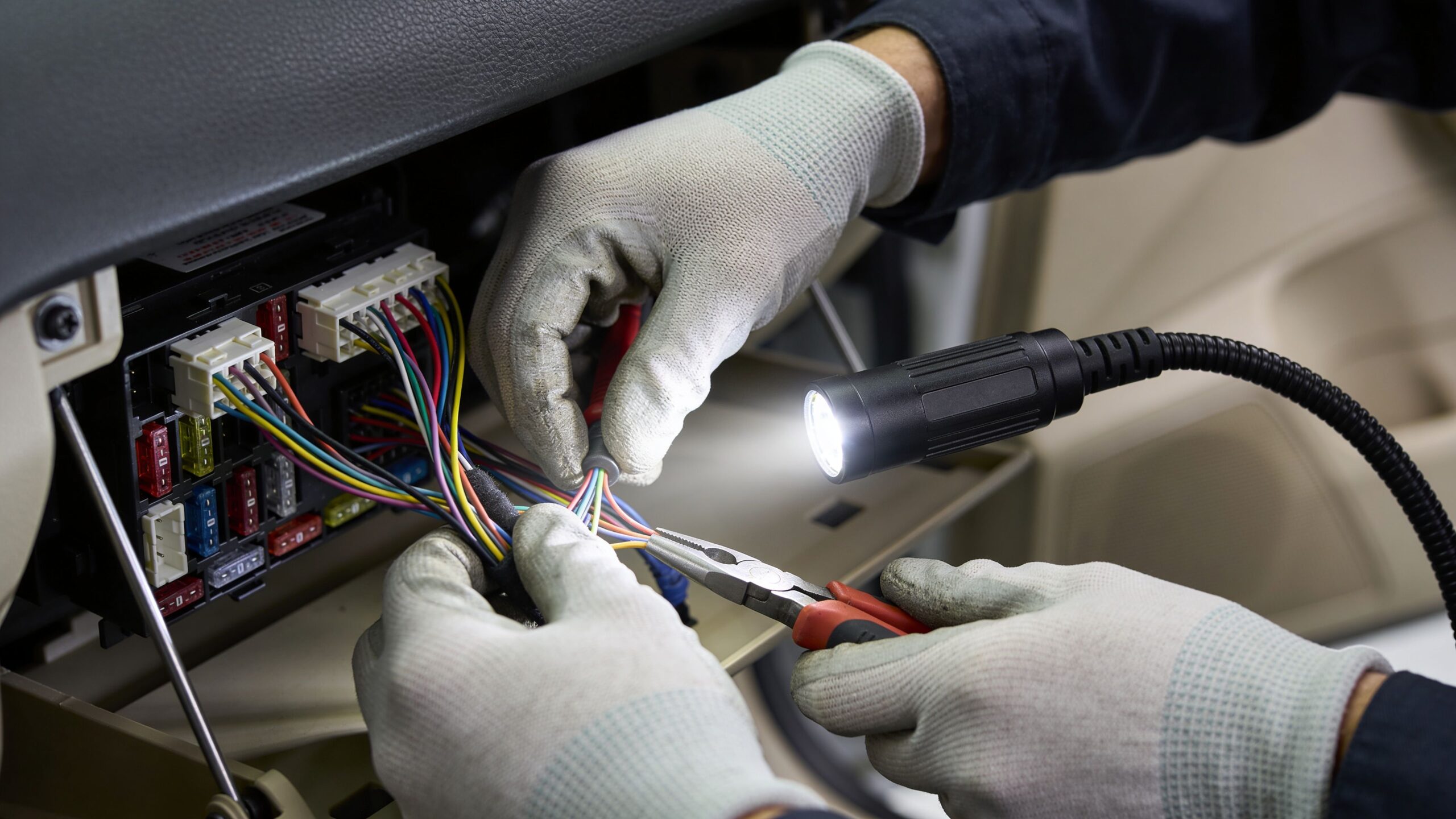
The first job is careful access. Lower dash panels, knee bolsters, steering column trim, and sometimes portions of the centre dash need to come off without damaging clips or leaving witness marks on the plastic.
Then the installer maps the job. Where will the module sit? Where can the antenna route cleanly? Which harness paths avoid moving pedals, steering shafts, sharp brackets, and heat sources? Planning this before making connections avoids ugly reroutes later.
A good install should look boring when it’s finished. No hanging harnesses. No rattles. No obvious aftermarket mess under the dash.
Mount the control module properly
The control module should be mounted in a concealed, secure location under the dash, away from heat and moisture exposure. It also needs to be accessible enough for service if programming changes are required later.
Loose modules create noise and future failures. If a module shifts and pulls on wiring every time the car hits a bump, the install won’t stay healthy.
Use stable mounting points. Avoid dropping the module where it can interfere with factory ducts, braces, or column movement. Secure the harness so the wiring supports the module, not the other way around.
Antenna placement affects range more than most people think
The antenna is often placed high on the glass for a reason. It needs a clear signal path and separation from electrical clutter. If it’s buried behind metal structure or placed near heavy interference sources, performance suffers.
Whitby drivers often park in neighbourhoods, workplaces, and commercial lots full of electronics, building structures, and other signal noise. In those conditions, antenna placement matters. Range complaints are often installation complaints in disguise.
Wire identification must be verified, not assumed
DIY jobs often encounter issues when people look up a wiring chart, find a similar model online, and assume wire colour equals function. That’s risky.
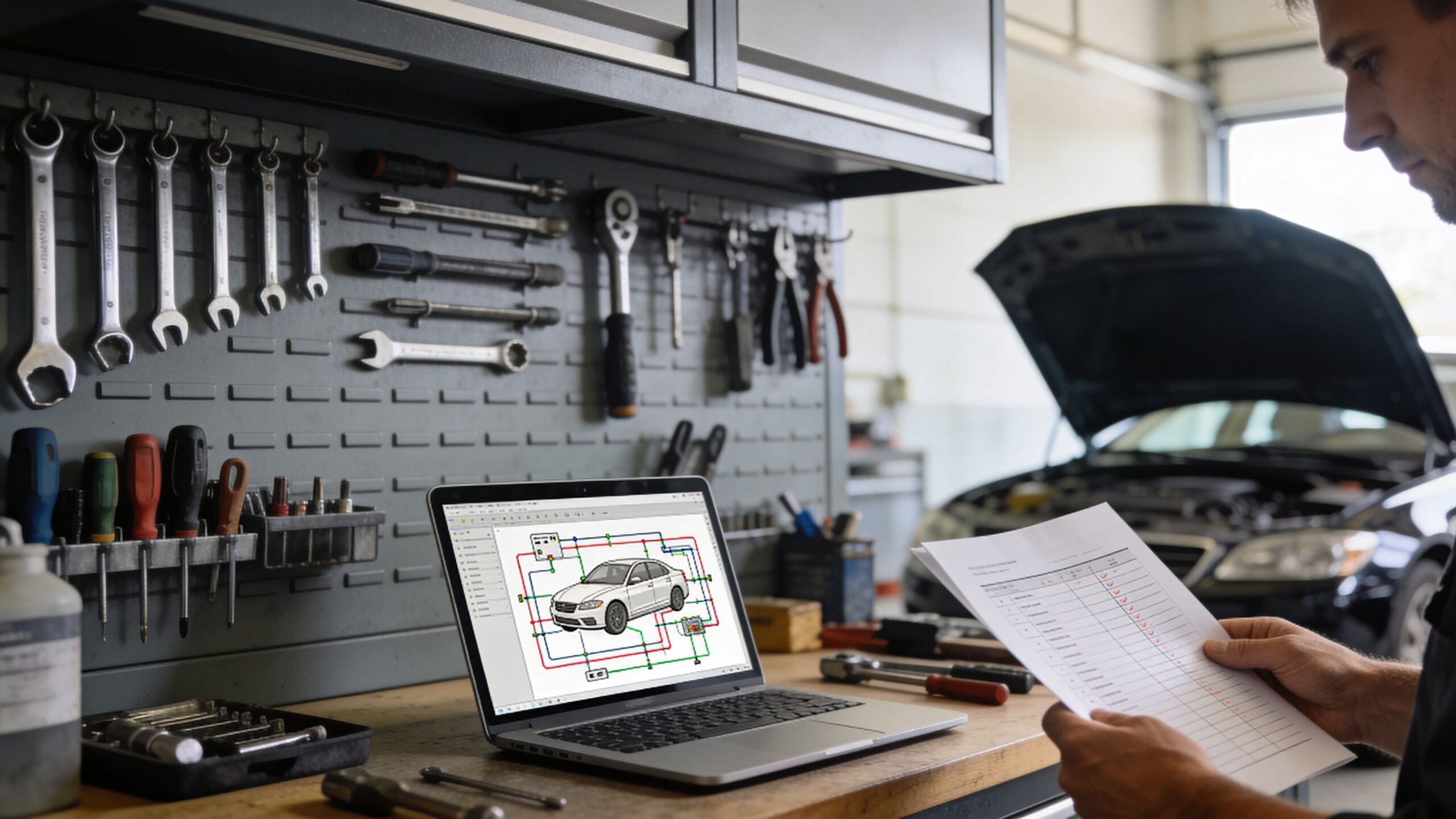
A proper method uses a multimeter to verify each required circuit on the actual vehicle. That can include ignition, accessory, starter, brake input, parking light output, door lock control, tach or data signal, and solid chassis ground.
Here’s the sequence that keeps the work controlled:
- Disconnect and protect the vehicle appropriately: Prevent accidental shorts while exposing the work area.
- Locate candidate circuits: Use diagrams as a guide, not as proof.
- Meter each circuit: Verify function in each key state or push-start condition.
- Label before joining: Once multiple wires are opened up, confusion starts fast.
- Build the harness cleanly: Keep service loops modest and routing tidy.
Bad remote starter installs often don’t fail on day one. They fail weeks later when a weak connection starts reacting to vibration, temperature change, or moisture.
Soldering versus quick-connect methods
This is one of the biggest quality separators in the trade. You can physically attach a wire with a T-tap, butt connector, or poor crimp and get the car to start. That doesn’t mean the job is good.
For critical connections, soldered joints with proper insulation hold up better than shortcut methods. They resist vibration better, create a more stable electrical path, and reduce the chance of intermittent faults that are hard to diagnose later.
Crimp-based shortcuts often create these problems:
- Intermittent starts: Connection resistance changes with temperature or vibration.
- Data communication errors: Weak or unstable splices affect networked systems.
- Callback issues: The car works until the customer hits a pothole or the weather changes.
- Noise and rattles: Poor harness management often follows poor connection choices.
If a harness allows a clean plug-in integration for some circuits, use it where appropriate. If hardwiring is required, do it properly. Sloppy speed under the dash always costs more later.
For owners already dealing with warning lights, accessory glitches, or charging concerns, it’s smart to address underlying automotive electrical repair issues before adding a remote starter. Layering a new system onto a troubled electrical foundation creates confusion during diagnosis.
Push-button start adds another level
Push-button ignition systems don’t behave like old keyed ignitions. The remote starter has to mimic the vehicle’s expected start logic while respecting brake input, run status, immobilizer communication, and takeover procedures.
That means the installer has to make the system start the engine, keep it running safely, and then hand control to the driver without stalling the vehicle when they enter and press the brake. If the programming or wiring is off, the car may start but not transition cleanly for driving.
This is one reason newer vehicles push many owners toward professional installation. The vehicle may not tolerate “close enough.”
Programming Testing and Final Assembly
Wiring the hardware is only half the job. The module still has to be programmed to the vehicle, and every function has to be tested before the trim goes back on. A rushed install reveals itself during these final steps.
Program the module to the vehicle
On modern systems, the control module usually needs vehicle-specific firmware and a learning process so it can work with the car’s immobilizer logic and starting behaviour. Depending on the system, the module may learn engine status through tach signal, voltage sensing, or data communication.
The important part isn’t just getting one successful start. The important part is getting repeatable starts and a clean takeover when the driver enters the vehicle.
Test every function before reassembly
Testing should be systematic. Not casual. Run every core function several times and check how the vehicle reacts in real use conditions.
A proper test routine includes:
- Remote start and remote stop: Confirm the engine starts and shuts down correctly.
- Lock and entry operation: Verify added convenience functions work without glitches.
- Brake shutdown logic: The system must respond properly when brake input is applied.
- Hood safety input: The remote starter should not operate if service conditions make it unsafe.
- Takeover procedure: Enter, enable driving, transition to drive-ready mode, and confirm there’s no stall or warning condition.
Reassemble nothing until the vehicle starts, stops, locks, unlocks, and hands off to the driver exactly the way it should.
Finish the install so it stays fixed
Final assembly separates professional work from “it works for now.” All new wiring should be bundled, supported, and protected so it won’t chafe, sag, or tap against dash structure over time.
Use proper tape where it belongs, secure tie points where they won’t cut into insulation, and make sure no harness runs across moving parts. Then reinstall the panels carefully so clips seat fully and the dash goes back together without gaps or squeaks.
A customer notices the remote starter. A technician notices the fit, routing, and silence afterward. Both matter.
DIY Reality vs Professional Installation at Carmedics Autowerks
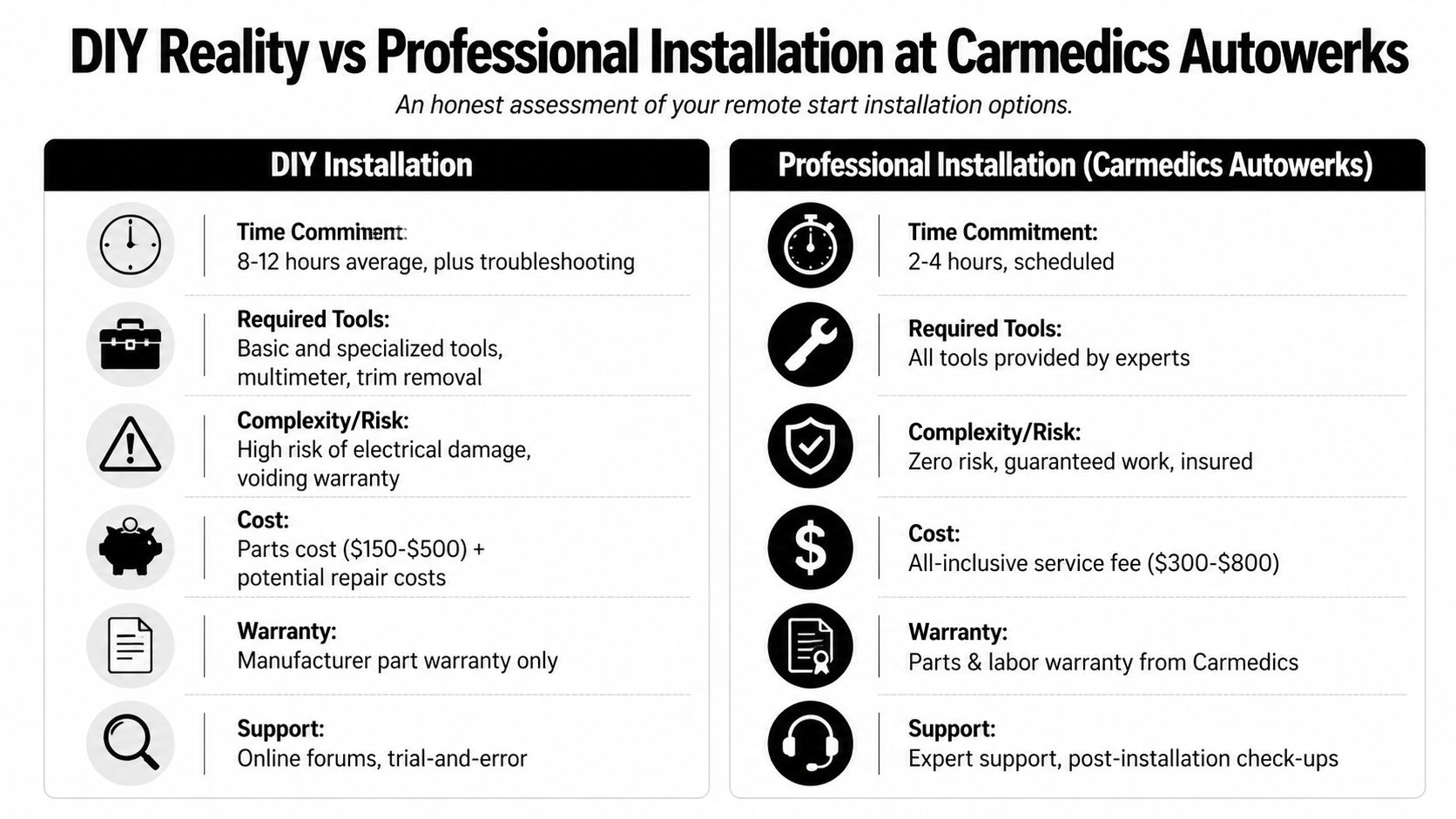
At this point, the trade-off is usually clear. DIY can work, but only in a narrow set of circumstances. The vehicle has to be simple enough, the installer has to understand automotive wiring well, and the project has to allow for time, troubleshooting, and some tolerance for risk.
When DIY is realistic
DIY makes the most sense on older vehicles with straightforward ignition wiring and fewer electronic dependencies. If you already own the proper tools, know how to read and verify circuits, and have done automotive electronic work before, the job may be manageable.
It’s not a good “learn as you go” project for most newer vehicles. Push-button start, smart key systems, immobilizer bypass programming, and dense data networks raise the stakes quickly.
Where professional installation earns its keep
Professional installation isn’t just paying someone else to connect wires. It’s paying for circuit verification, clean disassembly, proper module programming, reliable mounting, signal placement, and a finished result that doesn’t create a new electrical problem.
For Whitby-area drivers, that matters because local use is hard on poor installs. Cold weather exposes weak batteries and weak connections. Everyday vibration exposes loose modules and poor crimps. Dense residential and commercial environments expose range and interference problems.
Here’s the practical comparison.
| Factor | DIY Installation | Professional (Carmedics Autowerks) |
|---|---|---|
| Skill requirement | Requires strong wiring and diagnostic ability | Handled by technicians familiar with vehicle electronics |
| Best vehicle fit | Older, simpler vehicles | Newer vehicles, push-start systems, warranty-sensitive cars |
| Wiring quality risk | Depends entirely on the installer’s method | More likely to follow consistent shop procedures |
| Troubleshooting burden | Falls on the owner | Falls on the installer |
| Final fit and finish | Varies widely | Usually cleaner and more factory-like |
One local option is Carmedics Autowerks in Whitby, which handles automotive service work for cars and SUVs and can be considered when a vehicle owner wants remote starter integration that respects factory electronics.
The honest answer
If you own a newer daily driver and you’re asking whether the project is worth doing yourself, the answer is usually no. The savings shrink fast if you need extra tools, order the wrong module, damage trim, trigger electrical faults, or spend your weekend tracing a no-start issue.
If you own an older vehicle, understand wiring, and accept the risk, DIY might be reasonable. For everyone else, especially with modern push-start vehicles, professional installation is the smarter call.
Frequently Asked Questions About Remote Start Installation
Will a remote starter void my vehicle warranty
A properly installed remote starter doesn’t automatically void a vehicle warranty. The primary risk comes from poor installation that damages wiring, modules, trim, or factory systems. On newer and financed vehicles, the safer route is installation that respects the factory electrical architecture and leaves a clean serviceable result.
Can you install remote start on a manual transmission vehicle
It can be done on some manual vehicles, but it requires extra safety logic. The system has to make sure the vehicle isn’t left in gear before remote starting. This is not a casual install, and it’s one of the categories where shortcuts are a bad idea.
Do modern push-button start vehicles still need bypass programming
Yes, many do. Push-button start doesn’t eliminate immobilizer or security logic. It changes how the remote starter has to communicate with the vehicle. That’s why module compatibility, firmware selection, and correct programming matter so much on newer cars.
If you want a remote start for car installation that fits your vehicle properly and doesn’t create electrical headaches later, contact Carmedics Autowerks Inc to discuss your car, your parking situation, and the kind of system that makes sense for your setup.