


That high-pitched screech from your brakes is a message, and figuring out how to fix squeaky brakes usually starts with a little bit of listening. While some squeaks are harmless—think morning moisture burning off—a persistent noise often points to worn brake pads or a need for some lubrication. The fix can be as simple as cleaning a few parts or as involved as replacing your pads and rotors.
Quickly Identify Why Your Brakes Are Squeaking
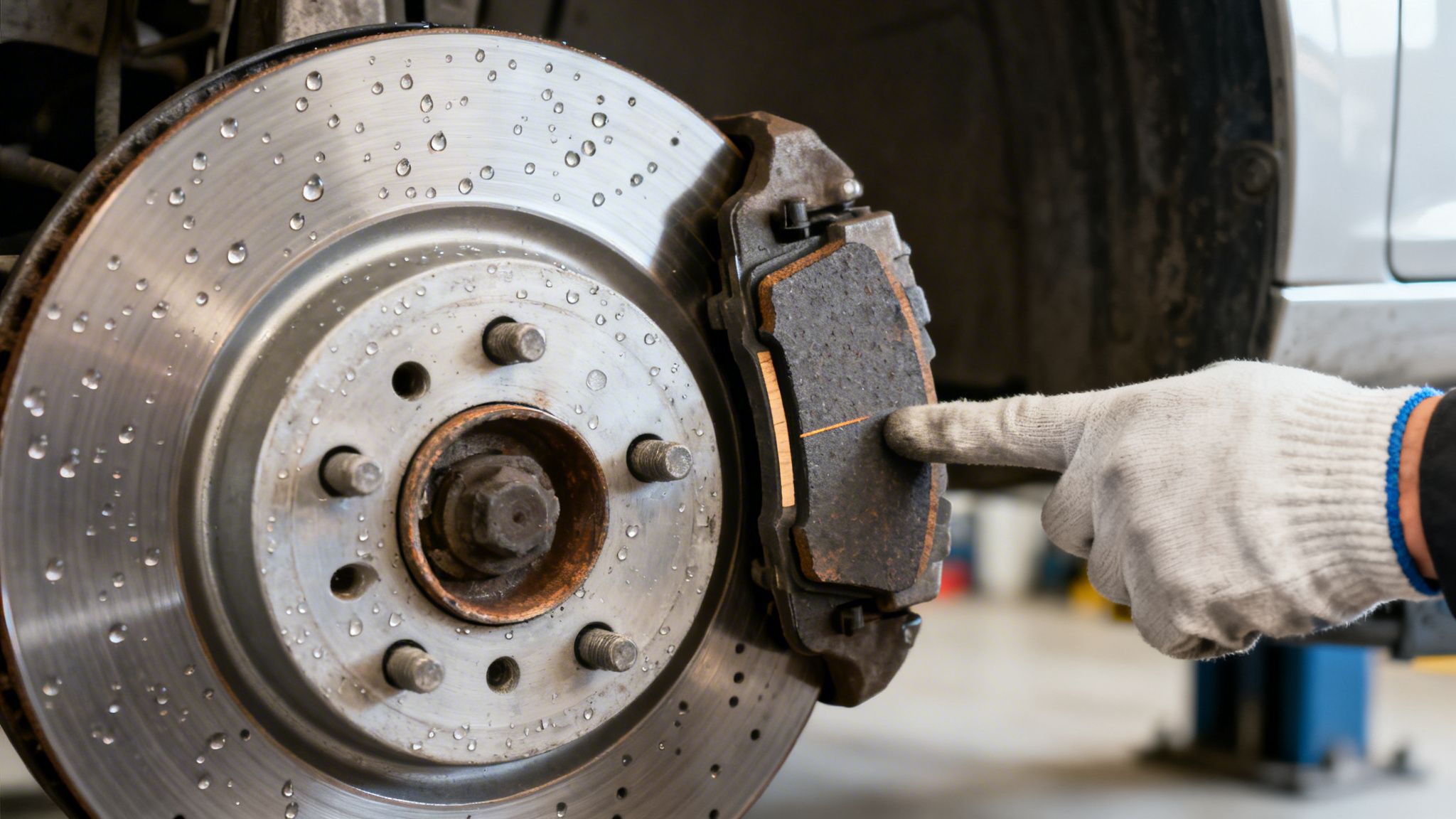
That squeal isn't just an annoying sound; it's your car's way of telling you something. Before you can jump to a solution, you need to understand what the noise is saying. The goal here is to quickly figure out if you're dealing with a minor fix you can tackle yourself or something that needs a professional eye.
First things first, not all squeaks are created equal. A faint squeal that vanishes after a couple of stops on a damp morning is almost always just a bit of surface rust burning off the brake rotors. It’s completely normal and nothing to worry about.
Common Noises and What They Mean
On the other hand, a sharp, consistent, high-pitched squeal every time you hit the brakes tells a different story. That’s the classic sound of the built-in wear indicator. It’s a small metal tab on the brake pad designed to scrape against the rotor when the pad material gets thin. This is your car giving you a heads-up that a brake job is on the horizon.
Key Takeaway: A persistent squeal is an alert, not a catastrophe. It's the wear indicator doing its job, giving you advance notice to schedule a brake service before more serious damage occurs.
Now, if the noise is a deep, metallic grinding or scraping, the situation has become urgent. This usually means the brake pads are worn down to the metal backing plate, and you’ve got metal-on-metal contact. This is a major safety hazard that drastically reduces your stopping power. If you hear this, stop driving the vehicle and get it inspected immediately.
A Quick Way to Diagnose the Squeak
To narrow down the cause, pay close attention to when the noise happens. Does it happen at low speeds? High speeds? Only when you're turning? The context is everything.
- Squeak when you first drive: Most likely moisture or light surface rust.
- Constant squeal during braking: A strong sign of worn brake pads.
- Grinding or scraping sound: Critical wear. This requires immediate attention.
Knowing how often to change brake pads also helps you put the noise into perspective. If your pads are relatively new, the cause might be different than if they're nearing the end of their service life. This initial diagnosis helps you decide on your next move with a lot more confidence.
Understanding the Root Causes of Brake Noise
Before you even think about picking up a wrench, the most important thing is to figure out why your brakes are making that racket. That high-pitched squeal is just a symptom. I’ve seen countless drivers swap out their brake pads only to have the same annoying sound come right back a few weeks later. To really fix squeaky brakes, you have to start by playing detective.
It’s not always about worn-out pads, either. Some of the loudest brakes I’ve worked on had plenty of life left in them. A common culprit is something we call glazing. This happens when pads get way too hot from repeated, hard braking—think of riding your brakes all the way down a long, steep hill. The intense heat literally crystallizes the surface of the pad material. It creates a smooth, glassy finish that squeals as it slides across the rotor instead of properly gripping it.
Then there's the hardware. Your brake pads don't just float inside the caliper; they're held snug by a set of small metal pieces, usually called anti-rattle clips or shims. With time, these little clips lose their spring tension, get choked with brake dust, or simply rust away. When that happens, the pads can vibrate just enough to create a high-frequency squeal every time you press the pedal.
Environmental and External Factors
Where and how you drive makes a huge difference. Living here in Ontario, we see a ton of brake issues caused by road salt in the winter. That corrosive slush attacks every bit of exposed metal on your car, and your brakes are right in the line of fire.
- Corroded Caliper Pins: These pins are what allow your brake caliper to slide smoothly back and forth. When they get rusty and seize up, the caliper can't apply even pressure, forcing one pad to do all the work and causing all sorts of noise and uneven wear.
- Rotor Surface Corrosion: Ever notice a light grinding or squeak first thing in the morning? If your car has been sitting for a day or two, especially in the rain, a thin layer of rust will form on the cast iron rotors. This is totally normal and the sound usually vanishes after a few stops as the pads wipe the surface clean.
- Debris on the Brakes: Sometimes the fix is surprisingly simple. A tiny stone or some other piece of road junk can get kicked up and wedged between the pad and the rotor. This usually creates a very loud, sharp scraping or grinding sound that can be pretty alarming.
A huge diagnostic clue is when the squeak happens. A noise that’s only there for the first couple of stops in the morning almost certainly points to surface rust. But a consistent squeal that gets worse as you drive suggests a deeper issue with the hardware or glazed pads.
Understanding these details is what separates a quick fix from a real solution. For example, if you just slap a new set of pads onto a caliper with seized slide pins, you haven't solved anything. You've just guaranteed that your brand-new pads will wear out crooked and start screaming at you again in no time.
Pinpointing the Problem with Your Ears
You don’t need a garage full of fancy equipment to get started—your ears are your best diagnostic tool. Listen closely to the sound itself. Does it happen the instant you touch the pedal, or does it hang around as you hold your foot down? Does the pitch change as you slow down?
Think about these scenarios I see every single week:
The Morning Squeak: You're backing out of the driveway, you tap the brakes, and hear a light squeal. By the time you get to the end of your street, it's gone. That's just the pads wiping off that overnight surface rust. Nothing to worry about.
The Low-Speed Chirp: You’re creeping through a parking lot or in slow traffic, and every light touch of the brake pedal produces a little chirp-chirp-chirp. This is a classic sign of worn or unlubricated anti-rattle clips that are letting the pads chatter.
The Hot Squeal: After you’ve been driving for a bit, especially in stop-and-go traffic, a piercing, high-pitched squeal starts up and gets louder the more you use the brakes. That’s the textbook sound of glazed brake pads that have been overheated.
This is the kind of foundational knowledge that lets you move from guessing to properly diagnosing. It gives you the confidence to either tackle the job yourself or to walk into a shop like Carmedics Autowerks and have an intelligent conversation with your mechanic, ensuring you get the right fix the first time.
Your DIY Brake Repair Toolkit and Parts Guide
Walking into a brake job without the right tools is a recipe for disaster. I've seen it a hundred times—a simple weekend fix turns into a week-long headache with stripped bolts and a car stuck on stands. To do this right, safely, and without wanting to throw a wrench across the garage, you need to get your gear in order first.
Before you even think about touching a lug nut, let's talk about safety. Your car's emergency jack is for roadside emergencies only. Never, ever work under a car supported by just a jack.
- Floor Jack: A good floor jack is your best friend here. It's stable, strong, and makes lifting the vehicle a smooth, controlled process.
- Jack Stands: These are completely non-negotiable. Once the car is up, the jack stands bear the load. A pair of 3-ton stands is more than enough for most cars and SUVs.
- Wheel Chocks: Slide these behind the wheels still on the ground. It’s a simple step that ensures the car has zero chance of rolling while you work.
The Essential Hand Tools for the Job
Once the car is safely in the air, you can get down to business. You don't need a professional-grade toolbox, but a few key items will separate a smooth job from a frustrating one. A decent mechanic's tool set will cover most of your bases.
Here's what you'll absolutely need to have within arm's reach:
- Lug Wrench or Breaker Bar: For getting those stubborn lug nuts loose.
- Socket Set: A 3/8-inch drive ratchet with a good range of metric sockets is perfect for caliper and bracket bolts.
- C-Clamp or Piston Spreader: When you put new, thicker pads in, you have to push the caliper piston back into its bore. This tool makes it easy.
- Wire Brush: Rust is your enemy. A stiff wire brush is essential for cleaning up the caliper bracket and hub so everything sits flush.
- Brake Cleaner: A can of this stuff is magic. It blasts away all the built-up brake dust and grime, giving you a clean surface to work with.
Pro Tip: Grab a bungee cord. After you unbolt the brake caliper, don't just let it hang by the brake hose—that's how you cause a leak or a catastrophic failure. Instead, use the bungee to hook the caliper to the coil spring or another suspension part. It's a simple trick that saves a world of trouble.
Choosing the Right Brake Pads and Parts
With your tools ready, it's time to pick your parts. The pads you choose will make the biggest difference in how your brakes feel, sound, and perform.
This choice matters. The North American automotive brake market is a massive $3.6 billion industry as of 2024, and a huge chunk of that is driven by fixing problems like squealing. It’s a common issue, affecting about 25% of vehicles with over 50,000 miles, often due to glazed rotors or uneven pad wear. You might be surprised to learn that in my experience, simply cleaning and lubricating the caliper pins and hardware can fix up to 60% of noise complaints without needing a full brake job. For a deeper look at industry trends, you can explore the full analysis of the North American brake market on gminsights.com.
When it comes to pads, there’s no single “best” option—it’s about what’s best for your car and how you drive.
To help you decide, here’s a quick comparison of the three most common types of brake pads on the market today.
Brake Pad Comparison Ceramic vs Semi-Metallic vs Organic
| Pad Type | Key Characteristic | Best For | Noise Level |
|---|---|---|---|
| Ceramic | Quiet operation & low dust | Daily driving, commuters | Lowest |
| Semi-Metallic | Excellent stopping power & heat dissipation | Trucks, SUVs, performance driving | Moderate |
| Organic (NAO) | Soft, quiet & inexpensive | Small, lightweight cars & gentle driving | Low |
For most drivers just looking to silence a squeak and get reliable stopping power for their daily commute, ceramic pads are the way to go. They are specifically designed for quiet, clean operation.
When you buy your pads, make sure they come with new hardware clips. If not, buy them separately. And don't forget a small packet of synthetic brake grease for the caliper pins and pad contact points. Finally, you’ll have to decide on a brand. If you’re weighing your options, our guide on OEM vs. aftermarket parts can help you make an informed choice.
A Practical Walkthrough to Silencing Your Brakes
Alright, you've got your tools and new parts laid out. It's time to get your hands dirty and finally fix that annoying brake squeal. I'm going to walk you through the entire process, from getting the car safely in the air to the final checks. Think of this as having an experienced mechanic guiding you over your shoulder, packed with tips I've picked up over years in the shop.
First thing’s first: safety. Always work on a flat, level surface—your driveway is perfect, but a sloped street is a big no-no. Before you lift anything, chock the wheel that's diagonally opposite from the one you're starting on. So, if you're tackling the front driver's side, stick chocks behind the rear passenger's wheel. This is non-negotiable; it keeps the car from rolling.
Now, grab your lug wrench and just loosen the lug nuts on the wheel you're about to remove. Don't take them off yet. You're just breaking them free while the car's weight is still on the tire to keep it from spinning.
Safely Lifting and Preparing Your Vehicle
Next, find the right spot for your floor jack. Your owner's manual will show you the manufacturer's recommended lift points, which are reinforced parts of the car's frame. Slide the jack under one of these points and smoothly raise the car until the wheel is a few inches off the ground.
This is the most critical safety step: position a jack stand securely under the frame rail or another solid support point right near the jack. Slowly lower the car until the jack stand is bearing its full weight. Remember, the jack is for lifting, the stand is for holding. Never trust a jack alone.
With the car securely supported, go ahead and finish removing the lug nuts and pull the wheel off. I like to slide it flat under the car's frame as an extra bit of insurance. Now you've got a clear view of the whole brake assembly: the caliper, the pads tucked inside, and the big, shiny rotor.
This whole process boils down to three core actions: getting the car up, using the right tools, and swapping the pads.
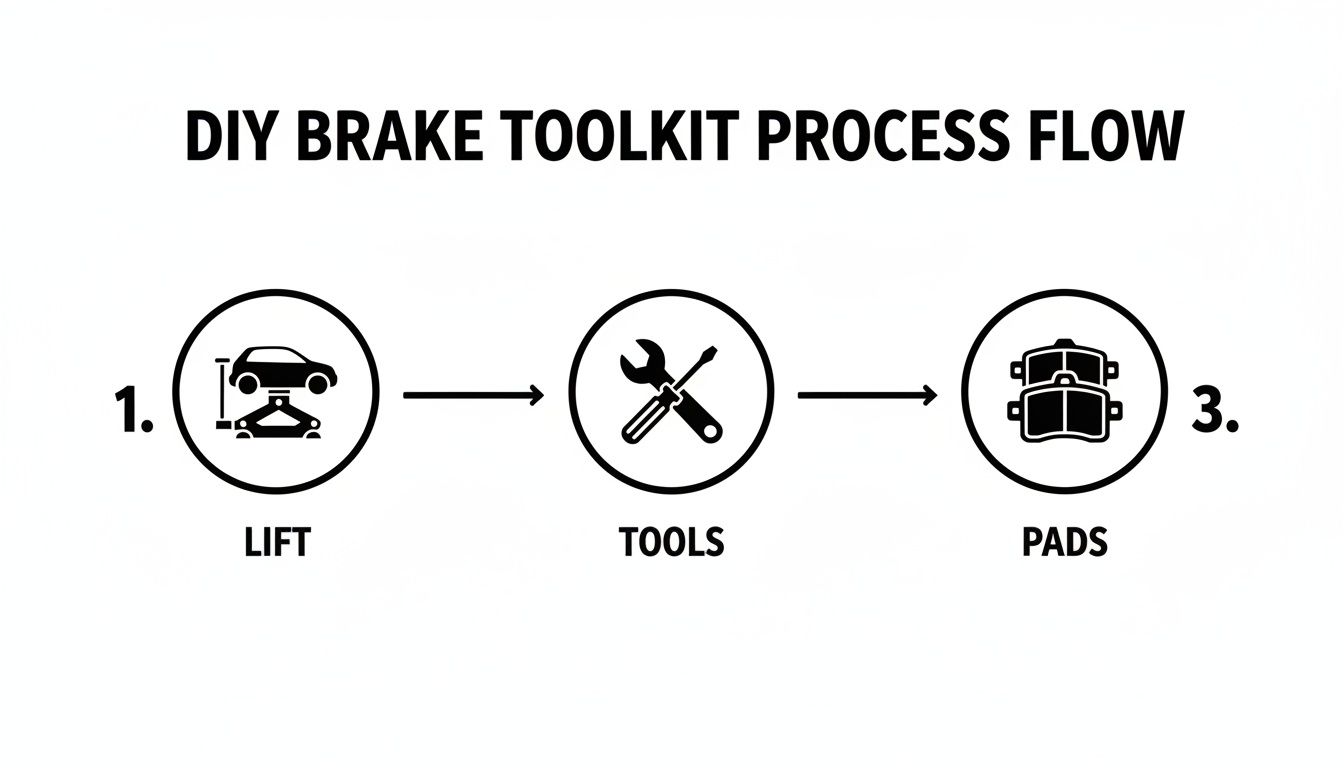
It really is that straightforward. Once you're properly set up, the actual parts-swapping is the easy bit.
Removing the Caliper and Old Brake Pads
Look at the back side of the caliper. You'll see two bolts, often called guide or slide pins, that hold it onto the mounting bracket. A socket wrench is your tool here. These bolts can sometimes be a little stubborn, so a quick spray of penetrating oil can work wonders if they put up a fight.
Once the bolts are out, you should be able to wiggle the caliper up and off the rotor. Now, whatever you do, never let the caliper dangle by its rubber brake hose. This can strain or tear the hose, leading to a brake fluid leak and a total loss of braking power. Use a bungee cord or a bit of sturdy wire to hang it from the suspension spring or another solid part.
With the caliper safely out of the way, the old brake pads will slide right out of the bracket. Pay attention to how they come out—sometimes there's a specific inner and outer pad, and you'll want to install the new ones the same way.
Expert Tip: Before going any further, pop the hood and take a look at your brake fluid reservoir. In a minute, you're going to compress the caliper piston, which will push fluid back up into the reservoir. If it's already full, you’ll need to siphon a little out to prevent a messy overflow. Our guide on checking and managing your brake fluid walks you through this.
Cleaning and Inspection
Honestly, this is the most crucial step for preventing squeaks from coming back. The number one enemy of quiet brakes is brake dust. A simple cleanup is often the "secret" to a successful DIY brake job. In fact, research shows that built-up dust and crud contribute to around 70% of all brake noise complaints. Ignoring that squeal can turn into a much pricier fix, like a rotor replacement costing $300-$600 per axle. You can get more insights on repair costs and trends over at aftermarketmatters.com.
Grab your wire brush and a can of brake cleaner. Get in there and scrub the caliper bracket where the little metal hardware clips sit. You want to remove every bit of rust and baked-on dust so the new pads can move freely, which is key to preventing noise. Spray it all down with the brake cleaner and wipe it dry.
While you're at it, pull out those caliper slide pins you removed earlier, wipe them completely clean, and set them aside. We'll lubricate them in the next step.
Installing New Pads and Lubricating Components
Your new brake pads are much thicker than the old, worn-out ones, so you need to make room for them. To do this, you have to push the caliper piston back into its housing. The easiest way is to place one of the old brake pads against the piston and use a C-clamp or a piston spreader tool. Squeeze it slowly and evenly until the piston is pushed all the way back, flush with the caliper body.
Now for the final assembly.
- Apply a very thin film of anti-squeal compound to the metal backing plates of your new pads. Don't get any on the friction material itself! This just creates a small vibration-dampening layer.
- Take those clean slide pins, apply a light coat of synthetic brake grease, and reinstall them.
- Snap the new hardware clips into the bracket and slide your new, lubricated pads into place.
Once the new pads are situated, carefully lower the caliper back down over them and the rotor. Reinstall the two caliper bolts and torque them to the manufacturer's spec.
Finally, put the wheel back on and thread the lug nuts on by hand. Lower the car completely off the jack stand, and then give the lug nuts their final tightening with a torque wrench, always in a star pattern. Before you even think about driving, get in the car and pump the brake pedal a few times. It will feel soft at first, then firm up as the caliper piston presses against the new pads. Now you're ready for a test drive.
Don't Skip This Last Step: Bedding-In Your New Brakes

Alright, so the wheels are back on and you’ve torqued the last lug nut. You might think the job is done, but there's one more crucial step that separates a good brake job from a great one. This is what we in the business call bedding-in, and it's your secret weapon for getting rid of brake squeal for good.
At a microscopic level, your new brake pads and rotors are far from a perfect match. The bedding-in process uses controlled heat to transfer a super-thin, even layer of the pad material onto the rotor surface. This creates a perfectly mated pair that works together silently and effectively. If you skip this, there’s a good chance that annoying squeak will be back before you know it.
The Correct Bedding-In Procedure
First things first: safety. Find yourself a safe, empty stretch of road where you can get up to speed without bothering other drivers. An industrial park on a Sunday morning or a quiet backroad is perfect.
The whole idea is to build up heat gradually and consistently without actually stopping the car, as that can leave uneven deposits on the rotor. It's a bit of a dance, but it's simple once you get the hang of it.
- Start by doing a series of five moderate slow-downs. Bring the car from about 60 km/h down to 15 km/h with firm, steady pressure. Think of it as approaching a stop sign a little too quickly, but don’t actually stop.
- After each slowdown, get back up to speed right away. The key is to keep moving.
- Next, it's time for five more aggressive slow-downs, this time from around 80 km/h down to 15 km/h. Be firm, but don't stomp on the pedal so hard that you lock the brakes or trigger the ABS.
You'll probably start to smell the pads by the end of this—that's a good thing! It means the material is getting hot enough to transfer. Once you're done with the ten cycles, drive normally for another 10-15 minutes, using the brakes as little as possible. This allows them to cool down and for that new friction layer to set.
Why This Process Is So Important
Properly bedding-in new pads is the single best way to prevent future squeaks. This process eliminates high-frequency vibrations that cause noise by creating a perfect friction layer between the pad and rotor.
This procedure gets right to the heart of what causes most brake noise: vibration. Some professional techniques involve a series of 20-30 stops from 65 km/h down to 15 km/h to really ensure a perfect finish. Here’s another pro-tip: chamfering the leading and trailing edges of new pads can also cut down on squeal and even extend pad life by up to 25%.
It's a fact that uneven wear is responsible for roughly 40% of all brake noises. This just goes to show how critical a proper bedding-in process is for balanced, long-lasting performance. If you want to dive into the data, the Bureau of Automotive Repair has full statistics on brake service standards.
Taking care of these final details is a core part of your car’s overall health. To build a great routine, check out our guide on preventive maintenance for vehicles.
Knowing When to Call a Professional Mechanic
Being a good DIYer means knowing how to turn a wrench, but it also means knowing when to put the tools down. There’s a huge sense of accomplishment in swapping your own brake pads, but some jobs are best left to the pros. Misjudging the complexity of a brake issue isn’t just a learning mistake—it can be a serious safety hazard.
Sometimes, a squeak isn't just a squeak. It’s a symptom of a much deeper problem that a simple pad change won't solve. These are the red flags that tell you it’s time to call in an expert with the right diagnostic tools and years of hands-on experience.
Serious Symptoms That Demand an Expert
If you run into any of these issues, your safest bet is to get a professional diagnosis. These signs often point to problems that you just can't tackle properly in a home garage.
- A Spongy or Soft Brake Pedal: Does the pedal feel mushy or sink toward the floor? That’s a classic symptom of air trapped in the hydraulic lines. Bleeding brakes, especially on cars with ABS, is a tricky procedure that can require a specialized scan tool to cycle the ABS pump.
- Deep Grooves on the Rotors: Run your finger across the surface of the brake rotor. If you feel deep ridges and valleys, slapping on new pads is a waste of time and money. A shop can measure the rotor’s thickness to determine if it can be safely machined (resurfaced) or if it’s time for a replacement.
- The Car Pulls to One Side When Braking: This is a major safety issue. If the car veers left or right the moment you touch the brakes, you likely have a seized caliper slide pin or a failing brake hose on one side. This creates a dangerous imbalance in braking force.
- Visible Fluid Leaks: Finding a puddle of oily fluid near a wheel or seeing wetness on a brake line is an immediate stop-sign. A brake fluid leak means your hydraulic system is compromised and could fail completely.
When it comes to your brakes, guesswork is not an option. Figuring out if you have a bad master cylinder or a failing ABS module requires complex diagnostics that are best left to a professional. Your safety, and the safety of your passengers, is what matters most.
When Modern Technology Outpaces DIY
Today's vehicles are more complex than ever. Systems like automatic emergency braking, electronic parking brakes, and adaptive cruise control are all tied into the braking system. Attempting a repair on these cars without the right equipment can cause expensive damage to electronic modules. For instance, you might need a diagnostic computer just to retract the rear calipers to change the pads.
For those in the Whitby area, getting an expert opinion is easy. If you've spotted any of these warning signs, or if you just want the peace of mind that comes from a professional job, consider a brake repair service at Carmedics Autowerks. A thorough diagnosis from an experienced technician will ensure your brakes are not only quiet but fundamentally safe.
Answering Your Lingering Questions About Squeaky Brakes
Even after you've put the tools away, a few questions can stick in your mind. Let's tackle some of the most common things drivers ask when dealing with the pesky problem of noisy brakes.
Why Are My Brakes Still Squeaking After I Just Replaced the Pads?
This is a classic, and it's one of the most frustrating things to experience after doing a brake job. If you’ve put in new pads and still hear that awful squeal, the problem is almost never the pads themselves.
More often than not, the culprit is unlubricated hardware. Caliper slide pins that aren't properly greased can't move freely, which causes uneven pressure on the pads. Another common oversight is putting new pads on old, worn rotors without resurfacing or replacing them. The new pad material just can't make perfect contact with a grooved surface.
And finally, don't skip the bedding-in process! This is a non-negotiable step for creating a quiet, perfectly mated surface between the new pads and rotors.
How Much Should I Expect to Pay for a Professional Brake Job?
The cost can swing quite a bit depending on your vehicle and what needs to be done. For a straightforward cleaning and lubrication service to quiet things down, you might be looking at around $100-$150.
If you're in for a more involved job, like new pads and rotors on one axle, the price for parts and labour usually lands somewhere between $350 and $600.
A good, trustworthy shop will always give you a detailed quote after they've done a full inspection. You should never have to guess what you're paying for before the work starts.
For those with electric vehicles, the principles are similar, though components can differ. You can find helpful information on related issues, like troubleshooting common golf cart brake problems, which highlights the nuances of EV brake systems.
Is It Actually Safe to Keep Driving with Squeaky Brakes?
Honestly, it depends entirely on the type of noise.
If you hear a light squeak for the first couple of stops on a damp morning, that’s usually just moisture burning off the rotors. It’s harmless and should disappear quickly.
A persistent, high-pitched squeal, however, is your brake pad's built-in wear indicator telling you it's time for new pads. But if you hear a loud grinding or scraping sound, that's a major red flag. It means you have metal-on-metal contact, which is a critical safety hazard. Stop driving the vehicle immediately and get it inspected.
If you've run into any of these snags or just want an expert opinion for total peace of mind, the team at Carmedics Autowerks Inc is always here to help. Schedule a professional brake inspection today and drive with confidence.