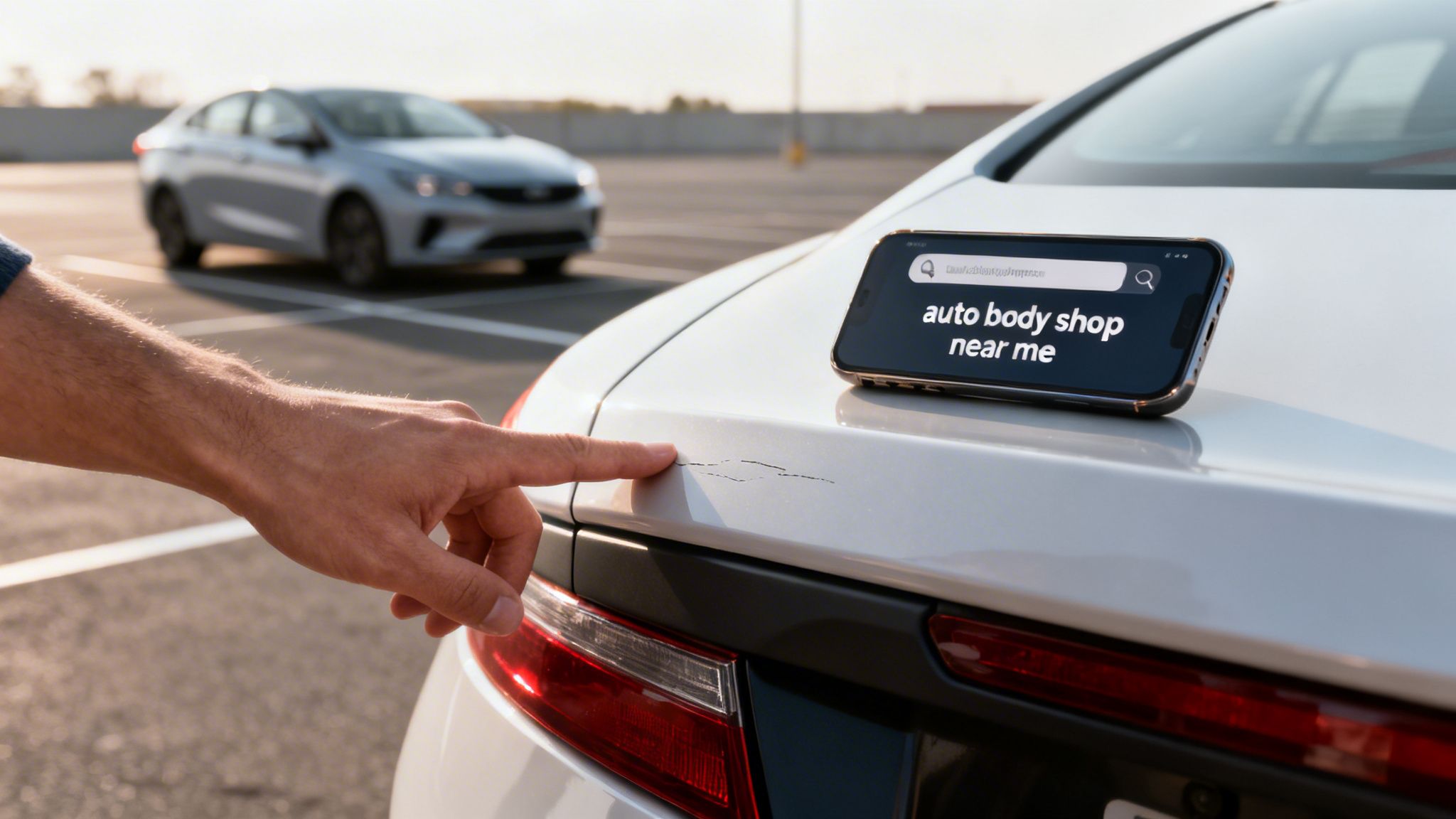
The moments after a car accident are a blur. But before you even start searching for an "auto body shop near me," the first few steps you take are critical. Knowing how to look at the damage—and spot the difference between a simple paint scuff and a sign of deeper trouble—is the first step toward getting the right repair.
This initial evaluation really sets the tone for everything that comes next.
What to Do Immediately After an Accident
That gut-wrenching feeling after a collision? We’ve all been there. Before you even think about repairs, your first job is to manage the scene. Safety is priority number one. Make sure everyone is okay and, if it's safe to do so, move the vehicles out of the flow of traffic.
Once you know the scene is secure, switch gears to documentation. This isn't just for your insurance company; it's vital information that will give your future auto body technician the complete picture.
- Take Detailed Photos: Get pictures of all vehicle damage from every angle. Don't just get close-ups; take wider shots that show the car's position and the surrounding area.
- Document the Scene: Snap photos of the road, including any skid marks, traffic signs, or debris from the impact.
- Exchange Information: You'll need the other driver's name, phone number, insurance details, and licence plate number.
This evidence is invaluable. If you're curious about how technology can protect you in these situations, you might want to read our guide on getting a dash cam installed. Depending on the severity of the incident, it might also be wise to consider consulting a car accident lawyer to ensure you understand your rights.
Your Initial Damage Assessment
After you've handled the immediate aftermath, take a calm moment to really look at your vehicle. You're not trying to become a professional estimator, but you want to gather enough information to have a clear conversation with a repair shop. Is the damage just cosmetic, or are there clues pointing to something more serious?
For instance, a bumper that's pushed in or a fender that no longer lines up with the door is a strong hint of hidden structural issues. A door that's suddenly hard to close is a major red flag that the vehicle's frame could be compromised.
Pro Tip: Gently run your fingernail across any scratch. If your nail catches in the groove, the damage has penetrated the clear coat. It'll need professional work to prevent rust from forming. If your nail glides smoothly over it, a good polish might be all it takes.
Understanding these early signs helps you communicate what’s wrong when you start your search for an auto body shop near me. You’ll be able to describe the problem clearly, which helps a shop give you a more accurate initial idea of the work involved and ensures you get the right kind of service from the get-go.
How to Properly Vet a Local Auto Body Shop
Type "auto body shop near me" into Google, and you’re instantly hit with a wall of options. On the surface, they all look pretty similar, but I can tell you from experience: the difference between a great repair and a months-long nightmare is staggering. Taking the time to properly vet a shop before you hand over your keys is the single most important thing you can do.
It all starts with checking their credentials. Any professional shop worth its salt will be proud of its team's qualifications. The one you absolutely want to see is an I-CAR (Inter-Industry Conference on Auto Collision Repair) certification. Think of it this way: you wouldn’t want a surgeon who isn’t board-certified, right? I-CAR is the auto body equivalent, proving a technician is trained on the latest vehicle materials and complex repair methods.
Look for Key Quality Indicators
Beyond the certificates on the wall, a shop's policies speak volumes. Don't be shy about asking for their warranty policy—in writing. A quality facility will confidently offer a comprehensive warranty covering both the parts they use and their own labour. This is their promise to you that the fix isn't just a temporary patch-up.
Another green light is how they handle insurance. While it's always your right to choose where your car gets fixed, a shop that's used to dealing with insurance companies can be a lifesaver. They know the lingo, the paperwork, and how to get approvals done efficiently, saving you a massive headache. You can learn more about why this matters by understanding the benefits of choosing a certified auto repair shop in Whitby.
Expert Insight: Take a good look around the shop itself. A clean, organized workspace with modern, well-maintained equipment is almost always a sign of meticulous, high-quality work. A messy, chaotic shop often produces exactly that: messy, chaotic repairs.
Recognizing Red Flags and Making a Confident Choice
Just as important as finding the positives is learning to spot the red flags. If a shop gives you a vague verbal quote or is hesitant to provide a detailed, written estimate before any work begins, walk away. A verbal "it should be about…" is a recipe for disaster and surprise charges down the road.
High-pressure sales tactics are another huge warning sign. A true professional will explain the necessary repairs, answer your questions, and give you the space to make a decision. If you feel like you're being rushed or pushed into something, trust your gut and leave.
The auto repair world is incredibly crowded. Just look at California, which had over 35,396 licensed automotive repair dealers as of late 2025. With cars getting more complex and industry trends showing total loss rates could climb to 30% by 2026, choosing a genuinely top-tier shop isn't just a preference; it's essential for your vehicle's safety and value. You can dig into these automotive repair licensing statistics and industry trends if you want to see the data for yourself.
Here's a quick checklist to run through when you're sizing up a potential auto body shop:
- Technician Certifications: Is the team I-CAR certified?
- Comprehensive Warranty: Does it cover both parts and labour, and will they give it to you in writing?
- Insurance Collaboration: Are they experienced and willing to work directly with your insurance provider?
- Written Estimates: Do they provide a detailed, itemized estimate before starting work?
- Facility Condition: Is the shop clean, organized, and equipped with modern tools?
Following this simple framework helps you move from just picking a name off a list to confidently choosing a reliable partner who will take proper care of your vehicle.
Decoding Repair Estimates and Understanding Costs
Getting a repair estimate can feel like trying to read a foreign language. It’s a page full of industry jargon and acronyms—OEM, AMR, PDR—that can leave you wondering what, exactly, you’re paying for. But learning to decipher this document is your best tool for comparing quotes and making sure you’re not just getting a deal, but a genuinely high-quality repair.
At the end of the day, every estimate really comes down to three things: labour, parts, and materials. Once you understand how each of these plays a role in the final bill, you can have a much more productive conversation with any auto body shop.
Breaking Down the Cost Components
Let's start with labour, which is usually the biggest piece of the puzzle. The labour charge reflects the time and, more importantly, the skill needed to bring your vehicle back to its pre-accident condition. You’ll notice that labour rates can swing quite a bit from one shop to the next, and there's a reason for that. A higher rate often signals a shop that invests heavily in certified technicians and the sophisticated equipment needed for modern cars.
For a real-world perspective, data from Southern California shows labour accounts for about 53% of a typical repair bill. Hourly rates there can range from $56 to $98—a 75% difference that shows just how much location and expertise factor into the cost. This is the kind of detail smart car owners pay attention to when vetting shops. You can see a more detailed regional breakdown of repair costs to get a feel for the market.
Next up are the parts, and this is where you'll face some important decisions. Your estimate should clearly list what kind of parts are being used:
- OEM (Original Equipment Manufacturer): These are brand-new parts straight from your car’s maker. They’re identical to what was on your vehicle when it rolled off the assembly line, guaranteeing a perfect fit and performance.
- Aftermarket: Made by third-party companies, these parts are often a cheaper alternative. The quality can be a mixed bag, which is why a trustworthy shop will only source aftermarket parts from proven suppliers that meet strict standards.
- Used/Recycled: These are genuine OEM parts taken from a salvaged vehicle. They can be a great, eco-friendly option that saves you money, particularly for older cars, as long as they're in top-notch condition.
This is where a shop’s standards really come into play. A top-tier facility won’t gamble on subpar parts just to lower a quote.
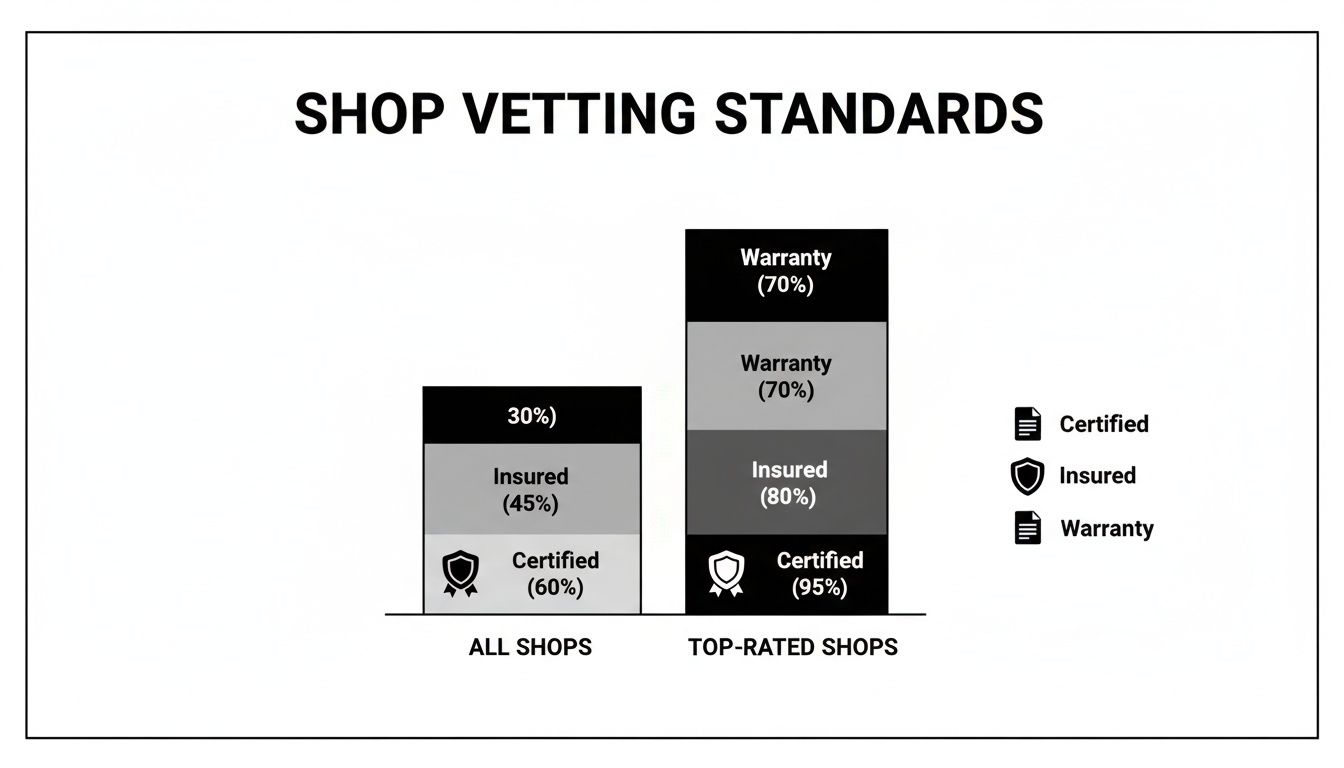
As you can see, the best shops are far more likely to be certified and offer solid warranties. That commitment to quality extends directly to the parts they choose for your vehicle.
Understanding the Total Picture
To give you a clearer idea of how these components come together, here’s a look at a typical repair bill. This table breaks down where the money goes.
Sample Auto Body Repair Cost Breakdown
| Cost Component | Average Percentage of Bill | What It Covers |
|---|---|---|
| Labour | 45-55% | Technician's time for disassembly, repair, reassembly, and finishing. |
| Parts | 30-40% | Replacement components like bumpers, fenders, lights, and brackets (OEM, aftermarket, or used). |
| Paint & Materials | 10-15% | The cost of paint, primer, clear coat, sandpaper, masking materials, and other shop supplies. |
| ADAS & Scans | Variable | Fees for pre-repair and post-repair diagnostic scans and safety system recalibration. |
This breakdown isn't set in stone—a major structural repair will have higher labour costs, while a simple bumper replacement is more parts-heavy. Still, it provides a solid framework for understanding your estimate.
Uncovering the Hidden—and Essential—Costs
Beyond the obvious parts and labour, a proper estimate will account for procedures that are absolutely critical for a seamless and, more importantly, safe repair. These are the details that often get skipped in a lowball quote, but they are non-negotiable for a professional job.
A great repair should be invisible. If an estimate seems too good to be true, it’s probably because the shop is cutting corners on crucial steps like paint blending or ADAS recalibration. These aren't optional extras; they're essential for a factory finish and your safety.
One of these is paint blending. This technique involves feathering the new paint onto the panels next to the repaired one. Why? Because even factory paint codes have subtle batch variations. Without blending, you’d see a distinct, mismatched square of colour where the new part is. It’s the difference between a repair that looks "good enough" and one that’s truly undetectable.
Even more critical is the recalibration of your vehicle's Advanced Driver-Assistance Systems (ADAS). The sensors and cameras for features like automatic emergency braking and lane-keep assist are often located in bumpers, mirrors, and windshields. After any collision work, these systems must be professionally recalibrated to ensure they work correctly. Skipping this step isn't just lazy; it's dangerous.
The debate over parts is a big one, and knowing the pros and cons is key. To get a better handle on this, check out our guide on OEM versus aftermarket components.
More Than Just Dents: Specialized Services of a Top-Tier Shop
When you search for an "auto body shop near me," it's usually because something’s gone wrong—a fender bender, a parking lot mishap, you name it. But the truly great shops do more than just fix what's broken. For those of us who really care about our cars, proactive protection is just as critical as reactive repairs.
These specialized services are what separate a standard repair centre from a genuine automotive partner. They're all about preserving your vehicle’s condition, boosting its appearance, and protecting your investment for the long haul.
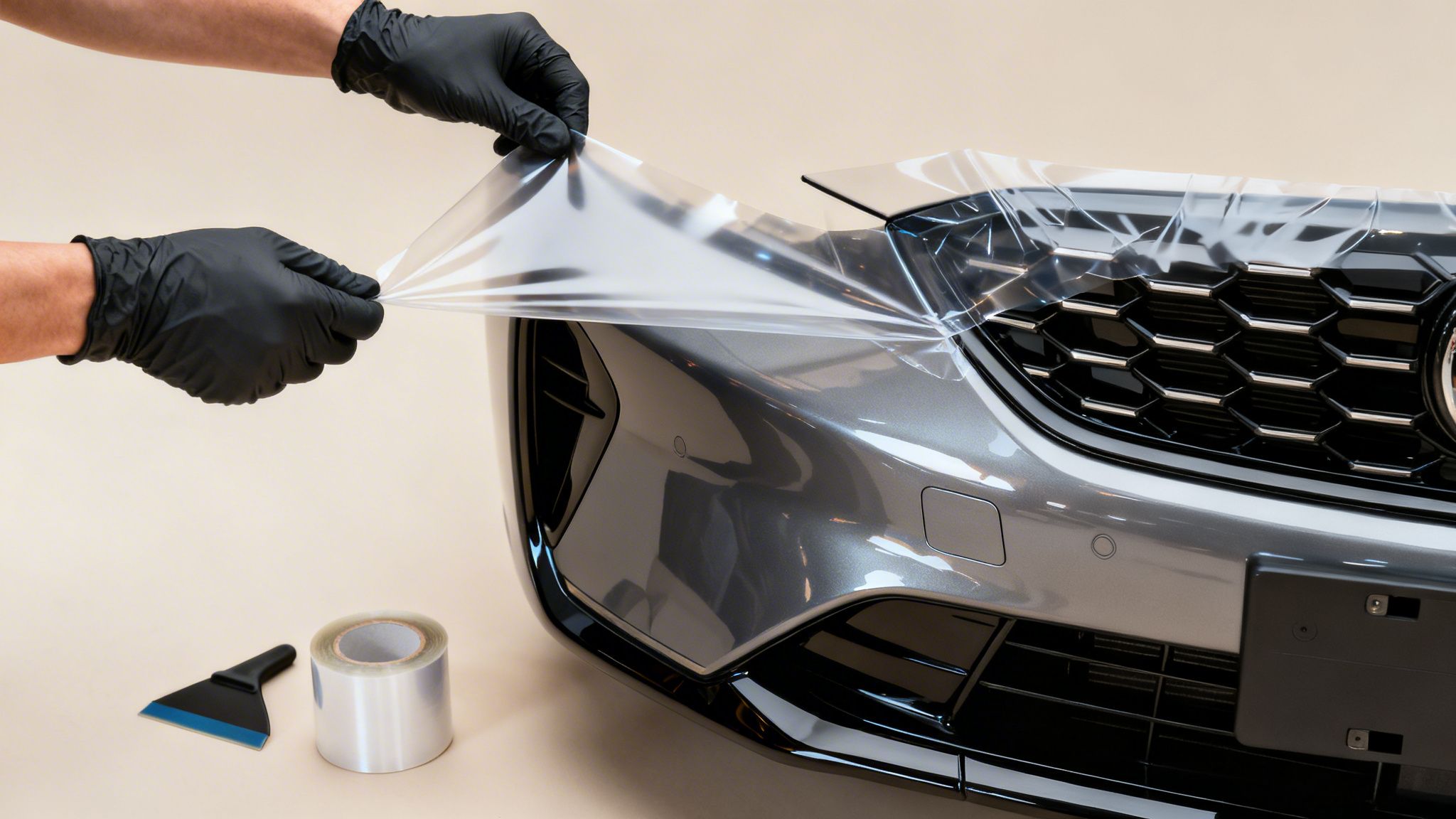
It’s one thing to fix damage, but it's another to stop it from happening in the first place. That’s where the best shops excel, offering services designed to defend against the daily grind that slowly chips away at your car's value and finish.
Invisible Armour With Paint Protection Film
Think of Paint Protection Film (PPF) as a clear, tough-as-nails suit of armour for your car's paint. This transparent urethane film is meticulously applied by a pro to the most vulnerable spots—your front bumper, hood, side mirrors, and door edges. It’s designed to be a sacrificial layer, taking the hits that would otherwise chip, scratch, or stain your factory paint job.
Driving on roads like Ontario’s Highway 401 is a constant assault of kicked-up rocks, sand, and other debris. PPF is built to withstand exactly that kind of punishment.
One of the coolest things about modern PPF is its self-healing ability. Light scratches and swirl marks literally vanish from the film’s surface when exposed to a bit of heat, whether from the sun on a warm day or a technician's heat gun. Your car’s finish stays looking immaculate.
If you have a new car or a vehicle you cherish, this is a non-negotiable. It's the single most effective way to protect your paint and lock in its resale value. To see exactly how it works, read our guide on the benefits and costs of Paint Protection Film.
The Benefits of Professional Window Tinting
Window tinting isn't just about getting that sleek, private look—though it certainly helps. High-quality window films bring some serious functional perks that protect you and your car's interior.
- UV Ray Blockage: A professional tint can block up to 99% of damaging UV rays. This is a game-changer for protecting your skin on long drives and preventing your dashboard, seats, and other interior surfaces from fading and cracking over time.
- Heat Rejection: You know that feeling of getting into a scorching car in July? Tint dramatically reduces interior heat buildup. Your A/C won't have to work as hard, which can even give you a little bump in fuel efficiency.
- Enhanced Privacy and Security: Tinting keeps prying eyes out. It gives you and your passengers more privacy and acts as a deterrent for thieves who can't easily see if there are valuables inside.
Specialized Services for Business Fleets
For a business, a vehicle is a rolling billboard and a critical asset. That’s why the best auto body shops provide specialized fleet maintenance programs designed to keep commercial vehicles looking sharp and on the road, not sitting in the shop.
This is way more than just oil changes. These programs cover everything from routine body inspections and vinyl wrap repairs for branding to efficiently fixing the minor dents and scuffs that company vehicles inevitably collect. A well-maintained fleet not only looks more professional but also holds its value far better, making it a smart investment for any business.
How to Read Between the Lines of Customer Reviews
When you start searching for an “auto body shop near me,” it’s easy to get lost in a sea of online reviews. But here’s something I’ve learned after years in this business: a perfect 5.0-star rating isn't always the full story. Sometimes, a 4.7-star shop with detailed, honest feedback tells you far more about what to expect.
Your job is to become a bit of a detective. You need to look past the star count and learn to spot the difference between a genuinely great experience and empty praise.
Spotting Genuine Feedback
Forget the one-liners like “Great service!” or “Fast repairs.” They’re nice, but they don’t give you anything concrete. The gold is in the reviews that tell a story. I always look for feedback where people mention a service advisor by name or describe how the shop kept them in the loop.
A truly happy customer often paints a complete picture of their experience, from the initial estimate to how well the shop worked with their insurance company. These details are signs of a shop that gets it right, consistently.
Look for reviews that clearly describe:
- The actual repair: Was it a small dent from a parking lot mishap or a complex post-collision reconstruction?
- The quality of communication: Did the shop send regular, clear updates, or did the customer have to chase them for information?
- The final result: How was the colour match in the sunlight? Did the new panels line up perfectly with the old ones?
- How they handled problems: If something didn't go as planned, did the shop own it and make things right without a fuss?
The best review I can imagine is from a customer whose insurance company was ready to write their car off as a total loss. But the body shop fought for them, found a way to do the repair properly, and saved the vehicle. That shows true expertise and a deep commitment to the customer, not just an easy payout.
The Warning Signs in Bad Reviews
Of course, negative reviews are just as revealing—if you read them correctly. One bad review might just be an unfortunate one-off situation. But when you start seeing the same complaints over and over again, that’s a pattern. That's a red flag.
Be on the lookout for recurring themes in negative reviews, such as:
- Constant complaints about poor communication and missed deadlines.
- Multiple people mentioning shoddy colour matching or visible paint flaws.
- Stories of surprise charges appearing on the final bill.
- Customers reporting that the same problem came back just weeks or months later.
This level of scrutiny is more important now than ever. The collision repair industry is facing what some are calling a total loss crisis. Forecasts suggest that by 2026, insurers could write off as many as 30% of repairable vehicles because of high salvage values and other factors.
A shop's ability to navigate this complicated environment and advocate for a proper repair is a critical skill. To get a better sense of what's at stake, you can discover more about these collision industry trends. Choosing a shop based on detailed, positive stories about complex repairs could be the very thing that saves your vehicle.
So, Who's the Right Choice for Your Car in Whitby?
You've done the homework. You now know exactly what to look for in a top-tier auto body shop—from spotting the difference between a shoddy estimate and a thorough one, to understanding the importance of certifications and warranties. It's a lot to take in, but that knowledge is your best tool.
At the end of the day, all this research points to one final, crucial step: finding a local shop that actually lives up to these high standards. For drivers across the Durham Region who refuse to settle for second-best, that’s where we come in.
We’re Car People, Just Like You
Here at Carmedics Autowerks, we’re not just another repair facility. We’re enthusiasts and specialists who are genuinely passionate about what we do. We built our shop on the very principles covered in this guide: total transparency, expert craftsmanship, and a customer experience that removes the stress from the repair process.
Our goal is simple: to hand you back your keys with your vehicle looking and feeling like the incident never happened.
More Than Just Collision Repair
We know that caring for your vehicle goes beyond fixing dents. That's why we’ve become a trusted one-stop destination for discerning owners, whether they're recovering from an accident or proactively protecting their investment.
- Collision Repair: Our bread and butter. We use factory-approved procedures and cutting-edge equipment to restore your vehicle’s structural integrity and flawless finish.
- Paint Protection Film (PPF): Think of it as invisible armour for your car. Our expert installers meticulously apply high-quality PPF to shield your paint from frustrating rock chips, scratches, and road debris.
- Window Tinting: A professional tint does more than just look good. It adds privacy, blocks damaging UV rays that fade your interior, and helps keep the cabin cooler.
We believe a great repair is an invisible one. It’s a philosophy that drives our team to obsess over the details, combining meticulous work with an absolute commitment to quality. We treat every vehicle that rolls into our bay as if it were our own.
We invite you to see for yourself what a difference passion and real expertise can make. Discover why so many people trust us as their go-to auto repair shop in Whitby and let us take care of your vehicle the right way.
Answering Your Top Auto Body Repair Questions
Even after you've done your homework, a few questions always pop up. It’s completely normal. We get asked these all the time, so let's clear up some of the most common concerns right now.
How Long Will My Auto Body Repair Take?
This is the million-dollar question, and the honest answer is: it depends entirely on the damage. A simple bumper scuff or a small dent repair? We might have you back on the road in just two to three days.
But for a more serious collision, the timeline naturally gets longer. We have to factor in parts availability—sometimes a specific part needs to be shipped from the manufacturer—and the time it takes for your insurance company to give the final approval. A job that requires frame straightening and replacing multiple panels could take several weeks. A good shop will give you a realistic timeline from the start and won't be afraid to call you with updates.
Do I Have to Use My Insurer's Recommended Shop?
Absolutely not. This is a big one. In Ontario, the law is on your side, giving you the right to choose your own repair facility. Insurance companies have their "preferred" shops, often chosen based on volume and cost agreements, not necessarily quality.
Your best move is to select an auto body shop near me that you've personally checked out and feel good about. A reputable shop will handle the communication with your insurer directly, fighting to make sure your vehicle is repaired correctly, not just cheaply.
What Is Paint Blending and Why Is It Necessary?
Ever see a car with a door that's just a slightly different shade from the rest of the body? That’s what happens when a shop skips paint blending. It’s a critical technique for getting a truly invisible repair.
Think of it this way: even with the factory paint code, there can be tiny variations between different batches of paint. Blending is the art of feathering the new colour onto the adjacent original panels. This creates a gradual transition that your eyes can't detect, ensuring the new paint melts perfectly into the old. It’s a non-negotiable step for any high-quality finish.
For drivers in Whitby who see their vehicle as more than just a way to get around, the search for that level of quality ends here. Bring your car to Carmedics Autowerks Inc and see for yourself what a difference true craftsmanship makes. Learn more about our services at CarmedicsAutowerks.com.