


When you run into electrical problems with your car and need an expert for auto electrical repair in Whitby, you've come to the right place. At Carmedics Autowerks, our certified technicians live and breathe the complex electrical systems in modern vehicles. We've got the tools and the know-how to fix everything from a flickering light to a major wiring nightmare.
Understanding Your Car's Electrical Nervous System
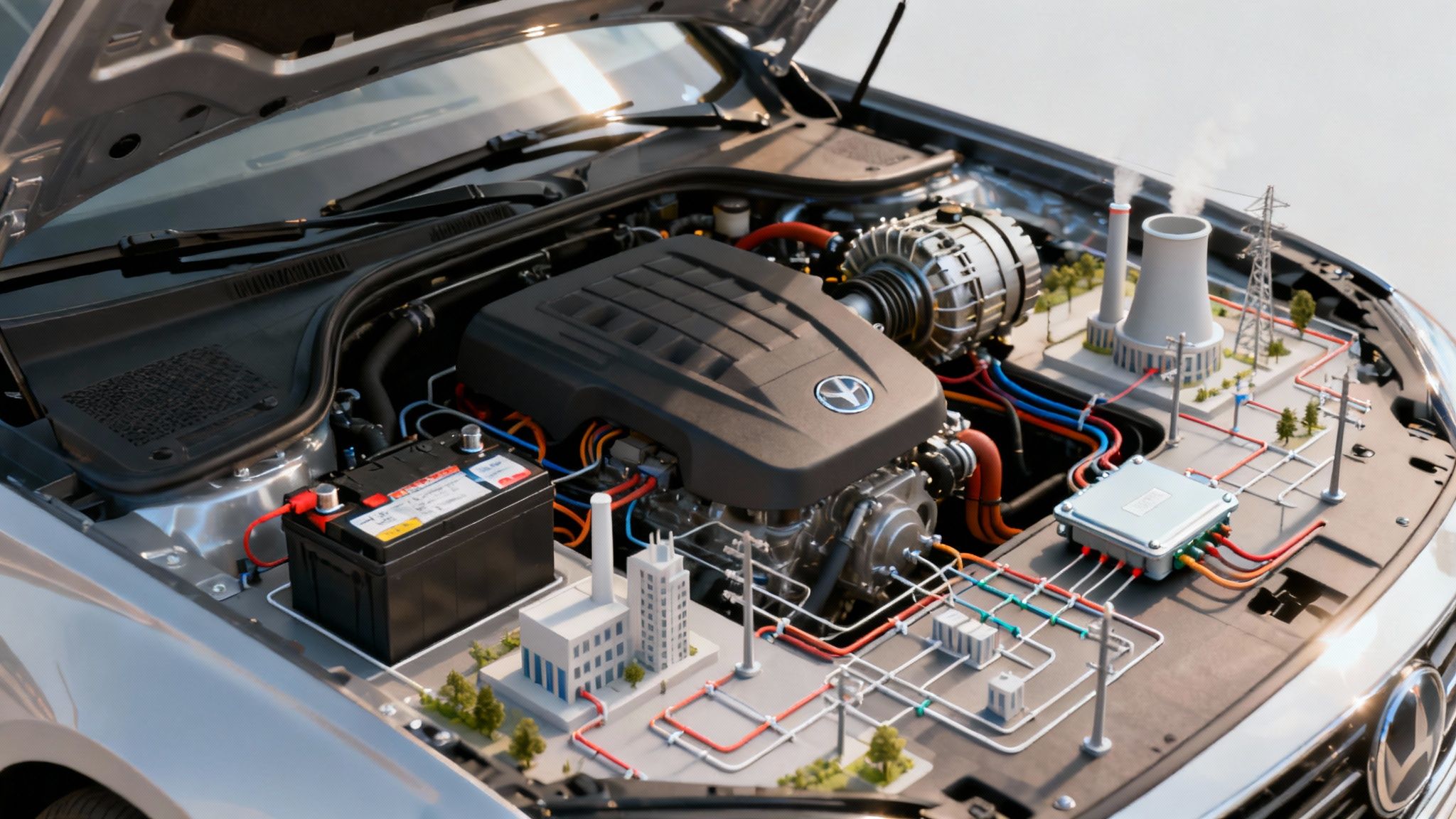
Ever thought about your car's electrical system? It's basically the vehicle's central nervous system. It’s a massive, complex network of wires, sensors, and computers that controls just about everything. We're talking starting the engine, turning on the headlights, and even running crucial safety features like airbags and anti-lock brakes. Take that away, and your car is little more than a fancy metal box.
To make sense of it all, picture a small city's power grid. Every single part has a job to do to keep the city humming along.
The Key Players in Your Vehicle's Power Grid
The three core components of this system are the battery, the alternator, and all the wiring. The battery is like the city's main power station; it gives that initial jolt of energy needed to fire up the engine and run your electronics when the car is off.
But once the engine is running, the alternator steps in. Think of it as the power plant, generating a steady stream of electricity to keep everything going and to recharge the battery for the next start. The wiring, of course, is the grid itself—the thousands of power lines carrying electricity to every part of your car that needs it.
This visual shows how these main components, all managed by the car's computer (ECU), work in harmony.
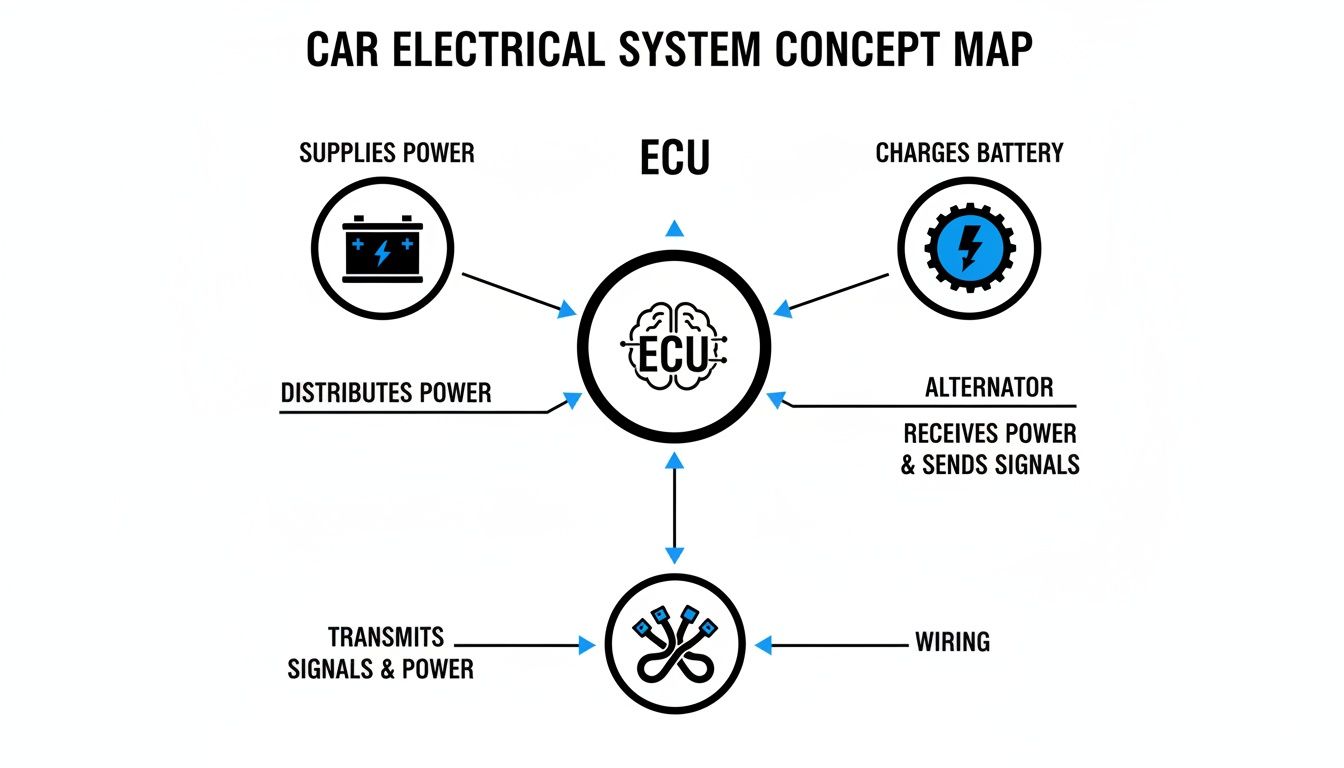
As you can see, the ECU is the traffic controller, directing the flow of power between the battery, alternator, and all the systems demanding electricity.
The Brain and Its Safeguards
The Electronic Control Unit (ECU) is the real brain of the operation. It's constantly monitoring and adjusting the engine and other systems, making countless decisions every second. But what happens if there's a power surge?
That's what fuses are for. Fuses are the circuit breakers of the system. If a circuit gets overloaded with too much current, the fuse blows, instantly cutting the connection. It's a simple, brilliant way to protect expensive electronics from getting fried. A blown fuse often signals a bigger problem, which is why a professional diagnosis is so important.
Getting a handle on these basics is a great start. For a deeper dive into how everything works together, check out our guide to general auto repair. This background knowledge really helps you see why specialized electrical repair is a must for the high-tech vehicles on the road today.
Common Electrical Problems Whitby Drivers Experience
From a dome light that won't turn off to a car that flat-out refuses to start, electrical gremlins give you warning signs long before they cause a major headache. For drivers here in Whitby, learning to spot these clues is the first step to getting things fixed quickly and correctly.
These aren't just small annoyances; they're messages. Think of them as your vehicle's way of telling you that its complex nervous system needs a check-up.
Lots of drivers first realize something's wrong when their car struggles to turn over, especially on one of our cold Ontario mornings. That classic slow crank usually points to a weak battery or a tired starter motor. But if your battery is new and still keeps dying, the real culprit is likely hiding somewhere in the charging system.
Decoding Common Electrical Symptoms
When an electrical fault pops up, your car will act out in very specific ways. Knowing what these symptoms mean helps you explain the issue to a technician, which always leads to a faster and more accurate diagnosis for your auto electrical repair.
We've seen it all, but here are some of the most frequent issues that bring cars into our Whitby shop:
- Dead Battery: This is the most common call we get. Batteries naturally wear out, but if a brand-new one dies on you, it's a classic sign of a parasitic drain. Something is secretly sipping power even when the key is out of the ignition.
- Dim or Flickering Lights: Do your headlights dim when you turn on the heat or the radio? This is a huge red flag that your alternator is struggling to keep up with the electrical demand. It's the powerhouse of your car, and when it gets weak, everything suffers.
- Blown Fuses: Fuses are the heroes of your electrical system—they sacrifice themselves to protect more expensive parts. If the same fuse keeps blowing, it tells us there's a short circuit somewhere in that specific system that needs to be found.
- Warning Lights: That glowing check engine or battery light on your dash isn't a suggestion. It's a direct order from your car's onboard computer telling you it's detected a fault and needs attention.
Our tough Ontario winters are notoriously hard on electrical components. The road salt and moisture accelerate corrosion on alternators and battery terminals. In fact, we see up to 30% more electrical failures across the Durham Region right after the snow melts compared to milder seasons.
Quick Guide to Electrical Symptoms and Potential Causes
Sometimes you just need a quick idea of what might be going on. Use this table to match what your car is doing with some of the most likely causes.
| Symptom | Possible Cause | Urgency Level |
|---|---|---|
| Car won't start, no clicks | Dead battery, faulty ignition switch | High |
| Engine cranks but won't start | Faulty starter motor, fuel system issue | High |
| Lights dim or flicker while driving | Failing alternator, loose battery connection | Medium |
| Power windows/seats don't work | Blown fuse, bad switch, faulty motor | Low |
| Burning plastic smell | Short circuit, melting wires | High (Stop Driving!) |
While this table is a helpful starting point, a professional diagnosis is the only way to be certain and avoid replacing the wrong parts.
When to Seek Professional Help
A dead battery seems simple enough, but it often hides a bigger problem. A failing alternator, for example, can quickly destroy a brand-new battery by either not charging it enough or overcharging it. That's why just swapping the battery without a full diagnostic check can be a waste of money.
Things like malfunctioning power windows, a starter that just clicks, or that unmistakable smell of burning plastic are clear signals it's time to call a pro. Attempting to fix complex wiring issues without the right tools and deep knowledge often leads to more damage and a much higher repair bill.
If you're already dealing with battery issues, our guide on car battery replacement cost can give you an idea of what to expect. Getting these signs checked out promptly is the best way to keep your car safe and reliable on the road.
How We Diagnose Electrical Faults Accurately
Finding an electrical gremlin in a modern car is a science, not a guessing game. Vehicles today are loaded with complex circuits, so just swapping out parts until something works is a recipe for frustration and a massive bill. Our diagnostic process is more like a methodical hunt for the root cause, making sure any repair we do is the right one.
It all starts with a good old-fashioned visual inspection. Before we even think about plugging in any high-tech gear, our technicians use their most valuable tools: their eyes and ears. They’re looking for the obvious red flags that are easy to miss, like corroded battery terminals, frayed wiring, loose connections, or even tell-tale signs of a mouse making a home under your hood.
You'd be surprised how often this first simple step points directly to the problem, saving you both time and money.
Diving into High-Tech Diagnostics
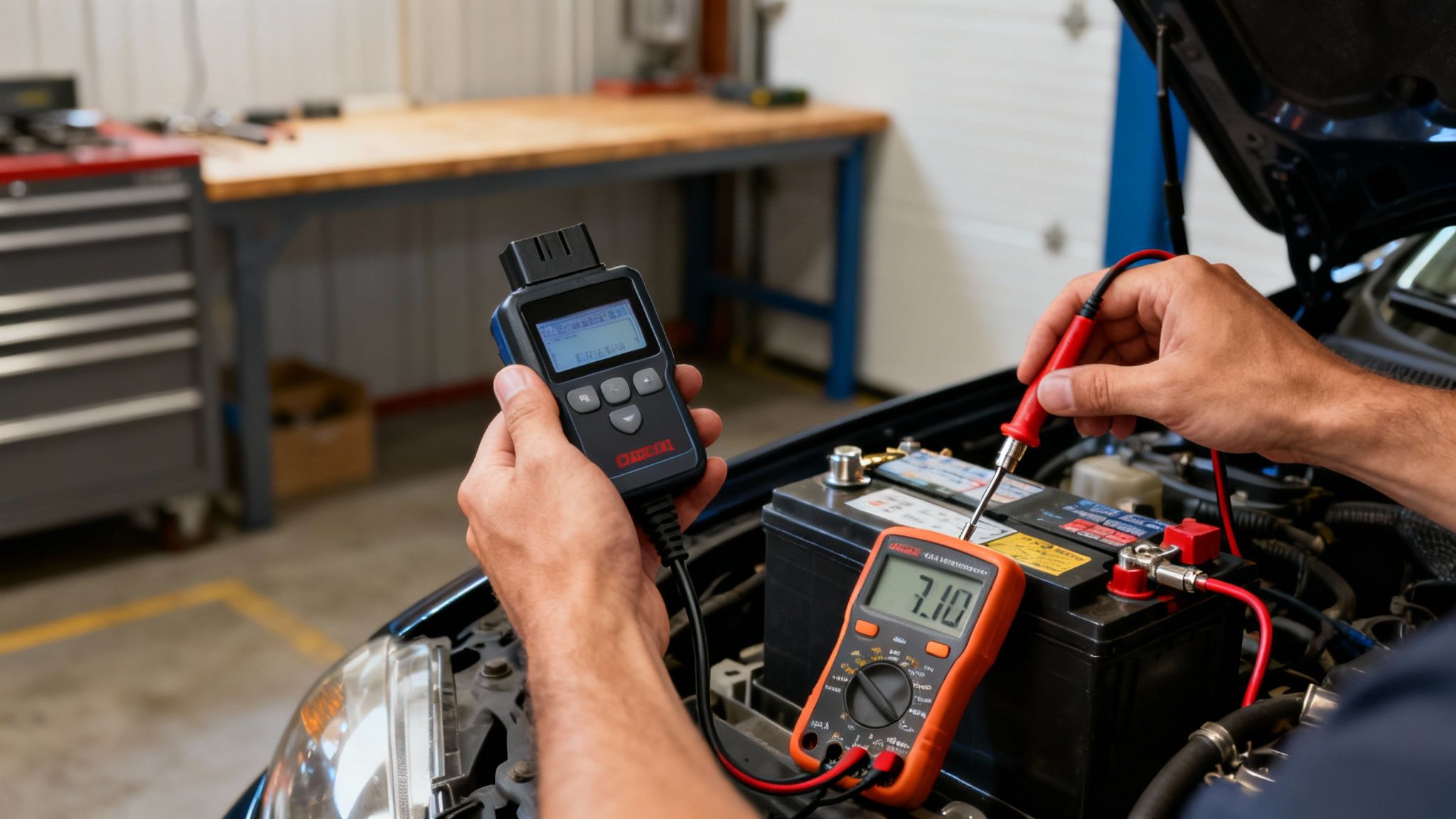
After the visual once-over, it's time to bring in the technology. We connect a professional-grade OBD-II (On-Board Diagnostics) scanner right into your vehicle's computer. The best way to think about this is like having a direct conversation with your car; the scanner reads the diagnostic trouble codes (DTCs) that your car's brain has stored.
These codes are essentially digital breadcrumbs, pointing us in the right direction. A code might tell us there's a fault in the oxygen sensor circuit or that the alternator's voltage is off. It’s a huge part of our complete engine diagnostics service.
Tracing the Flow of Power
Here's the thing: an error code tells us what circuit is having a problem, but it doesn't always tell us why. That’s where the real hands-on expertise comes in. The final and most critical step is using specialized tools like a digital multimeter to follow the electricity itself.
A multimeter is to an auto electrician what a stethoscope is to a doctor. It lets us measure voltage, current, and resistance, giving us a live picture of the electrical system's health and helping us pinpoint the exact point of failure.
With this tool, our technicians can run a few key tests:
- Voltage Drop Test: This is perfect for finding hidden corrosion or a weak connection that's choking the flow of electricity, kind of like a clog in a water pipe.
- Continuity Test: We use this to make sure a wire isn't broken somewhere inside its insulation. It confirms there’s a clear, unbroken path for power to travel.
- Parasitic Draw Test: If your battery keeps dying overnight, this test is our go-to. It helps us hunt down the sneaky circuit that’s draining power when your car is completely shut off.
By following this careful, multi-step process, we get past the symptoms and uncover the real source of the electrical problem. It’s our guarantee that when we recommend a fix, it’s the right one, done correctly the first time.
Understanding Auto Electrical Repair Costs
So, we've figured out what's wrong with your car. The next big question on your mind is probably, "How much is this going to cost?" The truth is, the price for an auto electrical repair in Whitby can be all over the map. Swapping out a dead battery is one thing; painstakingly tracing a short in a complex wiring harness is a whole different ball game.
Think of the final bill as a sum of three parts: your specific vehicle, the new components we need, and the hands-on time from our technicians. Each one has a real impact on the total needed to get your car back on the road safely.
Key Factors Influencing Your Repair Bill
The biggest drivers of cost are often the complexity of your car’s electrical system and how hard it is to get to the problem area. A modern luxury sedan, crammed with dozens of sensors and control modules, is naturally going to be more labour-intensive than a more straightforward, older model.
Here’s a quick rundown of what shapes the final invoice:
- Vehicle Make and Model: Premium brands and newer cars tend to have incredibly intricate electrical systems. More complexity often means more time on the hoist.
- Cost of Parts: The price of the component itself—whether it's a new alternator, a tiny sensor, or a section of wiring—is a major part of the cost. We only use high-quality parts to make sure the fix lasts.
- Labour Time: This is all about the complexity of the job. Getting to a wiring loom buried deep behind the dashboard takes a lot longer than changing an easy-to-reach fuse.
Industry numbers show that 44.9% of a repair shop's expenses go toward sourcing top-quality parts, with another 29.1% covering the skilled labour of certified technicians. This is why a certified shop like Carmedics Autowerks is a smart choice—you're paying for expertise and reliability.
Common Repairs and Cost Considerations
On the lower end of the cost scale, you have simple fixes like a new battery. An alternator replacement is a step up, as the part itself is more expensive and it's usually tucked away in the engine bay. For more custom jobs, like adding aftermarket accessories, the pricing has its own structure. If you're curious, you can get a better idea by checking out our guide on the cost to install a remote starter.
And while we're talking about electrical systems, it's interesting to look at how things differ in the EV world. You can learn more about their specific needs by reading up on Electric Car Maintenance Costs.
At the end of the day, our goal is to be completely transparent. After we’ve diagnosed the issue, we'll give you a detailed estimate and walk you through every line item. We want you to see exactly what you're paying for and why it's necessary. No surprises, just honest work.
Why Choose a Specialist for Electrical Repairs
Deciding where to take your car for service can be a tough call. In 2023, Ontario's auto repair shops pulled in 35.1% of all Canadian repair revenue, and with about 55 shops in Whitby alone, you've got a lot of options. You can learn more about the competitive Ontario auto repair market at Carmedics Autowerks. In a crowded field like this, picking the right technician is key—especially when it comes to the complex electronics in modern cars.
When you need an auto electrical repair in Whitby, going to a general mechanic is a bit like asking your family doctor to perform heart surgery. They have a great breadth of knowledge, but they don't have the focused, deep expertise needed for such a delicate job. A specialist, on the other hand, lives and breathes the complex world of automotive electronics day in and day out.
The Right Tools for a Complex Job
Modern cars, especially those loaded with Advanced Driver-Assistance Systems (ADAS), are packed with sensors, modules, and kilometres of wiring. Figuring out what’s wrong with these systems takes more than a basic code reader; it demands serious investment in highly specialized diagnostic equipment.
At Carmedics Autowerks, we’ve made that investment. We have the most current technology, which means we can:
- Talk directly to your vehicle’s specific control modules.
- Precisely calibrate sensitive ADAS parts like cameras and radar sensors.
- Find the exact fault in a complex circuit without playing a guessing game.
This dedication to having the right tools means we find the root cause faster and with far greater accuracy. That saves you from paying for parts you don't need and from having to come back for the same issue. Our equipment lets us see exactly what’s happening inside your car’s electrical nervous system.
Choosing a specialist isn't just about fixing a problem; it's about investing in peace of mind. You gain the confidence that the repair is done right the first time by technicians who possess a profound understanding of modern vehicle electronics.
Expertise That Makes a Difference
Beyond the fancy equipment, the real value comes from the technician's experience. Our team is made up of certified professionals who specialize in electrical systems. This isn’t just one part of their job—it’s their entire focus. They’re constantly training to keep up with the whirlwind of changes in automotive technology, from hybrid powertrains to intricate infotainment systems.
This deep, specialized knowledge is why we’re a trusted choice for certified auto repair in Whitby. When you bring your vehicle to a specialist, you're not just getting a quick fix; you're getting precision, reliability, and the assurance that your car is in the most capable hands possible.
A Few Simple Tips to Avoid Electrical Problems
Let's be honest, the best repair is the one you never have to make. A little proactive care for your car's electrical system is your best shield against a dead battery on a cold Whitby morning or a sudden dashboard light show. Staying on top of things helps your battery and alternator last longer and keeps your car reliable.
Think of it as a quick health check-up for your vehicle. You don't need to be a mechanic to do this stuff, and it can save you from the headache of being stranded.
Your At-Home Electrical Checklist
Carve out a few minutes every couple of months to give things a once-over. Spotting a small issue early is the secret to avoiding a much bigger, and more expensive, auto electrical repair down the road.
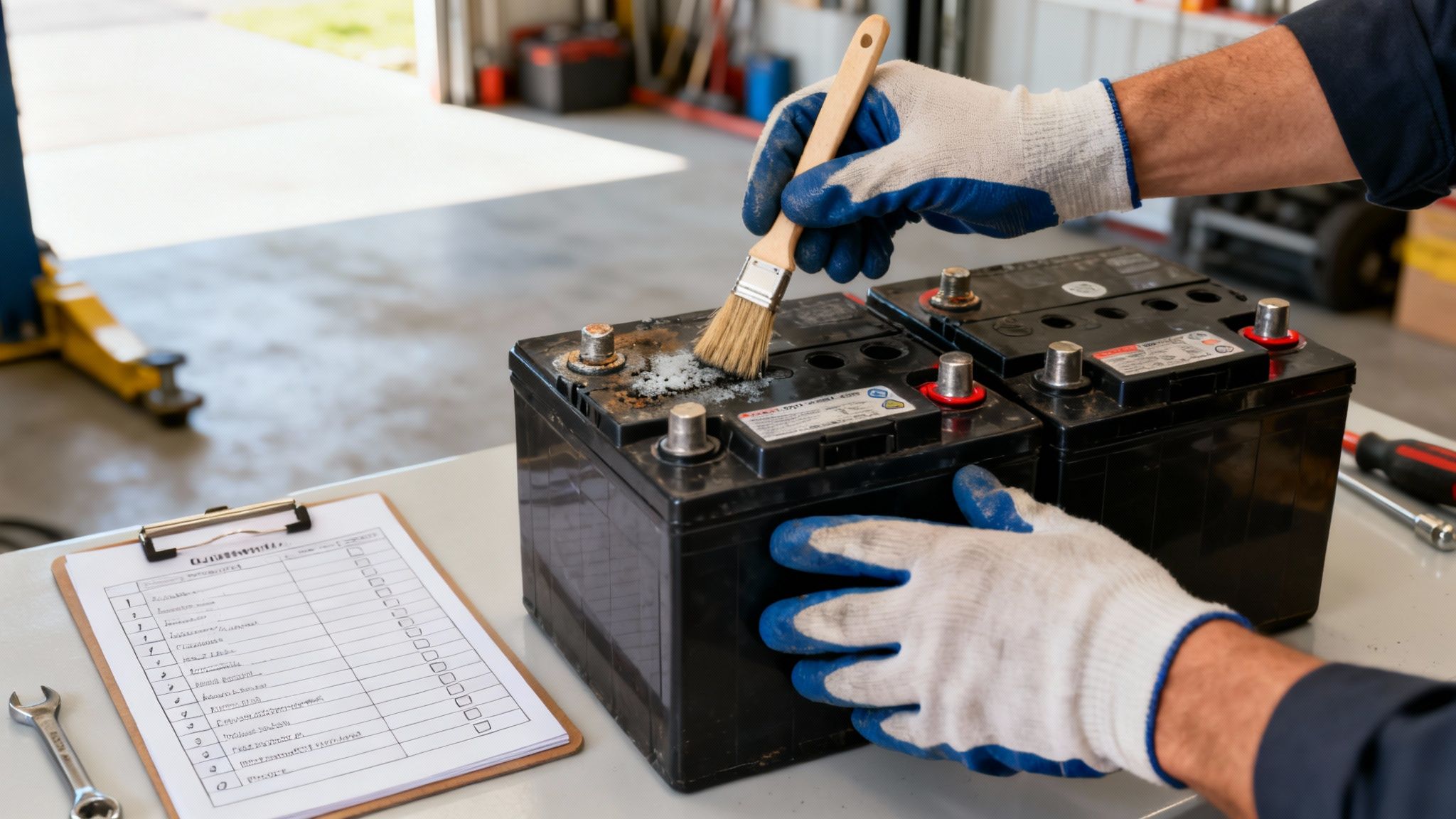
- Check the Battery Terminals: Pop the hood and take a look. See any fuzzy, white, or greenish-blue gunk on the metal posts where the cables connect? That’s corrosion, and it's a major barrier to the flow of electricity. It can stop your battery from charging properly or even prevent your car from starting.
- Inspect Visible Wires: Give the wiring you can see a quick visual scan. Anything that looks cracked, frayed, or brittle is a red flag. That plastic coating protects the wire, and if it's damaged, you could be looking at short circuits or blown fuses—problems that can be a real pain to track down.
- Confirm Connections Are Snug: Gently wiggle the cables attached to your battery terminals. They should be rock solid. A loose connection is one of the most frequent—and thankfully, easiest to fix—reasons a car won't start.
- Listen for Odd Noises: When you fire up the engine, listen for any squealing sounds. A sharp, high-pitched squeal often points to a worn or loose serpentine belt. That's the belt that drives the alternator, and if it’s not doing its job, your battery isn’t getting charged.
Think of a professional inspection as a smart investment. A technician can properly test your battery's health and your alternator's output, giving you a heads-up long before a critical part decides to call it quits.
By making these simple checks a regular habit, you're taking an active role in your car's well-being. Combine these quick inspections with a professional look-over now and then, and you’ll dramatically cut your risk of being caught off guard by an electrical failure.
Your Auto Electrical Questions, Answered
Dealing with car trouble is never fun, especially when it's a mysterious electrical problem. To help drivers in Whitby and the surrounding area feel a bit more prepared, we've pulled together the real-world answers to the questions we get asked most often about auto electrical repairs.
Think of this as your guide to making smart decisions for your vehicle's health, without all the confusing jargon.
How Long Does an Auto Electrical Repair Usually Take?
Honestly, it really depends on what we find. A simple job like a battery swap is straightforward and can often be done in under 30 minutes. You'll be in and out in no time.
But tracking down a phantom electrical issue—like a warning light that flickers on and off without warning—is more like detective work. That takes time. Complex repairs, such as fixing a wiring harness tucked away behind the dashboard, could take several hours of careful, focused labour. We'll always give you a clear, upfront time estimate once we know exactly what we're dealing with.
Can a Bad Alternator Ruin a New Battery?
Absolutely. We see it all the time, and it's a classic case of throwing good money after bad. A faulty alternator is the number one enemy of a healthy battery. It can either fail to charge the battery enough, leaving it constantly drained and struggling, or it can overcharge it.
An overcharged battery can essentially get "cooked" from the inside out. The excess voltage causes it to overheat, which damages the cells and drastically shortens its life. That’s why we always test the whole charging system. Just replacing the battery without checking the alternator is often a temporary fix for a much bigger problem.
Is It Expensive to Diagnose an Electrical Issue?
There is a diagnostic fee, but it’s better to think of it as an investment in getting the job done right the first time. That cost covers a skilled technician's time and the use of some very sophisticated and expensive scanning tools. The alternative—guessing—almost always leads to replacing parts that weren't the problem, which ends up costing you a lot more.
Paying for a proper diagnosis is easily the most cost-effective way forward. It ensures we find the actual root cause, so we can perform the correct auto electrical repair in Whitby from the get-go and save you from a headache of unnecessary bills.
When you need expert diagnostics and electrical repairs you can count on, bring your vehicle to Carmedics Autowerks Inc. Schedule your appointment online today and let our specialists get you back on the road safely.