

Ever wondered why you can't just put limo-dark tint on all your car windows? It all comes down to window tint laws, a set of rules that dictate how dark and reflective your tint can be.
In Canada, these regulations change from province to province. However, the general rule of thumb is that your front side windows need to let in more light than the back ones. This isn't just arbitrary red tape—it's about keeping everyone safe, and staying on the right side of these laws will save you from hefty fines.
Why Window Tint Laws Exist
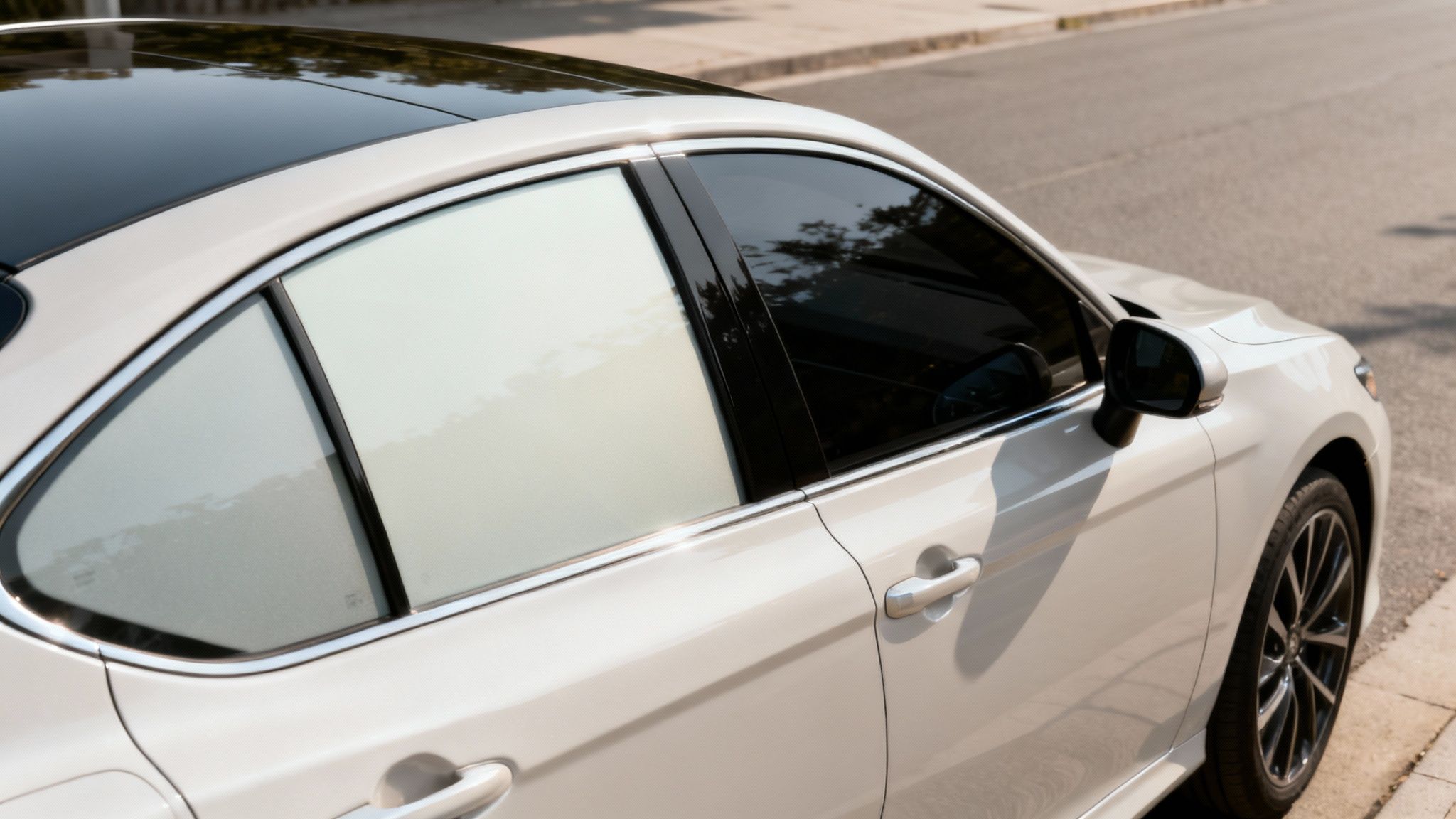
Window tint laws can feel like a nuisance, but they're really about striking a critical balance. Think of it as weighing your desire for a sleek look, privacy, and a cooler cabin against the absolute necessity of road safety for everyone. These rules ensure you can personalize your vehicle without putting yourself or others in harm's way.
The key concept behind these laws is Visible Light Transmission (VLT). It's just a fancy term for measuring how much light can pass through your tinted window. A lower VLT percentage means a darker tint. For instance, a 5% VLT is what you'd see on a limousine—it's nearly blacked out. On the flip side, a 70% VLT is very light and barely noticeable. If you want to see how these numbers translate to a real-world look, it's worth checking out a guide on automotive window tint percentages.
This single measurement, VLT, is the foundation for virtually all window tint legislation in Canada.
The Foundation of Safety
The main reason tint laws get so specific, especially for the front windows, boils down to one thing: driver visibility. Your ability to see what's happening around you is non-negotiable, especially when conditions are less than ideal.
- Night Driving: An extremely dark tint can make it dangerously difficult to spot pedestrians, cyclists, or hazards on dimly lit streets.
- Adverse Weather: In heavy rain, fog, or snow, dark tints can make a tough situation worse by further clouding your view of the road.
- Eye Contact: It might seem small, but making eye contact with other drivers or pedestrians at a four-way stop is a huge part of communicating on the road. Overly dark tints make that impossible.
Window tint regulations aren't there to ruin your car's aesthetic. They're designed to preserve a fundamental level of visibility that prevents accidents. This is precisely why the rules are always toughest for the front windows.
Law Enforcement and Public Safety
Beyond just your own visibility, tint laws are also about protecting police officers. During a traffic stop, an officer approaching a vehicle needs to be able to see inside to assess the situation and look for any potential threats. Blacked-out windows create a major blind spot, turning a routine stop into a risky and unpredictable encounter.
This is the very reason you'll find that almost every jurisdiction puts strict limits on how dark the driver and front passenger windows can be. By mandating higher VLT levels for those windows, the law finds a middle ground. You still get the benefits of tinting on your rear windows, but transparency is maintained where it matters most for safe interactions with law enforcement. It's all about making sure your car looks sharp without creating unnecessary risks.
The History Behind Window Tint Regulations
To really get why window tint laws are what they are today, we have to look back at how they started. These rules weren't just made up on a whim. They’re the result of decades of real-world problems, growing safety concerns, and some tragic lessons learned on the road. The whole story is a journey from a lawless, "anything goes" approach to the structured system we have now, all built around keeping people safe.
In the early days of car customization, window tinting was like the Wild West. Car lovers were drawn to the sleek, mysterious look that dark film gave their rides, and there were zero rules to say they couldn't. But that freedom came with a heavy cost—accidents caused by poor visibility started to pile up.
The Unregulated Era and Its Dangers
Before any official laws were on the books, tinting was often a DIY job. People would use spray-on products that could make a windshield almost completely black. It might have looked cool, but the real-world consequences were serious. Drivers with super dark tints couldn't see pedestrians, road signs, or other cars, especially at night or in bad weather.
This complete lack of rules created a very real danger on our streets. The exact thing that made a car stand out also made it a lot less safe to drive. Accident reports from that time often pointed to the driver's poor visibility as a key factor, which kicked off a public debate about where to draw the line between personal style and public safety.
California is a perfect case study. Before 1961, you could tint your windows as dark as you wanted, no questions asked. This led to some dangerously dark applications that made it nearly impossible to see. As accidents linked to impaired vision mounted, the state was forced to step in, eventually banning any material that blocked a driver's clear view through the windshield. You can read more about this crucial moment in early window tint regulation history on latimes.com.
The Shift Towards Safety and Regulation
The real turning point for window tint laws came when two major safety issues became too big to ignore: drivers not being able to see and the risk this posed to police officers.
- Driver Visibility: Lawmakers and safety groups started putting two and two together, linking extremely dark tints to a rise in preventable crashes. It became obvious that a driver's ability to see what's happening around them had to come before any cosmetic change.
- Officer Safety: An equally serious concern came directly from law enforcement. During a traffic stop, an officer walking up to a car with blacked-out windows has no idea what they're walking into. It created a tense, unpredictable situation where they couldn't spot potential threats or even see how many people were inside.
The whole point of modern window tint laws is simple: protect a driver's line of sight and an officer's ability to do their job safely. These rules were born out of necessity, not a desire to cramp anyone's style.
This twofold focus—on both driver and officer safety—laid the groundwork for the detailed laws we see all across North America today.
The Modern Legal Framework
The move from a free-for-all to today's specific regulations didn't happen overnight. It was a gradual process. Lawmakers dug into accident data, talked with police departments, and debated how to create a system that was both fair and effective. This eventually led them to the Visible Light Transmission (VLT) standard, which gave everyone an objective, measurable way to define what's legal and what's not.
Instead of vague rules, VLT percentages gave us a clear benchmark that both drivers and tint shops could follow. Developing these standards meant that window tint laws were finally based on safety science, not just someone's opinion. Every province and state now has its own specific limits, but they all come from the same place—a commitment to preventing the kinds of visibility-related dangers that defined that early, unregulated era. For a full breakdown of today's rules, you can check out our detailed guide on current Canadian window tinting laws.
A Provincial Breakdown of Canadian Tint Laws
Trying to figure out Canadian window tint laws can feel a bit like driving into a fog. The rules change the second you cross a provincial border, and what’s perfectly legal in Alberta might get you pulled over in Ontario. Think of this as your roadmap to navigating those differences.
We'll break down the specific rules for each province, focusing on that all-important number: the Visible Light Transmission (VLT) percentage. This will give you the confidence that your car looks great, feels comfortable, and stays on the right side of the law, no matter where your travels take you.
This infographic gives you a quick snapshot of how we got here—from the "anything goes" days to the safety-first regulations of today.
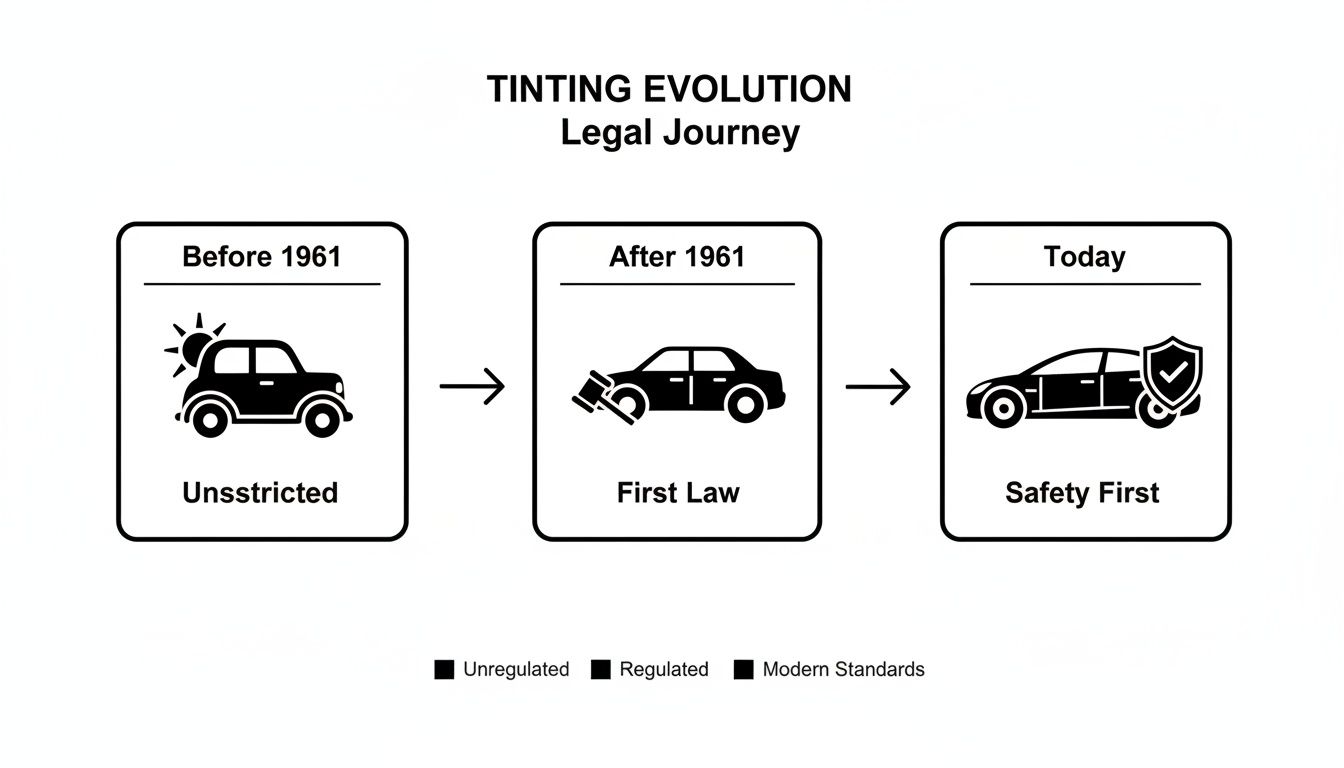
You can really see the shift in thinking. Over time, the focus has moved away from pure aesthetics and squarely onto ensuring driver and public safety.
A Focus on Ontario Window Tint Laws
Since we're based in Whitby, let's start with a close look at Ontario's rules. Here, the regulations are outlined in the Highway Traffic Act, and they happen to be some of the strictest in the country, especially when it comes to your front windows.
Simply put, you cannot apply any aftermarket tinting film to the windows in the driver's compartment. That means the front side windows next to the driver and passenger are off-limits. The only exception is for vehicles that rolled off the assembly line with factory-tinted glass, which usually has a VLT of around 70%.
For any windows behind the driver, however, the rules are much more relaxed. You can go as dark as you like on the rear side windows and the back windshield. The one major condition is that if you tint your rear window, your vehicle must be equipped with two working exterior side mirrors.
The Bottom Line for Ontario: No aftermarket tint on the front driver and passenger windows. For everything behind the driver, you have a lot of freedom, just make sure you can see clearly out of your side mirrors.
Comparing Tint Laws Across the Provinces
While Ontario draws a hard line on front windows, other provinces offer a bit more leeway. This is exactly where drivers get tripped up—a cross-country road trip can easily lead to confusion or an unexpected ticket if your tint doesn’t meet local standards.
Take British Columbia, Alberta, and Saskatchewan, for instance. They all agree that the front windshield is a no-tint zone. But they diverge on the front side windows, often allowing a light tint as long as it doesn’t block the driver's view or create a dangerous glare.
Manitoba gets very specific, setting the limit at 50% VLT for front side windows and 35% VLT for the rear. That’s a world away from Quebec, which requires a minimum of 70% VLT on the front side windows—one of the lightest allowances in all of Canada.
The Maritime Provinces and Territories
Out on the East Coast, the story is much the same: it all depends on where you are. Nova Scotia has some of the toughest laws, banning any film on the front side windows entirely. New Brunswick, on the other hand, is more flexible, permitting tints as long as the vehicle's interior is still visible from the outside.
The territories—Yukon, Northwest Territories, and Nunavut—tend to have less detailed legislation on the books. They often fall back on federal standards or have broader rules that just emphasize the need for a clear, unobstructed view for the driver.
To help you see these differences at a glance, here’s a quick-reference table.
Canadian Provincial Window Tint Law Summary
This table summarizes the VLT limits across Canada, but remember that laws can change. It's always a good idea to check the latest provincial regulations before getting your windows tinted.
| Province/Territory | Front Side Windows VLT % | Rear Side Windows VLT % | Rear Windshield VLT % | Key Notes |
|---|---|---|---|---|
| Ontario | Not Permitted (Aftermarket) | Any Darkness | Any Darkness | Must have dual side mirrors if the rear window is tinted. |
| Quebec | Must be 70% or more | Any Darkness | Any Darkness | Very strict on front side windows. |
| British Columbia | Not Permitted (Aftermarket) | Any Darkness | Any Darkness | No reflective or mirror tint allowed. |
| Alberta | Not Permitted (Aftermarket) | Any Darkness | Any Darkness | Medical exemptions are available. |
| Manitoba | Must be 50% or more | Must be 35% or more | Must be 35% or more | Specific VLT percentages are enforced. |
| Saskatchewan | Not Permitted (Aftermarket) | Any Darkness | Any Darkness | Focus is on non-obstructed driver vision. |
| Nova Scotia | Not Permitted (Aftermarket) | Any Darkness | Any Darkness | One of the strictest provinces for front windows. |
This chart is a great starting point, but for a deeper dive, check out our complete guide on how to navigate the complexities of tinted windows law.
Colour and Reflectivity Restrictions
It’s not just about how dark you go. Many provinces also have rules about the colour and reflectiveness of your window tint, all designed to stop dangerous glare from blinding other drivers.
- Reflective Tints: Mirrored or metallic films are a no-go virtually everywhere in Canada. They can act like a mirror, shooting sunlight directly into the eyes of other drivers and creating a serious hazard.
- Colour Restrictions: You also need to be careful with certain colours. Red and amber tints are almost always illegal on any window because they can be mistaken for brake lights or turn signals.
It's interesting to see how other places handle this. California's window tint laws, for example, require front side windows to allow over 70% VLT. Like in many Canadian provinces, the rear windows can be any darkness, but they have strict bans on red, amber, or blue films. It just goes to show how different governments tackle the same safety goals with slightly different solutions.
Ultimately, getting to know the specific window tint laws in your province is the first and most important step to getting a tint job you'll love—and that won't get you into trouble.
So, What Happens If You Get Caught with Illegal Tint?

Let’s be honest: window tint that’s too dark is an easy target. It gives police a clear reason—probable cause, in legal terms—to pull you over on sight.
Even if you're a perfect driver, that tint alone can trigger a traffic stop. And once you're on the side of the road, that initial stop can easily lead to officers finding other things to ticket you for.
So, what are you looking at if you're flagged for illegal tint?
- Fines: These can hit you for anywhere from $100 to $500, depending on your province.
- Demerit Points: You could get up to 2 points added to your licence.
- Removal Orders: You’ll be ordered to strip the illegal film off your windows, and that cost comes straight out of your pocket.
- Higher Insurance Premiums: Some insurance providers see tint violations as a sign of a higher-risk driver.
Enforcement and How a Traffic Stop Plays Out
While the specific approach can vary from one jurisdiction to another, the process is pretty standard. An officer who suspects your tint is too dark will likely pull out a tint meter to get an exact reading of your window's Visible Light Transmission (VLT).
This isn't just a minor issue, either. The numbers show it's a common ticket.
Nearly 200,000 citations were issued by the California Highway Patrol between January 2015 and August 2017. That averages out to about 80,000 tickets per year, or over 200 a day. You can read more about these stats on DevinadouglasLaw.
These "fix-it" tickets aren't just a slap on the wrist. They're an invitation for police to give your vehicle a closer look, which means any other small issue could suddenly become another ticket.
The stop itself usually goes something like this:
- The officer does a quick visual check, often shining a light through the window to gauge its transparency.
- They use a VLT meter to get an official reading, which is then logged.
- You're issued a "fix-it" ticket, which gives you a specific timeframe to get the tint corrected.
- You're officially ordered to have the tint removed before you can clear the ticket.
| Province | Fine Range | Demerit Points | Removal Deadline |
|---|---|---|---|
| Ontario | $100–$250 | 2 | 30 days |
| Alberta | $200–$400 | 1 | 15 days |
| Quebec | $250–$350 | 2 | 30 days |
The Consequences Go Way Beyond a Simple Fine
A small fine might seem manageable, but things can escalate fast if you don't take care of it. Ignoring a removal order or blowing past the deadline usually means more fees get tacked on.
Those demerit points are a big deal, too. Depending on your province, they can bring you closer to a licence suspension. And then there's your insurance company. Insurers see tint violations on your driving record as a red flag.
A single point can spike your annual insurance rates by 15% or more. If you're a repeat offender, you could be looking at a licence suspension or even a mandatory court date.
That's when the costs really start to add up:
- Court fees and the cost of hiring a lawyer can easily dwarf the original fine.
- You might be forced to get a vehicle inspection, which is another out-of-pocket expense.
- Think about the time you'll lose dealing with appointments and hearings.
- The unplanned cost of getting that tint professionally removed can run you $200 or more.
When you add it all up, staying within the legal limits is just plain smart. It saves you a ton of money and a whole lot of hassle. If you find yourself needing to get illegal tint removed, our guide on tinted window film removal walks you through the process.
How to Stay Compliant and Avoid the Headache
The easiest way to avoid penalties is to stick to the legal VLT limits from the start. Before you even think about installation, do your homework.
- Check your province’s regulations. You can usually find this in your driver’s handbook or on a government website.
- Go to a certified installer. A good pro knows the local laws inside and out.
- Keep the paperwork that shows your film’s VLT rating in your glove box.
- Keep an eye on your tint. If it starts fading or bubbling, it might be time for a replacement.
- If you have a medical exemption, always keep that documentation with you.
- Ask your installer about their warranty, especially if it covers peeling or discolouration.
- Carry your film’s certification sticker or card to show an officer during a stop.
Getting your tint checked once in a while is also a good idea. A quick test with a tint meter can tell you if your film is still within the legal range, catching any potential problems before they turn into a ticket.
A Little Expert Advice on Maintenance
"Regular inspections of your tint film can catch fading or bubbling early, helping you avoid tickets," notes one of our technicians here at Carmedics Autowerks.
Chatting with a professional installer will give you peace of mind that your film is legal and properly certified. Good maintenance doesn't just keep you compliant—it makes sure your tinted windows look great and perform well for years to come.
Ultimately, avoiding penalties saves you time, money, and stress. A quick check is a small price to pay for that. If you need an inspection or a professional installation, you can always trust Carmedics Autowerks to get it done right.
How to Choose a Legal and Quality Tint
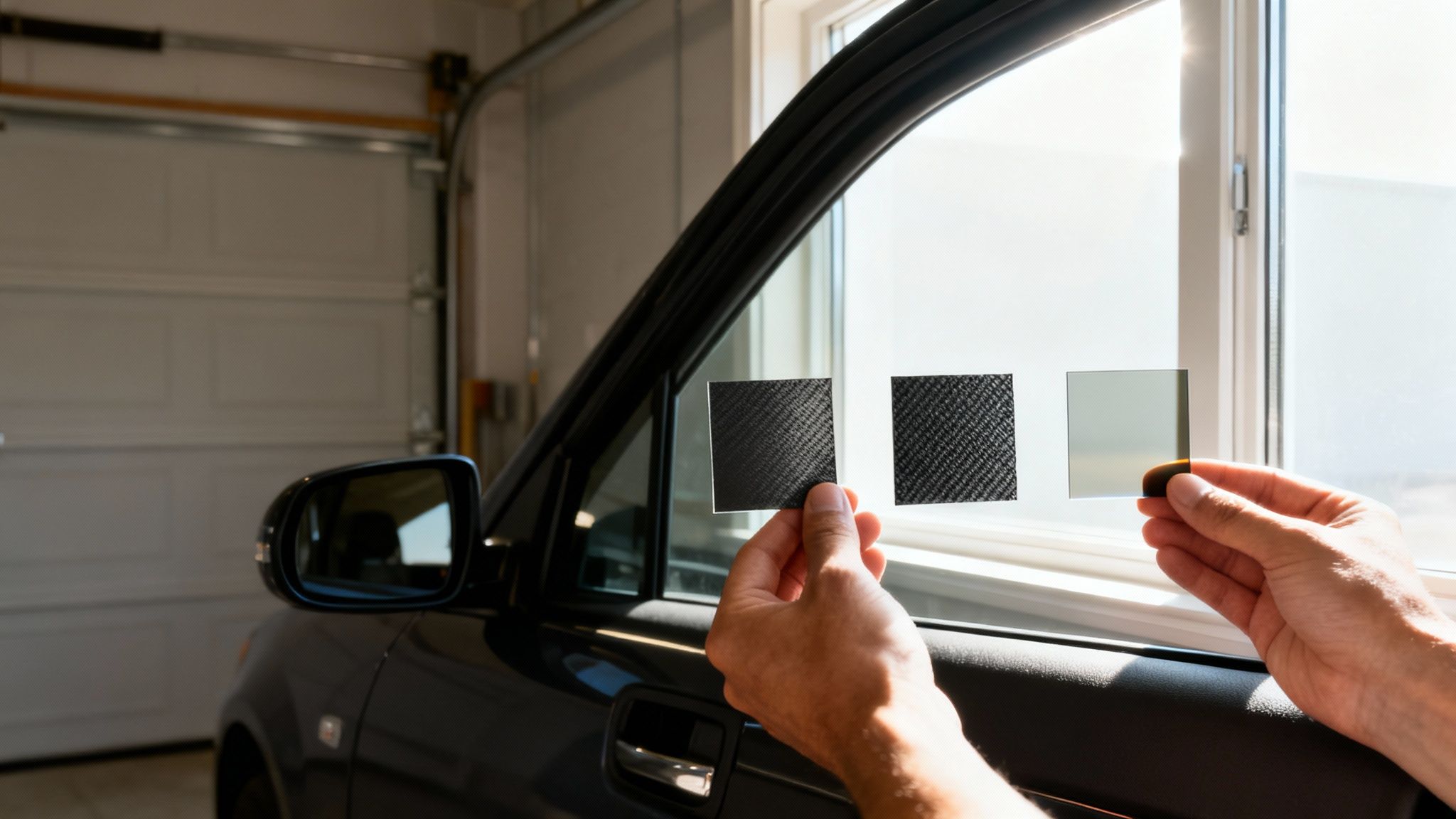
When it comes to window tint, picking the right shade is just the beginning. The real trick is finding a high-quality film that keeps you comfortable and on the right side of the law. A good tint is more than just a style choice—it’s a functional upgrade that shields you from UV rays, keeps your car's interior from baking in the sun, and cuts down on blinding glare.
Making the right choice from the start means you get all those perks without the headache of a ticket. Let's walk through the different types of tint films and why a professional installer is your best bet for getting it done right.
Exploring Your Tint Film Options
Not all tints are made the same. The materials and technology packed into that thin film make a huge difference in performance, lifespan, and price. Getting familiar with the three main players will help you make a smart investment.
- Dyed Film: This is your entry-level option. It uses layers of dye to soak up sunlight and is great for adding privacy and reducing glare on a budget. The downside? It offers the least heat rejection, and over time, it's known for fading and turning that dreaded shade of purple.
- Carbon Film: Taking a big step up, carbon film is infused with tiny carbon particles that are fantastic at blocking the infrared light that makes your car feel like an oven. It offers top-notch UV protection (up to 99%), won't fade like dyed film, and gives your windows a clean, matte look.
- Ceramic Film: This is the premium choice, and for good reason. Ceramic film uses advanced ceramic particles that are incredible at blocking heat and UV rays without messing with your phone, GPS, or radio signals. It delivers the best performance, maximum heat rejection, and crystal-clear visibility.
If you want to get into the nitty-gritty of these options, check out our guide on the https://carmedicsautowerks.com/best-window-tint-for-cars/ for a more detailed comparison.
The Importance of a Professional Installer
Picking the perfect film is only half the job. A clean, bubble-free finish that lasts for years all comes down to the skill of the person applying it. A true professional doesn't just stick film on glass; they understand the nuances of the materials and, just as importantly, the local laws like Ontario's Highway Traffic Act.
A shop you can trust will always:
- Know the Law: They’ll guide you on the legal VLT limits for your province, so you don't end up with an unexpected fine.
- Use Quality Film: Reputable installers work with trusted brands that offer solid warranties against peeling, bubbling, and fading.
- Guarantee Their Work: A professional job should always come with a workmanship guarantee. It's your peace of mind.
Thinking about the quality of parts and materials goes beyond just tint. To get a better handle on this, the definitive guide on the difference between Aftermarket Parts vs. OEM is a great resource.
What About Medical Exemptions?
In certain situations, the standard window tint laws don't apply. People with medical conditions that make them highly sensitive to sunlight might qualify for a medical exemption, allowing for a darker tint than what's normally permitted.
Getting an exemption is a formal process, and you’ll need to follow the steps carefully:
- Get a Doctor's Note: You'll need a signed letter from a medical professional explaining why a darker tint is a medical necessity for your specific condition.
- Apply to the Ministry: This medical documentation then gets submitted to your provincial ministry of transportation for official review.
- Keep It In the Car: If your application is approved, you’ll receive an official certificate. You must keep this document in your vehicle at all times in case you're pulled over.
The requirements can be quite strict, so make sure your paperwork is complete. A good tint shop can often point you in the right direction if you think you might qualify. A little bit of research upfront ensures your new tint is a valuable upgrade, not a legal liability.
Got Questions About Window Tint Laws? We've Got Answers
It's easy to get tangled up in the rules and regulations around window tinting. Even when you think you have a handle on the basics, real-world questions always pop up. Let's clear the air and tackle some of the most common questions car owners have, so you can make choices for your vehicle that are both smart and legal.
Is Factory Tint the Same as the Tint I Get at a Shop?
Great question, and the answer is a definite no. Knowing the difference is a huge part of staying on the right side of the law.
Factory tint isn't actually a film. It’s often called "privacy glass" because the glass itself is coloured during the manufacturing process. You'll typically find this on the back windows of SUVs, vans, and trucks. The great thing about it is that it's designed from the get-go to meet legal VLT standards, and since it’s embedded in the glass, it will never bubble or peel.
Aftermarket tint, on the other hand, is the film that a professional applies to the inside of your car's windows. This is where things get tricky. When you put an aftermarket film over glass that already has a factory tint, their VLT levels combine. For instance, if your glass has a 70% factory tint and you apply a 50% VLT film, the final result is a much darker 35% VLT (0.70 x 0.50 = 0.35).
A reputable installer will always test your glass's current VLT before they even think about applying a new film. This ensures the final combination doesn't accidentally dip below your province's legal limit.
Can I Get a Tint Ticket in a Different Province?
This is a big one for anyone who loves a good road trip. The short answer? Yes, you absolutely can.
Your vehicle has to follow the rules of its home province, but once you cross the border, you're also subject to local traffic laws. So, if your tint is perfectly legal in Alberta but you're driving through British Columbia where the rules are much stricter, an officer can pull you over and hand you a ticket.
To save yourself the potential headache, the smartest move is to choose a tint level that’s legal pretty much everywhere in Canada. If you stick with a VLT that meets the stricter provincial laws, like Quebec's 70% VLT limit for front side windows, you won't have to worry when you're on the road.
How Much Does Dark Tint Really Affect My Night Driving?
This gets right to the heart of why tint laws exist in the first place: safety. The link between how dark your tint is and how well you can see at night is direct and incredibly important. A dark tint dramatically cuts down the amount of light that gets to your eyes, which can be downright dangerous when visibility is already low.
Think about it in real-world terms:
- Seeing a pedestrian: On a dimly lit street, a dark tint could make it impossible to spot someone in dark clothes crossing the road until the last second.
- Navigating a car park: Trying to see parking curbs, other cars, or people walking through a dark lot becomes a serious challenge with low VLT film.
- Checking your blind spots: Darkened windows make it much harder to see a vehicle creeping up beside you, turning a simple lane change into a risky move.
This is exactly why the strictest rules are always for the front side windows. Your peripheral vision and your ability to react to sudden hazards are critical for keeping everyone on the road safe.
Can I Get a Medical Exemption for Darker Tint in Ontario?
Yes, Ontario does allow for medical exemptions, but it’s not a simple process. It's strictly for people with diagnosed medical conditions that cause a severe sensitivity to sunlight, like lupus or solar urticaria.
If you think this might apply to you, here’s what you need to do:
- Speak with your doctor. You'll need an official letter from a physician or ophthalmologist that clearly explains your medical condition and states why a darker tint is a medical necessity.
- Submit the paperwork. This documentation has to be sent to the Ontario Ministry of Transportation for them to review and approve.
- Keep the exemption with you. If your request is approved, you'll get an official exemption letter. You must keep this letter in your vehicle at all times and be ready to show it to a police officer if you're ever stopped.
Without that official piece of paper, any tint that breaks the Highway Traffic Act is illegal—no matter what the medical reason might be.
Making the right choice for your vehicle is all about finding that perfect balance between looks, comfort, and staying legal. For expert advice and a professional installation that respects all Ontario window tint laws, you can trust the team at Carmedics Autowerks Inc. We’ll make sure your car looks fantastic while keeping you safe and compliant. Check out our work at https://www.carmedicsautowerks.com.com to learn more.