

When it comes to tinted windows law in Ontario, there’s one golden rule that trips a lot of people up: you cannot apply any aftermarket tint film to your front windshield. For the windows next to the driver and front passenger, the law is just as specific, requiring at least 30% of visible light to pass through.
What Is the Legal Tint Limit in Ontario?
Getting your windows tinted is one of the best ways to upgrade your vehicle's look and comfort, but you need to know the rules to stay on the right side of the law. Ontario’s regulations aren't designed to ban tints; they’re about striking a sensible balance. You get the privacy and style you want, while ensuring the driver can see clearly and law enforcement can stay safe during a traffic stop.
These rules are laid out in Section 73 of the Highway Traffic Act. The focus is squarely on the windows that are most critical for your line of sight. That’s why the regulations for your front windshield and side windows are strict, but you have much more freedom for the windows behind the driver. It's the reason you see so many new vehicles with dark factory-installed privacy glass on the back windows—it’s completely legal.
Understanding the Key Restrictions
The easiest way to understand the law is to think of your car in two halves. The front half, where the driver sits, has tight restrictions. The back half is much more flexible. This is all about safety, ensuring you can see the road and police officers can see inside your vehicle if they pull you over.
This simple guide gives you a great visual breakdown of the rules for each window.
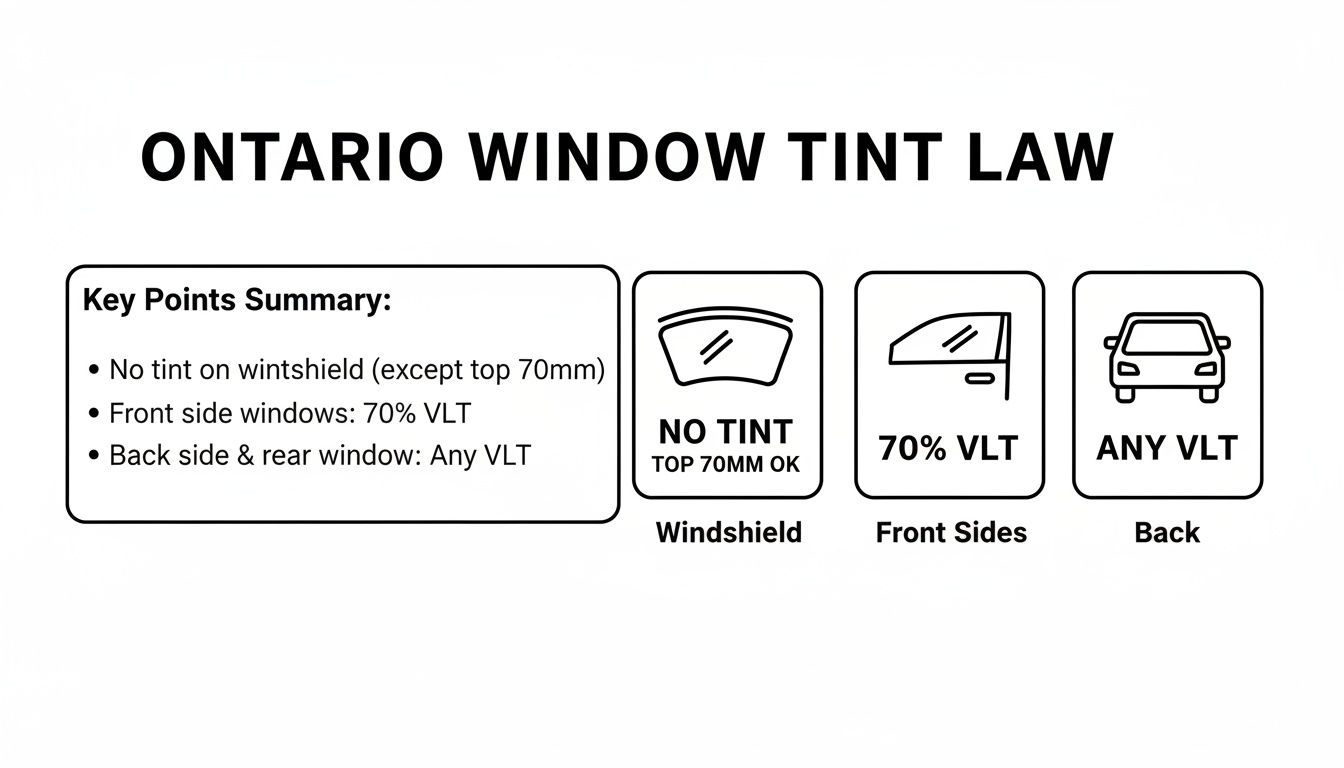
As you can see, the front is all about maintaining visibility, while the back offers plenty of room for darker shades.
Quick Summary of Ontario Tint Rules
A quick reference is always handy. One of the most common mistakes we see is when a driver chooses a tint film that, on its own, seems legal. But when you apply it over the glass that already has a slight factory tint, the combined VLT drops below the legal 30% limit.
Here's a pro tip: The legal VLT limit isn't just for the film—it’s for the total combination of the factory glass and the tint film you add. A professional installer at Carmedics will always measure this to guarantee your finished tint is 100% compliant.
For a quick overview, this table breaks down exactly what you need to know about the tinted windows law in Ontario.
Ontario Window Tint Law At a Glance
Here’s a simple summary of the legal VLT limits for passenger vehicles in Ontario.
| Window Location | Legal Tint Limit | Key Restriction |
|---|---|---|
| Front Windshield | No aftermarket film allowed | A 7.5cm (3-inch) strip at the very top is permitted. |
| Front Side Windows | Must allow 30% VLT | This applies to both the driver and front passenger windows. |
| Back Side Windows | Any darkness is fine | There's no specific VLT limit for these windows. |
| Rear Windshield | Any darkness is fine | This is only legal if your vehicle has two working side mirrors. |
Keep this table in mind, and you'll be able to choose a tint that looks great and keeps you out of trouble.
Understanding VLT and Reflectivity
When you start looking into window tinting, you’ll hear a lot of technical jargon thrown around. The big one you need to know is Visible Light Transmission, or VLT. It sounds complicated, but the idea behind it is actually pretty simple.
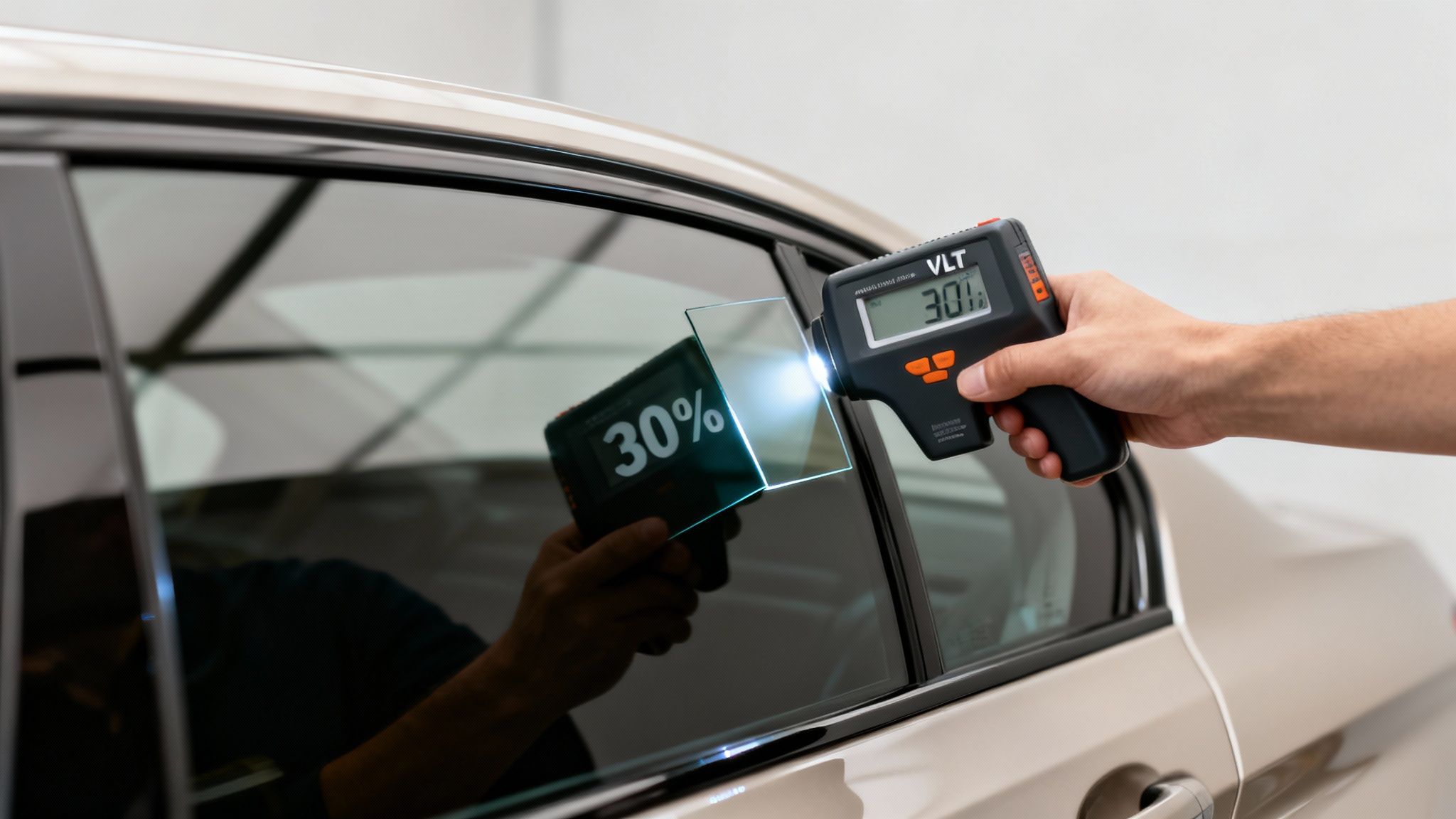
Think of VLT as a rating for how dark the tint is. The percentage tells you exactly how much light the film lets through the glass. A lower VLT number means a darker window because less light is getting in.
For instance, a 30% VLT film lets just 30% of the visible light pass through, blocking the other 70%. This is why a 5% VLT tint—what most people call "limo tint"—is incredibly dark compared to a much lighter 50% VLT film. Getting this straight is the first step to choosing a tint that won't get you into trouble.
How VLT Is Measured
Police officers don't just eyeball your windows and guess if they're too dark. They use a very precise tool called a VLT meter. It’s a small, handheld device that gives them an instant, accurate reading of how much light is passing through your window.
An officer simply clamps the meter over the glass, and the digital screen shows the VLT percentage. If that number is below the legal limit for your front side windows—which is 30% here in Ontario—you're looking at a ticket. It’s a quick, no-nonsense test that leaves zero room for argument on the side of the road.
This is exactly why professional installation is so important. A common mistake people make when trying to tint their own windows is forgetting that their factory glass isn't completely clear.
Most factory car windows already have a slight tint from the manufacturer, usually letting about 85-90% of light through. If you slap a 30% VLT film on that glass, the final combined VLT will actually be lower than 30%, landing you on the wrong side of the law. A pro installer at Carmedics Autowerks knows this and will always account for the factory tint to make sure your final result is compliant.
The Problem with Reflectivity
It's not just about how dark your windows are; it's also about how much they reflect. While dark tints absorb light, some films are designed to be reflective or mirrored, and they can be a real danger to other drivers.
Picture this: you're driving on a sunny day and suddenly get hit with a blinding glare from the car next to you. That mirror-like reflection can easily disorient you, creating a serious safety hazard. It’s for this very reason that highly reflective, metallic-finish tints are illegal on most cars.
The law is there to stop your vehicle from becoming a mobile hazard. A subtle sheen is one thing, but any film that creates a true mirror effect is a definite no-go.
Putting It All Together for a Legal Tint Job
So, how do you guarantee your tint job is by the book? It all boils down to understanding how the tint film and your factory glass work together.
Here’s the simple math:
- Factory Glass VLT: The transparency of your car's window before any film is applied.
- Tint Film VLT: The percentage on the box of the film you choose.
- Final VLT: The combined result of the two, which is what the police meter will read.
A professional installer does this calculation for you. We measure your factory glass first and then help you pick a film that keeps the final, combined VLT safely within the legal limit. This expertise is what saves you from the headache of a ticket and the cost of having illegal tint stripped off your car.
Getting it right from the start is the smartest move. For a better idea of what different shades look like on a vehicle, you can learn more about window tint percentage options and see what makes the most sense for you.
Navigating Tint Laws Across Borders
It’s a classic road trip headache. Your car’s window tint is perfectly legal here in Ontario, but the moment you cross a provincial or national border, you could be a magnet for a ticket. The tinted windows law you follow at home, unfortunately, doesn't travel with you. What’s compliant on one side of the line can be a clear violation on the other.
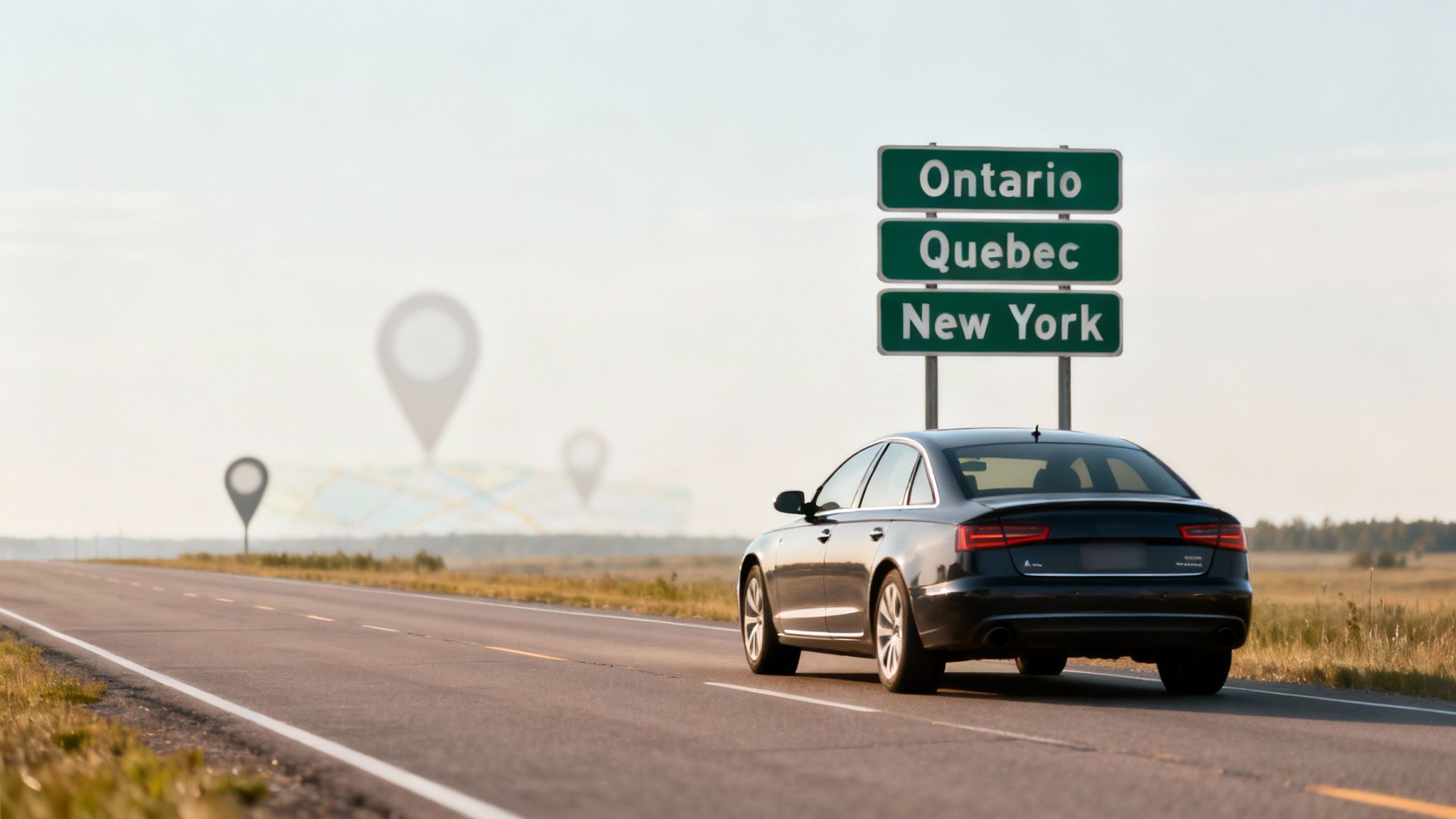
Think about this scenario: your car has a 30% VLT tint on the front side windows—the legal limit here in Ontario. You head out for a weekend trip to Quebec, where the law is far stricter, demanding a minimum of 70% VLT on those same windows. All of a sudden, your car sticks out, and you’re at risk of being pulled over for something that was totally fine just a few hours ago.
This isn't just a Canadian issue, either. The same patchwork of rules applies the second you drive into the United States. Every state has its own set of regulations, creating a complicated web for even the most careful driver to navigate.
Provincial Tint Law Variations
While Ontario’s front-side VLT limit is set at 30%, our neighbouring provinces have very different ideas about what’s safe and legal. This is exactly why it’s so critical to know the local laws before you hit the road.
A drive east from Ontario can put you in a tricky situation:
- Quebec: The laws here are among the strictest in Canada. They mandate a 70% VLT for front side windows, which means almost no aftermarket tint is allowed. Your legal Ontario tint will be an immediate red flag.
- Manitoba: If you’re heading west, the rules are a bit more relaxed. Manitoba permits a 50% VLT on front side windows, but that’s only if your vehicle has two side mirrors. If not, the limit tightens to 35% VLT.
These differences drive home a crucial point: there’s no such thing as a single “Canadian” tinted windows law. Each province sets and enforces its own standards based on local legislation and what they consider a priority for road safety.
Crossing into the United States
The moment you cross south into the U.S., the rulebook changes completely. The states bordering Ontario each have their own specific regulations that can be wildly different from what we’re used to.
When you travel, you're subject to the laws of the place you're in, not where your car is registered. An officer in New York doesn't care that your tint is legal back in Ontario; they only care if it meets New York's requirements.
Let’s look at a few popular destinations for Ontario drivers:
- New York: Just like Quebec, New York is very strict, requiring a minimum of 70% VLT on front side windows. This makes it a high-risk state for any Ontario-plated vehicle with a darker, yet legal-at-home, tint.
- Michigan: The rules here are quite unique. Michigan law prohibits any tint on the front side windows, though you are allowed a non-reflective tint on the top four inches.
- Ohio: This state is a bit more in line with Ontario's thinking, allowing a 50% VLT on the front sides. While that’s still stricter, it’s a world away from the 70% rule in New York.
The history of these laws shows just how specific they can be. California, for instance, had a chaotic situation before 1961 with unregulated spray-on tints. By 1973, that evolved into the law they still use today, which allows unlimited darkness on rear windows but demands over 70% VLT up front. You can learn more about how these rules came to be and find other insights in our full guide to window tinting laws.
Practical Advice for Road Trips
So, what can you do to avoid a ticket while travelling? The simplest answer is to be aware of the laws in every province and state on your itinerary. A quick search online before you leave can save you a fine and the headache of a traffic stop.
If you’re a frequent traveller to a place with tougher laws, you might want to consider a lighter tint that’s compliant in multiple regions. A 70% VLT film, for example, would keep you legal pretty much everywhere, though you’d sacrifice a lot in terms of privacy and heat rejection.
Ultimately, your best defence is being prepared. Knowing the local tinted windows law before you go is the only way to guarantee a stress-free trip.
The Real Cost of Illegal Window Tints

It can be tempting to push the limits with window tint, chasing that sleek, blacked-out look. But what really happens when you get pulled over? The consequences for violating tinted windows law are more than just a slap on the wrist—they hit you right in the wallet and waste a lot of your time.
It usually starts with a routine traffic stop. An officer spots your dark windows and decides to take a closer look. Out comes the VLT meter, a small device that instantly reads how much light is passing through your glass. If that number for your front side windows dips below 30%, the friendly chat is over.
From a Warning to a Hefty Fine
For a first-time offence in Ontario, you’ll most likely get a "fix-it" ticket. This isn't just a fine; it's a direct order to remove the illegal tint. You’re given a deadline to strip the film off and then bring your car to a police station to prove you’ve complied.
Let that sink in. You’ve already paid a professional for a tint job, and now you have to pay someone again to remove it. If you still want a tint, you'll be paying a third time to have a legal one applied. Your initial investment is completely lost, and your costs have just doubled, if not tripled.
The real sting of an illegal tint ticket isn't just the fine. It's being forced to remove a product you just paid good money for, turning a cool upgrade into a frustrating and expensive mistake.
And this happens more often than you’d think. As a reference point, between January 2015 and August 2017, the California Highway Patrol handed out nearly 200,000 tickets for window tint violations. That’s an average of 219 tickets every single day. While the fines might seem small, the real penalty is that mandatory removal order, showing just how seriously law enforcement treats this.
When the Penalties Escalate
If you decide to ignore the fix-it order or get caught again, things get a lot more serious. That initial fine, which hovers around $110 in Ontario, starts to climb. But the financial pain doesn't stop there.
Here’s a quick rundown of how the costs can spiral:
- Bigger Fines: Repeat offences mean much higher penalties.
- Demerit Points: Traffic violations can add demerit points to your licence, which is a red flag for your insurance company.
- Insurance Hikes: Your insurer sees non-compliance as risky behaviour. A tint ticket on your driving record can lead to higher premiums for years to come.
The knock-on effects are similar to other traffic violations. For a deeper understanding of how this works, you can check out this guide on the demerit points and insurance impacts of careless driving in Ontario.
The Hidden Safety Costs
Beyond the money and legal headaches, there’s a real, practical safety cost. The tinted windows law isn't arbitrary; it’s all about visibility. A tint that’s too dark seriously compromises your ability to see, especially at night or in bad weather like heavy rain or fog.
It cuts down on your peripheral vision and makes it much harder to spot pedestrians, cyclists, or other cars. Worse, if you’re in an accident and it’s determined that your illegal tint impaired your vision, you could be facing serious liability. The cool factor of a darker shade is never worth risking your safety—or the safety of others.
Choosing the Right Legal Tint for Your Vehicle
Alright, you've got a handle on the rules. Now for the fun part: picking a tint that not only looks great but also works hard for you and your car. This isn't just about making your windows darker; it's about choosing a high-performance film that will make every drive more comfortable and protect your car's interior for the long haul.
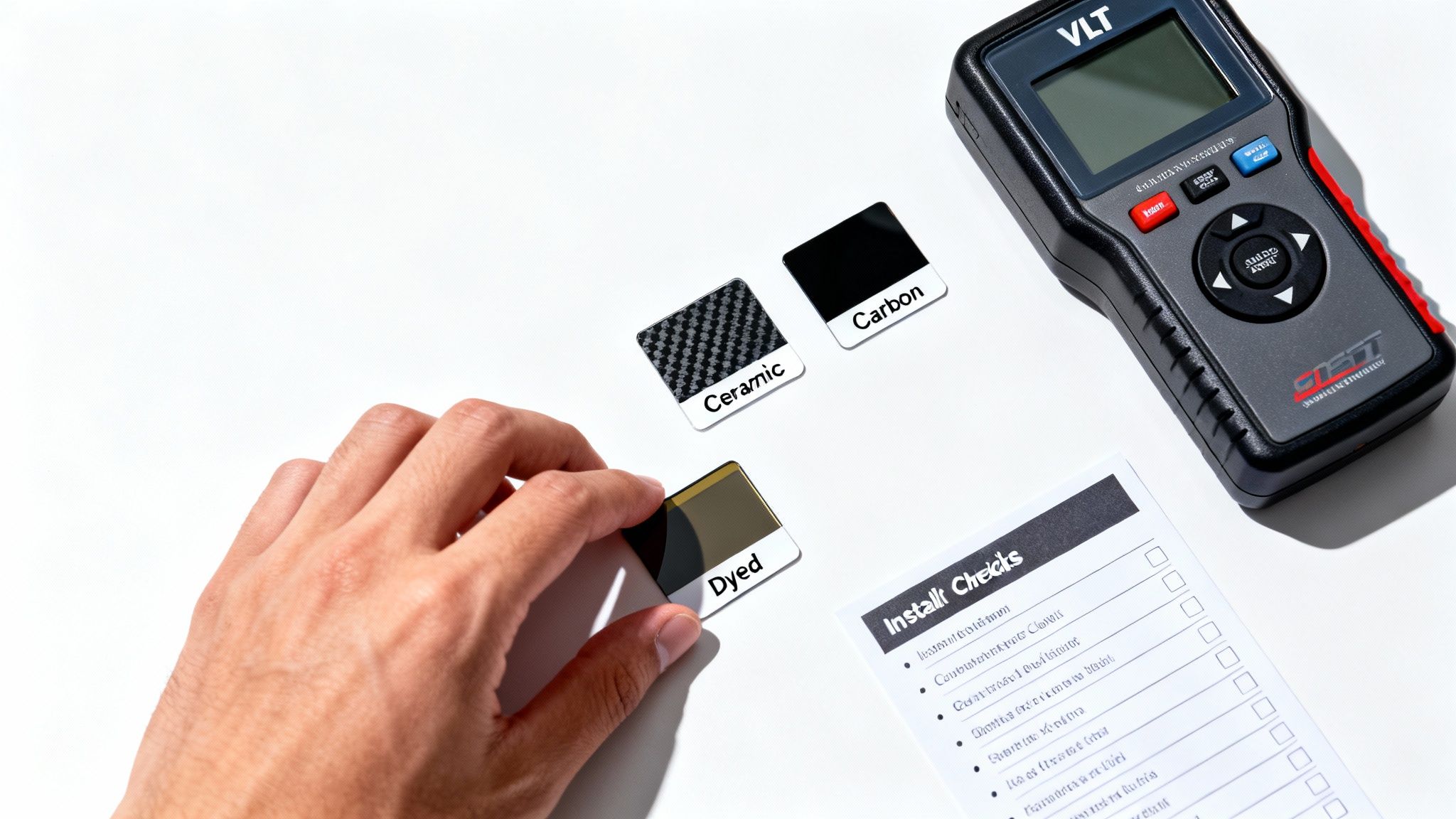
Think of modern window tints as a serious upgrade, not just a cosmetic one. The right film acts as a barrier, blocking harmful UV rays, drastically cutting down the heat that builds up inside on a sunny day, and reducing that blinding glare from the sun or other headlights.
Beyond Darkness: Film Types and Their Benefits
You'll quickly find that not all window films are the same. A basic dyed film will give you privacy, but that's about where its benefits end. To get performance you can actually feel, you'll want to look at higher-quality options like carbon or ceramic films.
- Carbon Film: This film is infused with tiny carbon particles, which are fantastic at blocking infrared light—the kind of light that makes your car feel like an oven. It gives you great heat rejection without that metallic look, so it won't mess with your radio, GPS, or cell phone signal.
- Ceramic Film: This is the top-tier choice for a reason. Ceramic films use non-metallic, non-conductive ceramic particles to deliver the best possible heat and UV rejection. The clarity is incredible, it’s exceptionally durable, and it won't interfere with any of your electronics.
Knowing the difference here is huge. If keeping your car cool and protecting yourself from the sun are top priorities, investing in a quality ceramic film is money well spent. To really get into the weeds, check out our guide comparing colour-stable vs ceramic window tints.
Your choice of film directly impacts your daily drive. A high-performance ceramic tint can reduce interior temperatures by a significant margin, meaning your air conditioning doesn't have to work as hard and you stay more comfortable behind the wheel.
Your Pre-Installation Checklist
To make sure everything goes smoothly and your new tint is 100% compliant, you need to ask the right questions before any film touches your glass. Any reputable shop like Carmedics Autowerks will be completely transparent, but being an informed customer is your best tool for getting exactly what you want.
Before you hand over the keys, run through a few key points with your installer. This little checklist will help you sidestep common issues and ensure you walk away with a professional, legal, and lasting tint job.
Critical Questions for Your Tint Installer
- Will you confirm the final VLT? This is the most important question you can ask. Your installer must confirm they will measure the VLT of your factory glass plus the film to ensure the final result is compliant with Ontario's 30% limit on the front-side windows.
- What does the warranty cover? Get the details. Does it cover bubbling, peeling, and colour fading? How long is the warranty valid, and what’s the claims process like? For any quality film, a lifetime warranty should be the standard.
- What type of film are you using? Ask for the specific brand and product line. This lets you look up the specs yourself and verify the manufacturer's claims on things like heat rejection and UV protection.
- Can I get documentation of the work? Always get an invoice that spells out the film used, the VLT percentage installed on each window, and the warranty info. This piece of paper is your proof of a professional, legal installation if you ever need it.
Taking a few minutes to be proactive here ensures there are no surprises later. It confirms you're getting what you paid for and gives you peace of mind for years to come. This simple diligence is what separates a decent tint job from an exceptional one.
Your Tinted Windows Law Questions Answered
We've gone through the rules, the risks, and the reasons behind Ontario's tinted windows law. But even after all that, it's totally normal to have a few more questions pop up. To help clear up any lingering confusion, here are the answers to the queries we hear most often from drivers here at the shop.
Think of this as your final quick-reference guide, so you can feel completely confident about your window tinting choices.
Are There Medical Exemptions for Darker Tints in Ontario?
Yes, getting a medical exemption is possible, but it’s not as simple as just getting a doctor's note. It's a formal process that requires very specific documentation. These exemptions are typically reserved for people with light-sensitive medical conditions like lupus or certain skin cancers, who genuinely need extra protection from UV rays.
To even start the process, you need a prescription from a qualified medical doctor or an ophthalmologist. This isn't just a recommendation; it has to clearly state why a tint darker than the legal limit is a medical necessity for you.
If you are granted an exemption, you absolutely must keep that official paperwork in your vehicle at all times. If you're pulled over, you'll need to show it to the officer to explain your tint. It's also important to know that even with an exemption, there might still be a cap on how dark you can go—officer safety is always a factor.
Does the Law Apply to Factory Privacy Glass?
This is a fantastic question and a super common point of confusion. The simple answer is no—the laws that govern aftermarket tint films don't apply to factory-installed privacy glass in the same way.
The big difference is how that tint is created. Factory privacy glass, which you see all the time on the back windows of SUVs, minivans, and trucks, isn't a film at all. The glass itself is actually made with a darker pigment mixed right in, a process called "deep dipping."
Because the colour is literally part of the glass, it's not considered an aftermarket modification under the Highway Traffic Act. This is why a brand-new SUV can roll off the dealership lot with rear windows that would be illegal if you tried to get that dark with a film on a regular car's front windows.
Ontario's tinted windows law specifically targets films or coatings that are applied to the glass after it leaves the manufacturer. So, while any film on your front side windows has to meet that 30% VLT mark, the factory-darkened rear windows on your vehicle are perfectly legal just as they are.
How Can I Check if My Window Tint Is Legal?
While police officers use calibrated VLT meters for official readings, you don't have to just cross your fingers and hope you're compliant. The most reliable way to check your tint is to swing by a professional tint shop.
A reputable installer like Carmedics Autowerks has the same professional-grade tools and can give you a precise VLT reading in minutes. It's really the only way to know for sure what the combined VLT of your glass and the film is.
Your next best bet is your paperwork. When you get your windows tinted by a pro, you should always walk away with an invoice or certificate that spells out:
- The exact brand and type of film used.
- The stated VLT percentage of the film on each window.
- Warranty details.
This documentation is your proof that you did things the right way. Keep it in your glove box with your ownership and insurance. While it won't override an officer's meter, it shows you made every effort to follow the tinted windows law.
Should I Install Window Tint Myself?
I get the temptation. DIY tint kits are everywhere online and in auto parts stores, but honestly, we strongly advise against it for a few critical reasons. Applying window film is a true craft that demands precision, specific tools, and a dust-free space—three things that are almost impossible to get right in a home garage.
The usual result of a DIY job? Bubbles, peeling corners, and little specks of dirt trapped under the film. It not only looks bad but can also get in the way of your vision.
Even more important is the legal risk you're taking. It's incredibly difficult for an amateur to accurately figure out the final VLT. As we've discussed, you have to account for the natural tint already in your factory glass. One small miscalculation can easily push you over the legal limit, leading to a ticket and the miserable job of scraping all your hard work off the glass.
Going with a professional guarantees a flawless finish that's backed by a warranty and, most importantly, ensures your car is 100% compliant with the law. The peace of mind and quality you get is well worth the investment.
Ready to upgrade your vehicle with a high-quality, legal window tint? The expert team at Carmedics Autowerks inc is here to help. We use premium films and precise installation techniques to give you the perfect look while ensuring you're fully compliant with Ontario's laws. Book your professional window tinting service with us today