


Knowing when to swap your tires for the season is a classic Canadian debate, but it's really more about science than superstition. The "golden rule" everyone talks about is the 7°C mark. When the average daily temperature consistently dips below that point, it’s time to put on your winter tires.
The rubber compound in your all-season or summer tires starts to get hard and lose its grip once it gets that cold. In the spring, you just reverse the process—once the temperatures are staying reliably above 7°C, it’s time to switch back.
Timing Your Seasonal Tire Swap
Figuring out the perfect moment for a tire changeover is crucial, and it’s about watching for a trend, not just reacting to a single chilly morning. When you see the forecast consistently hovering at or below that 7°C threshold, that’s your cue. Don't wait for the first snowflake.
That temperature is the magic number because it’s when the very physics of your tires change. The rubber in winter tires is designed with a high silica content, which keeps it soft and flexible in the cold. This allows the tread to bite into snow and ice effectively. All-season tires, on the other hand, become stiff and almost plastic-like, which dramatically increases your stopping distance and makes handling feel unpredictable.
To help you keep track, here's a quick guide on the key signals for your seasonal tire change.
Seasonal Tire Change Timing Guide
This simple table breaks down the main indicators to watch for when deciding to swap between your winter and all-season/summer sets.
| Indicator | Switching to Winter Tires (Autumn) | Switching to All-Season/Summer Tires (Spring) |
|---|---|---|
| Temperature | Consistently below 7°C | Consistently above 7°C |
| Forecast | First frost or snowfall is predicted | Risk of overnight frost has passed |
| Road Conditions | Icy mornings, slush, or light snow | Roads are consistently clear and dry |
| Local Climate | When long-term autumn patterns set in | When spring weather feels established |
Think of this table as a checklist. Once you start ticking these boxes, it’s time to book your appointment or get the jack out.
It's More Than Just the Thermometer
While temperature is a great guide, it isn't the only thing to consider. Where you live in Canada plays a massive role in when you should make the switch.
- Provincial Laws: Don't get caught out. In Quebec, for instance, winter tires are mandatory from December 1st to March 15th. Certain highways in British Columbia have similar requirements for mountain passes. Fines for not complying can be steep.
- Insurance Discounts: Many insurance companies offer a nice little discount for using winter tires. The catch? You usually have to have them on by a specific date, often in November. Miss it, and you miss out on the savings.
- Local Weather Habits: A driver in the Lower Mainland of B.C. has a completely different set of concerns than someone in Calgary. Get to know your local climate. Pay attention to when that first real frost usually hits or when the spring thaw is truly here to stay. If you're looking for more specific timing advice, you can learn more about the optimal winter tire change date in our detailed guide.
Your location is a huge factor. It's no surprise that historical data from the Tire and Rubber Association of Canada shows over 90% of Quebec drivers use winter tires, largely because of the law. In other provinces, the numbers shift based on how harsh the winter usually is.
The bottom line is to be proactive. Waiting until the first major storm guarantees two things: a dangerously slippery drive and a long wait at every garage in town. Schedule your seasonal tire change before the weather turns, and you'll stay safe and in control, no matter what the season throws at you.
The Hands-On Guide to Changing Your Own Tires
There's a real sense of accomplishment that comes from doing your own seasonal tire change. Not only does it save you a bit of cash and a trip to the shop, but it also puts you more in tune with your vehicle. But doing it right is about more than just muscle; it's about being safe and methodical. Let's walk through how to tackle this job like a pro, right in your own driveway.
First things first, where you work matters. A lot. Always set up on a hard, level surface—think concrete garage floor or a flat paved driveway. Trying to change a tire on grass, gravel, or any kind of slope is asking for trouble. The jack can easily shift, creating a seriously dangerous situation. Safety begins before you even touch a lug nut.
Setting Up for a Safe Swap
Once you've picked your spot, get your gear and your vehicle prepped. Having everything you need within arm's reach makes the whole process go a lot smoother and keeps you from taking risky shortcuts.
- Chock Those Wheels: Before you do anything else, secure the car. Grab some wheel chocks and wedge them tightly against the tire that's diagonally opposite the one you're about to lift. For example, if you're starting with the front right tire, you'll chock the rear left. This is your insurance against the car rolling.
- The Right Tools for the Job: You'll need a proper jack (the flimsy emergency one in your trunk isn't ideal for this), a lug wrench that fits your vehicle, and the most critical tool of all: a torque wrench.
- Crack 'em Loose: Here's a pro tip: before you lift the car, use your lug wrench to break the lug nuts loose. Just a quarter-turn is all you need. If you wait until the wheel is off the ground, the tire will just spin, and you'll have a much tougher time.
This simple flowchart breaks down the when-and-why of a seasonal swap, from the first temperature drop to the final turn of the wrench.
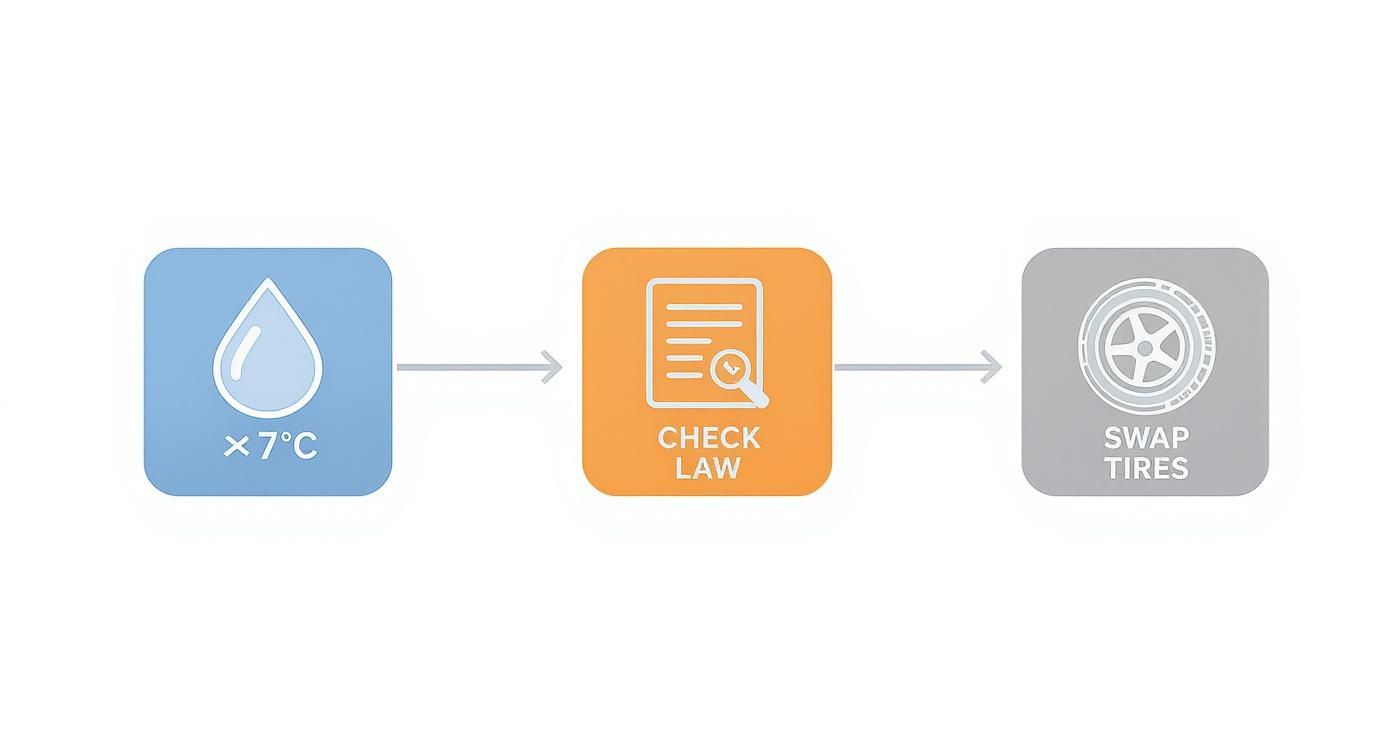
It's a great visual reminder that the process starts with a simple weather check, which then leads you to consider local regulations before getting your hands dirty.
Lifting and Tightening: The Details That Matter
With the prep work done, it's time to get the car in the air. Grab your owner's manual and find the vehicle's official jack points. These are reinforced spots on the frame designed to handle the load. Using the wrong spot can cause serious, expensive damage. Lift the car just high enough for the tire to clear the ground by a few centimetres—no need to go sky-high.
After you've swapped the old wheel for the new one, thread the lug nuts on by hand until they're snug. Now, lower the car just enough so the tire makes contact with the ground. This stops it from spinning while you give the nuts their initial tightening.
Crucial Safety Tip: Always tighten lug nuts in a star pattern. This isn't just a quirky habit; it ensures the wheel seats flush and evenly against the hub. An improperly seated wheel can cause vibrations and, in a worst-case scenario, could come off.
With the wheel snugged up, lower the car all the way. Now for the final, non-negotiable step: use a torque wrench. Look up the manufacturer's torque specification for your vehicle in the owner's manual and tighten each nut precisely to that value. Over-tightening can stretch and weaken the wheel studs, while under-tightening is an obvious hazard.
As a final safety check, I always recommend re-torquing the wheels after about 100 kilometres of driving. Things can settle, and it's smart to make sure everything is still perfectly secure.
Give Your Tires and Wheels a Once-Over Before the Swap
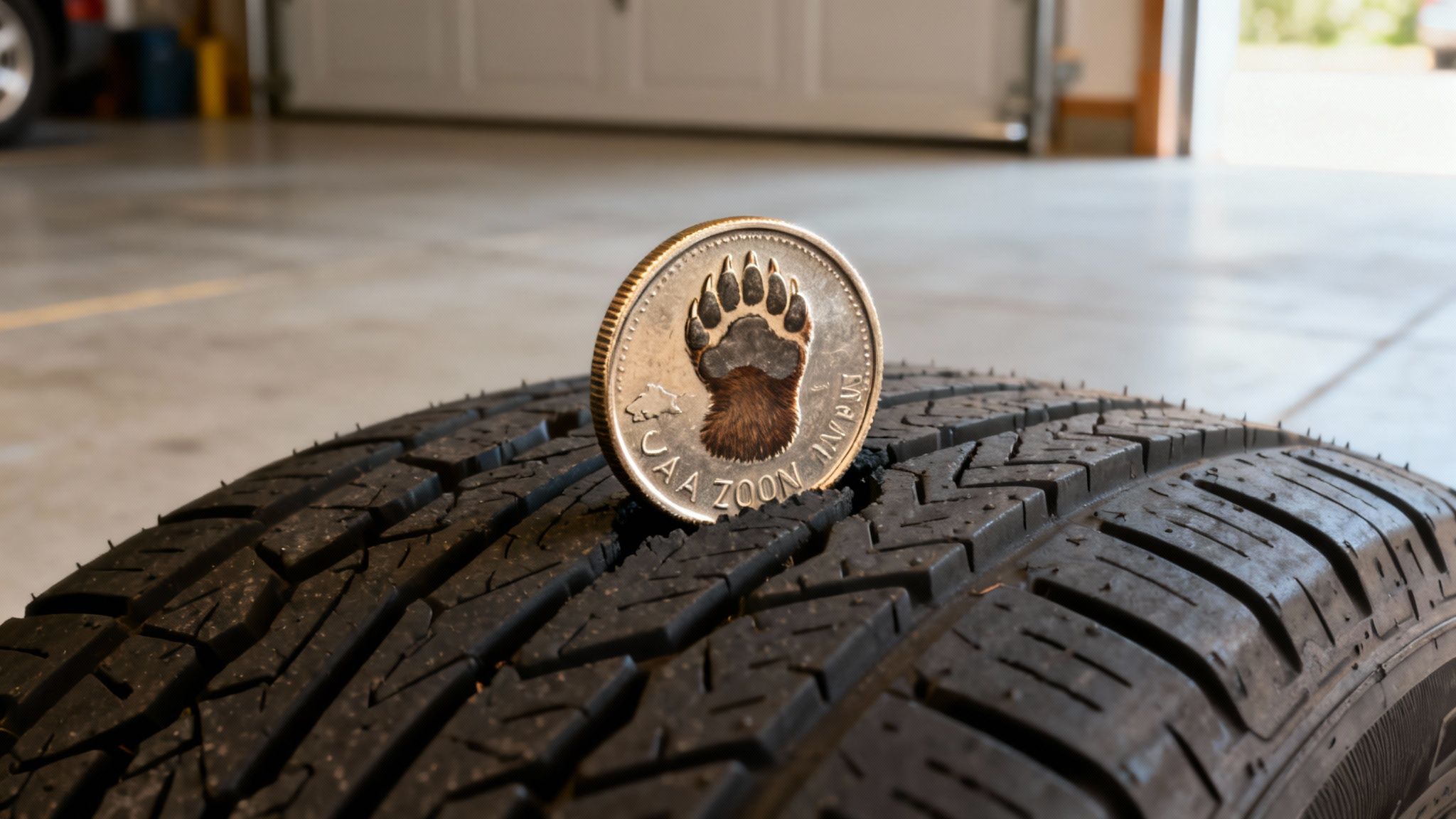
Before a single lug nut is loosened, take a few minutes to give both sets of tires a thorough inspection. Looking over the tires coming off and the ones going on is your best defense against finding a problem when it's too late. Trust me, this quick check can save you from a major headache—or worse—down the road.
Start with the most critical part: the tread. Here in Canada, all you need is a toonie.
Checking Tread Depth and Condition
Grab a toonie and stick it into a few of the tread grooves across the tire. If the rubber reaches the bear's paws, you’re in good shape with lots of life left. But if you can see the paws peeking out, your tread is getting thin, and you should start budgeting for new tires before the next season hits.
While you're down there, look at how the tread is wearing. Is one shoulder worn down more than the other? That’s a classic sign of an alignment issue. If the centre of the tread is bald but the edges are fine, the tires were likely over-inflated. The opposite—wear on both outer edges—points to under-inflation. These wear patterns are little clues your car leaves you about its overall health.
Most drivers in North America run all-seasons, which generally last somewhere between 50,000 to 80,000 kilometres. But that lifespan depends heavily on proper maintenance. You can read the full research about tire longevity to see just how much of a difference it makes. A quick inspection before each seasonal swap is key to getting the most out of them.
Inspecting for Hidden Dangers
Your inspection isn't just about tread depth. You need to look for the sneaky stuff, too. Carefully scan the sidewalls of each tire for these red flags:
- Cracks or Crazing: A web of fine lines in the rubber. This means the tire is drying out and getting brittle.
- Bulges or Bubbles: These look like little pimples on the sidewall and signal a weak spot in the tire's structure, often from hitting a nasty pothole. This is a serious blowout risk.
- Punctures: Run your hand (carefully!) over the tread surface. You might find a nail or screw embedded in there that’s causing a slow, unnoticeable leak.
Pro Tip: Don't forget the wheels themselves. A bent or cracked rim can cause a terrible vibration at highway speeds. Give each wheel a good visual check for dents or damage, especially around the inner and outer lip.
Lastly, take a peek at the lug nuts and wheel studs. Are they caked in rust? Heavy corrosion can be a real pain, making it tough to remove the nuts and even harder to torque them correctly. Damaged threads are a huge safety no-go. If you're seeing a lot of rust here, it might be a good time to learn more about how to prevent rust on your car and protect other vital components.
Spending five extra minutes on this checkup ensures your entire wheel assembly is safe and ready for the season ahead.
Proper Tire Storage to Protect Your Investment
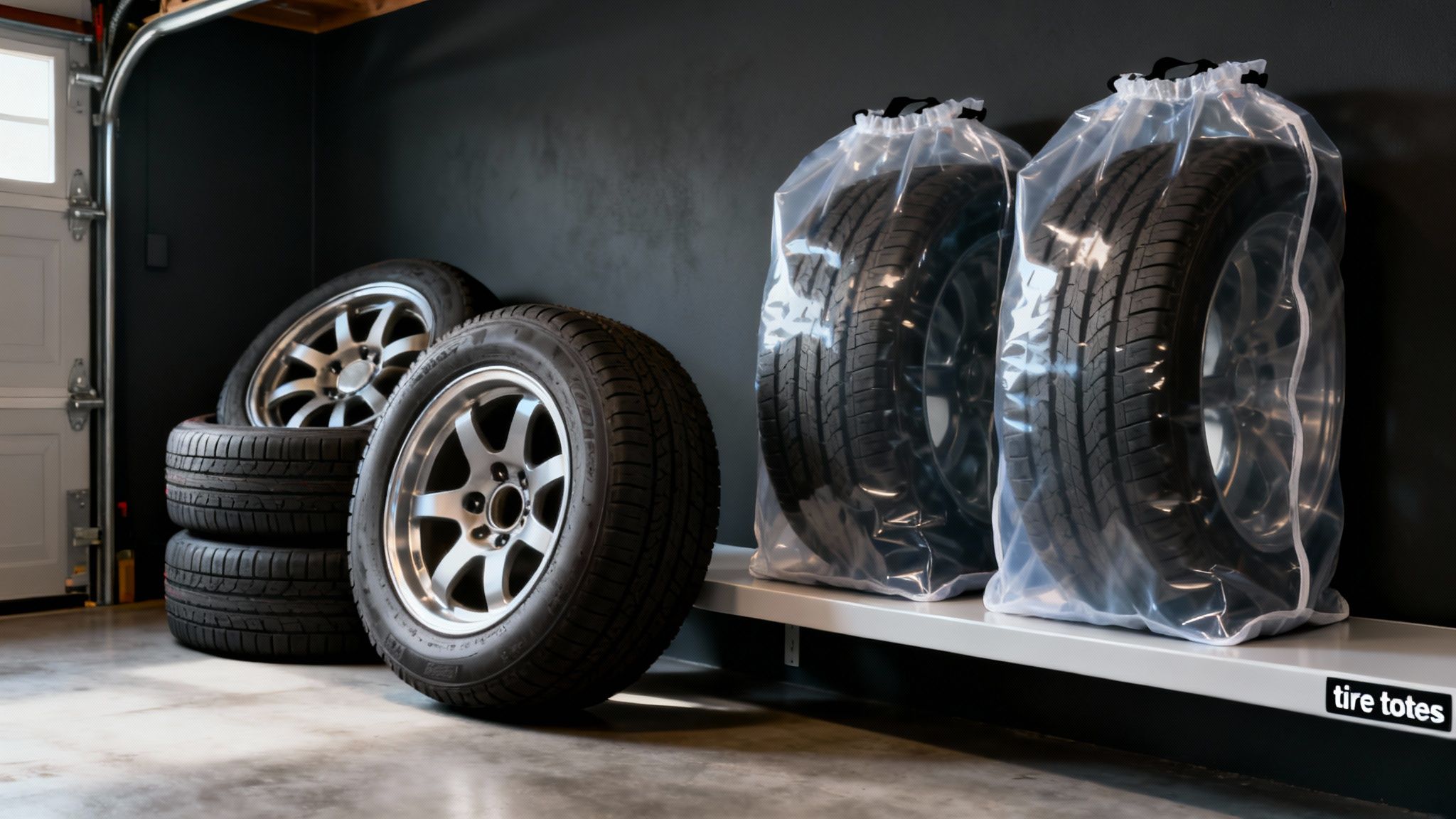
Once the seasonal tire swap is done, you're not quite across the finish line. How you store your off-season tires makes a huge difference in their lifespan and safety. It's tempting to just roll them into a corner of the shed and forget about them, but that's a surefire way to damage a very important investment.
Think of proper storage as protecting the rubber from its natural enemies: harsh UV light, extreme temperature swings, and chemical contamination. Exposure to these elements causes the rubber compound to dry out and become brittle, stripping it of the flexibility it needs to grip the road. This can easily cost you an entire season of use, if not more.
Preparing Your Tires for Their Off-Season
Before you put them away, give your tires a good, thorough cleaning. That road grime isn't just mud—it's a nasty cocktail of corrosive brake dust, road salt, and oils that can slowly degrade the rubber over the months they're stored.
Grab a decent tire cleaner, a stiff brush, and some elbow grease to scrub down the tread and sidewalls. Most importantly, make sure they are completely dry before storing them. Trapped moisture can damage the rubber and even cause corrosion on the wheels if they're still mounted.
Next, it’s a great idea to bag them up. You can get dedicated tire totes, but even large, heavy-duty garbage bags will do the trick. Sealing each tire creates its own little micro-environment, shielding it from atmospheric oxygen and ozone that accelerate the aging process.
Finding the Right Spot and Stacking Them Correctly
Where and how you position your tires are the last two critical steps. The perfect spot is somewhere cool, dark, and dry—think a climate-controlled basement or an insulated garage, far away from direct sunlight. Try to avoid places like a backyard shed that can turn into an oven in the summer and a freezer in the winter.
Ozone is a major enemy of rubber, and you might not even realize where it comes from. Keep your tires clear of any electric motors, like those in furnaces, sump pumps, or air compressors, as these are common household sources of ozone.
Finally, how you place them depends on whether they're on rims or not.
- Tires on Rims: If the tires are still mounted on wheels, the best practice is to stack them horizontally. This method distributes the weight evenly and takes pressure off the sidewalls.
- Tires Only (Unmounted): For just the tires, stand them upright, side-by-side like soldiers in a row. To prevent flat spots from developing over time, it’s a good idea to give them a little turn every month or so.
Making these simple storage habits part of your routine can add years to the life of your tires, ensuring they perform safely when you need them next season.
When to Trust the Pros with Your Tire Change

While there’s a certain satisfaction in doing your own seasonal tire change, there are definitely times when handing the keys over to a professional is the smartest, safest move you can make. It’s not just about convenience. It’s about the precision, specialized equipment, and trained eye that can spot trouble long before you’d ever notice it.
Think of it this way: a professional tire swap is more than just swapping rubber. It's a critical safety check-up for your vehicle as it heads into a new season, and it can save you from major headaches down the road.
Precision Services You Can't Replicate at Home
One of the biggest differences between a driveway swap and a professional one is high-speed wheel balancing. If you’ve ever felt that annoying vibration through your steering wheel at highway speeds, you’ve experienced an unbalanced wheel. That shake isn’t just uncomfortable; it’s a sign that your tires are wearing unevenly and putting extra strain on your suspension.
Technicians use sophisticated machinery that spins each wheel at high speeds to identify the exact spot where a counterweight is needed. This guarantees a perfectly smooth ride and maximizes the life of your tires. It’s a level of precision that’s simply impossible to achieve with DIY tools.
Then there’s the matter of torque. Sure, you can buy a torque wrench for your home garage, but professional shops use tools that are regularly calibrated for absolute accuracy. This ensures every lug nut is tightened to the exact manufacturer’s specification—not so tight that it damages the wheel studs, but not so loose that it becomes a serious safety hazard.
A Technician's Eye for Hidden Dangers
Maybe the most valuable part of a professional service is the inspection that happens while your car is on the hoist. An experienced technician isn’t just focused on the tires; they’re looking at the entire wheel assembly, brakes, and suspension.
They’re trained to spot subtle issues you could easily miss, like:
- A slow leak coming from a dried-out, cracked valve stem.
- The early signs of a worn-out tie rod or ball joint.
- Uneven wear patterns that are a dead giveaway for an alignment issue.
Catching these things early doesn't just save you money; it prevents potential accidents. This turns a routine tire swap into a crucial piece of preventative maintenance. For anyone in Whitby, having a reliable automotive service centre near you provides this essential oversight.
Expert Insight: A professional isn't just changing your tires; they are performing a vital health check on your vehicle's steering and suspension. We often uncover underlying issues during these swaps that, if ignored, could seriously compromise your safety on the road.
DIY vs. Professional Tire Change Comparison
Deciding whether to tackle the job yourself or head to a shop can be tricky. Both have their place, depending on your tools, confidence, and what you want to get out of the process. This table breaks down the key differences to help you choose what's right for you.
| Feature | DIY Method | Professional Service |
|---|---|---|
| Cost | Minimal upfront cost if you own tools; free labour. | Service fee ($60 – $100 for on-rim swaps). |
| Tools | Requires jack, stands, lug wrench, torque wrench. | All specialized, calibrated equipment is provided. |
| Time | Can take 1-2 hours, depending on experience. | Typically completed in under an hour. |
| Balancing | Not possible without specialized machinery. | High-speed balancing ensures a smooth ride and even wear. |
| Inspection | Limited to your own knowledge; hidden issues can be missed. | Includes a professional inspection of brakes and suspension. |
| Convenience | Can be done on your own schedule. | Requires scheduling an appointment but is hands-off for you. |
| Safety | Relies on proper use of tools and safety procedures. | Handled by trained technicians, ensuring all specs are met. |
Ultimately, while the DIY approach can save you a few dollars, the investment in a professional service provides a layer of safety, precision, and preventative care that’s hard to put a price on.
Answering Your Top Questions About Seasonal Tire Swaps
Even seasoned drivers have questions when it comes to the twice-yearly tire change. Getting the details right is crucial for your safety, your car's performance, and getting the most life out of your tires. Let's tackle some of the most common questions we hear from drivers here at the shop.
Can I Just Use All-Weather Tires and Skip the Swap?
This is a big one. All-weather tires are a fantastic middle-ground for many drivers in Southern Ontario, particularly if you stick to well-maintained city roads. They've earned that important Three-Peak Mountain Snowflake (3PMSF) symbol, which means they're rated for severe snow conditions—a league above standard all-seasons.
But here’s the reality check: they are a compromise. If you're dealing with heavy lake-effect snow, icy country roads, or consistently frigid temperatures, nothing beats a dedicated winter tire. A true winter tire is made with a softer rubber compound that stays flexible in the cold, giving you a much better grip for stopping and cornering when it matters most. It really comes down to where and how you drive.
Do I Need a Wheel Alignment After Changing Tires?
Not necessarily with every single swap, no. But it's a very good idea to get your alignment checked at least once a year. Think of it as a health check-up for your suspension. Your tires will tell you if something's wrong—if you see uneven wear patterns or feel the car pulling to one side, that’s your cue.
The tire changeover is the perfect time for an alignment check. It's a small, proactive step that protects your investment in both sets of tires, preventing premature wear and saving you money in the long run.
What’s the Right Tire Pressure After a Swap?
This is a common point of confusion. Always, always go by the sticker inside your driver's side doorjamb or the specs in your owner's manual. The "max pressure" number moulded into the tire's sidewall is just that—the absolute maximum the tire can handle, not what you should be running it at.
For the most accurate reading, check the pressure in the morning before you've driven anywhere. Tires heat up as you drive, which increases the pressure and gives you a false reading. Checking them "cold" gives you the true baseline for your vehicle's recommended PSI.
Should I Still Rotate My Tires if I'm Swapping Them Seasonally?
Absolutely. Even with seasonal swaps, regular rotation is key to ensuring your tires wear down evenly. This helps maintain balanced traction and predictable handling, which is a huge factor in safety.
It's easy to build this into your routine. When you put your winters on, just make a note of which ones were on the front last season and move them to the back this time (assuming they aren't directional and are all the same size). This simple habit can add thousands of kilometres to the life of your tires, making it one of the smartest, most cost-effective things you can do.
For a professional inspection, precise balancing, and a perfectly executed seasonal tire change in the Whitby area, you need to trust the experts. The team at Carmedics autowerks inc handles every detail with care, giving you total peace of mind on the road, no matter what the season throws at you. Book your seasonal tire change with us today!